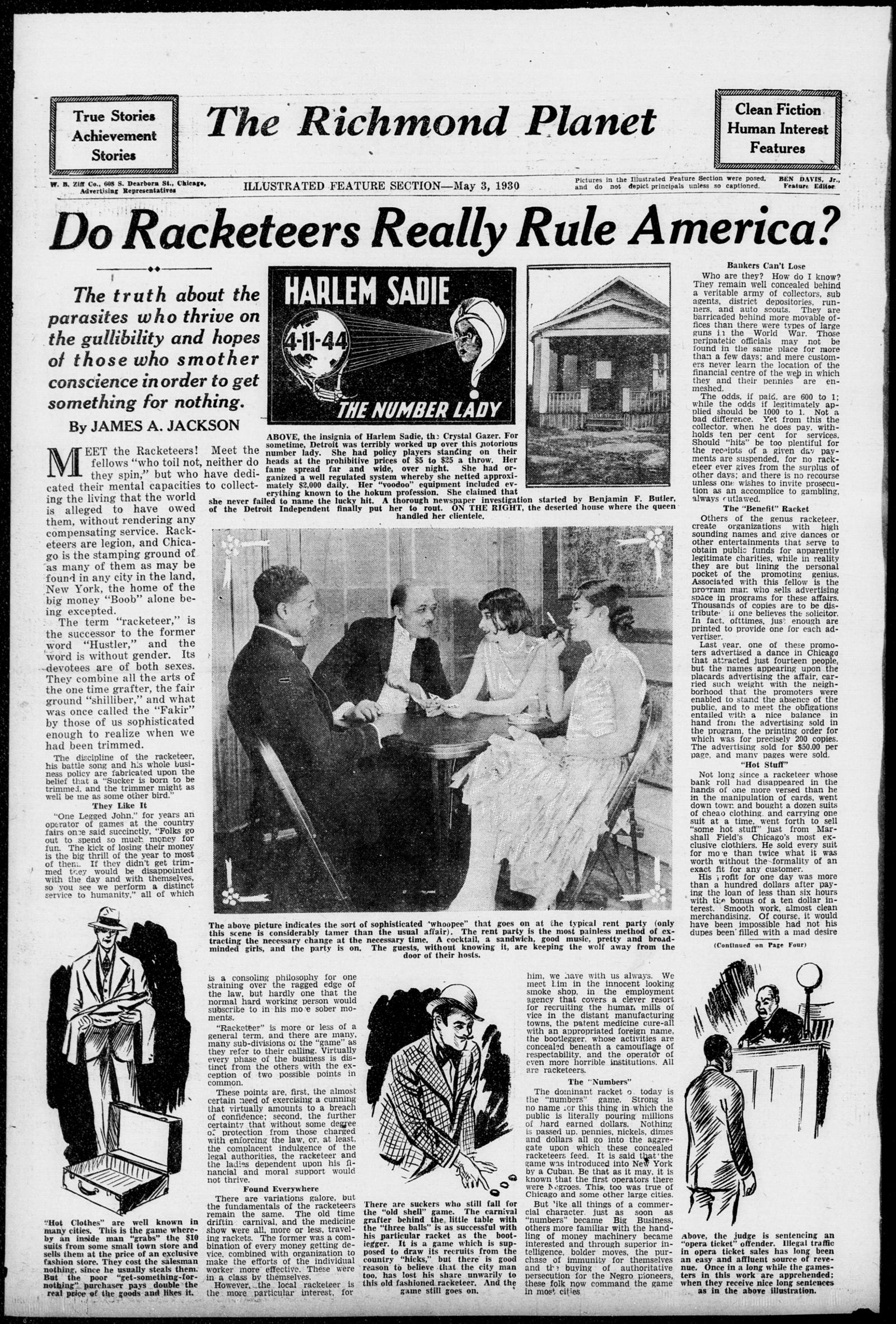
The Richmond Planet, 3 May 1930, Illustrated Feature Section: 'Do Racketeers Really Rule America?'
Do Racketeers Really Rule America?
- Paper
- The Richmond Planet (Richmond, Va.)
- Date
- 1930-05-03
- Page
- Image 9 (first page of the Illustrated Feature Section)
- Headline
- Do Racketeers Really Rule America?
- Rights
- A United States newspaper published in 1930 or earlier. Public domain in the United States. The Library of Congress serves the page from Chronicling America.
The Richmond Planet’s Illustrated Feature Section for 3 May 1930 opens with “Do Racketeers Really Rule America?” by James A. Jackson, under the standfirst “The truth about the parasites who thrive on the gullibility and hopes of those who smother conscience in order to get something for nothing.” The section’s masthead carries the notice: “Pictures in the Illustrated Feature Section were posed, and do not depict principals unless so captioned.”
Under the subhead “The ‘Numbers’,” Jackson writes that “The dominant racket of today is the “numbers” game.” He continues: “It is said that the game was introduced into New York by a Cuban. Be that as it may, it is known that the first operators there were Negroes. This, too was true of Chicago and some other large cities.” Once the game “became Big Business,” he says, others, through “the purchase of immunity for themselves and the buying of authoritative persecution for the Negro pioneers,” came to “command the game in most cities.” He describes bankers hidden behind “a veritable army of collectors, sub agents, district depositories, runners, and auto scouts,” and gives the odds: “The odds, if paid, are 600 to 1; while the odds if legitimately applied should be 1000 to 1.” A captioned picture describes a Detroit “number lady” called Harlem Sadie, whom a newspaper investigation “finally put her to rout.”
This is opinion and hearsay (“It is said”), filed only to show how a 1930 writer described the numbers game. Its claims about who started the game and who took it over are the author’s; no record filed here supports or tests them. The words “Negroes” and “Negro pioneers” are the author’s. The pictures are posed, as the page says.