PersonAbe AxlerNamed in 1929 wire reports among four Purple Gang 'ringleaders' convicted in federal court at Detroit, listed in a 1932 Bureau letter among the gang's 'ring leaders', and reported by the Bureau's Detroit office as murdered in November 1933.PersonAbe BernsteinListed in a 1932 Bureau of Investigation letter among Detroit men 'known to be ring leaders of the Purple Gang', and called 'the original head of the Purple Gang' in the Detroit FBI office's survey of 1939.PersonAbraham RelesProsecution witness in the Brooklyn Murder, Inc. cases, called "concededly an accomplice" by the New York Court of Appeals in 1941. A police official testified to the Kefauver Committee about holding him at the Half Moon Hotel and about his fall from a window there.PersonAdam C. RichettiCharged with Floyd and Miller in a federal conspiracy indictment concerning Frank Nash's custody; the FBI says he was convicted in Jackson County of the murder of an officer at Union Station, sentenced to be hanged, and executed on 7 October 1938.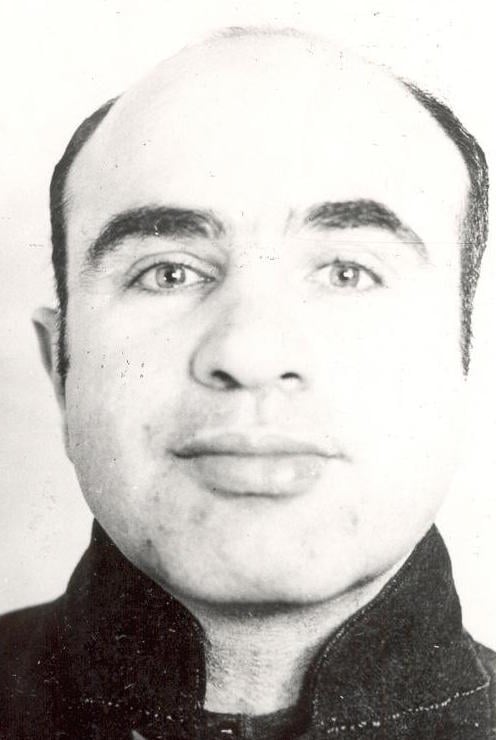 PersonAlphonse CaponeNamed by the FBI Vault as Alphonse Gabriel Capone (1899–1947), sentenced in 1931 for tax evasion. The National Archives lists him as former Alcatraz inmate, register 85.PersonAladena FratiannoCalled "an FBI informant" by the Ninth Circuit, which describes his testimony on the organization of La Cosa Nostra at the 1980s Los Angeles RICO trial. The FBI Director told the Senate in 1983 that he was a protected government witness.PersonAlbert AnastasiaKefauver Committee witness in New York, described in a 1950s FBI memorandum as a waterfront racketeer. New York police testified in 1963 that he was the last predecessor of Carlo Gambino and was shot to death in a barber shop in 1957.
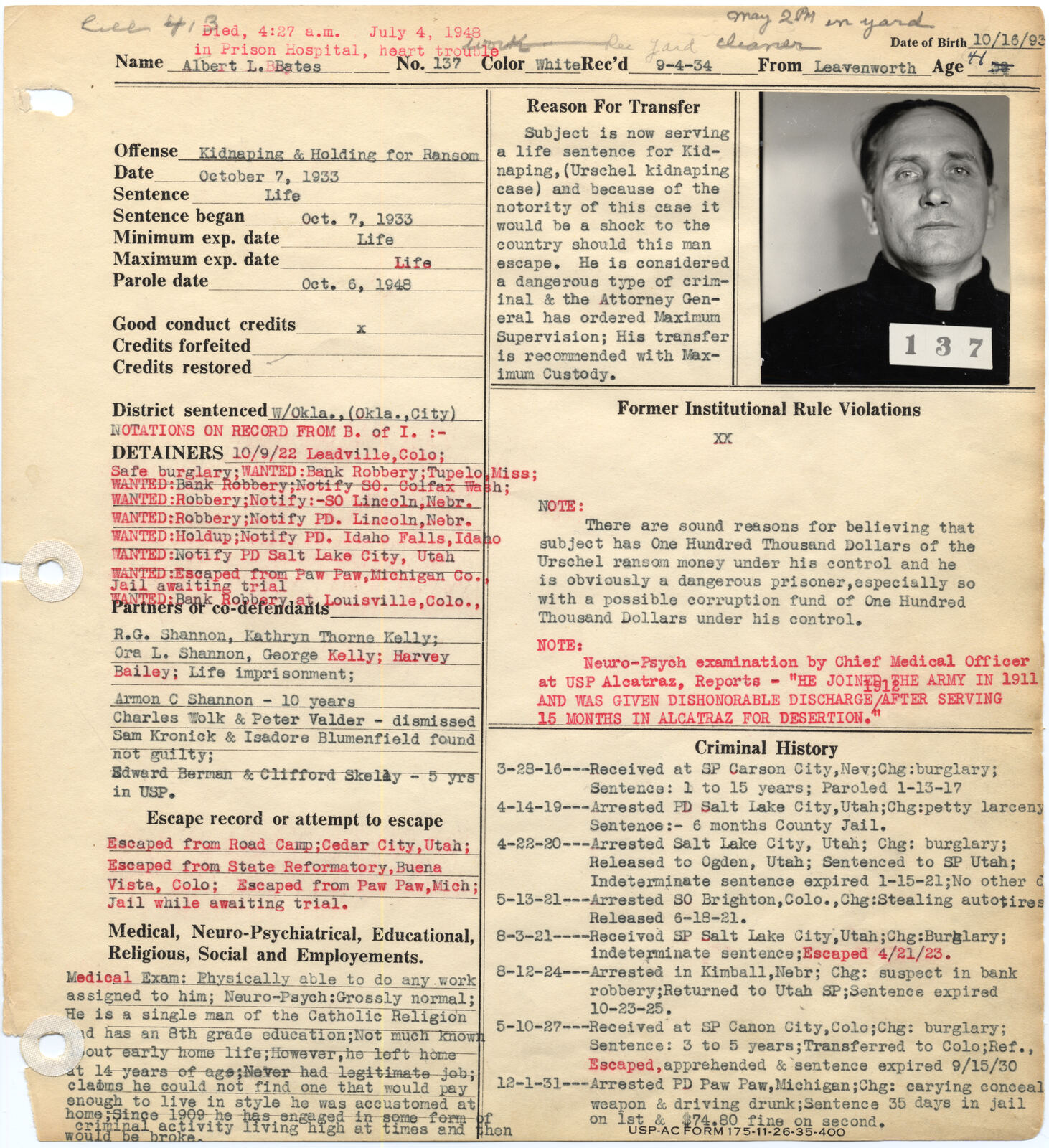 PersonAlbert L. "George" BatesAlcatraz register no. 137. The warden's notebook page records receipt from Leavenworth on 4 September 1934 under a life sentence for kidnapping and holding for ransom, and a red header recording his death in the prison hospital on 4 July 1948.PersonAlfred MineoKilled with Stephen Ferrigno by shotgun fire on Pelham Parkway in the Bronx on November 5, 1930, according to the New York police record read into the 1963 Senate hearings, which names him "Manfredi Maineo."PersonAlfred PolizziTestified to the Kefauver Committee in 1951 that he had left Cleveland in 1945 for Coral Gables, and denied the accusations that he belonged to the Mafia or the 'Mayfield Road gang'; Angelo Lonardo testified in 1988 that 'Al Polizzi' had been 'the boss of Cleveland'.PersonAllen DorfmanConvicted in 1972 of conspiring to accept a bribe affecting the Teamsters Central States Pension Fund, where the Second Circuit described him as special consultant. The Seventh Circuit records that he was found guilty of conspiring to bribe a senator and was murdered before sentencing.PersonAlphonse D'ArcoFormer Lucchese captain who testified for the government against Vittorio Amuso and Vincent Gigante. The Second Circuit described him in 1999 as "once the acting boss of the Lucchese" family.PersonAlphonse IndelicatoOne of three men killed in May 1981 whom the 1982 New York indictment called "captains" of the Bonanno family seeking "to wrest control of the family." FBI teletypes of 1981 report that only his body had been found.
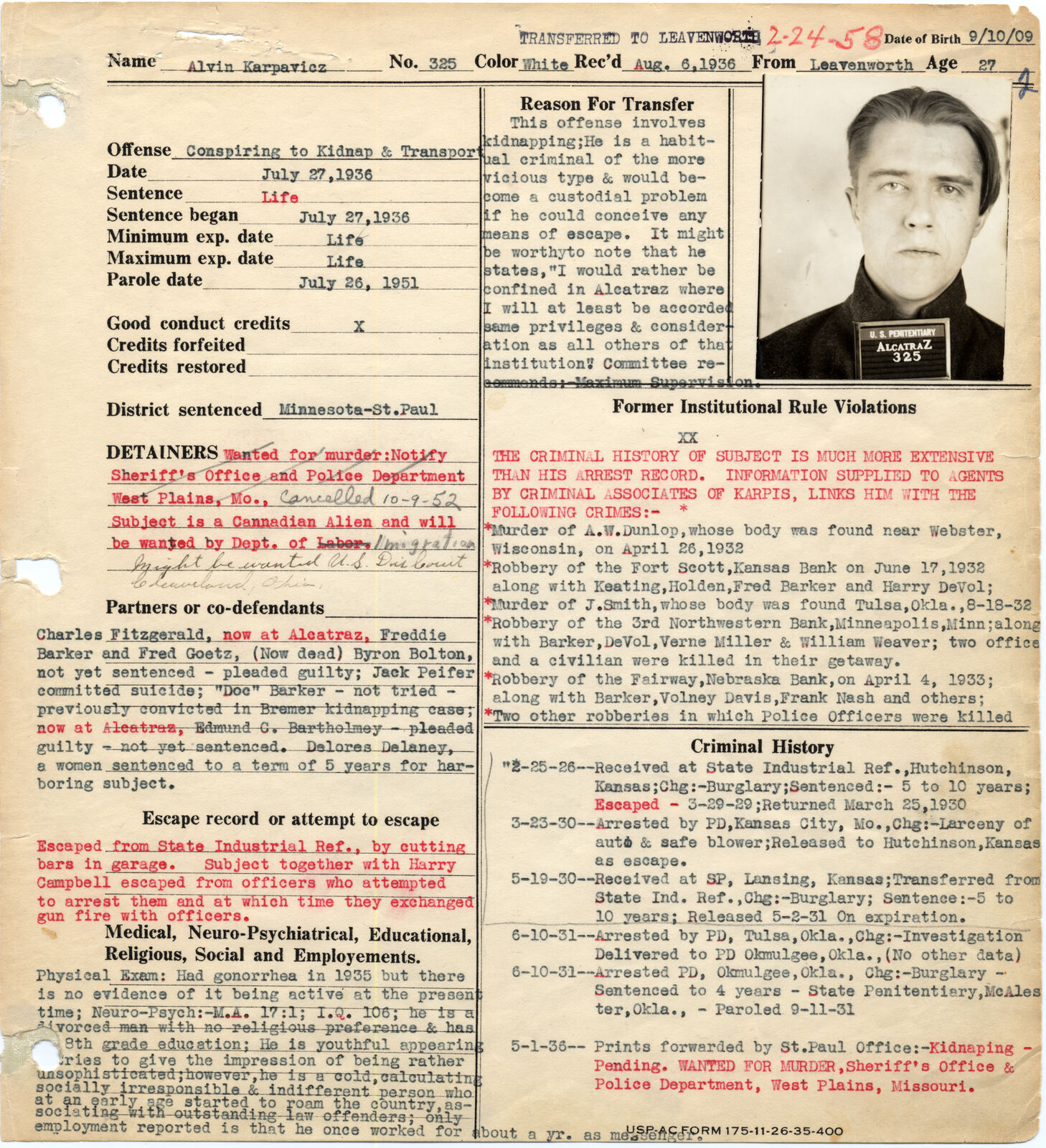 PersonAlvin KarpisAlcatraz register no. 325. The warden's notebook page, under the name Alvin Karpavicz, records receipt from Leavenworth on 6 August 1936 under a life sentence for conspiring to kidnap and transport, and a transfer back on 24 February 1958.PersonAngelo BrunoNamed by the Third Circuit as head of the Philadelphia enterprise charged in a 1972 to 1978 RICO case, and in its 1990 account of the trial record as boss from about 1960 until his murder in 1980. Killed on March 21, 1980, FBI records and testimony state.PersonAngelo LonardoConvicted in Cleveland in 1983 and sentenced to life without parole plus 103 years; described by the Justice Department as underboss of the Cleveland LCN, he later testified for the government and, in 1988, before the Senate Permanent Subcommittee on Investigations.PersonAngelo MeliTestified at the Kefauver Committee's Detroit hearing in 1951 that he lived on rents and a farm and had been in the jukebox business until 1943; named in a 1958 McClellan investigator's marriage chart and, by a newspaper account the FBI summarized, among five Detroit 'dons' in 1963.PersonAniello DellacroceDescribed by the Second Circuit in 1989 as the Gambino family underboss whom a Bonanno member consulted at Gambino headquarters less than half an hour after the 1979 Galante murders.PersonAnthony Joseph AccardoTestified to the Kefauver Committee in 1951 and refused to answer. His 1960 tax conviction was reversed in 1962. FBI Chicago teletypes of the early 1970s call him one of a three-man leadership team directing organized crime in Chicago.PersonAnthony CassoDescribed in a 1996 district court finding, with Vittorio Amuso, as the boss and underboss of the Lucchese family. The Second Circuit records evidence that he handled the family's finances while he and Amuso were fugitives.PersonAnthony CiullaThe Government's principal witness in the 1979 Boston horse-race-fixing trial of Howard T. Winter and others. The First Circuit's 1981 opinions turn in part on FBI reports of his interviews and his grand jury testimony about race fixing in Detroit.PersonAnthony CorneroNamed as President, Secretary and Treasurer of Stardust, Inc. in a 1955 Ninth Circuit opinion on an SEC investigation of its stock sales. The opinion does not say the company's project was in Las Vegas.PersonAnthony Joseph GiacaloneSubject of a Detroit FBI anti-racketeering file opened in December 1957; the FBI history says Canadian authorities arrested him on racketeering charges in 1966, and an FBI affidavit printed by the Sixth Circuit says James R. Hoffa told witnesses he was going to meet him on 30 July 1975.PersonAnthony IndelicatoCommission case defendant. The Second Circuit wrote that the government established he was a Bonanno family member approved by the Commission for promotion to capo after the Galante murders, and reversed his substantive RICO conviction.PersonAnthony M. ScottoPresident of ILA Local 1814 in Brooklyn and the ILA's vice president for legislative affairs from 1975 to 1979, according to the Second Circuit, which in 1980 affirmed his convictions on counts including RICO.PersonAnthony MilanoTestified to the Kefauver Committee in 1951 that he ran the Brotherhood Loan Co. and the Mayfield Importing Co., had served about fifty-four months at Leavenworth for counterfeiting in 1911-1912, and did not know 'what Mafia mean'; Angelo Lonardo's 1988 statement calls him 'the underboss' at a 1940s initiation.PersonAnthony ProvenzanoOfficer of Teamsters Local 560 in New Jersey. Convicted of Hobbs Act extortion (affirmed 1964) and of RICO offenses (affirmed 1980); named by the Government in the Local 560 civil RICO case and the 1988 Teamsters complaint. A 1989 opinion records that he had died since the 1988 complaint was filed.PersonAnthony RabitoA defendant in the 1982 Southern District of New York case, in which the court upheld a wiretap on his telephone. In 2007 the U.S. Attorney for the Eastern District announced a superseding indictment that, as the release describes it, charged him as the Bonanno family's "acting consigliere."PersonAnthony SalernoDefendant in the Commission case. The Second Circuit wrote in 1989 that the government established he was acting boss and then boss of the Genovese family from the late 1970s until 1985. His pretrial detention reached the Supreme Court in 1987.PersonAnthony SpilotroCharged in Las Vegas and in the Kansas City casino-skimming case, where the Government alleged he represented Chicago co-conspirators. The Ninth Circuit describes a 1977 and 1978 FBI investigation of him and the Gold Rush jewelry store, and FBI Las Vegas records place him at the Upper Crust Pizzaria in 1980. An FBI Chicago communication of 1993 calls him a known Chicago LCN member murdered with his brother in June 1986.PersonAnthony StrolloKnown as Tony Bender. Valachi testified in 1963 that Bender became the new lieutenant over his group after 1931; New York police testified that Thomas Eboli succeeded him.PersonAnthony UrsoNamed in a 2006 U.S. Attorney's release as the man who led the Bonanno family from January 2003 to January 2004, and as convicted. The only records opened are Justice Department releases.PersonAnthony ZerilliConvicted with others of the Travel Act offenses over hidden interests in Vegas Frontier, Inc., which operated the Frontier Hotel in Las Vegas in 1966 and 1967; the Ninth Circuit affirmed in 1974. No opened record states a family or rank for him.PersonAntonio CaponigroNamed by the Third Circuit as Angelo Bruno's consigliere, killed after Bruno's death. FBI testimony of 1988 gives an account of his part in the events of 1980.PersonAntonio CoralloCommission case defendant. The Second Circuit wrote in 1989 that the government established he was boss of the Lucchese family. Twenty years earlier he was convicted in the Jerome Park Reservoir kickback case.PersonAntonio MagaddinoOf Niagara Falls. John C. Montana testified that he drove to the Apalachin area on November 14, 1957 with "Anthony Maggadino," and the Second Circuit lists Antonio Magaddino among four men apprehended in the fields near Joseph Barbara's house that day.PersonArnold RothsteinNew York gambler shot on the night of Sunday, November 4, 1928 in a room of the Park Central Hotel; he died at Polyclinic Hospital on November 6 without naming the person who shot him. This page rests on 1928 newspaper pages; no federal record about him has been found.PersonArthur B. McBrideCleveland newspaper circulation man who, by 1950 testimony and committee exhibits, organized Continental Press Service in 1939 after Moses Annenberg gave up the race-wire business, and later passed it to the Ragens and to his son Edward.
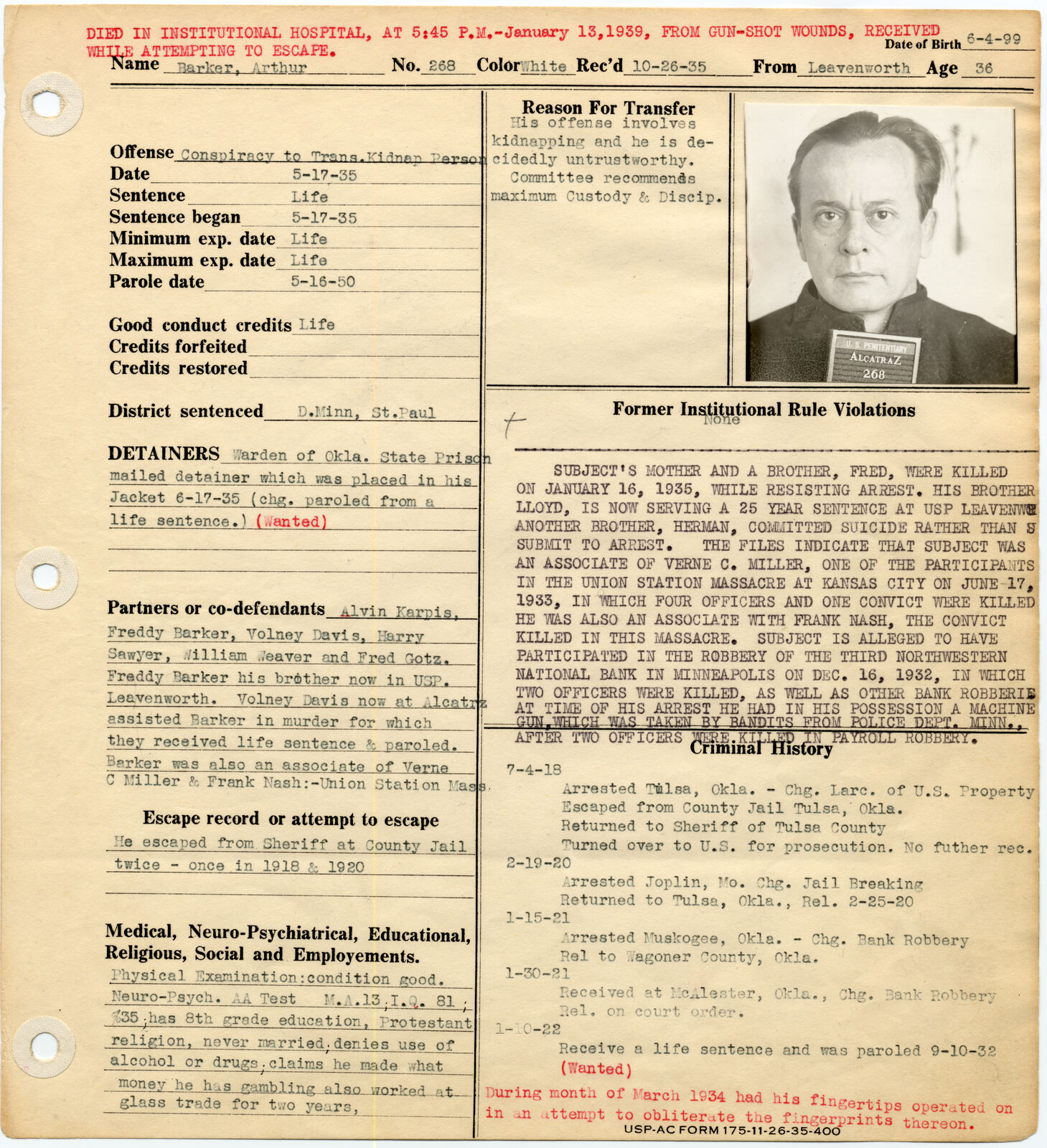 PersonArthur "Doc" BarkerAlcatraz register no. 268. The warden's notebook page records receipt from Leavenworth on 26 October 1935 under a life sentence and a red header recording his death in the institutional hospital on 13 January 1939 from gunshot wounds received while attempting to escape.
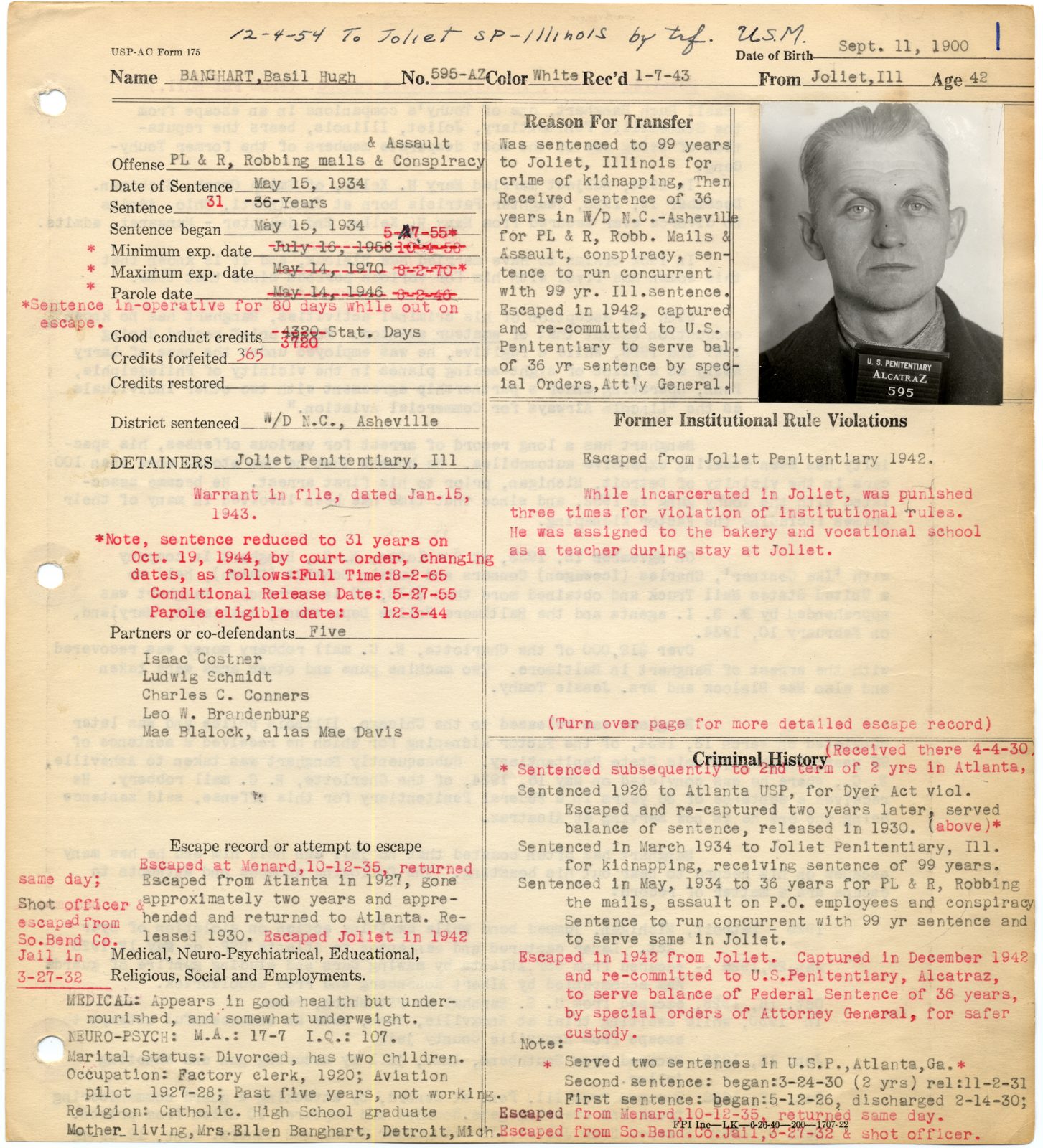 PersonBasil BanghartReceived at Alcatraz from Joliet in January 1943 for mail robbery and conspiracy; named by the FBI and the National Archives as a member of the Touhy gang captured in Chicago on 29 December 1942.PersonBenedetto MadoniaThe man whose body was found in a barrel on East Eleventh Street, New York, on 14 April 1903, identified a week later as a stone mason from Buffalo. No record filed here names anyone convicted of his killing.PersonBenjamin RuggieroConvicted of RICO conspiracy at the 1982 New York trial and sentenced to fifteen years; the Eleventh Circuit says the evidence showed he "was a member of the 'crew' captained by Napolitano." The Seventh Circuit records that he "described himself as a member of the Bonanno crime family of New York" and pleaded guilty in the Milwaukee extortion case.PersonBenjamin SiegelNamed in FBI memoranda of 1946 and 1947 as a director of the Nevada Project Corporation, owner of the Flamingo Hotel, and in the Kefauver Committee's Las Vegas record. An FBI letter records that he was shot at Beverly Hills on June 20, 1947. No federal record opened for this page states a family or rank.
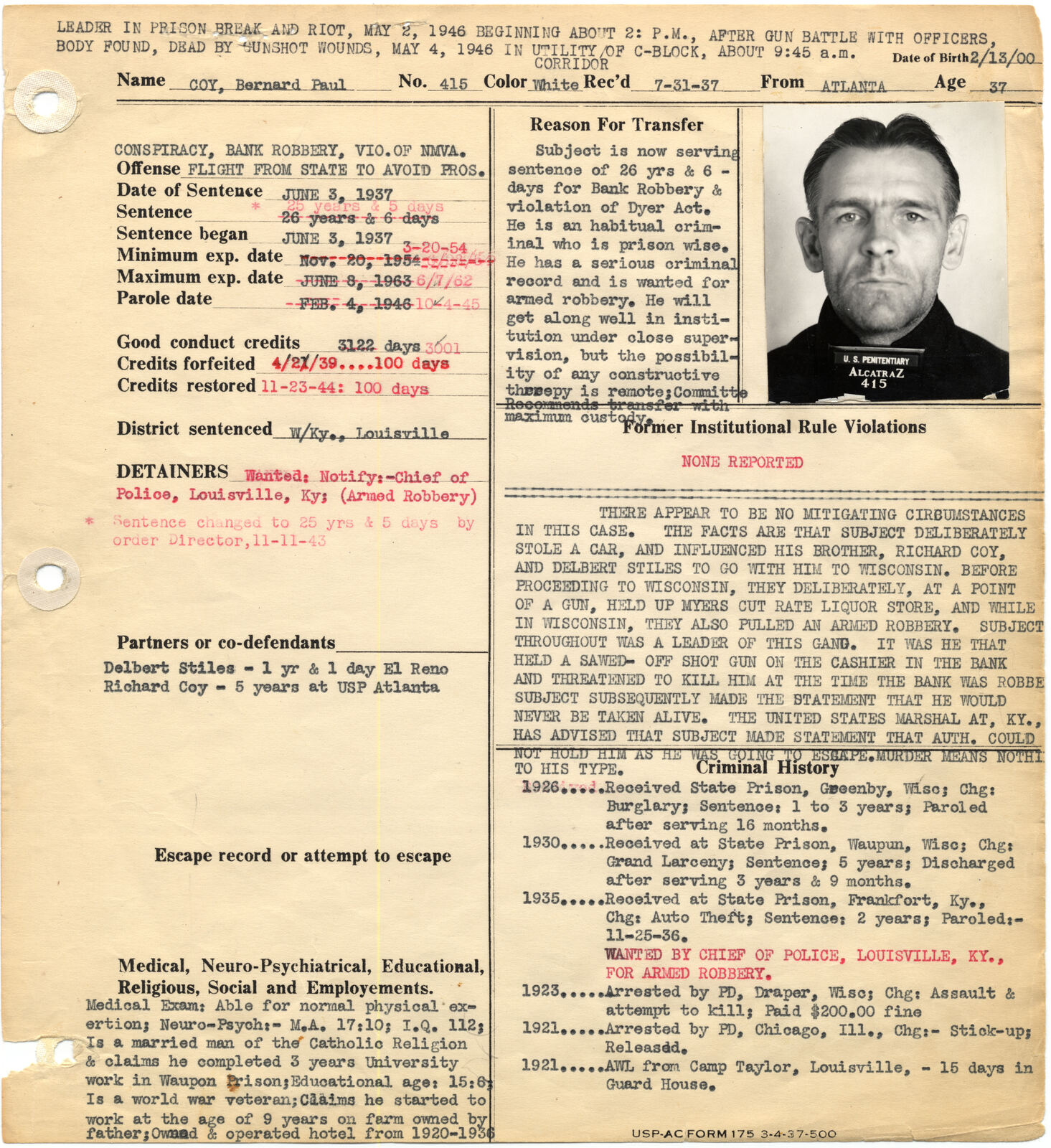 PersonBernard Paul "Barney" CoyAlcatraz register no. 415. The warden's notebook page records receipt from Atlanta on 31 July 1937 under a sentence for conspiracy and bank robbery, and a typed header recording the 2 to 4 May 1946 prison break and that his body was found on 4 May.
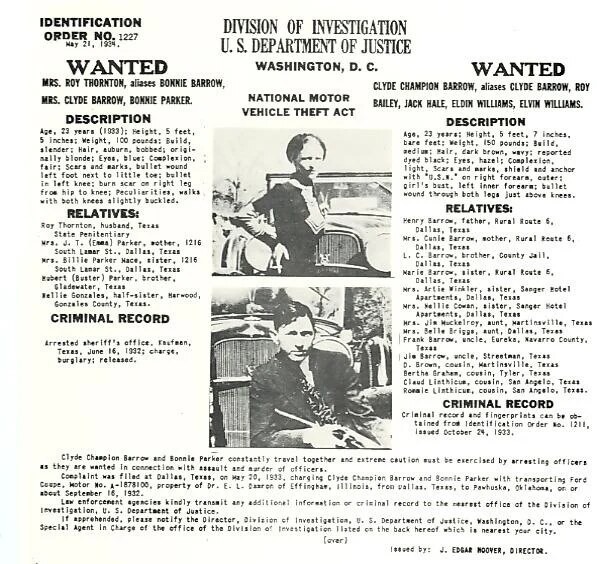 PersonBonnie ParkerNamed with Clyde Barrow in a federal stolen-car warrant of 20 May 1933 and in Identification Order No. 1227; killed with him by officers near Sailes, Louisiana on 23 May 1934, as the FBI states.PersonCarl CivellaIn the Eighth Circuit's 1985 opinion on the Tropicana skim, Carl James Civella was convicted in the Western District of Missouri on a conspiracy count, interstate transport counts and Travel Act counts and sentenced to thirty years; the opinion lists him among those who met about the Tropicana.PersonCarl DeLunaConvicted in the Tropicana skimming case and sentenced to thirty years, affirmed in 1985; the Eighth Circuit also records the Government's account that he kept records for the Kansas City group in the Argent case, and that he pleaded guilty during that trial.PersonCarlo GambinoNamed in 1963 by Valachi and by New York police as boss of the family that bears his name, after Anastasia's death. A 1962 FBI report relays an informant who called him a "boss." He was taken from the Apalachin roadblock in 1957.PersonCarlos MarcelloA New Orleans-area figure in federal records from 1951 to 1989: a Senate committee witness who declined to answer, a deportation case at the Supreme Court, a removal to Guatemala in 1961, and the Brilab prosecution that ended in a RICO conspiracy conviction affirmed in 1983.PersonCarmine GalanteMurdered with two associates on July 12, 1979 on the terrace of a Brooklyn restaurant. The Second Circuit wrote that his "violent elimination ... as boss of the Bonanno family" related to the Commission's role in resolving leadership disputes.PersonCarmine PersicoConvicted in the Colombo family RICO case and in the Commission case. In the Commission appeal the Second Circuit wrote that the government established he was boss of the Colombo family.PersonCasper HolsteinA Harlem figure whose kidnapping in September 1928 was reported across the country. The records filed here are newspaper pages from 1928 to 1930. They call him a wealthy sportsman, clubman and philanthropist and an Elks leader; one Seattle paper calls him a "reputed ace of Harlem gamblers." None of them is a court or federal record.
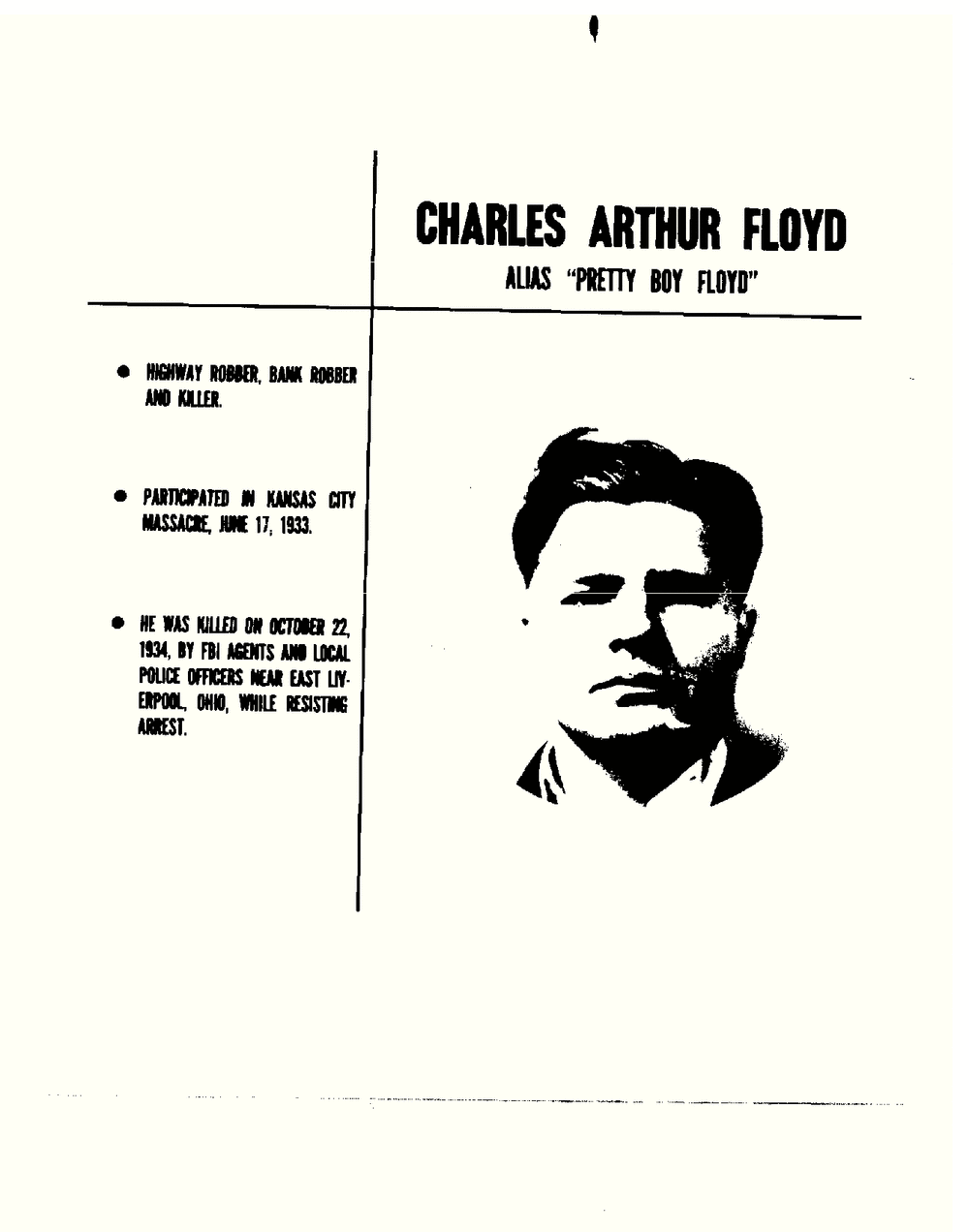 PersonCharles Arthur "Pretty Boy" FloydNamed with Richetti and Miller in a federal conspiracy indictment concerning Frank Nash, and identified by the FBI as one of the Union Station gunmen; the FBI says he was shot by agents and local officers near East Liverpool, Ohio, on 22 October 1934. Whether he fired was an FBI finding not tested in court.PersonCharles BinaggioDescribed on a Kansas City police list entered in the Senate record as a 'prominent political leader' reportedly involved in nation-wide gambling operations, and recorded there as found shot to death in a political club on 5 April 1950; a former police commissioner testified about two meetings with him in 1949.PersonCharles GargottaRecorded with Charles Binaggio on a Kansas City police list as 'found shot to death in political club at 718 Truman Road' on April 5, 1950, and described there as a 'well-known gunman and muscle-man engaged in gambling operations'; a former sheriff testified that jury intimidation prevented a murder conviction.PersonCharles GioeConvicted in 1943 in the motion-picture extortion case and sentenced to ten years; paroled from Leavenworth on 13 August 1947, retaken in July 1948, and in 1951 discharged by the Atlanta court as a reinstated parolee.
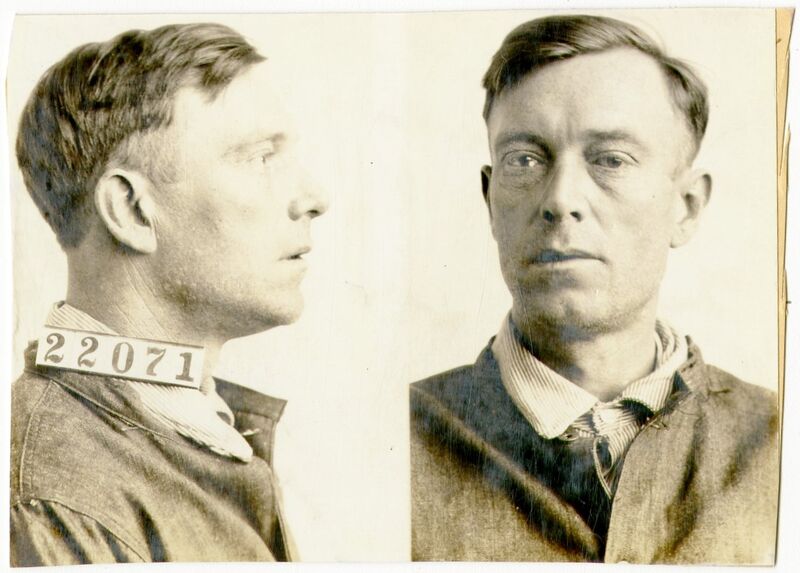 PersonCharles LanhamA defendant convicted in 1924 in the federal case over the 1923 Staunton, Illinois mail robbery and sentenced to 25 years; his Leavenworth identification photograph is No. 22071.PersonCharles LeiterListed in a 1932 Bureau of Investigation letter among the Purple Gang's 'ring leaders', named in the Detroit FBI office's 1939 survey as one of Abe Bernstein's two lieutenants 'in the old Purple Gang', and listed in a 1948 Miami memorandum.PersonCharles LucianoConvicted in a New York State vice prosecution in 1936; the state's highest court called him "the head of this enterprise." Valachi testified in 1963 that Luciano took over as boss after Maranzano's killing. An FBI file records his parole on condition of deportation in 1946.PersonCharles MatrangaNamed in 1890-91 records on the Hennessy case: a State Department registration abstract lists him; the 14 March 1891 verdict acquitted him; and the 1891 papers describe a Matranga faction in a stevedoring rivalry, claims that are the papers' and not court findings.PersonCharles PanarellaNamed in a 1985 opinion in the Persico case as the intended beneficiary of a charged bribe of an IRS agent. No opened federal record places him in Las Vegas or states a family or rank.PersonCharles SiragusaFederal Bureau of Narcotics agent who testified to the Kefauver Committee on 27 June 1951 about his work with the Italian police on Lucky Luciano and on the Mafia's income from narcotics.PersonCharles SmithA defendant convicted in 1924 in the federal case over the 1923 Staunton, Illinois mail robbery and sentenced to 25 years, named in the indictment as Charles Smith, alias "Red" Smith.PersonCharles M. WallTestified at Tampa on 29 December 1950 about his gambling background; committee counsel called him an 'elder statesman' of Tampa gambling, and the state's attorney gave his own opinion that Wall was the 'head and brains of the underworld.' Wall said he left gambling in the county in 1939 or 1940.PersonChristopher FurnariCommission case defendant. The Second Circuit wrote in 1989 that the government established he served as consigliere of the Lucchese family. His FBI file holds 1984 serials from the Bureau's construction-industry investigations.PersonCiro TerranovaNamed in the 1963 Senate hearings by staff counsel as on Masseria's side in the 1930–31 war, and by Valachi, from what he was told, as one of the men at the Coney Island restaurant where Masseria was killed.
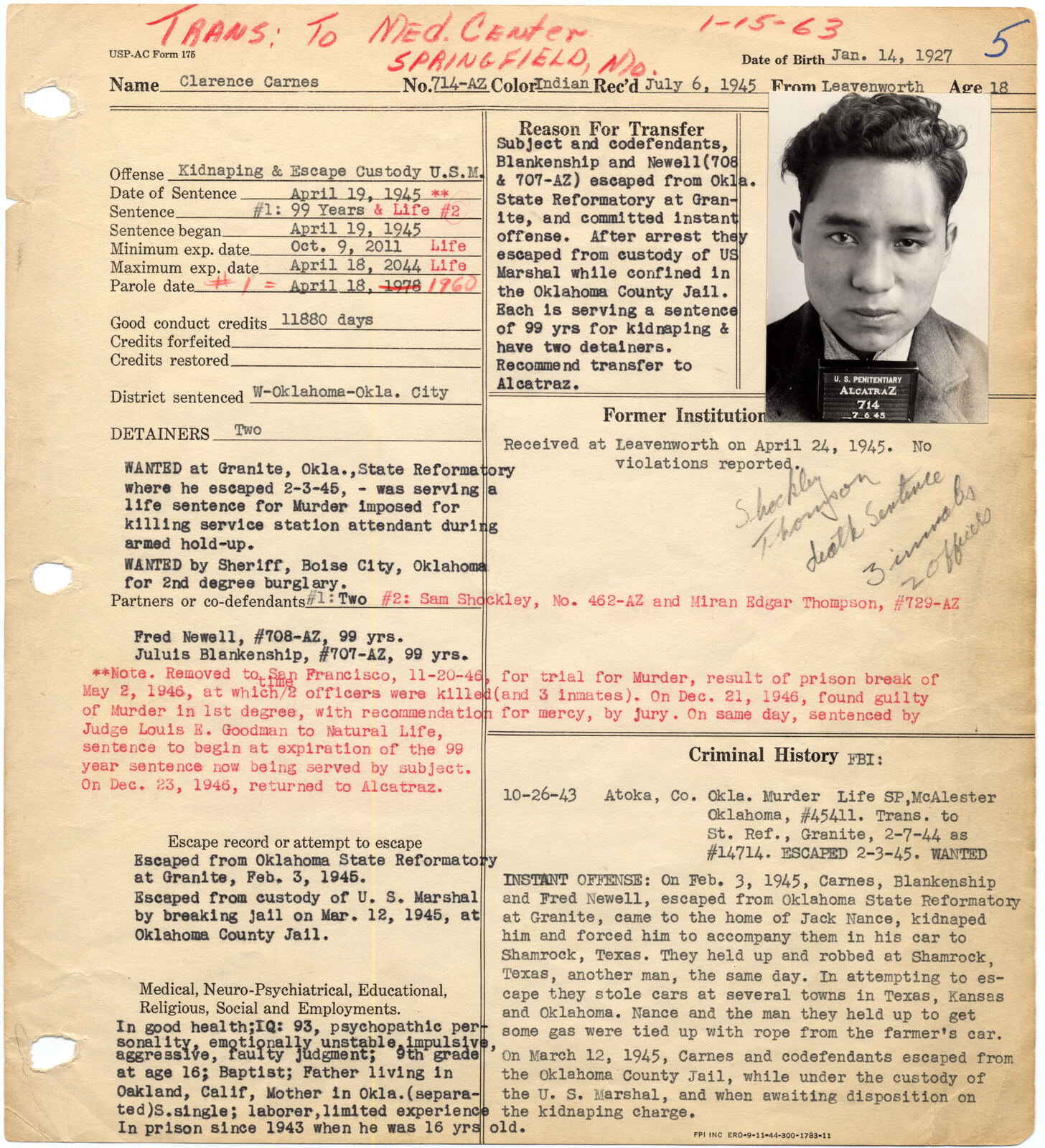 PersonClarence CarnesAlcatraz register no. 714-AZ. The warden's notebook page records receipt from Leavenworth on 6 July 1945 at age 18 under sentences for kidnapping and escape from a U.S. marshal's custody, a 1946 federal murder conviction in San Francisco with a recommendation for mercy, and a transfer to the Medical Center at Springfield, Missouri, on 15 January 1963.PersonClyde BarrowWanted by the Division of Investigation under the stolen-car law from May 1933; named in Identification Order No. 1227; killed with Bonnie Parker by officers near Sailes, Louisiana on 23 May 1934, as the FBI states.PersonConnie HurleyLas Vegas race-wire operator described in Kefauver Committee testimony and exhibits as Continental's local representative there in 1946-1949.PersonDanny GreeneKilled by a remote-controlled car bomb in Cleveland on 6 October 1977; the Sixth Circuit, affirming the RICO convictions of James Licavoli and others, described him as the leader of a rival criminal organization in West Cleveland whom Licavoli decided in 1976 to have killed.PersonDave BeckPresident of the International Brotherhood of Teamsters when he testified before the McClellan Committee in March 1957 and declined to answer questions about union money. The committee's 1958 interim report found that he "took, not borrowed, more than $370,000 in union funds."PersonDavid C. HennessyNew Orleans Chief of Police, shot near midnight on 15 October 1890 and dead the next morning; the 1890 newspaper pages here report the shooting and the arrests, and the State Department's later correspondence calls the prosecution the case of the murder of 'Chief D. C. Hennessy.'PersonDavid RobinsonA defendant convicted in 1924 in the federal case over the 1923 Staunton, Illinois mail robbery and sentenced to 25 years, named in the indictment as David Robinson, alias "Chippy" Robinson.PersonDominick NapolitanoCharged in the 1982 Southern District of New York case as a member of "the Bonanno Family of La Cosa Nostra." The Eleventh Circuit says the trial evidence showed Benjamin Ruggiero was a member of "the 'crew' captained by Napolitano," that he did not appear for trial, and that he "later was found murdered."PersonDominick TrincheraKilled in May 1981 with Alphonse Indelicato and Philip Giaccone. The en banc Second Circuit names him among the Bonanno soldiers through whom the Commission planned the 1979 Galante killing, and says he was later "promoted to the rank of capo."
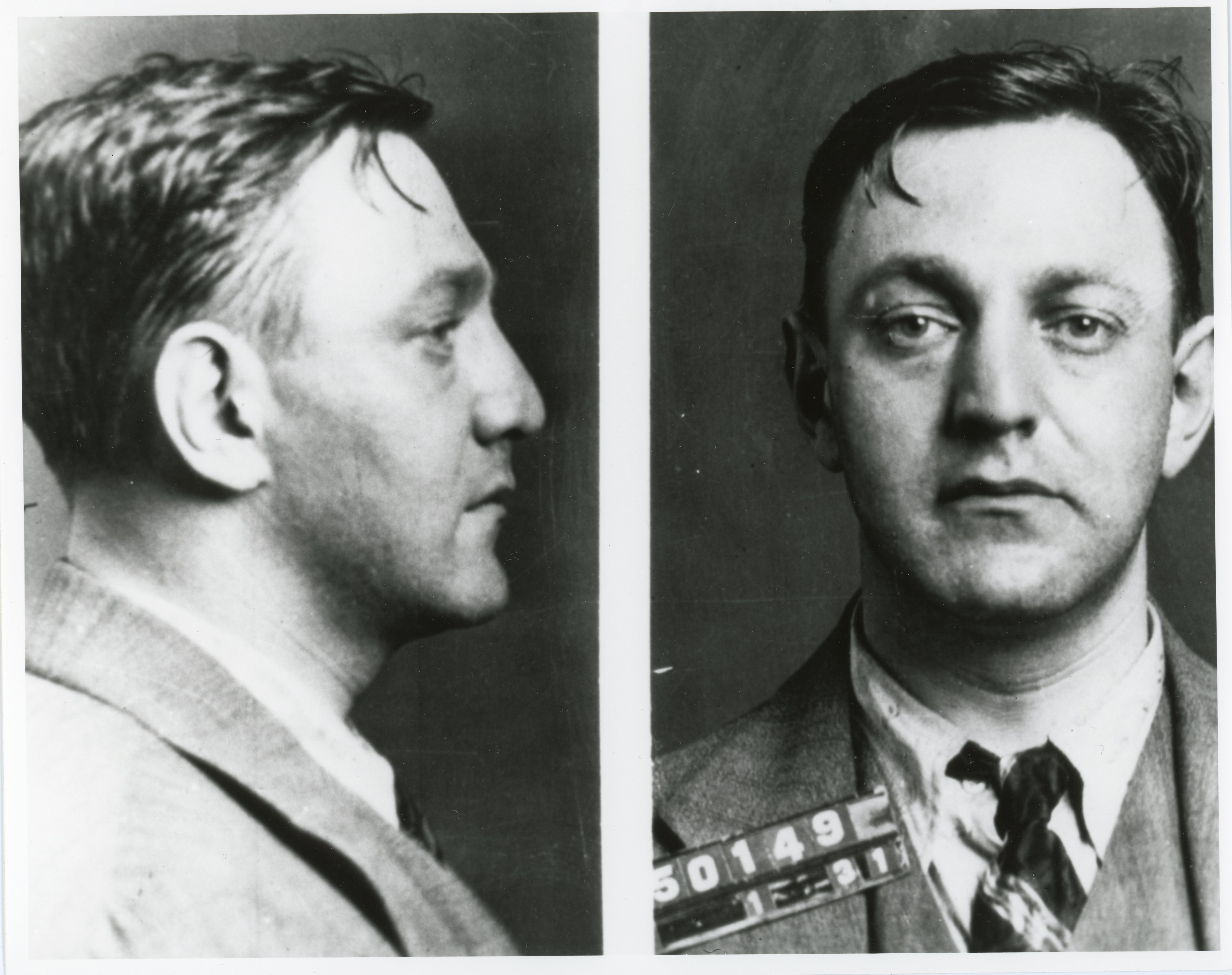 PersonArthur Flegenheimer (Dutch Schultz)Named Arthur Flegenheimer, alias "Dutch" Schultz, in a Division of Investigation wanted notice of 1934 that states his indictment in the Southern District of New York on January 25, 1933 for violation of the federal income tax law. The FBI states he was shot at the Palace Chop House in Newark on October 23, 1935 and died the next day. No record filed here states a family or rank.PersonEarl WeissIndicted in Chicago in June 1926 for possessing and transporting liquor under the National Prohibition Act; killed by gunfire near Holy Name Cathedral on 11 October 1926. The charges against him were dismissed after his death.PersonEddie FletcherNamed in 1929 wire reports among four Purple Gang 'ringleaders' convicted in federal court at Detroit, and reported by the Bureau's Detroit office in November 1933 as murdered with Abe Axler.PersonEdward J. McBrideOwner of Continental Press Service in 1948-1950 by his own testimony and a federal court's description; a law student who said control of the business rested with his uncle, Thomas F. Kelly.PersonEdward LatoSentenced in Providence in 2012 to 108 months for racketeering extortion conspiracies. The Justice Department calls him an admitted capo regime in the New England La Cosa Nostra.PersonEdward P. JonesA Kefauver Committee witness of December 1950, then living in Mexico City, who testified that he shared in the profits of the Maine-Idaho Club policy wheel in Chicago, agreed that he had been convicted of an income-tax violation on its income, and described being kidnapped in Chicago.
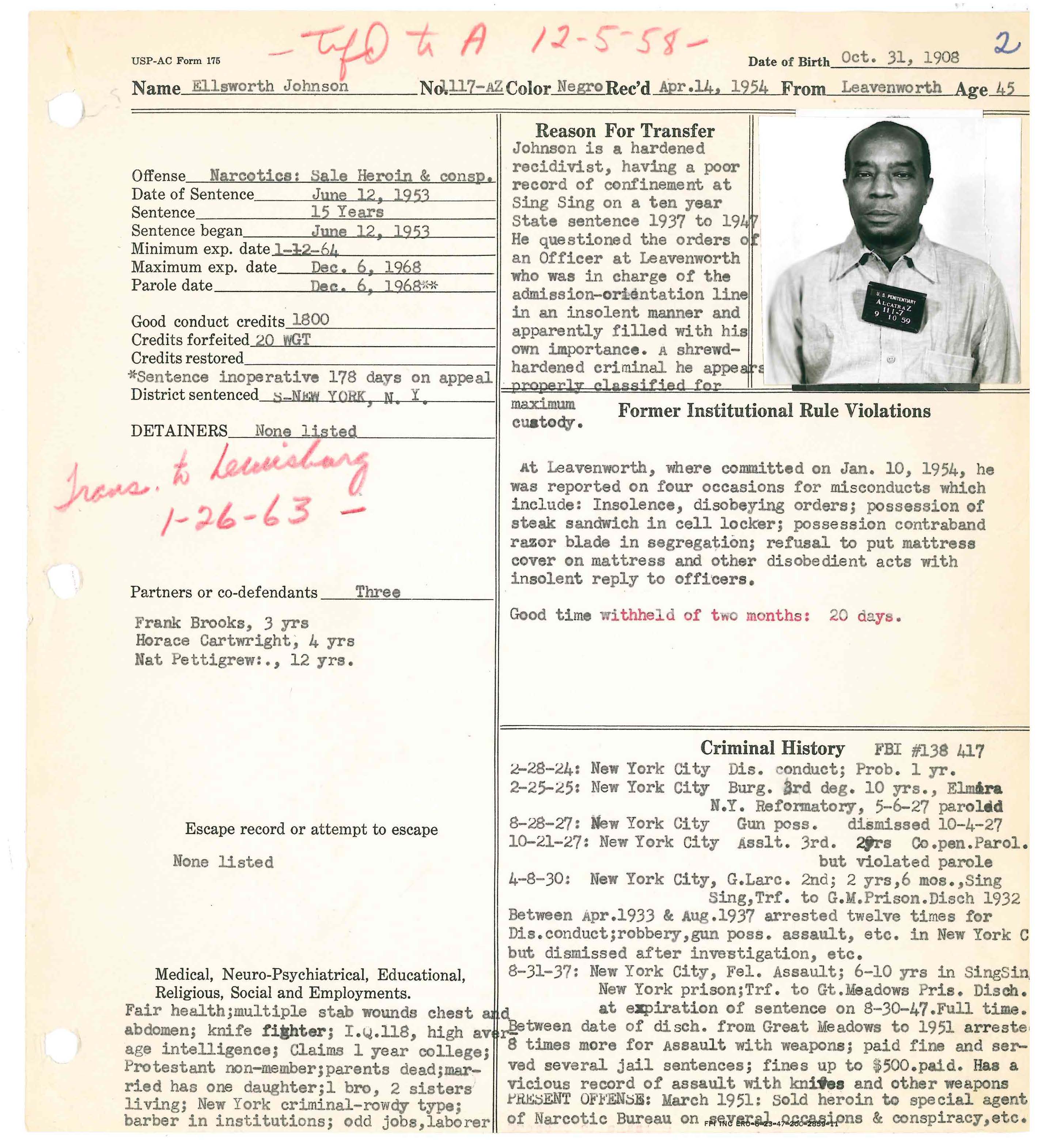 PersonEllsworth "Bumpy" JohnsonAlcatraz register no. 1117. The warden's notebook page records receipt from Leavenworth on 14 April 1954 under a 15-year narcotics sentence from the Southern District of New York, a transfer to Atlanta in December 1958 and a transfer to Lewisburg on 26 January 1963.PersonFelix Antonio AlderisioConvicted in Denver in 1965 of conspiring to transmit threats in interstate commerce. His case reached the Supreme Court in Alderman v. United States (1969) over government surveillance of his Chicago place of business.PersonFrancis FeatherstoneA Government witness in the Westies prosecutions. The Second Circuit recites trial evidence that he had become the group's second-in-command by the mid-1970s; a state murder conviction against him was set aside after an investigation showed he was not involved.PersonFrancis MaritoteConvicted in 1943 in the motion-picture extortion case; the Second Circuit says he was given a sinecure with a Chicago exhibitor. Received at Atlanta in March 1945 under a ten-year sentence and transferred to Leavenworth that July.PersonFrancis P. SalemmeIndicted with Bulger and Flemmi in January 1995, convicted of racketeering in 1999 and of obstruction in 2008, and convicted in 2018 of the 1993 murder of a federal witness. The First Circuit and the U.S. Attorney describe him as boss of the New England LCN in the early 1990s. Court and DOJ records only.PersonFrank BalistrieriConvicted in Milwaukee of conducting an illegal gambling business, affirmed in 1985. The Eighth Circuit records the Government's theory that he helped Allen Glick obtain a pension-fund loan for the Stardust and Fremont, and he pleaded guilty during the Argent trial.PersonFrank J. Calabrese, Sr.Named by the Seventh Circuit in 2012 as boss of the Calabrese Street Crew (the South Side/26th Street Crew). Convicted at the 2007 Family Secrets trial and sentenced to life in prison.PersonFrank CostelloKefauver Committee witness in 1951, convicted of contempt of the Senate and of income-tax evasion, and stripped of his citizenship in 1959. New York police testimony in 1963 said that "at least he was second in command at one time."PersonFrank CullottaRecorded by name in FBI Las Vegas surveillance logs of June and July 1980 at the Upper Crust Pizzaria and My Place, in a case captioned as a RICO murder matter. An Illinois appellate court records his 1982 agreement with the FBI. No opened record states a family or rank for him.
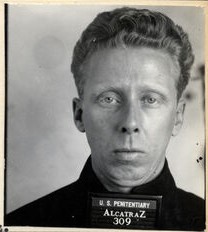 PersonFrank EppelsheimerA defendant convicted in 1924 in the federal case over the 1923 Staunton, Illinois mail robbery and sentenced to 25 years and a $4,000 fine. He was held at Alcatraz as No. 309 from 1936 to 1938; his notebook page lists his codefendants.PersonFrank FitzsimmonsTeamsters president after James R. Hoffa. The President's Commission on Organized Crime states that he was not indicted during his tenure and died in office in 1981.
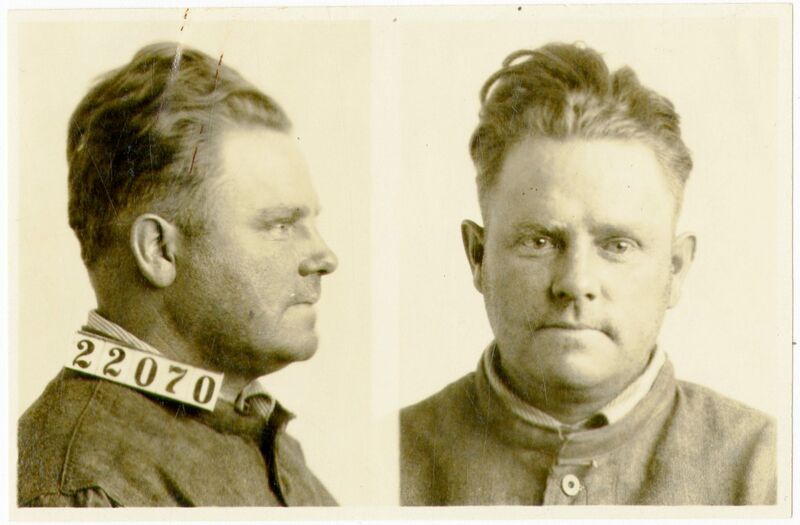 PersonFrank HackethalA defendant convicted in 1924 in the federal case over the 1923 Staunton, Illinois mail robbery and sentenced to 25 years; his petition to the Supreme Court was denied. His Leavenworth photograph, No. 22070, is filed under the spelling Heckethal.PersonFrank LocascioTried with John Gotti and convicted; the Second Circuit wrote in 1993 that the government established at trial that his function as underboss was to advise Gotti.PersonFrank MilanoBrother of Anthony Milano; the restaurant where Joe Porrello was shot in 1930 was his, by Associated Press accounts, and Cleveland's public safety director told the Kefauver Committee in 1951 that he had been living in Mexico for years.
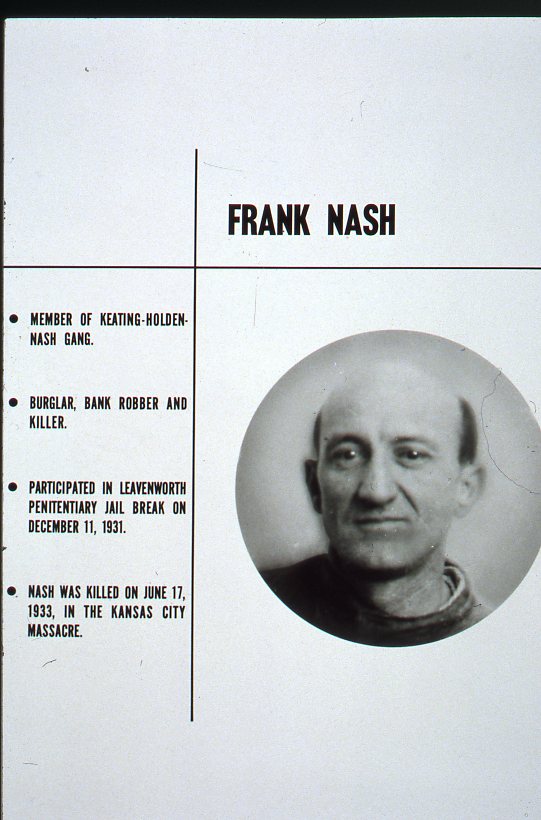 PersonFrank NashA federal prisoner who escaped from Leavenworth on 19 October 1930, was recaptured at Hot Springs, Arkansas, on 16 June 1933 and was killed at Union Station, Kansas City, on 17 June 1933 while being returned to Leavenworth. The FBI's photograph caption describes him as a member of the 'Keating-Holden-Nash gang.'PersonFrank Nitti (Frank R. Nitto)A Bureau of Investigation letter in his FBI Vault file lists him as Frank R. Nitto, alias Frank Nitti, a member of the Al Capone Gang, indicted for income tax evasion on March 14, 1930.PersonFrank RosenthalAn FBI Las Vegas airtel of January 27, 1975 records that he was made Executive Consultant to the Chairman of the Argent Corporation on October 22, 1974 and oversaw casino operations at the Hacienda, Stardust and Fremont. The Eighth Circuit describes the Government's evidence that he supervised the skimming.PersonFrank ScaliceNamed in 1963 as an underboss of the Gambino family, predecessor of Joseph Biondo. New York police testified that he was a homicide victim in the Bronx.
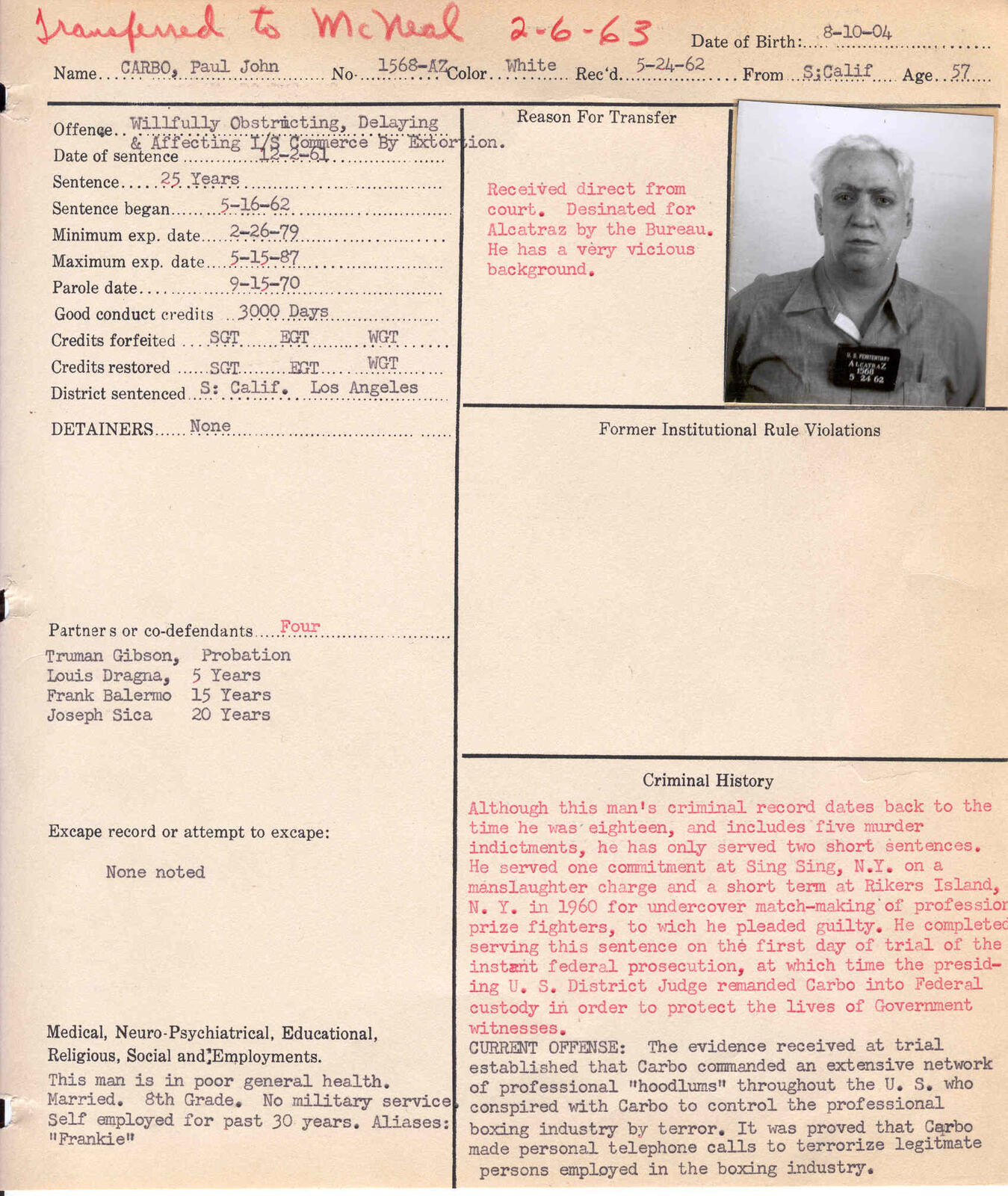 PersonPaul John "Frankie" CarboAlcatraz register no. 1568. The warden's notebook page records receipt from the Southern District of California on 24 May 1962 under a 25-year sentence for obstructing interstate commerce by extortion, and a transfer on 6 February 1963 whose destination the page and the catalog give differently.
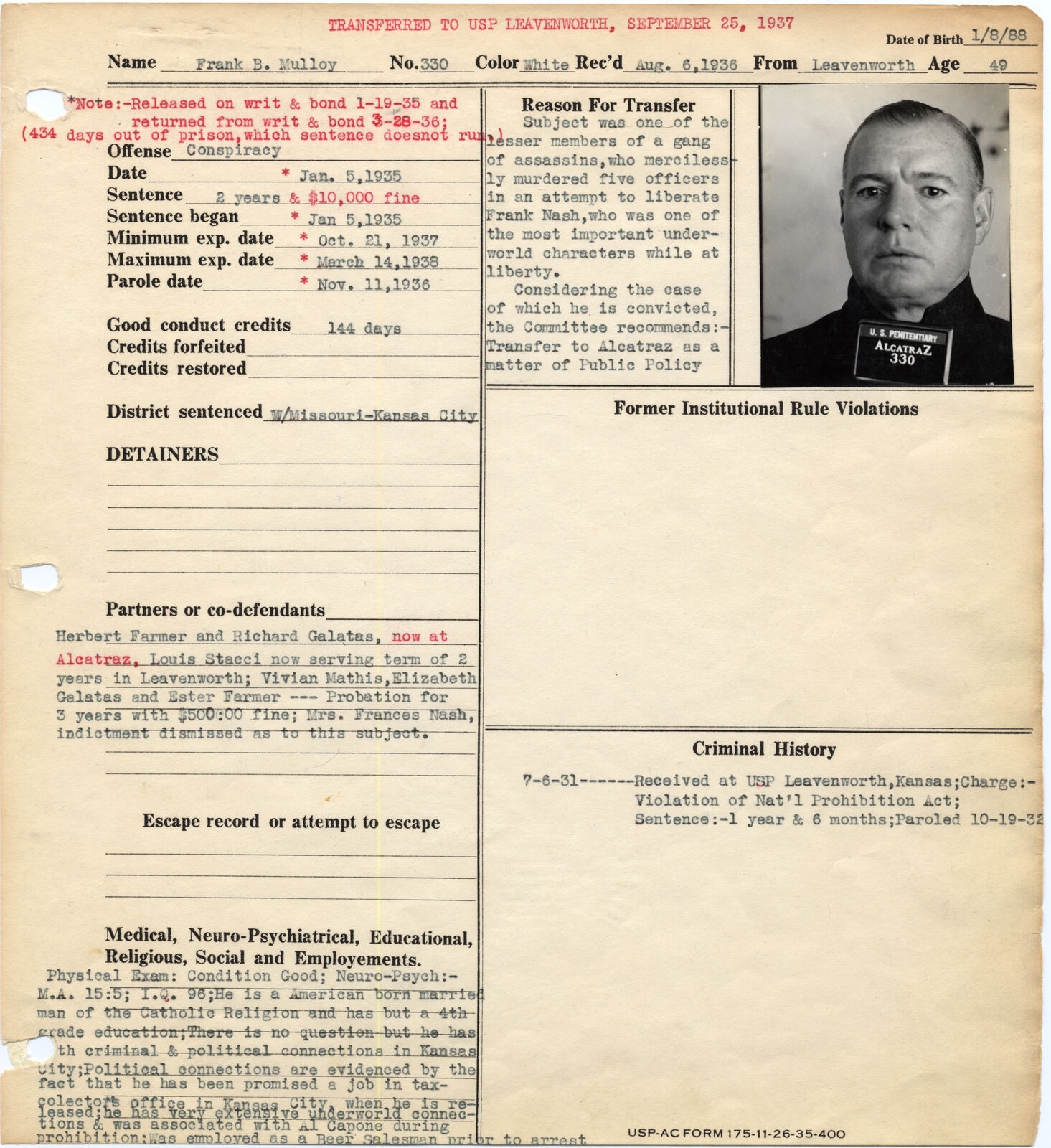 PersonFrank B. "Fritz" MulloyAlcatraz register no. 330. The warden's notebook page records receipt from Leavenworth on 6 August 1936 under a two-year sentence and $10,000 fine for conspiracy, and a transfer back on 25 September 1937. The catalog remark "KCUS MASSACRE" is not expanded.PersonGabriel MannarinoOf New Kensington, Pa. The Second Circuit lists him among the men taken to the Vestal barracks after the Apalachin roadblock of 1957. The McClellan Committee staff list calls him a former owner, with his brothers, of the Sans Souci in Havana.PersonGaetano BadalamentiDefendant in the Pizza Connection case, arrested in Madrid on April 8, 1984 according to the FBI, convicted of a narcotics conspiracy and of engaging in a continuing criminal enterprise, and sentenced to forty-five years with release ordered after thirty.PersonGaetano GaglianoNamed in the 1963 Senate hearings as the underboss who took over the Reina gang after Reina's killing and recruited Valachi. The only record opened is the subcommittee staff's description of its chart.PersonGaetano LuccheseNamed in 1963 by Valachi and by New York police as boss of the family that bears his name. Police testimony said he took Frank Costello's place when Costello went to jail.PersonGennaro J. AngiuloConvicted under RICO after an eight-month trial built on the FBI's 1981 surveillance of 98 Prince Street in Boston. The First Circuit, stating the trial evidence, calls him the underboss of the Patriarca Family. Boston police testimony of 1963 also names him.PersonGennaro LangellaConvicted in the Colombo family RICO case and in the Commission case. The Second Circuit wrote in 1989 that the government established he was underboss of the Colombo family.PersonGeorge E. BrownePresident of the stagehands' and projectionists' union from 1934, in the Second Circuit's account; convicted with Bioff in 1941, and with Bioff the government's principal witness against the Chicago defendants in 1943.PersonGeorge Kelly (Illinois Sports News)Owner of the Illinois Sports News scratch sheet in Chicago from January 1947, by his own 1950 testimony; earlier a road man for James Ragen's Continental Press.
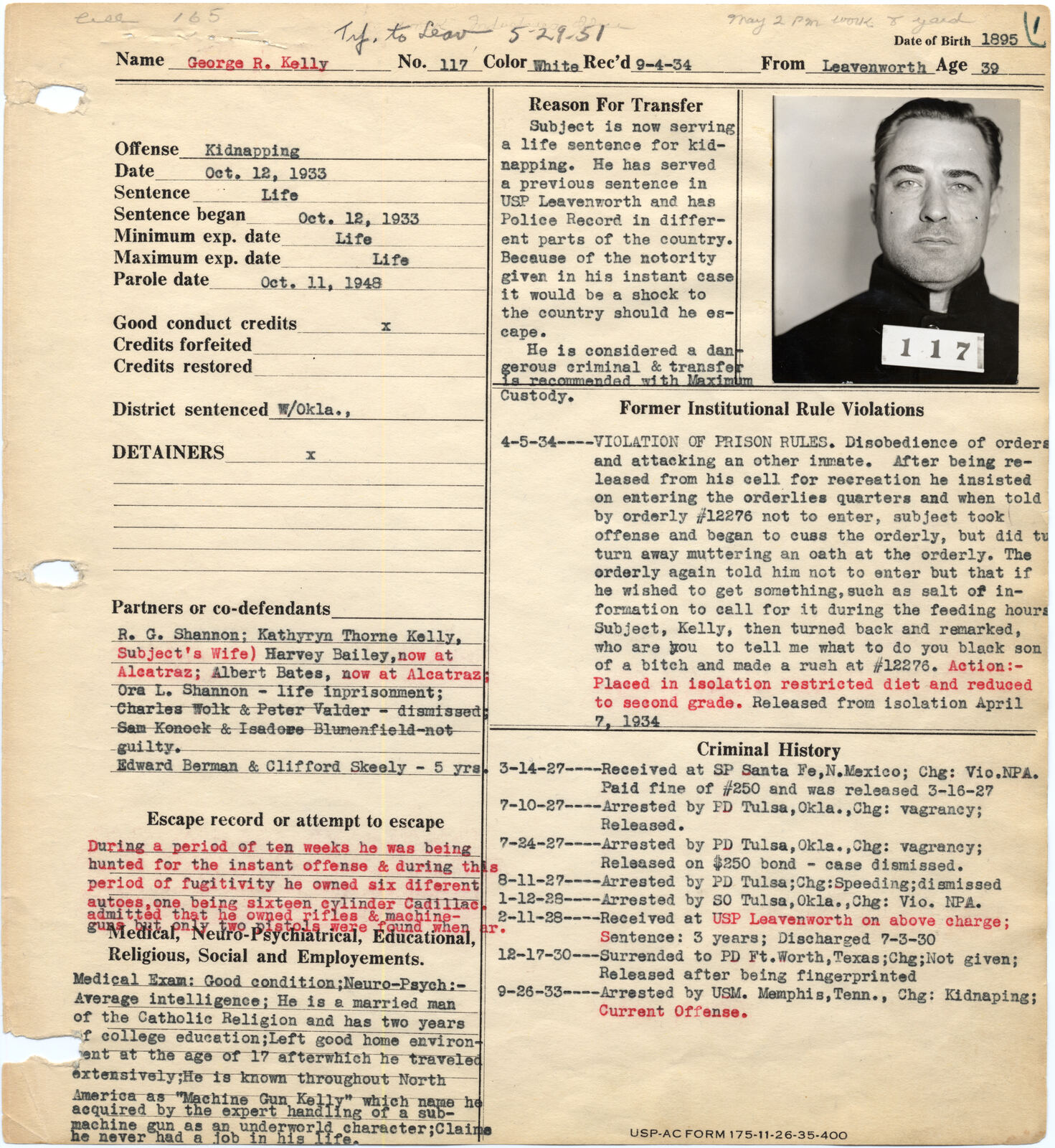 PersonGeorge "Machine Gun" KellyAlcatraz register no. 117. The warden's notebook page records receipt from Leavenworth on 4 September 1934 under a life sentence for kidnapping; the National Archives records his birth year and middle initial two ways.PersonGeorge MoranThe subject of a three-part FBI file. A 1946 memorandum for the Attorney General calls him "formerly the leader" of the Chicago North Side gang; newspapers of 1925 to 1930 reported him charged in the Torrio shooting in 1925 and missing in 1930, and a 1929 feature said the February garage killings had been aimed at him.PersonGerardo CatenaNamed by Joseph Valachi in 1963 as the underboss under Vito Genovese, and by the Attorney General as Genovese's substitute in New Jersey. He was in the car stopped with Genovese at the Apalachin roadblock in 1957.PersonGiuseppe MorelloArrested in April 1903 in the barrel-murder inquiry and watched by the Secret Service; convicted of counterfeiting in February 1910 and sentenced to twenty-five years. The Second Circuit, affirming in 1911, wrote that his 1903 arrest for the murder 'proved nothing.'PersonGregory Scarpa, Sr.Designated an FBI informant in 1962 in the Bureau's Top Echelon program, according to the FBI's own memoranda, and found by a federal court in 1997 to have informed again from 1980 to 1992. After a 1990s Colombo family trial the government disclosed his informant role. He did not testify in these cases.PersonGus GreenbaumNamed in testimony before the Kefauver Committee in 1950 as one of the El Cortez Hotel owners about 1945 and as a member of the group that bought the Flamingo after Siegel's death. An FBI report records an informant's statement about him in 1946.
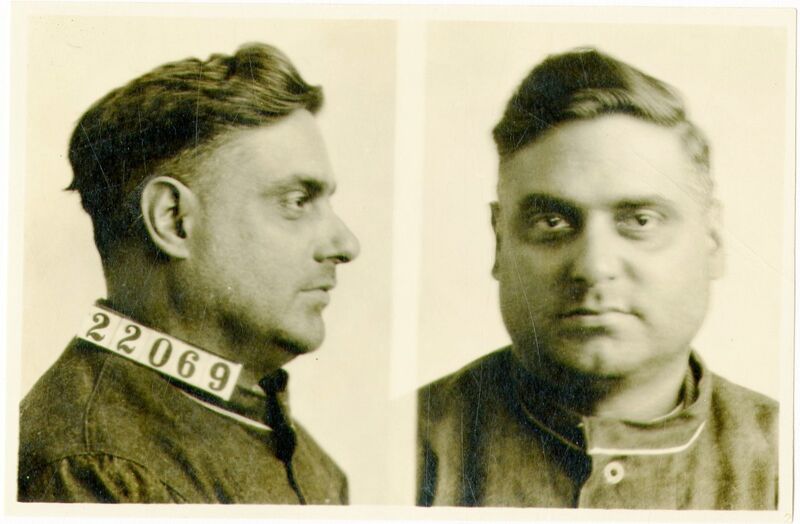 PersonGustav B. DietmeyerA defendant in the federal case over the 1923 Staunton, Illinois mail robbery, found guilty on two of four counts in 1924 and sentenced to 25 years; the Seventh Circuit held that the evidence showed him active in preparing the robbery. His Leavenworth photograph is No. 22069.PersonH. Paul RicoFBI special agent in Boston who, federal courts found, recruited Stephen Flemmi as an informant in the 1960s and, with Dennis Condon, handled Joseph Barboza.
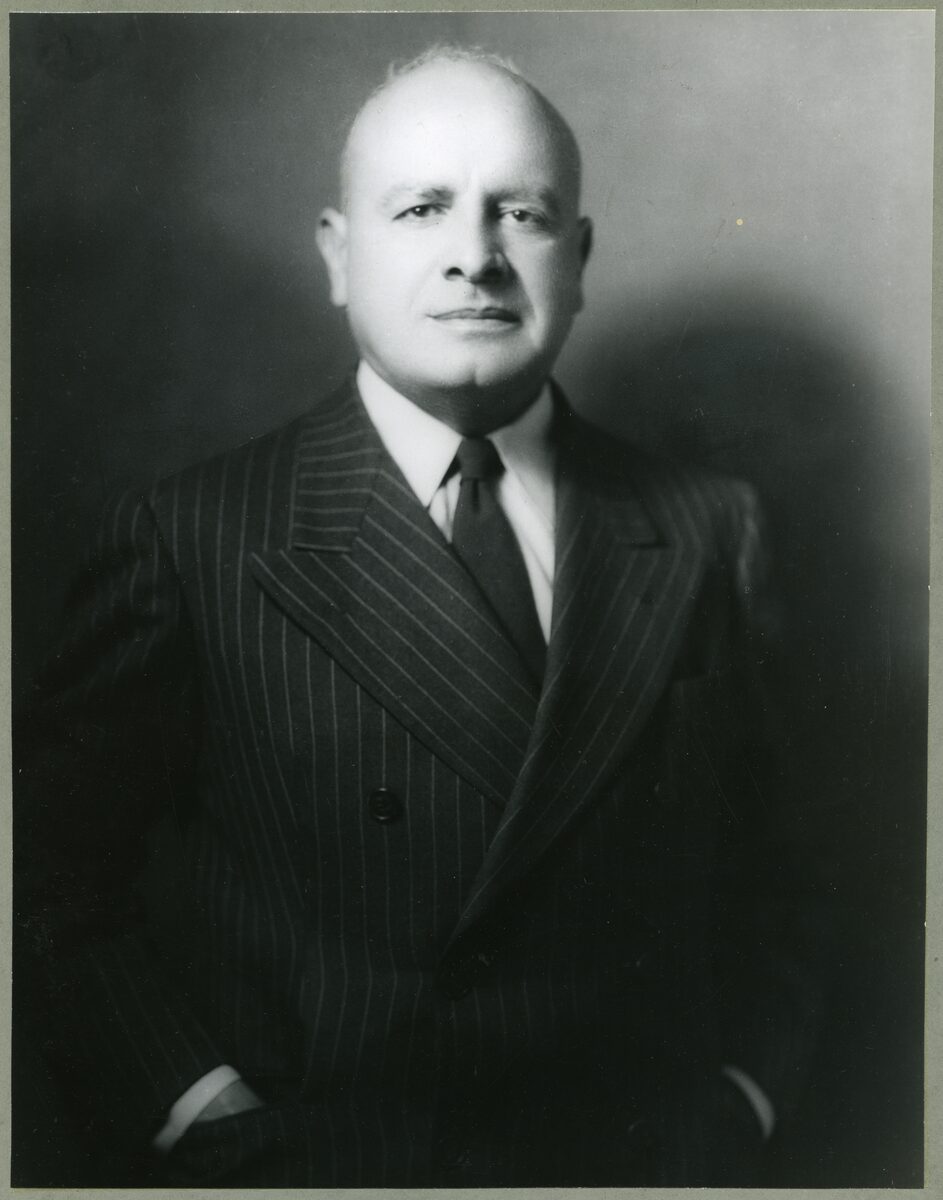 PersonHarry J. AnslingerU.S. Commissioner of Narcotics, in the National Archives' caption of his Bureau of Narcotics portrait. He testified to the Kefauver Committee in 1951 and, as a former commissioner, to the Senate narcotics hearings of 1964.
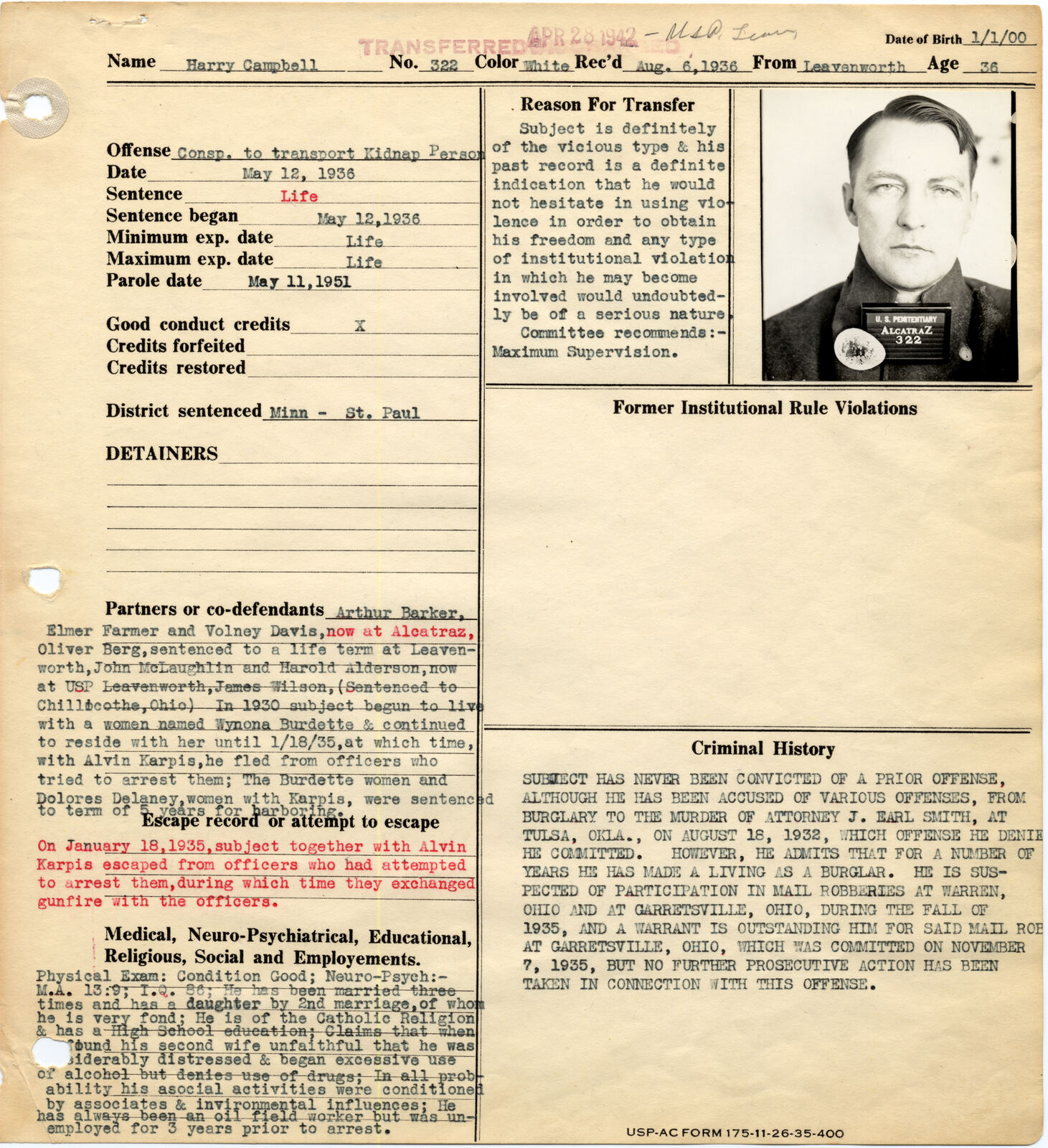 PersonHarry CampbellAlcatraz register no. 322. The warden's notebook page records receipt from Leavenworth on 6 August 1936 under a life sentence for conspiracy to transport a kidnapped person, and a transfer back on 28 April 1942.
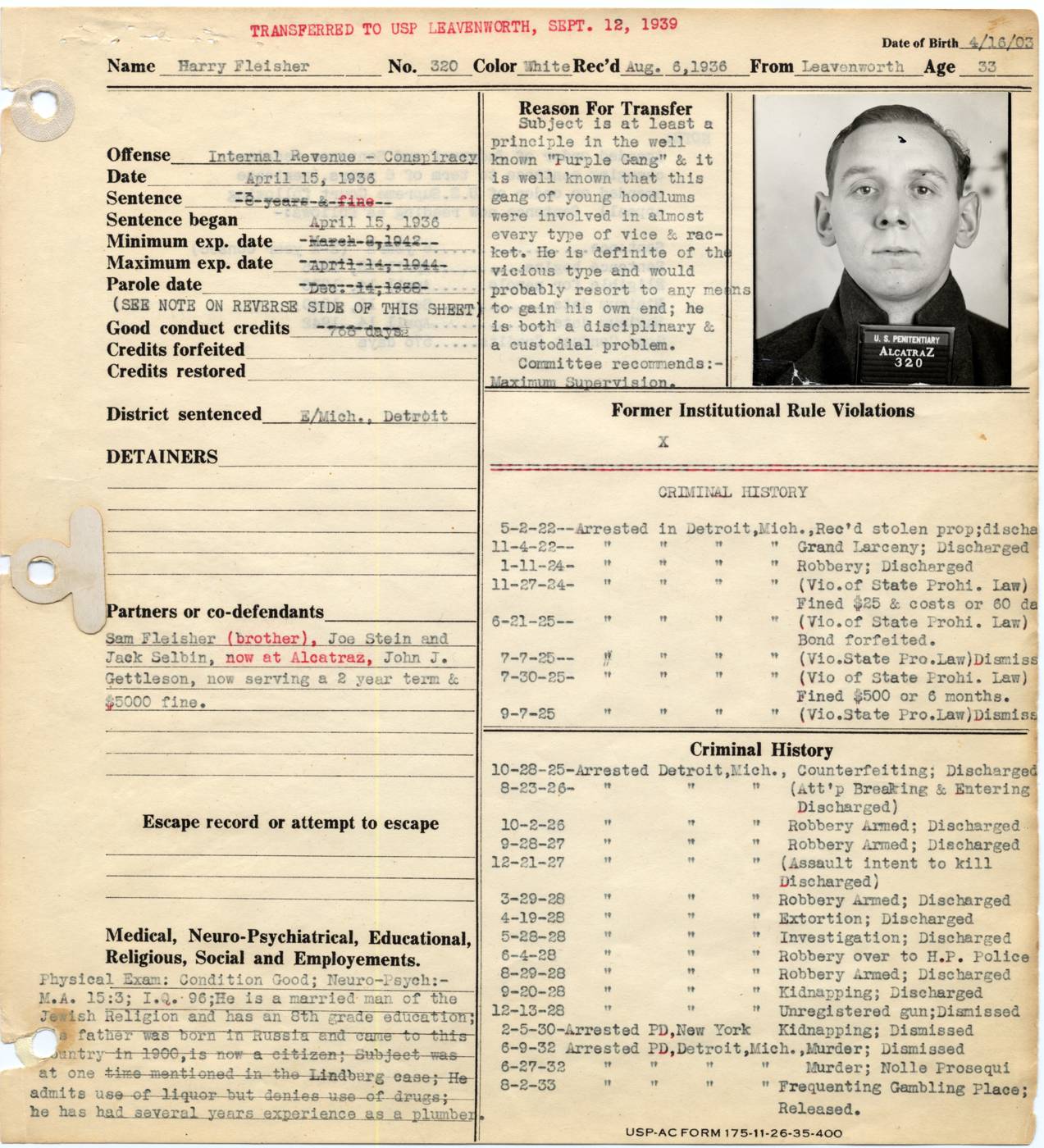 PersonHarry FleisherNamed in a 1932 Bureau of Investigation letter among the Purple Gang's 'ring leaders' and as wanted by Michigan authorities; convicted in 1936 in the Eastern District of Michigan of an internal revenue conspiracy and held at Alcatraz as No. 320 from 1936 to 1939.
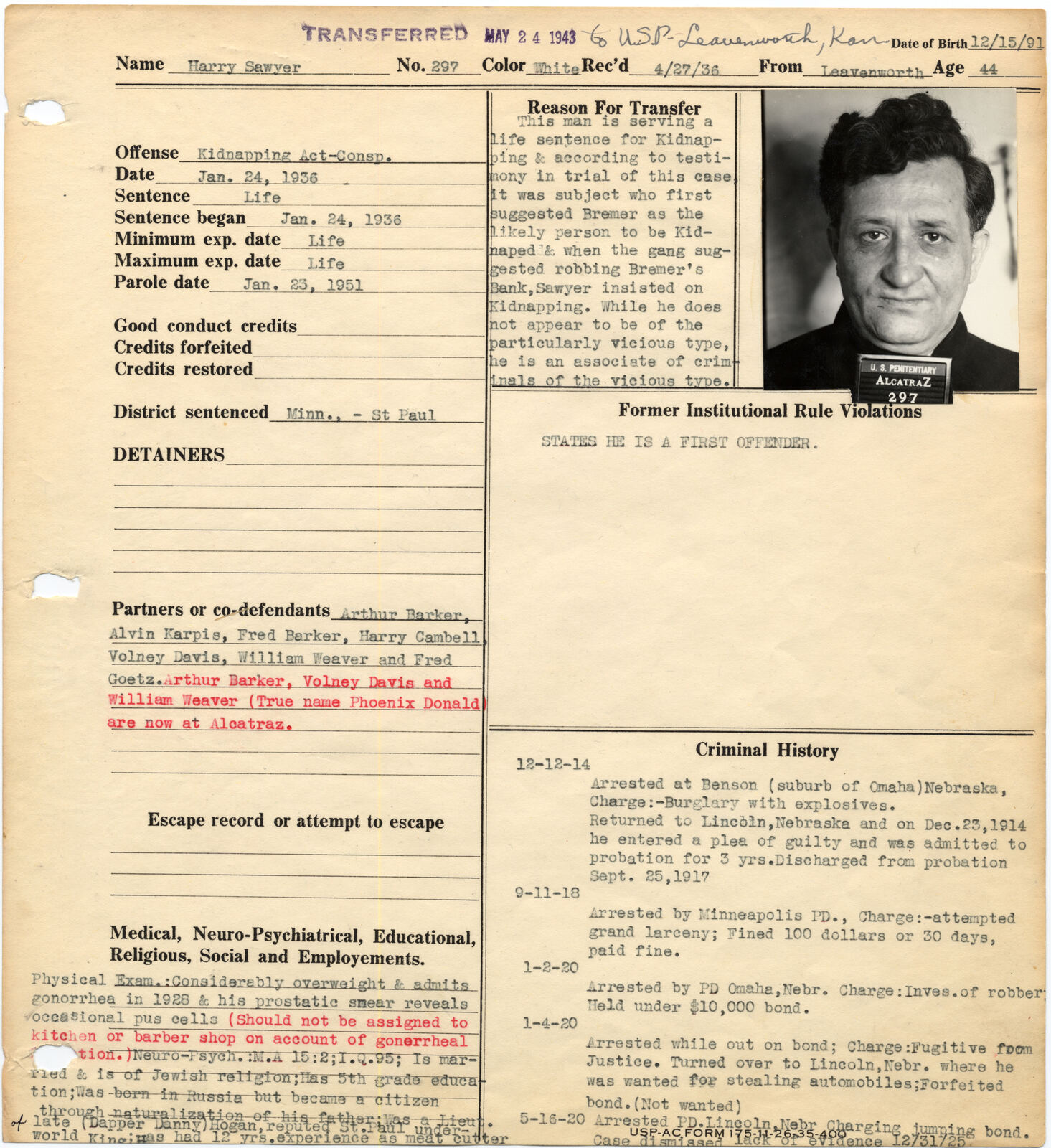 PersonHarry SawyerAlcatraz register no. 297. The warden's notebook page records receipt from Leavenworth on 27 April 1936 under a life sentence for conspiracy under the Kidnapping Act, and a transfer back on 24 May 1943. The catalog remark gives the true name as Sandlovich.
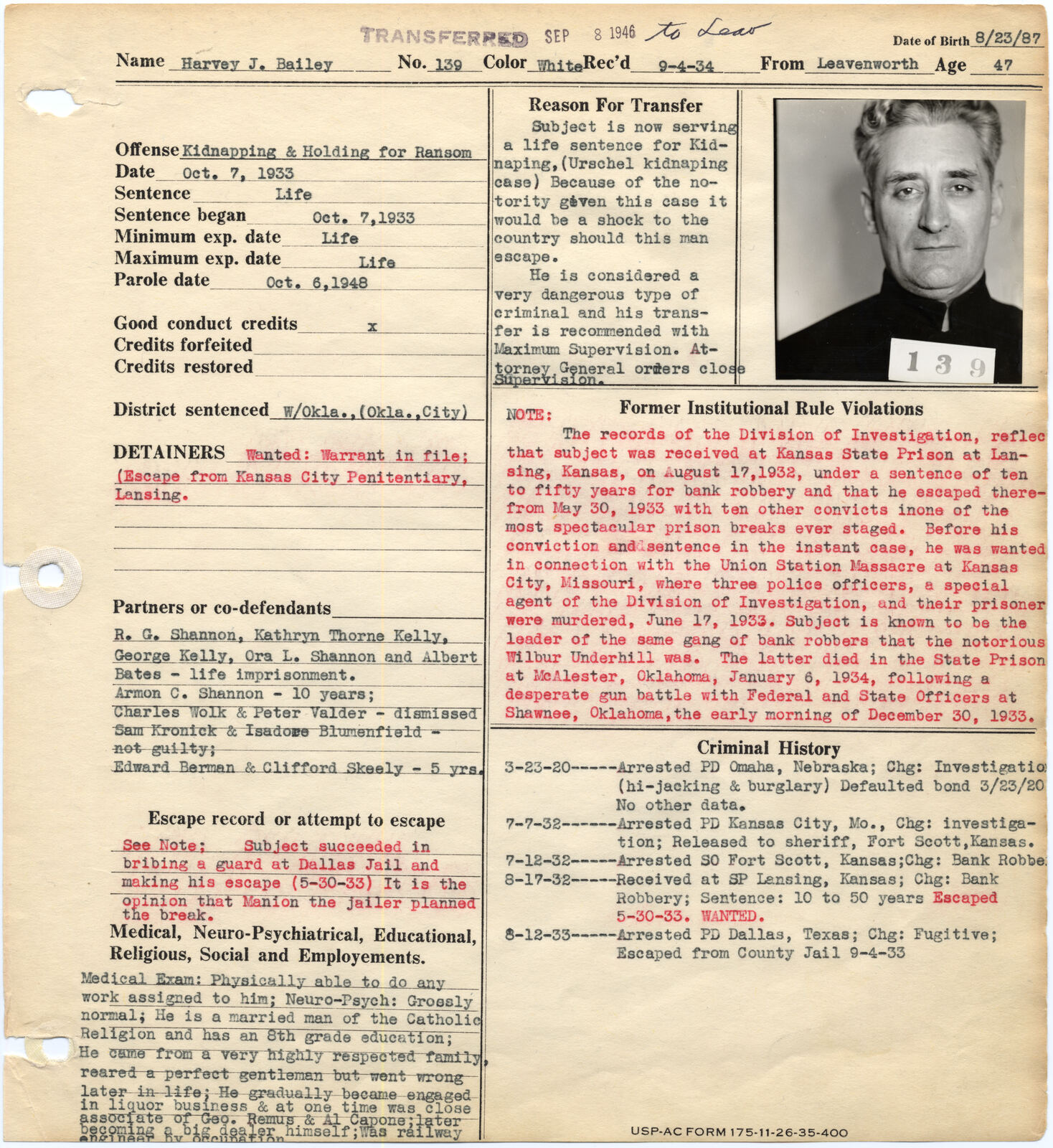 PersonHarvey BaileyAlcatraz register no. 139. The warden's notebook page records receipt from Leavenworth on 4 September 1934 under a life sentence for kidnapping and holding for ransom, and a transfer back on 8 September 1946.PersonHenry HillIndicted with James Burke at Tampa in 1970 in a federal extortion case, according to the FBI file. In 1983 the Second Circuit described him as the principal government witness in the Boston College point-shaving trial, testifying under an immunity agreement.PersonHenry TameleoAppellant with Raymond Patriarca in the 1968 First Circuit decision on the Marfeo conspiracy, and one of four men convicted in 1968 of the Deegan murder, convictions later vacated. He died in prison in 1985, a federal court found.PersonHerbert BlitzsteinDescribed by the Ninth Circuit in 1986 as "an associate of Anthony Spilotro" and an officer of Gold Rush, Ltd. in its account of an FBI investigation; the same court in 2001 summarizes testimony that he was killed in Las Vegas in January 1997.PersonHoward T. WinterFirst-named of twenty-one defendants in the 1979 federal horse-race-fixing prosecution in Boston, United States v. Howard T. Winter et al.; the verdict transcript records the jury finding him guilty on count two, and the First Circuit affirmed his conviction in 1981. The opinions do not call him a member or leader of any group.PersonIgnazio LupoConvicted with Giuseppe Morello of counterfeiting in 1910 and sentenced to thirty years; paroled in 1920, his sentence was conditionally commuted by President Harding in 1921, the commutation was revoked in 1936, and the Fifth Circuit upheld his return to Atlanta in 1937.PersonIlario M.A. ZanninoConvicted in Boston on two gambling counts and one extortionate-credit count from the 1981 North End surveillance case, with a 30-year sentence affirmed in 1990. The First Circuit, on the trial evidence, calls him a "Capo Regime" in the Patriarca Family.PersonIndalecio PertierraA Cuban congressman whom FBI reports of 1947 describe as reportedly controlling the gambling at the Jockey Club at Oriental Park and the Gran Casino Nacional, and as the man behind Luciano's Cuban visa, which he denied. Every statement about him in these records is 'reportedly' or an informant's.PersonIrving MilbergNamed in 1929 among four Purple Gang 'ringleaders' convicted in federal court at Detroit; a 1932 Bureau of Investigation letter says he had been in jail since September 1931 in the murder case for which Harry Keywell received a life sentence.PersonJack CeroneConvicted in the Kansas City prosecution for skimming Las Vegas casinos, affirmed in 1987. The Eighth Circuit's opinion says the Government charged that Aiuppa was boss of the Chicago group, with Cerone as its underboss.PersonJack "Legs" DiamondCalled a New York gangster and racketeer in 1930 wire stories. In August 1930 the Irish Free State ordered that he not be allowed to land from the liner Baltic. On October 12, 1930 he was shot five times in a room of the Hotel Monticello on West Sixty-fourth Street, New York, and would not tell police who shot him. This page rests on 1930 newspaper pages.PersonJack William ToccoCharged in the 1996 Detroit indictment as 'Boss of the Detroit Cosa Nostra Family' since about 1979, and convicted in 1998 of two RICO conspiracy counts and a Hobbs Act conspiracy count; the Sixth Circuit affirmed the convictions and twice vacated his sentence.PersonJackie PresserTeamsters general president when he appeared under subpoena before the President's Commission on Organized Crime in April 1985. Indicted in 1986, with two others, on charges of paying "ghost" employees at Local 507.PersonJacob "Gurrah" ShapiroDefendant with Louis Buchalter in the federal fur dressers antitrust cases. His 1936 Sherman Act conviction was affirmed in 1937; he became a fugitive, surrendered on April 14, 1938, and was sentenced again on June 17, 1938. The FBI states he was sentenced on May 5, 1944 to 15 years to life for conspiracy and extortion.PersonJake GuzikHis FBI Vault file describes him as business manager of some of the Capone underworld enterprises. The Seventh Circuit affirmed his 1930 income tax conviction in 1931.PersonJake LanskyMeyer Lansky's brother, whom FBI reports place in Havana in 1952 'looking after' his brother's interests and, in a 1958 informant report, as 'overseer of operations at the hotel casino' of the Hotel Nacional.
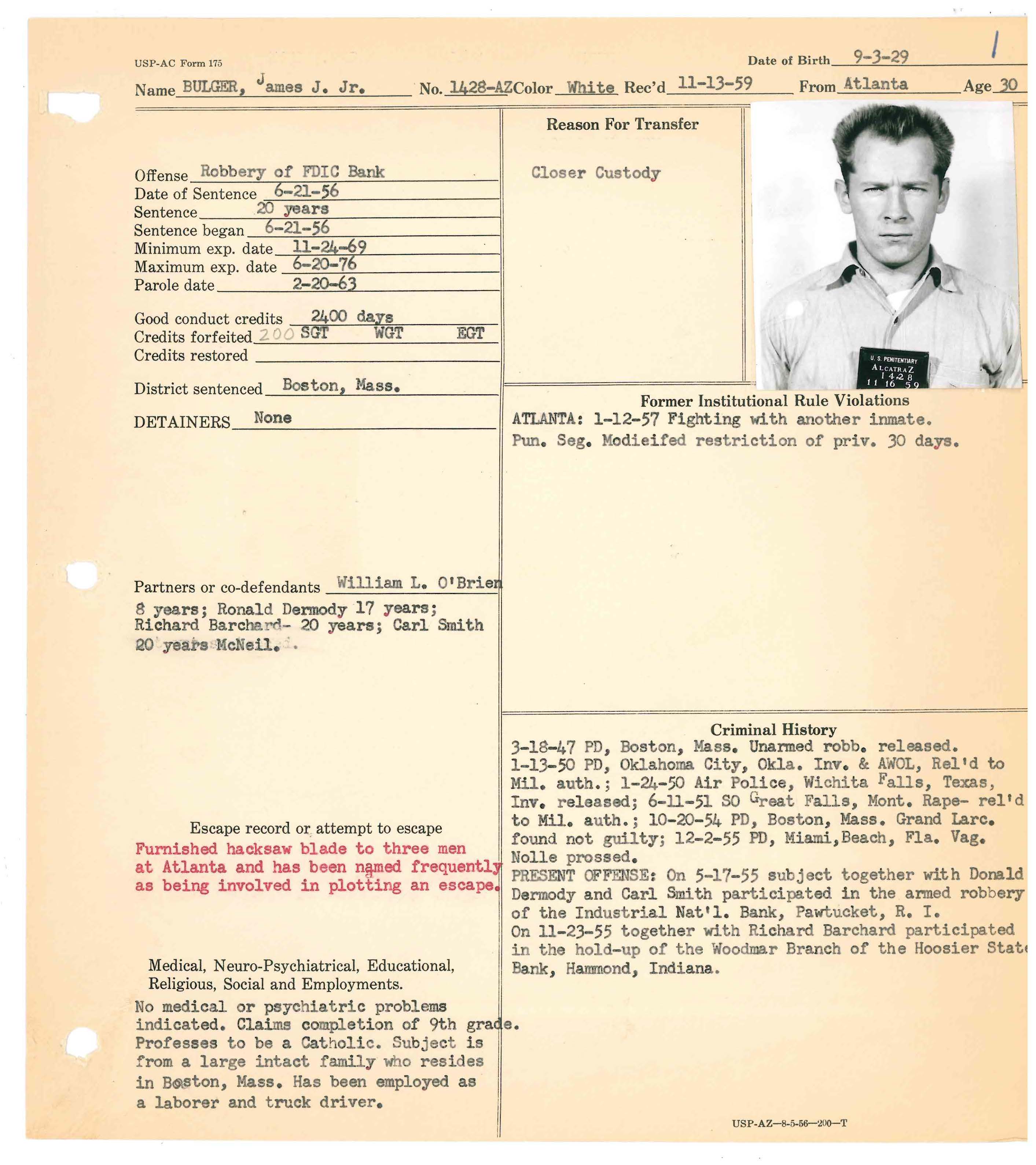 PersonJames J. BulgerSentenced in 1956 for bank robbery and held at Alcatraz from 1959 to 1962; an FBI informant from 1975, a federal court found; a fugitive from late 1994 until June 2011; convicted in 2013 of racketeering, with the jury finding he played a role in eleven murders.PersonJames CoonanLead defendant in the 1987 federal racketeering indictment of the group the Second Circuit calls the Westies, a Hell's Kitchen organized crime group; the court of appeals describes him as its leader. Sentenced in 1988 to seventy-five years.PersonJames EpiscopiaA defendant in the 1982 Southern District of New York case against Napolitano and Ruggiero. FBI reports in the Vault record his conviction on December 12, 1983 for methaqualone conspiracy and distribution and a five-year sentence imposed by Judge Robert W. Sweet on November 17, 1986.PersonJames LicavoliConvicted with five others of RICO violations in Cleveland; the Sixth Circuit, affirming in 1984, stated that the evidence established he was 'a leader of organized crime in Cleveland' who in 1976 'decided that he needed to have one Danny Greene killed'.PersonJames M. Ragen, Jr.Named general manager of Continental Press in 1940, according to 1950 testimony; convicted in the Consensus Publishing tax case in 1940, a conviction reversed on appeal; sold his interest in Continental to Edward J. McBride in 1947.PersonJames M. Ragen, Sr.Chicago race-news executive who, by 1950 testimony and a Senate report quoted in it, ran Annenberg's General News Bureau and then took over the wire service with Arthur McBride in 1939; convicted in the Consensus Publishing tax case, a conviction the Supreme Court reinstated in 1942; shot in June 1946, according to the Kefauver Committee's chronology.PersonJames MartoranoA defendant in the 1979 Boston horse-race-fixing prosecution, United States v. Howard T. Winter et al.; the First Circuit affirmed his conviction in 1981 and the denial of his motion for a new trial.PersonJames McElroyA defendant in the 1987 Westies racketeering indictment, tried with James Coonan before Judge Whitman Knapp and sentenced to sixty years, according to the Second Circuit's 1995 opinion.
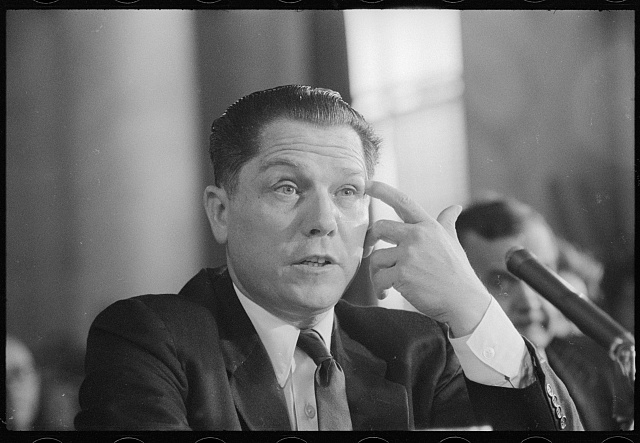 PersonJames R. HoffaTeamsters president. Convicted in 1964 of jury tampering in Tennessee and of defrauding the Teamsters Pension Fund in Illinois; President Nixon commuted his sentence in December 1971 on condition that he not manage a union before 1980. The FBI took jurisdiction after his disappearance on 30 July 1975 and says the investigation remains active.
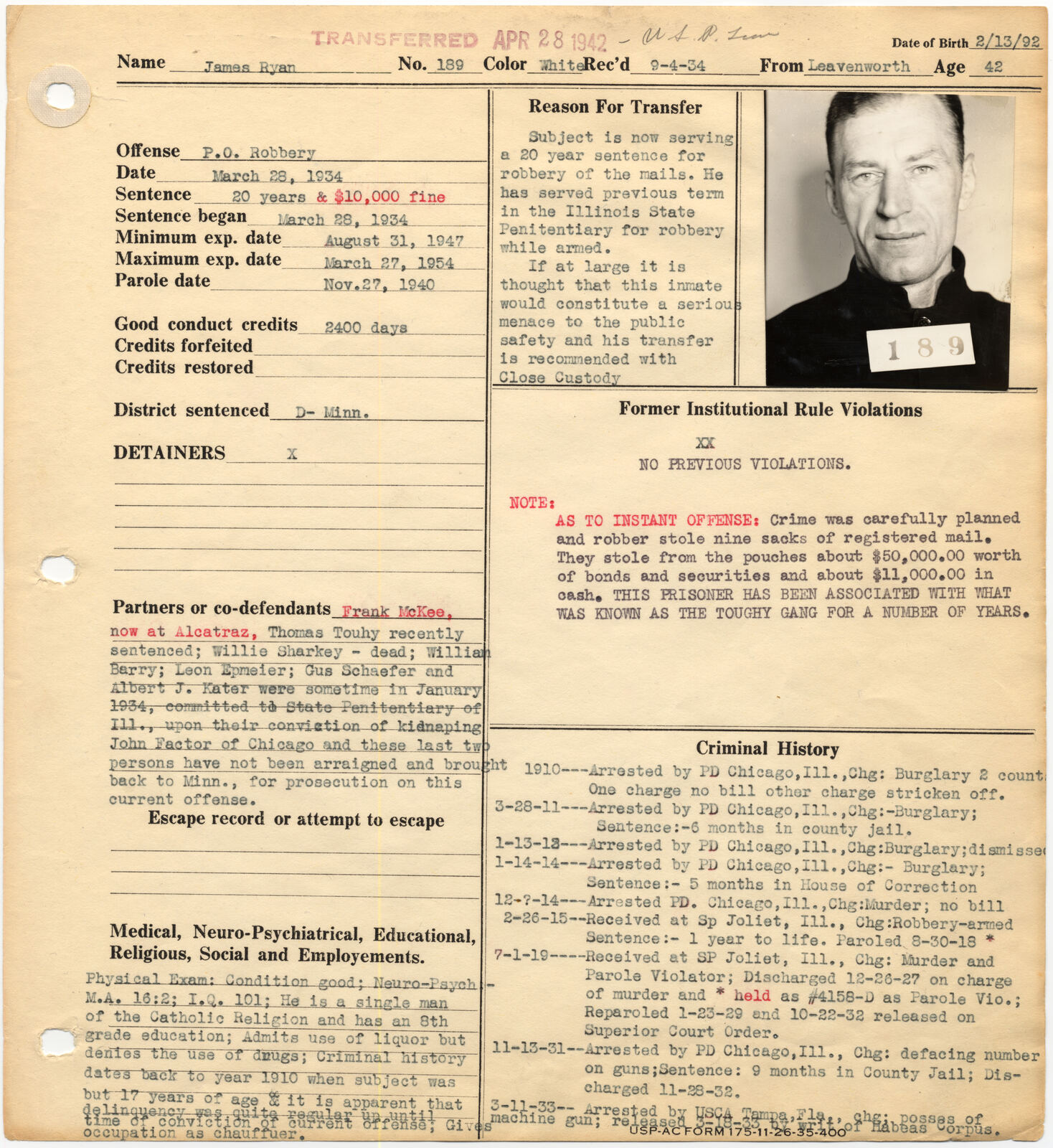 PersonJames Ryan ("Silent Jim")Alcatraz register no. 189. The warden's notebook page records receipt from Leavenworth on 4 September 1934 under a 20-year sentence and $10,000 fine for post-office robbery, and a transfer back on 28 April 1942.
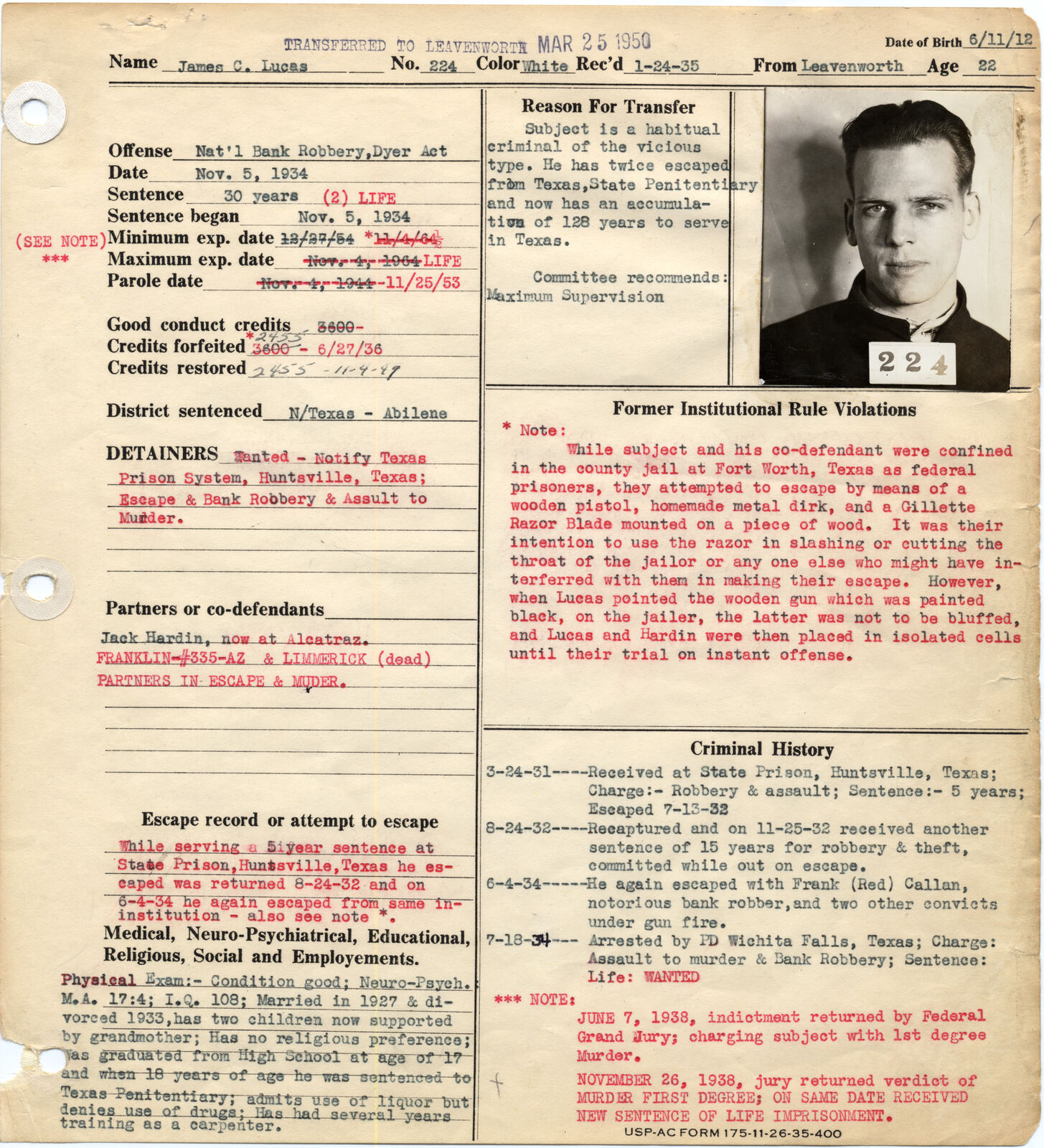 PersonJames C. "Tex" LucasAlcatraz register no. 224. The warden's notebook page records receipt from Leavenworth on 24 January 1935 under a sentence for national bank robbery and the Dyer Act, and a 1938 federal first-degree murder verdict and life sentence. The National Park Service says he attacked Capone in 1936.PersonJames V. La DucaOf Lewiston, N.Y. Called before the McClellan Committee in 1958, he declined on Fifth Amendment grounds to say whether he attended the Apalachin meeting. The committee's staff list and a 1963 Buffalo police witness describe his ties by marriage to the Magaddino family.PersonJim ColosimoNamed in a 1947 FBI memorandum and in the FBI's Capone history essay as the man whose Chicago gang Torrio took over after Colosimo was killed on May 11, 1920.PersonJoseph Doto (Joe Adonis)Under oath before the Kefauver Committee in December 1950 he gave his name as Joseph Doto and said he was known as Joe Adonis; he declined to answer most questions, and the committee reported him twice for contempt of the Senate. The FBI's 1943 and 1944 files on a kickback case at the Brooklyn Army Base name him among the subjects. No record filed here states a family or rank.PersonJoe BernsteinListed among the Purple Gang's 'ring leaders' in a 1932 Bureau of Investigation letter; 1930 wire reports call him a 'reputed leader' of the gang, the alleged victim in an assault case and the owner of a seized armored car.PersonJohn C. MontanaPresident of the Van Dyke Taxicab Co. of Buffalo and a former Buffalo councilman. He testified to the McClellan Committee in 1958 about his trip of November 14, 1957, and his Apalachin conviction was reversed in 1960. Joseph Valachi testified in 1963 that he had been a lieutenant under Stefano Magaddino.PersonJohn J. Connolly, Jr.FBI agent in Boston from 1973 to 1990 who handled James Bulger and Stephen Flemmi as informants. Convicted in 2002 of racketeering, obstruction and a false statement; the First Circuit affirmed in 2003.
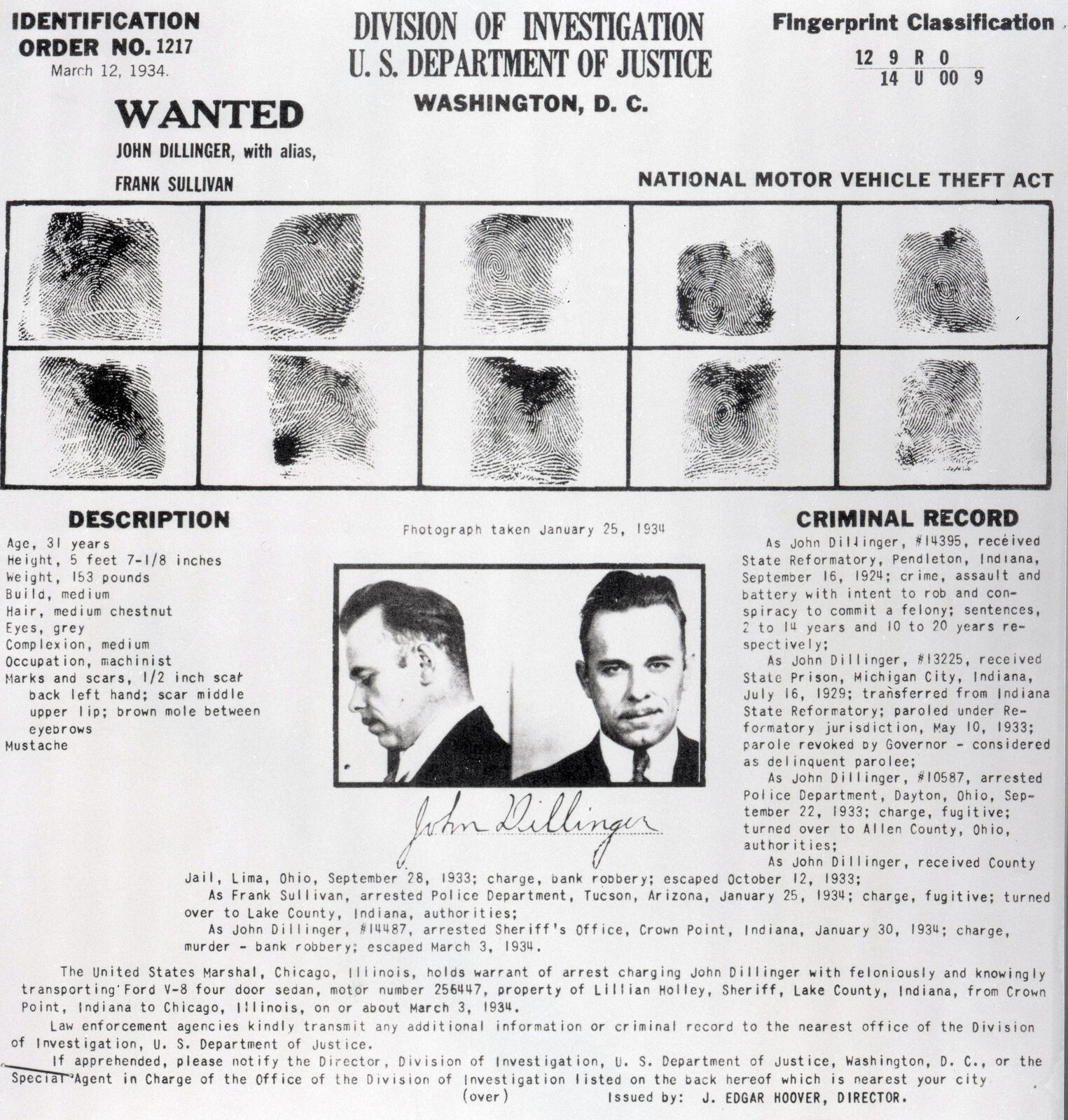 PersonJohn DillingerBank robber wanted by the Division of Investigation under the stolen-car law in 1934; shot by Bureau agents outside the Biograph Theatre in Chicago on 22 July 1934, as the FBI states.PersonJohn GottiCharged in 1991 as head of the Gambino family and convicted in 1992, largely on recordings made at the Ravenite Social Club; the Second Circuit affirmed. The FBI's history page says he took over after Castellano's murder and died in prison in June 2002.PersonJohn H. BalistrieriConvicted in Milwaukee with his father, Frank Balistrieri, and his brother Joseph of conspiracy to extort and attempted extortion arising from an FBI sting; the Seventh Circuit affirmed in 1985. In the Argent skimming trial in Kansas City the court entered a judgment of acquittal for him.PersonJohn LaRoccaOf Pittsburgh. A McClellan Committee investigator named him in 1958 among five men added to the list of Apalachin attendees and said he was in business in Pittsburgh with Gabriel Mannarino and Michael James Genovese. A Los Angeles police captain testified to stopping a car in which he was a passenger in 1956.PersonJohn LaziaDescribed in 1950 Senate hearings, by a Treasury narcotics agent and by a witness agreeing with counsel's question, as a leader of Kansas City's underworld and a figure in its gambling; he was killed in 1934, as the agent testified.PersonJohn MonaghanDistrict Attorney of Philadelphia in 1928 and 1929, as the newspaper reports call him. He led the 1928 grand jury inquiry into bootlegging and police graft and prosecuted Al Capone's 1929 weapons case.PersonJohn MorrisFBI supervisor in Boston, named by a federal court among John Connolly's supervisors and as chief of the organized crime squad, who the court found told Flemmi and Bulger they would not be prosecuted for anything on the 98 Prince Street tapes.PersonJohn NardiKilled by a car bomb in Cleveland in May 1977, by the account of the FBI's Cleveland chief in 1988 Senate testimony; a 1986 federal court summarized the government's proffer that he and Danny Greene were killed in car bombings in 1977.PersonJohn OrmentoConvicted in 1962 in the federal Canada-to-New York narcotics conspiracy and sentenced to forty years as a multiple offender. He appears in the courier's testimony in the 1959 Genovese trial, and the Commissioner of Narcotics named him among the Bureau's convictions in 1964.
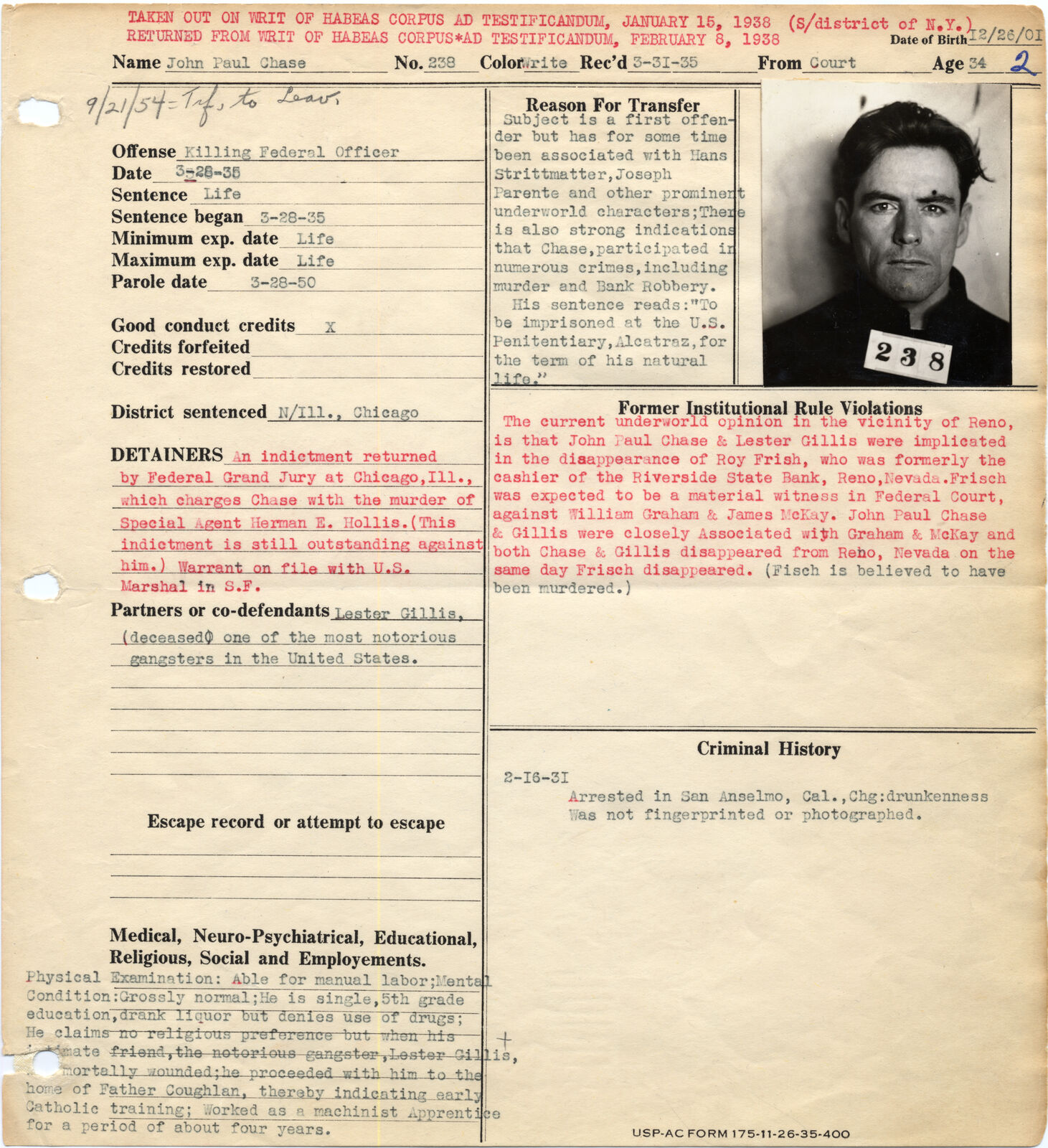 PersonJohn Paul ChaseConvicted at Chicago in 1935 of killing a Division of Investigation agent at Barrington, Illinois; held at Alcatraz from 1935 to 1954, as his warden's notebook page records.PersonJohn RoselliIntroduced to Bioff as "the representative of the group in California," in the Second Circuit's account of the testimony; convicted in 1943 in the motion-picture extortion case, sentenced to ten years, and paroled on 13 August 1947.PersonJohn ScalishNamed as a defendant in the Apalachin conspiracy case, whose convictions were reversed in 1960; the subject of a Cleveland FBI file opened after the 1957 meeting; and described in 1988 Senate testimony by Angelo Lonardo and the FBI's Cleveland chief as boss of the Cleveland family until his death in 1976.PersonJohn TorrioThe FBI's Capone history essay says Torrio led the gang after Colosimo's death and handed control to Capone in 1925. His FBI Vault file holds a 1947 background memorandum and a 1946 extortion case.PersonJohn TronoloneA Cleveland defendant in the 1987-88 Genovese family trial in New York, acquitted on the Teamsters election charges and not found to have conspired to murder John Simone; described in a 1986 government proffer and in 1988 FBI testimony as the Cleveland family's consigliere.PersonJoseph A. FortierThe United States Treasury Department representative at the American Embassy in Havana who, in the FBI's 1946-47 reports, looked for Luciano from October 1946, believed his own report led to the Bureau of Narcotics' action, and interviewed Luciano at the Tiscornia immigration center.PersonJoseph AgostoDescribed by the Eighth Circuit as the Government's principal witness in the Tropicana skimming trial, and by a Senate subcommittee staff summary of FBI affidavits as the Kansas City "outfit" principal management agent in Las Vegas.PersonJoseph AielloKilled by machine-gun fire in front of 205 N. Kolmar Ave., Chicago, on October 23, 1930, according to a Chicago police entry printed as Exhibit 10 of the 1963 Senate hearings. Valachi testified that Aiello sent $5,000 a week to the Maranzano side and was the one man that side lost.PersonJoseph AiuppaRefused the Kefauver Committee's questions, was convicted in a federal migratory-bird case affirmed in 1968, and was convicted in the Las Vegas skimming case affirmed in 1987, where the Government charged him as boss of the Chicago group.PersonJoseph Barbara, Sr.The host of the gathering of November 14, 1957 at Apalachin, N.Y. The federal courts describe it as held at his home and estate; the McClellan Committee staff list calls him president of the Canada Dry Bottling Co. of Endicott.PersonJoseph BarbozaChief prosecution witness in the 1968 federal trial of Raymond Patriarca and others. Federal courts later found that his testimony in the Deegan murder case was perjured and that his FBI handlers knew it. He was murdered in 1976, a federal court states.PersonJoseph BiondoNamed in 1963 by New York police as the Gambino family's underboss and the successor of Frank Scalice. Valachi called him "Joe Bandy."PersonJoseph BonannoNamed by Valachi in 1963 as the boss "in the other part of Brooklyn." The government's 1987 civil RICO complaint alleged that he founded the Bonanno family and remained its boss until October 21, 1964.PersonJoseph CatalanottiA former Detroit resident deported in 1957 whom Detroit police testified 'later turned up in Cuba during the tail end of the Batista regime,' and whom a Bureau of Narcotics sheet says was 'deported to Italy again 1959 from Cuba.'PersonJoseph CataniaShot six times near 647 Crescent Avenue in the Bronx on February 3, 1931, and died in Fordham Hospital, according to the New York police record read into the 1963 Senate hearings. Valachi testified that Maranzano would not make peace until "Joe Baker" was killed.PersonJoseph ColomboFBI memoranda of 1970–71 call him "boss" of the Colombo La Cosa Nostra "family"; agents arrested him on federal gambling charges on April 2, 1971. FBI testimony in 1988 refers to his shooting at an Italian-American rally in 1971.
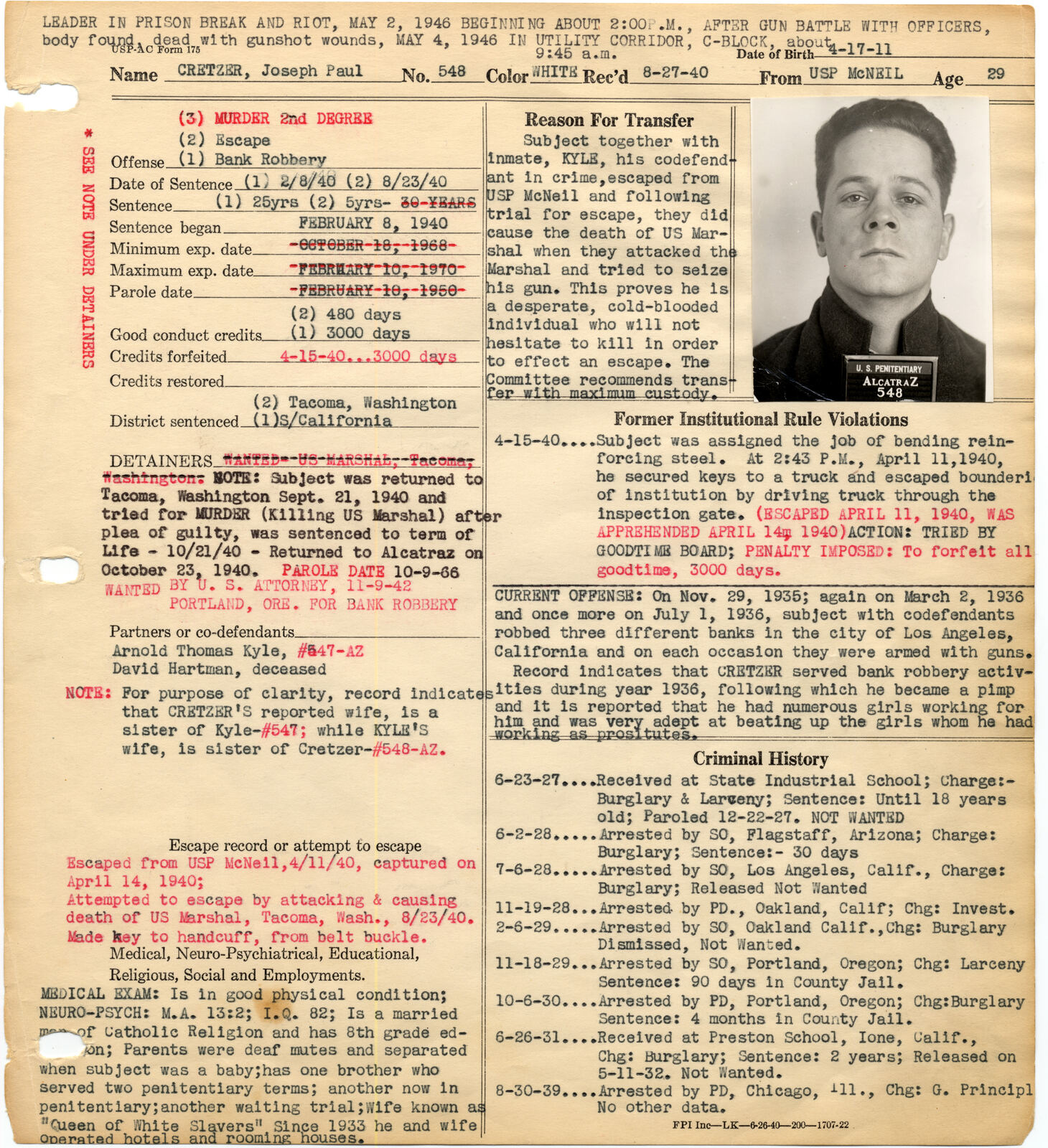 PersonJoseph Paul "Dutch" CretzerAlcatraz register no. 548. The warden's notebook page records receipt from USP McNeil on 27 August 1940 under sentences for bank robbery, escape and second-degree murder, and a typed header recording the 2 to 4 May 1946 prison break and that his body was found on 4 May.PersonJoseph FerriolaNamed by the Seventh Circuit in 1997 as boss of the Ferriola Street Crew, a unit of the Chicago Outfit, from 1979 to 1989. Convicted with Jack Cerone in a 1971 Travel Act gambling case.PersonJoseph LombardoConvicted with Roy Williams, later president of the Teamsters, of conspiring to bribe a U.S. Senator (affirmed 1984), in the Las Vegas skimming case (affirmed 1987), and at the 2007 Family Secrets trial, where he was sentenced to life.PersonJoseph LonardoKilled with his brother John in a Cleveland barber shop in October 1927; wire reports of the time call the brothers sugar dealers or commission merchants, later reports call him 'Big Joe' Lonardo, and his son Angelo testified in 1988 that he had been 'the former boss of the Cleveland family'.PersonJoseph MachecaNamed in 1890-91 records as one of the nine tried for the Hennessy killing, acquitted by a unanimous jury on 13 March 1891, and listed among the eleven killed at the Parish Prison on 14 March; the papers' claim that he headed a society was a prosecution theory not proved in court.PersonGiuseppe MaglioccoNamed in 1963 as Joseph Profaci's successor in Brooklyn. The Attorney General told the subcommittee that the Commission had not confirmed him and probably would not.PersonJoseph MasseriaHead of one side in the 1930–31 New York gang war, as the 1963 Senate hearings describe it. Joseph Valachi called him "the boss we were fighting" and testified, from hearsay, that his own people killed him in a Coney Island restaurant. A police record read into the same hearing dates the killing April 15, 1931, at 2715 West 15th Street.PersonJoseph MassinoConvicted with Rastelli in the Local 814 case. The government's 1987 civil complaint called him the Bonanno family's underboss; a 2006 U.S. Attorney's release calls him "Bonanno family boss," and the Second Circuit in 2010 "the then-incarcerated official boss."PersonJoseph MessinaCharged in the 1982 New York case. The indictment, as the Eleventh Circuit summarizes it, named him and Dominick Napolitano as the two "captains" whom the three men killed in May 1981 sought to displace. He did not appear for trial.PersonJoseph P. BalistrieriConvicted in Milwaukee with his father, Frank Balistrieri, and his brother John of conspiracy to extort and attempted extortion arising from an FBI sting; the Seventh Circuit affirmed in 1985. In the Argent skimming trial in Kansas City the court entered a judgment of acquittal for him.
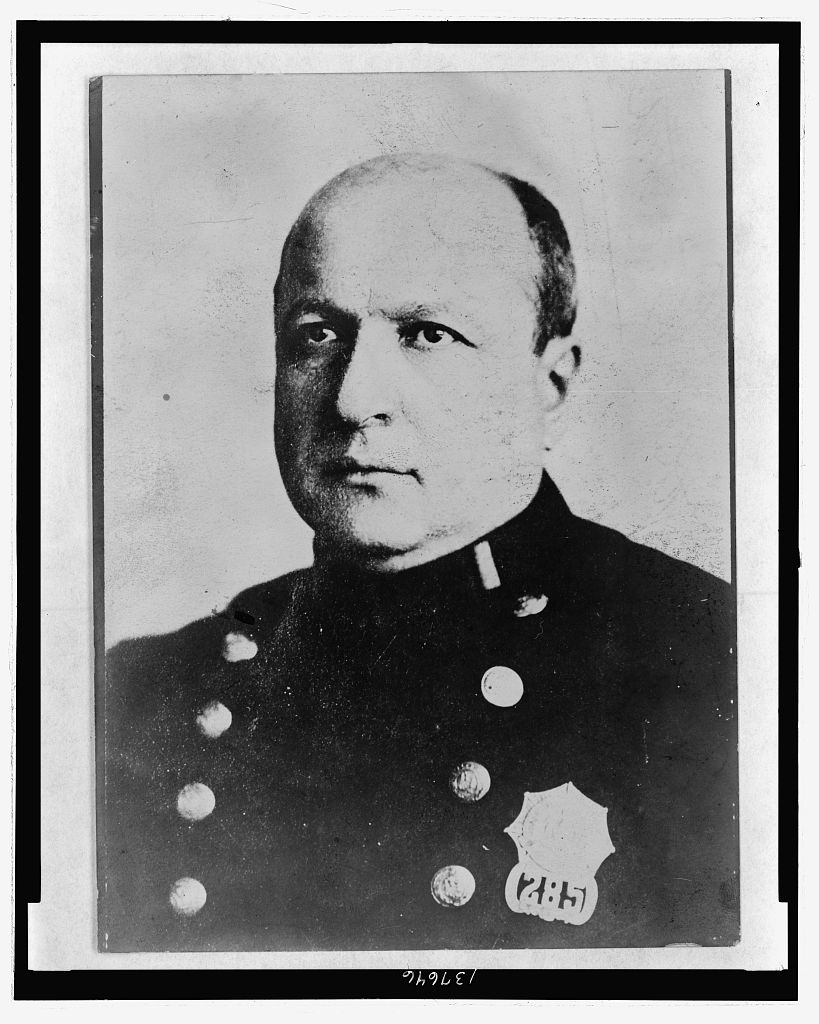 PersonJoseph PetrosinoNew York police detective in the 1903 barrel-murder inquiry, shot dead in Palermo on 12 March 1909. The records here are newspaper pages of 1903 to 1912, Library of Congress photographs, and a question quoted in a 1911 federal appeal; who killed him is not established in any of them.PersonJoseph PinzoloFound shot dead in suite 1007 of the Brokaw Building, 1487 Broadway, on September 9, 1930, according to the New York police record read into the 1963 Senate hearings. Thomas Lucchese, the lessee, was arraigned and not indicted.PersonJoseph PistoneFBI Special Agent who worked undercover as "Donnie Brasco." A federal court wrote in 1998 that "In 1976, FBI Agent Joseph D. Pistone assumed the identity of Donnie Brasco ... and infiltrated the Bonanno Crime Family" for some six years; he testified at the 1982 New York trial, at a Milwaukee trial, and before the Senate in 1988.PersonJoseph ProfaciNamed by Valachi in 1963 as the boss in Brooklyn "when I left the streets in 1960." New York police agreed that the Magliocco family was known originally as the Profaci family. He was stopped near Apalachin in 1957.PersonJoseph StacherNamed in an FBI Los Angeles report of 1963 as the person the Las Vegas Office believed the Sands Hotel's owner of record "now appears to be a front for," with the Gerardo Catena group. The Second Circuit records the Government's belief in 1961 and 1962 that he held undisclosed interests in Las Vegas gambling.
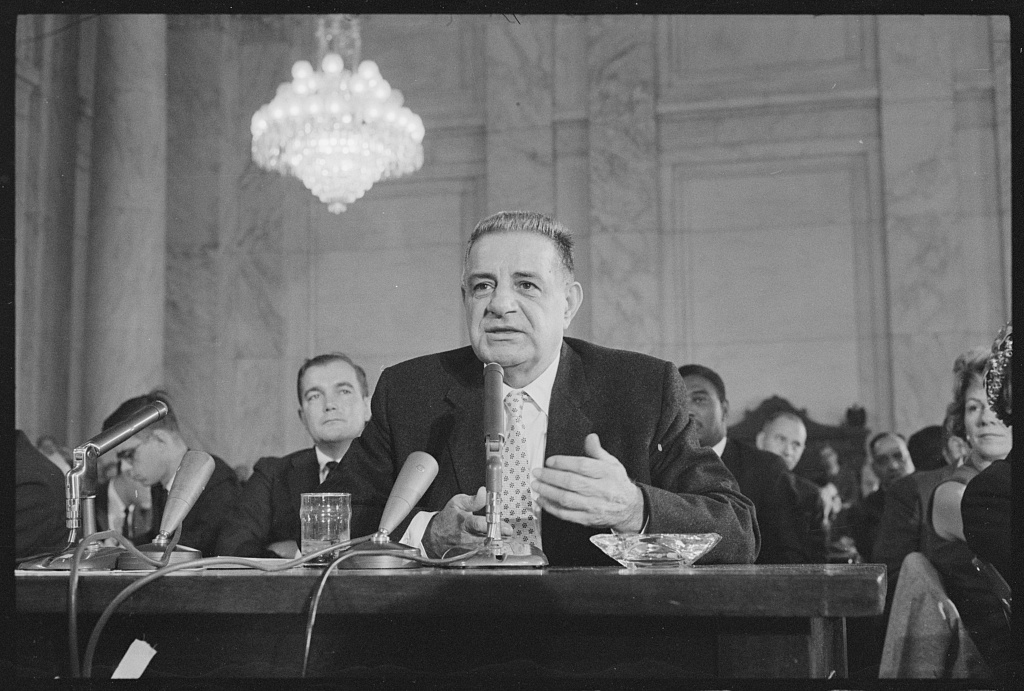 PersonJoseph ValachiTestified in public before the Senate Permanent Subcommittee on Investigations in September and October 1963 that he had been a member of "Cosa Nostra" since 1930. A federal docket in Atlanta records his 1962 guilty plea to second-degree murder at the U.S. Penitentiary.PersonJoseph ZerilliNamed in 1951 Kefauver testimony as a partner with William Tocco in the State Products Co., described in a 1958 McClellan Committee list as an associate of Pete Licavoli, and named in 1963, by a newspaper account the FBI summarized, among five Detroit 'dons'.PersonKathryn Thorne KellyCommitted for life on 12 October 1933 by the federal court at Oklahoma City for the kidnapping of Charles F. Urschel. The Tenth Circuit affirmed in 1935, and in 1959 reversed an order that had vacated her sentence and her mother's.PersonKenneth ShannonA defendant in the 1987 Westies racketeering indictment who pleaded guilty to a racketeering conspiracy charge; separately convicted in state court in 1989 of second-degree murder for driving Billie Bokun to and from the 1985 shooting of Michael Holly. His federal habeas petition was denied in 1997.PersonKevin KellyA defendant in the 1987 Westies racketeering indictment who was a fugitive at the first trial, was tried separately before Judge Whitman Knapp, and was sentenced to fifty years; the Second Circuit affirmed in 1991.PersonLeo J. FoxFBI special agent in the Havana office who wrote the Bureau's reports of 12 February and 22 March 1947 on Luciano in Cuba and confirmed his identity at the Oriental Park race track on 8 February 1947.
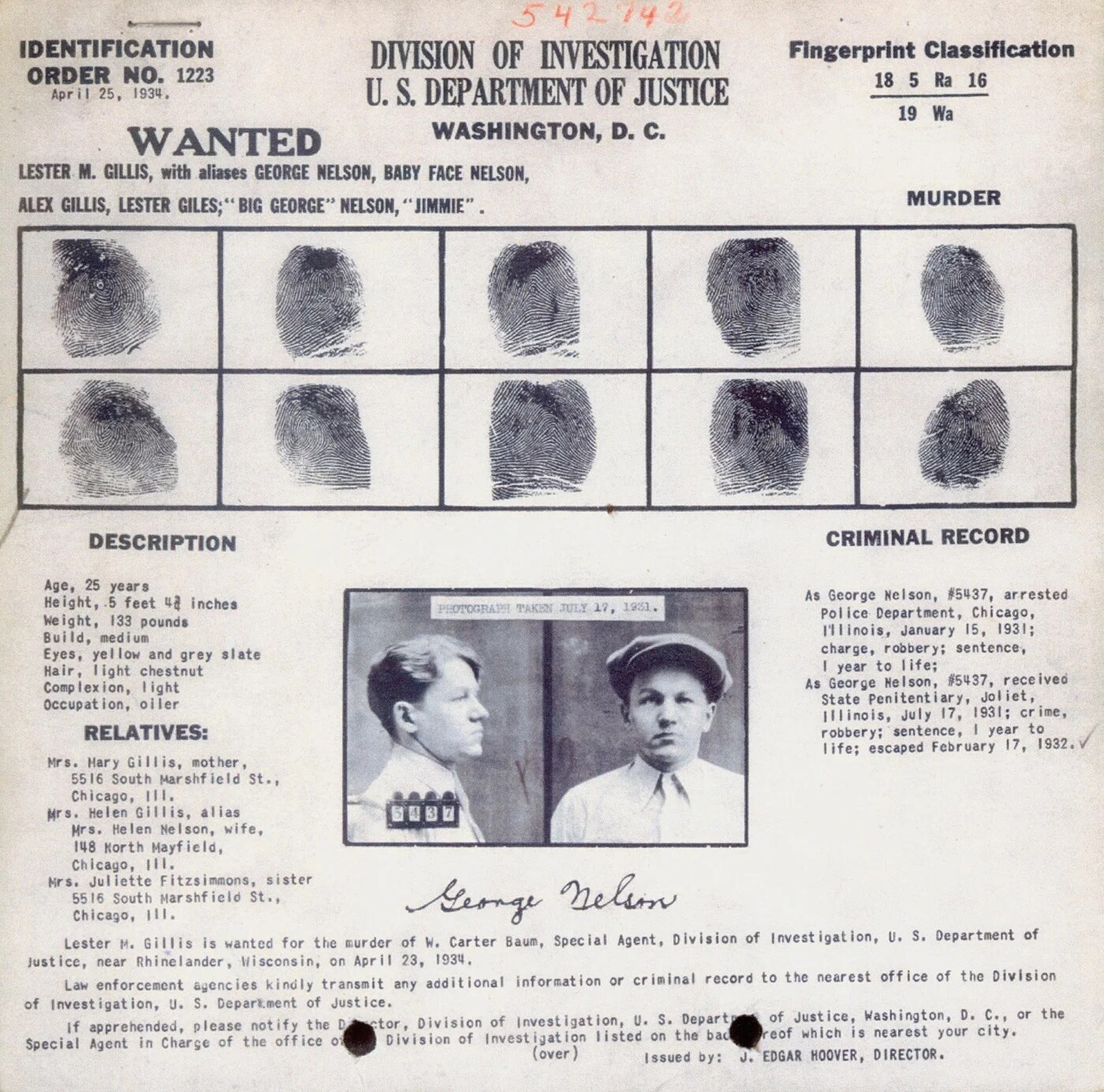 PersonLester Gillis ("Baby Face" Nelson)Wanted by the Division of Investigation for the killing of Special Agent W. Carter Baum near Little Bohemia Lodge in April 1934; died after the gun battle at Barrington, Illinois on 27 November 1934, as the FBI states.PersonLewis J. McWillieTold the FBI in June 1964 that he managed the Tropicana Casino in Havana from September 1958 to May 1960 and was a pit boss at the Capri Hotel-Casino until 2 January 1961, and that after Castro took over 'American ownership was forced out of the gambling business.'
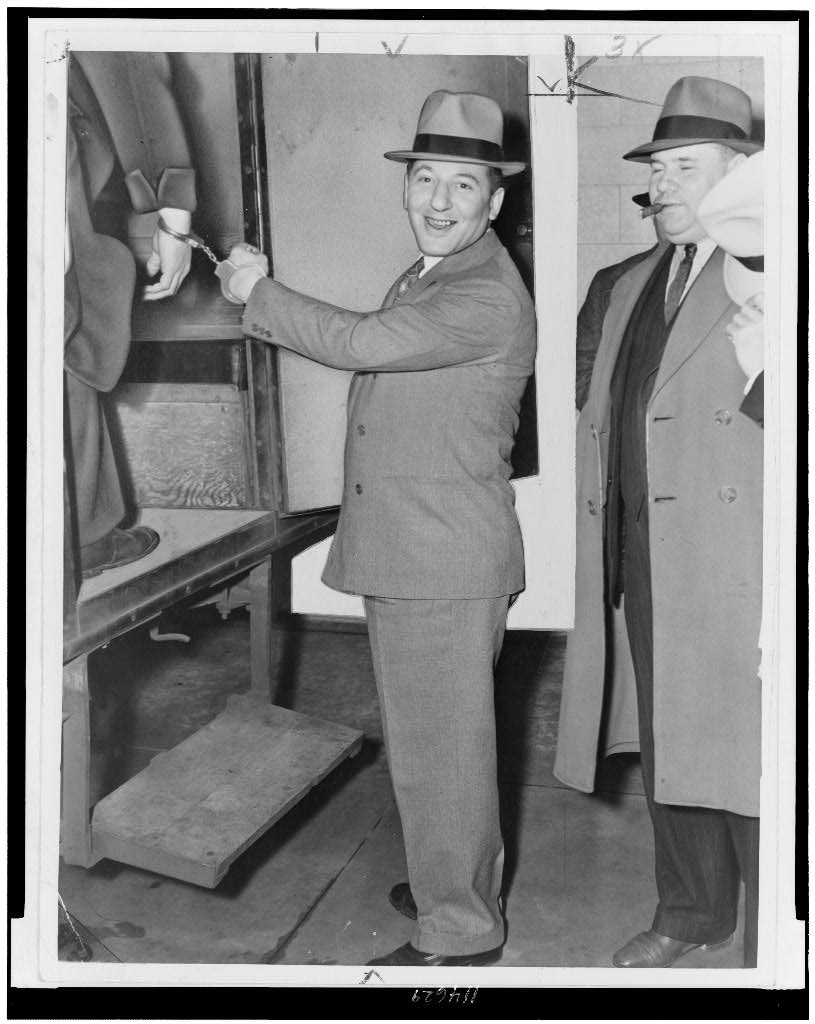 PersonLouis "Lepke" BuchalterDefendant with Jacob Shapiro in the federal fur dressers antitrust cases. His 1936 Sherman Act conviction was reversed on appeal in 1937; he failed to appear in 1937, surrendered to J. Edgar Hoover on August 24, 1939, pleaded guilty to a federal indictment and was sentenced to fourteen years, and was handed to New York for a state trial. The FBI states he was executed at Sing Sing on March 4, 1944.PersonLouis CampagnaConvicted in the Hollywood extortion case affirmed in 1944, and a witness before the Kefauver Committee in 1950. A 1959 FBI memorandum relays a source's claim that he was "the man" in Chicago before 1955.PersonLouis Kaufman"The local agent of the New Jersey local" of the stagehands' union, in the Second Circuit's words. His conviction in the motion-picture extortion case, on evidence of a $15,000 payment from Warner Brothers' New Jersey subsidiary in 1936, was affirmed in 1944.PersonLouis RothkopfNamed by Cleveland's public safety director in 1951 among the city's leading Prohibition bootleggers; a Cleveland record printed by the Kefauver Committee lists the aliases Lou Rhody and John Zarumba and a 1937 internal revenue case.PersonLuigi ManocchioSentenced in 2012 to 66 months for a racketeering and extortion conspiracy against Rhode Island adult entertainment businesses. The Justice Department calls him an admitted former boss and underboss of the New England La Cosa Nostra.
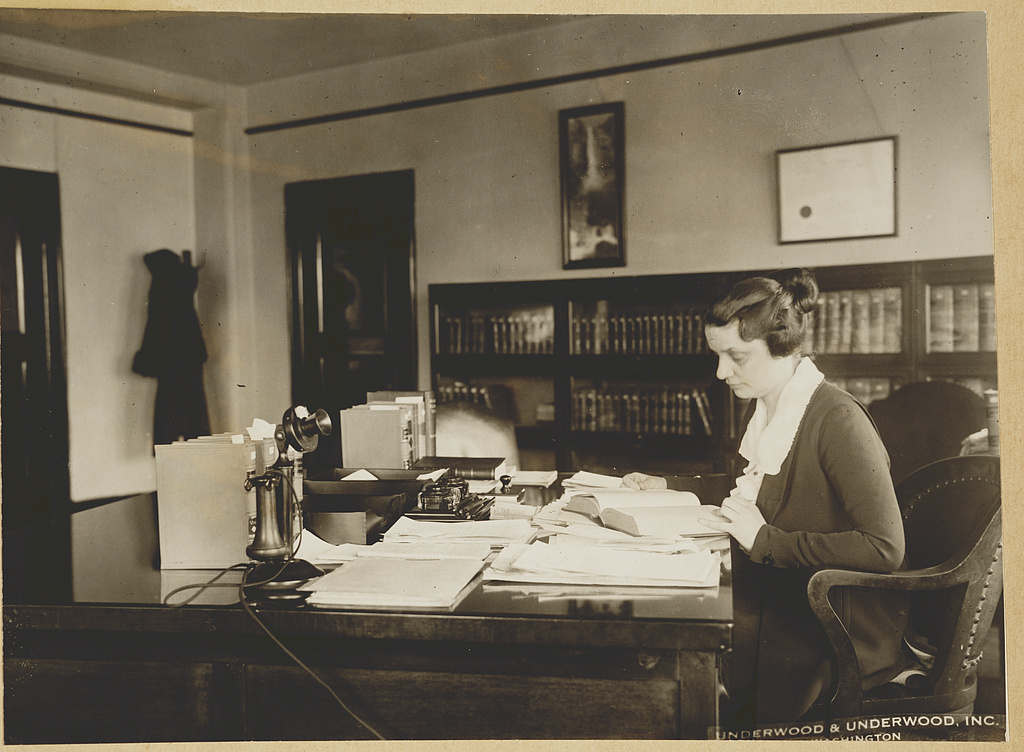 PersonMabel Walker WillebrandtAssistant Attorney General in the 1920s, named on the government's briefs in Prohibition cases in the Supreme Court and addressed by the Bureau of Investigation's Director in the 1929 Capone contempt inquiry. A 1929 photograph records her successor being sworn in.PersonManuel CapestanyA Cuban senator whose letter in Cuban immigration records, as the FBI reported in 1947, guaranteed Luciano 'as a person of democratic ideals' with the means to avoid becoming a public charge.PersonMarshall CaifanoNamed in the Ninth Circuit's 1966 opinion as "John Marshall," one of eleven men in Nevada's 1960 "black book" who was asked to leave the Tropicana and the Desert Inn. A footnote quotes a California report giving his birth name as Marchello Caifano.
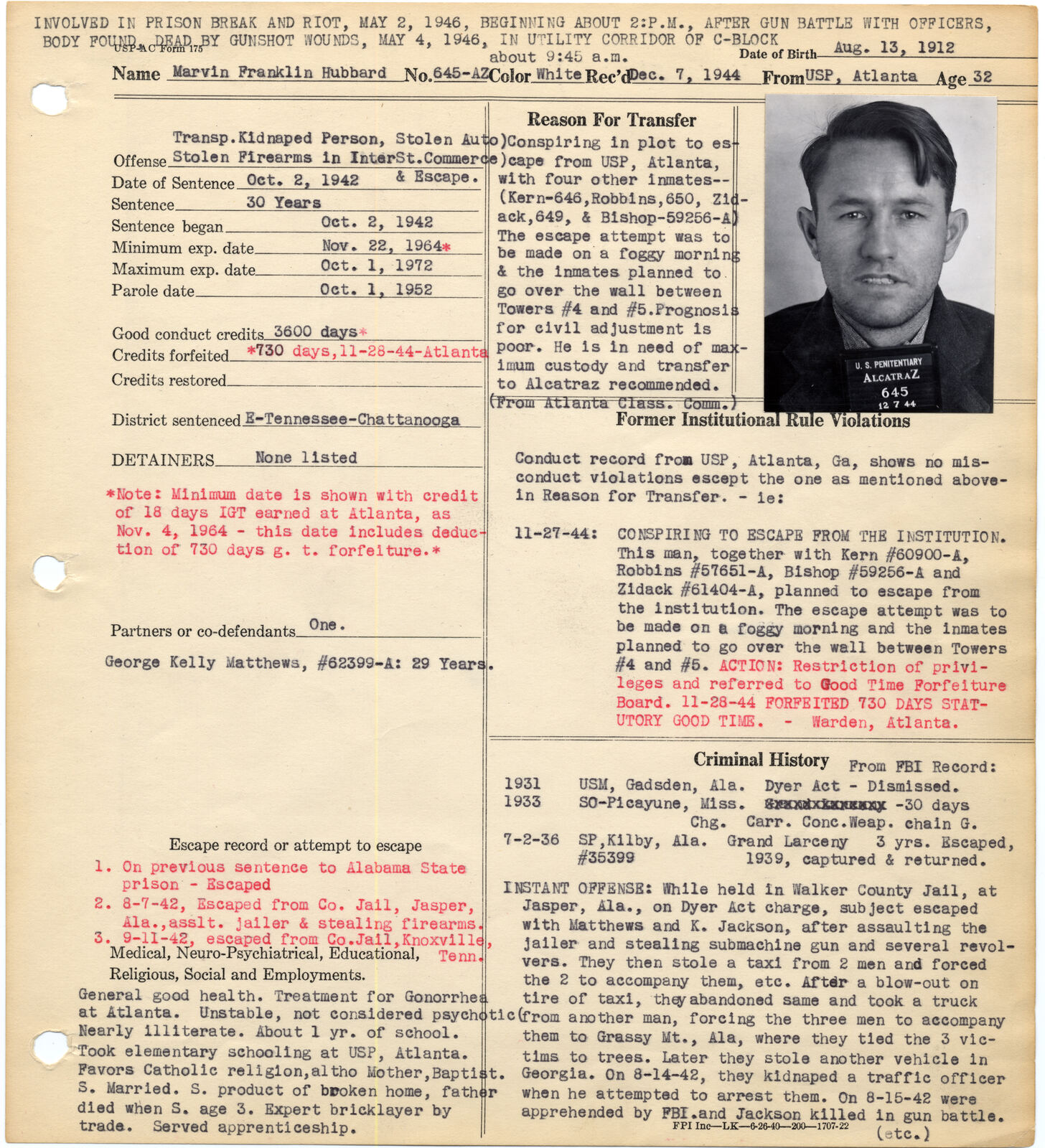 PersonMarvin Franklin HubbardAlcatraz register no. 645-AZ. The warden's notebook page records receipt from USP Atlanta on 7 December 1944 under a 30-year sentence, and a typed header recording the 2 to 4 May 1946 prison break and that his body was found on 4 May.PersonMax HoffPhiladelphia fight promoter whom the city's district attorney, as wire reports of 1928 relayed, accused of heading a bootleg ring and giving gifts to police. No charge or conviction of Hoff appears in the records filed here.
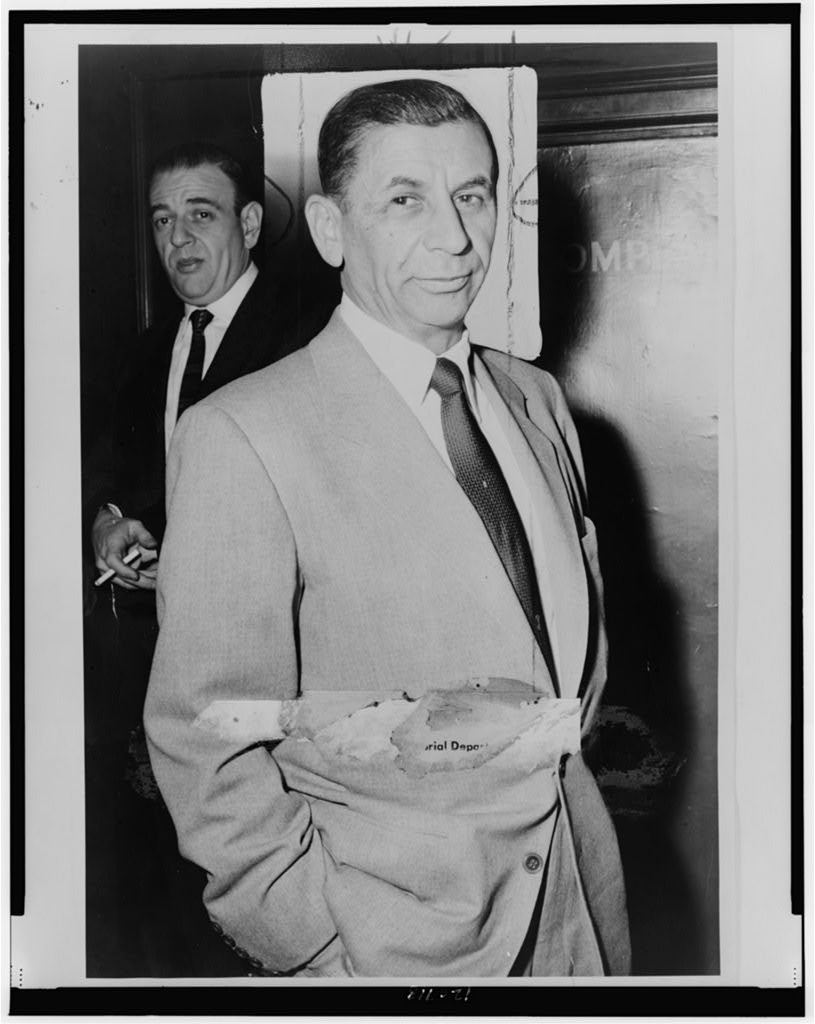 PersonMeyer LanskyA 1952 Justice Department release in the FBI Vault states that he "allegedly has gambling interests in Hollywood, Miami, Council Bluffs, Iowa, and Las Vegas, Nev." He told the Kefauver Committee he had "the race track, and a casino, Nationale" in Havana from 1937 until the war, and FBI reports place him in Havana gambling until the revolution. An FBI Miami report records his March 1971 indictment on a charge of conspiring to skim profits from the Flamingo Hotel Casino.PersonMichele MirandaShown as consigliere on the 1963 subcommittee chart; New York police testimony agreed that he was the organization's counsel, consulted on big decisions. He was among those taken from the Apalachin roadblock in 1957.
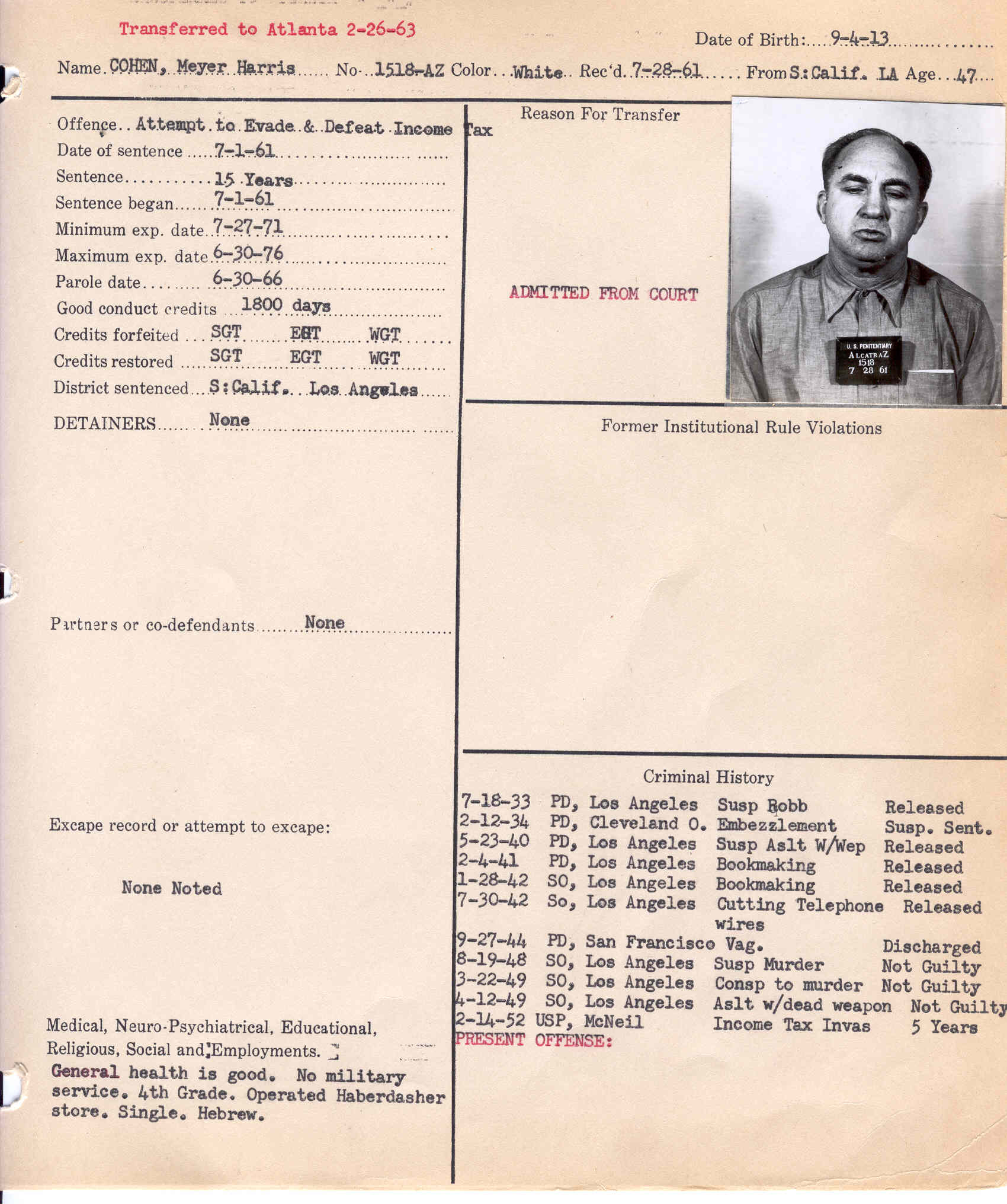 PersonMeyer Harris "Mickey" CohenAlcatraz register no. 1518. The warden's notebook page records receipt on 28 July 1961 by direct commitment under a 15-year sentence for attempting to evade and defeat income tax; he was released on appeal bond, returned on 14 May 1962 and moved to Atlanta on 26 February 1963.PersonMilton RockmanConvicted in the Kansas City trial of the Las Vegas casino skim; the Eighth Circuit recited the government's charge that he 'was an associate of the Cleveland group' and received the Cleveland group's share. A New York jury acquitted him in 1987-88 on the Teamsters election charges.
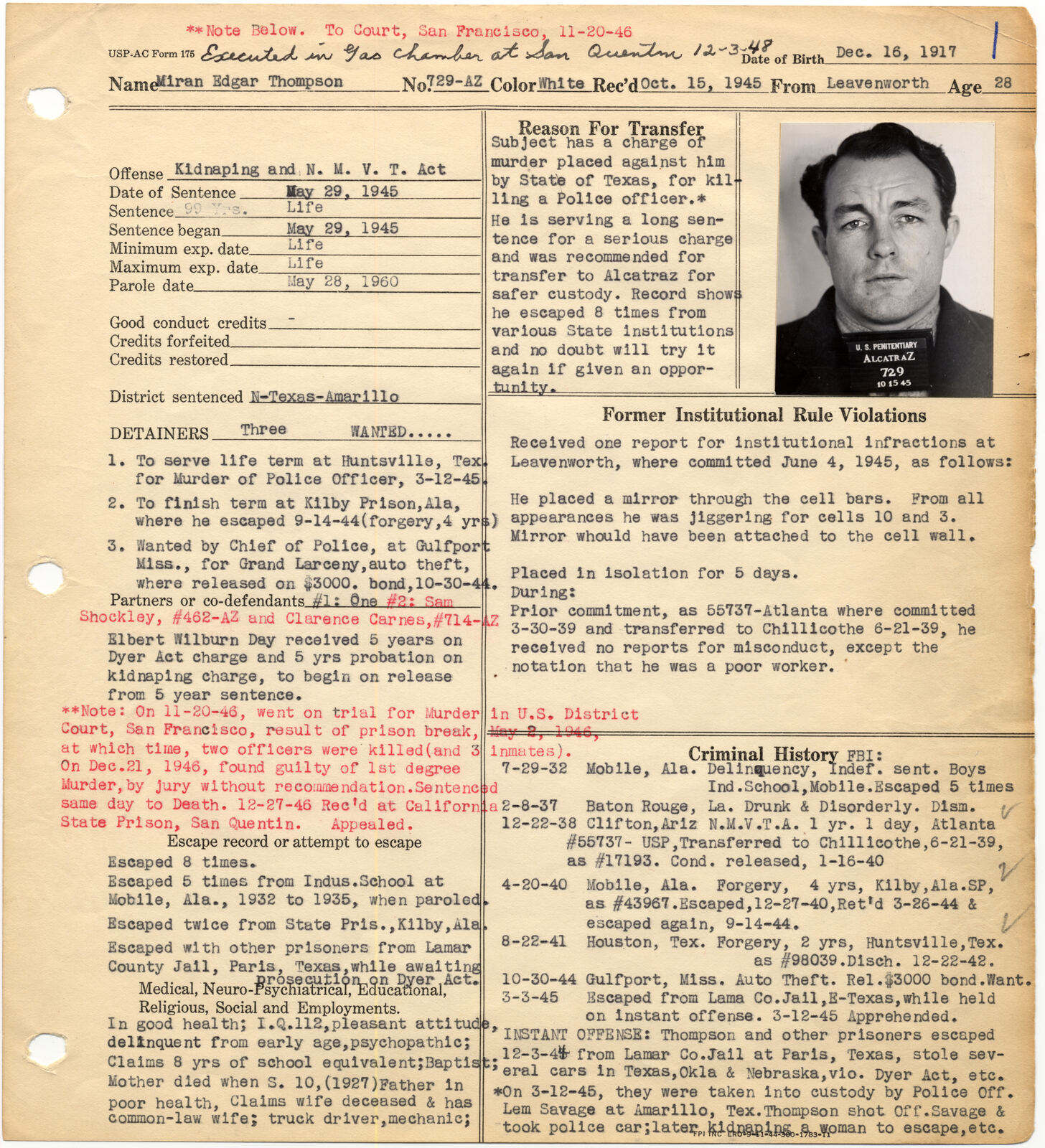 PersonMiran Edgar ThompsonAlcatraz register no. 729-AZ. The warden's notebook page records receipt from Leavenworth on 15 October 1945 under a life sentence for kidnapping and violation of the National Motor Vehicle Theft Act, a 1946 federal murder trial in San Francisco, and execution at San Quentin on 3 December 1948.PersonMoe SedwayTestified to the Kefauver Committee at Las Vegas in 1950 that he was vice president of the Flamingo Hotel, and named with Siegel among the five directors of the Nevada Project Corporation in an FBI memorandum of 1946.PersonMont TennesNamed in Chicago newspaper reports of October 1916 as head of a syndicate selling race information through the General News Bureau, during Judge Landis's federal inquiry into gambling by Automatic telephone.PersonMorris DalitzTestified to the Kefauver Committee in 1951 that he held 13 percent of the Desert Inn and was an officer of its corporation. An FBI airtel of July 1961 lists him at Las Vegas among hoodlums selected for concentrated investigation.PersonMorris KleinmanCalled by Cleveland's public safety director in 1951 'the king of the bootleggers in the northern district of Ohio'; a Cleveland police record printed by the Kefauver Committee gives a 1933 income tax evasion sentence and calls him a principal owner of the Desert Inn.PersonMoses L. AnnenbergNamed in the 1939 Consensus Publishing tax indictment and dismissed before trial; the Supreme Court called him "the dominant figure" in several horse-race betting corporations, and 1950 testimony traces the Continental Press wire service to the business he gave up in 1939.PersonMurray HumphreysThe FBI summary that opens his 25-part Vault file says his activities centered on the domination of labor unions and that he had served one sentence since 1916, 18 months in Leavenworth for income tax evasion.PersonNicholas W. CalabreseNamed in the 2005 Family Secrets indictment of the Chicago Outfit. A 2007 U.S. Attorney's release, citing an FBI affidavit, says he admitted being a "made" member of the Outfit, agreed in 2002 to cooperate, and entered the Witness Security Program. A separate opinion in the 2012 Family Secrets appeal cites his testimony.PersonNicholas SantoraA defendant in the 1982 Southern District of New York case against Napolitano and Ruggiero. In 2007 the U.S. Attorney for the Eastern District announced a superseding indictment that, as the release describes it, charged him as the Bonanno family's "acting underboss."
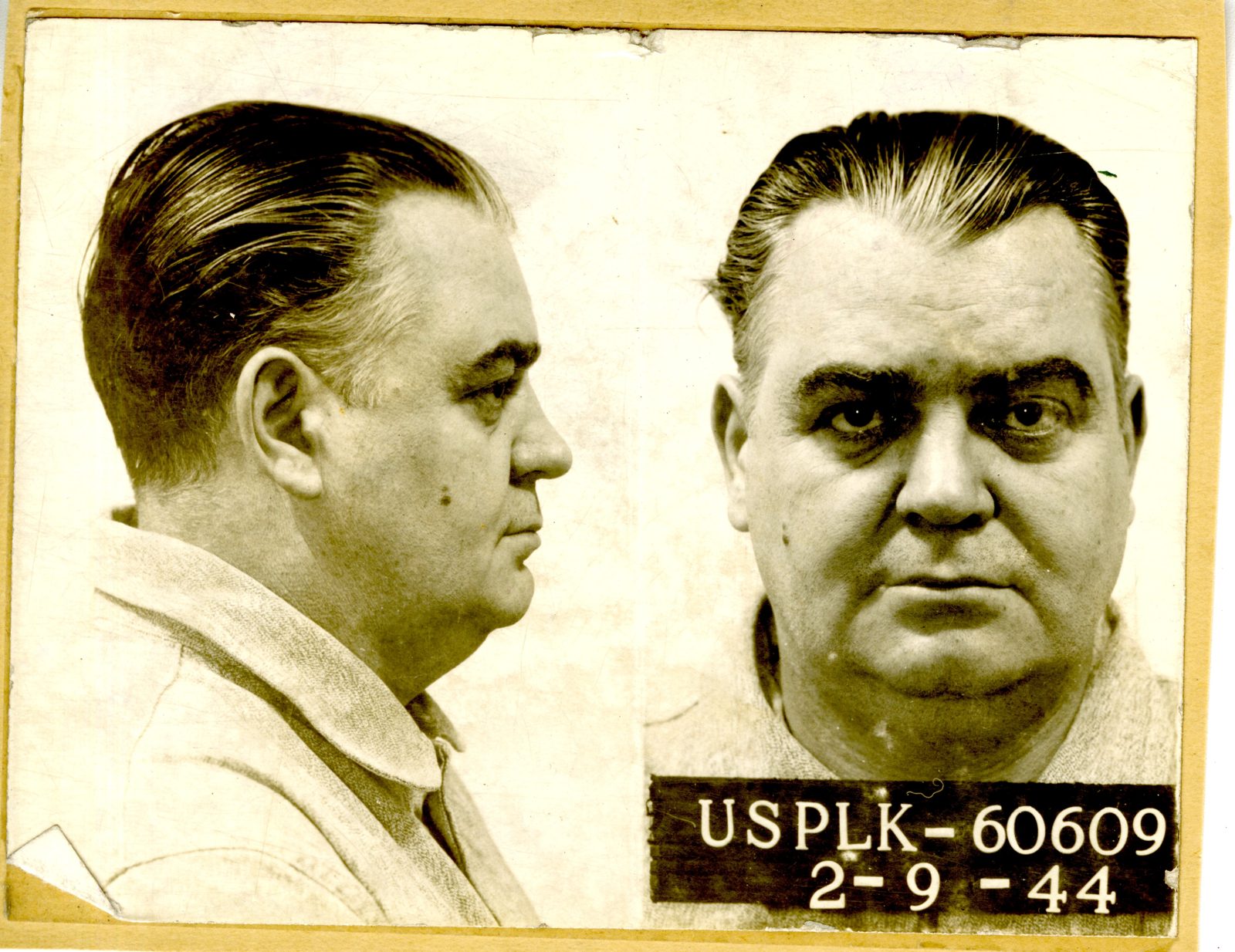 PersonNick CircellaLeavenworth inmate 60609, photographed in February 1944. In the Second Circuit's account of the motion-picture extortion testimony, Circella kept a Chicago night club and, with Bioff, was given a union office as Browne's personal representative.PersonNick CivellaCharged in the 1981 Tropicana skimming indictment and dead before the trial. A Senate subcommittee staff summary of FBI affidavits identifies him as head of the Kansas City "outfit." The Eighth Circuit affirmed his 1980 conviction for conspiring to bribe a prison warden.PersonNicodemo ScarfoConvicted in federal court of a firearms offense (1981), of extortion in the Penn's Landing case (1987), and of RICO offenses with sixteen co-defendants (1988). The Third Circuit, on the trial evidence, calls him boss of the Philadelphia La Cosa Nostra. Court records only.PersonNorman RothmanNamed in FBI memoranda of 1955 and 1957 as the man Santo Trafficante, Jr. was 'closely associated with' on his frequent trips to Havana.
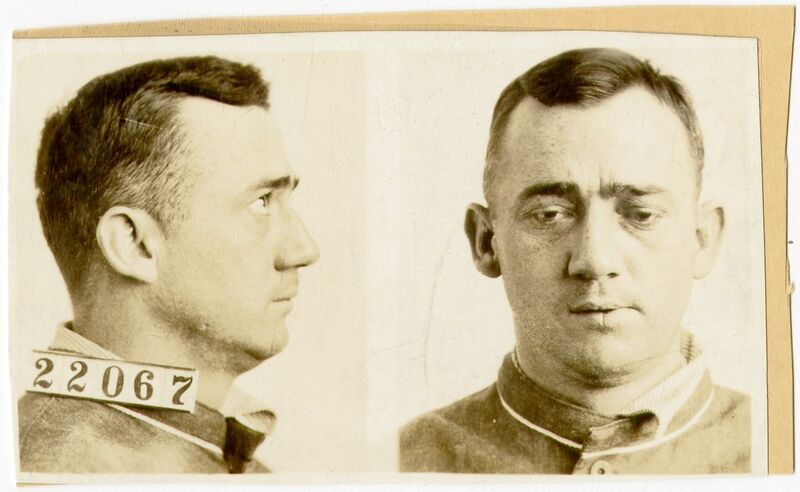 PersonOliver DaughertyA defendant convicted in 1924 in the federal case over the 1923 Staunton, Illinois mail robbery and sentenced to 25 years; his Leavenworth identification photograph is No. 22067.PersonOwney MaddenNamed in a 1930 syndicated newspaper series as one of the men behind the boxer Primo Carnera's management, "since his release from Sing Sing," and in a witness statement on the FBI's Fur Dressers Case page, in 1915 New York newspaper reports of his manslaughter trial and conviction, in a 1921 report of a shooting, and in three passages of the Kefauver hearings where other witnesses name him. No federal case, FBI file or court opinion about him has been found.PersonPaul CastellanoThe Second Circuit describes him as boss of the Gambino family, named in the Commission indictment and murdered before trial. He and Thomas Bilotti were shot and killed outside Sparks Steak House on December 16, 1985.PersonPaul De Lucia (Paul Ricca)Testified to the Kefauver Committee in 1950 that he was also known as Ricca and Salvi. Convicted in the Hollywood extortion case; his 1928 naturalization was revoked by a decree the Seventh Circuit affirmed in 1958.PersonPeter LicavoliRefused on self-incrimination grounds to answer most of the Kefauver Committee's questions at Detroit in 1951; named by relatives and investigators in 1951, 1958 and 1963 records, and drawn as 'Nominal Leader' on a Youngstown police chief's 1951 chart.PersonPeter MorelloShot dead in his office at 362 East 116th Street on August 15, 1930, according to the New York police record read into the 1963 Senate hearings. Valachi testified, from what he was told, that the Maranzano group killed him.PersonPhil D'AndreaConvicted in 1943 in the motion-picture extortion case and sentenced to ten years; transferred from Atlanta to Leavenworth in July 1945 and paroled on 13 August 1947. A 1947 FBI memorandum records his 1931 arrest for carrying a revolver into the federal court during Al Capone's trial.PersonPhil KastelTestified in New Orleans on 25-26 January 1951 as president and general manager of the Beverly Club in Jefferson Parish, agreed that he and Frank Costello were in a 50-50 joint venture in the Bayou Novelty Co., and declined to say whether the club had a casino; the committee reported him for contempt.PersonPhilip GiacconeKilled in May 1981 with Alphonse Indelicato and Dominick Trinchera. The en banc Second Circuit calls him "another Bonanno family capo" in its account of the evening of the 1979 Galante killing.PersonPhilip LombardoNamed in the government's 1986 detention proffer against Anthony Salerno, as the district court summarized it, as the "Boss" of the Genovese family in 1977. The only record opened is that proffer.PersonPhilip ManganoNamed in 1963 with Vincent Mangano as a predecessor of Carlo Gambino. New York police testified that he was found dead of gunshot wounds in a Brooklyn swamp.PersonPhilip RastelliGalante's rival for leadership of the Bonanno family; the Second Circuit wrote that after the 1979 murders the Commission reorganized the family under him. He was convicted in the Local 814 moving-industry case.PersonPhilip TestaNamed by the Third Circuit as underboss of the enterprise Angelo Bruno headed, and as Bruno's successor as boss in 1980. Killed by a bomb at his house in early 1981; FBI testimony gives March 18, 1981.PersonPhillip KeywellSentenced in 1930 to life imprisonment in the Michigan state prison for the murder of Arthur Mixon, as an Associated Press item and a 1932 Bureau of Investigation letter both report.PersonThe Provenzano brothersNamed in March 1891 newspaper pages as one side of a New Orleans stevedoring rivalry with the Matrangas; Giovanni and Pietro Provenzano were held in the Parish Prison on a wounding charge, and Joseph Provenzano is named in a later report. The accounts are the papers' and prisoners' statements, not court findings.PersonRaymond BernsteinDescribed in a 1932 Bureau of Investigation letter as 'the third member of the Purple Gang doing a life sentence' in the murder case involving Irving Milberg and Harry Keywell, and in a 1939 FBI letter as sent to Marquette prison for the 'Collingwood Massacre'.PersonRaymond J. PatriarcaSon of Raymond L. S. Patriarca. Charged in 1990 under RICO with Travel Act predicates; the Government said he was the former boss of the family named after his father, and the court listed him as its alleged "Boss." Federal court records only.PersonRaymond PatriarcaThe subject of 1968 and 1979 First Circuit opinions about his conviction for conspiring to use interstate facilities to commit murder to further an unlawful gambling enterprise, and about FBI surveillance of his Providence office. An FBI airtel of 1961 lists him at Boston among selected "hoodlums." No opened record ties him to Las Vegas.PersonRaymond RenardCharged in the 1924 indictment over the 1923 Staunton, Illinois mail robbery, he testified for the Government. The Seventh Circuit called him "an admitted convict" who "admitted his guilt in the instant case"; the National Archives description says he made a deal for clemency.
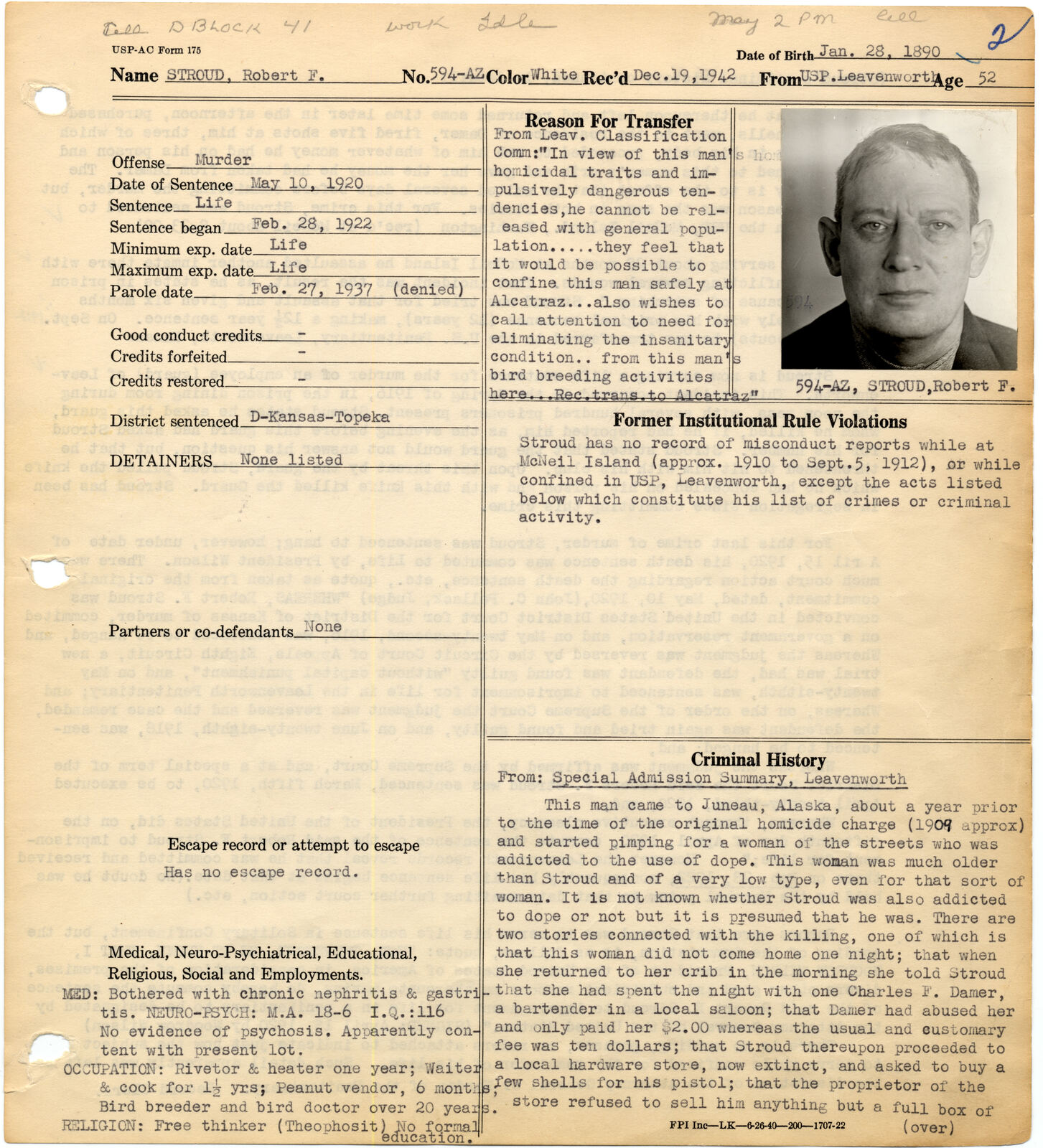 PersonRobert F. Stroud ("Birdman of Alcatraz")Alcatraz register no. 594-AZ. The warden's notebook page records receipt from Leavenworth on 19 December 1942 under a life sentence for murder; the Leavenworth file records the same sentence and a 1922 receipt. The National Archives and the Bureau of Prisons give different destinations for his 1959 transfer.PersonRoger TouhyNamed by the FBI as the leader of a gang that escaped from an Illinois penitentiary in October 1942 and was captured in Chicago on 29 December 1942. A federal draft-registration case against him is at the National Archives.
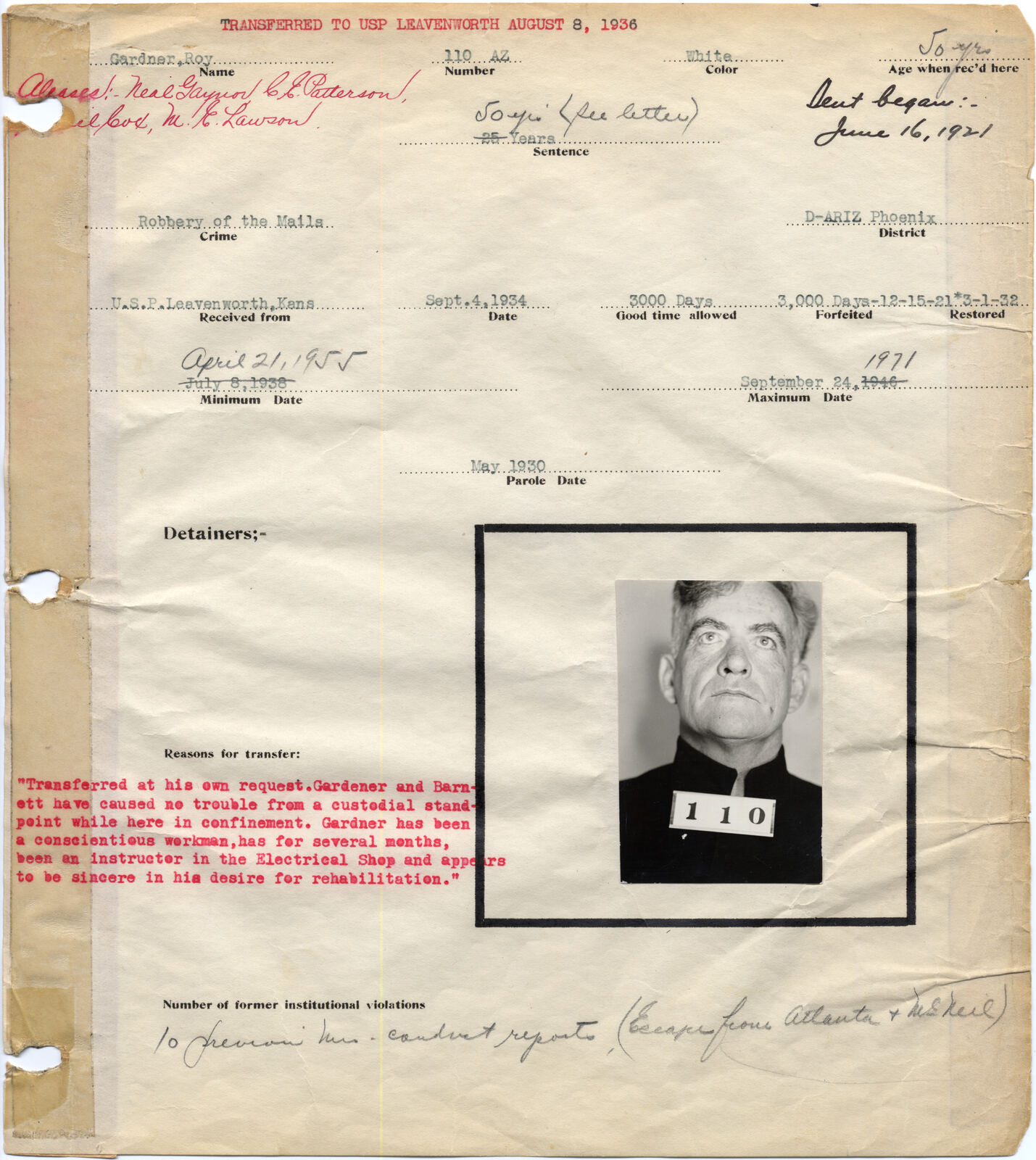 PersonRoy GardnerAlcatraz register no. 110. The warden's notebook page records receipt from Leavenworth on 4 September 1934 for robbery of the mails and a transfer back on 8 August 1936.PersonRoy L. WilliamsTeamsters international vice-president in 1979 and, according to the President's Commission, IBT president from 1981 to 1983. The Seventh Circuit affirmed his convictions for conspiring to bribe United States Senator Howard Cannon.PersonSalvatore BattagliaConvicted with Dave Evans of a Hobbs Act extortion conspiracy against the Riley Management Corporation; the Seventh Circuit affirmed in 1968 over Judge Swygert's dissent.PersonSalvatore GravanoCharged in 1991 as consigliere of the Gambino family; he pleaded guilty and testified against Gotti and Locascio. The Second Circuit later called him "the former Gambino family underboss" when describing him as a witness.PersonSalvatore MaranzanoHead of the other side in the 1930–31 war, according to the 1963 Senate hearings. Valachi testified that Maranzano declared himself "the boss of all bosses." A 1931 Bureau of Investigation report concerns papers found in the Park Avenue office where he was killed.PersonSalvatore SantoroCommission case defendant. The Second Circuit wrote in 1989 that the government established he served as underboss of the Lucchese family under Corallo.PersonSalvatore TestaSon of Philip Testa. A partner in an illegal sports-betting business in 1983 and killed on September 14, 1984, according to the Third Circuit's account of the 1988 RICO trial record.PersonSalvatore VitaleIndicted with Joseph Massino in the Southern District of New York on October 4, 1984. Vincent Basciano's 2006 conviction included the solicitation of his murder, and he was called as a witness at Basciano's 2011 trial.PersonSamuel A. CarlisiNamed by the Seventh Circuit in 1997 as the leader and financial backer of the Carlisi Street Crew. He died while his appeal was pending, and the court ordered his conviction vacated.PersonSam CarolloAppears in the 1951 Louisiana hearings as a man 'deported here recently' and as the father of Anthony Carollo; an exhibit says he was deported to Italy in 1947 and is 'believed to be in Mexico.' The record spells the name Sam, Sylvestro and Corolla and does not say they are the same man.
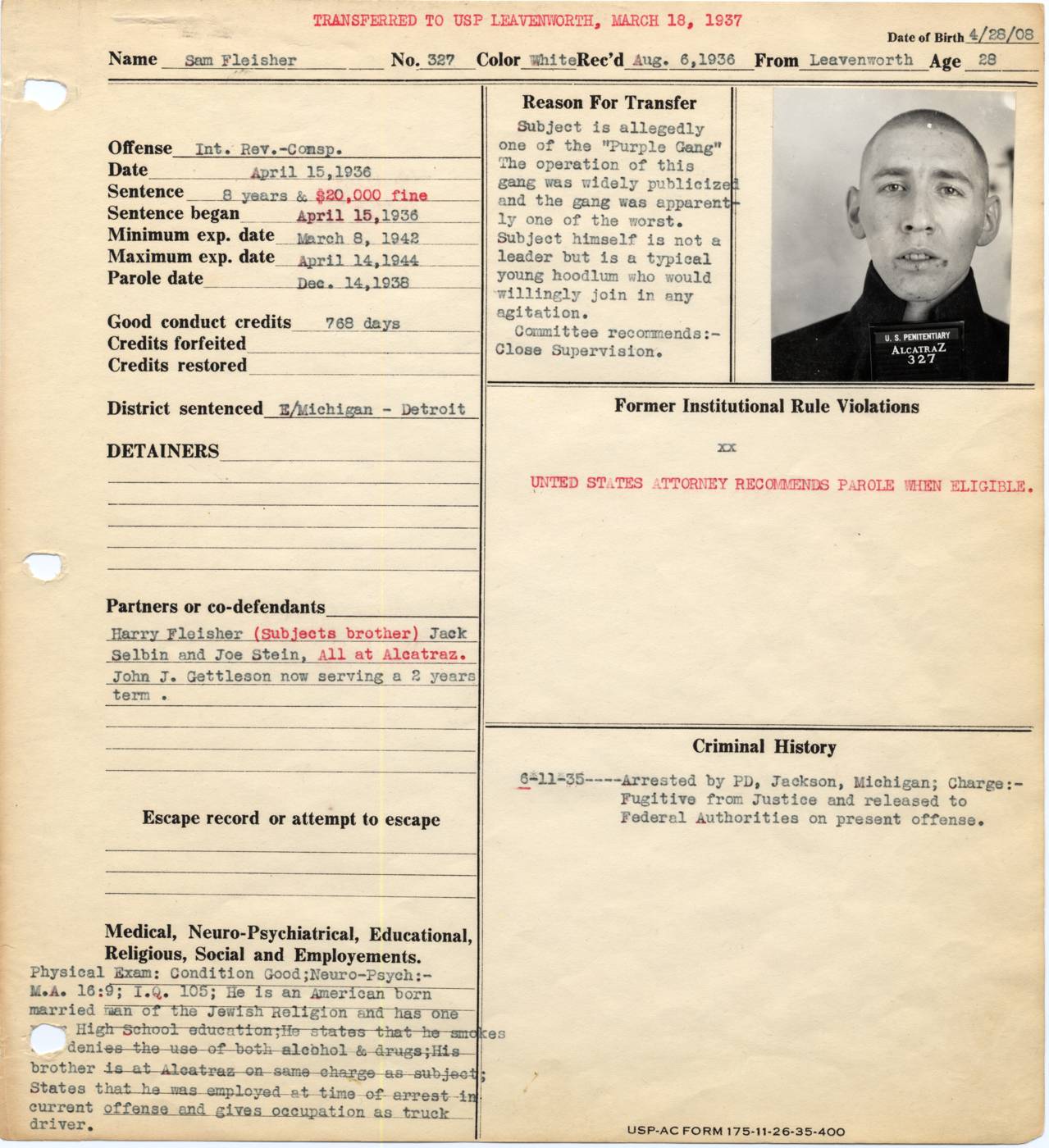 PersonSam FleisherBrother and co-defendant of Harry Fleisher in a 1936 internal revenue conspiracy case from Detroit; held at Alcatraz as No. 327 from 1936 to 1937, and listed in a 1948 FBI Miami memorandum among men said to be members of the Detroit Purple Gang.PersonSam GiancanaCalled "a top figure in the underworld in Chicago" by McClellan Committee staff in 1959, when he refused to answer. The Church Committee identified him as the "Sam Gold" of the CIA's Castro operation and recorded his murder on June 20, 1975.PersonSam TuckerNamed by Cleveland's public safety director in 1951 among the city's leading Prohibition bootleggers; a Desert Inn partner by Thomas McGinty's 1951 testimony; one of 'the Jewish Boys' in Angelo Lonardo's 1988 testimony.PersonSamuel S. GranitoConvicted under RICO and of conducting an illegal gambling business in the 1981 North End surveillance case. The First Circuit, stating the trial evidence, names him one of two "Capo Regimes" beneath Gennaro Angiulo.PersonSamuel MonacoReported missing in New Jersey on September 10, 1931, the day of Maranzano's killing; his body was found in Newark Bay at Bayonne on September 13, according to the 1963 testimony of New Jersey's assistant attorney general. Valachi called him "Sam Monica."
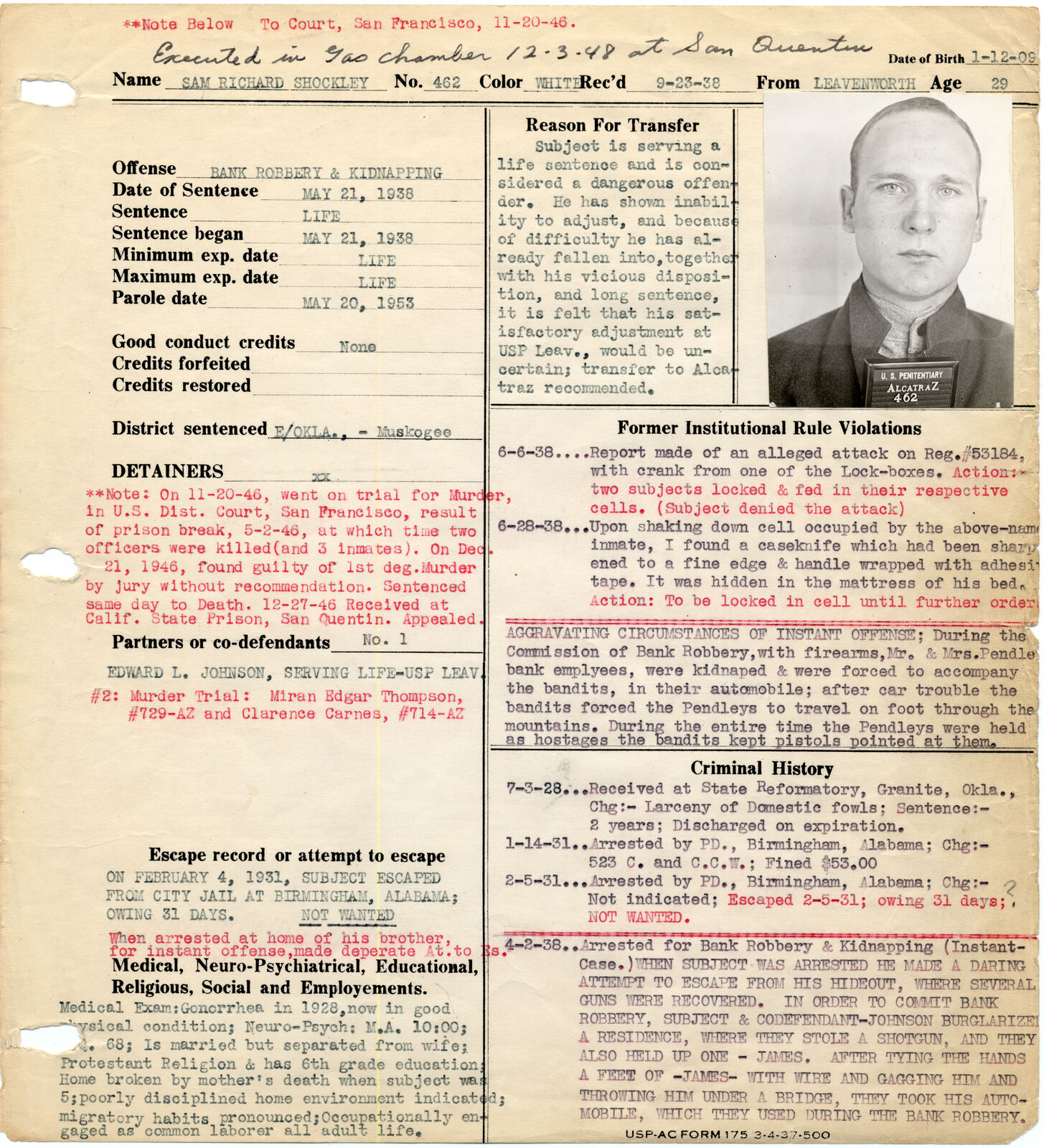 PersonSam Richard ShockleyAlcatraz register no. 462. The warden's notebook page records receipt from Leavenworth on 23 September 1938 under a life sentence for bank robbery and kidnapping, a 1946 federal murder trial in San Francisco, and execution at San Quentin on 3 December 1948.PersonSanto Trafficante, Jr.The subject of a Tampa and Cuba record from 1950 to 1979: Kefauver rumor, FBI memoranda on his Havana casinos and his 1959 detention, Tampa police testimony, a 1964 tax-lien opinion, the Church Committee's passages, and the House committee's report, which calls him the 'La Cosa Nostra leader in Florida' and concludes it is unlikely he plotted the President's death.PersonSanto Trafficante, Sr.Named in 1950 Tampa hearings only through counsel's questions and secondhand testimony; an FBI memorandum of 1953 gives his birth and naturalization data. No testimony by him is filed, and no role is entered.PersonStefano LaSalleNamed by Valachi in 1963 as the Lucchese family's underboss. The New York police witness said the department went along with that rating while having very little information on him.PersonStefano MagaddinoNamed first in a 1968 Western District of New York gambling indictment that was dismissed after the government conceded illegal FBI bugging in the Buffalo area; the Second Circuit affirmed the dismissal in 1974. Joseph Valachi testified in 1963 that he was the boss in Buffalo.PersonStephanie St. ClairReported by wire services in December 1930 as "the policy queen of Harlem," appearing at the New York inquiry into the magistrates' courts and saying she had paid police and magistrates. Both records are newspaper reports of what she said.PersonStephen FerrignoKilled by shotgun fire on Pelham Parkway in the Bronx on November 5, 1930, with Manfredi (Alfred) Mineo, according to the New York police record read into the 1963 Senate hearings. Valachi testified that he had watched Ferrigno's apartment for the Gagliano-Maranzano side.PersonStephen J. FlemmiFBI informant from 1965, a federal court found, and with James Bulger a leader of the Winter Hill Gang in the First Circuit's words. Indicted in 1995; in 2003 he pleaded guilty to twelve murders and other crimes, the First Circuit states.
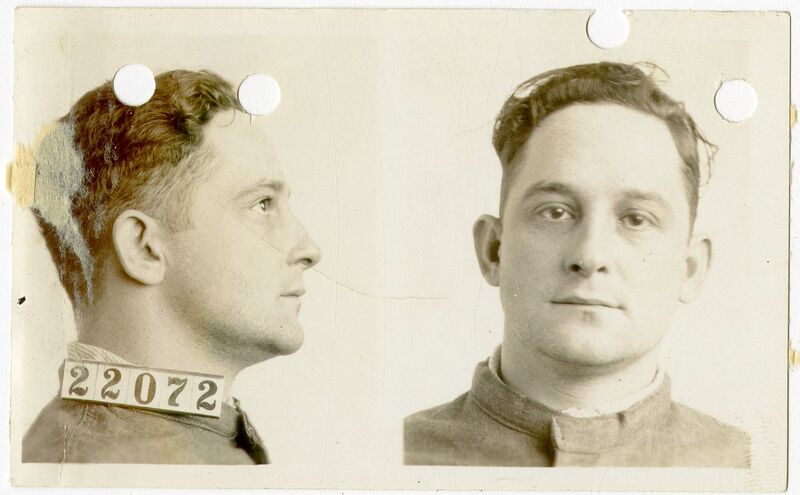 PersonStephen RyanA defendant convicted in 1924 in the federal case over the 1923 Staunton, Illinois mail robbery and sentenced to 25 years; his Leavenworth identification photograph is No. 22072.PersonTheodore RoeA Chicago witness before the Kefauver Committee in October and December 1950, who testified that his business was "Operating a policy wheel" in partnership with the Jones brothers and that he had begun working for them in the later 1920s. Everything on this page is his sworn testimony or a staff exhibit drawn from his records.PersonTheresa CaponeFiled and swore to a 1938 habeas corpus petition in the federal court at Chicago on behalf of Alphonse Capone, then at Alcatraz, as "his mother and duly authorized agent."PersonThomas BilottiShot and killed with Paul Castellano outside Sparks Steak House on December 16, 1985. Gotti was charged with, and convicted of, his murder as a racketeering act.PersonThomas E. DeweyLawyer listed of counsel for the United States, under United States Attorney George Z. Medalie, in the 1933 income-tax prosecution of a defendant named Wexler in the Southern District of New York. A 1946 FBI teletype records that as Governor of New York he granted Charles Luciano parole on January 3, 1946, on condition of release to immigration custody.PersonThomas EboliNamed in 1963 by the Attorney General and New York police as the man substituting for Vito Genovese in New York. A 1985 FBI teletype states that he was acting boss of the Genovese family in July 1972 and was murdered in Brooklyn on July 16, 1972.PersonThomas F. KellyGeneral manager of Continental Press Service in Chicago in 1950, by his own testimony; he described working for James Ragen and Moses Annenberg's news bureaus from the 1920s.PersonThomas J. PendergastSentenced in the Western District of Missouri on 22 May 1939 for attempted income-tax evasion, after pleading guilty; Judge Otis described him as a private citizen who had exercised 'a dominating influence in city, county and state politics for a quarter of a century,' and the Supreme Court reversed his 1941 contempt conviction on limitations grounds.PersonThomas J. McGintyTestified to the Kefauver Committee in 1951 that he had served six months on a prohibition conspiracy charge, had been a partner in the Mounds Club, and was a partner in the Desert Inn at Las Vegas with Wilbur Clark, Moe Dalitz, Morris Kleinman and Sam Tucker.PersonTom ReinaShot dead as he left 1522 Sheridan Avenue in the Bronx on February 26, 1930, according to the New York police record read into the 1963 Senate hearings. Subcommittee staff named him as the boss of a gang whose killing opened the 1930–31 war.
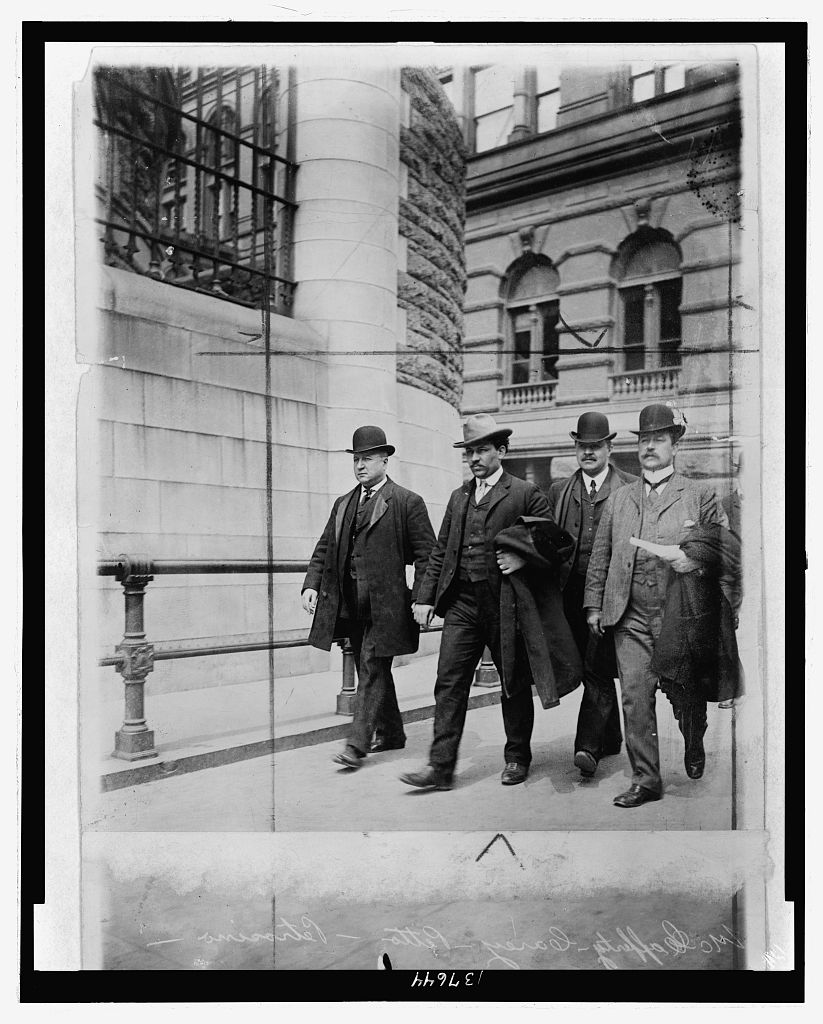 PersonTomasso PettoArrested with Giuseppe Morello on 15 April 1903 in the barrel-murder inquiry and photographed in police custody; the records filed here state no charge, trial or sentence for him.PersonVenero ManganoConvicted of extortion in the window-replacement case; the Second Circuit, viewing the evidence for the government, called him a senior member of the Genovese administration. A 1996 district court finding describes him with Gigante as the family's boss and underboss.PersonVernon C. MillerIdentified by the FBI as the leader of the gunmen at Union Station on 17 June 1933 and named with Richetti and Floyd in a federal conspiracy indictment concerning the custody of Frank Nash; the FBI says his body was found near Detroit on 29 November 1933. No conviction of Miller exists in the records filed.PersonVincent AloConvicted of obstructing an SEC investigation into the ownership of Tel-A-Sign, Inc. stock, affirmed in 1971. An FBI report of 1963 lists him among New York-area individuals known to the Sands Hotel's owner of record. No opened record links him to a Las Vegas casino.PersonVincent BascianoThe Second Circuit refers to his January 2004 assumption of the role of acting boss of the Bonanno family; a 2006 U.S. Attorney's release says he "assumed control" after Anthony Urso.PersonVincent CafaroArrested with Anthony Salerno in March 1986, cooperated covertly with the FBI from October 1986, withdrew in October 1987, and testified to the Senate in April 1988, without immunity, that he had been a "made" member of the Genovese family since 1974.PersonVincent DrucciNamed in Associated Press reports of 1925 and 1927: held in the inquiry into the Torrio shooting, and shot dead by a Chicago detective after his arrest on the eve of the April 1927 election.PersonVincent GiganteA federal judge found in 1996 that Gigante became boss of the Genovese family "in title as well as in fact" after Salerno's 1985 arrest, and that he feigned mental illness. He was convicted in 1997; the Second Circuit affirmed.PersonVincent ManganoNamed in 1963 with Philip Mangano as a predecessor of Carlo Gambino. New York police testified that he had been missing since 1951 and was declared dead in 1961.PersonVirginia HillTestified to the Kefauver Committee in New York on 15 March 1951 as Mrs. Virginia Hill Hauser. FBI memoranda of 1946 and 1947 in the Siegel file record surveillance of her and Benjamin Siegel and give a background summary written after Siegel was shot at her Beverly Hills residence.PersonVito GenoveseConvicted in 1959 of a narcotics conspiracy that the Second Circuit found he helped direct. Joseph Valachi named him in 1963 as head of "my family" and called him "a boss of all bosses under the table."PersonVito William GiacaloneInvestigated by the Detroit Organized Crime Strike Force from 1990 or 1992, he pleaded guilty in 1998 to a RICO conspiracy count of the 1996 Detroit indictment; the Sixth Circuit directed forfeiture of $1,234,700 against him in 2000.PersonVittorio AmusoConvicted of racketeering and murder-related charges; the Second Circuit affirmed in 1994. The indictment charged him as boss of the Lucchese family, and a 1996 district court finding describes him and Anthony Casso as the family's boss and underboss.
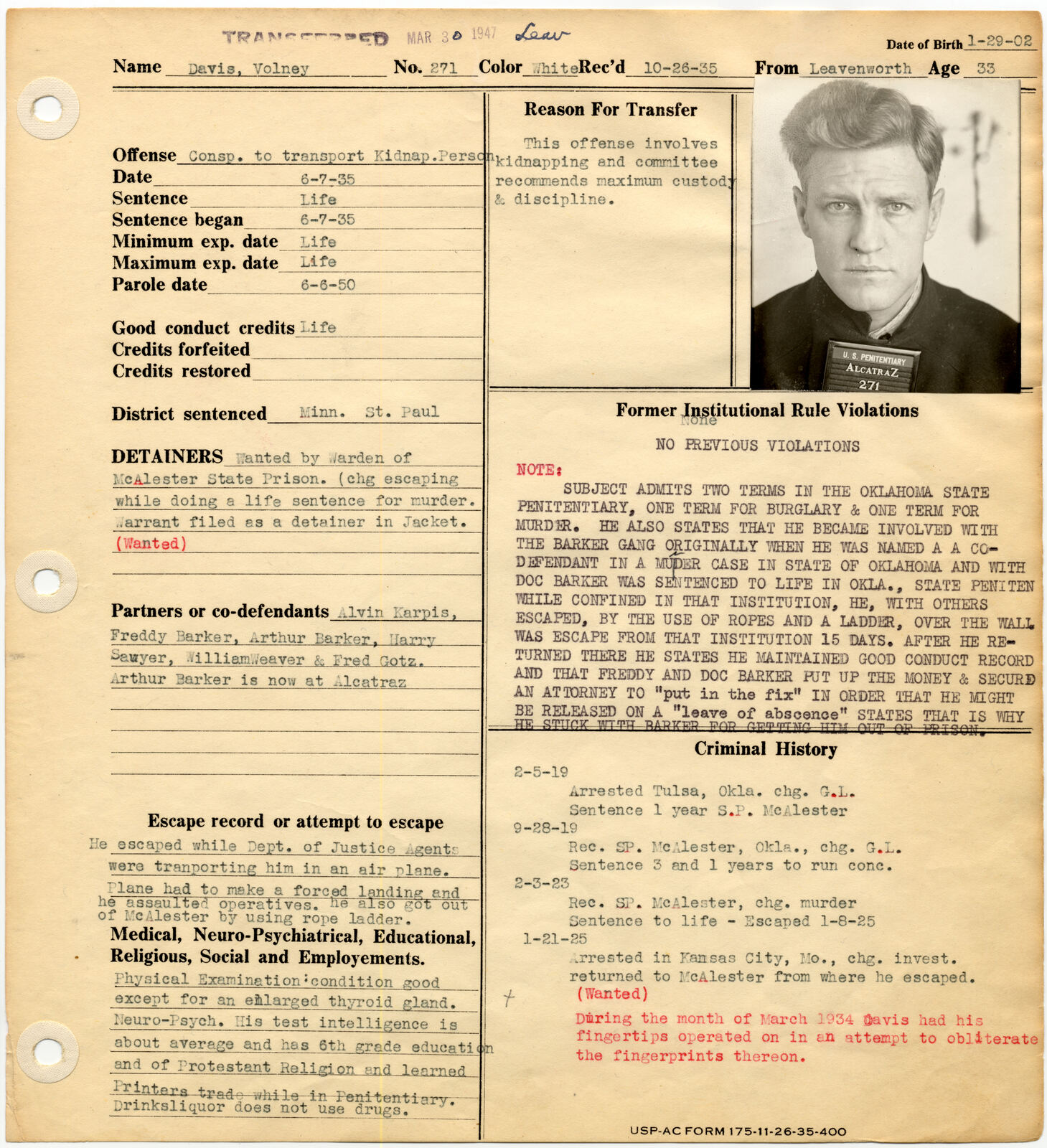 PersonVolney DavisAlcatraz register no. 271. The warden's notebook page records receipt from Leavenworth on 26 October 1935 under a life sentence for conspiracy to transport a kidnapped person, and a transfer back on 30 March 1947. The National Park Service names him as a softball pitcher in 1938.PersonWilliam BioffBrowne's "personal representative" in the stagehands' union, in the words of two 1944 court opinions. Convicted in 1941 of extortion from motion-picture producers, he then testified for the government against the Chicago defendants in the 1943 trial.PersonWilliam BokunA defendant in the 1987 Westies racketeering indictment, convicted in 1988 of racketeering and a cocaine conspiracy; the jury found the 1985 murder of Michael Holly proven as a predicate act. His thirty-five-year sentence was reinstated by the Second Circuit in 1995.
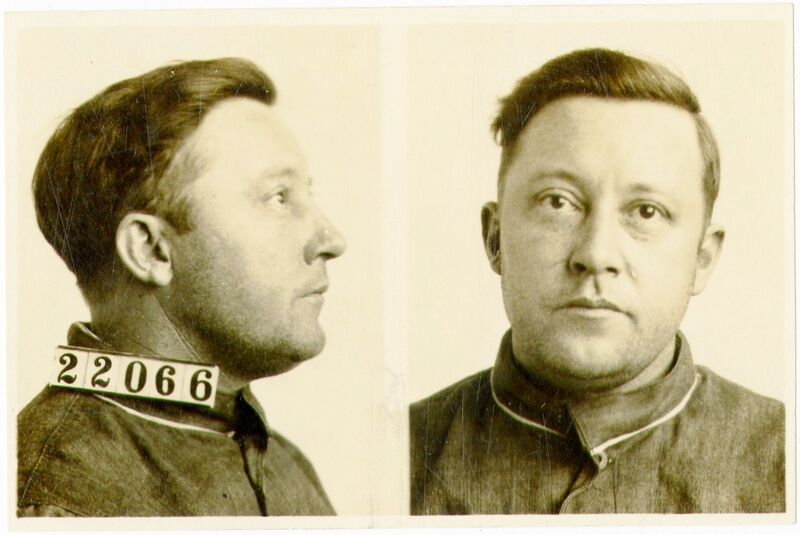 PersonWilliam P. ColbeckFirst-named defendant in the federal case over the 1923 Staunton, Illinois mail robbery, convicted in 1924 and sentenced to 25 years. The National Archives description of the case file says the defendants were "members of a gang called Egan's Rats" led by Colbeck; a 1950 Senate committee exhibit says he was killed in St. Louis in 1943.PersonWilliam Daniel JonesNamed by the FBI as a member of the Barrow group from November 1932 who was captured in Houston in November 1933. The only filed photograph of him is a snapshot the FBI publishes.PersonWilliam G. (Butsy) O'BrienNamed in Kefauver Committee staff exhibits as the head of Intra-State News, a Miami wire service, and among the wire-service witnesses the committee could not serve in 1950.PersonWilliam J. FlynnOperative in charge of the U.S. Secret Service New York District, whose daily reports of 1903 to 1910 record the watch on Morello and Lupo, the barrel-murder arrests, and the 1909 counterfeiting case; a government witness at the 1910 trial.PersonWilliam MolaskySt. Louis shareholder in the Consensus Publishing Company and the Pioneer News Co.; convicted in the 1940 Consensus tax case, a conviction reversed on appeal; testified to the Kefauver Committee in 1950.PersonWilliam MorettiTestified to the Kefauver Committee on 13 December 1950 that he went to Cuba to see Lucky Luciano, 'A good friend of mine,' with Vincent Mangano and Gerry Catena, and stayed about five or six days.PersonWilliam ToccoTestified at the Kefauver Committee's Detroit hearing in 1951, where he named Joe Zerilli as a partner in the State Products Co. and said he had been a bootlegger during Prohibition; an FBI teletype of 1962 calls him William 'Black Bill' Tocco.
PersonAlphonse CaponeNamed by the FBI Vault as Alphonse Gabriel Capone (1899–1947), sentenced in 1931 for tax evasion. The National Archives lists him as former Alcatraz inmate, register 85.PersonAladena FratiannoCalled "an FBI informant" by the Ninth Circuit, which describes his testimony on the organization of La Cosa Nostra at the 1980s Los Angeles RICO trial. The FBI Director told the Senate in 1983 that he was a protected government witness.PersonAlbert AnastasiaKefauver Committee witness in New York, described in a 1950s FBI memorandum as a waterfront racketeer. New York police testified in 1963 that he was the last predecessor of Carlo Gambino and was shot to death in a barber shop in 1957.PersonAlbert L. "George" BatesAlcatraz register no. 137. The warden's notebook page records receipt from Leavenworth on 4 September 1934 under a life sentence for kidnapping and holding for ransom, and a red header recording his death in the prison hospital on 4 July 1948.PersonAlfred MineoKilled with Stephen Ferrigno by shotgun fire on Pelham Parkway in the Bronx on November 5, 1930, according to the New York police record read into the 1963 Senate hearings, which names him "Manfredi Maineo."PersonAlfred PolizziTestified to the Kefauver Committee in 1951 that he had left Cleveland in 1945 for Coral Gables, and denied the accusations that he belonged to the Mafia or the 'Mayfield Road gang'; Angelo Lonardo testified in 1988 that 'Al Polizzi' had been 'the boss of Cleveland'.PersonAllen DorfmanConvicted in 1972 of conspiring to accept a bribe affecting the Teamsters Central States Pension Fund, where the Second Circuit described him as special consultant. The Seventh Circuit records that he was found guilty of conspiring to bribe a senator and was murdered before sentencing.PersonAlphonse D'ArcoFormer Lucchese captain who testified for the government against Vittorio Amuso and Vincent Gigante. The Second Circuit described him in 1999 as "once the acting boss of the Lucchese" family.PersonAlphonse IndelicatoOne of three men killed in May 1981 whom the 1982 New York indictment called "captains" of the Bonanno family seeking "to wrest control of the family." FBI teletypes of 1981 report that only his body had been found.PersonAlvin KarpisAlcatraz register no. 325. The warden's notebook page, under the name Alvin Karpavicz, records receipt from Leavenworth on 6 August 1936 under a life sentence for conspiring to kidnap and transport, and a transfer back on 24 February 1958.PersonAngelo BrunoNamed by the Third Circuit as head of the Philadelphia enterprise charged in a 1972 to 1978 RICO case, and in its 1990 account of the trial record as boss from about 1960 until his murder in 1980. Killed on March 21, 1980, FBI records and testimony state.PersonAngelo LonardoConvicted in Cleveland in 1983 and sentenced to life without parole plus 103 years; described by the Justice Department as underboss of the Cleveland LCN, he later testified for the government and, in 1988, before the Senate Permanent Subcommittee on Investigations.PersonAngelo MeliTestified at the Kefauver Committee's Detroit hearing in 1951 that he lived on rents and a farm and had been in the jukebox business until 1943; named in a 1958 McClellan investigator's marriage chart and, by a newspaper account the FBI summarized, among five Detroit 'dons' in 1963.PersonAniello DellacroceDescribed by the Second Circuit in 1989 as the Gambino family underboss whom a Bonanno member consulted at Gambino headquarters less than half an hour after the 1979 Galante murders.PersonAnthony Joseph AccardoTestified to the Kefauver Committee in 1951 and refused to answer. His 1960 tax conviction was reversed in 1962. FBI Chicago teletypes of the early 1970s call him one of a three-man leadership team directing organized crime in Chicago.PersonAnthony CassoDescribed in a 1996 district court finding, with Vittorio Amuso, as the boss and underboss of the Lucchese family. The Second Circuit records evidence that he handled the family's finances while he and Amuso were fugitives.PersonAnthony CiullaThe Government's principal witness in the 1979 Boston horse-race-fixing trial of Howard T. Winter and others. The First Circuit's 1981 opinions turn in part on FBI reports of his interviews and his grand jury testimony about race fixing in Detroit.PersonAnthony CorneroNamed as President, Secretary and Treasurer of Stardust, Inc. in a 1955 Ninth Circuit opinion on an SEC investigation of its stock sales. The opinion does not say the company's project was in Las Vegas.PersonAnthony Joseph GiacaloneSubject of a Detroit FBI anti-racketeering file opened in December 1957; the FBI history says Canadian authorities arrested him on racketeering charges in 1966, and an FBI affidavit printed by the Sixth Circuit says James R. Hoffa told witnesses he was going to meet him on 30 July 1975.PersonAnthony IndelicatoCommission case defendant. The Second Circuit wrote that the government established he was a Bonanno family member approved by the Commission for promotion to capo after the Galante murders, and reversed his substantive RICO conviction.PersonAnthony M. ScottoPresident of ILA Local 1814 in Brooklyn and the ILA's vice president for legislative affairs from 1975 to 1979, according to the Second Circuit, which in 1980 affirmed his convictions on counts including RICO.PersonAnthony MilanoTestified to the Kefauver Committee in 1951 that he ran the Brotherhood Loan Co. and the Mayfield Importing Co., had served about fifty-four months at Leavenworth for counterfeiting in 1911-1912, and did not know 'what Mafia mean'; Angelo Lonardo's 1988 statement calls him 'the underboss' at a 1940s initiation.PersonAnthony ProvenzanoOfficer of Teamsters Local 560 in New Jersey. Convicted of Hobbs Act extortion (affirmed 1964) and of RICO offenses (affirmed 1980); named by the Government in the Local 560 civil RICO case and the 1988 Teamsters complaint. A 1989 opinion records that he had died since the 1988 complaint was filed.PersonAnthony RabitoA defendant in the 1982 Southern District of New York case, in which the court upheld a wiretap on his telephone. In 2007 the U.S. Attorney for the Eastern District announced a superseding indictment that, as the release describes it, charged him as the Bonanno family's "acting consigliere."PersonAnthony SalernoDefendant in the Commission case. The Second Circuit wrote in 1989 that the government established he was acting boss and then boss of the Genovese family from the late 1970s until 1985. His pretrial detention reached the Supreme Court in 1987.PersonAnthony SpilotroCharged in Las Vegas and in the Kansas City casino-skimming case, where the Government alleged he represented Chicago co-conspirators. The Ninth Circuit describes a 1977 and 1978 FBI investigation of him and the Gold Rush jewelry store, and FBI Las Vegas records place him at the Upper Crust Pizzaria in 1980. An FBI Chicago communication of 1993 calls him a known Chicago LCN member murdered with his brother in June 1986.PersonAnthony StrolloKnown as Tony Bender. Valachi testified in 1963 that Bender became the new lieutenant over his group after 1931; New York police testified that Thomas Eboli succeeded him.PersonAnthony UrsoNamed in a 2006 U.S. Attorney's release as the man who led the Bonanno family from January 2003 to January 2004, and as convicted. The only records opened are Justice Department releases.PersonAnthony ZerilliConvicted with others of the Travel Act offenses over hidden interests in Vegas Frontier, Inc., which operated the Frontier Hotel in Las Vegas in 1966 and 1967; the Ninth Circuit affirmed in 1974. No opened record states a family or rank for him.PersonAntonio CaponigroNamed by the Third Circuit as Angelo Bruno's consigliere, killed after Bruno's death. FBI testimony of 1988 gives an account of his part in the events of 1980.PersonAntonio CoralloCommission case defendant. The Second Circuit wrote in 1989 that the government established he was boss of the Lucchese family. Twenty years earlier he was convicted in the Jerome Park Reservoir kickback case.PersonAntonio MagaddinoOf Niagara Falls. John C. Montana testified that he drove to the Apalachin area on November 14, 1957 with "Anthony Maggadino," and the Second Circuit lists Antonio Magaddino among four men apprehended in the fields near Joseph Barbara's house that day.PersonArnold RothsteinNew York gambler shot on the night of Sunday, November 4, 1928 in a room of the Park Central Hotel; he died at Polyclinic Hospital on November 6 without naming the person who shot him. This page rests on 1928 newspaper pages; no federal record about him has been found.PersonArthur B. McBrideCleveland newspaper circulation man who, by 1950 testimony and committee exhibits, organized Continental Press Service in 1939 after Moses Annenberg gave up the race-wire business, and later passed it to the Ragens and to his son Edward.PersonArthur "Doc" BarkerAlcatraz register no. 268. The warden's notebook page records receipt from Leavenworth on 26 October 1935 under a life sentence and a red header recording his death in the institutional hospital on 13 January 1939 from gunshot wounds received while attempting to escape.PersonBasil BanghartReceived at Alcatraz from Joliet in January 1943 for mail robbery and conspiracy; named by the FBI and the National Archives as a member of the Touhy gang captured in Chicago on 29 December 1942.PersonBenedetto MadoniaThe man whose body was found in a barrel on East Eleventh Street, New York, on 14 April 1903, identified a week later as a stone mason from Buffalo. No record filed here names anyone convicted of his killing.PersonBenjamin RuggieroConvicted of RICO conspiracy at the 1982 New York trial and sentenced to fifteen years; the Eleventh Circuit says the evidence showed he "was a member of the 'crew' captained by Napolitano." The Seventh Circuit records that he "described himself as a member of the Bonanno crime family of New York" and pleaded guilty in the Milwaukee extortion case.PersonBenjamin SiegelNamed in FBI memoranda of 1946 and 1947 as a director of the Nevada Project Corporation, owner of the Flamingo Hotel, and in the Kefauver Committee's Las Vegas record. An FBI letter records that he was shot at Beverly Hills on June 20, 1947. No federal record opened for this page states a family or rank.PersonBernard Paul "Barney" CoyAlcatraz register no. 415. The warden's notebook page records receipt from Atlanta on 31 July 1937 under a sentence for conspiracy and bank robbery, and a typed header recording the 2 to 4 May 1946 prison break and that his body was found on 4 May.PersonBonnie ParkerNamed with Clyde Barrow in a federal stolen-car warrant of 20 May 1933 and in Identification Order No. 1227; killed with him by officers near Sailes, Louisiana on 23 May 1934, as the FBI states.PersonCarl CivellaIn the Eighth Circuit's 1985 opinion on the Tropicana skim, Carl James Civella was convicted in the Western District of Missouri on a conspiracy count, interstate transport counts and Travel Act counts and sentenced to thirty years; the opinion lists him among those who met about the Tropicana.PersonCarl DeLunaConvicted in the Tropicana skimming case and sentenced to thirty years, affirmed in 1985; the Eighth Circuit also records the Government's account that he kept records for the Kansas City group in the Argent case, and that he pleaded guilty during that trial.PersonCarlo GambinoNamed in 1963 by Valachi and by New York police as boss of the family that bears his name, after Anastasia's death. A 1962 FBI report relays an informant who called him a "boss." He was taken from the Apalachin roadblock in 1957.PersonCarlos MarcelloA New Orleans-area figure in federal records from 1951 to 1989: a Senate committee witness who declined to answer, a deportation case at the Supreme Court, a removal to Guatemala in 1961, and the Brilab prosecution that ended in a RICO conspiracy conviction affirmed in 1983.PersonCarmine GalanteMurdered with two associates on July 12, 1979 on the terrace of a Brooklyn restaurant. The Second Circuit wrote that his "violent elimination ... as boss of the Bonanno family" related to the Commission's role in resolving leadership disputes.PersonCarmine PersicoConvicted in the Colombo family RICO case and in the Commission case. In the Commission appeal the Second Circuit wrote that the government established he was boss of the Colombo family.PersonCasper HolsteinA Harlem figure whose kidnapping in September 1928 was reported across the country. The records filed here are newspaper pages from 1928 to 1930. They call him a wealthy sportsman, clubman and philanthropist and an Elks leader; one Seattle paper calls him a "reputed ace of Harlem gamblers." None of them is a court or federal record.PersonCharles Arthur "Pretty Boy" FloydNamed with Richetti and Miller in a federal conspiracy indictment concerning Frank Nash, and identified by the FBI as one of the Union Station gunmen; the FBI says he was shot by agents and local officers near East Liverpool, Ohio, on 22 October 1934. Whether he fired was an FBI finding not tested in court.PersonCharles BinaggioDescribed on a Kansas City police list entered in the Senate record as a 'prominent political leader' reportedly involved in nation-wide gambling operations, and recorded there as found shot to death in a political club on 5 April 1950; a former police commissioner testified about two meetings with him in 1949.PersonCharles GargottaRecorded with Charles Binaggio on a Kansas City police list as 'found shot to death in political club at 718 Truman Road' on April 5, 1950, and described there as a 'well-known gunman and muscle-man engaged in gambling operations'; a former sheriff testified that jury intimidation prevented a murder conviction.PersonCharles GioeConvicted in 1943 in the motion-picture extortion case and sentenced to ten years; paroled from Leavenworth on 13 August 1947, retaken in July 1948, and in 1951 discharged by the Atlanta court as a reinstated parolee.PersonCharles LanhamA defendant convicted in 1924 in the federal case over the 1923 Staunton, Illinois mail robbery and sentenced to 25 years; his Leavenworth identification photograph is No. 22071.PersonCharles LeiterListed in a 1932 Bureau of Investigation letter among the Purple Gang's 'ring leaders', named in the Detroit FBI office's 1939 survey as one of Abe Bernstein's two lieutenants 'in the old Purple Gang', and listed in a 1948 Miami memorandum.PersonCharles LucianoConvicted in a New York State vice prosecution in 1936; the state's highest court called him "the head of this enterprise." Valachi testified in 1963 that Luciano took over as boss after Maranzano's killing. An FBI file records his parole on condition of deportation in 1946.PersonCharles MatrangaNamed in 1890-91 records on the Hennessy case: a State Department registration abstract lists him; the 14 March 1891 verdict acquitted him; and the 1891 papers describe a Matranga faction in a stevedoring rivalry, claims that are the papers' and not court findings.PersonCharles PanarellaNamed in a 1985 opinion in the Persico case as the intended beneficiary of a charged bribe of an IRS agent. No opened federal record places him in Las Vegas or states a family or rank.PersonCharles SiragusaFederal Bureau of Narcotics agent who testified to the Kefauver Committee on 27 June 1951 about his work with the Italian police on Lucky Luciano and on the Mafia's income from narcotics.PersonCharles SmithA defendant convicted in 1924 in the federal case over the 1923 Staunton, Illinois mail robbery and sentenced to 25 years, named in the indictment as Charles Smith, alias "Red" Smith.PersonCharles M. WallTestified at Tampa on 29 December 1950 about his gambling background; committee counsel called him an 'elder statesman' of Tampa gambling, and the state's attorney gave his own opinion that Wall was the 'head and brains of the underworld.' Wall said he left gambling in the county in 1939 or 1940.PersonChristopher FurnariCommission case defendant. The Second Circuit wrote in 1989 that the government established he served as consigliere of the Lucchese family. His FBI file holds 1984 serials from the Bureau's construction-industry investigations.PersonCiro TerranovaNamed in the 1963 Senate hearings by staff counsel as on Masseria's side in the 1930–31 war, and by Valachi, from what he was told, as one of the men at the Coney Island restaurant where Masseria was killed.PersonClarence CarnesAlcatraz register no. 714-AZ. The warden's notebook page records receipt from Leavenworth on 6 July 1945 at age 18 under sentences for kidnapping and escape from a U.S. marshal's custody, a 1946 federal murder conviction in San Francisco with a recommendation for mercy, and a transfer to the Medical Center at Springfield, Missouri, on 15 January 1963.PersonClyde BarrowWanted by the Division of Investigation under the stolen-car law from May 1933; named in Identification Order No. 1227; killed with Bonnie Parker by officers near Sailes, Louisiana on 23 May 1934, as the FBI states.PersonConnie HurleyLas Vegas race-wire operator described in Kefauver Committee testimony and exhibits as Continental's local representative there in 1946-1949.PersonDanny GreeneKilled by a remote-controlled car bomb in Cleveland on 6 October 1977; the Sixth Circuit, affirming the RICO convictions of James Licavoli and others, described him as the leader of a rival criminal organization in West Cleveland whom Licavoli decided in 1976 to have killed.PersonDave BeckPresident of the International Brotherhood of Teamsters when he testified before the McClellan Committee in March 1957 and declined to answer questions about union money. The committee's 1958 interim report found that he "took, not borrowed, more than $370,000 in union funds."PersonDavid C. HennessyNew Orleans Chief of Police, shot near midnight on 15 October 1890 and dead the next morning; the 1890 newspaper pages here report the shooting and the arrests, and the State Department's later correspondence calls the prosecution the case of the murder of 'Chief D. C. Hennessy.'PersonDavid RobinsonA defendant convicted in 1924 in the federal case over the 1923 Staunton, Illinois mail robbery and sentenced to 25 years, named in the indictment as David Robinson, alias "Chippy" Robinson.PersonDominick NapolitanoCharged in the 1982 Southern District of New York case as a member of "the Bonanno Family of La Cosa Nostra." The Eleventh Circuit says the trial evidence showed Benjamin Ruggiero was a member of "the 'crew' captained by Napolitano," that he did not appear for trial, and that he "later was found murdered."PersonDominick TrincheraKilled in May 1981 with Alphonse Indelicato and Philip Giaccone. The en banc Second Circuit names him among the Bonanno soldiers through whom the Commission planned the 1979 Galante killing, and says he was later "promoted to the rank of capo."PersonArthur Flegenheimer (Dutch Schultz)Named Arthur Flegenheimer, alias "Dutch" Schultz, in a Division of Investigation wanted notice of 1934 that states his indictment in the Southern District of New York on January 25, 1933 for violation of the federal income tax law. The FBI states he was shot at the Palace Chop House in Newark on October 23, 1935 and died the next day. No record filed here states a family or rank.PersonEarl WeissIndicted in Chicago in June 1926 for possessing and transporting liquor under the National Prohibition Act; killed by gunfire near Holy Name Cathedral on 11 October 1926. The charges against him were dismissed after his death.PersonEddie FletcherNamed in 1929 wire reports among four Purple Gang 'ringleaders' convicted in federal court at Detroit, and reported by the Bureau's Detroit office in November 1933 as murdered with Abe Axler.PersonEdward J. McBrideOwner of Continental Press Service in 1948-1950 by his own testimony and a federal court's description; a law student who said control of the business rested with his uncle, Thomas F. Kelly.PersonEdward LatoSentenced in Providence in 2012 to 108 months for racketeering extortion conspiracies. The Justice Department calls him an admitted capo regime in the New England La Cosa Nostra.PersonEdward P. JonesA Kefauver Committee witness of December 1950, then living in Mexico City, who testified that he shared in the profits of the Maine-Idaho Club policy wheel in Chicago, agreed that he had been convicted of an income-tax violation on its income, and described being kidnapped in Chicago.PersonEllsworth "Bumpy" JohnsonAlcatraz register no. 1117. The warden's notebook page records receipt from Leavenworth on 14 April 1954 under a 15-year narcotics sentence from the Southern District of New York, a transfer to Atlanta in December 1958 and a transfer to Lewisburg on 26 January 1963.PersonFelix Antonio AlderisioConvicted in Denver in 1965 of conspiring to transmit threats in interstate commerce. His case reached the Supreme Court in Alderman v. United States (1969) over government surveillance of his Chicago place of business.PersonFrancis FeatherstoneA Government witness in the Westies prosecutions. The Second Circuit recites trial evidence that he had become the group's second-in-command by the mid-1970s; a state murder conviction against him was set aside after an investigation showed he was not involved.PersonFrancis MaritoteConvicted in 1943 in the motion-picture extortion case; the Second Circuit says he was given a sinecure with a Chicago exhibitor. Received at Atlanta in March 1945 under a ten-year sentence and transferred to Leavenworth that July.PersonFrancis P. SalemmeIndicted with Bulger and Flemmi in January 1995, convicted of racketeering in 1999 and of obstruction in 2008, and convicted in 2018 of the 1993 murder of a federal witness. The First Circuit and the U.S. Attorney describe him as boss of the New England LCN in the early 1990s. Court and DOJ records only.PersonFrank BalistrieriConvicted in Milwaukee of conducting an illegal gambling business, affirmed in 1985. The Eighth Circuit records the Government's theory that he helped Allen Glick obtain a pension-fund loan for the Stardust and Fremont, and he pleaded guilty during the Argent trial.PersonFrank J. Calabrese, Sr.Named by the Seventh Circuit in 2012 as boss of the Calabrese Street Crew (the South Side/26th Street Crew). Convicted at the 2007 Family Secrets trial and sentenced to life in prison.PersonFrank CostelloKefauver Committee witness in 1951, convicted of contempt of the Senate and of income-tax evasion, and stripped of his citizenship in 1959. New York police testimony in 1963 said that "at least he was second in command at one time."PersonFrank CullottaRecorded by name in FBI Las Vegas surveillance logs of June and July 1980 at the Upper Crust Pizzaria and My Place, in a case captioned as a RICO murder matter. An Illinois appellate court records his 1982 agreement with the FBI. No opened record states a family or rank for him.PersonFrank EppelsheimerA defendant convicted in 1924 in the federal case over the 1923 Staunton, Illinois mail robbery and sentenced to 25 years and a $4,000 fine. He was held at Alcatraz as No. 309 from 1936 to 1938; his notebook page lists his codefendants.PersonFrank FitzsimmonsTeamsters president after James R. Hoffa. The President's Commission on Organized Crime states that he was not indicted during his tenure and died in office in 1981.PersonFrank HackethalA defendant convicted in 1924 in the federal case over the 1923 Staunton, Illinois mail robbery and sentenced to 25 years; his petition to the Supreme Court was denied. His Leavenworth photograph, No. 22070, is filed under the spelling Heckethal.PersonFrank LocascioTried with John Gotti and convicted; the Second Circuit wrote in 1993 that the government established at trial that his function as underboss was to advise Gotti.PersonFrank MilanoBrother of Anthony Milano; the restaurant where Joe Porrello was shot in 1930 was his, by Associated Press accounts, and Cleveland's public safety director told the Kefauver Committee in 1951 that he had been living in Mexico for years.PersonFrank NashA federal prisoner who escaped from Leavenworth on 19 October 1930, was recaptured at Hot Springs, Arkansas, on 16 June 1933 and was killed at Union Station, Kansas City, on 17 June 1933 while being returned to Leavenworth. The FBI's photograph caption describes him as a member of the 'Keating-Holden-Nash gang.'PersonFrank Nitti (Frank R. Nitto)A Bureau of Investigation letter in his FBI Vault file lists him as Frank R. Nitto, alias Frank Nitti, a member of the Al Capone Gang, indicted for income tax evasion on March 14, 1930.PersonFrank RosenthalAn FBI Las Vegas airtel of January 27, 1975 records that he was made Executive Consultant to the Chairman of the Argent Corporation on October 22, 1974 and oversaw casino operations at the Hacienda, Stardust and Fremont. The Eighth Circuit describes the Government's evidence that he supervised the skimming.PersonFrank ScaliceNamed in 1963 as an underboss of the Gambino family, predecessor of Joseph Biondo. New York police testified that he was a homicide victim in the Bronx.PersonPaul John "Frankie" CarboAlcatraz register no. 1568. The warden's notebook page records receipt from the Southern District of California on 24 May 1962 under a 25-year sentence for obstructing interstate commerce by extortion, and a transfer on 6 February 1963 whose destination the page and the catalog give differently.PersonFrank B. "Fritz" MulloyAlcatraz register no. 330. The warden's notebook page records receipt from Leavenworth on 6 August 1936 under a two-year sentence and $10,000 fine for conspiracy, and a transfer back on 25 September 1937. The catalog remark "KCUS MASSACRE" is not expanded.PersonGabriel MannarinoOf New Kensington, Pa. The Second Circuit lists him among the men taken to the Vestal barracks after the Apalachin roadblock of 1957. The McClellan Committee staff list calls him a former owner, with his brothers, of the Sans Souci in Havana.PersonGaetano BadalamentiDefendant in the Pizza Connection case, arrested in Madrid on April 8, 1984 according to the FBI, convicted of a narcotics conspiracy and of engaging in a continuing criminal enterprise, and sentenced to forty-five years with release ordered after thirty.PersonGaetano GaglianoNamed in the 1963 Senate hearings as the underboss who took over the Reina gang after Reina's killing and recruited Valachi. The only record opened is the subcommittee staff's description of its chart.PersonGaetano LuccheseNamed in 1963 by Valachi and by New York police as boss of the family that bears his name. Police testimony said he took Frank Costello's place when Costello went to jail.PersonGennaro J. AngiuloConvicted under RICO after an eight-month trial built on the FBI's 1981 surveillance of 98 Prince Street in Boston. The First Circuit, stating the trial evidence, calls him the underboss of the Patriarca Family. Boston police testimony of 1963 also names him.PersonGennaro LangellaConvicted in the Colombo family RICO case and in the Commission case. The Second Circuit wrote in 1989 that the government established he was underboss of the Colombo family.PersonGeorge E. BrownePresident of the stagehands' and projectionists' union from 1934, in the Second Circuit's account; convicted with Bioff in 1941, and with Bioff the government's principal witness against the Chicago defendants in 1943.PersonGeorge Kelly (Illinois Sports News)Owner of the Illinois Sports News scratch sheet in Chicago from January 1947, by his own 1950 testimony; earlier a road man for James Ragen's Continental Press.PersonGeorge "Machine Gun" KellyAlcatraz register no. 117. The warden's notebook page records receipt from Leavenworth on 4 September 1934 under a life sentence for kidnapping; the National Archives records his birth year and middle initial two ways.PersonGeorge MoranThe subject of a three-part FBI file. A 1946 memorandum for the Attorney General calls him "formerly the leader" of the Chicago North Side gang; newspapers of 1925 to 1930 reported him charged in the Torrio shooting in 1925 and missing in 1930, and a 1929 feature said the February garage killings had been aimed at him.PersonGerardo CatenaNamed by Joseph Valachi in 1963 as the underboss under Vito Genovese, and by the Attorney General as Genovese's substitute in New Jersey. He was in the car stopped with Genovese at the Apalachin roadblock in 1957.PersonGiuseppe MorelloArrested in April 1903 in the barrel-murder inquiry and watched by the Secret Service; convicted of counterfeiting in February 1910 and sentenced to twenty-five years. The Second Circuit, affirming in 1911, wrote that his 1903 arrest for the murder 'proved nothing.'PersonGregory Scarpa, Sr.Designated an FBI informant in 1962 in the Bureau's Top Echelon program, according to the FBI's own memoranda, and found by a federal court in 1997 to have informed again from 1980 to 1992. After a 1990s Colombo family trial the government disclosed his informant role. He did not testify in these cases.PersonGus GreenbaumNamed in testimony before the Kefauver Committee in 1950 as one of the El Cortez Hotel owners about 1945 and as a member of the group that bought the Flamingo after Siegel's death. An FBI report records an informant's statement about him in 1946.PersonGustav B. DietmeyerA defendant in the federal case over the 1923 Staunton, Illinois mail robbery, found guilty on two of four counts in 1924 and sentenced to 25 years; the Seventh Circuit held that the evidence showed him active in preparing the robbery. His Leavenworth photograph is No. 22069.PersonH. Paul RicoFBI special agent in Boston who, federal courts found, recruited Stephen Flemmi as an informant in the 1960s and, with Dennis Condon, handled Joseph Barboza.PersonHarry J. AnslingerU.S. Commissioner of Narcotics, in the National Archives' caption of his Bureau of Narcotics portrait. He testified to the Kefauver Committee in 1951 and, as a former commissioner, to the Senate narcotics hearings of 1964.PersonHarry CampbellAlcatraz register no. 322. The warden's notebook page records receipt from Leavenworth on 6 August 1936 under a life sentence for conspiracy to transport a kidnapped person, and a transfer back on 28 April 1942.PersonHarry FleisherNamed in a 1932 Bureau of Investigation letter among the Purple Gang's 'ring leaders' and as wanted by Michigan authorities; convicted in 1936 in the Eastern District of Michigan of an internal revenue conspiracy and held at Alcatraz as No. 320 from 1936 to 1939.PersonHarry SawyerAlcatraz register no. 297. The warden's notebook page records receipt from Leavenworth on 27 April 1936 under a life sentence for conspiracy under the Kidnapping Act, and a transfer back on 24 May 1943. The catalog remark gives the true name as Sandlovich.PersonHarvey BaileyAlcatraz register no. 139. The warden's notebook page records receipt from Leavenworth on 4 September 1934 under a life sentence for kidnapping and holding for ransom, and a transfer back on 8 September 1946.PersonHenry HillIndicted with James Burke at Tampa in 1970 in a federal extortion case, according to the FBI file. In 1983 the Second Circuit described him as the principal government witness in the Boston College point-shaving trial, testifying under an immunity agreement.PersonHenry TameleoAppellant with Raymond Patriarca in the 1968 First Circuit decision on the Marfeo conspiracy, and one of four men convicted in 1968 of the Deegan murder, convictions later vacated. He died in prison in 1985, a federal court found.PersonHerbert BlitzsteinDescribed by the Ninth Circuit in 1986 as "an associate of Anthony Spilotro" and an officer of Gold Rush, Ltd. in its account of an FBI investigation; the same court in 2001 summarizes testimony that he was killed in Las Vegas in January 1997.PersonHoward T. WinterFirst-named of twenty-one defendants in the 1979 federal horse-race-fixing prosecution in Boston, United States v. Howard T. Winter et al.; the verdict transcript records the jury finding him guilty on count two, and the First Circuit affirmed his conviction in 1981. The opinions do not call him a member or leader of any group.PersonIgnazio LupoConvicted with Giuseppe Morello of counterfeiting in 1910 and sentenced to thirty years; paroled in 1920, his sentence was conditionally commuted by President Harding in 1921, the commutation was revoked in 1936, and the Fifth Circuit upheld his return to Atlanta in 1937.PersonIlario M.A. ZanninoConvicted in Boston on two gambling counts and one extortionate-credit count from the 1981 North End surveillance case, with a 30-year sentence affirmed in 1990. The First Circuit, on the trial evidence, calls him a "Capo Regime" in the Patriarca Family.PersonIndalecio PertierraA Cuban congressman whom FBI reports of 1947 describe as reportedly controlling the gambling at the Jockey Club at Oriental Park and the Gran Casino Nacional, and as the man behind Luciano's Cuban visa, which he denied. Every statement about him in these records is 'reportedly' or an informant's.PersonIrving MilbergNamed in 1929 among four Purple Gang 'ringleaders' convicted in federal court at Detroit; a 1932 Bureau of Investigation letter says he had been in jail since September 1931 in the murder case for which Harry Keywell received a life sentence.PersonJack CeroneConvicted in the Kansas City prosecution for skimming Las Vegas casinos, affirmed in 1987. The Eighth Circuit's opinion says the Government charged that Aiuppa was boss of the Chicago group, with Cerone as its underboss.PersonJack "Legs" DiamondCalled a New York gangster and racketeer in 1930 wire stories. In August 1930 the Irish Free State ordered that he not be allowed to land from the liner Baltic. On October 12, 1930 he was shot five times in a room of the Hotel Monticello on West Sixty-fourth Street, New York, and would not tell police who shot him. This page rests on 1930 newspaper pages.PersonJack William ToccoCharged in the 1996 Detroit indictment as 'Boss of the Detroit Cosa Nostra Family' since about 1979, and convicted in 1998 of two RICO conspiracy counts and a Hobbs Act conspiracy count; the Sixth Circuit affirmed the convictions and twice vacated his sentence.PersonJackie PresserTeamsters general president when he appeared under subpoena before the President's Commission on Organized Crime in April 1985. Indicted in 1986, with two others, on charges of paying "ghost" employees at Local 507.PersonJacob "Gurrah" ShapiroDefendant with Louis Buchalter in the federal fur dressers antitrust cases. His 1936 Sherman Act conviction was affirmed in 1937; he became a fugitive, surrendered on April 14, 1938, and was sentenced again on June 17, 1938. The FBI states he was sentenced on May 5, 1944 to 15 years to life for conspiracy and extortion.PersonJake GuzikHis FBI Vault file describes him as business manager of some of the Capone underworld enterprises. The Seventh Circuit affirmed his 1930 income tax conviction in 1931.PersonJake LanskyMeyer Lansky's brother, whom FBI reports place in Havana in 1952 'looking after' his brother's interests and, in a 1958 informant report, as 'overseer of operations at the hotel casino' of the Hotel Nacional.PersonJames J. BulgerSentenced in 1956 for bank robbery and held at Alcatraz from 1959 to 1962; an FBI informant from 1975, a federal court found; a fugitive from late 1994 until June 2011; convicted in 2013 of racketeering, with the jury finding he played a role in eleven murders.PersonJames CoonanLead defendant in the 1987 federal racketeering indictment of the group the Second Circuit calls the Westies, a Hell's Kitchen organized crime group; the court of appeals describes him as its leader. Sentenced in 1988 to seventy-five years.PersonJames EpiscopiaA defendant in the 1982 Southern District of New York case against Napolitano and Ruggiero. FBI reports in the Vault record his conviction on December 12, 1983 for methaqualone conspiracy and distribution and a five-year sentence imposed by Judge Robert W. Sweet on November 17, 1986.PersonJames LicavoliConvicted with five others of RICO violations in Cleveland; the Sixth Circuit, affirming in 1984, stated that the evidence established he was 'a leader of organized crime in Cleveland' who in 1976 'decided that he needed to have one Danny Greene killed'.PersonJames M. Ragen, Jr.Named general manager of Continental Press in 1940, according to 1950 testimony; convicted in the Consensus Publishing tax case in 1940, a conviction reversed on appeal; sold his interest in Continental to Edward J. McBride in 1947.PersonJames M. Ragen, Sr.Chicago race-news executive who, by 1950 testimony and a Senate report quoted in it, ran Annenberg's General News Bureau and then took over the wire service with Arthur McBride in 1939; convicted in the Consensus Publishing tax case, a conviction the Supreme Court reinstated in 1942; shot in June 1946, according to the Kefauver Committee's chronology.PersonJames MartoranoA defendant in the 1979 Boston horse-race-fixing prosecution, United States v. Howard T. Winter et al.; the First Circuit affirmed his conviction in 1981 and the denial of his motion for a new trial.PersonJames McElroyA defendant in the 1987 Westies racketeering indictment, tried with James Coonan before Judge Whitman Knapp and sentenced to sixty years, according to the Second Circuit's 1995 opinion.PersonJames R. HoffaTeamsters president. Convicted in 1964 of jury tampering in Tennessee and of defrauding the Teamsters Pension Fund in Illinois; President Nixon commuted his sentence in December 1971 on condition that he not manage a union before 1980. The FBI took jurisdiction after his disappearance on 30 July 1975 and says the investigation remains active.PersonJames Ryan ("Silent Jim")Alcatraz register no. 189. The warden's notebook page records receipt from Leavenworth on 4 September 1934 under a 20-year sentence and $10,000 fine for post-office robbery, and a transfer back on 28 April 1942.PersonJames C. "Tex" LucasAlcatraz register no. 224. The warden's notebook page records receipt from Leavenworth on 24 January 1935 under a sentence for national bank robbery and the Dyer Act, and a 1938 federal first-degree murder verdict and life sentence. The National Park Service says he attacked Capone in 1936.PersonJames V. La DucaOf Lewiston, N.Y. Called before the McClellan Committee in 1958, he declined on Fifth Amendment grounds to say whether he attended the Apalachin meeting. The committee's staff list and a 1963 Buffalo police witness describe his ties by marriage to the Magaddino family.PersonJim ColosimoNamed in a 1947 FBI memorandum and in the FBI's Capone history essay as the man whose Chicago gang Torrio took over after Colosimo was killed on May 11, 1920.PersonJoseph Doto (Joe Adonis)Under oath before the Kefauver Committee in December 1950 he gave his name as Joseph Doto and said he was known as Joe Adonis; he declined to answer most questions, and the committee reported him twice for contempt of the Senate. The FBI's 1943 and 1944 files on a kickback case at the Brooklyn Army Base name him among the subjects. No record filed here states a family or rank.PersonJoe BernsteinListed among the Purple Gang's 'ring leaders' in a 1932 Bureau of Investigation letter; 1930 wire reports call him a 'reputed leader' of the gang, the alleged victim in an assault case and the owner of a seized armored car.PersonJohn C. MontanaPresident of the Van Dyke Taxicab Co. of Buffalo and a former Buffalo councilman. He testified to the McClellan Committee in 1958 about his trip of November 14, 1957, and his Apalachin conviction was reversed in 1960. Joseph Valachi testified in 1963 that he had been a lieutenant under Stefano Magaddino.PersonJohn J. Connolly, Jr.FBI agent in Boston from 1973 to 1990 who handled James Bulger and Stephen Flemmi as informants. Convicted in 2002 of racketeering, obstruction and a false statement; the First Circuit affirmed in 2003.PersonJohn DillingerBank robber wanted by the Division of Investigation under the stolen-car law in 1934; shot by Bureau agents outside the Biograph Theatre in Chicago on 22 July 1934, as the FBI states.PersonJohn GottiCharged in 1991 as head of the Gambino family and convicted in 1992, largely on recordings made at the Ravenite Social Club; the Second Circuit affirmed. The FBI's history page says he took over after Castellano's murder and died in prison in June 2002.PersonJohn H. BalistrieriConvicted in Milwaukee with his father, Frank Balistrieri, and his brother Joseph of conspiracy to extort and attempted extortion arising from an FBI sting; the Seventh Circuit affirmed in 1985. In the Argent skimming trial in Kansas City the court entered a judgment of acquittal for him.PersonJohn LaRoccaOf Pittsburgh. A McClellan Committee investigator named him in 1958 among five men added to the list of Apalachin attendees and said he was in business in Pittsburgh with Gabriel Mannarino and Michael James Genovese. A Los Angeles police captain testified to stopping a car in which he was a passenger in 1956.PersonJohn LaziaDescribed in 1950 Senate hearings, by a Treasury narcotics agent and by a witness agreeing with counsel's question, as a leader of Kansas City's underworld and a figure in its gambling; he was killed in 1934, as the agent testified.PersonJohn MonaghanDistrict Attorney of Philadelphia in 1928 and 1929, as the newspaper reports call him. He led the 1928 grand jury inquiry into bootlegging and police graft and prosecuted Al Capone's 1929 weapons case.PersonJohn MorrisFBI supervisor in Boston, named by a federal court among John Connolly's supervisors and as chief of the organized crime squad, who the court found told Flemmi and Bulger they would not be prosecuted for anything on the 98 Prince Street tapes.PersonJohn NardiKilled by a car bomb in Cleveland in May 1977, by the account of the FBI's Cleveland chief in 1988 Senate testimony; a 1986 federal court summarized the government's proffer that he and Danny Greene were killed in car bombings in 1977.PersonJohn OrmentoConvicted in 1962 in the federal Canada-to-New York narcotics conspiracy and sentenced to forty years as a multiple offender. He appears in the courier's testimony in the 1959 Genovese trial, and the Commissioner of Narcotics named him among the Bureau's convictions in 1964.PersonJohn Paul ChaseConvicted at Chicago in 1935 of killing a Division of Investigation agent at Barrington, Illinois; held at Alcatraz from 1935 to 1954, as his warden's notebook page records.PersonJohn RoselliIntroduced to Bioff as "the representative of the group in California," in the Second Circuit's account of the testimony; convicted in 1943 in the motion-picture extortion case, sentenced to ten years, and paroled on 13 August 1947.PersonJohn ScalishNamed as a defendant in the Apalachin conspiracy case, whose convictions were reversed in 1960; the subject of a Cleveland FBI file opened after the 1957 meeting; and described in 1988 Senate testimony by Angelo Lonardo and the FBI's Cleveland chief as boss of the Cleveland family until his death in 1976.PersonJohn TorrioThe FBI's Capone history essay says Torrio led the gang after Colosimo's death and handed control to Capone in 1925. His FBI Vault file holds a 1947 background memorandum and a 1946 extortion case.PersonJohn TronoloneA Cleveland defendant in the 1987-88 Genovese family trial in New York, acquitted on the Teamsters election charges and not found to have conspired to murder John Simone; described in a 1986 government proffer and in 1988 FBI testimony as the Cleveland family's consigliere.PersonJoseph A. FortierThe United States Treasury Department representative at the American Embassy in Havana who, in the FBI's 1946-47 reports, looked for Luciano from October 1946, believed his own report led to the Bureau of Narcotics' action, and interviewed Luciano at the Tiscornia immigration center.PersonJoseph AgostoDescribed by the Eighth Circuit as the Government's principal witness in the Tropicana skimming trial, and by a Senate subcommittee staff summary of FBI affidavits as the Kansas City "outfit" principal management agent in Las Vegas.PersonJoseph AielloKilled by machine-gun fire in front of 205 N. Kolmar Ave., Chicago, on October 23, 1930, according to a Chicago police entry printed as Exhibit 10 of the 1963 Senate hearings. Valachi testified that Aiello sent $5,000 a week to the Maranzano side and was the one man that side lost.PersonJoseph AiuppaRefused the Kefauver Committee's questions, was convicted in a federal migratory-bird case affirmed in 1968, and was convicted in the Las Vegas skimming case affirmed in 1987, where the Government charged him as boss of the Chicago group.PersonJoseph Barbara, Sr.The host of the gathering of November 14, 1957 at Apalachin, N.Y. The federal courts describe it as held at his home and estate; the McClellan Committee staff list calls him president of the Canada Dry Bottling Co. of Endicott.PersonJoseph BarbozaChief prosecution witness in the 1968 federal trial of Raymond Patriarca and others. Federal courts later found that his testimony in the Deegan murder case was perjured and that his FBI handlers knew it. He was murdered in 1976, a federal court states.PersonJoseph BiondoNamed in 1963 by New York police as the Gambino family's underboss and the successor of Frank Scalice. Valachi called him "Joe Bandy."PersonJoseph BonannoNamed by Valachi in 1963 as the boss "in the other part of Brooklyn." The government's 1987 civil RICO complaint alleged that he founded the Bonanno family and remained its boss until October 21, 1964.PersonJoseph CatalanottiA former Detroit resident deported in 1957 whom Detroit police testified 'later turned up in Cuba during the tail end of the Batista regime,' and whom a Bureau of Narcotics sheet says was 'deported to Italy again 1959 from Cuba.'PersonJoseph CataniaShot six times near 647 Crescent Avenue in the Bronx on February 3, 1931, and died in Fordham Hospital, according to the New York police record read into the 1963 Senate hearings. Valachi testified that Maranzano would not make peace until "Joe Baker" was killed.PersonJoseph ColomboFBI memoranda of 1970–71 call him "boss" of the Colombo La Cosa Nostra "family"; agents arrested him on federal gambling charges on April 2, 1971. FBI testimony in 1988 refers to his shooting at an Italian-American rally in 1971.PersonJoseph Paul "Dutch" CretzerAlcatraz register no. 548. The warden's notebook page records receipt from USP McNeil on 27 August 1940 under sentences for bank robbery, escape and second-degree murder, and a typed header recording the 2 to 4 May 1946 prison break and that his body was found on 4 May.PersonJoseph FerriolaNamed by the Seventh Circuit in 1997 as boss of the Ferriola Street Crew, a unit of the Chicago Outfit, from 1979 to 1989. Convicted with Jack Cerone in a 1971 Travel Act gambling case.PersonJoseph LombardoConvicted with Roy Williams, later president of the Teamsters, of conspiring to bribe a U.S. Senator (affirmed 1984), in the Las Vegas skimming case (affirmed 1987), and at the 2007 Family Secrets trial, where he was sentenced to life.PersonJoseph LonardoKilled with his brother John in a Cleveland barber shop in October 1927; wire reports of the time call the brothers sugar dealers or commission merchants, later reports call him 'Big Joe' Lonardo, and his son Angelo testified in 1988 that he had been 'the former boss of the Cleveland family'.PersonJoseph MachecaNamed in 1890-91 records as one of the nine tried for the Hennessy killing, acquitted by a unanimous jury on 13 March 1891, and listed among the eleven killed at the Parish Prison on 14 March; the papers' claim that he headed a society was a prosecution theory not proved in court.PersonGiuseppe MaglioccoNamed in 1963 as Joseph Profaci's successor in Brooklyn. The Attorney General told the subcommittee that the Commission had not confirmed him and probably would not.PersonJoseph MasseriaHead of one side in the 1930–31 New York gang war, as the 1963 Senate hearings describe it. Joseph Valachi called him "the boss we were fighting" and testified, from hearsay, that his own people killed him in a Coney Island restaurant. A police record read into the same hearing dates the killing April 15, 1931, at 2715 West 15th Street.PersonJoseph MassinoConvicted with Rastelli in the Local 814 case. The government's 1987 civil complaint called him the Bonanno family's underboss; a 2006 U.S. Attorney's release calls him "Bonanno family boss," and the Second Circuit in 2010 "the then-incarcerated official boss."PersonJoseph MessinaCharged in the 1982 New York case. The indictment, as the Eleventh Circuit summarizes it, named him and Dominick Napolitano as the two "captains" whom the three men killed in May 1981 sought to displace. He did not appear for trial.PersonJoseph P. BalistrieriConvicted in Milwaukee with his father, Frank Balistrieri, and his brother John of conspiracy to extort and attempted extortion arising from an FBI sting; the Seventh Circuit affirmed in 1985. In the Argent skimming trial in Kansas City the court entered a judgment of acquittal for him.PersonJoseph PetrosinoNew York police detective in the 1903 barrel-murder inquiry, shot dead in Palermo on 12 March 1909. The records here are newspaper pages of 1903 to 1912, Library of Congress photographs, and a question quoted in a 1911 federal appeal; who killed him is not established in any of them.PersonJoseph PinzoloFound shot dead in suite 1007 of the Brokaw Building, 1487 Broadway, on September 9, 1930, according to the New York police record read into the 1963 Senate hearings. Thomas Lucchese, the lessee, was arraigned and not indicted.PersonJoseph PistoneFBI Special Agent who worked undercover as "Donnie Brasco." A federal court wrote in 1998 that "In 1976, FBI Agent Joseph D. Pistone assumed the identity of Donnie Brasco ... and infiltrated the Bonanno Crime Family" for some six years; he testified at the 1982 New York trial, at a Milwaukee trial, and before the Senate in 1988.PersonJoseph ProfaciNamed by Valachi in 1963 as the boss in Brooklyn "when I left the streets in 1960." New York police agreed that the Magliocco family was known originally as the Profaci family. He was stopped near Apalachin in 1957.PersonJoseph StacherNamed in an FBI Los Angeles report of 1963 as the person the Las Vegas Office believed the Sands Hotel's owner of record "now appears to be a front for," with the Gerardo Catena group. The Second Circuit records the Government's belief in 1961 and 1962 that he held undisclosed interests in Las Vegas gambling.PersonJoseph ValachiTestified in public before the Senate Permanent Subcommittee on Investigations in September and October 1963 that he had been a member of "Cosa Nostra" since 1930. A federal docket in Atlanta records his 1962 guilty plea to second-degree murder at the U.S. Penitentiary.PersonJoseph ZerilliNamed in 1951 Kefauver testimony as a partner with William Tocco in the State Products Co., described in a 1958 McClellan Committee list as an associate of Pete Licavoli, and named in 1963, by a newspaper account the FBI summarized, among five Detroit 'dons'.PersonKathryn Thorne KellyCommitted for life on 12 October 1933 by the federal court at Oklahoma City for the kidnapping of Charles F. Urschel. The Tenth Circuit affirmed in 1935, and in 1959 reversed an order that had vacated her sentence and her mother's.PersonKenneth ShannonA defendant in the 1987 Westies racketeering indictment who pleaded guilty to a racketeering conspiracy charge; separately convicted in state court in 1989 of second-degree murder for driving Billie Bokun to and from the 1985 shooting of Michael Holly. His federal habeas petition was denied in 1997.PersonKevin KellyA defendant in the 1987 Westies racketeering indictment who was a fugitive at the first trial, was tried separately before Judge Whitman Knapp, and was sentenced to fifty years; the Second Circuit affirmed in 1991.PersonLeo J. FoxFBI special agent in the Havana office who wrote the Bureau's reports of 12 February and 22 March 1947 on Luciano in Cuba and confirmed his identity at the Oriental Park race track on 8 February 1947.PersonLester Gillis ("Baby Face" Nelson)Wanted by the Division of Investigation for the killing of Special Agent W. Carter Baum near Little Bohemia Lodge in April 1934; died after the gun battle at Barrington, Illinois on 27 November 1934, as the FBI states.PersonLewis J. McWillieTold the FBI in June 1964 that he managed the Tropicana Casino in Havana from September 1958 to May 1960 and was a pit boss at the Capri Hotel-Casino until 2 January 1961, and that after Castro took over 'American ownership was forced out of the gambling business.'PersonLouis "Lepke" BuchalterDefendant with Jacob Shapiro in the federal fur dressers antitrust cases. His 1936 Sherman Act conviction was reversed on appeal in 1937; he failed to appear in 1937, surrendered to J. Edgar Hoover on August 24, 1939, pleaded guilty to a federal indictment and was sentenced to fourteen years, and was handed to New York for a state trial. The FBI states he was executed at Sing Sing on March 4, 1944.PersonLouis CampagnaConvicted in the Hollywood extortion case affirmed in 1944, and a witness before the Kefauver Committee in 1950. A 1959 FBI memorandum relays a source's claim that he was "the man" in Chicago before 1955.PersonLouis Kaufman"The local agent of the New Jersey local" of the stagehands' union, in the Second Circuit's words. His conviction in the motion-picture extortion case, on evidence of a $15,000 payment from Warner Brothers' New Jersey subsidiary in 1936, was affirmed in 1944.PersonLouis RothkopfNamed by Cleveland's public safety director in 1951 among the city's leading Prohibition bootleggers; a Cleveland record printed by the Kefauver Committee lists the aliases Lou Rhody and John Zarumba and a 1937 internal revenue case.PersonLuigi ManocchioSentenced in 2012 to 66 months for a racketeering and extortion conspiracy against Rhode Island adult entertainment businesses. The Justice Department calls him an admitted former boss and underboss of the New England La Cosa Nostra.PersonMabel Walker WillebrandtAssistant Attorney General in the 1920s, named on the government's briefs in Prohibition cases in the Supreme Court and addressed by the Bureau of Investigation's Director in the 1929 Capone contempt inquiry. A 1929 photograph records her successor being sworn in.PersonManuel CapestanyA Cuban senator whose letter in Cuban immigration records, as the FBI reported in 1947, guaranteed Luciano 'as a person of democratic ideals' with the means to avoid becoming a public charge.PersonMarshall CaifanoNamed in the Ninth Circuit's 1966 opinion as "John Marshall," one of eleven men in Nevada's 1960 "black book" who was asked to leave the Tropicana and the Desert Inn. A footnote quotes a California report giving his birth name as Marchello Caifano.PersonMarvin Franklin HubbardAlcatraz register no. 645-AZ. The warden's notebook page records receipt from USP Atlanta on 7 December 1944 under a 30-year sentence, and a typed header recording the 2 to 4 May 1946 prison break and that his body was found on 4 May.PersonMax HoffPhiladelphia fight promoter whom the city's district attorney, as wire reports of 1928 relayed, accused of heading a bootleg ring and giving gifts to police. No charge or conviction of Hoff appears in the records filed here.PersonMeyer LanskyA 1952 Justice Department release in the FBI Vault states that he "allegedly has gambling interests in Hollywood, Miami, Council Bluffs, Iowa, and Las Vegas, Nev." He told the Kefauver Committee he had "the race track, and a casino, Nationale" in Havana from 1937 until the war, and FBI reports place him in Havana gambling until the revolution. An FBI Miami report records his March 1971 indictment on a charge of conspiring to skim profits from the Flamingo Hotel Casino.PersonMichele MirandaShown as consigliere on the 1963 subcommittee chart; New York police testimony agreed that he was the organization's counsel, consulted on big decisions. He was among those taken from the Apalachin roadblock in 1957.PersonMeyer Harris "Mickey" CohenAlcatraz register no. 1518. The warden's notebook page records receipt on 28 July 1961 by direct commitment under a 15-year sentence for attempting to evade and defeat income tax; he was released on appeal bond, returned on 14 May 1962 and moved to Atlanta on 26 February 1963.PersonMilton RockmanConvicted in the Kansas City trial of the Las Vegas casino skim; the Eighth Circuit recited the government's charge that he 'was an associate of the Cleveland group' and received the Cleveland group's share. A New York jury acquitted him in 1987-88 on the Teamsters election charges.PersonMiran Edgar ThompsonAlcatraz register no. 729-AZ. The warden's notebook page records receipt from Leavenworth on 15 October 1945 under a life sentence for kidnapping and violation of the National Motor Vehicle Theft Act, a 1946 federal murder trial in San Francisco, and execution at San Quentin on 3 December 1948.PersonMoe SedwayTestified to the Kefauver Committee at Las Vegas in 1950 that he was vice president of the Flamingo Hotel, and named with Siegel among the five directors of the Nevada Project Corporation in an FBI memorandum of 1946.PersonMont TennesNamed in Chicago newspaper reports of October 1916 as head of a syndicate selling race information through the General News Bureau, during Judge Landis's federal inquiry into gambling by Automatic telephone.PersonMorris DalitzTestified to the Kefauver Committee in 1951 that he held 13 percent of the Desert Inn and was an officer of its corporation. An FBI airtel of July 1961 lists him at Las Vegas among hoodlums selected for concentrated investigation.PersonMorris KleinmanCalled by Cleveland's public safety director in 1951 'the king of the bootleggers in the northern district of Ohio'; a Cleveland police record printed by the Kefauver Committee gives a 1933 income tax evasion sentence and calls him a principal owner of the Desert Inn.PersonMoses L. AnnenbergNamed in the 1939 Consensus Publishing tax indictment and dismissed before trial; the Supreme Court called him "the dominant figure" in several horse-race betting corporations, and 1950 testimony traces the Continental Press wire service to the business he gave up in 1939.PersonMurray HumphreysThe FBI summary that opens his 25-part Vault file says his activities centered on the domination of labor unions and that he had served one sentence since 1916, 18 months in Leavenworth for income tax evasion.PersonNicholas W. CalabreseNamed in the 2005 Family Secrets indictment of the Chicago Outfit. A 2007 U.S. Attorney's release, citing an FBI affidavit, says he admitted being a "made" member of the Outfit, agreed in 2002 to cooperate, and entered the Witness Security Program. A separate opinion in the 2012 Family Secrets appeal cites his testimony.PersonNicholas SantoraA defendant in the 1982 Southern District of New York case against Napolitano and Ruggiero. In 2007 the U.S. Attorney for the Eastern District announced a superseding indictment that, as the release describes it, charged him as the Bonanno family's "acting underboss."PersonNick CircellaLeavenworth inmate 60609, photographed in February 1944. In the Second Circuit's account of the motion-picture extortion testimony, Circella kept a Chicago night club and, with Bioff, was given a union office as Browne's personal representative.PersonNick CivellaCharged in the 1981 Tropicana skimming indictment and dead before the trial. A Senate subcommittee staff summary of FBI affidavits identifies him as head of the Kansas City "outfit." The Eighth Circuit affirmed his 1980 conviction for conspiring to bribe a prison warden.PersonNicodemo ScarfoConvicted in federal court of a firearms offense (1981), of extortion in the Penn's Landing case (1987), and of RICO offenses with sixteen co-defendants (1988). The Third Circuit, on the trial evidence, calls him boss of the Philadelphia La Cosa Nostra. Court records only.PersonNorman RothmanNamed in FBI memoranda of 1955 and 1957 as the man Santo Trafficante, Jr. was 'closely associated with' on his frequent trips to Havana.PersonOliver DaughertyA defendant convicted in 1924 in the federal case over the 1923 Staunton, Illinois mail robbery and sentenced to 25 years; his Leavenworth identification photograph is No. 22067.PersonOwney MaddenNamed in a 1930 syndicated newspaper series as one of the men behind the boxer Primo Carnera's management, "since his release from Sing Sing," and in a witness statement on the FBI's Fur Dressers Case page, in 1915 New York newspaper reports of his manslaughter trial and conviction, in a 1921 report of a shooting, and in three passages of the Kefauver hearings where other witnesses name him. No federal case, FBI file or court opinion about him has been found.PersonPaul CastellanoThe Second Circuit describes him as boss of the Gambino family, named in the Commission indictment and murdered before trial. He and Thomas Bilotti were shot and killed outside Sparks Steak House on December 16, 1985.PersonPaul De Lucia (Paul Ricca)Testified to the Kefauver Committee in 1950 that he was also known as Ricca and Salvi. Convicted in the Hollywood extortion case; his 1928 naturalization was revoked by a decree the Seventh Circuit affirmed in 1958.PersonPeter LicavoliRefused on self-incrimination grounds to answer most of the Kefauver Committee's questions at Detroit in 1951; named by relatives and investigators in 1951, 1958 and 1963 records, and drawn as 'Nominal Leader' on a Youngstown police chief's 1951 chart.PersonPeter MorelloShot dead in his office at 362 East 116th Street on August 15, 1930, according to the New York police record read into the 1963 Senate hearings. Valachi testified, from what he was told, that the Maranzano group killed him.PersonPhil D'AndreaConvicted in 1943 in the motion-picture extortion case and sentenced to ten years; transferred from Atlanta to Leavenworth in July 1945 and paroled on 13 August 1947. A 1947 FBI memorandum records his 1931 arrest for carrying a revolver into the federal court during Al Capone's trial.PersonPhil KastelTestified in New Orleans on 25-26 January 1951 as president and general manager of the Beverly Club in Jefferson Parish, agreed that he and Frank Costello were in a 50-50 joint venture in the Bayou Novelty Co., and declined to say whether the club had a casino; the committee reported him for contempt.PersonPhilip GiacconeKilled in May 1981 with Alphonse Indelicato and Dominick Trinchera. The en banc Second Circuit calls him "another Bonanno family capo" in its account of the evening of the 1979 Galante killing.PersonPhilip LombardoNamed in the government's 1986 detention proffer against Anthony Salerno, as the district court summarized it, as the "Boss" of the Genovese family in 1977. The only record opened is that proffer.PersonPhilip ManganoNamed in 1963 with Vincent Mangano as a predecessor of Carlo Gambino. New York police testified that he was found dead of gunshot wounds in a Brooklyn swamp.PersonPhilip RastelliGalante's rival for leadership of the Bonanno family; the Second Circuit wrote that after the 1979 murders the Commission reorganized the family under him. He was convicted in the Local 814 moving-industry case.PersonPhilip TestaNamed by the Third Circuit as underboss of the enterprise Angelo Bruno headed, and as Bruno's successor as boss in 1980. Killed by a bomb at his house in early 1981; FBI testimony gives March 18, 1981.PersonPhillip KeywellSentenced in 1930 to life imprisonment in the Michigan state prison for the murder of Arthur Mixon, as an Associated Press item and a 1932 Bureau of Investigation letter both report.PersonThe Provenzano brothersNamed in March 1891 newspaper pages as one side of a New Orleans stevedoring rivalry with the Matrangas; Giovanni and Pietro Provenzano were held in the Parish Prison on a wounding charge, and Joseph Provenzano is named in a later report. The accounts are the papers' and prisoners' statements, not court findings.PersonRaymond BernsteinDescribed in a 1932 Bureau of Investigation letter as 'the third member of the Purple Gang doing a life sentence' in the murder case involving Irving Milberg and Harry Keywell, and in a 1939 FBI letter as sent to Marquette prison for the 'Collingwood Massacre'.PersonRaymond J. PatriarcaSon of Raymond L. S. Patriarca. Charged in 1990 under RICO with Travel Act predicates; the Government said he was the former boss of the family named after his father, and the court listed him as its alleged "Boss." Federal court records only.PersonRaymond PatriarcaThe subject of 1968 and 1979 First Circuit opinions about his conviction for conspiring to use interstate facilities to commit murder to further an unlawful gambling enterprise, and about FBI surveillance of his Providence office. An FBI airtel of 1961 lists him at Boston among selected "hoodlums." No opened record ties him to Las Vegas.PersonRaymond RenardCharged in the 1924 indictment over the 1923 Staunton, Illinois mail robbery, he testified for the Government. The Seventh Circuit called him "an admitted convict" who "admitted his guilt in the instant case"; the National Archives description says he made a deal for clemency.PersonRobert F. Stroud ("Birdman of Alcatraz")Alcatraz register no. 594-AZ. The warden's notebook page records receipt from Leavenworth on 19 December 1942 under a life sentence for murder; the Leavenworth file records the same sentence and a 1922 receipt. The National Archives and the Bureau of Prisons give different destinations for his 1959 transfer.PersonRoger TouhyNamed by the FBI as the leader of a gang that escaped from an Illinois penitentiary in October 1942 and was captured in Chicago on 29 December 1942. A federal draft-registration case against him is at the National Archives.PersonRoy GardnerAlcatraz register no. 110. The warden's notebook page records receipt from Leavenworth on 4 September 1934 for robbery of the mails and a transfer back on 8 August 1936.PersonRoy L. WilliamsTeamsters international vice-president in 1979 and, according to the President's Commission, IBT president from 1981 to 1983. The Seventh Circuit affirmed his convictions for conspiring to bribe United States Senator Howard Cannon.PersonSalvatore BattagliaConvicted with Dave Evans of a Hobbs Act extortion conspiracy against the Riley Management Corporation; the Seventh Circuit affirmed in 1968 over Judge Swygert's dissent.PersonSalvatore GravanoCharged in 1991 as consigliere of the Gambino family; he pleaded guilty and testified against Gotti and Locascio. The Second Circuit later called him "the former Gambino family underboss" when describing him as a witness.PersonSalvatore MaranzanoHead of the other side in the 1930–31 war, according to the 1963 Senate hearings. Valachi testified that Maranzano declared himself "the boss of all bosses." A 1931 Bureau of Investigation report concerns papers found in the Park Avenue office where he was killed.PersonSalvatore SantoroCommission case defendant. The Second Circuit wrote in 1989 that the government established he served as underboss of the Lucchese family under Corallo.PersonSalvatore TestaSon of Philip Testa. A partner in an illegal sports-betting business in 1983 and killed on September 14, 1984, according to the Third Circuit's account of the 1988 RICO trial record.PersonSalvatore VitaleIndicted with Joseph Massino in the Southern District of New York on October 4, 1984. Vincent Basciano's 2006 conviction included the solicitation of his murder, and he was called as a witness at Basciano's 2011 trial.PersonSamuel A. CarlisiNamed by the Seventh Circuit in 1997 as the leader and financial backer of the Carlisi Street Crew. He died while his appeal was pending, and the court ordered his conviction vacated.PersonSam CarolloAppears in the 1951 Louisiana hearings as a man 'deported here recently' and as the father of Anthony Carollo; an exhibit says he was deported to Italy in 1947 and is 'believed to be in Mexico.' The record spells the name Sam, Sylvestro and Corolla and does not say they are the same man.PersonSam FleisherBrother and co-defendant of Harry Fleisher in a 1936 internal revenue conspiracy case from Detroit; held at Alcatraz as No. 327 from 1936 to 1937, and listed in a 1948 FBI Miami memorandum among men said to be members of the Detroit Purple Gang.PersonSam GiancanaCalled "a top figure in the underworld in Chicago" by McClellan Committee staff in 1959, when he refused to answer. The Church Committee identified him as the "Sam Gold" of the CIA's Castro operation and recorded his murder on June 20, 1975.PersonSam TuckerNamed by Cleveland's public safety director in 1951 among the city's leading Prohibition bootleggers; a Desert Inn partner by Thomas McGinty's 1951 testimony; one of 'the Jewish Boys' in Angelo Lonardo's 1988 testimony.PersonSamuel S. GranitoConvicted under RICO and of conducting an illegal gambling business in the 1981 North End surveillance case. The First Circuit, stating the trial evidence, names him one of two "Capo Regimes" beneath Gennaro Angiulo.PersonSamuel MonacoReported missing in New Jersey on September 10, 1931, the day of Maranzano's killing; his body was found in Newark Bay at Bayonne on September 13, according to the 1963 testimony of New Jersey's assistant attorney general. Valachi called him "Sam Monica."PersonSam Richard ShockleyAlcatraz register no. 462. The warden's notebook page records receipt from Leavenworth on 23 September 1938 under a life sentence for bank robbery and kidnapping, a 1946 federal murder trial in San Francisco, and execution at San Quentin on 3 December 1948.PersonSanto Trafficante, Jr.The subject of a Tampa and Cuba record from 1950 to 1979: Kefauver rumor, FBI memoranda on his Havana casinos and his 1959 detention, Tampa police testimony, a 1964 tax-lien opinion, the Church Committee's passages, and the House committee's report, which calls him the 'La Cosa Nostra leader in Florida' and concludes it is unlikely he plotted the President's death.PersonSanto Trafficante, Sr.Named in 1950 Tampa hearings only through counsel's questions and secondhand testimony; an FBI memorandum of 1953 gives his birth and naturalization data. No testimony by him is filed, and no role is entered.PersonStefano LaSalleNamed by Valachi in 1963 as the Lucchese family's underboss. The New York police witness said the department went along with that rating while having very little information on him.PersonStefano MagaddinoNamed first in a 1968 Western District of New York gambling indictment that was dismissed after the government conceded illegal FBI bugging in the Buffalo area; the Second Circuit affirmed the dismissal in 1974. Joseph Valachi testified in 1963 that he was the boss in Buffalo.PersonStephanie St. ClairReported by wire services in December 1930 as "the policy queen of Harlem," appearing at the New York inquiry into the magistrates' courts and saying she had paid police and magistrates. Both records are newspaper reports of what she said.PersonStephen FerrignoKilled by shotgun fire on Pelham Parkway in the Bronx on November 5, 1930, with Manfredi (Alfred) Mineo, according to the New York police record read into the 1963 Senate hearings. Valachi testified that he had watched Ferrigno's apartment for the Gagliano-Maranzano side.PersonStephen J. FlemmiFBI informant from 1965, a federal court found, and with James Bulger a leader of the Winter Hill Gang in the First Circuit's words. Indicted in 1995; in 2003 he pleaded guilty to twelve murders and other crimes, the First Circuit states.PersonStephen RyanA defendant convicted in 1924 in the federal case over the 1923 Staunton, Illinois mail robbery and sentenced to 25 years; his Leavenworth identification photograph is No. 22072.PersonTheodore RoeA Chicago witness before the Kefauver Committee in October and December 1950, who testified that his business was "Operating a policy wheel" in partnership with the Jones brothers and that he had begun working for them in the later 1920s. Everything on this page is his sworn testimony or a staff exhibit drawn from his records.PersonTheresa CaponeFiled and swore to a 1938 habeas corpus petition in the federal court at Chicago on behalf of Alphonse Capone, then at Alcatraz, as "his mother and duly authorized agent."PersonThomas BilottiShot and killed with Paul Castellano outside Sparks Steak House on December 16, 1985. Gotti was charged with, and convicted of, his murder as a racketeering act.PersonThomas E. DeweyLawyer listed of counsel for the United States, under United States Attorney George Z. Medalie, in the 1933 income-tax prosecution of a defendant named Wexler in the Southern District of New York. A 1946 FBI teletype records that as Governor of New York he granted Charles Luciano parole on January 3, 1946, on condition of release to immigration custody.PersonThomas EboliNamed in 1963 by the Attorney General and New York police as the man substituting for Vito Genovese in New York. A 1985 FBI teletype states that he was acting boss of the Genovese family in July 1972 and was murdered in Brooklyn on July 16, 1972.PersonThomas F. KellyGeneral manager of Continental Press Service in Chicago in 1950, by his own testimony; he described working for James Ragen and Moses Annenberg's news bureaus from the 1920s.PersonThomas J. PendergastSentenced in the Western District of Missouri on 22 May 1939 for attempted income-tax evasion, after pleading guilty; Judge Otis described him as a private citizen who had exercised 'a dominating influence in city, county and state politics for a quarter of a century,' and the Supreme Court reversed his 1941 contempt conviction on limitations grounds.PersonThomas J. McGintyTestified to the Kefauver Committee in 1951 that he had served six months on a prohibition conspiracy charge, had been a partner in the Mounds Club, and was a partner in the Desert Inn at Las Vegas with Wilbur Clark, Moe Dalitz, Morris Kleinman and Sam Tucker.PersonTom ReinaShot dead as he left 1522 Sheridan Avenue in the Bronx on February 26, 1930, according to the New York police record read into the 1963 Senate hearings. Subcommittee staff named him as the boss of a gang whose killing opened the 1930–31 war.PersonTomasso PettoArrested with Giuseppe Morello on 15 April 1903 in the barrel-murder inquiry and photographed in police custody; the records filed here state no charge, trial or sentence for him.PersonVenero ManganoConvicted of extortion in the window-replacement case; the Second Circuit, viewing the evidence for the government, called him a senior member of the Genovese administration. A 1996 district court finding describes him with Gigante as the family's boss and underboss.PersonVernon C. MillerIdentified by the FBI as the leader of the gunmen at Union Station on 17 June 1933 and named with Richetti and Floyd in a federal conspiracy indictment concerning the custody of Frank Nash; the FBI says his body was found near Detroit on 29 November 1933. No conviction of Miller exists in the records filed.PersonVincent AloConvicted of obstructing an SEC investigation into the ownership of Tel-A-Sign, Inc. stock, affirmed in 1971. An FBI report of 1963 lists him among New York-area individuals known to the Sands Hotel's owner of record. No opened record links him to a Las Vegas casino.PersonVincent BascianoThe Second Circuit refers to his January 2004 assumption of the role of acting boss of the Bonanno family; a 2006 U.S. Attorney's release says he "assumed control" after Anthony Urso.PersonVincent CafaroArrested with Anthony Salerno in March 1986, cooperated covertly with the FBI from October 1986, withdrew in October 1987, and testified to the Senate in April 1988, without immunity, that he had been a "made" member of the Genovese family since 1974.PersonVincent DrucciNamed in Associated Press reports of 1925 and 1927: held in the inquiry into the Torrio shooting, and shot dead by a Chicago detective after his arrest on the eve of the April 1927 election.PersonVincent GiganteA federal judge found in 1996 that Gigante became boss of the Genovese family "in title as well as in fact" after Salerno's 1985 arrest, and that he feigned mental illness. He was convicted in 1997; the Second Circuit affirmed.PersonVincent ManganoNamed in 1963 with Philip Mangano as a predecessor of Carlo Gambino. New York police testified that he had been missing since 1951 and was declared dead in 1961.PersonVirginia HillTestified to the Kefauver Committee in New York on 15 March 1951 as Mrs. Virginia Hill Hauser. FBI memoranda of 1946 and 1947 in the Siegel file record surveillance of her and Benjamin Siegel and give a background summary written after Siegel was shot at her Beverly Hills residence.PersonVito GenoveseConvicted in 1959 of a narcotics conspiracy that the Second Circuit found he helped direct. Joseph Valachi named him in 1963 as head of "my family" and called him "a boss of all bosses under the table."PersonVito William GiacaloneInvestigated by the Detroit Organized Crime Strike Force from 1990 or 1992, he pleaded guilty in 1998 to a RICO conspiracy count of the 1996 Detroit indictment; the Sixth Circuit directed forfeiture of $1,234,700 against him in 2000.PersonVittorio AmusoConvicted of racketeering and murder-related charges; the Second Circuit affirmed in 1994. The indictment charged him as boss of the Lucchese family, and a 1996 district court finding describes him and Anthony Casso as the family's boss and underboss.PersonVolney DavisAlcatraz register no. 271. The warden's notebook page records receipt from Leavenworth on 26 October 1935 under a life sentence for conspiracy to transport a kidnapped person, and a transfer back on 30 March 1947. The National Park Service names him as a softball pitcher in 1938.PersonWilliam BioffBrowne's "personal representative" in the stagehands' union, in the words of two 1944 court opinions. Convicted in 1941 of extortion from motion-picture producers, he then testified for the government against the Chicago defendants in the 1943 trial.PersonWilliam BokunA defendant in the 1987 Westies racketeering indictment, convicted in 1988 of racketeering and a cocaine conspiracy; the jury found the 1985 murder of Michael Holly proven as a predicate act. His thirty-five-year sentence was reinstated by the Second Circuit in 1995.PersonWilliam P. ColbeckFirst-named defendant in the federal case over the 1923 Staunton, Illinois mail robbery, convicted in 1924 and sentenced to 25 years. The National Archives description of the case file says the defendants were "members of a gang called Egan's Rats" led by Colbeck; a 1950 Senate committee exhibit says he was killed in St. Louis in 1943.PersonWilliam Daniel JonesNamed by the FBI as a member of the Barrow group from November 1932 who was captured in Houston in November 1933. The only filed photograph of him is a snapshot the FBI publishes.PersonWilliam G. (Butsy) O'BrienNamed in Kefauver Committee staff exhibits as the head of Intra-State News, a Miami wire service, and among the wire-service witnesses the committee could not serve in 1950.PersonWilliam J. FlynnOperative in charge of the U.S. Secret Service New York District, whose daily reports of 1903 to 1910 record the watch on Morello and Lupo, the barrel-murder arrests, and the 1909 counterfeiting case; a government witness at the 1910 trial.PersonWilliam MolaskySt. Louis shareholder in the Consensus Publishing Company and the Pioneer News Co.; convicted in the 1940 Consensus tax case, a conviction reversed on appeal; testified to the Kefauver Committee in 1950.PersonWilliam MorettiTestified to the Kefauver Committee on 13 December 1950 that he went to Cuba to see Lucky Luciano, 'A good friend of mine,' with Vincent Mangano and Gerry Catena, and stayed about five or six days.PersonWilliam ToccoTestified at the Kefauver Committee's Detroit hearing in 1951, where he named Joe Zerilli as a partner in the State Products Co. and said he had been a bootlegger during Prohibition; an FBI teletype of 1962 calls him William 'Black Bill' Tocco.