Gerardo Catena
Named by Joseph Valachi in 1963 as the underboss under Vito Genovese, and by the Attorney General as Genovese's substitute in New Jersey. He was in the car stopped with Genovese at the Apalachin roadblock in 1957.
- Aliases
- Jerry Catena, Gerry Catena
- Family
- Genovese family (testimony, 1963)
- Role
- Underboss under Genovese, as Valachi answered the chairman (testimony, 1963)
- Rights
- Biography on this page is limited to what the cited federal records state.
On the record
- February 1951 — Kefauver Committee, Part 7, pp. 647-664: a witness printed as "Gerald Catena, South Orange, N.J." says he is in trucking and the awning business, agrees he was "in a way" ducking the subpoena, and refuses on self-incrimination grounds to say whether he has other businesses. Testimony; the identification with this page is discussed below.
- 16 August 1951 — Kefauver Committee, Part 18, p. 768: the retired Treasury agent Edwin A. Baldwin, listing from memory the men he associated with "the third ward mob" in the Reinfeld syndicate investigation, names "Gerard Catena." A witness's recollection.
- 1957-1958 — FBI Newark report on Abner Zwillman (Vault, Zwillman Part 03, p. 30, OCR): Zwillman admits acquaintanceship with "GERARD, Jerry CATENA," who, the report says, "attended the recent meeting of hoodlums at Apalachin, New York, on November 14, 1957." An FBI memorandum's statement.
- 14 November 1957 — United States v. Bufalino, 285 F.2d 408 (1960): "Next came Russell Bufalino in his Chrysler Imperial with Joseph Ida, Gerardo Catena, Dominick Oliveto and Vito Genovese." Court's account of the evidence.
- 25 September 1963 — Attorney General Kennedy (printed p. 7): "Gerry Catena is doing the same in New Jersey," substituting for Genovese. Attorney General's statement.
- 8 October 1963 — The chairman asked Valachi (printed p. 246), "Who is the underboss under Genovese?" (cleaned from the OCR) Valachi: "Jerry Catena." Shanley confirmed to counsel: "Jerry Catena; that is correct" (printed p. 251). Testimony.
- 2 September 1971 — United States ex rel. Catena v. Elias, 449 F.2d 40 (3d Cir., en banc): "Appellant Catena was subpoenaed to appear before the New Jersey State Commission of Investigation in the course of an investigation into organized crime in that state"; held in contempt after a grant of use immunity, he had "been deprived of his liberty for more than a year." The court reversed the denial of habeas corpus.
- 8 August 1972 — Catena v. Elias, 465 F.2d 765 (3d Cir.): after the Supreme Court reversed in light of Zicarelli, the court affirmed the March 20, 1970 denial of habeas corpus, noting that he could "purge himself of contempt by answering the propounded questions."
The New Jersey records use three spellings: “Gerardo Catena” in the 1971 and 1972 Third Circuit captions (as in Bufalino), “Gerald Catena, South Orange, N.J.” in the 1951 Kefauver transcript, and “Gerard” or “Jerry” Catena in the Treasury agent’s testimony and the FBI’s Zwillman file. The FBI report ties its “Jerry Catena” to Newark and to Apalachin, which links it to the Bufalino record; no record states that the 1951 Kefauver witness is the same man, so that testimony is listed with its own spelling and the identification is this archive’s, made on the name and the New Jersey setting. The family and role above rest only on the 1963 testimony and are not changed by these records.
No opened record gives his birth or death. The 1963 hearing record mixes kinds of statement. Valachi’s and Shanley’s answers are sworn testimony; counsel’s questions are not, though a witness’s “yes” makes them part of the testimony; LaVern Duffy’s description of Exhibit 8 is the committee staff reading its own chart. A chart entry never fills a role on this archive.
Records
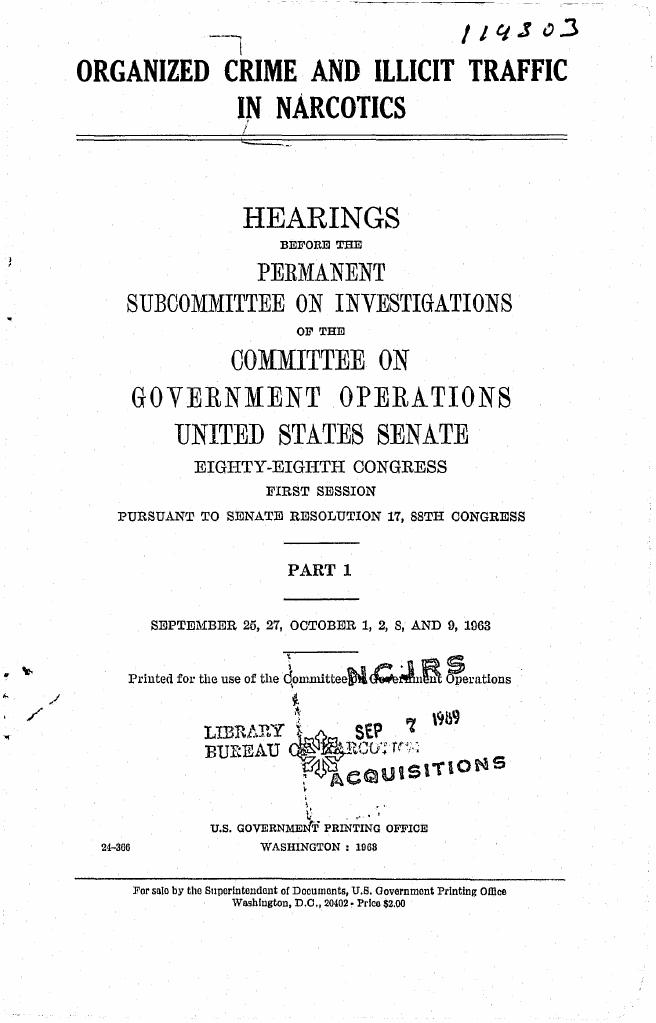 itemOrganized Crime and Illicit Traffic in Narcotics, Part 1 (September 25 to October 9, 1963)The first printed volume of the 1963 Senate hearings: Attorney General Robert F. Kennedy's opening testimony, Joseph Valachi's public testimony, New York police witnesses, Exhibit 8 and Charts A to E.itemUnited States v. Bufalino, 285 F.2d 408 (2d Cir. 1960)Second Circuit opinion reversing the convictions of Russell Bufalino and nineteen others for obstructing justice and perjury after the 14 November 1957 gathering at Apalachin, New York. The court says the government offered no evidence of the meeting's purpose.
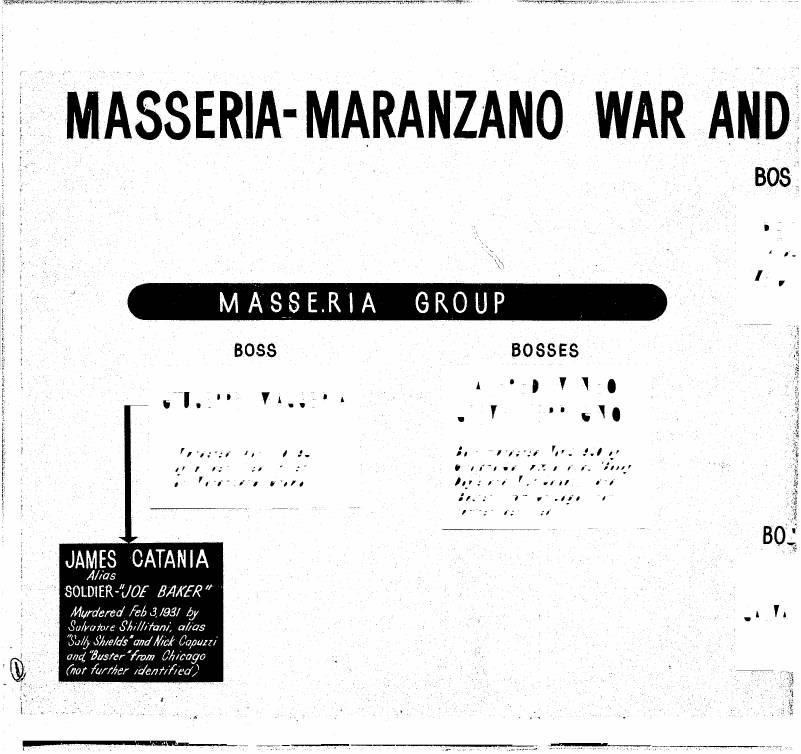 itemExhibit No. 8: "Masseria-Maranzano War and Evolution of Gang Control—1930 to Present"Staff fold-out chart presented on October 1, 1963: the 1930 to 1931 war in three key-coded groups and the lines of succession drawn from it to five 1963 bosses. Several name boxes are illegible in the scan.itemUnited States ex rel. Catena v. Elias, 449 F.2d 40 (3d Cir. 1971) (en banc)The en banc Third Circuit holds that New Jersey's use-immunity statute did not justify jailing Gerardo Catena for contempt after he refused to testify before the State Commission of Investigation in an inquiry "into organized crime," and orders its mandate to issue at once because he had been held for more than a year.itemUnited States ex rel. Catena v. Elias, 465 F.2d 765 (3d Cir. 1972)After the Supreme Court reversed its 1971 judgment in light of Zicarelli, the Third Circuit rejects Gerardo Catena's remaining due-process objections to the New Jersey State Commission of Investigation and affirms the 1970 denial of his habeas petition.
 itemFBI Vault, Abner Zwillman, Part 03: Newark report, December 1957 to early 1958A Newark anti-racketeering report on Zwillman: his background, residences and businesses, associates he acknowledged in a 1938 interview and in 1951 testimony, and the status of his income-tax case after the 1956 hung jury. Read from a poor OCR.
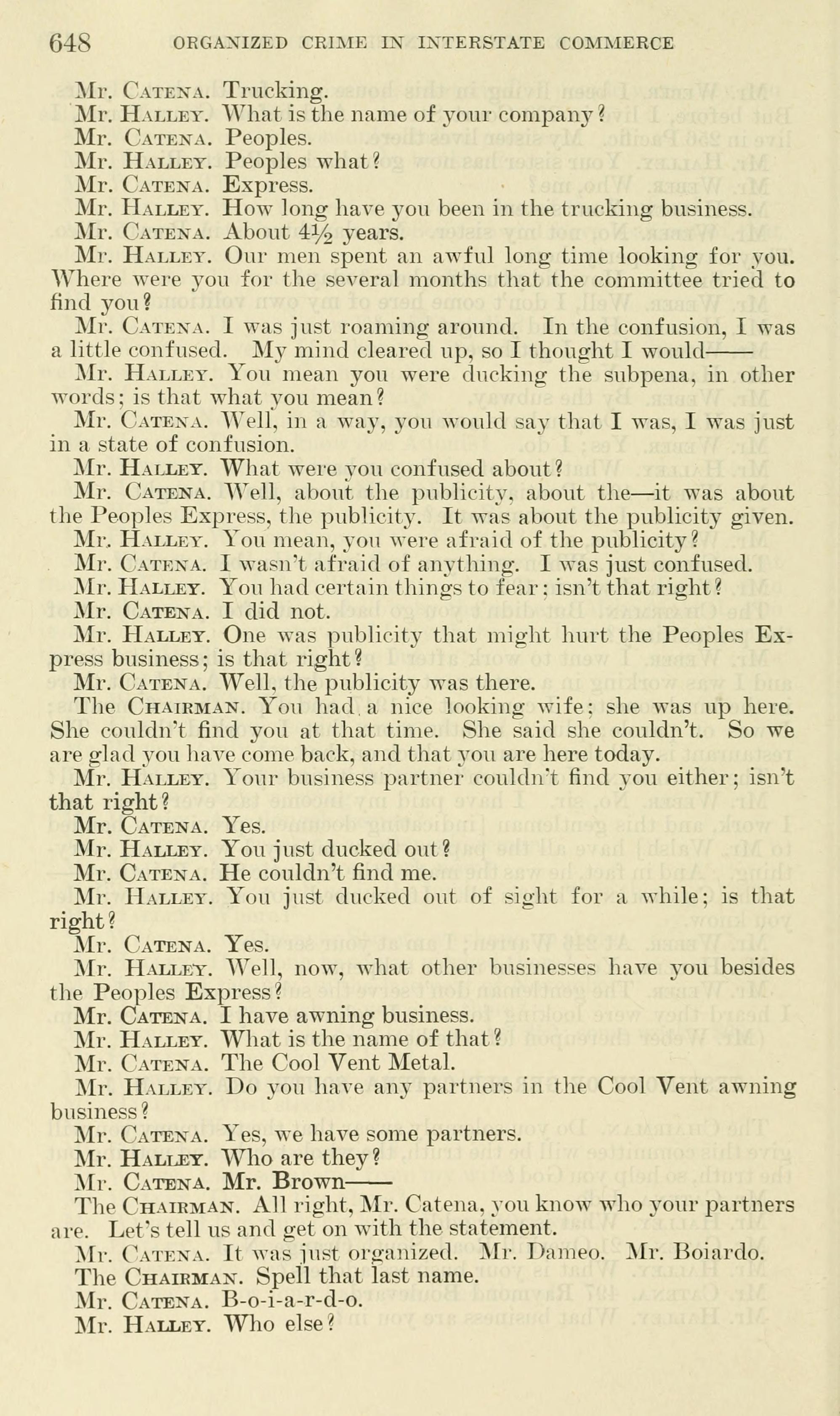 itemTestimony of Gerald Catena, South Orange, N.J., February 1951 (Kefauver Committee, Part 7, pp. 647–664)A New Jersey witness printed as Gerald Catena, who agrees he had been "ducking the subpena," tells the Kefauver Committee he is in trucking and the awning business and then refuses to say whether he has other businesses, on the ground that the answer might incriminate him.
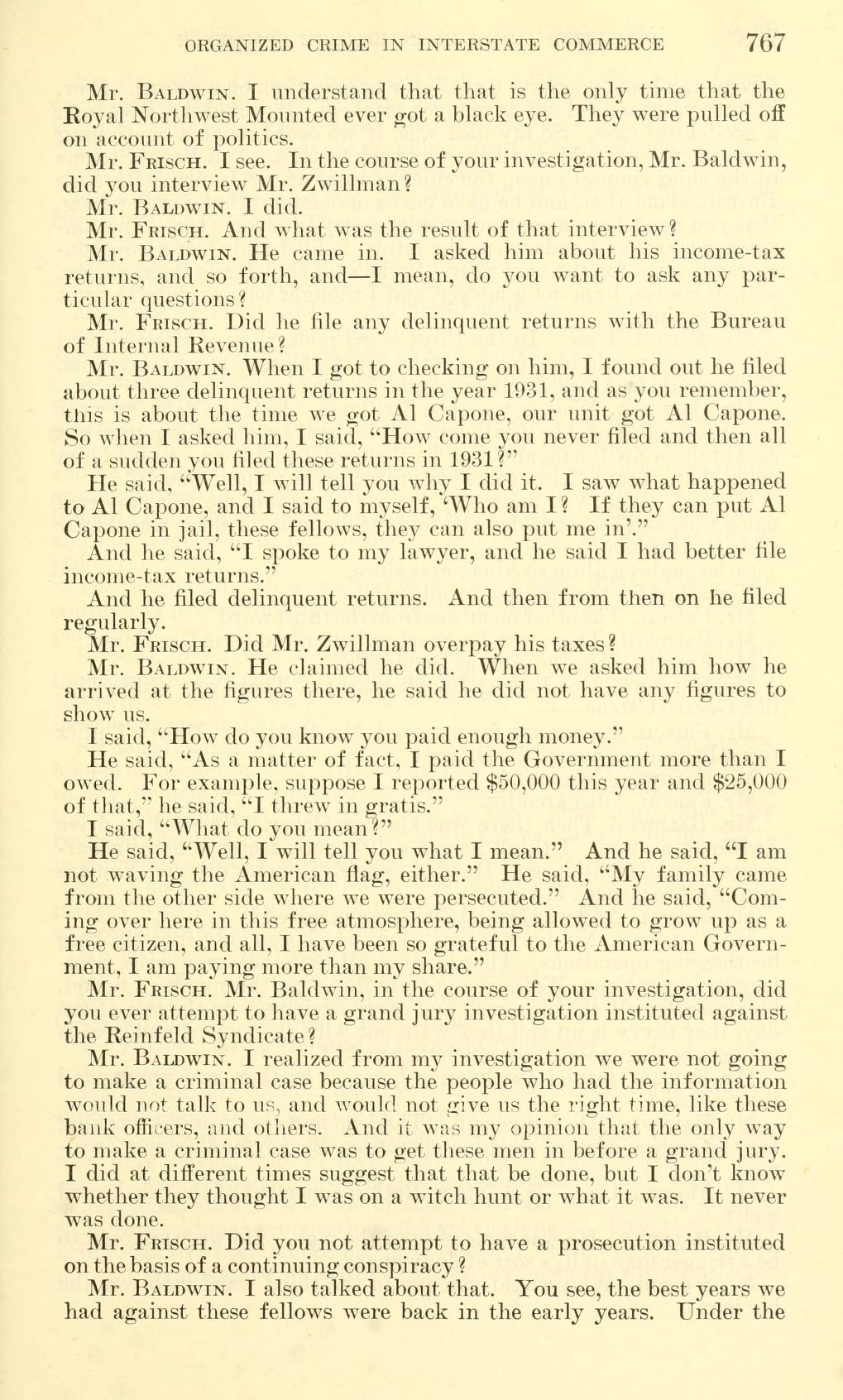 itemTestimony of Edwin A. Baldwin, retired Treasury intelligence agent, August 16, 1951 (Kefauver Committee, Part 18, pp. 761–771)A retired Treasury Intelligence Unit agent tells the Kefauver Committee about his 1926–1933 investigation of the "Reinfeld syndicate" and Abner Zwillman's tax returns, including Zwillman's account of why he filed delinquent returns in 1931: "I saw what happened to Al Capone."