Testimony of Edwin A. Baldwin, retired Treasury intelligence agent, August 16, 1951 (Kefauver Committee, Part 18, pp. 761–771)
A retired Treasury Intelligence Unit agent tells the Kefauver Committee about his 1926–1933 investigation of the "Reinfeld syndicate" and Abner Zwillman's tax returns, including Zwillman's account of why he filed delinquent returns in 1931: "I saw what happened to Al Capone."
- Date
- 1951-08-16
- Kind
- hearing
- Retrieved
- 2026-10-12
- Docket
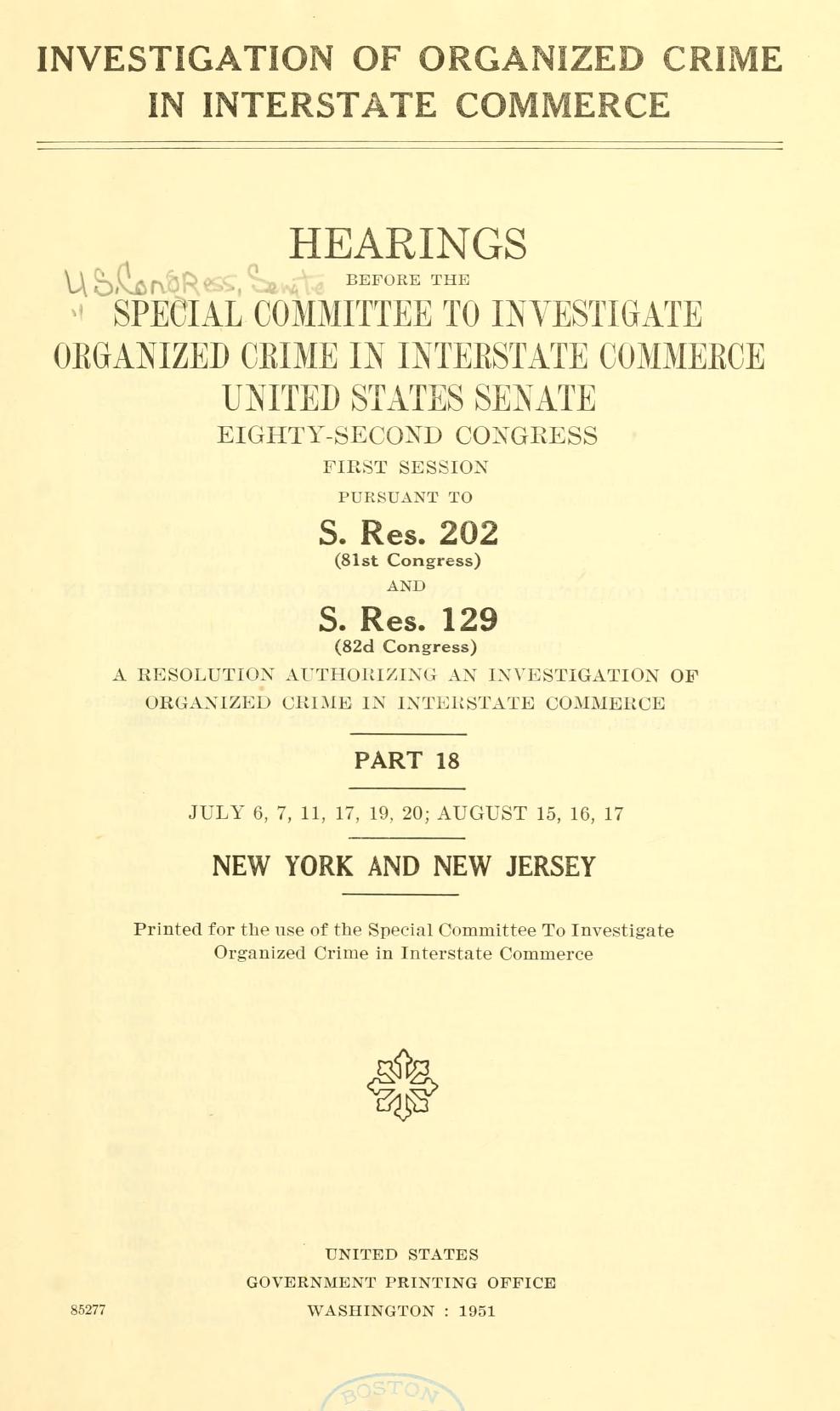
- Investigation of Organized Crime in Interstate Commerce, Hearings before the Special Committee, 82d Cong., Part 18: New York and New Jersey, pp. 761–771
- Rights
- A work of the United States Congress, printed by the Government Printing Office. Public domain in the United States under 17 U.S.C. § 105. The scan is of a GPO printing; Internet Archive marks it not in copyright. The stored page image was taken from the Internet Archive scan; quotations follow the Archive OCR, checked against the page image.
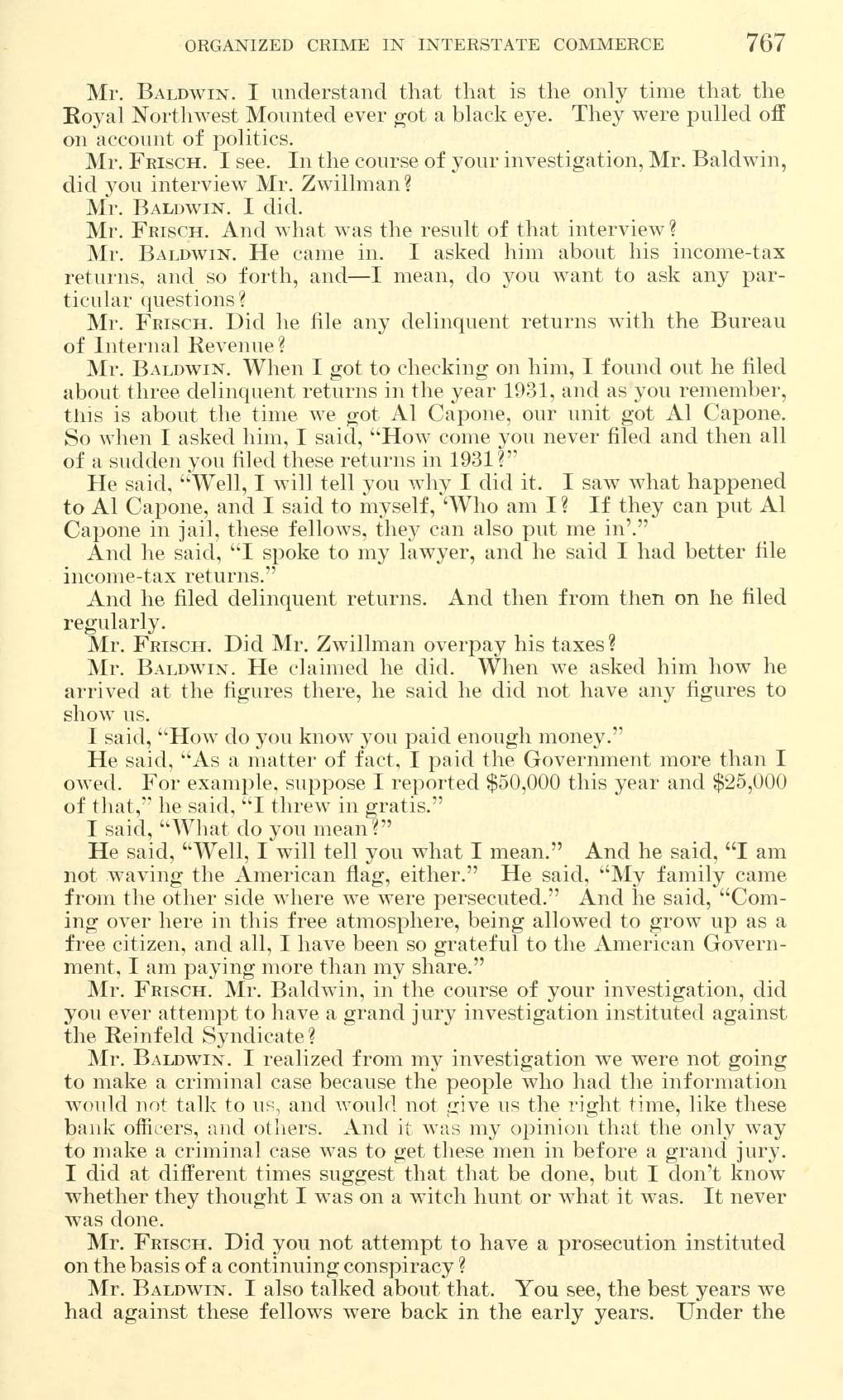
Printed in Part 18, with the session held in Room 318, Senate Office Building, Washington, on Thursday, August 16, 1951. Baldwin had retired in June 1951 after 25 years in the Treasury Intelligence Unit. Questioning is by the chairman, counsel Moser and Mr. Frisch. Baldwin says more than once that he is “testifying from memory now, 11 years ago.” The stored image is page 767.
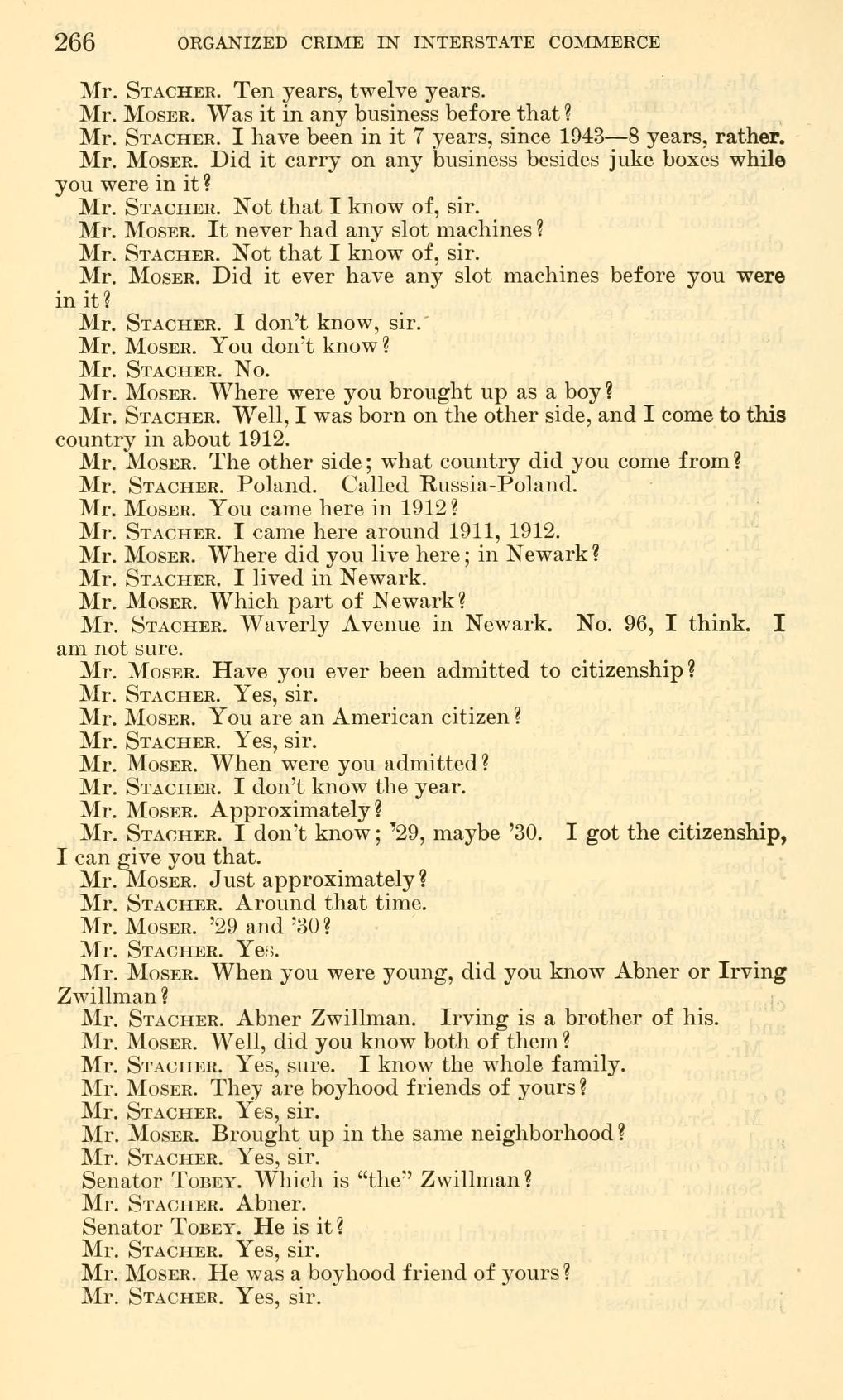
He says his investigation “covered the years 1926 to 1933, inclusive”; that revenue agents’ reports on “the whole syndicate” disappeared from government files and a copy turned up in the suit “Niggy Rutkin brought against Joe Reinfeld”; and that tracing that report led to Rutkin’s own tax conviction. Asked who was in the Reinfeld syndicate, he names “Abner Zwillman, Joseph H. Reinfeld, he was the kingpin — he and Zwillman were the kingpins, I would say,” with Reinfeld’s brothers and others. He estimates bank deposits of “around $25 million” and says Stacher “was one of the men who operated these bank accounts.” Asked to list “the third ward mob,” he names “Joe Stacher, better known as Doc Rosen,” “Willie Tiplitz, Gerard Catena,” and others.
On page 767 he recalls interviewing Zwillman, who had filed “about three delinquent returns in the year 1931.” Zwillman told him: “I saw what happened to Al Capone, and I said to myself, ‘Who am I? If they can put Al Capone in jail, these fellows, they can also put me in’.” Baldwin also recalls that Zwillman’s lawyer Arthur Garfield Hays “first came into the picture about 1937, when Zwillman was cited for contempt at New York,” that he got “a 6-months’ sentence,” and that the circuit court “reversed the district court” (see 108 F.2d 802, which dates the grand jury appearance to August 1939).
Everything here is one witness’s recollection. Words such as “mob,” “kingpins” and the percentage of illicit liquor he attributes to the group are his characterizations, not findings of the committee or a court, and the names he lists are not shown here to have been charged with anything.