William Bioff
Browne's "personal representative" in the stagehands' union, in the words of two 1944 court opinions. Convicted in 1941 of extortion from motion-picture producers, he then testified for the government against the Chicago defendants in the 1943 trial.
- Aliases
- Willie Bioff
- Role
- Personal representative of George E. Browne in the union. Court opinions: the Second Circuit (1944), "Circella and Bioff were then given offices in the union as personal representatives of Browne, as president"; the California Court of Appeal (1944), "George E. Browne, international president of appellant Alliance, accompanied by his personal representative, William Bioff"
- Rights
- Biography on this page is limited to what the cited federal records state. A state-court opinion is cited only for the title it gives him.
On the record
- 1934–1940 — United States v. Compagna (2d Cir. 1944), recounting the testimony the jury could believe, says that a Chicago group forced on Browne and Bioff an agreement to take "first one-half and, later two-thirds" of what they collected, that after Browne's election "Circella and Bioff were then given offices in the union as personal representatives of Browne, as president," and that in 1936 Bioff and a producers' representative agreed a "tariff" of $50,000 a year from the larger producers and $25,000 from the smaller.
- July 1938 — Russel v. International Alliance of Theatrical Stage Employees (Cal. Ct. App. 1944) records that Browne, "accompanied by his personal representative, William Bioff," engaged a tax consultant because the Treasury was investigating local unions, and that Bioff executed a power of attorney for federal tax matters.
- 1939 — A Bureau of Internal Revenue Intelligence Unit memorandum of 30 October 1939 (Morgenthau Diaries, Book 220) names "the William Bioff case" among three tax cases referred to the Justice Department in June and July 1939 for criminal prosecution.
- 10–30 July 1940 — Habeas Corpus Case No. 84 in the federal court at Chicago: Bioff petitioned against the superintendent of the City of Chicago House of Correction on 10 July 1940; on 30 July the "Demurrer to petition for writ of habeas corpus sustained and petition for writ dismissed." The docket does not say why he was held.
- 5 September 1941 — United States v. Bioff (S.D.N.Y. 1941): the court overruled George E. Browne's demurrer and plea in abatement to the indictment in the case that bears Bioff's name.
- November 1941 — A House speech of 10 November 1941 (Congressional Record, pp. 8741-8742) says Browne and Bioff "were convicted this month." It is a partisan speech, used only for that point.
- 7 August 1942 — Ratner v. Paramount Pictures (S.D.N.Y. 1942) describes a stockholders' suit over "corporate funds allegedly paid by them to one Willie Bioff, to induce him not to cause a strike."
- October 1942 — The Treasury General Counsel's report for October 1942 states: "Bioff is presently serving a ten-year sentence as a result of his conviction last year on charges of extortion from moving picture producers," with a Los Angeles income-tax indictment for 1936 and 1937 outstanding.
- 1943 — The Second Circuit (1944) calls the case against the Chicago defendants "woven out of the testimony of two accomplices — Bioff and Browne," and calls Bioff "a man with a long, discreditable and criminal past, confessedly guilty of perjury in an earlier examination of the same transactions."
- Before April 1945 — Attorney General Biddle to President Roosevelt, 10 April 1945: "After Bioff and Browne had been convicted they testified for the Government against a group of Chicago racketeers, subsequently convicted," Judge Knox modified their sentence, "and they were recently released."
- 1949 — Nitto v. Commissioner (Tax Court, 1949): Bioff was a witness for the government; the petitioner argued he might gain an advantage "as a tax case in which he is involved is still pending."
The role field quotes two court opinions from 1944. The Second Circuit’s sentence is its account of the trial testimony; the California Court of Appeal’s is from a civil fee case and is cited only for the title. Neither is an organizational rank, and Bioff holds no seat on any chart in this archive.
No record opened for this archive gives his birth or death, the date of the 1941 verdict, his own sentence in a court record, or the date of his release. The House speech of November 1941 is used only for its statement that the conviction came that month.
Records
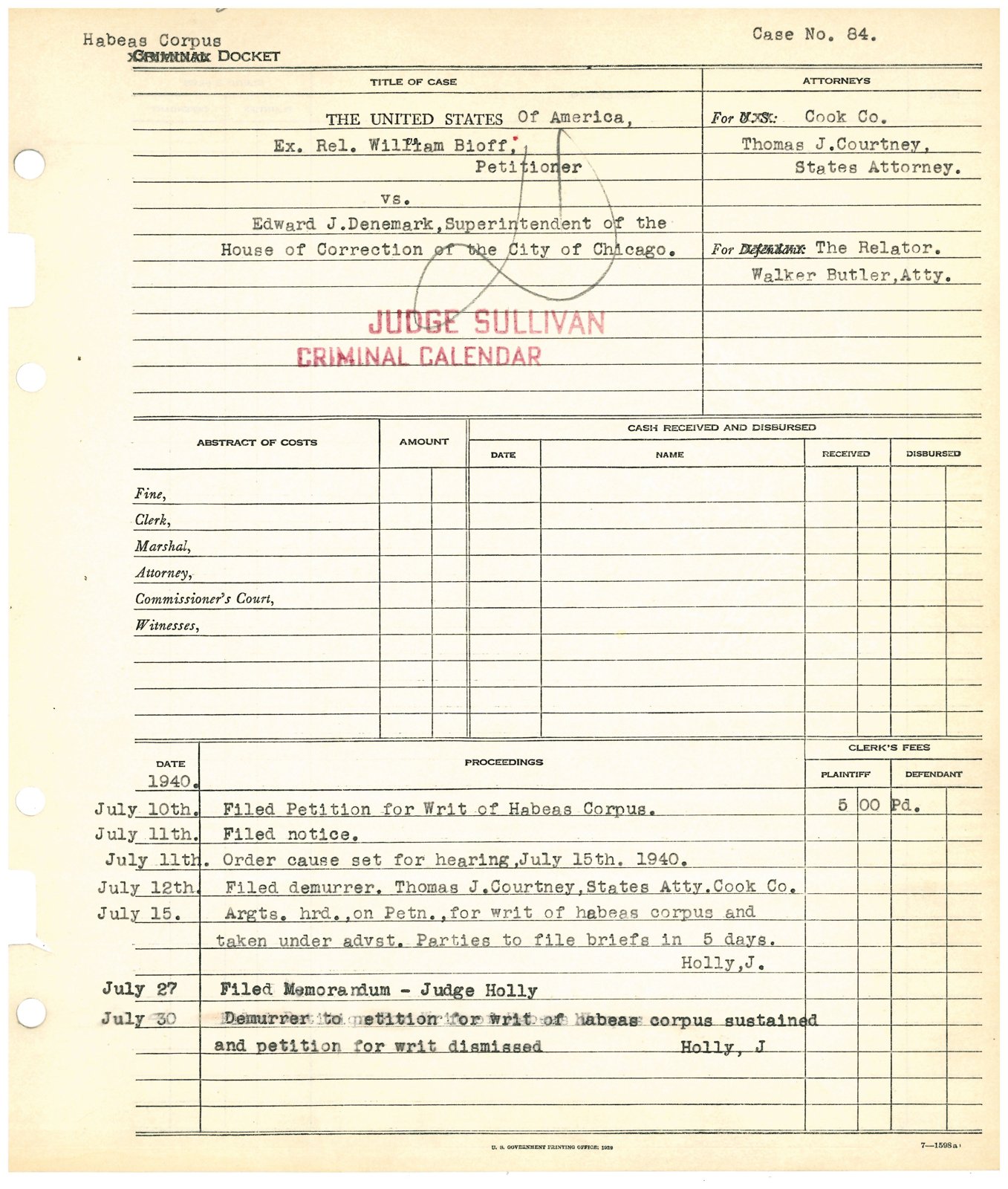 itemHabeas corpus docket, Case No. 84: United States ex rel. William Bioff v. Edward J. Denemark (N.D. Ill., 1940)Docket sheet from the Chicago federal court's habeas corpus dockets. Bioff petitioned on 10 July 1940 against the superintendent of the City of Chicago House of Correction; the petition was dismissed on 30 July 1940.itemUnited States v. Bioff, 40 F. Supp. 497 (S.D.N.Y. 1941)District Judge Rifkind's ruling of 5 September 1941 overruling George E. Browne's demurrer and plea in abatement against the Anti-Racketeering Act indictment in the Bioff case.itemCongressional Record, House, 10 November 1941: Representative Bennett lists Browne and Bioff as "convicted this month"A House floor speech for a union-reporting bill, used here for one point only: on 10 November 1941 a member of Congress stated that George E. Browne and Bioff "were convicted this month." No court record of the 1941 verdict was opened.itemRatner v. Paramount Pictures, Inc., 6 F.R.D. 618 (S.D.N.Y. 1942)A federal stockholders' suit to make Paramount's officers and directors account for "corporate funds allegedly paid by them to one Willie Bioff, to induce him not to cause a strike" was dismissed on 7 August 1942, the state-court judgment in the Hornstein actions being res judicata.itemTreasury General Counsel's summary report for October 1942: "William Bioff" (Morgenthau Diaries, Book 594)The Treasury legal staff's monthly report, sent to Secretary Morgenthau on 8 December 1942, states that Bioff "is presently serving a ten-year sentence as a result of his conviction last year on charges of extortion from moving picture producers."itemAttorney General Francis Biddle to President Roosevelt, 10 April 1945, on Joseph Schenck and the Bioff and Browne prosecutionsRecommending against a pardon for Joseph Schenck, the Attorney General writes that after Bioff and Browne were convicted "they testified for the Government against a group of Chicago racketeers," that Judge Knox modified their sentences, and that "they were recently released."itemRussel v. International Alliance of Theatrical Stage Employees, 66 Cal. App. 2d 691 (1944)A California Court of Appeal opinion on a tax consultant's fee claim against the stagehands' union. It records that in July 1938 "George E. Browne, international president of appellant Alliance, accompanied by his personal representative, William Bioff" engaged him because the Treasury was investigating local unions.itemHornstein v. Paramount Pictures, Inc., 292 N.Y. 468 (1944)The New York Court of Appeals affirmed judgment for Paramount's officers and directors in a stockholders' suit over money paid "to labor union officials," holding that payments "coerced by threats" of a strike were not a crime under the Penal Law. Counsel's points name the payees as Bioff and Browne.itemNitto v. Commissioner, 13 T.C. 858 (1949)The Tax Court held on 30 November 1949 that the government had "established convincingly" Frank Nitto's "association with Bioff and Browne in their scheme of procuring substantial sums of money from various members of the motion picture industry," that he failed to report his share, and that fraud penalties applied.itemBureau of Internal Revenue Intelligence Unit memorandum for the Secretary, 30 October 1939, naming "the William Bioff case" (Morgenthau Diaries, Book 220)A Treasury memorandum stating that Joseph M. Schenck was "the dominating figure" in three tax cases, "his own individual case, the William Bioff case and the so-called Twentieth Century-Fox reorganization case," referred to the Justice Department in mid-1939 for criminal prosecution.