Louis Campagna
Convicted in the Hollywood extortion case affirmed in 1944, and a witness before the Kefauver Committee in 1950. A 1959 FBI memorandum relays a source's claim that he was "the man" in Chicago before 1955.
- Born
- 1900-09-23
- Aliases
- Little New York, Compagna, Lefty Louie, Louis Compagna, Louis Cook
- Rights
- Biography on this page is limited to what the cited federal records state.
On the record
- 23 September 1900 — An FBI memorandum of 16 September 1947 (Vault, Roselli Part 01, scan 6) says "He was born on September 23, 1900 at Brooklyn, New York," and that he "is popularly known in hoodlum circles as 'Little New York' Compagna." The research for this archive notes that the Bureau's 1947 Atlanta report quotes immigration records for the same date.
- 1935–1940 — United States v. Compagna, 146 F.2d 524 (2d Cir. 1944), states: "Compagna and six others have appealed from convictions for violation of subdivision (d) of § 420a, Title 18 U.S.C.A.: a conspiracy to extort money from producers and exhibitors of moving pictures during the years 1935 to 1940." Of Compagna it says: "Bioff connected him with the venture in the most direct way; apparently he was the chief."
- 20 December 1944 — The Second Circuit affirmed the convictions.
- 22 and 31 December 1943 — The same FBI memorandum: "On December 22, 1943, in the U. S. District Court at New York City, Louis Campagna and others were found guilty on jury trial for violation of the Anti-Racketeering Statute"; on December 31, 1943 he was sentenced to ten years and fined $10,000. The FBI memorandum on Gioe gives December 23 for the verdict; Compagna v. Hiatt (N.D. Ga. 1948) confirms the sentence date.
- 4 April 1944 — Atlanta index card No. 63773-A: "COMPAGNA, Louis," alias "Lefty Louie; Little New York," ten years and a $10,000 fine, received 4-4-44, residence Berwyn, Ill., stamped "Transferred to U.S. Penitentiary Leavenworth, Kansas JUL 28 1945."
- 13 August 1947 — Representative Hoffman told the House on 28 November 1947 that parole was granted "on August 13, 1947, just 37 days after they first became eligible for parole on July 7, 1947," and that federal tax claims "aggregating $486,877 levied against Campagna, were compromised and settled on the payment of around $89,000." A congressman's floor statement.
- 23 July 1948 — Compagna v. Hiatt (N.D. Ga. 1948): retaken on 23 July 1948 on a warrant dated 21 July and returned to Atlanta. His second Atlanta card is stamped "Discharged by Order of Court DEC 20 1948." The Fifth Circuit reversed in 1949, noting "three against Compagna" among the written charges, and the Supreme Court affirmed by an equally divided Court in 1950.
- 9 September 1950 — Before the Kefauver Committee (Part 5, p. 53) he gave his name as Louis Campagna and, asked whether that was his real name, answered: "It is."
- 1950 — In the same testimony (Part 5, p. 65) he said of Murray Humphreys: "I have known Humphreys for a few years. ... Eight or seven years."
- 18 September 1951 — On remand, Compagna v. Hiatt (N.D. Ga. 1951) held "that the order of revocation of Compagna's parole was arbitrary and a total nullity, because unsupported by substantial evidence, or any evidence, of parole violations and that he should be discharged as a reinstated parolee."
- 1953–1954 — An FBI memorandum of August 1954 in the Vault's Jake Guzik file quotes the Chicago file title "Louis Campagna, was., et al; Bribery, Parole Matter, Falsely Claiming Citizenship, Perjury," Bufile 58-2000, still under investigation in 1953.
- Before 1955 — A Chicago FBI memorandum dictated July 22, 1959 (Vault, Anthony Accardo Part 02, p. 5) relays a source's account, passed through two reporters, that "Prior to 1955, 'the man' was" Campagna, and that on his death Paul Ricca assumed the position. The memorandum is a third-hand account, not a Bureau finding.
The alias “Little New York” is from the Kefauver contents page, which lists him as Louis (“Little New York”) Campagna, Berwyn, Ill., and from the 1947 FBI memorandum and the Atlanta card. “Compagna” is the spelling of the Second Circuit, the Atlanta court and the prison card. “Lefty Louie” is on the card; “Louis Compagna” and “Louis Cook” head the FBI memorandum’s longer alias list.
The role field is left empty. The 1959 memorandum’s claim, kept in the events, carries its weakness: an unnamed person told a reporter, who told a Chicago Tribune reporter, who told an FBI agent. The Second Circuit’s word “chief” refers to the extortion venture in that case, not to an organization. The 1947 FBI memorandum relays “underworld rumors” that when Capone went to prison in 1931 he left his interests “in the hands of Louis Campagna, Frank Nitti, Paul DeLucia and others”; that is rumor as the Bureau recorded it, and it is not used as a role. The birth date is the FBI memorandum’s. No opened record gives his death date. The parole records are gathered in the Hollywood extortion case.
Records
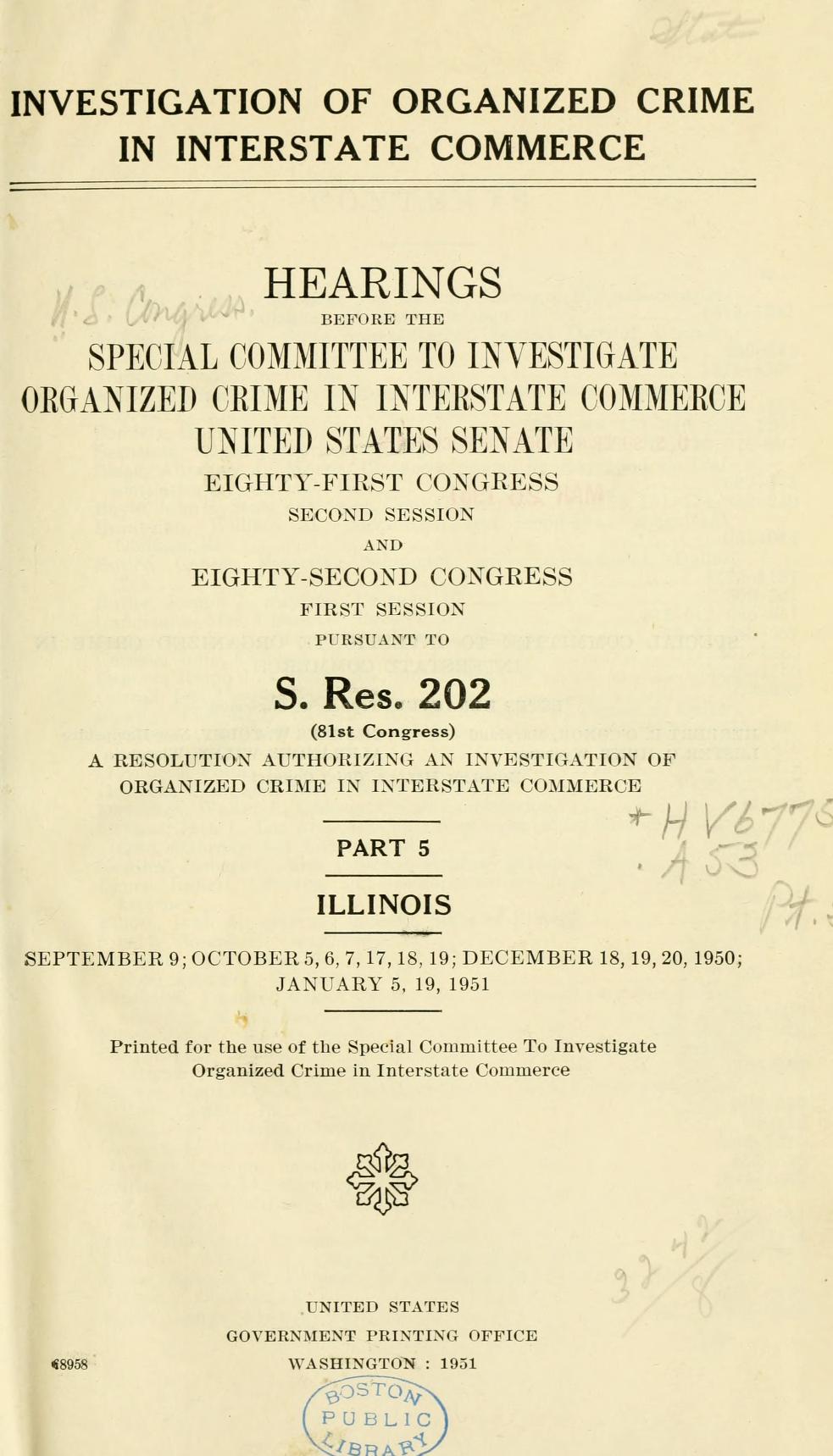 itemKefauver Committee hearings, Part 5: Illinois (1950–1951)Printed hearings of the Senate Special Committee to Investigate Organized Crime in Interstate Commerce, Part 5, Illinois: testimony taken from September 1950 to January 1951, including Paul DeLucia, Louis Campagna, Anthony J. Accardo, and Joseph Aiuppa.itemUnited States v. Compagna, 146 F.2d 524 (2d Cir. 1944)Second Circuit opinion of December 20, 1944 affirming the convictions of Compagna and six others for a conspiracy to extort money from motion-picture producers and exhibitors, 1935 to 1940.
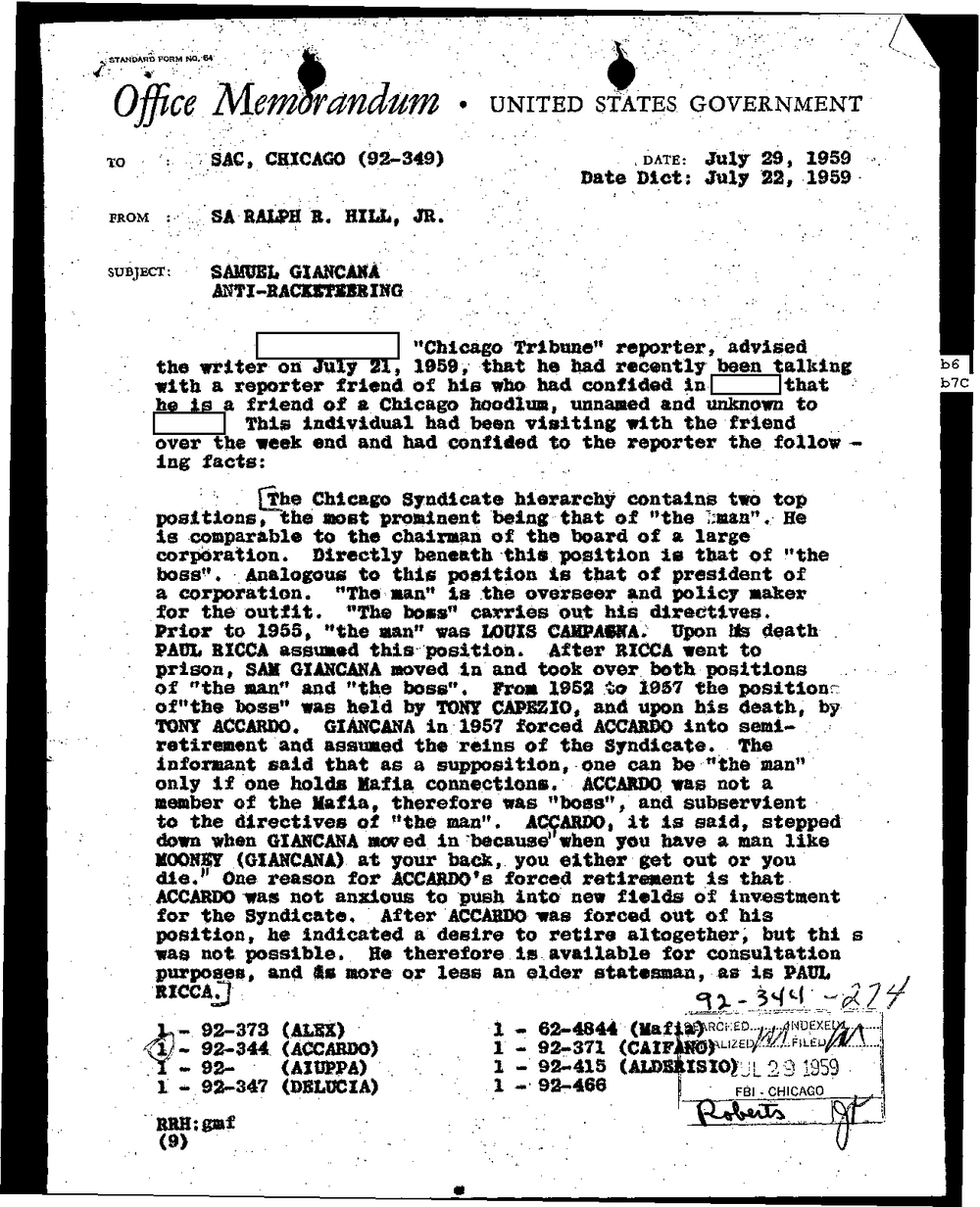 itemFBI Vault file on Anthony AccardoThe FBI Vault's release of the Bureau file on Anthony Accardo, in two parts, including a 1946 informant report, a 1959 Chicago memorandum relaying a source's account of the Chicago syndicate's hierarchy, and early-1970s teletypes on its leadership.
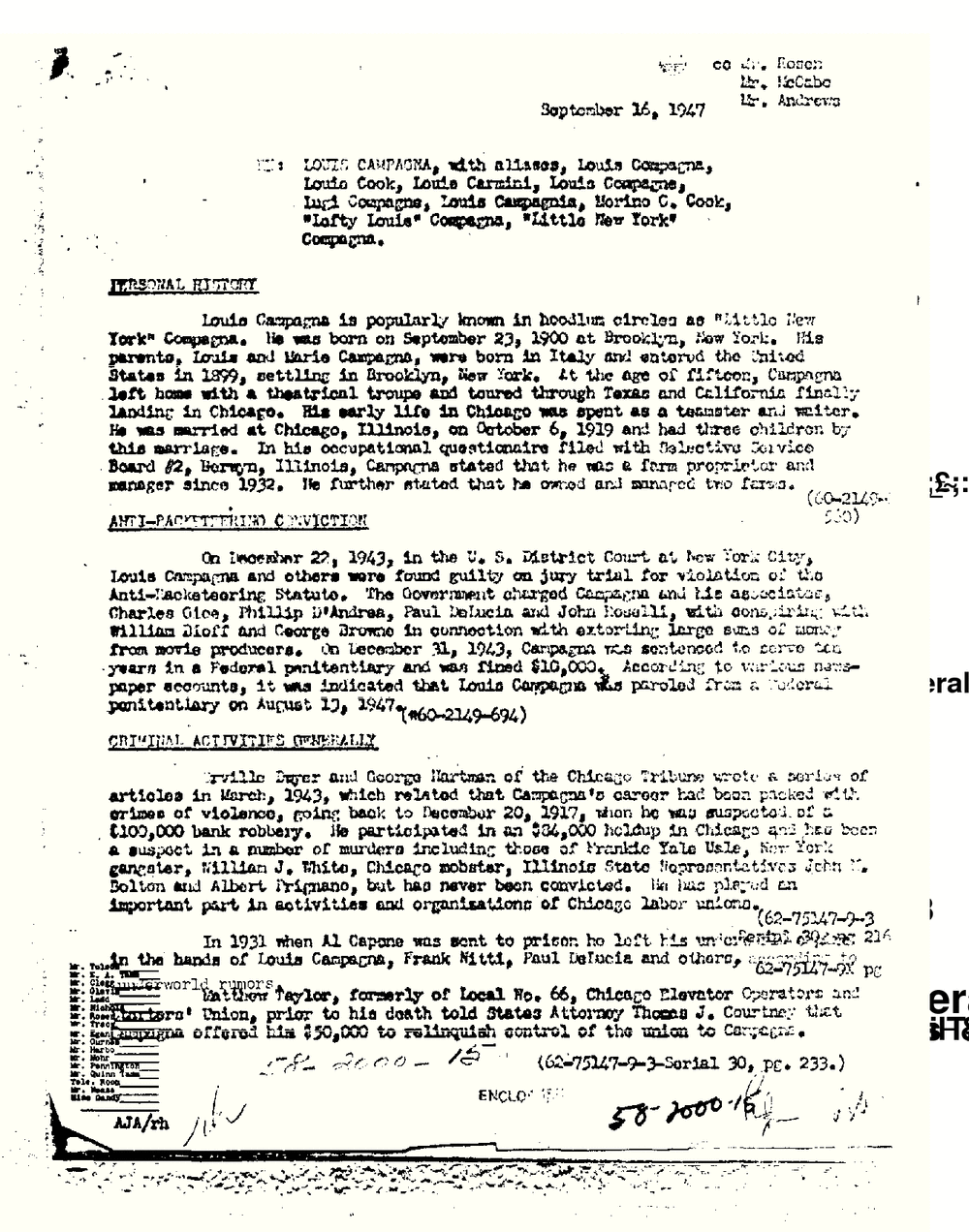 itemFBI memorandum of 16 September 1947 on Louis Campagna (Vault, John Roselli Part 01)One of the personal-history memoranda the FBI prepared in September 1947, after the paroles. It lists Campagna's aliases and says he and others were found guilty in New York on 22 December 1943 of violating the Anti-Racketeering Statute, and were sentenced on 31 December 1943.
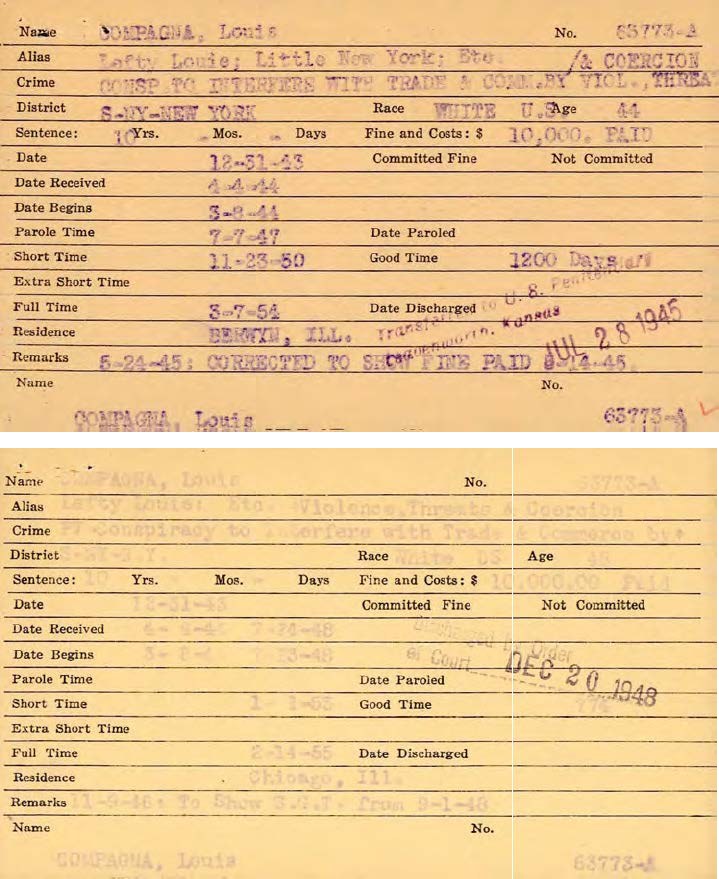 itemAtlanta penitentiary index cards: Compagna, Louis, No. 63773-A (1944–1948)Two prisoner index cards from the U.S. Penitentiary, Atlanta: conspiracy to interfere with trade and commerce by violence, threats and coercion, Southern District of New York, ten years from 31 December 1943, transferred to Leavenworth on 28 July 1945, received again in July 1948, and stamped "Discharged by Order of Court DEC 20 1948."itemCompagna v. United States, 324 U.S. 867 (1945): certiorari deniedThe Supreme Court's order of 2 April 1945 denying the petitions for certiorari in the motion-picture extortion case. "Reported below: 146 F. 2d 524."
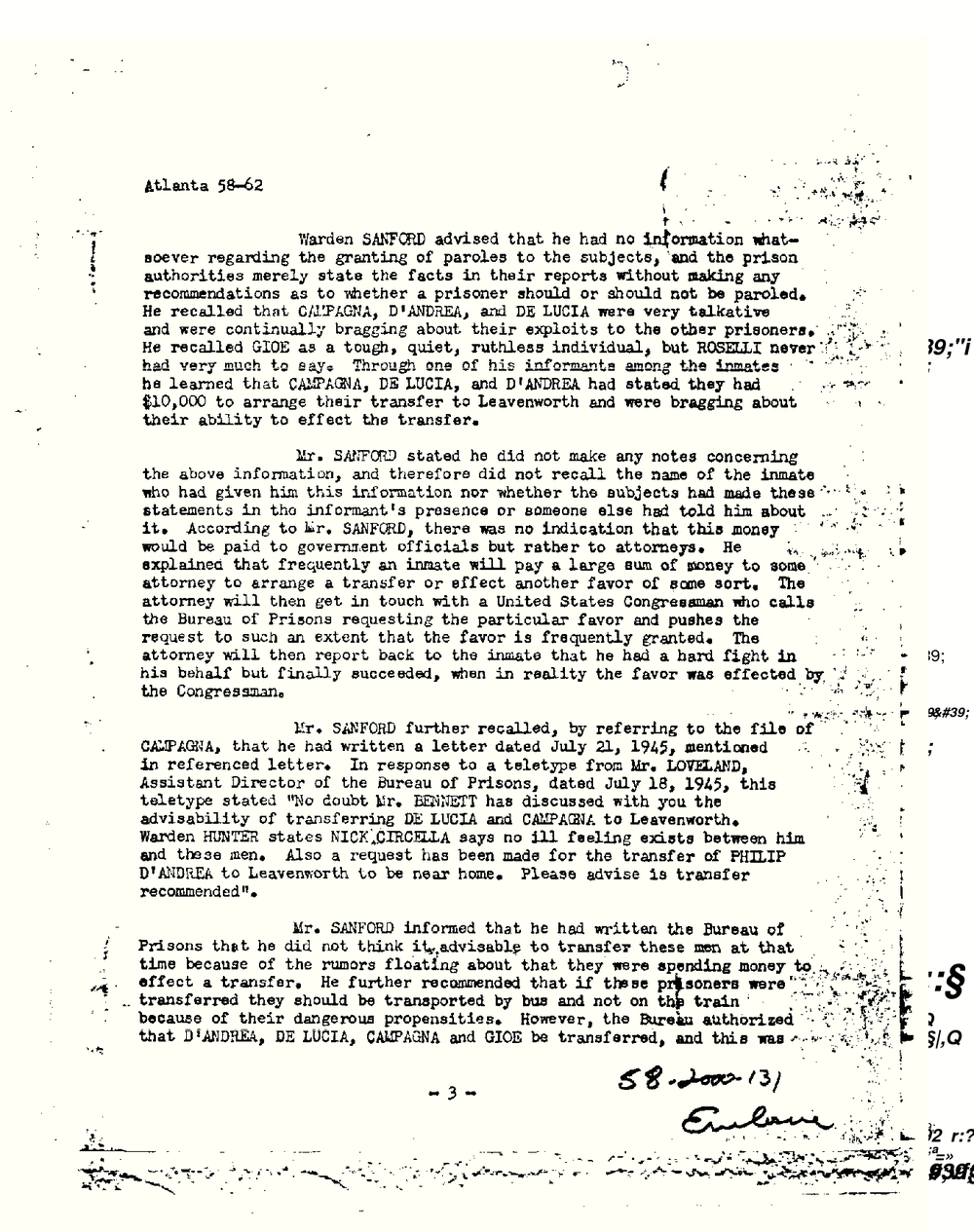 itemFBI Atlanta report (file Atlanta 58-62), autumn 1947: Warden Sanford on the prisoners and their 1945 transfer to Leavenworth (Vault, John Roselli Part 02)The Atlanta office's report for the 1947 parole inquiry. Warden Sanford said he made no parole recommendations, recalled an inmate informant's report that three of the men "had stated they had $10,000 to arrange their transfer", and said the transfer to Leavenworth was "done by bus on July 28, 1945."itemCongressional Record, House, 28 November 1947: Representative Hoffman, "The Parole of Four Capone Gangsters"The chairman of the House Committee on Expenditures in the Executive Departments reports on his subcommittee's inquiry into the August 1947 paroles: hearings in Chicago on 25 and 26 September 1947 (508 pages of transcript) and in Washington on 7 October, paroles granted "just 37 days" after eligibility, a tax compromise, and the Atlanta warden's 1945 letter against the transfer.itemCompagna v. Hiatt, 82 F. Supp. 295 (N.D. Ga. 1948)Judge Underwood's findings of 4 December 1948 on the habeas petitions of Louis Campagna (spelled Compagna) and Charles Gioe at the Atlanta penitentiary: sentenced 31 December 1943, paroled 13 August 1947, retaken 23 July 1948. The court held the warrants void; reconsideration was denied 20 December 1948.itemHiatt v. Compagna, 178 F.2d 42 (5th Cir. 1949)The Fifth Circuit reversed the Atlanta court on 10 November 1949 and remanded Campagna and Gioe to the warden's custody. It records that after the 1947 paroles "Unfavorable newspaper publicity followed" and a congressional investigation; Judge Waller dissented.itemCompagna v. Hiatt, 340 U.S. 880 (1950)The Supreme Court's per curiam of 13 November 1950: "The judgment is affirmed by an equally divided Court. Mr. Justice Clark took no part in the consideration or decision of this case."itemCompagna v. Hiatt, 100 F. Supp. 74 (N.D. Ga. 1951)On remand, Judge Underwood held on 18 September 1951 that the revocations of Campagna's and Gioe's paroles were "arbitrary and total nullities" and discharged both "as reinstated parolees." The findings describe the 13 August 1947 release from Leavenworth and the flight from Kansas City to Chicago.itemCongressional Record, Senate, 18 August 1949: Representative Busbey's additional views to House Report No. 2441 on the "Capone gang paroles"During debate on Tom C. Clark's nomination to the Supreme Court, Senator Ferguson had printed Representative Fred E. Busbey's additional views from the Seventeenth Intermediate Report of the House Expenditures Committee. Busbey lists what the subcommittee examined, including the dismissal of a mail-fraud indictment and the reduction of tax liens on two of the men.itemKefauver Part 5: testimony of U.S. Attorney Otto Kerner, Jr., on the parole grand jury (5 October 1950)In executive session at Chicago, the U.S. Attorney for the Northern District of Illinois described the grand jury that heard Campagna, Gioe, De Lucia and D'Andrea on "the manner of obtaining their paroles," and Accardo's visits to Leavenworth under the name Joseph Bulger. Printed pp. 182-196.itemFBI memorandum to Mr. Rosen, August 1954, citing the "Louis Campagna, et al; Bribery, Parole Matter" case, Bufile 58-2000 (Vault, Jake Guzik)A headquarters memorandum on Jake Guzik quotes the Chicago office's June 1954 intelligence report on what was learned "During the investigation of Chicago file 58-194 entitled, 'Louis Campagna, was., et al; Bribery, Parole Matter, Falsely Claiming Citizenship, Perjury,' Bufile 58-2000." It shows the parole case still open in 1953–54.itemKefauver Part 5: testimony of Mrs. Charlotte Campagna, Berwyn, Illinois (17 October 1950)Questioned in Chicago about who raised money to settle a federal tax claim against her husband, Louis Campagna, while he was in Leavenworth, Mrs. Campagna declined to answer, standing on her constitutional rights. Pp. 515-517.itemKefauver Part 5: further testimony of Mrs. Charlotte Campagna (18 October 1950)Recalled the next morning, Mrs. Campagna said she had decided she did not need counsel and would cooperate, and that she did not know who had paid money toward her husband's tax settlement: "Up to this day I don't know who did it." Pp. 645-651.