Kefauver Committee hearings, Part 5: Illinois (1950–1951)
Printed hearings of the Senate Special Committee to Investigate Organized Crime in Interstate Commerce, Part 5, Illinois: testimony taken from September 1950 to January 1951, including Paul DeLucia, Louis Campagna, Anthony J. Accardo, and Joseph Aiuppa.
- Date
- 1950-09-09/1951-01-19
- Kind
- hearing
- Retrieved
- 2026-10-11
- Docket
- Hearings, S. Res. 202 (81st Cong.), Part 5: Illinois (GPO 1951)
- Rights
- A work of the United States Congress, printed by the Government Printing Office. Public domain in the United States. 17 U.S.C. § 105. The scan is of a GPO printing; Internet Archive marks it not in copyright.
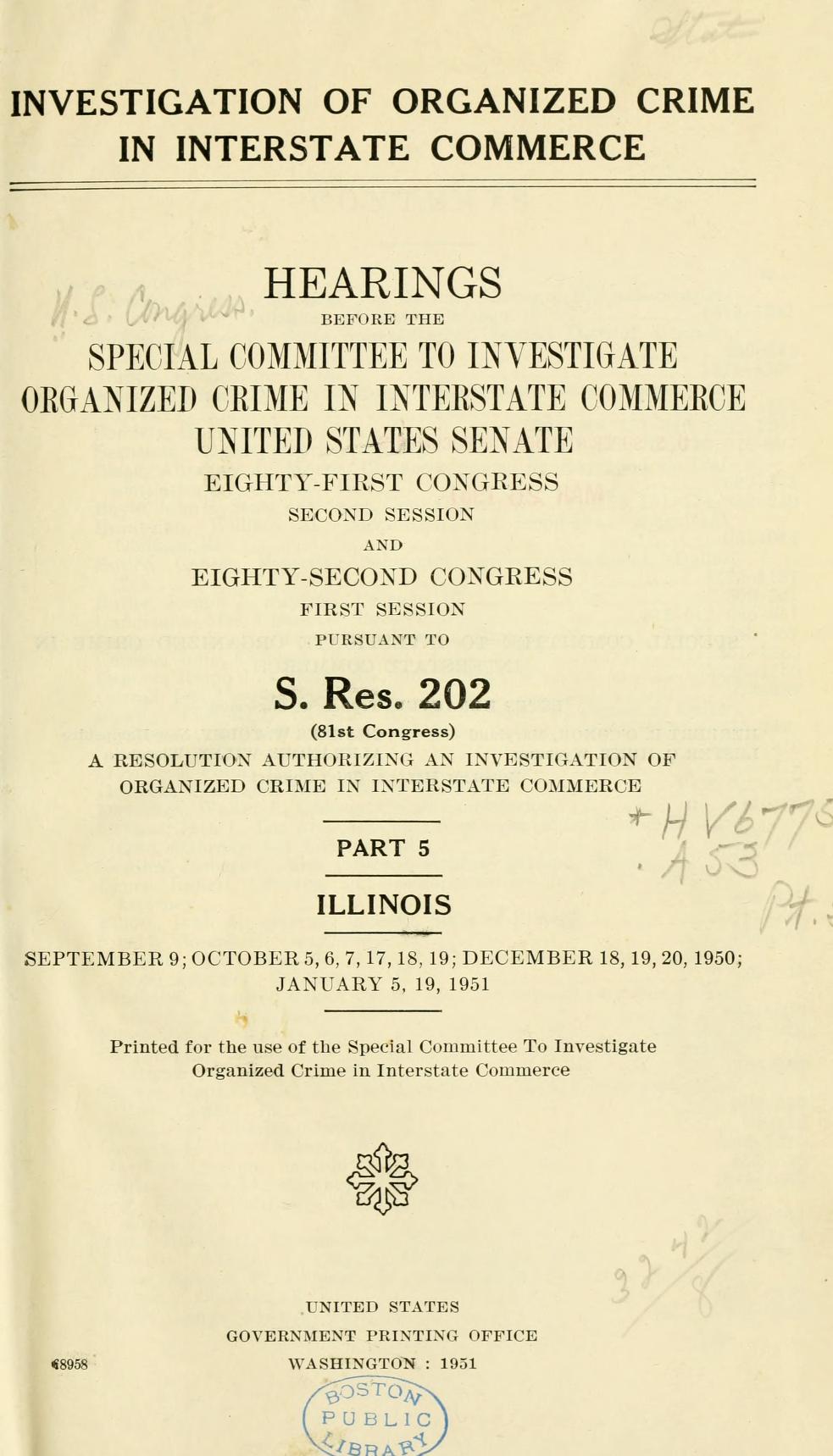
The title page reads “Investigation of Organized Crime in Interstate Commerce. Hearings before a Special Committee to Investigate Organized Crime in Interstate Commerce, United States Senate, Eighty-first Congress, second session, and Eighty-second Congress, first session, pursuant to S. Res. 202 (81st Congress)… Part 5, Illinois.” The hearing dates printed are September 9; October 5, 6, 7, 17, 18, 19; December 18, 19, 20, 1950; January 5, 19, 1951. Estes Kefauver was chairman and Rudolph Halley chief counsel. The Government Printing Office printed the volume in 1951.
The contents list “Accardo, Anthony J., alias Joe Batters” (pp. 1318–1341), “Aiuppa, Joseph, Cicero, Ill.” (pp. 1371–1375), and “Campagna, Louis (‘Little New York’), Berwyn, Ill.” (pp. 53–74, 543–557). On September 9, 1950, in executive session, Paul DeLucia gave his name and, asked whether he was known by any other name, answered “Ricca and Salvi.” Louis Campagna, sworn the same morning, testified that Louis Campagna was his real name, and later said he had known Humphreys “Eight or seven years.” On January 5, 1951 Accardo refused to answer questions, including whether he had been known as Joe Batters. Aiuppa gave his name and a Cicero address and refused all other questions.
At p. 1320 counsel Halley told the committee that “after the death of Al Capone, Frank Nitti assumed the mantle of the so-called Capone gang,” that Nitti “was found dead, apparently a suicide,” and that “then the mantle of the Capone gang descended upon Tony Accardo, the witness, and Paul Ricca.” These are counsel’s statements summarizing the committee’s record (the OCR prints “Ca])one”; the name is corrected here). They are not sworn testimony or committee findings. Capone was alive until 1947, so the words “after the death of Al Capone” cannot be read literally.
This is a different volume from the New York contempt proceedings against Frank Costello (Senate Report 199). The quotations here are from the archive’s OCR text of the scan.