Record
Hearing
1950-12-19
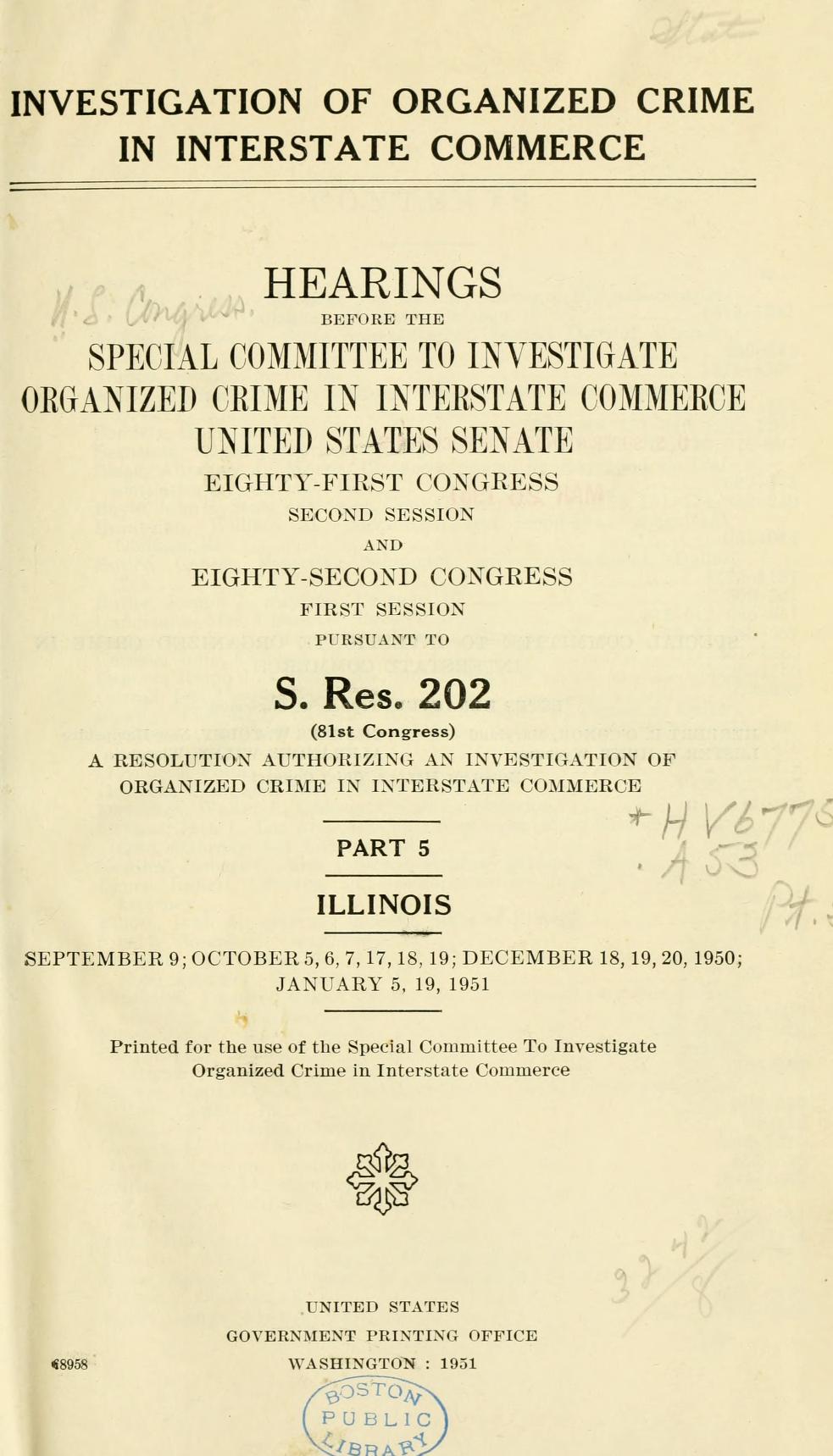
Internet Archive, scan of the printed hearings, Part 5: Illinois (Boston Public Library copy)
Kefauver Committee, Chicago: testimony of Edward P. Jones (evening of 19 December 1950)
Edward P. Jones, living in Mexico City, told the committee he shared in the profits of the Maine-Idaho Club policy wheel, agreed that he had been convicted of an income-tax violation on income from the wheel, and described being kidnapped near Forty-third Street and South Parkway and held blindfolded for almost a week.
- Date
- 1950-12-19
- Kind
- hearing
- Retrieved
- 2026-10-12
- Docket
- Hearings, S. Res. 202 (81st Cong.), Part 5: Illinois (GPO 1951)
- Rights
- A work of the United States Congress, printed by the Government Printing Office. Public domain in the United States. 17 U.S.C. § 105. The scan is of a GPO printing; Internet Archive marks it not in copyright.
Printed pages 1163 to 1175 of Part 5, in the evening session of 19 December 1950, after Theodore Roe. Jones appeared with his attorney, Aaron Payne, and was examined by chief counsel Rudolph Halley. The start page is inferred from the running heads in the OCR.
He gave his name as “Edward P. Jones” and said, “I reside in Mexico City,” where he had lived “for about 7 years.” Asked whether he was a partner in “the Maine-Idaho Club—a policy wheel,” he answered: “I should say I participate in the profits of it,” and agreed that his share was one-fifth, held with his wife. Halley asked: “Now before you went to Mexico, you were convicted of an income-tax violation; is that right?” Jones: “That is right, sir.” Halley: “In connection with income from the policy wheel?” Jones: “Yes, sir.” He said the conviction came before he moved to Mexico.
He said he was kidnapped “In the night—in the evening,” while visiting Chicago, “near Forty-third and South Parkway,” on the street, when “some fellows came up with guns” as his car stopped to take a woman home. Asked whether the kidnappers were white or colored, he said, “I couldn’t say definitely, really, because they were all blindfolded also,” meaning masked. He said he was held “almost a week,” blindfolded the whole time, and could give the police no more than he was giving the committee.
These are Jones’s sworn answers. The income-tax conviction is stated in counsel’s question and his assent; no judgment or court record of it has been opened. The OCR of his answers has gaps, and only clean passages are quoted.