Record
Hearing
1950-12-19
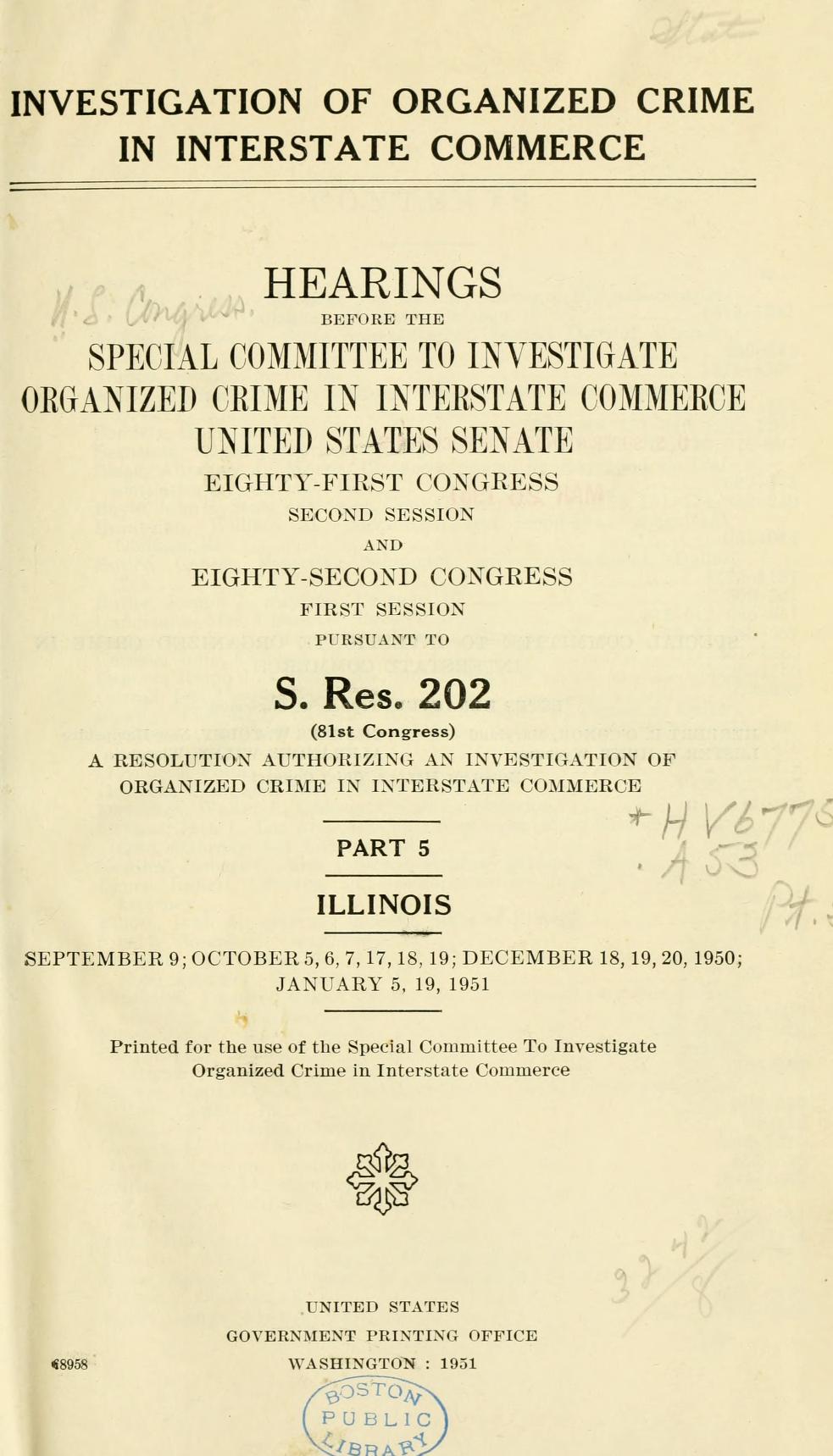
Internet Archive, scan of the printed hearings, Part 5: Illinois (Boston Public Library copy)
Kefauver Committee, Chicago: Theodore Roe's second testimony (evening of 19 December 1950)
Recalled in December, Roe named his partners in the Maine-Idaho-Ohio policy wheel, said the earlier owners were the Jones brothers Edward, McKissick and George, and described the kidnapping of Edward Jones, which he dated to 1946, and a ransom of $100,000 paid by George Jones.
- Date
- 1950-12-19
- Kind
- hearing
- Retrieved
- 2026-10-12
- Docket
- Hearings, S. Res. 202 (81st Cong.), Part 5: Illinois (GPO 1951)
- Rights
- A work of the United States Congress, printed by the Government Printing Office. Public domain in the United States. 17 U.S.C. § 105. The scan is of a GPO printing; Internet Archive marks it not in copyright.
Printed pages 1137 to 1163 of Part 5, the evening session of Tuesday, 19 December 1950 (the committee had recessed “until 8 p.m. the same day”). Roe was sworn again and again appeared with Edward J. Hess. Associate counsel George Robinson examined him.
Roe said he had “been operating a policy wheel” whose present name “is Maine, Idaho, and Ohio,” and named his partners as “Davis, Edward Jones, and George Jones, and their mother, Mary Jones” (in October he had given the mother’s name as Harriet). He said that he had earlier been an employee, and that the owners then were “The Jones brothers … Edward Jones and McKissick Jones and George Jones.” Asked where the business operated, he said “mostly on the South Side that include the colored belt,” and explained that a “station” was a place where the books came in; his wife and Ed Jones’s wife, he said, had one.
He said Ed Jones was kidnapped in “1946, I think,” that he learned of it by a telephone call to his wife and reported it to the police, and that the kidnappers demanded “$250,000.” He told them, he said, “there is not that much money on the South Side, to my knowledge.” George Jones came in from Mexico, and “finally on Friday they agreed to accept $100,000.” Asked if he paid it, Roe said: “George paid the money.” He said Ed Jones told him he was turned loose “somewhere around Sixty-second and Ada” at about one in the morning, and left Chicago about a week later. Roe said he did not know who the kidnappers were.
This is sworn testimony. The ransom sum is Roe’s account; a Dallas police officer gave the committee a different figure the same evening, from notes of what another man had told him (Butler), and Edward Jones did not give one (his testimony). Roe also gave his home address, which is not repeated here. The phrase “colored belt” is the witness’s.