Record
Hearing
1950-12-19
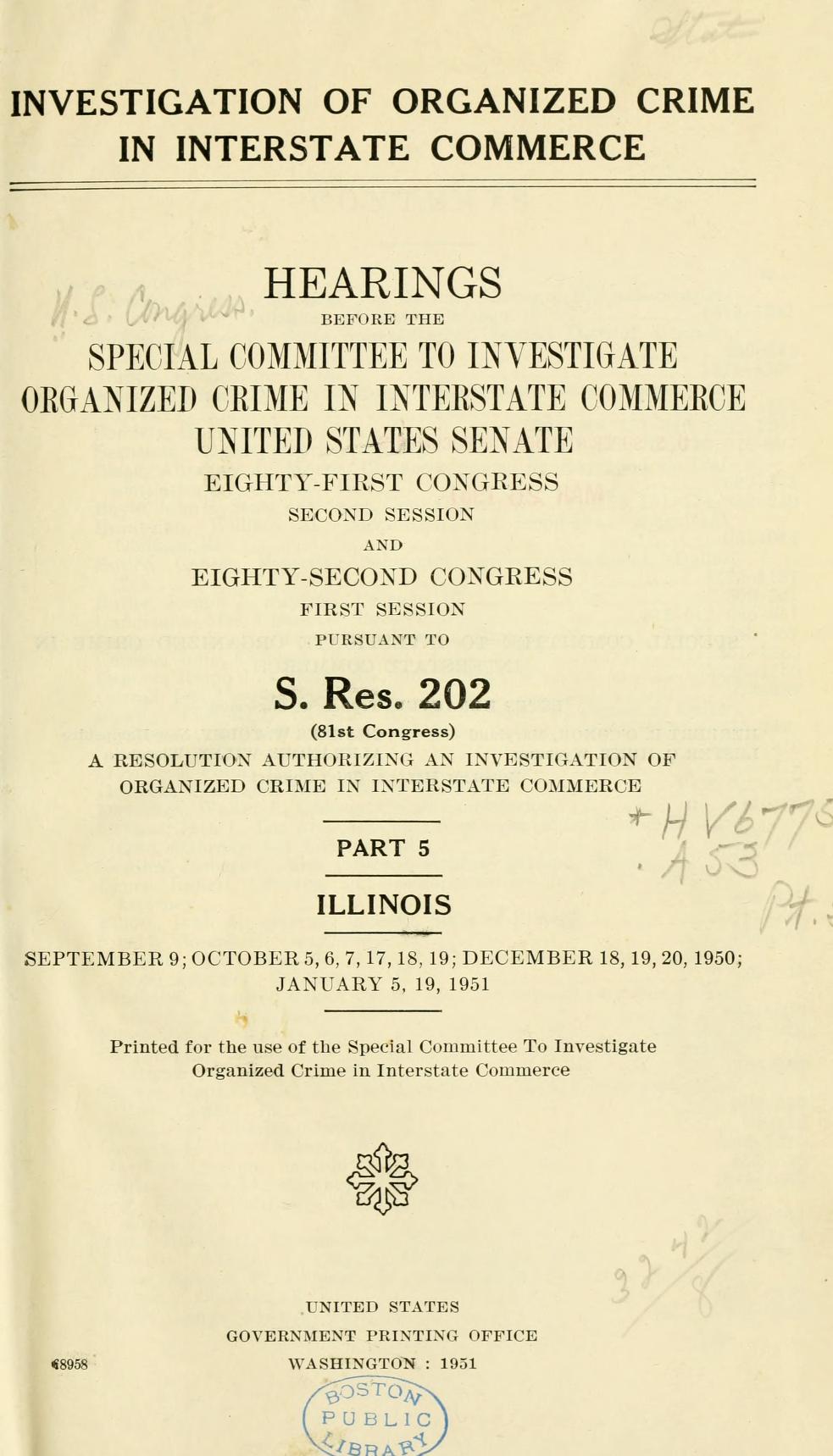
Internet Archive, scan of the printed hearings, Part 5: Illinois (Boston Public Library copy)
Kefauver Committee, Chicago: testimony of Lt. George Butler of the Dallas police (evening of 19 December 1950)
A Dallas detective lieutenant read the committee his notes of 1946 conversations with a man who claimed to represent a syndicate. Among the man's claims was that "the Jones boys," policy operators in Chicago, had paid $200,000 for "the snatch." The line is third-hand hearsay.
- Date
- 1950-12-19
- Kind
- hearing
- Retrieved
- 2026-10-12
- Docket
- Hearings, S. Res. 202 (81st Cong.), Part 5: Illinois (GPO 1951)
- Rights
- A work of the United States Congress, printed by the Government Printing Office. Public domain in the United States. 17 U.S.C. § 105. The scan is of a GPO printing; Internet Archive marks it not in copyright.
Printed pages 1176 to 1180 of Part 5, in the evening session of 19 December 1950, after the testimony of Theodore Roe and Edward P. Jones. George Butler gave his position as “Detective lieutenant, Dallas Police Department, Dallas, Tex.,” on the force since 1 May 1936 and assigned to the vice squad. At the start of his appearance counsel offered the committee’s chart of Chicago policy wheels as Exhibit 62 (Exhibits 60 to 62).
Butler was then questioned about a 1946 approach to the newly elected Dallas County sheriff, and read from notes of what a man, referred to in the questioning as Jones, had told him. In the passage at page 1179 he reads that the man said his outfit was authorized to offer the new district attorney and sheriff money for protection, “that the Jones boys, Negro policy operators in Chicago, paid $200,000 for the snatch there and they were now in Mexico,” and that his outfit was trying to take over the racing wire service. The OCR prints “Xegro” for “Negro”; the word is the notes’ own.
This is hearsay at two removes: a police officer reading his own notes of what another man claimed. Nothing in it shows how that man knew. The $200,000 differs from the $100,000 that Roe testified George Jones paid the same evening (Roe), and Edward Jones gave no figure (Jones). The man Butler calls Jones is not shown by this record to be one of the Chicago Jones brothers, and should not be confused with them. The record is filed because it is the only figure in the volume from outside the Jones and Roe accounts, and it is labelled as hearsay for that reason.