Record
Hearing
1947-11-28
Congressional Record (Bound Edition), vol. 93, pt. 9, House, pp. 10944-10946, via govinfo
Congressional Record, House, 28 November 1947: Representative Hoffman, "The Parole of Four Capone Gangsters"
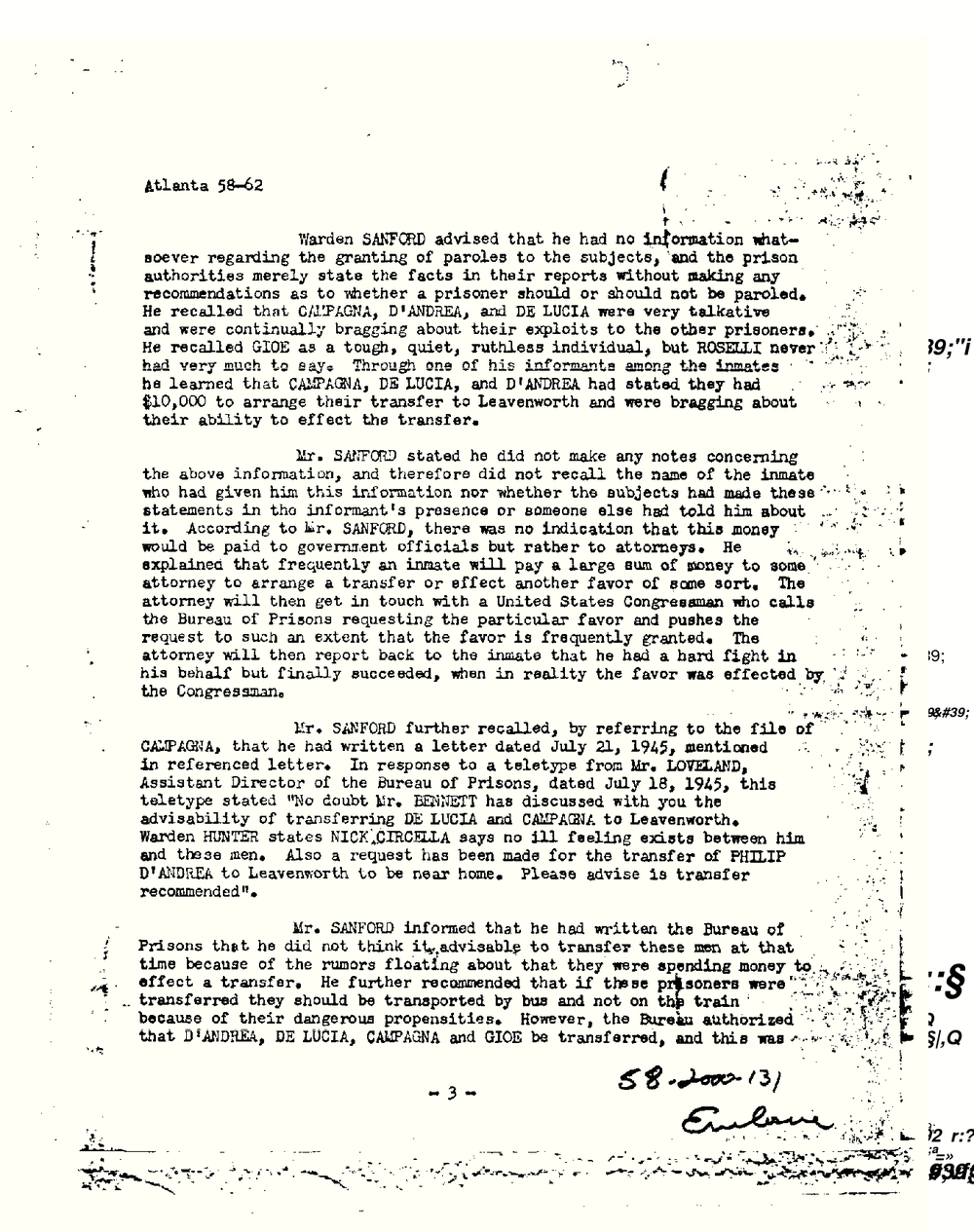
The chairman of the House Committee on Expenditures in the Executive Departments reports on his subcommittee's inquiry into the August 1947 paroles: hearings in Chicago on 25 and 26 September 1947 (508 pages of transcript) and in Washington on 7 October, paroles granted "just 37 days" after eligibility, a tax compromise, and the Atlanta warden's 1945 letter against the transfer.
- Date
- 1947-11-28
- Kind
- hearing
- Retrieved
- 2026-10-12
- Rights
- The Congressional Record, printed by the Government Printing Office. A work of the United States Congress, public domain under 17 U.S.C. § 105.
The bound Congressional Record for 28 November 1947, House section, read from the text layer of the govinfo PDF. The text layer interleaves the three printed columns; the passages below were read in column order, and only short phrases are quoted. The Record prints the speaker as “Mr. HOFFMAN” of Michigan; the 1949 Record gives his name as Clare E. Hoffman.
Under the heading “The Parole of Four Capone Gangsters,” Hoffman reported on the inquiry “into the parole last August of four notorious Capone gangsters from the city of Chicago.” He said that a subcommittee of the Committee on Expenditures in the Executive Departments began with “hearings at the Federal Building, Chicago, on September 25 and 26, 1947,” which “produced 508 pages of stenographic transcript,” followed by hearings in the committee rooms at Washington on October 7, 1947. Members of the subcommittee, Mr. Busbey and Mr. Dorn, visited the federal penitentiaries at Atlanta and Leavenworth.
He said each man was sentenced to ten years beginning in April 1944, that parole “was granted to each on August 13, 1947, just 37 days after they first became eligible for parole on July 7, 1947,” and that the paroles were granted “over the objection of the trial judge.” He said federal tax claims “aggregating 86,877 levied against Campagna, were compromised and settled on the payment of around 9,000” while he was in prison. He cited a letter of July 21, 1945 from “Warden Joseph W. Sanford, of Atlanta,” recommending against the transfer to Leavenworth, and quoted testimony of Paul Dillon, a St. Louis lawyer, who “dropped in on August 6” at the Parole Board, a week before the paroles were signed.
This is a congressman’s floor statement. Its characterizations, including a Department of Justice notation it quotes that De Lucia “was one of the leaders of a gang in Chicago, commonly known as the Syndicate which succeeded to the power of Al Capone,” are quoted statements, not findings, and are not used for any chart. The printed hearing transcript itself has not been found; see the Seventh Circuit’s account in 178 F.2d 876.