Record
Hearing
1950-10-05
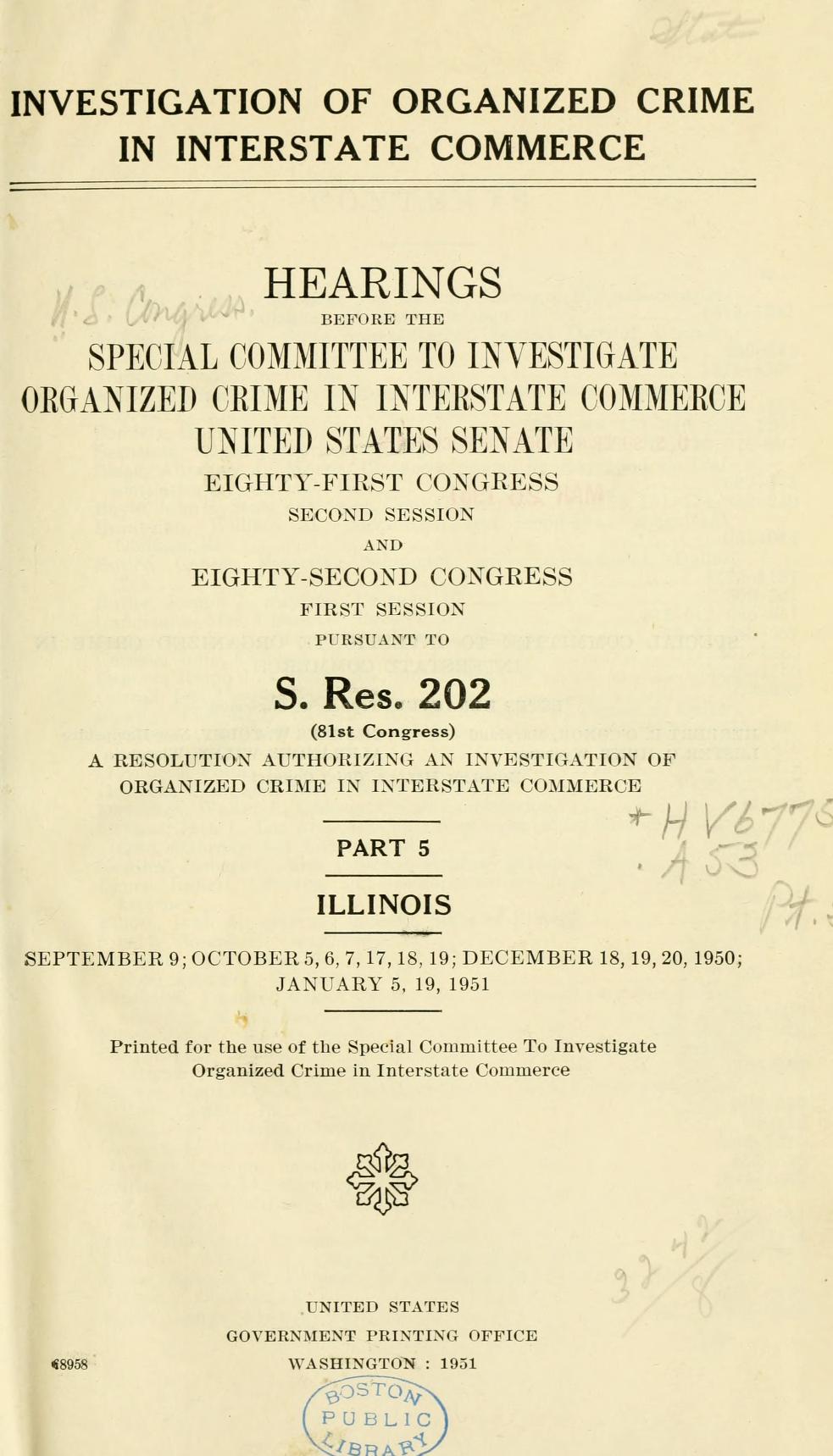
U.S. Senate Special Committee to Investigate Organized Crime in Interstate Commerce, Hearings, Part 5 (Illinois), via Internet Archive
Kefauver Part 5: testimony of U.S. Attorney Otto Kerner, Jr., on the parole grand jury (5 October 1950)
In executive session at Chicago, the U.S. Attorney for the Northern District of Illinois described the grand jury that heard Campagna, Gioe, De Lucia and D'Andrea on "the manner of obtaining their paroles," and Accardo's visits to Leavenworth under the name Joseph Bulger. Printed pp. 182-196.
- Date
- 1950-10-05
- Kind
- hearing
- Retrieved
- 2026-10-12
- Rights
- A hearing print of the United States Senate, published by the Government Printing Office. A work of the United States Congress, public domain under 17 U.S.C. § 105.
Otto Kerner, Jr., U.S. Attorney for the Northern District of Illinois, testified in executive session at Chicago on Thursday, October 5, 1950. His testimony runs pp. 182-196 of Part 5; the volume’s index lists him at pp. 111-136 and 182-196. This page was filed from the Internet Archive’s OCR text of the volume.
Kerner said that “the parole warrants against three of the parolees, Campagna, Gioe, and DeLucia, were issued out of this district,” and that a federal grand jury sat intermittently over many months (the OCR of the figure is garbled). “Campagna, Gioe, DeLucia, and D’Andrea, were before the grand jury. We sought information both as to the manner of obtaining their paroles and also as to their conduct since the paroles were granted.” He described testimony that an attorney was paid 0,000 by check to appear before the Parole Board, and an attorney’s account of being asked to obtain dismissal of “another indictment pending against these same defendants” in New York, for which he asked 5,000, after which the indictment was dismissed.
He testified that attorney Eugene Bernstein visited the prisoners at Leavenworth and that on one visit “he was accompanied by Tony Accardo, who used the name of Joseph Bulger” in signing the visitors’ register; both were indicted for it. He said he understood that the sentencing judge had “advised by letter that these men should not be considered for parole.”
Kerner’s statements about payments describe what other witnesses told the grand jury. They are his testimony, not findings of the committee or of a court. The Ricca, Campagna, Gioe and Accardo testimony before the committee is in the Part 5 volume.