Between 1935 and 1940, according to the testimony a federal jury accepted, officers of the stagehands’ and projectionists’ union and a group of Chicago men extorted money from motion-picture exhibitors and producers by threatening strikes. This section files the records of what followed: the prosecution of the union’s president, George E. Browne, and William Bioff in 1941; the 1943 trial of the Chicago defendants, at which Browne and Bioff testified for the government; the paroles of four of those defendants in August 1947; the House inquiry into the paroles; and the habeas corpus cases that ran in Atlanta and Chicago until 1952.
Every page is cited to a court opinion, a National Archives record, an FBI Vault page, the Congressional Record or the Kefauver hearings. A court’s account of the testimony is labelled as that. Statements by congressmen, informants and FBI interviewees are labelled as theirs, and none of them is used for a chart. The Chicago Outfit chart stays empty.
Bioff and Browne, 1939–1945
- United States v. Bioff, 40 F. Supp. 497: Judge Rifkind overruled Browne’s demurrer and plea in abatement on 5 September 1941. It is a pretrial ruling and does not describe the trial.
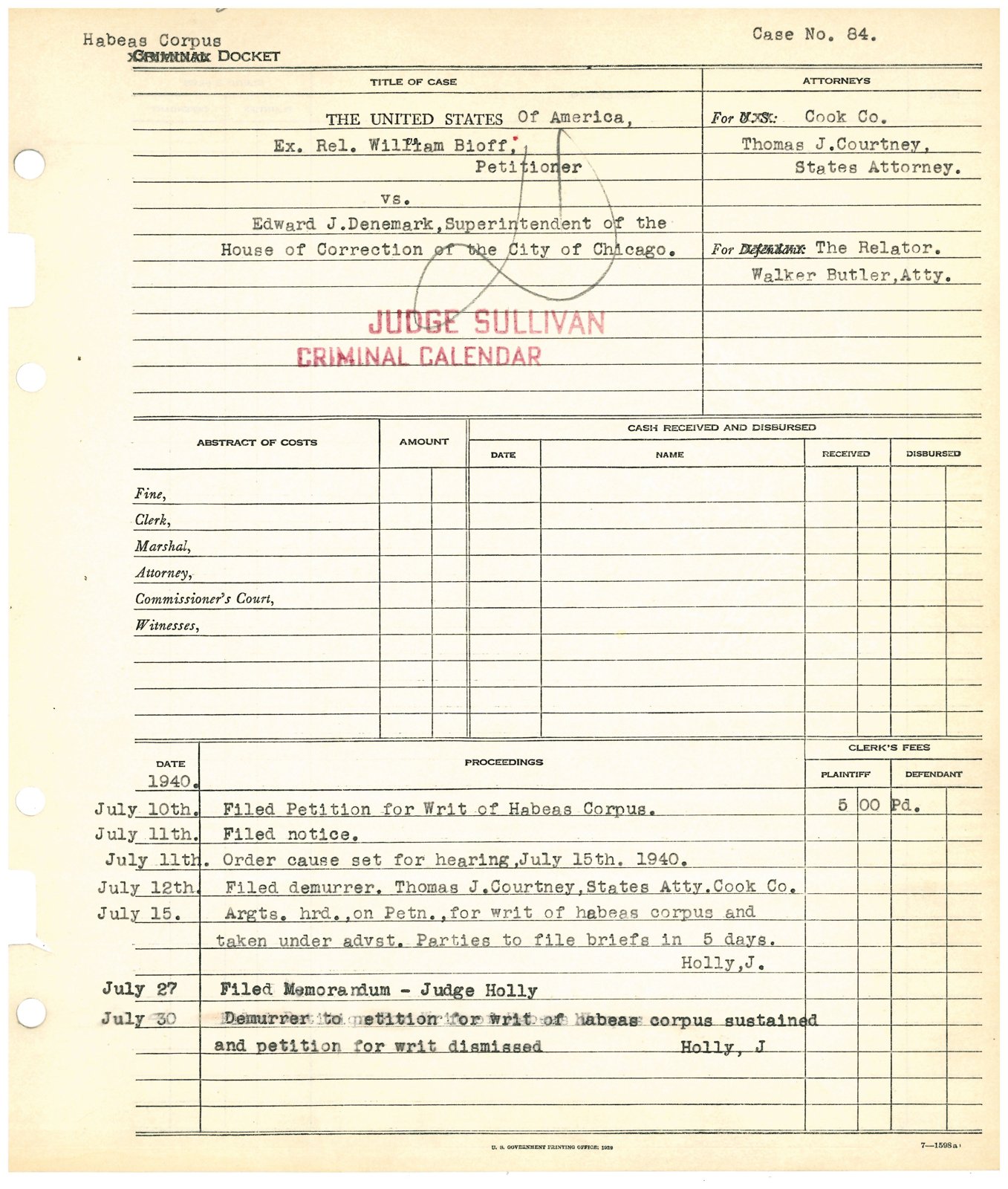
- Bioff’s 1940 habeas docket: Case No. 84 in the federal court at Chicago, against the superintendent of the City of Chicago House of Correction, dismissed on 30 July 1940. The docket does not say why he was held.
- The Treasury report for October 1942: “Bioff is presently serving a ten-year sentence as a result of his conviction last year on charges of extortion from moving picture producers.” It is the only record on file that gives his sentence. An earlier Intelligence Unit memorandum of October 1939 names “the William Bioff case” among three tax cases referred for prosecution.
- Attorney General Biddle’s letter of 10 April 1945: after their conviction Bioff and Browne “testified for the Government against a group of Chicago racketeers,” Judge Knox modified their sentence, “and they were recently released.”
- The House speech of 10 November 1941, used with caution and only for its statement that the two “were convicted this month.” No court record of the 1941 verdict or sentence has been found.
The 1943 convictions
- United States v. Compagna, 146 F.2d 524: the Second Circuit affirmed the convictions of Compagna, De Lucia, D’Andrea, Gioe, Rosselli, Maritote and Kaufman on 20 December 1944. Its account of the testimony is the main source for the scheme. It gives the indictment date as 18 March 1943. Certiorari was denied on 2 April 1945.
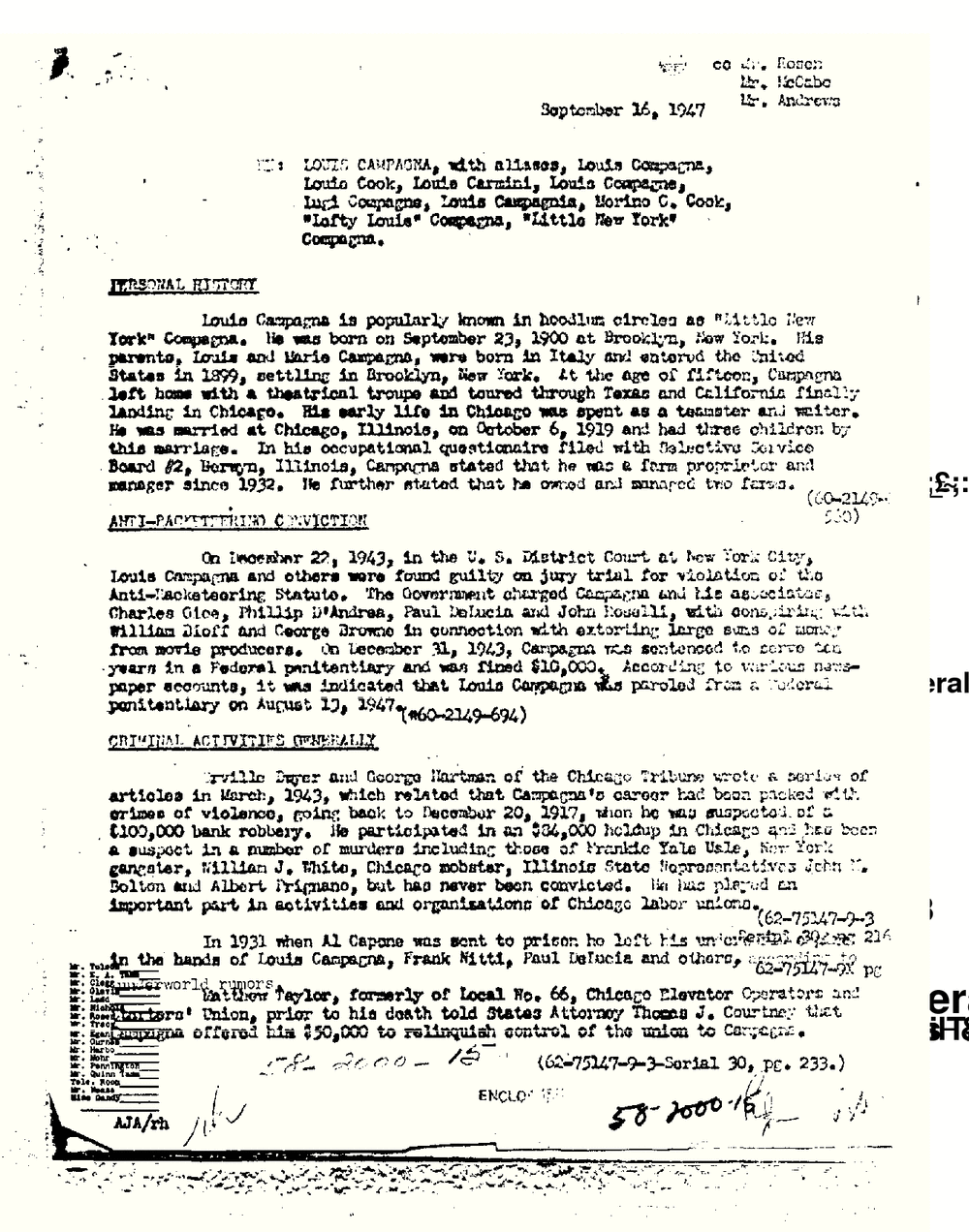
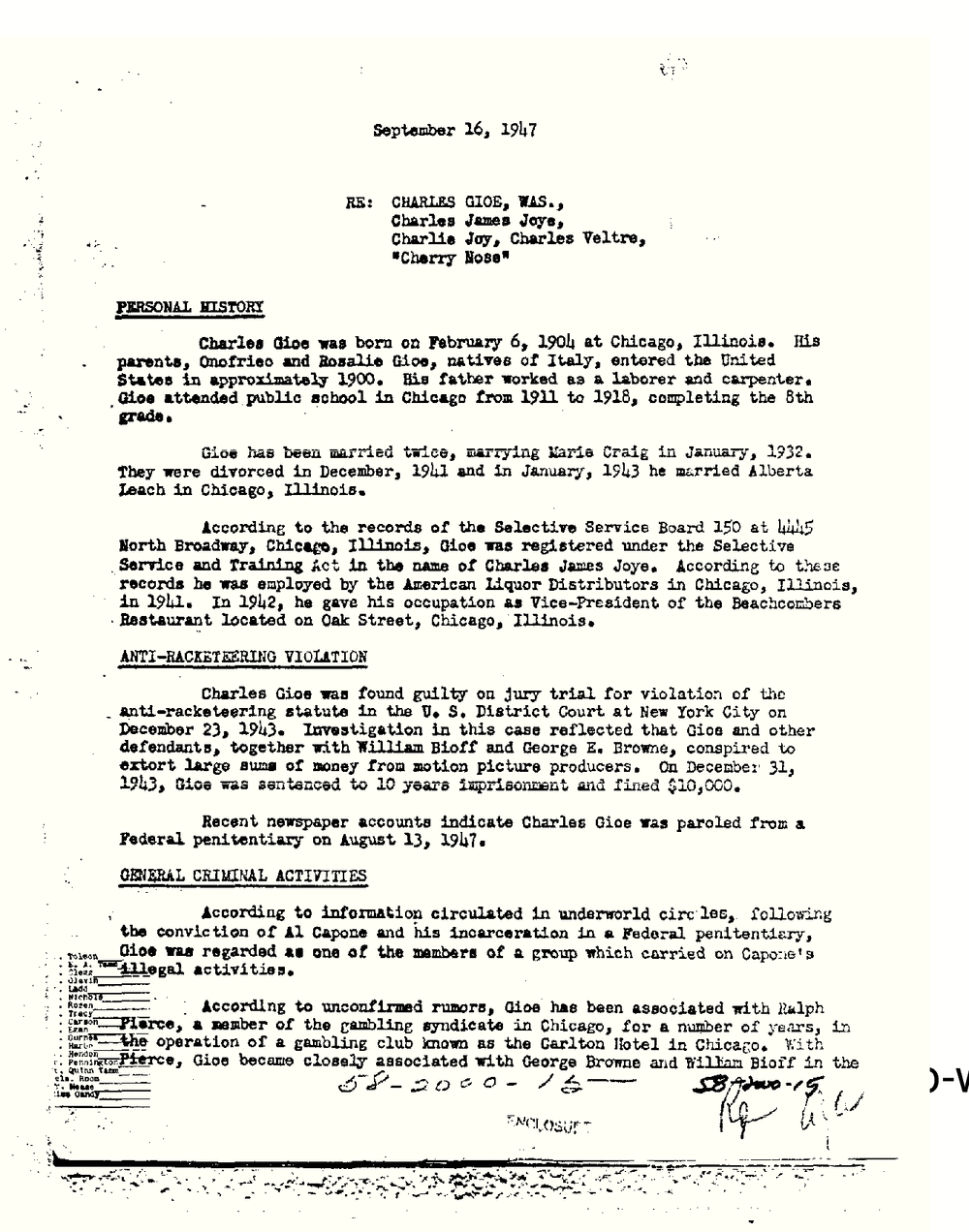
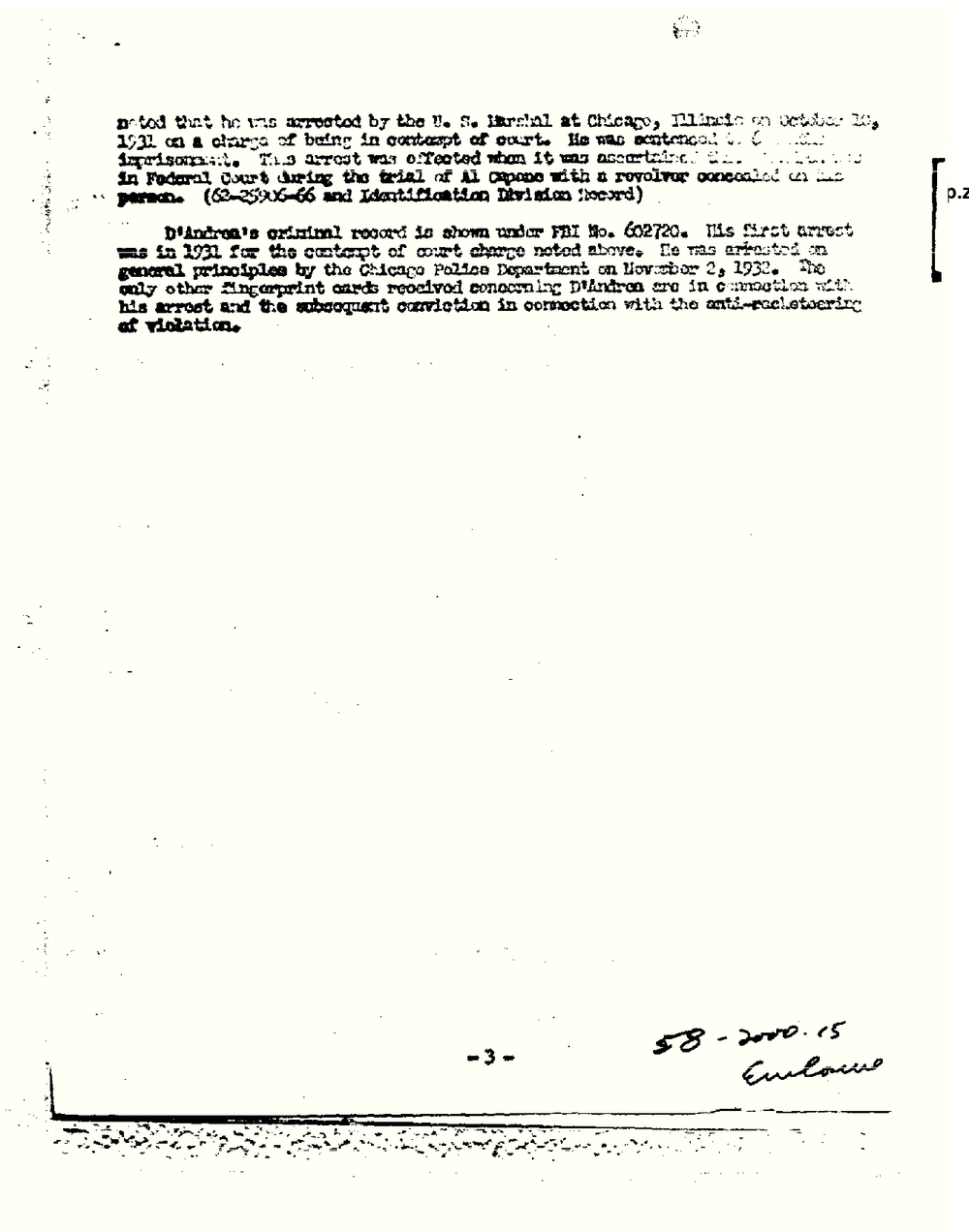
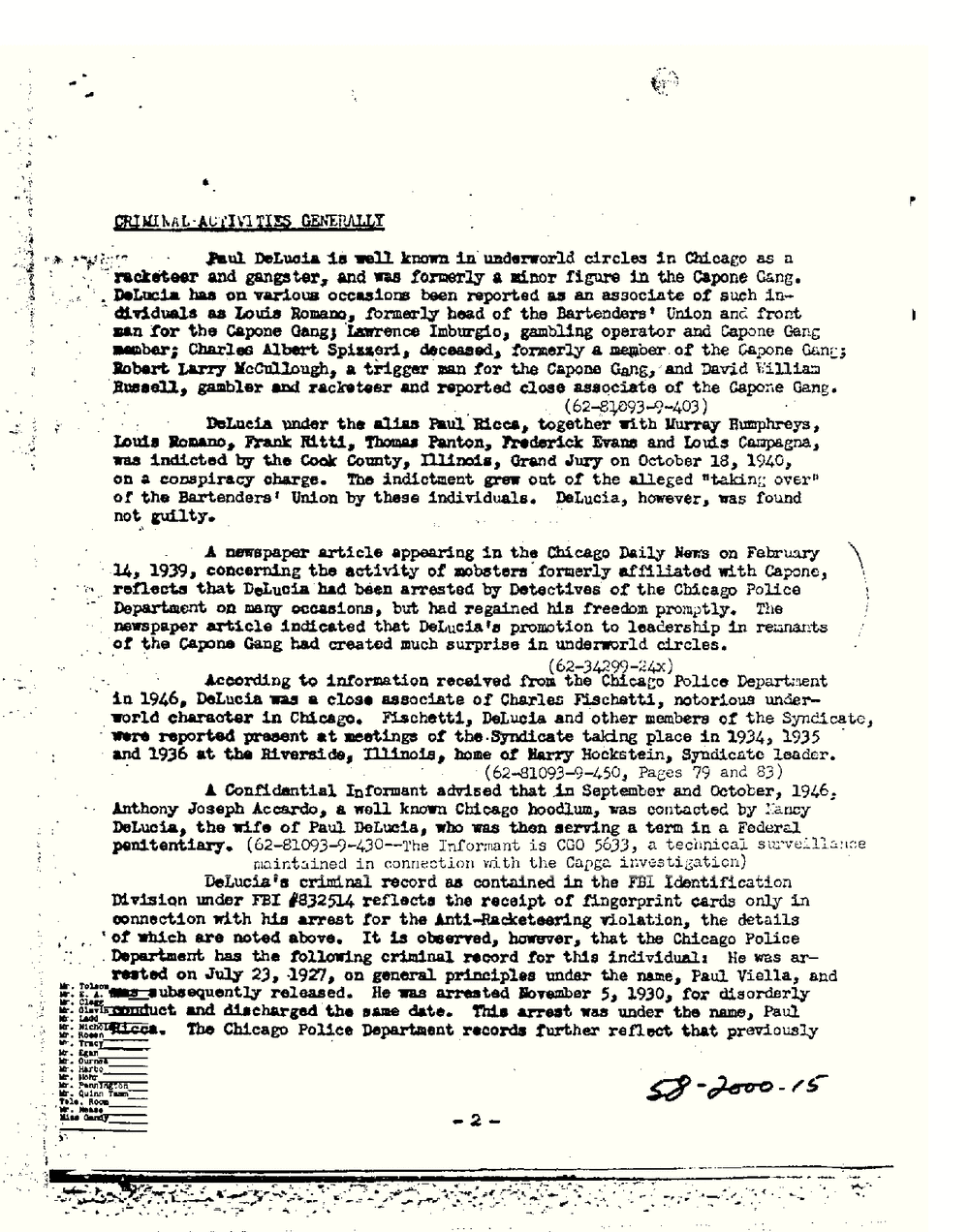
- The FBI’s personal-history memoranda of September 1947 on Campagna, Gioe, D’Andrea and De Lucia, filed in the Vault’s John Roselli Part 01, give the sentence date of 31 December 1943.
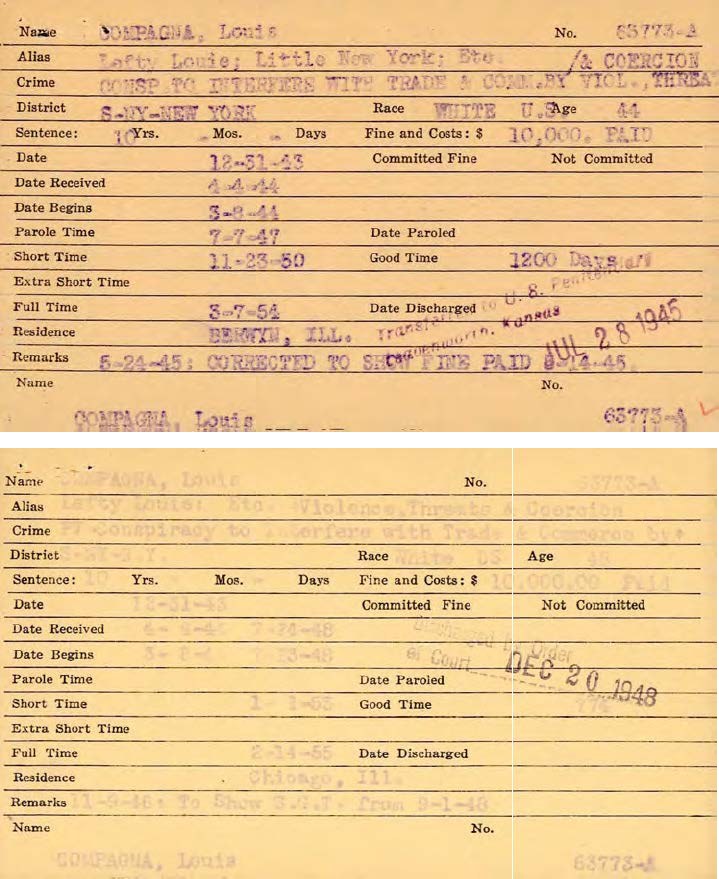
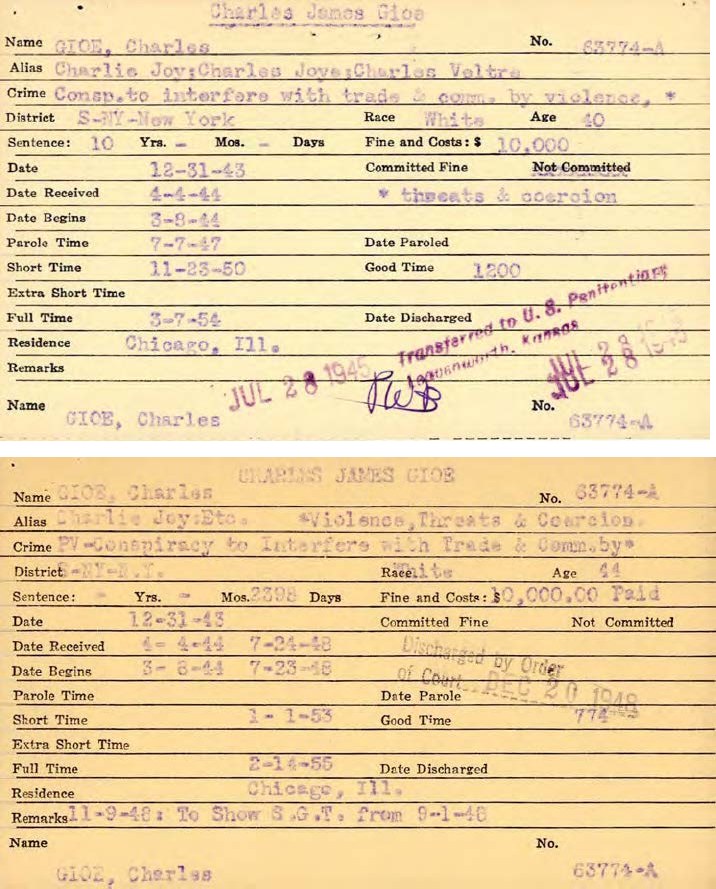
- The verdict date conflicts. The memoranda on Campagna and De Lucia, and the one on Roselli, say the jury found the defendants guilty on December 22, 1943. The memorandum on Gioe says December 23, 1943. No court paper giving the verdict was opened, so this archive does not choose between them. The sentence date of 31 December 1943 is the same in the FBI memoranda, the Atlanta court’s findings and the prison cards.
- The civil cases: Ratner v. Paramount (S.D.N.Y. 1942) and Hornstein v. Paramount (N.Y. 1944), stockholders’ suits over Paramount’s payments to Bioff and Browne, which the New York court held were “coerced by threats” of a strike; and Russel v. IATSE (Cal. 1944), a fee case that records Browne as the union’s “international president” and Bioff as his “personal representative.”
Hornstein and Russel are state-court opinions. They are not federal works, and this archive files them on the government-edicts doctrine, under which judicial opinions carry no copyright. Each page says so.
The 1947 paroles and the litigation, 1947–1952
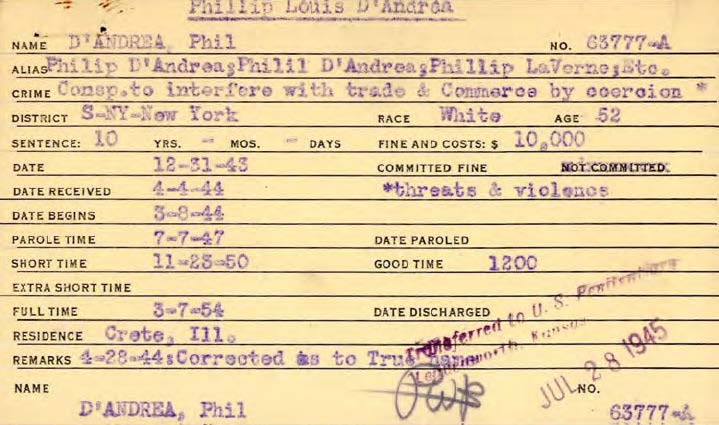
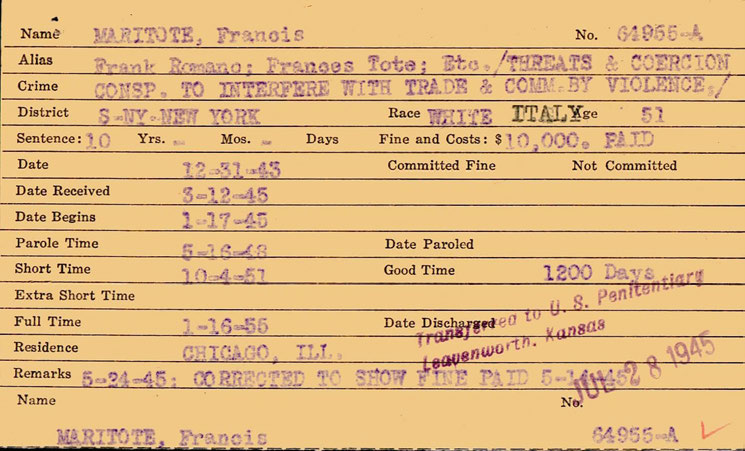
- The Atlanta index cards for Compagna, Gioe, D’Andrea and Maritote record the ten-year sentences, the transfer to Leavenworth stamped “JUL 28 1945,” and, for Compagna and Gioe, the return to Atlanta in July 1948 and the stamp “Discharged by Order of Court DEC 20 1948.”
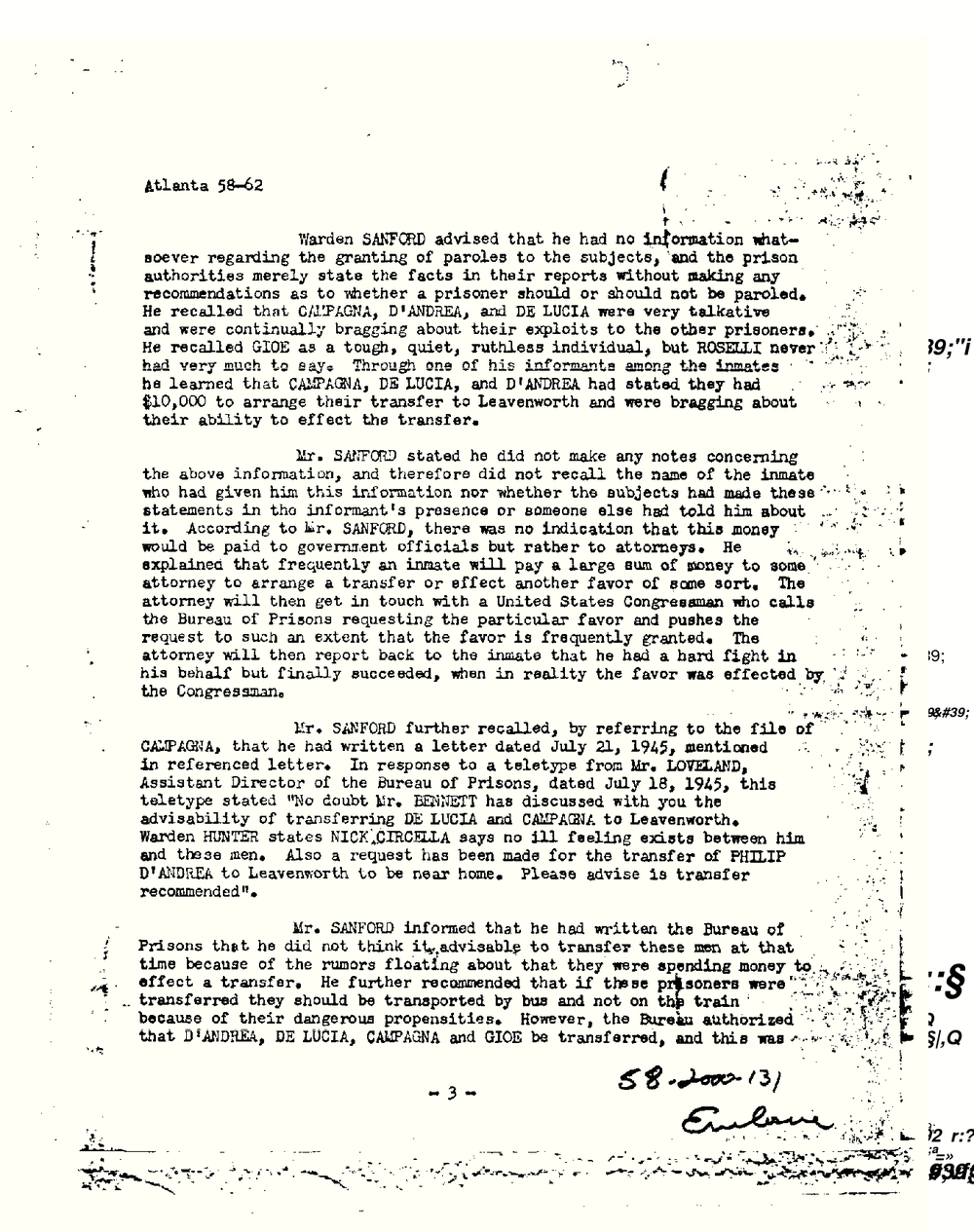
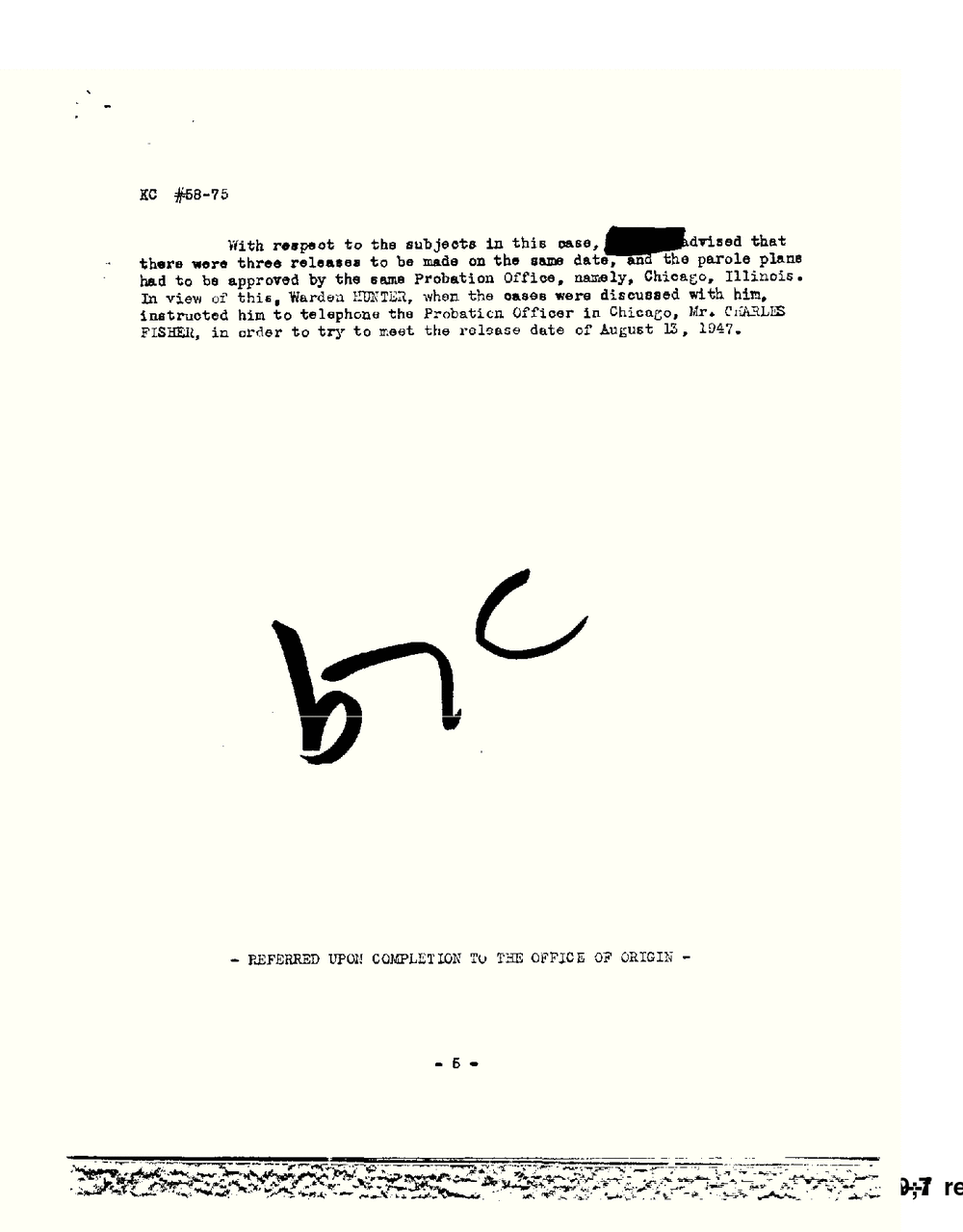
- The FBI’s Atlanta report gives the warden’s account of the 1945 transfer, “done by bus on July 28, 1945.” A Kansas City report records how the Leavenworth releases were timed “to try to meet the release date of August 13, 1947.” Chicago interview reports cover two letters written for D’Andrea’s parole.
- The Chicago habeas case of Paul De Lucia: 82 F. Supp. 435 (1948), affirmed at 178 F.2d 876 (7th Cir. 1949), and the second case after a new warrant, 107 F. Supp. 347 (1952), which discharged him “as a reinstated parolee.”
- The Atlanta habeas case of Campagna and Gioe: 82 F. Supp. 295 (1948); reversed in 178 F.2d 42 (5th Cir. 1949), with Judge Waller dissenting; affirmed by an equally divided Supreme Court in 340 U.S. 880 (1950); and on remand 100 F. Supp. 74 (1951), which held the revocations “arbitrary and total nullities.”
- Nitto v. Commissioner, 13 T.C. 858 (1949): the Tax Court found Frank Nitto’s “association with Bioff and Browne in their scheme” established and taxed his estate on the unreported proceeds.
- An FBI memorandum of August 1954 in the Jake Guzik file shows the Bureau’s “Louis Campagna, et al; Bribery, Parole Matter” case, Bufile 58-2000, still open in 1953.
The congressional inquiry
- Representative Hoffman’s statement of 28 November 1947: the House Expenditures subcommittee’s hearings in Chicago on 25 and 26 September 1947 and in Washington on 7 October, and the paroles granted “just 37 days” after eligibility.
- Representative Busbey’s additional views to House Report No. 2441, as printed in the Senate’s Record on 18 August 1949: the dismissal of a mail-fraud indictment, reduced tax liens, and lawyers’ fees, as one member stated them.
- U.S. Attorney Otto Kerner’s testimony to the Kefauver Committee, 5 October 1950: the Chicago grand jury that heard the parolees on “the manner of obtaining their paroles.”
The hearing transcript itself has not been found. The courts describe it: the De Lucia court records that “A five volume copy of the transcript of the Congressional Committee hearings was filed with the petition,” and the Seventh Circuit dates the hearings from 25 September 1947 to 7 June 1948.
The Circella photograph
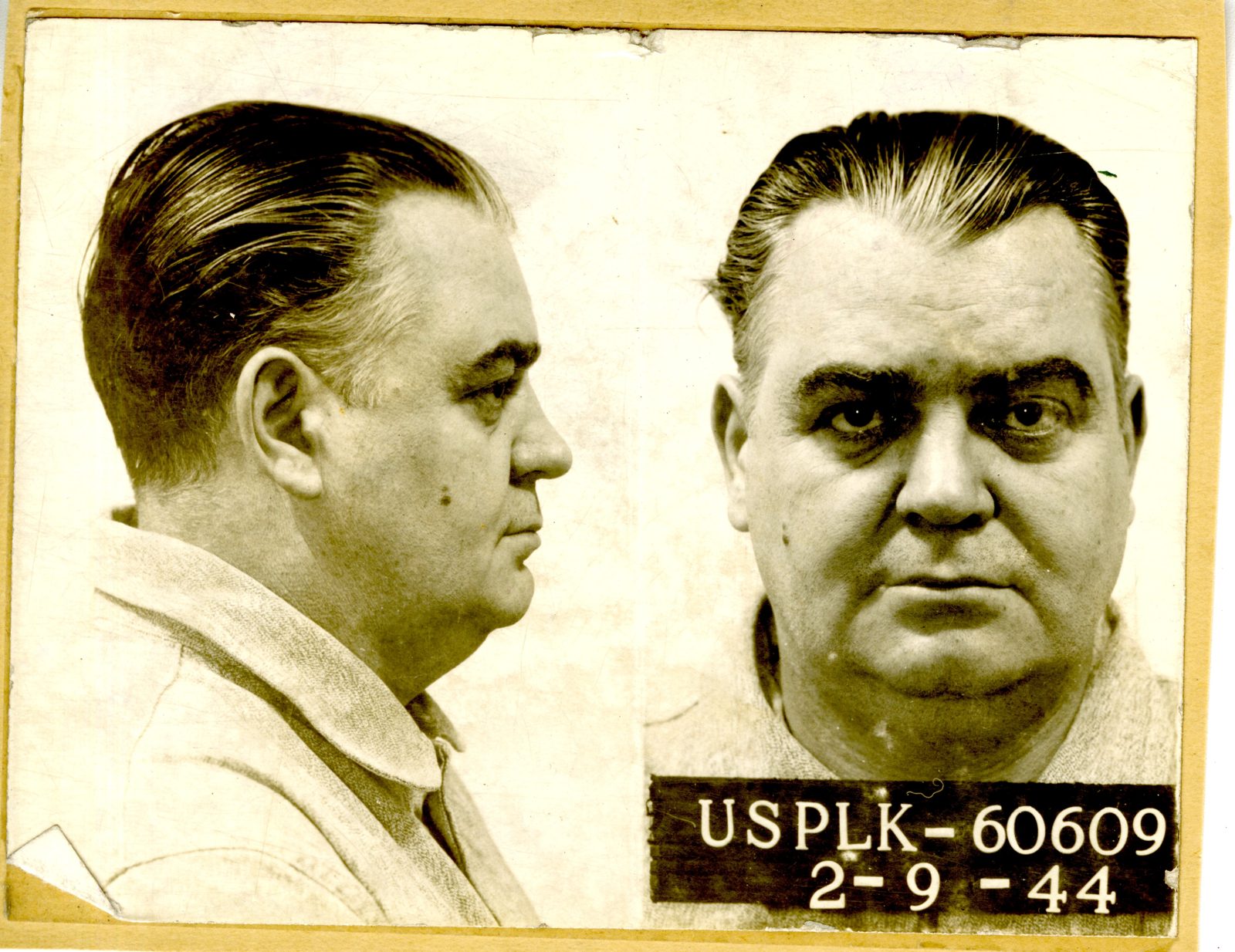
Nick Circella’s Leavenworth photograph of 9 February 1944, inmate 60609, is also in Faces. The photograph does not name a case. The Second Circuit’s account names a Circella who “kept a night club in Chicago” and who, with Bioff, was given a union office as Browne’s personal representative.
People
William Bioff, George E. Browne, Louis Campagna, Charles Gioe, Phil D’Andrea, Paul De Lucia (Ricca), John Roselli, Francis Maritote, Nick Circella, Louis Kaufman and Frank Nitti. A role is given only where a court opinion states one: Browne as president of the union, Bioff and Circella as his personal representatives, Roselli as “the representative of the group in California,” and Kaufman as “the local agent of the New Jersey local.” Each is the court’s description of a union office or of the testimony. None is a seat on a chart.
Not yet found
- No court record of the 1941 verdict and sentences of Bioff and Browne, and no appeal by either.
- The 1943 indictment, verdict and judgment papers, and the district court docket number. The appeal number, No. 103, is the only number on file.
- The mail-fraud indictment against the four parolees and its dismissal, described by Kerner and Busbey.
- The House hearing transcript and House Report No. 2441.
- De Lucia’s and Roselli’s Atlanta index cards; Leavenworth files for the parolees; any record of Circella’s sentence.
- A federal record of Frank Nitti’s death in 1943.
- Newspaper pages for 1941 to 1947. They were not reachable during the research and, if filed, will need a rights decision.