Charles Gioe
Convicted in 1943 in the motion-picture extortion case and sentenced to ten years; paroled from Leavenworth on 13 August 1947, retaken in July 1948, and in 1951 discharged by the Atlanta court as a reinstated parolee.
- Aliases
- Charles James Joye, Charlie Joy, Charles Joye, Charles Veltre, Cherry Nose
- Rights
- Biography on this page is limited to what the cited federal records state.
On the record
- 1904 — The FBI memorandum of 16 September 1947 (Vault, Roselli Part 01, scan 9) says he "was born on February 6, 1904 at Chicago, Illinois," as read on the page image; the OCR used in the research read the year as 1901. The born field is left empty.
- 1935–1940 — United States v. Compagna (2d Cir. 1944): "To deLucia Bioff repeatedly paid part of the blackmail; and, on occasion, he did the same to Gioe, though not so often."
- 23 December 1943 — The same FBI memorandum says Gioe "was found guilty on jury trial for violation of the anti-racketeering statute in the U. S. District Court at New York City on December 23, 1943," and was sentenced on December 31, 1943 to ten years and a $10,000 fine. The companion memoranda on Campagna and De Lucia give December 22.
- 4 April 1944 — Atlanta index card No. 63774-A: aliases "Charlie Joy; Charles Joye; Charles Veltre," ten years dated 12-31-43, received 4-4-44, residence Chicago, stamped "Transferred to U.S. Penitentiary Leavenworth, Kansas" on 28 July 1945.
- 13 August 1947 — Compagna v. Hiatt (N.D. Ga. 1951): "Petitioners and a co-defendant, de Lucia, were discharged together from Leavenworth Penitentiary August 13, 1947."
- 23 July 1948 — Compagna v. Hiatt (N.D. Ga. 1948): arrested on 23 July 1948 on a parole-violator warrant dated 21 July 1948 and returned to the Atlanta penitentiary. His second Atlanta card is stamped "Discharged by Order of Court DEC 20 1948."
- 1949–1950 — Hiatt v. Compagna (5th Cir. 1949) records that he was charged with five parole violations and remanded him to custody; the Supreme Court affirmed by an equally divided Court in 1950.
- 18 September 1951 — Compagna v. Hiatt (N.D. Ga. 1951) found "no substantial evidence of violations of parole by either of petitioners" and ordered both discharged "as reinstated parolees."
The aliases are those on the Atlanta card and in the heading of the 1947 FBI memorandum, which reads “Charles Gioe, was., Charles James Joye, Charlie Joy, Charles Veltre, ‘Cherry Nose’.” The memorandum says he registered for the draft “in the name of Charles James Joye.”
The 1947 memorandum also relays “information circulated in underworld circles” that after Capone’s imprisonment Gioe “was regarded as one of the members of a group which carried on Capone’s illegal activities.” That is rumor as the Bureau recorded it, so this page leaves family and role empty. No record opened for this archive gives his death.
Records
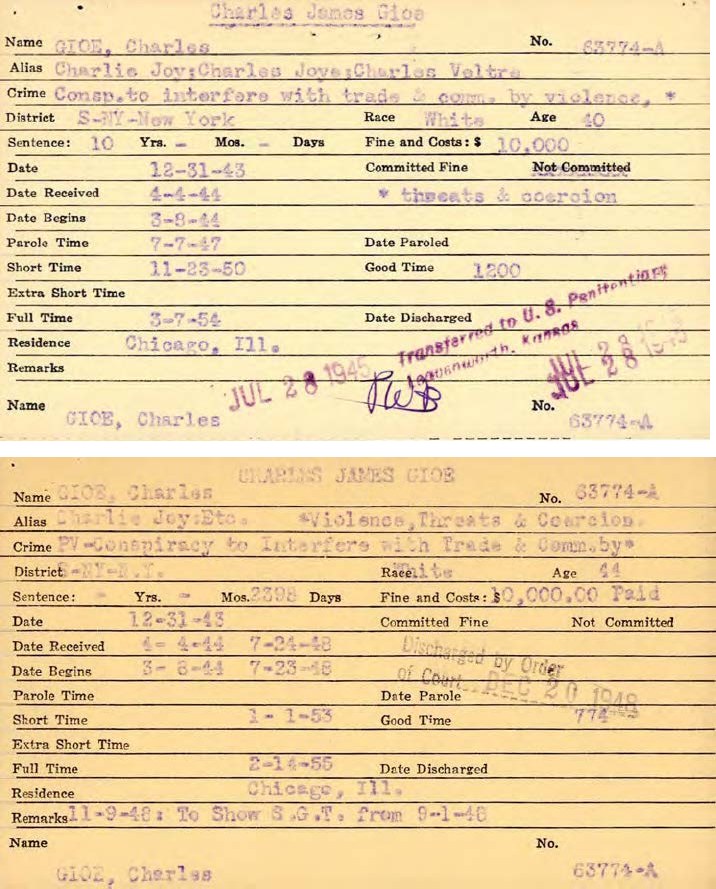 itemAtlanta penitentiary index cards: Gioe, Charles, No. 63774-A (1944–1948)Two prisoner index cards from the U.S. Penitentiary, Atlanta, for "Charles James Gioe," aliases Charlie Joy, Charles Joye and Charles Veltre: ten years from 31 December 1943, transferred to Leavenworth on 28 July 1945, received again in July 1948, and stamped "Discharged by Order of Court DEC 20 1948."
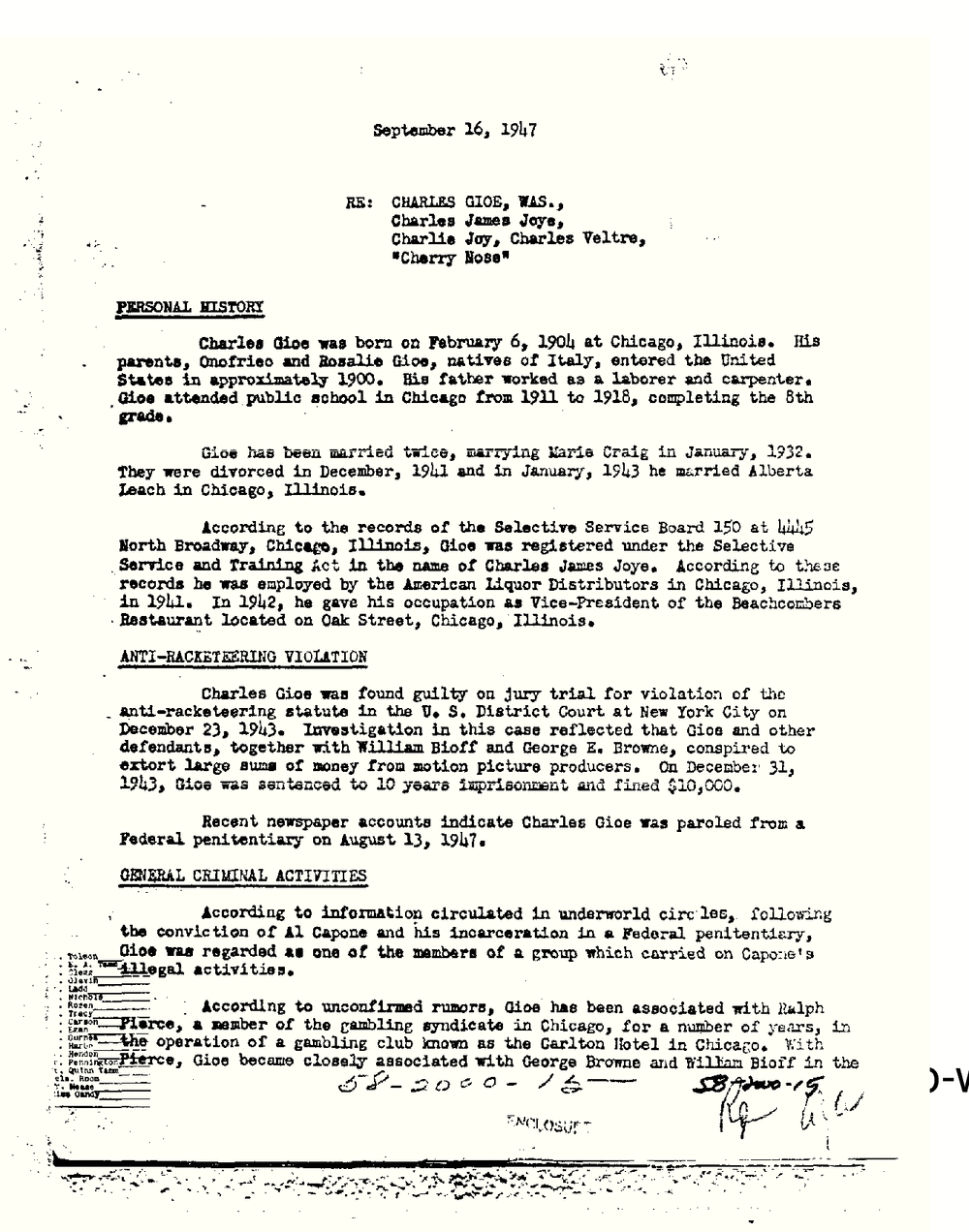 itemFBI memorandum of 16 September 1947 on Charles Gioe (Vault, John Roselli Part 01)The FBI's September 1947 personal-history memorandum on Charles Gioe. It says he "was found guilty on jury trial for violation of the anti-racketeering statute" in New York "on December 23, 1943," a day later than the date in the companion memoranda, and was sentenced on 31 December 1943.itemUnited States v. Compagna, 146 F.2d 524 (2d Cir. 1944)Second Circuit opinion of December 20, 1944 affirming the convictions of Compagna and six others for a conspiracy to extort money from motion-picture producers and exhibitors, 1935 to 1940.itemCompagna v. Hiatt, 82 F. Supp. 295 (N.D. Ga. 1948)Judge Underwood's findings of 4 December 1948 on the habeas petitions of Louis Campagna (spelled Compagna) and Charles Gioe at the Atlanta penitentiary: sentenced 31 December 1943, paroled 13 August 1947, retaken 23 July 1948. The court held the warrants void; reconsideration was denied 20 December 1948.itemHiatt v. Compagna, 178 F.2d 42 (5th Cir. 1949)The Fifth Circuit reversed the Atlanta court on 10 November 1949 and remanded Campagna and Gioe to the warden's custody. It records that after the 1947 paroles "Unfavorable newspaper publicity followed" and a congressional investigation; Judge Waller dissented.itemCompagna v. Hiatt, 340 U.S. 880 (1950)The Supreme Court's per curiam of 13 November 1950: "The judgment is affirmed by an equally divided Court. Mr. Justice Clark took no part in the consideration or decision of this case."itemCompagna v. Hiatt, 100 F. Supp. 74 (N.D. Ga. 1951)On remand, Judge Underwood held on 18 September 1951 that the revocations of Campagna's and Gioe's paroles were "arbitrary and total nullities" and discharged both "as reinstated parolees." The findings describe the 13 August 1947 release from Leavenworth and the flight from Kansas City to Chicago.
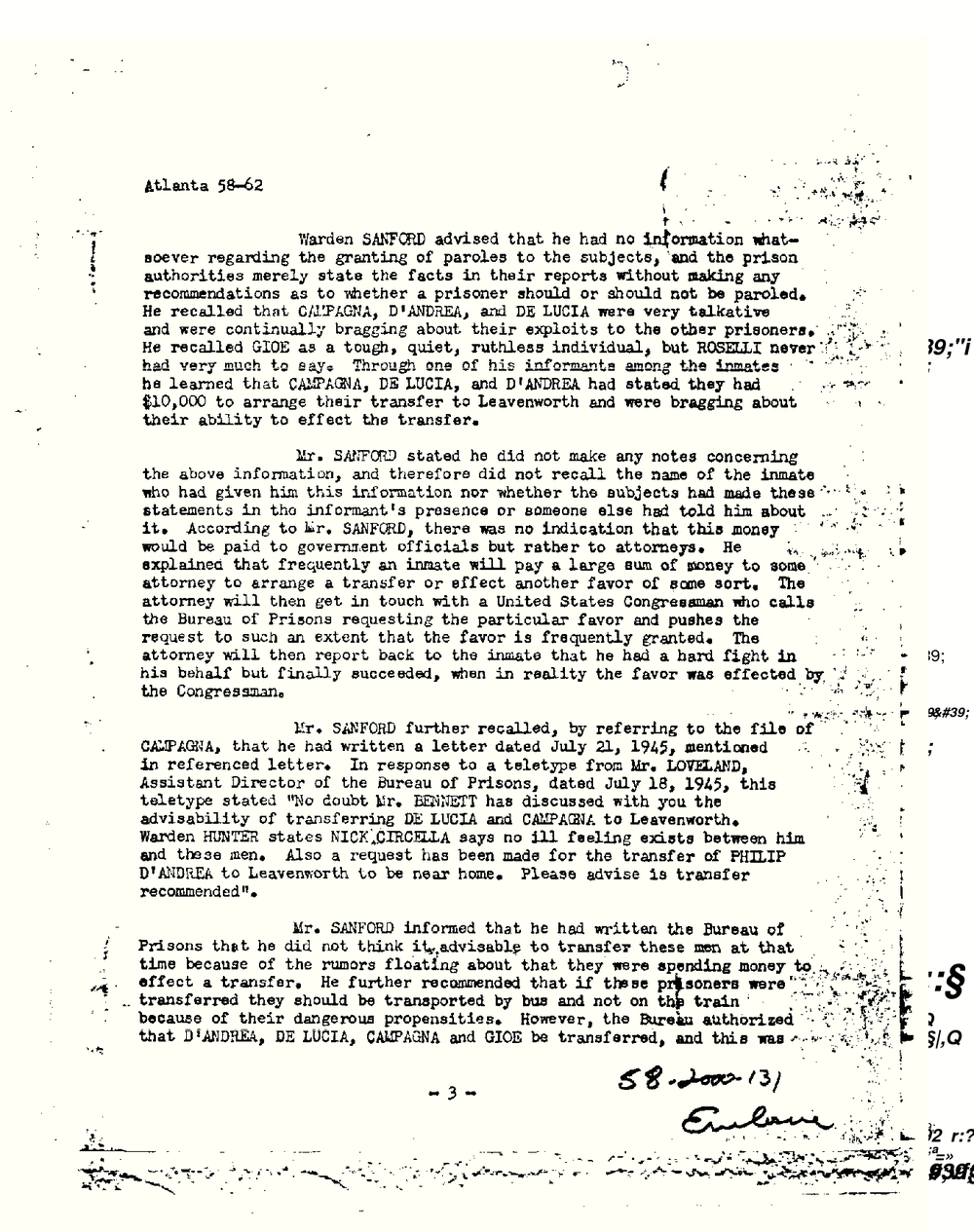 itemFBI Atlanta report (file Atlanta 58-62), autumn 1947: Warden Sanford on the prisoners and their 1945 transfer to Leavenworth (Vault, John Roselli Part 02)The Atlanta office's report for the 1947 parole inquiry. Warden Sanford said he made no parole recommendations, recalled an inmate informant's report that three of the men "had stated they had $10,000 to arrange their transfer", and said the transfer to Leavenworth was "done by bus on July 28, 1945."itemKefauver Part 5: testimony of U.S. Attorney Otto Kerner, Jr., on the parole grand jury (5 October 1950)In executive session at Chicago, the U.S. Attorney for the Northern District of Illinois described the grand jury that heard Campagna, Gioe, De Lucia and D'Andrea on "the manner of obtaining their paroles," and Accardo's visits to Leavenworth under the name Joseph Bulger. Printed pp. 182-196.itemCongressional Record, Senate, 18 August 1949: Representative Busbey's additional views to House Report No. 2441 on the "Capone gang paroles"During debate on Tom C. Clark's nomination to the Supreme Court, Senator Ferguson had printed Representative Fred E. Busbey's additional views from the Seventeenth Intermediate Report of the House Expenditures Committee. Busbey lists what the subcommittee examined, including the dismissal of a mail-fraud indictment and the reduction of tax liens on two of the men.