Phil D'Andrea
Convicted in 1943 in the motion-picture extortion case and sentenced to ten years; transferred from Atlanta to Leavenworth in July 1945 and paroled on 13 August 1947. A 1947 FBI memorandum records his 1931 arrest for carrying a revolver into the federal court during Al Capone's trial.
- Aliases
- Phillip Louis D'Andrea, Philip D'Andrea, Phillip D'Andrea, Phillip LaVerne
- Rights
- Biography on this page is limited to what the cited federal records state.
On the record
- 1931 — The FBI memorandum of September 1947 (Vault, Roselli Part 01, scan 13) says he was arrested by the U.S. Marshal at Chicago in October 1931 for contempt of court, an arrest "effected when it was ascertained" that he was "in Federal Court during the trial of Al Capone with a revolver concealed on his person." It gives his FBI number as 602720. Representative Hoffman cited the same incident from Justice Department records in 1947.
- 1935–1940 — United States v. Compagna (2d Cir. 1944): "Maritote and D'Andrea were given sinecures in the business of Barger, at weekly payments of from $175 to $200."
- 4 April 1944 — Atlanta index card No. 63777-A: ten years dated 12-31-43, $10,000 fine, received 4-4-44, residence Crete, Ill., stamped "Transferred to U.S. Penitentiary Leavenworth, Kansas JUL 28 1945."
- July 1945 — An FBI Atlanta report of 1947 quotes a Bureau of Prisons teletype of 18 July 1945: "a request has been made for the transfer of PHILIP D'ANDREA to Leavenworth to be near home."
- September 1947 — FBI Chicago reports (Vault, Roselli Part 03) record interviews of two truck-company sales officials who said they had written letters urging his parole and that no money, threats or pressure were used.
- 16 June 1948 — United States ex rel. De Lucia v. O'Donovan (N.D. Ill. 1948) names him as one of the four men who petitioned for habeas corpus in Chicago on 16 June 1948.
- 5 October 1950 — U.S. Attorney Otto Kerner testified to the Kefauver Committee that D'Andrea was among the parolees heard by the Chicago grand jury on "the manner of obtaining their paroles."
The aliases are those on the Atlanta card, which is headed “Phillip Louis D’Andrea,” and in the FBI memorandum. The FBI memorandum’s birth data and any titles on its first pages are not legible enough to record, and its first page prints residence addresses, so it is not reproduced. No record opened for this archive gives his birth or death, and none states a family or role for him.
Records
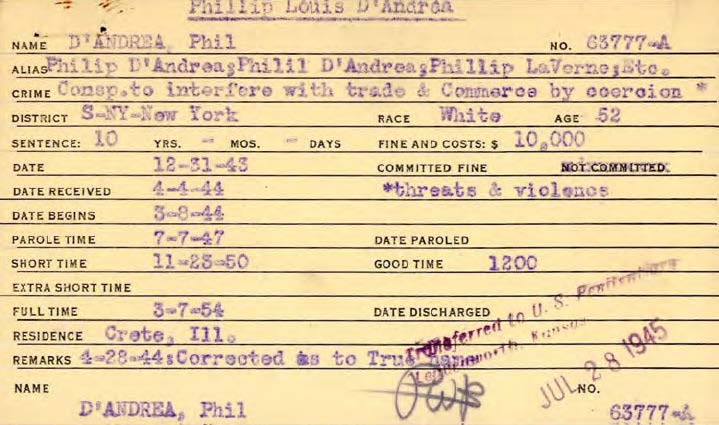 itemAtlanta penitentiary index card: D'Andrea, Phil, No. 63777-A (1944–1945)Prisoner index card from the U.S. Penitentiary, Atlanta, for "Phillip Louis D'Andrea": conspiracy to interfere with trade and commerce by coercion, threats and violence, Southern District of New York, ten years from 31 December 1943, residence Crete, Ill., transferred to Leavenworth on 28 July 1945.
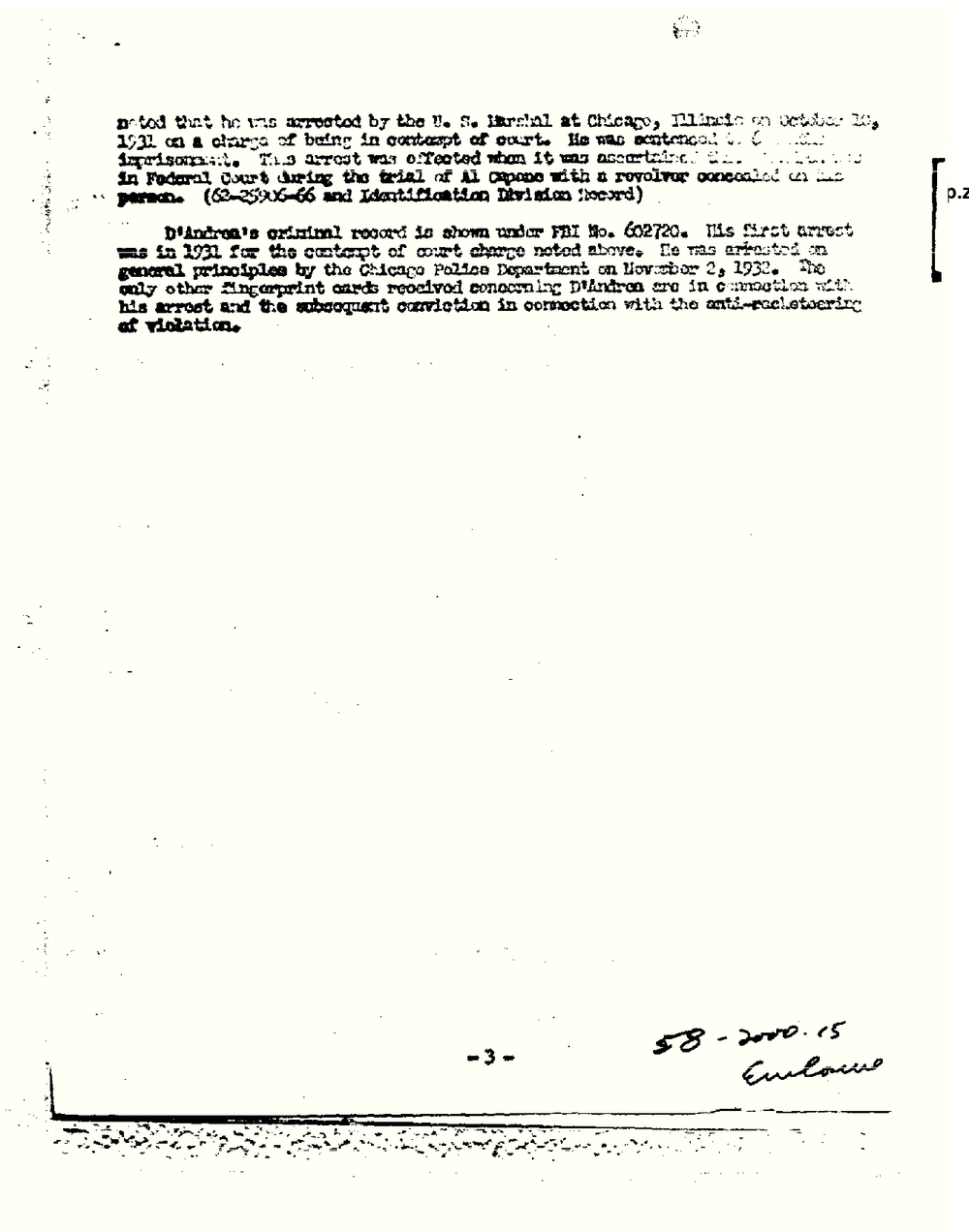 itemFBI memorandum of September 1947 on Phillip D'Andrea (Vault, John Roselli Part 01)The FBI's September 1947 personal-history memorandum on Phillip D'Andrea, prepared with the others on the paroled men. Its last page records his 1931 arrest by the U.S. Marshal at Chicago for contempt of court, "during the trial of Al Capone with a revolver concealed on his person."itemFBI Chicago reports (file 58-194), September 1947: interviews of truck-company salesmen who wrote letters for D'Andrea's parole (Vault, John Roselli Part 03)The four-page Part 03 holds Chicago interview reports of about 26 September 1947. Sales officials of the Mack Truck Company and the International Harvester Company said they had written letters urging Phillip D'Andrea's parole after dealings over trucks, and said no money, threats or pressure were used.itemUnited States v. Compagna, 146 F.2d 524 (2d Cir. 1944)Second Circuit opinion of December 20, 1944 affirming the convictions of Compagna and six others for a conspiracy to extort money from motion-picture producers and exhibitors, 1935 to 1940.
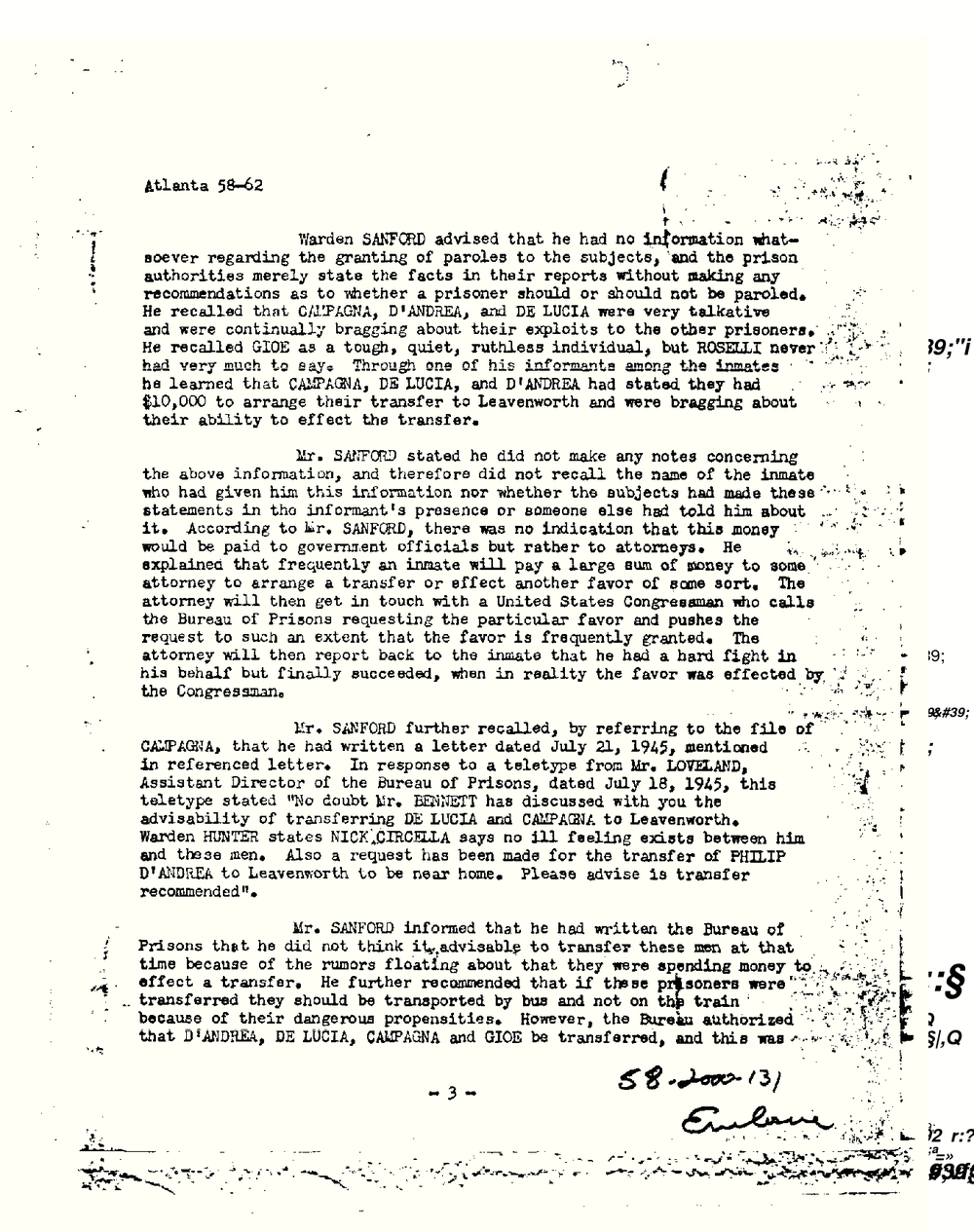 itemFBI Atlanta report (file Atlanta 58-62), autumn 1947: Warden Sanford on the prisoners and their 1945 transfer to Leavenworth (Vault, John Roselli Part 02)The Atlanta office's report for the 1947 parole inquiry. Warden Sanford said he made no parole recommendations, recalled an inmate informant's report that three of the men "had stated they had $10,000 to arrange their transfer", and said the transfer to Leavenworth was "done by bus on July 28, 1945."itemUnited States ex rel. De Lucia v. O'Donovan, 82 F. Supp. 435 (N.D. Ill. 1948)Judge Igoe's ruling of 10 November 1948 in Paul De Lucia's habeas corpus case, overruling the government's demurrer. It records the four parolees' petition of 16 June 1948, the congressional inquiry into their paroles, and the parole-violator warrant of 15 June 1948.itemCongressional Record, House, 28 November 1947: Representative Hoffman, "The Parole of Four Capone Gangsters"The chairman of the House Committee on Expenditures in the Executive Departments reports on his subcommittee's inquiry into the August 1947 paroles: hearings in Chicago on 25 and 26 September 1947 (508 pages of transcript) and in Washington on 7 October, paroles granted "just 37 days" after eligibility, a tax compromise, and the Atlanta warden's 1945 letter against the transfer.itemKefauver Part 5: testimony of U.S. Attorney Otto Kerner, Jr., on the parole grand jury (5 October 1950)In executive session at Chicago, the U.S. Attorney for the Northern District of Illinois described the grand jury that heard Campagna, Gioe, De Lucia and D'Andrea on "the manner of obtaining their paroles," and Accardo's visits to Leavenworth under the name Joseph Bulger. Printed pp. 182-196.