John Roselli
Introduced to Bioff as "the representative of the group in California," in the Second Circuit's account of the testimony; convicted in 1943 in the motion-picture extortion case, sentenced to ten years, and paroled on 13 August 1947. A witness before the Kefauver Committee in 1950; named by the Church Committee as the go-between in the CIA's 1960 approach to Giancana; convicted in 1968 as an unregistered alien and in the Friars Club case; found dead in a sealed oil drum near Miami in August 1976.
- Died
- 1976
- Aliases
- John Rosselli, Filippo Sacco, John Rawlston, J. A. Rollins
- Role
- "The representative of the group in California," as Circella introduced him to Bioff. Court opinion: the Second Circuit's account of the trial testimony, United States v. Compagna (1944): "Circella introduced Rosselli to Bioff as the representative of the group in California"
- Rights
- Biography on this page is limited to what the cited federal records state.
On the record
- 1905 — Testifying to the Kefauver Committee on 7 October 1950 (Part 5, p. 375), he said: "I was born in Chicago in 1905, June 4, 1905." The FBI's 1968 Los Angeles report and 1977 Miami report (Vault, Part 08) say instead that he was born in Italy as Filippo Sacco, the Miami synopsis giving "born 7/4/05, Esperia, Italy." The two accounts conflict.
- 1935–1940 — United States v. Compagna (2d Cir. 1944): "Circella introduced Rosselli to Bioff as the representative of the group in California; Bioff arranged to pay him a part of the money extracted from the producers in that state, though the payments were disguised by bookkeeping designed to hide the nature of the transaction."
- 22 December 1943 — An FBI memorandum of 16 September 1947 on Roselli (Vault, Roselli Part 01, scan 17, read in OCR) says he was found guilty by a jury in New York on December 22, 1943 in the case entitled "William Bioff, with aliases, et al., Anti-Racketeering, Mail Fraud," and was sentenced on December 31, 1943 to ten years and a $10,000 fine. The FBI memorandum on Gioe gives December 23.
- 31 December 1943 — He told the Kefauver Committee he was sentenced on this date in the movie extortion case.
- 1944–1947 — The same memorandum (scan 18, OCR partly garbled) says he was able to arrange a transfer from the Atlanta penitentiary to Terre Haute, Indiana. It gives no date.
- 1947 — An FBI Atlanta report of 1947 records Warden Sanford's recollection that "ROSELLI never had very much to say," and the immigration investigator's statement that Roselli was among the men interviewed at Atlanta to verify citizenship.
- 13 August 1947 — The 16 September 1947 memorandum cites newspaper clippings for his parole from federal custody on 13 August 1947, and he gave the same date in his Kefauver testimony. FBI memoranda of September 1947 (Vault, Part 01) record Congressman Fred Busbey's allegation, passed on from a reporter, of a rumored quarter-million-dollar payment for the paroles of Roselli and four men named as "members of the Capone Gang"; the memoranda do not find it true.
- 7 October 1950 — Before the Kefauver Committee in Chicago (Part 5, pp. 376-377) he said he first met Al Capone through Jo Esposito during a Chicago visit for the Dempsey-Tunney fight, and that he knew Charlie Fischetti.
- 1960 — The Church Committee report (S. Rep. 94-465, PDF pp. 86-88) says the CIA's Support Chief and Robert Maheu approached "John Rosselli, an underworld figure," about a plan against Castro, that he used the cover name "John Rawlston" and registered at a Miami hotel as J. A. Rollins, and that he introduced Maheu to "Sam Gold," later identified as Sam Giancana.
- 31 October 1960 — The Church Committee report (PDF pp. 89-91) says Rosselli paid the bail of Arthur Balletti, arrested in Las Vegas over a wiretap, and that Rosselli testified he told Giancana the CIA was involved "in order to have him keep his mouth shut."
- June–July 1961 — FBI teletypes in the Balletti case (Vault, Part 12) report that Robert Maheu named Roselli as the man through whom he made his original contact with Giancana, and a Bureau airtel of 7-5-61 ordered that Roselli be located and thoroughly interviewed.
- 23 May 1968 — A Los Angeles FBI report (Vault, Part 08) records that a jury found him guilty of failing to register as an alien and of failing to furnish his address for 1963-1967, after FBI evidence that he was born in Italy as Filippo Sacco, which he admitted at trial while claiming derivative citizenship.
- 2 December 1968 — The same report: convicted in the "Friars Club case" of conspiracy, interstate travel in aid of racketeering, interstate transportation of stolen property and income-tax counts; sentenced on 3 February 1969 to five years and a $55,000 fine, and on 4 February 1969 to six months in the alien case, concurrent.
- 28 September 1970 — United States v. Roselli, 432 F.2d 879 (9th Cir. 1970), affirmed the Friars Club convictions of Roselli and three others, reversing only one count against Maurice Friedman.
- 28 July 1976 — A Bureau memorandum of August 9, 1976 (Vault, Part 08, p. 147) says he left his sister's residence in Plantation, Florida on this date and did not return.
- 7 August 1976 — The same memorandum and the Miami report say his body was recovered from a sealed 55-gallon oil drum found floating in the intracoastal waterway off Miami Beach, and that the Dade County Medical Examiner stated death was caused by asphyxiation. An Attorney General's memorandum of August 13, 1976 asked the FBI to determine whether his homicide related to his testimony before the Senate intelligence committee. No finding of who killed him appears in the pages read.
The role field quotes the Second Circuit’s account of the testimony at the 1943 trial. It is the court’s report of how Circella introduced him to Bioff, not an organizational rank, and Roselli holds no seat on any chart in this archive. “Rosselli” is the court’s spelling, and also the spelling of the Kefauver transcript and the Church Committee; “Roselli” is the FBI Vault’s. “Filippo Sacco” is the name the FBI says was his true one; “John Rawlston” and “J. A. Rollins” are the cover name and hotel registration in the Church Committee report.
The September 1947 memorandum on him (scans 17 and 18 of Vault Part 01) is not filed as its own item here; it is cited above by its Vault part. Its birthplace conflicts with later FBI records, so no birth data are recorded: his sworn testimony gives Chicago, June 4, 1905, and the FBI’s later reports give Esperia, Italy. His Atlanta index card was not found: the Atlanta index holds a card for a different man with a similar name.
The died field gives the year only: the FBI records that he was last seen on July 28, 1976 and that his body was recovered on August 7, 1976, but no record read gives the date of death. An FBI report of 1968 calls him “Sam Giancana’s lieutenant”; that is the Bureau’s characterization and is not used as a role.
Records
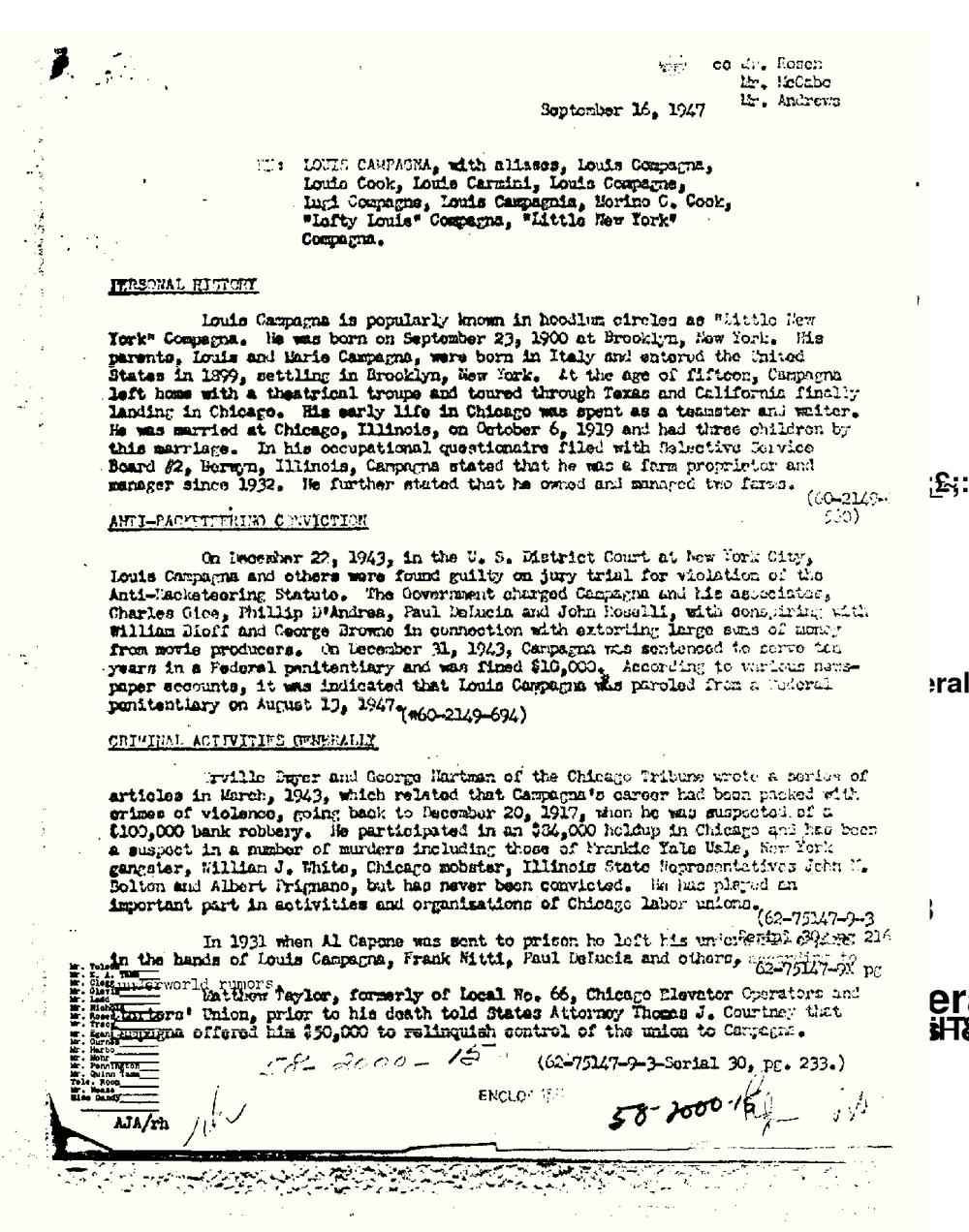 itemFBI memorandum of 16 September 1947 on Louis Campagna (Vault, John Roselli Part 01)One of the personal-history memoranda the FBI prepared in September 1947, after the paroles. It lists Campagna's aliases and says he and others were found guilty in New York on 22 December 1943 of violating the Anti-Racketeering Statute, and were sentenced on 31 December 1943.
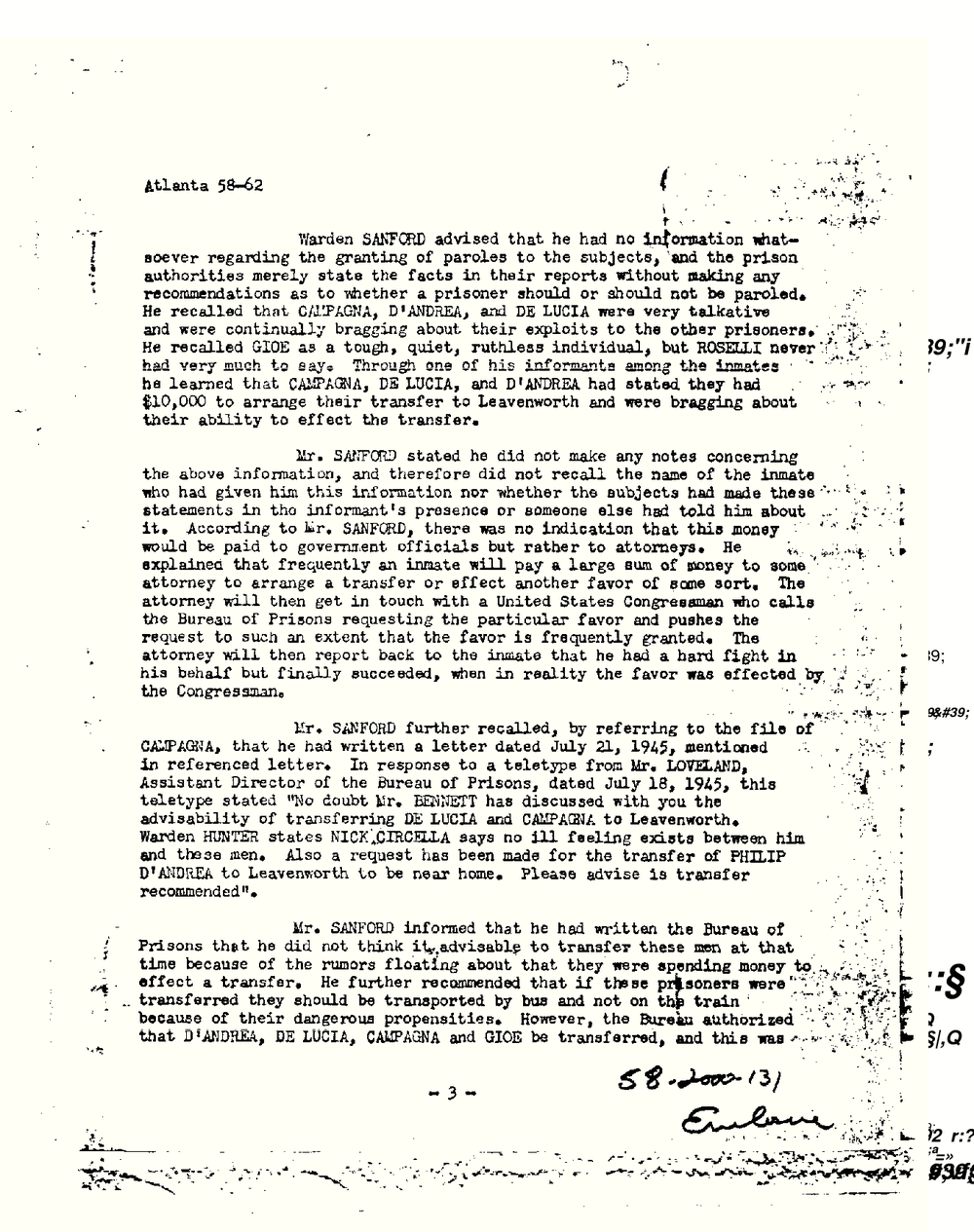 itemFBI Atlanta report (file Atlanta 58-62), autumn 1947: Warden Sanford on the prisoners and their 1945 transfer to Leavenworth (Vault, John Roselli Part 02)The Atlanta office's report for the 1947 parole inquiry. Warden Sanford said he made no parole recommendations, recalled an inmate informant's report that three of the men "had stated they had $10,000 to arrange their transfer", and said the transfer to Leavenworth was "done by bus on July 28, 1945."itemKefauver Part 5: testimony of John Rosselli (7 October 1950, Chicago), pp. 372-406Rosselli testified that he was born in Chicago on June 4, 1905, was sentenced on December 31, 1943 in the movie extortion case and released on August 13, 1947, and that he met Al Capone during a Chicago visit for the Dempsey-Tunney fight.
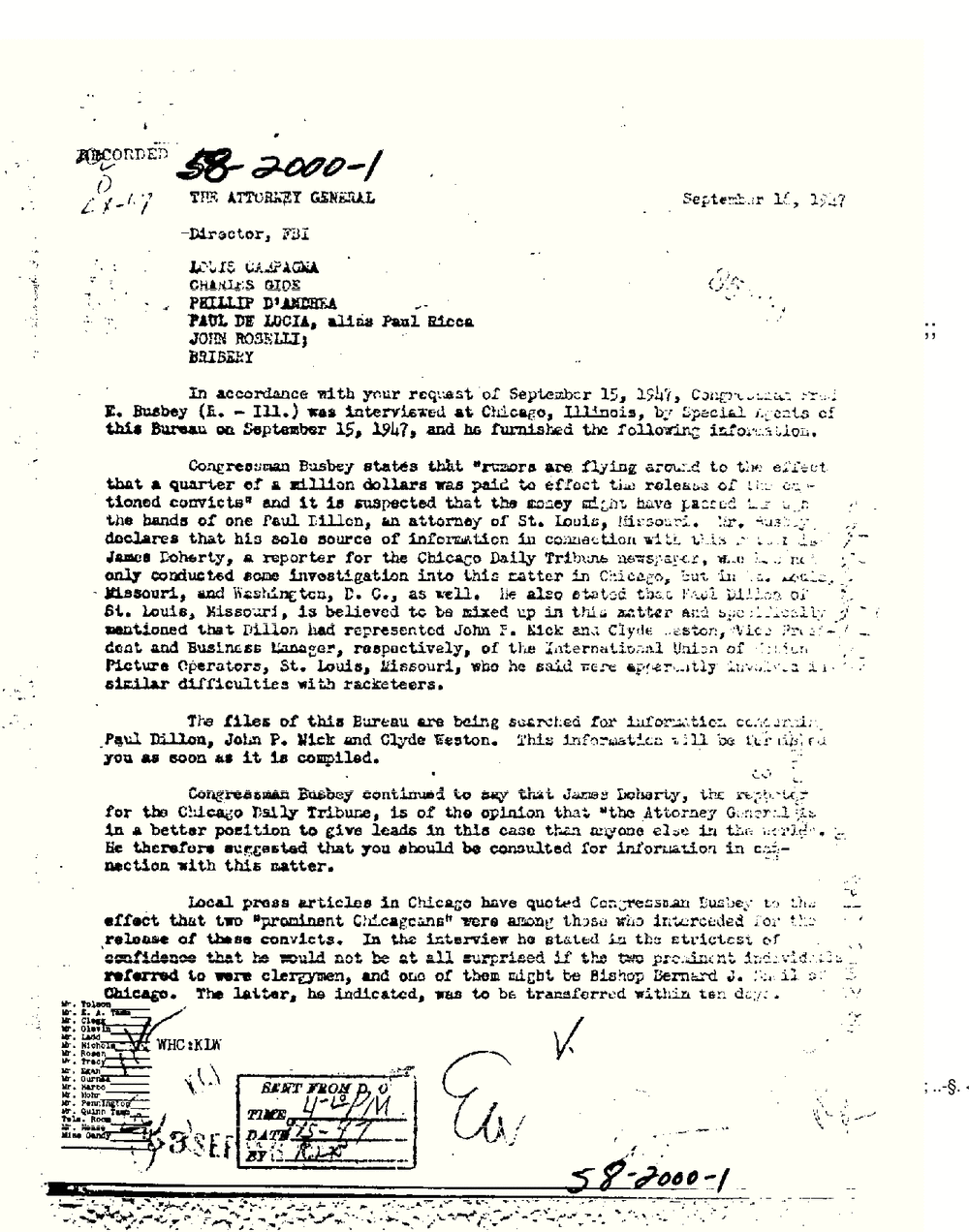 itemFBI memoranda, September 1947: Congressman Busbey's parole-bribery allegation and a profile of John Roselli (Vault Roselli Part 01)FBI memoranda to the Attorney General report Congressman Fred Busbey's allegation that a quarter of a million dollars was rumored to have been paid for the 1947 paroles of Campagna, D'Andrea, Gioe, Ricca and Roselli. The memoranda do not find it true.
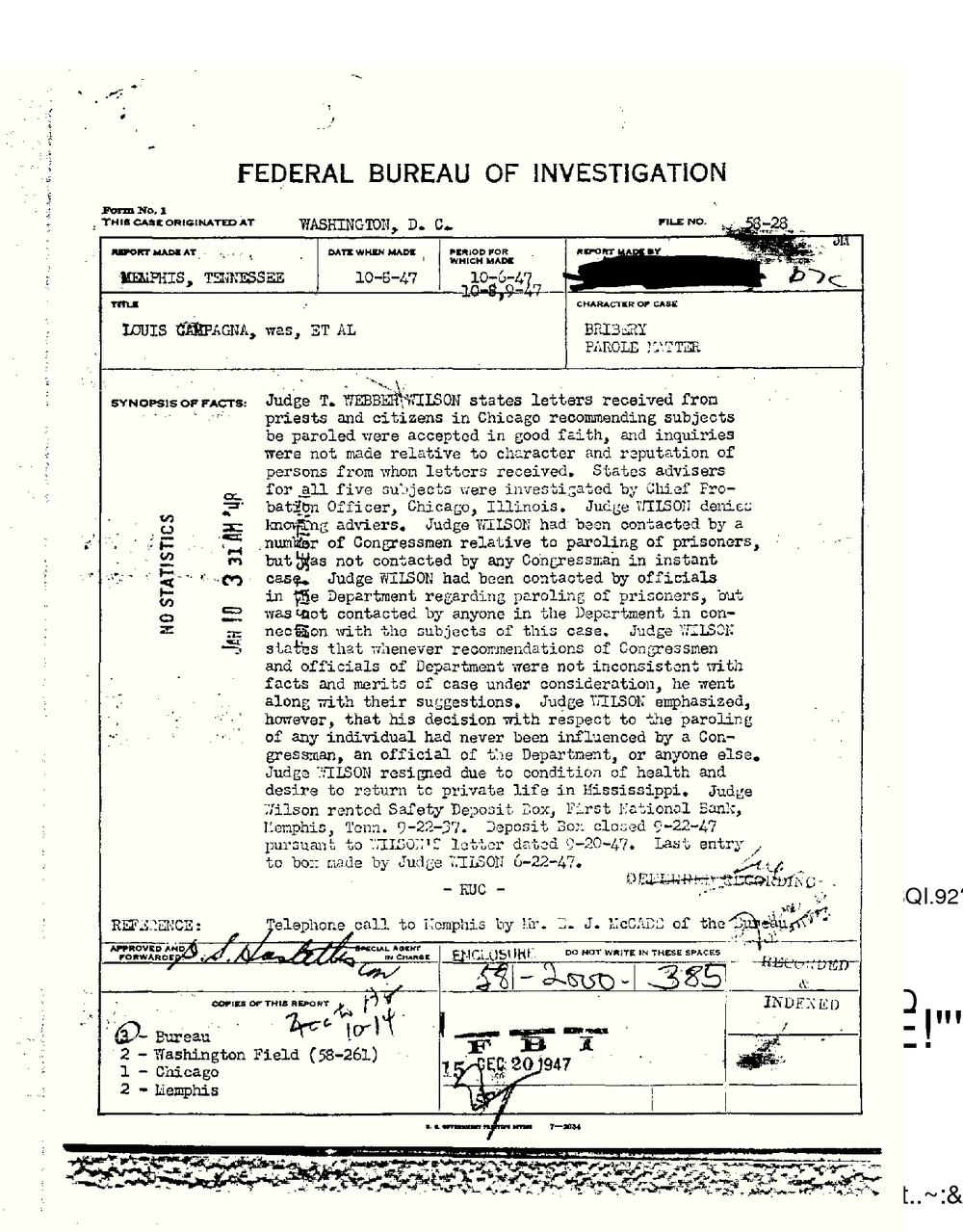 itemFBI report, October 1947: interview of Parole Board Chairman T. Webber Wilson (Vault Roselli Part 06)Judge T. Webber Wilson, chairman of the federal Parole Board, told FBI agents on October 6, 1947 that letters from priests and citizens in Chicago recommending the five paroles were accepted in good faith without inquiry into the writers.itemChurch Committee report, PDF pp. 86-88: Rosselli, 'John Rawlston' and 'Sam Gold' in the 1960 approachThe report explains how the CIA's Support Chief and Robert Maheu approached John Rosselli in 1960, how he used the cover name 'John Rawlston', and how 'Sam Gold' and 'Joe' were later identified from a newspaper supplement as Giancana and Santos Trafficante.itemChurch Committee report, PDF pp. 89-91: the October 1960 Las Vegas wiretap and the Hoover memorandum on GiancanaThe report describes the arrest of Arthur Balletti in Las Vegas on 31 October 1960 over a wiretap, the conflicting accounts of why it was placed, a Hoover memorandum of 18 October 1960 relaying a source on Giancana and Castro, and the 1962 decision not to prosecute.
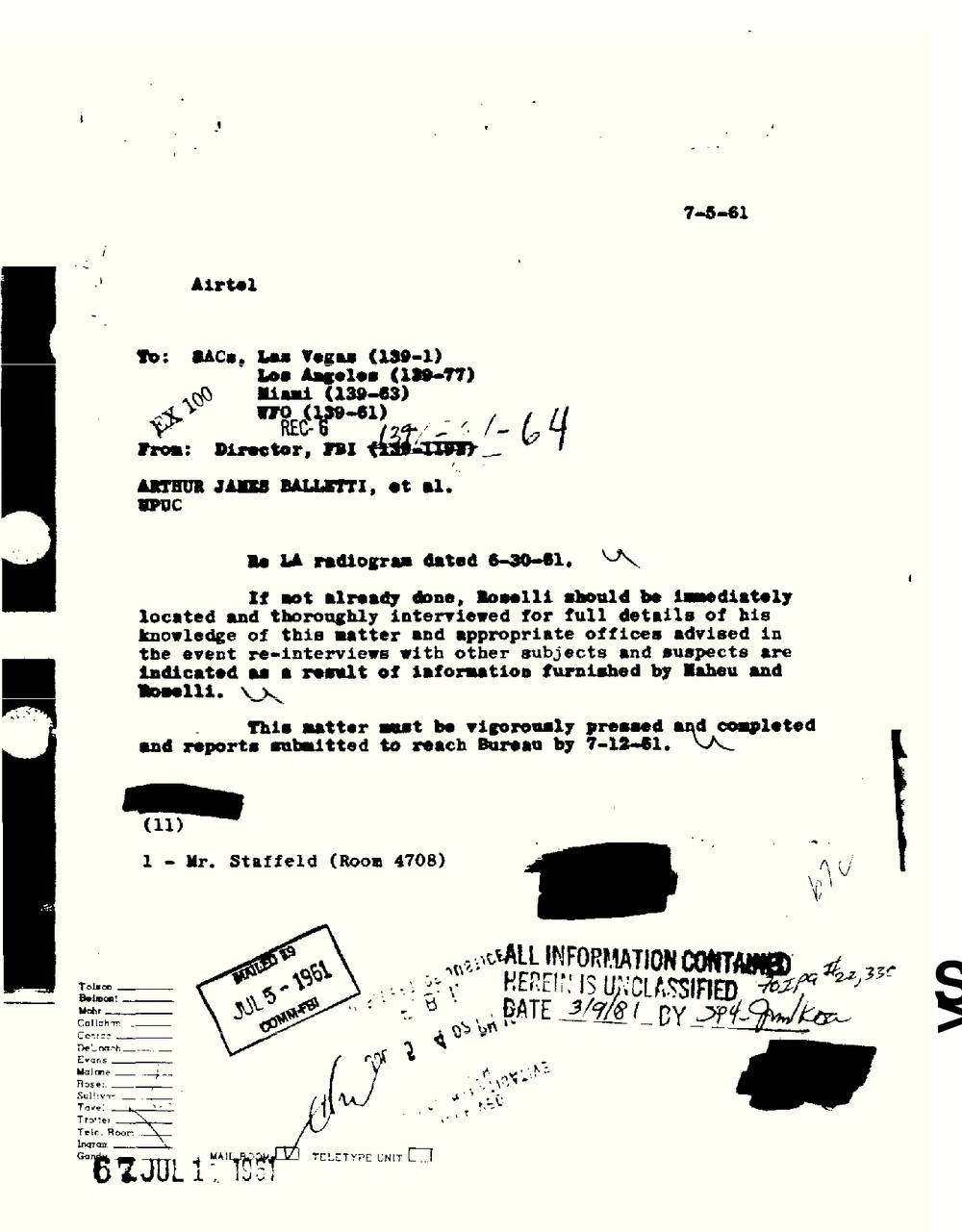 itemFBI teletypes and airtels, June-July 1961: the Balletti wiretap case and Robert Maheu's account of reaching Giancana through Roselli (Vault Roselli Part 12)In the case 'Arthur James Balletti, et al', FBI teletypes report that Robert Maheu, located on June 29, 1961, named John Roselli as his route to Sam Giancana, and that on re-interview he said his work had been for a Central Intelligence Agency assignment.itemFBI 'Personal History' of John Roselli, 1960s reports (Vault Roselli Part 11)FBI reports of the late 1960s record Roselli's own account of his background: born in Chicago of Italian parents, raised by an uncle, to Los Angeles at fifteen or sixteen, six grades of school. The FBI elsewhere records a different birthplace.
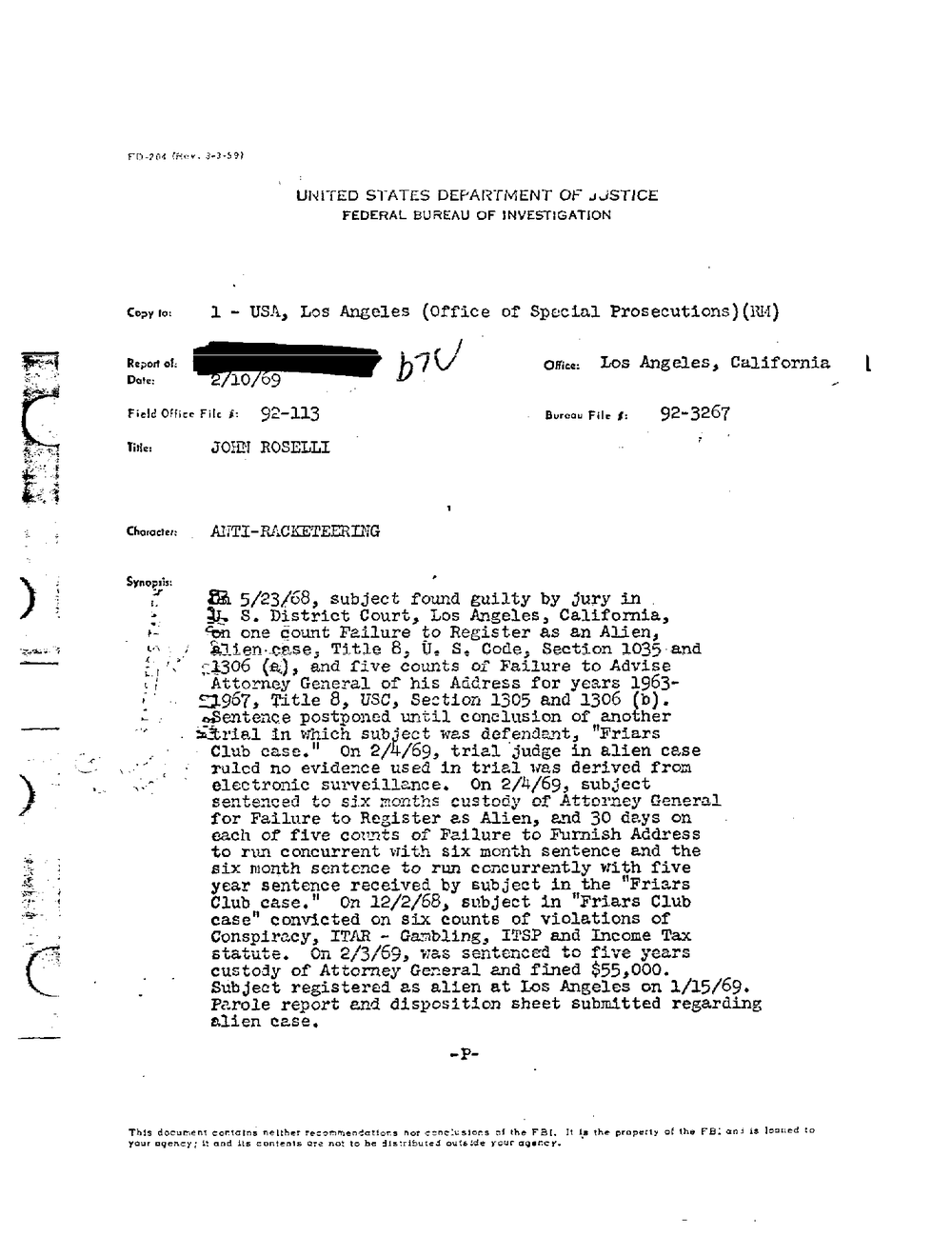 itemFBI Los Angeles report, 1968-1969: John Roselli convicted as an unregistered alien and in the Friars Club case (Vault Roselli Part 08)A Los Angeles report records Roselli's May 23, 1968 conviction for failing to register as an alien, after FBI evidence that he was born in Italy as Filippo Sacco, his December 2, 1968 conviction in the Friars Club case, and his February 1969 sentences.itemUnited States v. Roselli, 432 F.2d 879 (9th Cir. 1970)The Ninth Circuit affirmed the convictions of John Roselli, Maurice Friedman, Benjamin Teitelbaum and Manuel Jacobs for a scheme to cheat at high-stakes gin rummy at the Friars Club in Beverly Hills, using observers at ceiling peepholes who signaled the cards.
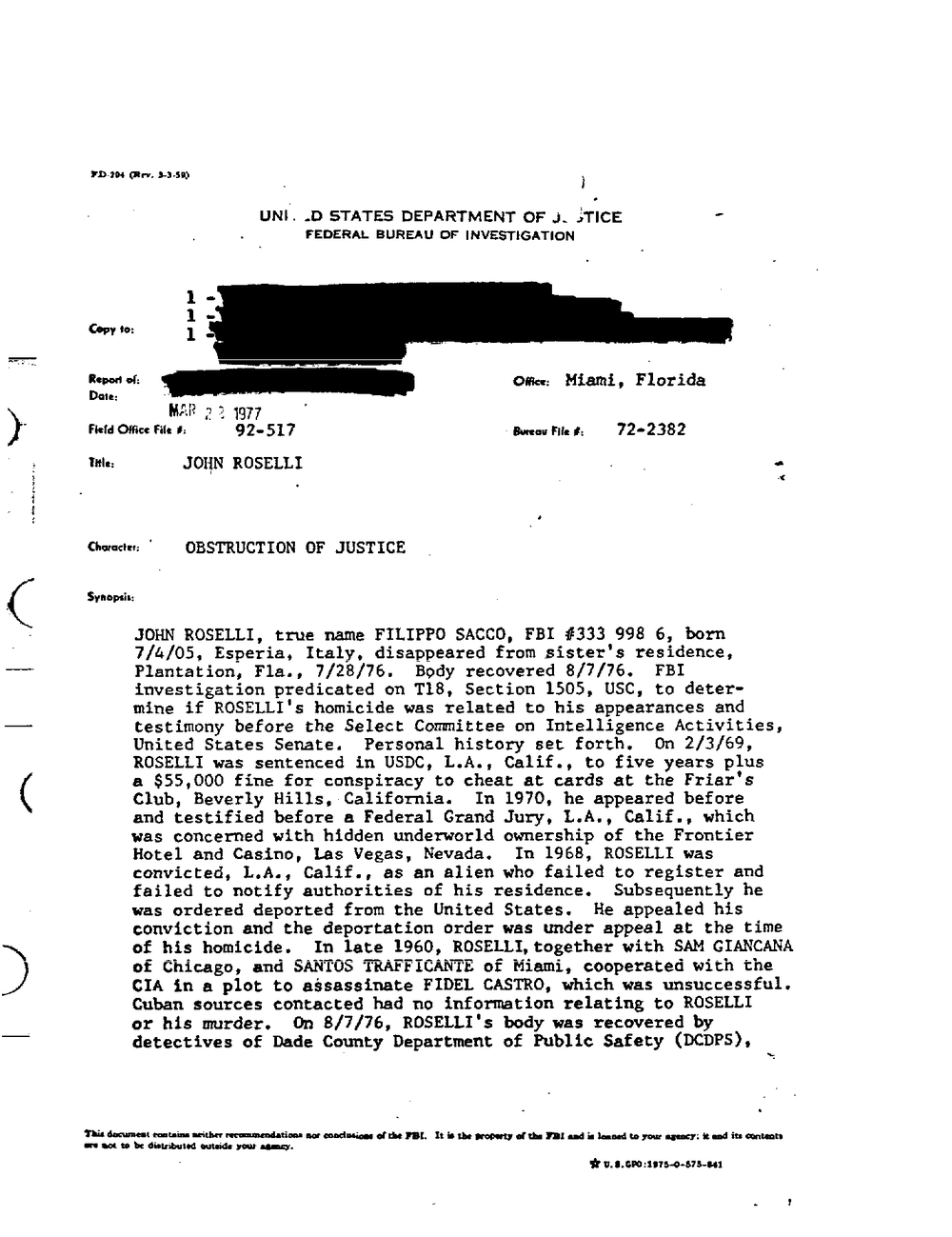 itemFBI Miami report and Bureau memoranda, July-August 1976: John Roselli's disappearance and death, and the obstruction inquiry (Vault Roselli Part 08)A Bureau memorandum and a Miami report record that Roselli left his sister's home in Plantation, Florida on July 28, 1976 and did not return, that his body was recovered from a sealed oil drum near Miami Beach on August 7, and that the FBI was asked to determine whether his killing related to his Senate testimony.