Empty seats. A name is added only with a citation on this page.
- BossNot filled
- UnderbossNot filled
- ConsigliereNot filled
Key to statement kinds (defined in the text below)Court opinionGovernment charge, as a court summarized itIndictment, as the U.S. Attorney’s release reported itCommittee counsel or staffFBI fileThird-hand 1959 memorandum
This page is a hub for the Chicago Outfit, the lineage usually listed as Torrio, Capone, Nitti, Accardo and Giancana and those who followed. The chart above stays empty: no record filed here is a cited, separate decision to place a name in a seat. What does exist is a person page for each figure below, and each page quotes the strongest statement a record makes about that person’s role. Those statements are not of one kind, and they are not interchangeable.
- Court opinion. A federal court’s own statement in its opinion, after a trial record. The strongest kind here.
- Government charge, as a court summarized it. What the prosecution alleged, in the court’s words. An allegation, not a finding.
- Indictment, as the U.S. Attorney’s release reported it. An allegation; the release says the defendants are presumed innocent.
- Committee counsel or staff. Kefauver Committee counsel’s statements at the hearings, which are not testimony, and McClellan Committee staff testimony, given under oath by the committee’s own staff. Neither is a committee finding.
- FBI file. The Bureau’s own letters, memoranda and teletypes, or its later history essay.
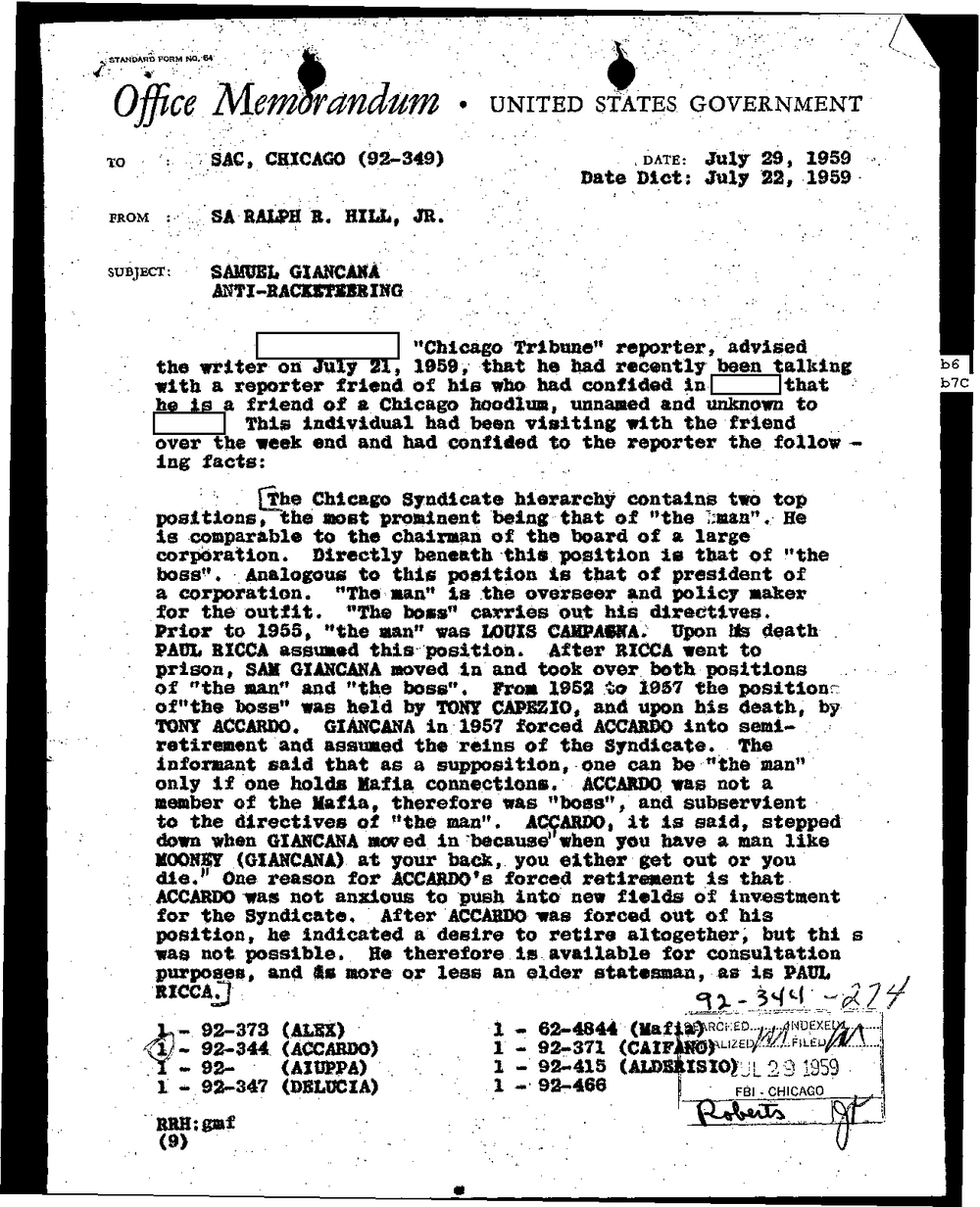
- Third-hand 1959 memorandum. A Chicago FBI memorandum dictated 22 July 1959, in which an agent recorded what a Chicago Tribune reporter said a reporter friend had been told by an unnamed person. It is the weakest source on this page.
The lineage pages
The order is roughly that of the records’ dates. It is not a succession chart.
- Jim Colosimo: the FBI history essay says Torrio “had become an influential lieutenant in the Colosimo mob” and “soon succeeded to full leadership of the gang with the violent demise of Big Jim Colosimo.” FBI file (history essay).
- John Torrio: the same essay: “In 1925, Capone became boss when Torrio, seriously wounded in an assassination attempt, surrendered control and retired to Brooklyn.” FBI file (history essay). A 1947 FBI memorandum in his Vault file records only a Chicago Police allegation about Colosimo’s killing.
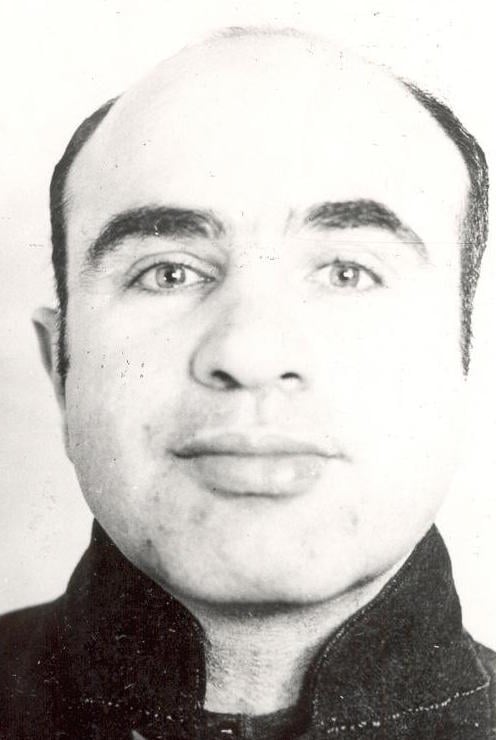
- Alphonse Capone: the Bureau of Prisons’ Alcatraz notebook page: “He is a notorious criminal, being a gang leader and racketeer.” Prison administrative record. His person page states no rank.
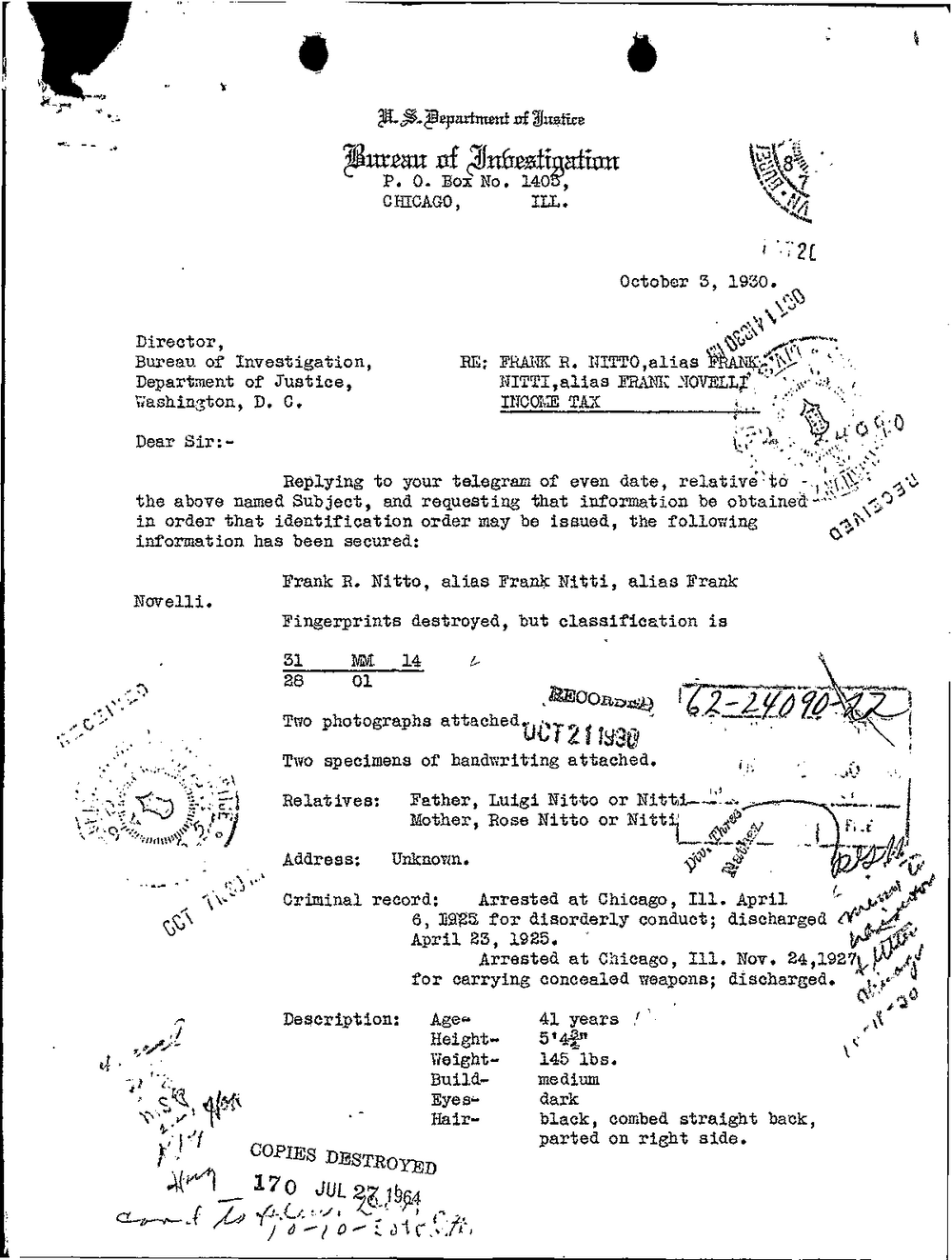
- Frank Nitti: a Bureau of Investigation letter of about 1930: “Frank Nitto is a member of the Al Capone Gang of Chicago, Illinois.” FBI file. Kefauver counsel Rudolph Halley’s remark that Nitti “assumed the mantle” is counsel’s summary and cannot be read literally.
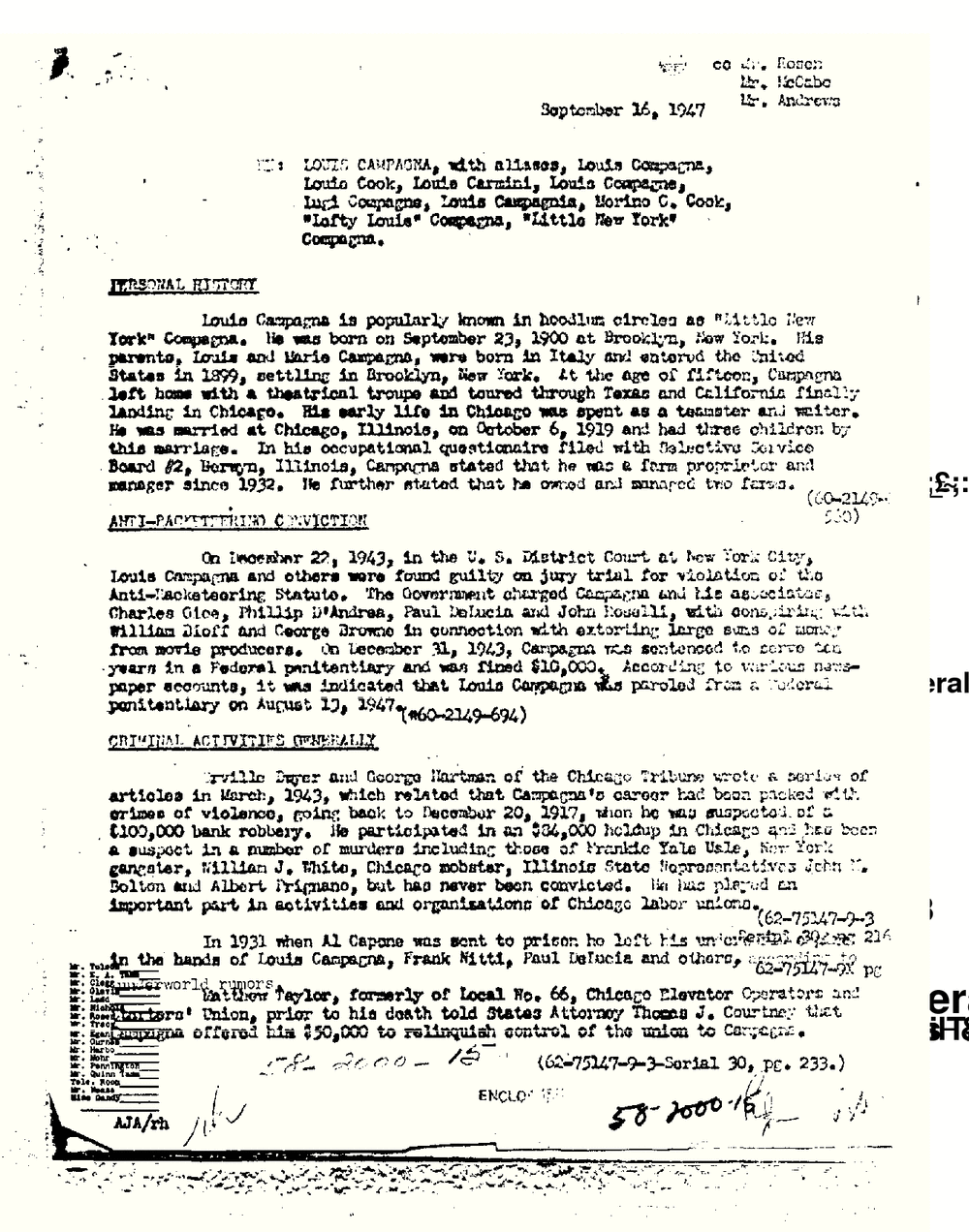
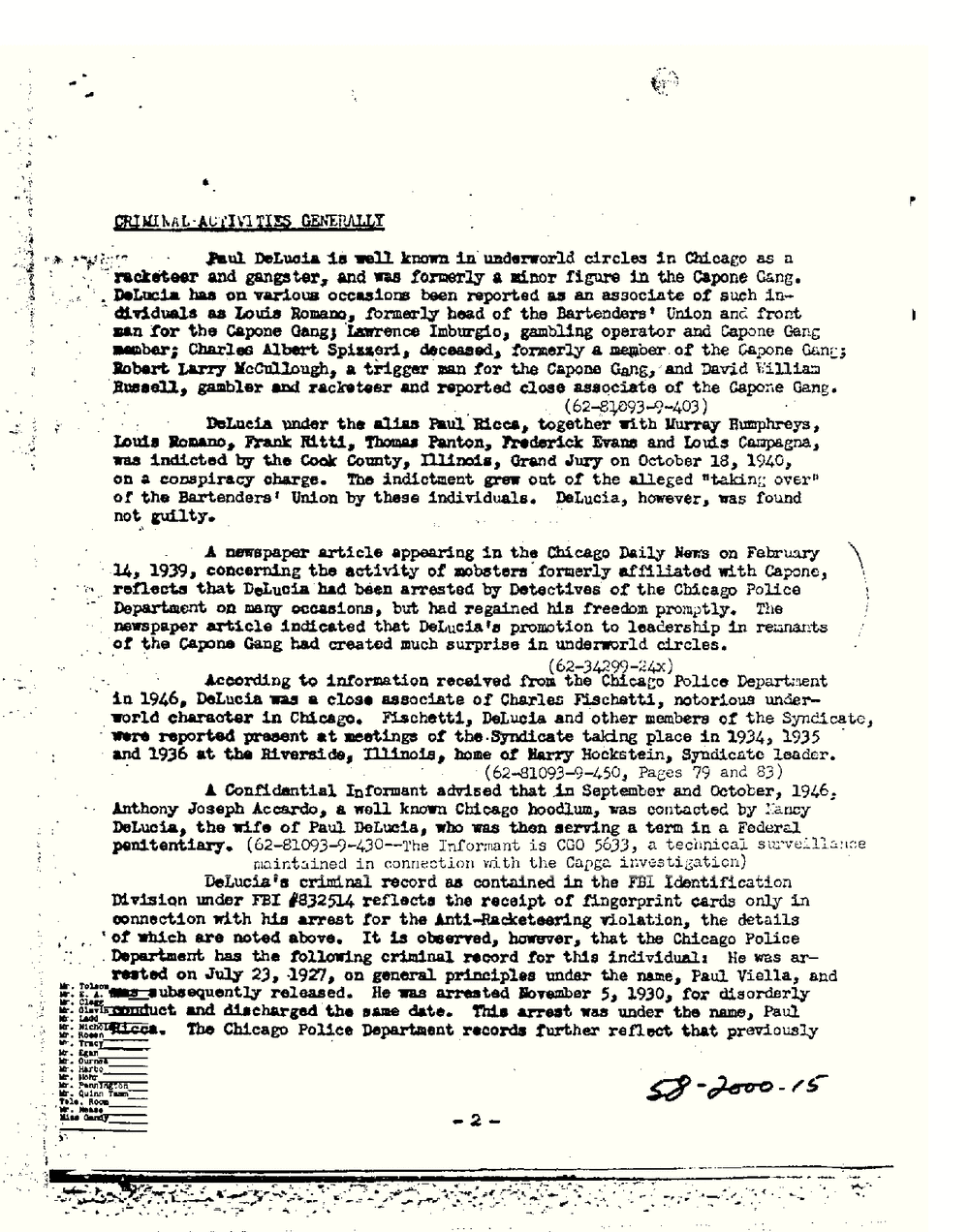
- Paul De Lucia (Ricca): the 1959 memorandum says that on Campagna’s death “RICCA assumed this position” of “the man.” Third-hand 1959 memorandum. Halley’s statement that “the mantle of the Capone gang descended upon Tony Accardo, the witness, and Paul Ricca” is committee counsel. The Second Circuit (1944) states that “To deLucia Bioff repeatedly paid part of the blackmail,” a court opinion about the Hollywood extortion case.
- Louis Campagna: the Second Circuit (1944), recounting testimony in the Hollywood extortion case: “apparently he was the chief.” Court opinion, about that extortion venture, not an organization. The 1959 memorandum’s “Prior to 1955, ‘the man’ was” Campagna is the third-hand 1959 memorandum.
- Jake Guzik: an FBI memorandum in his file says he “later graduated to business manager of some of the Capone underworld enterprises.” FBI file. The Seventh Circuit (1931) affirmed his income-tax conviction, a court opinion that states no role.
- Murray Humphreys: the FBI summary at the head of his file says his activities centered on “the domination of labor unions.” FBI file. No record gives him a rank.
- Anthony Accardo: FBI Chicago teletypes of the early 1970s: “ONE OF TOP LEADERSHIP TEAM DIRECTING ORGANIZED CRIME IN CHICAGO.” FBI file. McClellan staff testimony (1959) calls him “the top figure in the Chicago underworld” (committee staff); Halley’s “mantle” sentence is committee counsel; the 1959 memorandum’s account of his “semi-retirement” is third-hand; and the Seventh Circuit in 1997 remarked in passing that “boss of all bosses” was a title “once held by the likes of Al Capone and Tony ‘Big Tuna’ Accardo” (court opinion, a remark rather than a finding on an issue before it).
- Sam Giancana: the 1959 memorandum: “SAM GIANCANA moved in and took over both positions of ‘the man’ and ‘the boss’.” Third-hand 1959 memorandum. McClellan staff member Pierre Salinger testified that “Mr. Giancana is a top figure in the underworld in Chicago” (committee staff). The Church Committee report calls him “a Chicago-based gangster” (committee report).
- Salvatore Battaglia: Judge Swygert’s dissent (1968) quotes the government’s brief that Battaglia was “known to a few as ‘The Man.’” Government’s brief, quoted by a dissenting judge, about the extortion scheme. No rank is given.
- Felix Alderisio: the Tenth Circuit (1970) and the Supreme Court (1969) record his threats conviction and the surveillance of his Chicago place of business. Court opinions; no role is stated.
- Jack Cerone: the Eighth Circuit (1987), summarizing the charge in the Las Vegas skimming case: “Aiuppa was the boss of the Chicago group, with Cerone as its underboss.” Government charge, as a court summarized it.
- Joseph Aiuppa: the same sentence of the Eighth Circuit (1987). Government charge, as a court summarized it.
- Anthony Spilotro: a 1993 FBI Chicago airtel calls him “a known Chicago LCN member.” FBI file. The Eighth Circuit (1986) records the government’s allegation that he acted as a Las Vegas representative of Chicago co-conspirators (government charge, as a court summarized it); the 2005 release calls him a “deceased ‘made’ member” (indictment).
- Joseph Ferriola: the Seventh Circuit (1997) describes “the Ferriola Street Crew (named after Joseph Ferriola, the boss of the crew from 1979 to 1989)” as “a unit of Chicago’s organized crime establishment, often referred to as the ‘Outfit.’” Court opinion. It makes him boss of a crew, not of the Outfit.
- Samuel Carlisi: the Seventh Circuit (1997): “Samuel ‘Wings’ Carlisi, the Outfit’s former boss of all bosses.” Court opinion. He died while the appeal was pending, and the court ordered his conviction vacated.
- Joseph Lombardo: the Seventh Circuit (2012) says he was tried with Calabrese and Marcello as one of “three other members of the Outfit.” Court opinion, after the Family Secrets verdict. The 2005 release’s “member of the Grand Avenue crew” is the indictment.
- Frank J. Calabrese, Sr.: the Seventh Circuit (2012): “Calabrese was the boss of the Calabrese Street Crew (also known as the South Side/26th Street Crew).” Court opinion. The 2005 release’s “a ‘made’ member of the Outfit” is the indictment.
The Hollywood extortion case
The Hollywood extortion case files the records of the 1943 conviction of Campagna, De Lucia, D’Andrea, Gioe, Roselli, Maritote and Kaufman, the 1947 paroles and the litigation that followed. What those records say about the defendants is of the same kinds as above, and none of it is a seat.
- Court opinion, about the extortion venture. The Second Circuit (1944), recounting the testimony: of Compagna, “apparently he was the chief”; “Circella introduced Rosselli to Bioff as the representative of the group in California”; Circella “was one of a group, or gang, of confederates who lived by blackmail”; Kaufman was “the local agent of the New Jersey local.” The Tax Court (1949) found Frank Nitto’s “association with Bioff and Browne in their scheme.” These describe the scheme and union offices. They name no organization.
- FBI file. The September 1947 memoranda call De Lucia “formerly a minor figure in the Capone Gang,” relay “underworld rumors” that in 1931 Capone left his interests “in the hands of Louis Campagna, Frank Nitti, Paul DeLucia and others,” and relay “information circulated in underworld circles” that Gioe “was regarded as one of the members of a group which carried on Capone’s illegal activities.” These are rumor and newspaper reports as the Bureau recorded them.
- Congressional statement. Representative Hoffman (1947) quoted a Department of Justice notation that De Lucia “was one of the leaders of a gang in Chicago, commonly known as the Syndicate which succeeded to the power of Al Capone.” Busbey (1949) wrote that a former Attorney General had called two of the men “boss and treasurer of a national crime syndicate.” These are one member’s floor statement and one member’s additional views.
- Testimony. U.S. Attorney Otto Kerner (Kefauver, 1950) described the grand jury on the paroles. He gave no ranks.
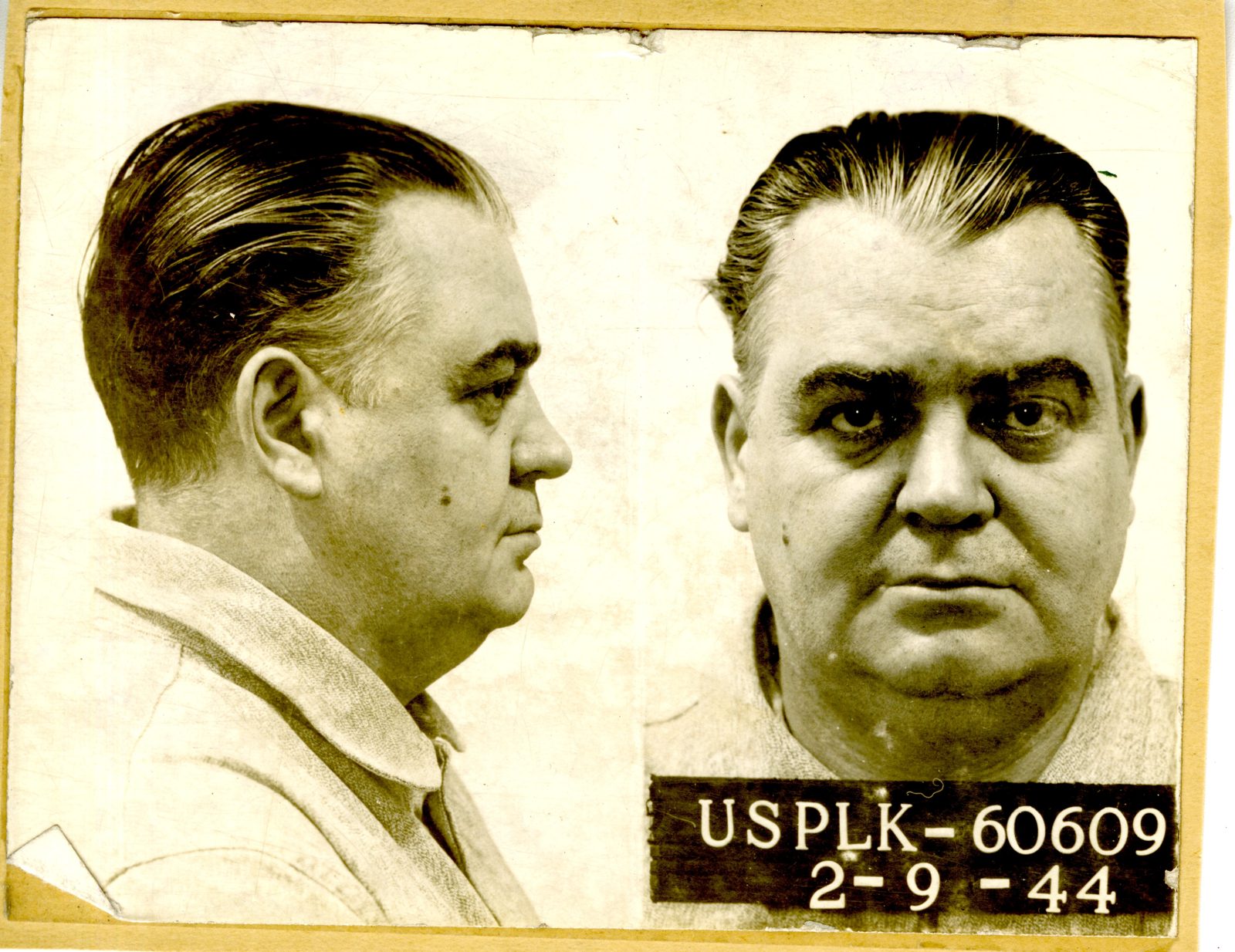
Paul De Lucia (Ricca), Louis Campagna, Charles Gioe, Phil D’Andrea, John Roselli, Francis Maritote, Nick Circella and Louis Kaufman have person pages. Their family fields are empty.
What the chart still waits for
The seats are Boss, Underboss and Consigliere. Of the statements above, those that put a seat title on a named figure for the organization as a whole are the Eighth Circuit’s summary of the government’s charge, Aiuppa as boss and Cerone as underboss, which is an allegation, and the 1959 memorandum’s “the boss” for Giancana, which is third-hand. “Boss” of a street crew (Ferriola, Calabrese) and “boss of all bosses” (Carlisi) are court statements, but neither is a seat on this chart. No record on file names a consigliere. A name goes into a seat only by a separate, cited decision on this page.
The National Archives’ Alcatraz list includes register number 1498 under the name Anthony Michael Accardo. That record is for a man born in 1923, a different person from the Anthony Joseph Accardo of the 1962 Seventh Circuit opinion and the FBI Vault file, and it is not cited for him. Capone is on the same list as register number 85; see the Atlanta and Alcatraz spoke. The Al Capone section and the Chicago region are separate pages.