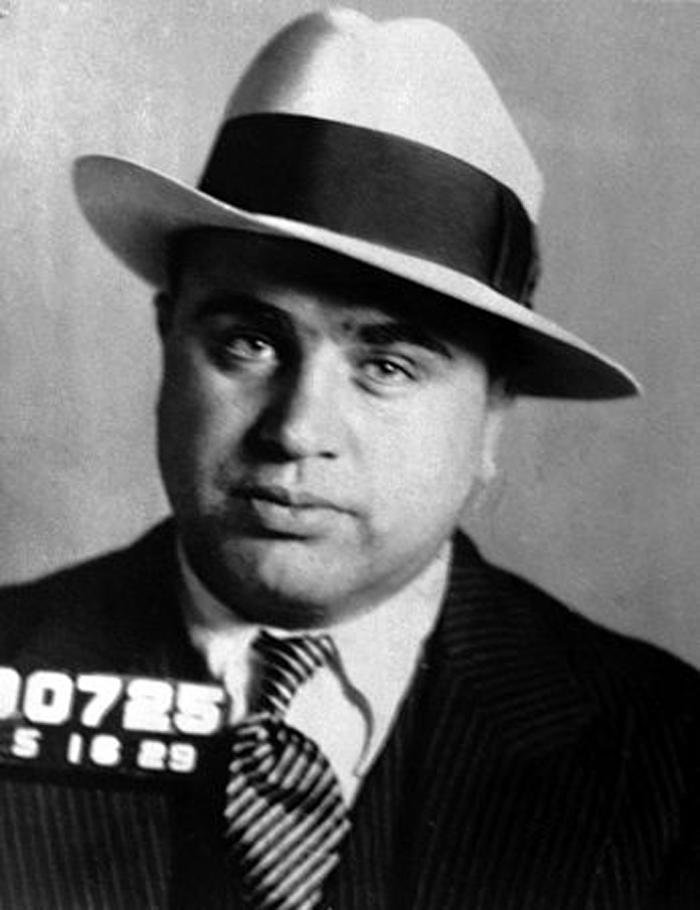
Jake Guzik
His FBI Vault file describes him as business manager of some of the Capone underworld enterprises. The Seventh Circuit affirmed his 1930 income tax conviction in 1931.
- Died
- 1956-02-21
- Aliases
- Greasy Thumb, Jack Guzik, Jacob Guzik, John Guzik, Harry Stone Guzik, Jack Guzick, Jack Cusick, Jack Cusik, Sam Kusick, Short Pants, The Little Man, The Little Mayor of Cicero, The Little Guy
- Role
- Business manager of some of the Capone underworld enterprises, according to an FBI memorandum in his file
- Rights
- Biography on this page is limited to what the cited federal records state.
On the record
- 1886 — An undated FBI memorandum in his Vault file (p. 13) states: "John Guzik was born in Moscow, Russia, May 20th or 30th 1886." A clipping elsewhere in the file gives a different date, so the year is not entered in the born field.
- 1920s — The same memorandum says he began "as an operator of vice resorts and wildcat bootleg shops" and "later graduated to business manager of some of the Capone underworld enterprises."
- About 1923 — Ralph J. Capone testified to the Kefauver Committee in December 1950 (Part 5, pp. 1228-1229) that for six or seven years from about 1923 he sold beer to taverns, buying it through "a man by the name of Guzik," whom counsel identified as Jack Guzik.
- 8 April 1930 — The memorandum: "On April 8, 1930, he was sentenced to five years and a day" and fined for violation of the income tax laws. The FBI history essay "Al Capone" names Jake "Greasy Thumb" Guzik among those who were subjects of tax evasion charges.
- 20 November 1930 — Virgil Peterson of the Chicago Crime Commission told the Kefauver Committee in July 1950 (Part 2, pp. 138-139) that Guzik "was the business manager of the Capone syndicate or was called such during the heyday of Al Capone's regime," and that he was found guilty on November 20, 1930 of income-tax evasion for 1927-1929 and sentenced to five years and a $7,500 fine. This conflicts with the FBI memorandum's April 8, 1930 date above.
- 10 December 1931 — Guzik v. United States, 54 F.2d 618 (7th Cir. 1931), affirmed his conviction on three counts of willfully attempting to evade income tax for 1927 through 1929: "The judgment is affirmed."
- 13 April 1944 — A Chicago FBI teletype (Vault, p. 8) reports a newspaper story that "JACK GUZIK, GAMBLING BOSS AND FROMER [sic] CAPONE BUSINESS MANAGER" had been kidnapped, and says police had not confirmed it.
- 14 April 1944 — A second Chicago teletype (Vault, pp. 9-10) says an attorney reported a call from Guzik saying he was safe, not kidnapped, and "remaining in hiding" because he did not want to be questioned. The Bureau made no investigation.
- 17-18 October 1950 — Eugene Bernstein testified (Part 5, pp. 468-471) that he had prepared returns for "John Guzik," among others, and, asked whether Guzik had an interest in the R. & H. wire service, answered "To my knowledge, he did not." Daniel Serritella testified (pp. 668-669) that he had known Guzik "ever since I got into politics" and owed him "between 15 and 20 thousand dollars," lent to start a scratch sheet.
- January 1951 — Kefauver Committee counsel stated that "the partnership of Accardo and Guzik took a tax loss of seven thousand-some-odd dollars on an investment described by Accardo as S. & G. Service" (Part 5).
- March 1951 — Brought before the committee (Part 12, pp. 384-394), he refused every question on grounds of incrimination, including questions about a 1949 "Guzik and Accardo" partnership return put to him by counsel.
- 11 January 1952 — An FBI Chicago summary of March 16, 1954 (Vault, p. 15) relays a newspaper report that he was acquitted that day of the contempt-of-Congress charge that followed his 1951 refusals. The newspaper's account, as the FBI relayed it.
- 21 February 1956 — An FBI report in the Vault file (p. 47) relays that the Chicago Sun-Times of February 22, 1956 reported his death on the evening of February 21, 1956. The death date on this page is the newspaper's, as the Bureau recorded it.
- February 1956 — The FBI memorandum that relays his death (Vault, p. 47) says that, because he was deceased, "he is being deleted from the list of Chicago's top hoodlums and this file is being closed."
- 10 July 1958 — Lt. Joseph Morris testified to the McClellan Committee (Part 33, p. 12738) that James Weinberg's group named "Accardo, Guzik, Prio" as the "old fellows" who wanted no violence. The remark is attributed to Weinberg's group.
The aliases are from the FBI memorandum’s heading (p. 13), the 1944 teletype (“Jack Guzik”), and the FBI history essay (“Greasy Thumb”). The memorandum uses both “Jacob” and “John” as his first name.
The role line is the memorandum’s wording. That memorandum’s sentencing date, April 8, 1930, conflicts with Virgil Peterson’s 1950 testimony (found guilty November 20, 1930); both are kept in the events and neither is relied on. The teletype’s phrase “gambling boss” is a newspaper’s description that the Bureau repeated, so it is quoted in the events but not used as a role.
Records
itemFBI Vault file on Jake GuzikThe FBI Vault's release of the Bureau file on Jake Guzik, 114 scanned pages, including a 1944 teletype, a memorandum on his aliases and career, and a 1956 report relaying newspaper accounts of his death.itemGuzik v. United States, 54 F.2d 618 (7th Cir. 1931)Seventh Circuit opinion of December 10, 1931 affirming Guzik's conviction for willfully attempting to evade income tax for 1927 through 1929.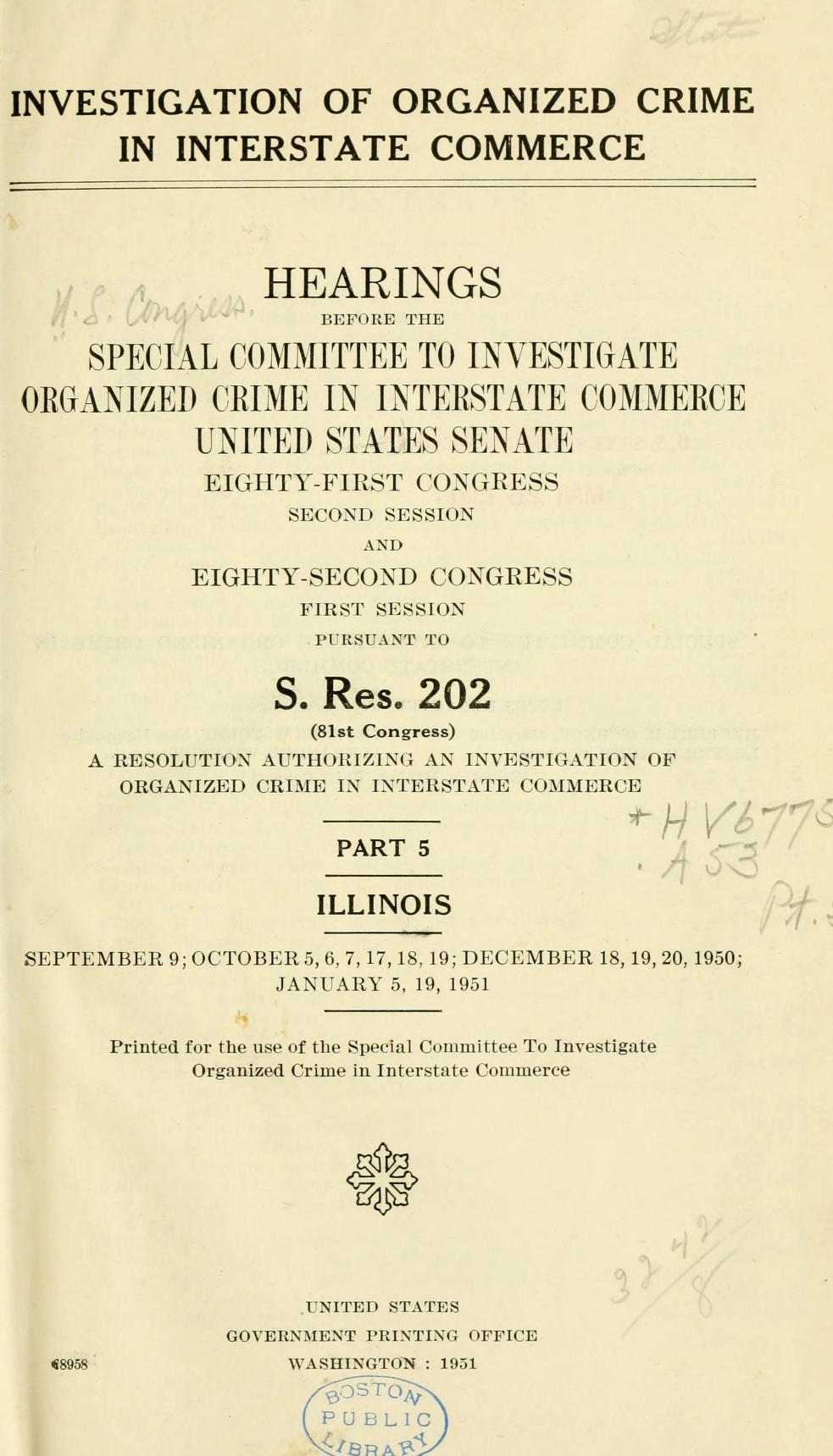 itemKefauver Committee hearings, Part 5: Illinois (1950–1951)Printed hearings of the Senate Special Committee to Investigate Organized Crime in Interstate Commerce, Part 5, Illinois: testimony taken from September 1950 to January 1951, including Paul DeLucia, Louis Campagna, Anthony J. Accardo, and Joseph Aiuppa.
 itemAl Capone (FBI history page)The FBI's history essay on Capone. It states that he was released on November 16, 1939, and that he lived on Palm Island until his death due to a stroke and pneumonia on January 25, 1947.itemKefauver Part 2: testimony of Virgil W. Peterson, Chicago Crime Commission, on the Capone syndicate (6-7 July 1950), pp. 125-213The Crime Commission's operating director gave a prepared history of the Capone organization from the Torrio era on, including that Nitti headed it after Capone went to prison and that since Nitti's suicide in 1943 Accardo had 'frequently been considered the leader.'itemKefauver Part 5: testimony of Ralph J. Capone (December 1950), pp. 1226-1250Ralph J. Capone testified that he was born in Naples, was convicted of income-tax evasion in 1931 and served three years, and sold beer to taverns from about 1923, buying through 'a man by the name of Guzik.'itemKefauver Part 5: testimony of Eugene Bernstein, Chicago tax attorney (17 October and 18 December 1950)Bernstein said he prepared tax returns for Accardo, Guzik, Humphreys and others and handled the tax settlement for Campagna and DeLucia, and that Accardo went with him on ten or twelve visits to Leavenworth. U.S. Attorney Otto Kerner stated that the prison records showed those visits signed 'Joseph Bulger.'itemKefauver Part 5: Daniel Serritella and Thomas Kelly on Continental Press and James Ragen's allegations (18-19 October 1950)Serritella said he had known Jack Guzik 'ever since I got into politics' and owed him $15,000 to $20,000 lent for a scratch sheet. Counsel put to him and to Thomas Kelly Ragen's allegations against Guzik and Humphreys; both men denied knowledge.itemKefauver Part 12: testimony of Jacob Guzik (March 1951), pp. 384-394Guzik refused to answer every question on grounds of incrimination. Counsel put to him a 1949 partnership return titled 'Guzik and Accardo' reporting a $278,667 share from the Erie-Buffalo Co.; the figures are counsel's.itemMcClellan Part 33: Lt. Joseph Morris on the Weinberg surveillance (10 July 1958), pp. 12730-12745Chicago police Lt. Joseph Morris described the surveillance of James Weinberg's efforts to organize restaurant and tavern associations, including Weinberg's reported 'deal with Ross Prio' on the North Side and the 'old fellows' who wanted no violence.
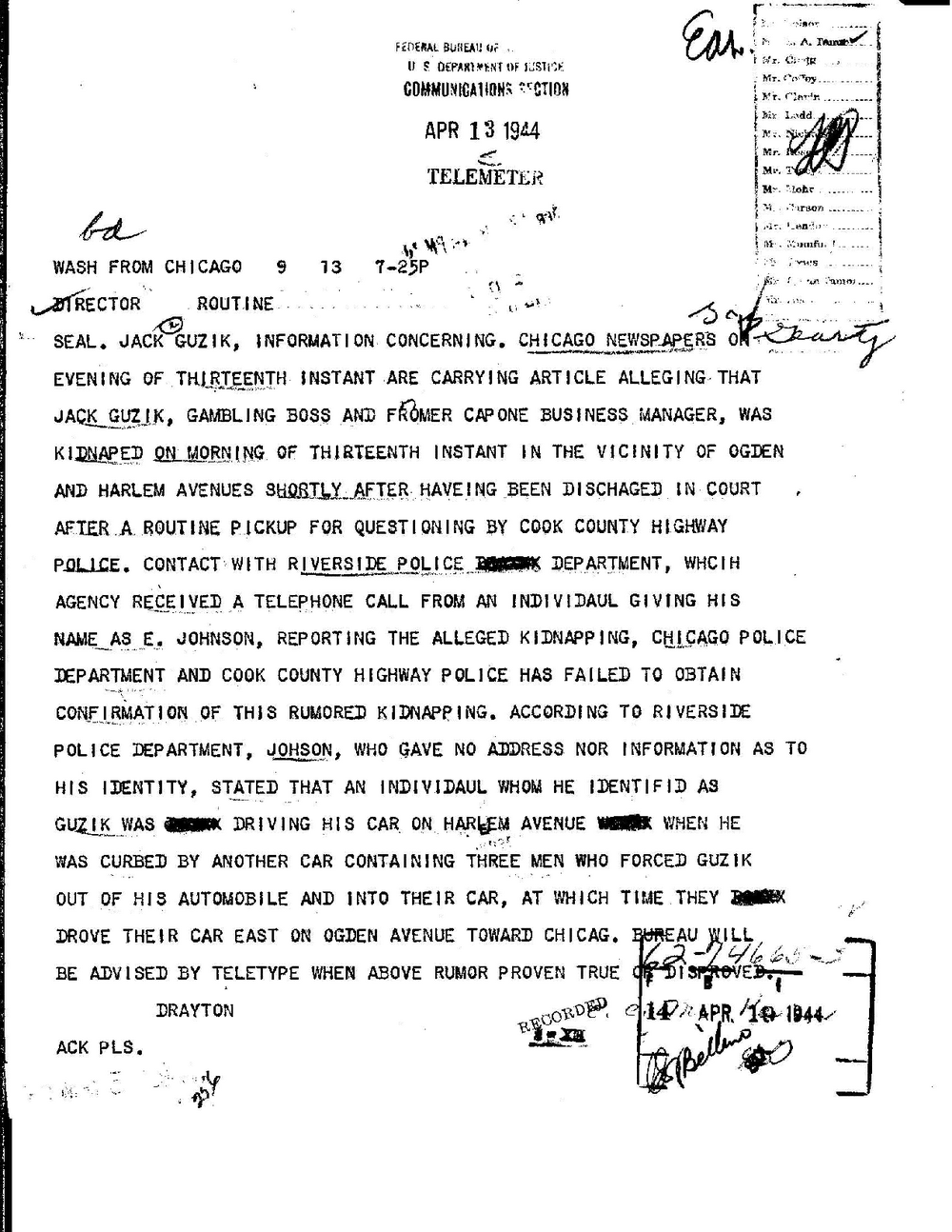 itemFBI Chicago teletypes and Bureau memorandum, April 13-19, 1944: the rumored kidnapping of Jack Guzik (Vault Jake Guzik)A Chicago teletype of April 13, 1944 reports a newspaper story that Jack Guzik had been kidnapped near Ogden and Harlem Avenues, which police could not confirm. A second says Guzik called an attorney to say he was safe, not kidnapped, and 'remaining in hiding.' The Bureau made no investigation.
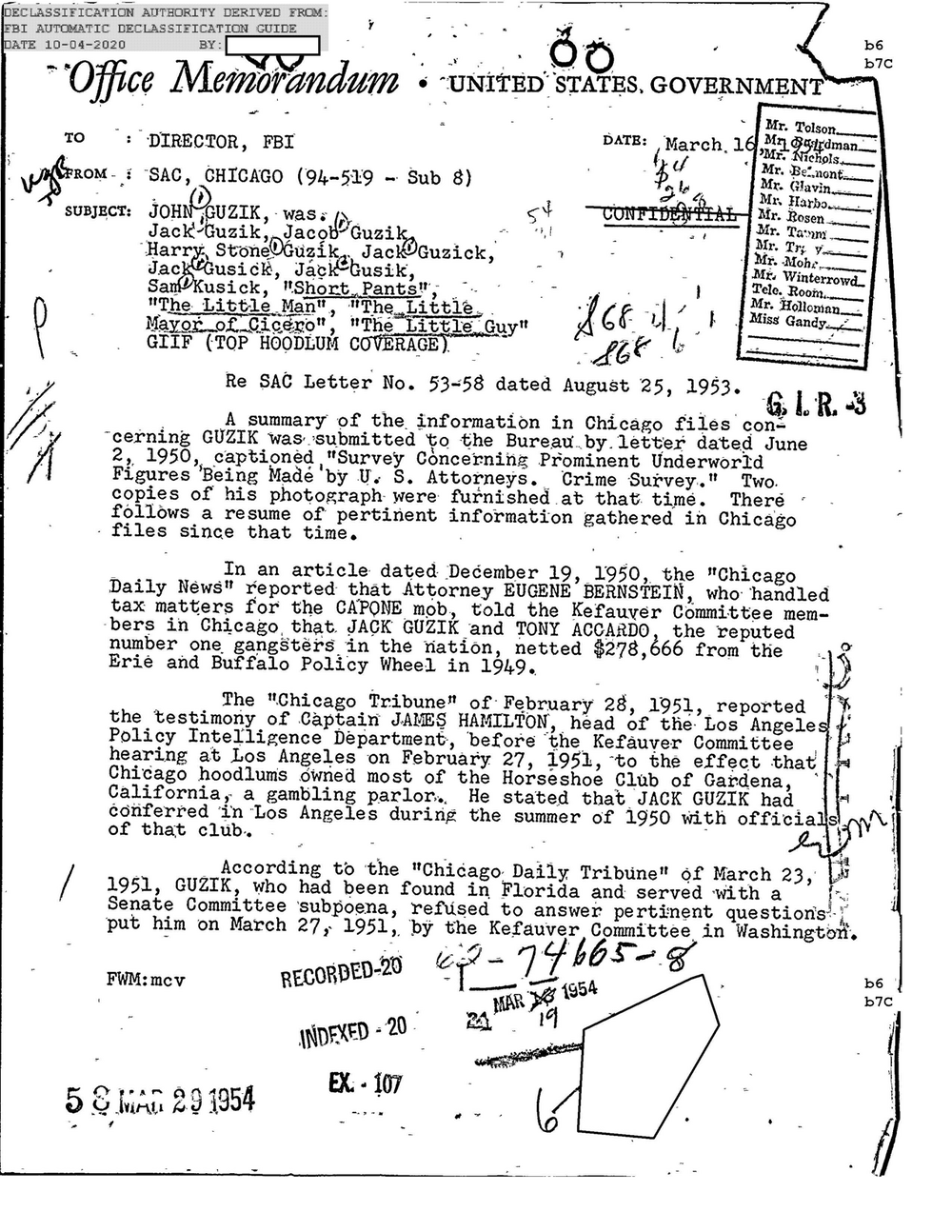 itemFBI Chicago summary on Jack Guzik for the Top Hoodlum Program, March 1954 (Vault Jake Guzik)A Chicago summary under 'Top Hoodlum Coverage' lists Guzik's aliases and relays, from newspaper reports, events since 1950: testimony that he and Accardo netted $278,666 from a policy wheel in 1949, the 1951 Senate contempt citation, and his reported acquittal on January 11, 1952.itemFBI Chicago memorandum on Jack Guzik's death (February 21, 1956) and the closing of the file (Vault Jake Guzik)A Chicago memorandum relays the Chicago Sun-Times report that Guzik died of a heart attack on the evening of February 21, 1956, summarizes his false-arrest suit after a January 1956 arrest, and says he is being deleted from the list of Chicago's top hoodlums and the file closed.
itemKefauver Committee hearings, Part 5: Illinois (1950–1951)Printed hearings of the Senate Special Committee to Investigate Organized Crime in Interstate Commerce, Part 5, Illinois: testimony taken from September 1950 to January 1951, including Paul DeLucia, Louis Campagna, Anthony J. Accardo, and Joseph Aiuppa.itemAl Capone (FBI history page)The FBI's history essay on Capone. It states that he was released on November 16, 1939, and that he lived on Palm Island until his death due to a stroke and pneumonia on January 25, 1947.itemKefauver Part 2: testimony of Virgil W. Peterson, Chicago Crime Commission, on the Capone syndicate (6-7 July 1950), pp. 125-213The Crime Commission's operating director gave a prepared history of the Capone organization from the Torrio era on, including that Nitti headed it after Capone went to prison and that since Nitti's suicide in 1943 Accardo had 'frequently been considered the leader.'itemKefauver Part 5: testimony of Ralph J. Capone (December 1950), pp. 1226-1250Ralph J. Capone testified that he was born in Naples, was convicted of income-tax evasion in 1931 and served three years, and sold beer to taverns from about 1923, buying through 'a man by the name of Guzik.'itemKefauver Part 5: testimony of Eugene Bernstein, Chicago tax attorney (17 October and 18 December 1950)Bernstein said he prepared tax returns for Accardo, Guzik, Humphreys and others and handled the tax settlement for Campagna and DeLucia, and that Accardo went with him on ten or twelve visits to Leavenworth. U.S. Attorney Otto Kerner stated that the prison records showed those visits signed 'Joseph Bulger.'itemKefauver Part 5: Daniel Serritella and Thomas Kelly on Continental Press and James Ragen's allegations (18-19 October 1950)Serritella said he had known Jack Guzik 'ever since I got into politics' and owed him $15,000 to $20,000 lent for a scratch sheet. Counsel put to him and to Thomas Kelly Ragen's allegations against Guzik and Humphreys; both men denied knowledge.itemKefauver Part 12: testimony of Jacob Guzik (March 1951), pp. 384-394Guzik refused to answer every question on grounds of incrimination. Counsel put to him a 1949 partnership return titled 'Guzik and Accardo' reporting a $278,667 share from the Erie-Buffalo Co.; the figures are counsel's.itemMcClellan Part 33: Lt. Joseph Morris on the Weinberg surveillance (10 July 1958), pp. 12730-12745Chicago police Lt. Joseph Morris described the surveillance of James Weinberg's efforts to organize restaurant and tavern associations, including Weinberg's reported 'deal with Ross Prio' on the North Side and the 'old fellows' who wanted no violence.itemFBI Chicago teletypes and Bureau memorandum, April 13-19, 1944: the rumored kidnapping of Jack Guzik (Vault Jake Guzik)A Chicago teletype of April 13, 1944 reports a newspaper story that Jack Guzik had been kidnapped near Ogden and Harlem Avenues, which police could not confirm. A second says Guzik called an attorney to say he was safe, not kidnapped, and 'remaining in hiding.' The Bureau made no investigation.itemFBI Chicago summary on Jack Guzik for the Top Hoodlum Program, March 1954 (Vault Jake Guzik)A Chicago summary under 'Top Hoodlum Coverage' lists Guzik's aliases and relays, from newspaper reports, events since 1950: testimony that he and Accardo netted $278,666 from a policy wheel in 1949, the 1951 Senate contempt citation, and his reported acquittal on January 11, 1952.itemFBI Chicago memorandum on Jack Guzik's death (February 21, 1956) and the closing of the file (Vault Jake Guzik)A Chicago memorandum relays the Chicago Sun-Times report that Guzik died of a heart attack on the evening of February 21, 1956, summarizes his false-arrest suit after a January 1956 arrest, and says he is being deleted from the list of Chicago's top hoodlums and the file closed.