Record
Hearing
1950-10-18/1950-10-19
U.S. Senate Special Committee to Investigate Organized Crime in Interstate Commerce, via Internet Archive
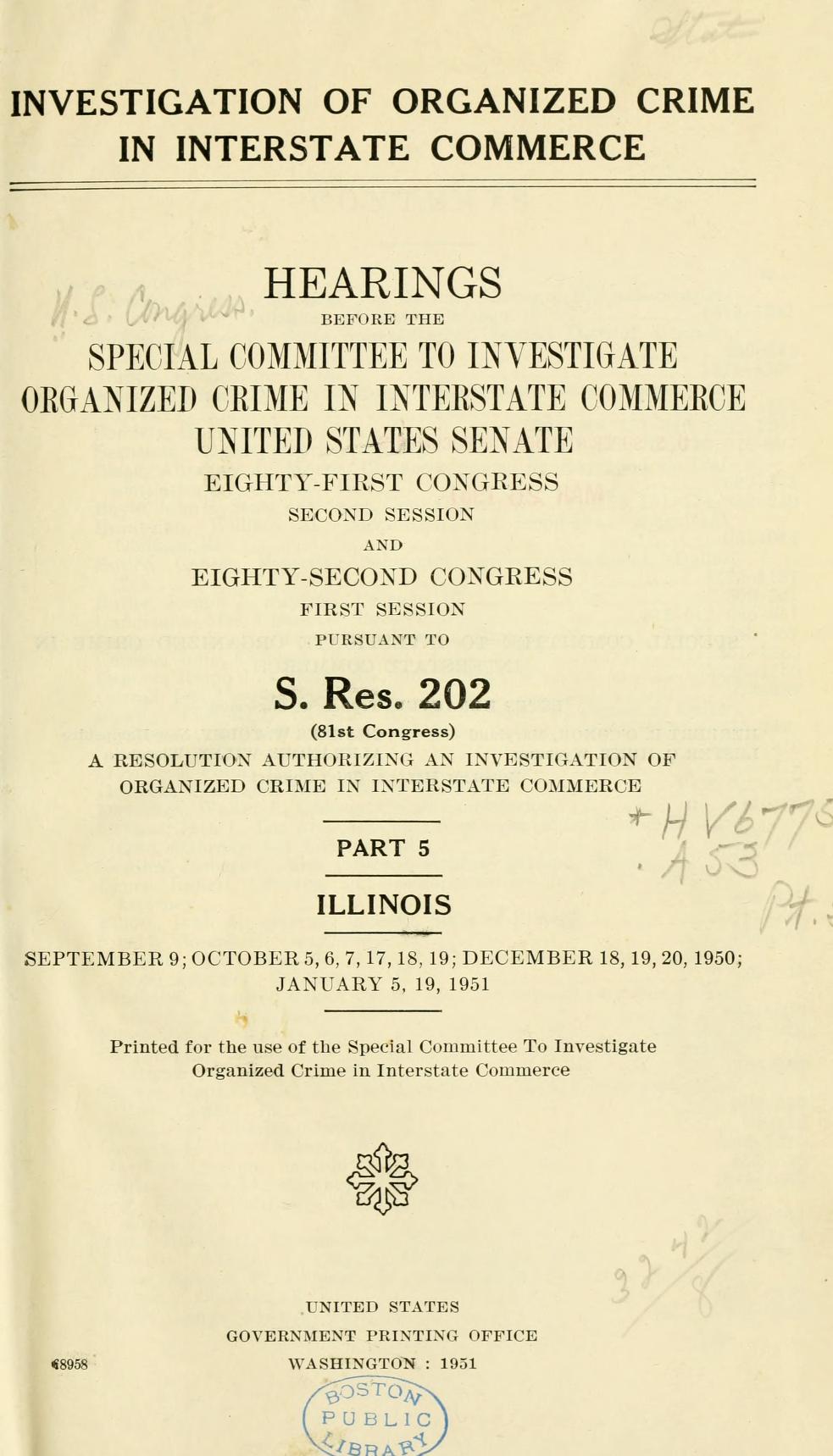
Kefauver Part 5: Daniel Serritella and Thomas Kelly on Continental Press and James Ragen's allegations (18-19 October 1950)
Serritella said he had known Jack Guzik 'ever since I got into politics' and owed him $15,000 to $20,000 lent for a scratch sheet. Counsel put to him and to Thomas Kelly Ragen's allegations against Guzik and Humphreys; both men denied knowledge.
- Date
- 1950-10-18/1950-10-19
- Kind
- hearing
- Retrieved
- 2026-10-12
- Rights
- A hearing print of the United States Senate, published by the Government Printing Office. A work of the United States Congress, public domain under 17 U.S.C. § 105. The Internet Archive item marks it not in copyright.
Daniel Serritella testified on 18 and 19 October 1950 (Part 5, pp. 664-691 and 757-771). He said he worked in the circulation department of the Daily Sports News, a racing scratch sheet, that he had been “president of the newsboys union away back,” and that he had known James Ragen for over thirty years (“He was the godfather of my son”). He said (pp. 668-669) that he had known Jack Guzik “ever since I got into politics” and owed him “between 15 and 20 thousand dollars,” lent to start the scratch sheet.
Committee counsel put to him that the wire-service operator Hymie Levin was “practically partners with Murray Humphreys, Anthony Accardo, and Guzik,” and (pp. 768-769) that Ragen had said Humphreys was one of the men who threatened him. Serritella said Levin dealt with Ragen and that he did not know of Humphreys’s part, and that when he raised the dispute with Guzik, Guzik said the only thing he could tell Levin and Ragen was to “get together and straighten it out.”
In Thomas F. Kelly’s session of 19 October (p. 845), counsel Robinson stated that Ragen had said he was propositioned in September 1945 by Guzik and Humphreys for 40 percent of the Midwest wire-service income. Kelly said Ragen never told him that.
The allegations come from counsel’s questions and were denied or disclaimed by both witnesses. They are not testimony to the facts alleged and not findings. Quotations follow the Internet Archive’s OCR of the printed volume. Page numbers are the printed running heads and can be off by one near a page break.