Anthony Joseph Accardo
Testified to the Kefauver Committee in 1951 and refused to answer. His 1960 tax conviction was reversed in 1962. FBI Chicago teletypes of the early 1970s call him one of a three-man leadership team directing organized crime in Chicago.
- Aliases
- Tony Accardo, Anthony J. Accardo, Joe Batters, Big Tuna
- Role
- One of a three-man leadership team directing organized crime in Chicago, according to FBI Chicago teletypes of the early 1970s
- Rights
- Biography on this page is limited to what the cited federal records state.
On the record
- 1929 and 1931 — Virgil W. Peterson of the Chicago Crime Commission told the Kefauver Committee in July 1950 (Part 2, p. 130) that Accardo was among those "sought by police as suspects - and they were just suspects" in the Saint Valentine's Day killings, and (p. 134) that the Crime Commission named him a public enemy in 1931. Testimony from the Commission's files; no charge is stated.
- About 1941-1947 — Eugene Bernstein, a Chicago tax attorney, testified on 17 October 1950 (Part 5, pp. 476-483) that he had represented Accardo from about 1941 and that Accardo went with him on perhaps ten to twelve visits to Paul DeLucia and Louis Campagna at Leavenworth and paid him nothing. U.S. Attorney Otto Kerner stated that the prison records showed those visits signed "Joseph Bulger," the name of an attorney. The FBI's summary of Bernstein's 1947 interview (Vault, Roselli Part 04) also says Accardo, "alias Joe Batters," accompanied him on most visits.
- August 1946 — An FBI report extract (Vault, Anthony Accardo Part 02, p. 2) concerns "ANTHONY JOSEPH ACCARDO, alias Tony Accardo, alias Joe Batters," and lists callers at his residence reported by informants.
- July 1950 — Peterson told the Kefauver Committee (Part 2, p. 134): "Since Frank Nitti committed suicide in 1943, Tony Accardo has frequently been considered the leader of the Capone syndicate." A witness describing reputation, not a finding.
- 5 October 1950 — Frederick Pretzie, Jr. of the Chicago Crime Commission told the committee (Part 5, p. 202) that the old Twentieth Ward "gave you Tony Accardo," that Accardo was among Al Capone's bodyguards, and that "Mooney Giancana" was his chauffeur and bodyguard. The witness's characterization.
- 5 January 1951 — Before the Kefauver Committee (Part 5, pp. 1318–1319) he gave his name as Anthony J. Accardo and, asked whether he had been known as Joe Batters, answered: "I refuse to answer."
- 5 January 1951 — Committee counsel Rudolph Halley stated (Part 5, p. 1320) that "the mantle of the Capone gang descended upon Tony Accardo, the witness, and Paul Ricca." This is counsel's statement, not testimony or a finding.
- 5 January 1951 — Chief counsel Halley described to the committee (Part 5, pp. 1324-1325) two checks of $5,000 each, dated February 2 and 9, 1950, drawn by the S & G Service and endorsed "Anthony J. Accardo," deposited to a Florida boat works; Accardo declined to identify the endorsement.
- March 1951 — Kefauver counsel put to Jake Guzik (Part 12, p. 389) a partnership return titled "Guzik and Accardo" reporting a share of $278,667 from the Erie-Buffalo Co. in 1949; Guzik refused to answer. Counsel's question.
- 1953 — McClellan Committee staff member Pierre Salinger testified on June 9, 1959 (Part 53, p. 18674) that Giancana went to Los Angeles in 1953 "in the company of Anthony Accardo, who is the top figure in the Chicago underworld."
- 1957 — A Chicago FBI memorandum dictated July 22, 1959 (Vault, Part 02, p. 5) relays a source's account that "GIANCANA in 1957 forced ACCARDO into semi-retirement and assumed the reins of the Syndicate," and that Accardo remained available "as more or less an elder statesman." Third-hand; not a Bureau finding.
- 1 July 1958 — U.S. Bureau of Narcotics agent Martin F. Pera told the McClellan Committee (Part 32, pp. 12244-12245): "Certainly the important figures in Chicago would be Tony Accardo and Paul Ricca." On 2 July Los Angeles police Capt. James E. Hamilton testified (p. 12333) that Accardo had visited Los Angeles about five years earlier with "Monny Giancanna." On 3 July the chairman announced that Accardo, "who has long been reputed as one of the racket overlords of Chicago," would be called. A federal agent's and the chairman's characterizations.
- 11 July 1958 — Before the McClellan Committee (Part 33, pp. 12782-12790) he gave his residence as River Forest and invoked the Fifth Amendment. Chief counsel Kennedy asked whether he "took over as the head of the Capone syndicate in 1943" and whether he and Paul Ricca were "the two most important figures in Chicago"; he declined to answer. Counsel's questions.
- October 1959-January 1960 — The FBI's compilation of Chicago newspaper clippings in his file (Vault, Part 01, pp. 305-370) records, by its own caption lines, the disclosure that he and a Chicago police lieutenant were in Europe at the same time and the lieutenant's suspension and dismissal.
- September-November 1960 — A Chicago FBI report of September 14, 1961 (Vault, Humphreys Part 12) says Accardo was tried in the Northern District of Illinois from September to November 1960 on income-tax charges. It relays an informant's statement that Murray Humphreys directed the defense strategy and obtained the jury list, but says no approach to a juror was ever made and that Accardo took the position that such tactics would only cause more trouble.
- 5 January 1962 — United States v. Accardo, 298 F.2d 133 (7th Cir. 1962): his 1960 conviction on three counts under § 7206(1) of the Internal Revenue Code, with a sentence of six years and a $15,000 fine, was reversed: "For prejudicial error at the trial, the judgment is reversed and the cause remanded for new trial."
- Early 1970s — FBI Chicago teletypes (Vault, Part 01, pp. 157 and 249; one refers to a teletype of January 15, 1972) describe him as "ONE OF TOP LEADERSHIP TEAM DIRECTING ORGANIZED CRIME IN CHICAGO" and say that Gus Alex and Accardo "ARE TWO MEMBERS OF THREE MAN LEADERSHIP TEAM."
- January 1974 — Chicago and Los Angeles FBI communications (Vault, Part 01, pp. 154-174) dated January 1974 call him one of the "top leadership team" and, with Gus Alex, one of "two members of three man leadership team," say he was wintering at Palm Springs, and in a Los Angeles memorandum of 1/28/74 call him "a La Cosa Nostra (LCN) member." The legible date lines are January 1974; one teletype refers to an earlier teletype typed "1/15/72." The FBI's assessments.
- 1975 — Chicago FBI reports of 1975 (Vault, Part 01, pp. 398-440) state "ACCARDO still remains Chicago LCN Boss," and informants quoted in them say "TONY ACCARDO and JOEY AIUPPA still run the Chicago 'Mafia'," with Aiuppa the "street boss." The FBI's synopses and informants' claims, not findings.
- 1984-1985 — His file holds the Chicago division's 1984-85 Racketeering Enterprise Investigation of "the Chicago LCN Family" (Vault, Part 01, pp. 75-139); Headquarters granted a further 180 days on November 25, 1985.
- 29 July 1997 — United States v. Zizzo, 120 F.3d 1338 (7th Cir. 1997), calls "boss of all bosses" a title "once held by the likes of Al Capone and Tony 'Big Tuna' Accardo."
The heading follows the caption of the 1962 opinion and the 1946 FBI report. “Joe Batters” is the alias in the Kefauver contents and the FBI report; “Big Tuna” is the Seventh Circuit’s in 1997 (CourtListener’s text prints the surname there as “Aecardo”, an error in its scan).
The role line is the FBI Chicago office’s own assessment in the 1970s teletypes. The Kefauver counsel’s words, the McClellan staff testimony, and the 1959 memorandum are quoted in the events with their limits stated, and are not combined into a rank. No opened record gives his birth or death date legibly. The role line, written from the leadership teletypes, says “early 1970s”; the legible date lines around those pages are January 1974, as the events record. The FBI’s 1975 “Chicago LCN Boss” wording is the Bureau’s and its informants’, and like the Kefauver and McClellan characterizations it is kept in the events, not on the chart. Kerner’s “Joseph Bulger” is the name on the prison register, which was also the name of a real attorney; it is not listed as an alias.
The National Archives’ Alcatraz record for register number 1498 is for Anthony Michael Accardo, born 1923, a different man. It is not cited here.
Records
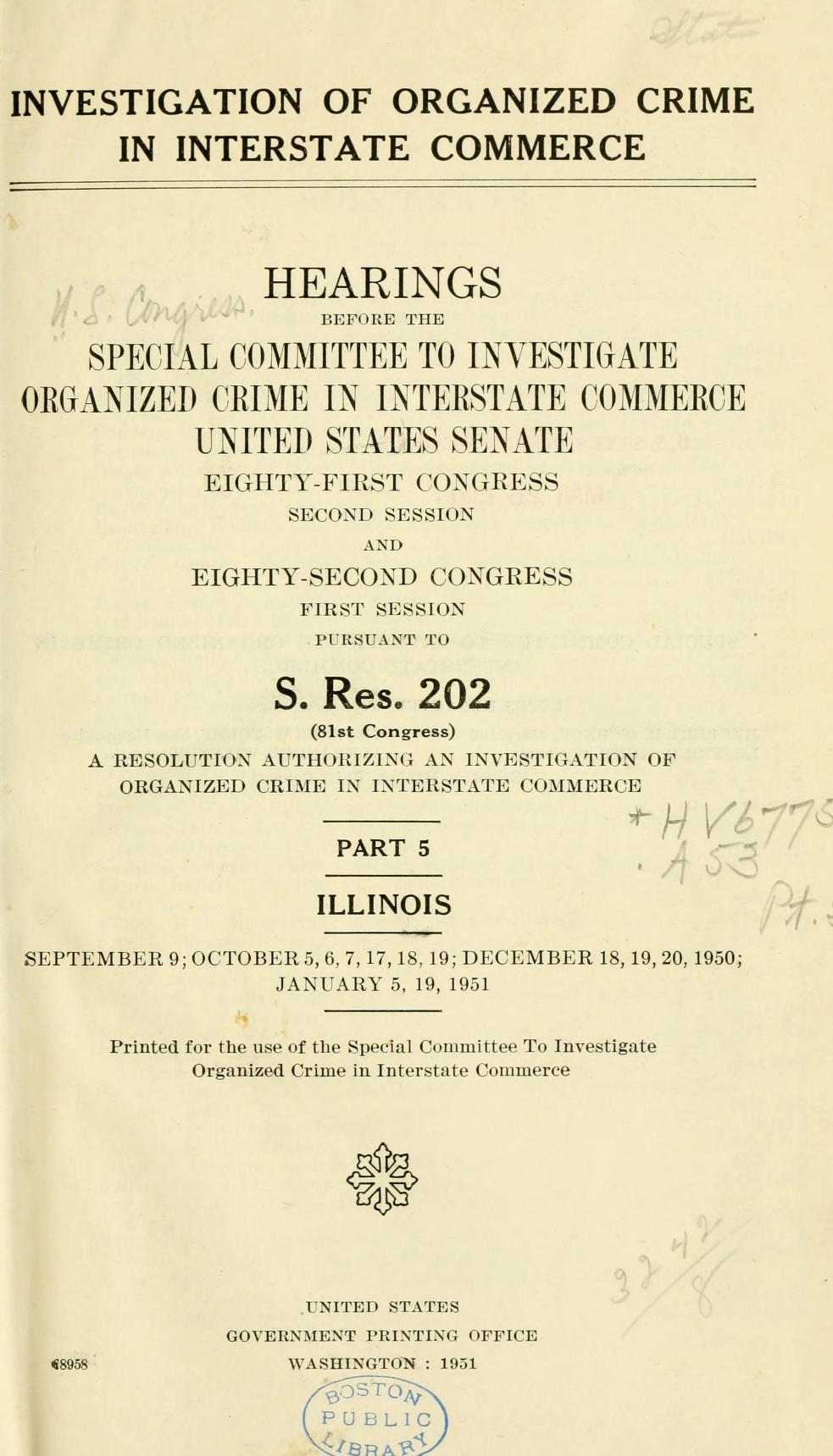 itemKefauver Committee hearings, Part 5: Illinois (1950–1951)Printed hearings of the Senate Special Committee to Investigate Organized Crime in Interstate Commerce, Part 5, Illinois: testimony taken from September 1950 to January 1951, including Paul DeLucia, Louis Campagna, Anthony J. Accardo, and Joseph Aiuppa.itemMcClellan Committee hearings, Part 53 (June 1959)Printed hearings of the Senate Select Committee on Improper Activities in the Labor or Management Field, Part 53, June 1959, including Sam Giancana's appearance on June 9, 1959 and staff testimony about him and Anthony Accardo.
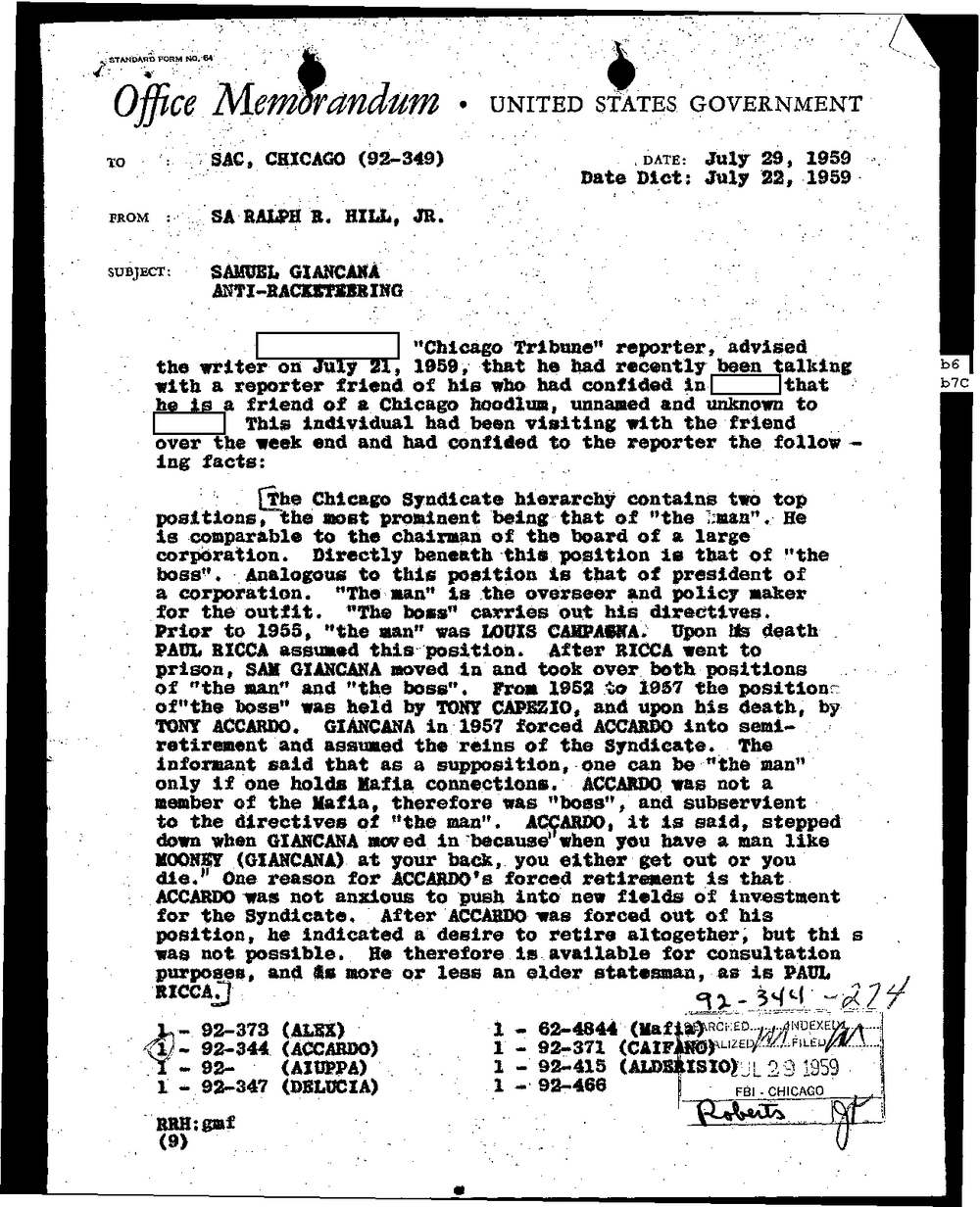 itemFBI Vault file on Anthony AccardoThe FBI Vault's release of the Bureau file on Anthony Accardo, in two parts, including a 1946 informant report, a 1959 Chicago memorandum relaying a source's account of the Chicago syndicate's hierarchy, and early-1970s teletypes on its leadership.itemUnited States v. Zizzo, 120 F.3d 1338 (7th Cir. 1997)Seventh Circuit opinion of July 29, 1997 in the Carlisi Street Crew gambling and loansharking case; it vacates Samuel Carlisi's conviction because he died while the appeals were pending and affirms the others.itemKefauver Part 5: testimony of Anthony J. Accardo, alias Joe Batters (5 January 1951), pp. 1318-1341Accardo refused nearly every question, including whether he was known as Joe Batters or knew Capone, Nitti or Ricca. Chief counsel Rudolph Halley put on the record statements about the 'mantle of the Capone gang' and checks endorsed by Accardo; those are counsel's statements.itemKefauver Part 2: testimony of Virgil W. Peterson, Chicago Crime Commission, on the Capone syndicate (6-7 July 1950), pp. 125-213The Crime Commission's operating director gave a prepared history of the Capone organization from the Torrio era on, including that Nitti headed it after Capone went to prison and that since Nitti's suicide in 1943 Accardo had 'frequently been considered the leader.'itemKefauver Part 5: statement of Frederick Pretzie, Jr., Chicago Crime Commission (5 October 1950), pp. 197-203The Crime Commission's administrative assistant described the defeat of its bills in the 1949 legislature and the 'West Side bloc', and called 'Mooney Giancana' the youngest member of the mob and the chauffeur and bodyguard for Tony Accardo.itemKefauver Part 5: testimony of Eugene Bernstein, Chicago tax attorney (17 October and 18 December 1950)Bernstein said he prepared tax returns for Accardo, Guzik, Humphreys and others and handled the tax settlement for Campagna and DeLucia, and that Accardo went with him on ten or twelve visits to Leavenworth. U.S. Attorney Otto Kerner stated that the prison records showed those visits signed 'Joseph Bulger.'itemKefauver Part 12: testimony of Jacob Guzik (March 1951), pp. 384-394Guzik refused to answer every question on grounds of incrimination. Counsel put to him a 1949 partnership return titled 'Guzik and Accardo' reporting a $278,667 share from the Erie-Buffalo Co.; the figures are counsel's.
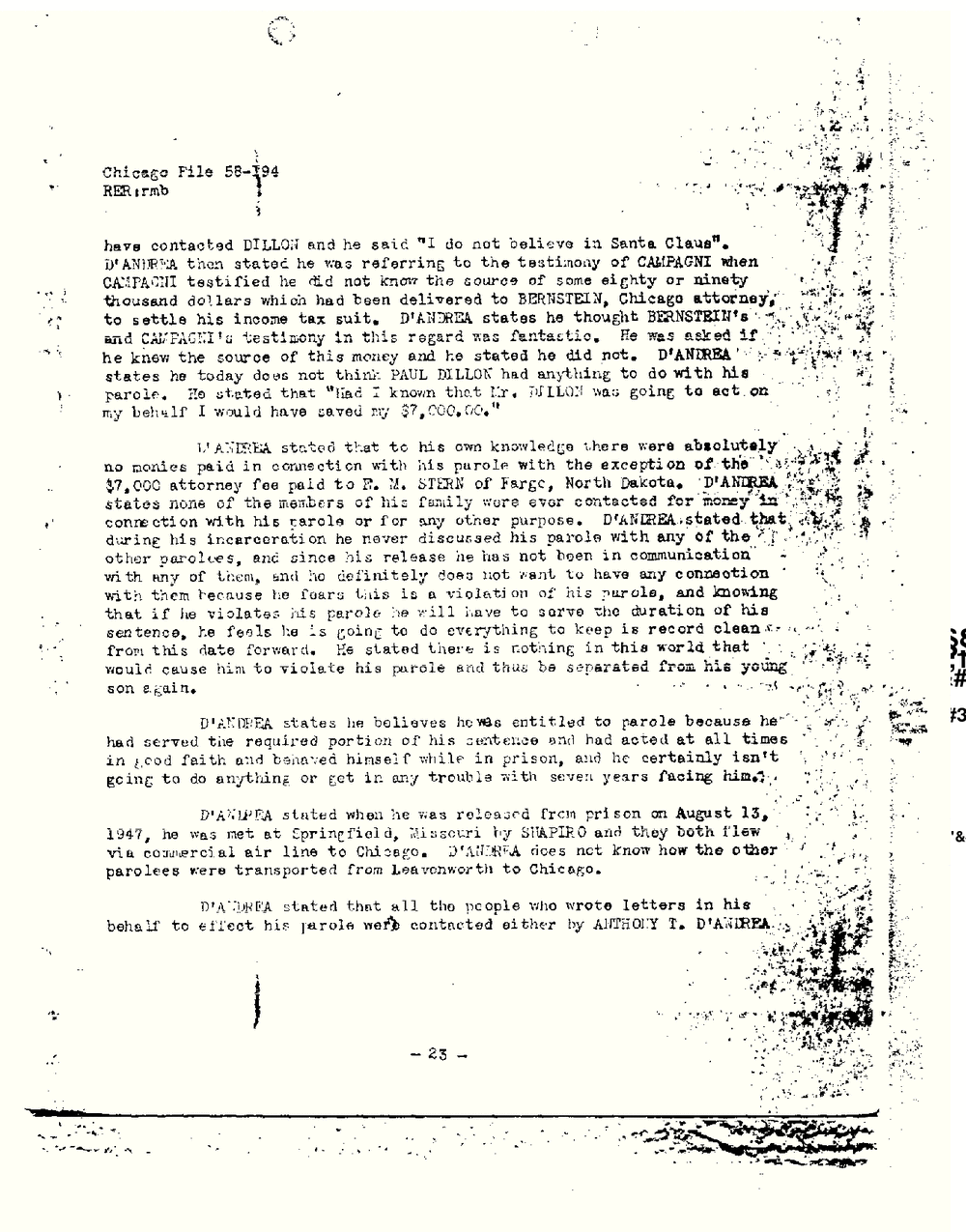 itemFBI Chicago report, September 29, 1947: attorney Eugene Bernstein on his Leavenworth visits with Anthony Accardo (Vault Roselli Part 04)The FBI summarizes its interview of Eugene Bernstein, tax attorney for Paul DeLucia and Louis Campagna, who said that Anthony Accardo, 'alias Joe Batters', went with him on most of his visits to DeLucia at Leavenworth.itemMcClellan Part 32: Chicago in the testimony of Martin F. Pera (1 July 1958) and the chairman's closing statement (3 July 1958)Bureau of Narcotics agent Martin Pera told the committee that 'the important figures in Chicago would be Tony Accardo and Paul Ricca.' The chairman's statement of 3 July announced hearings on the Chicago restaurant industry, naming Accardo among the witnesses.
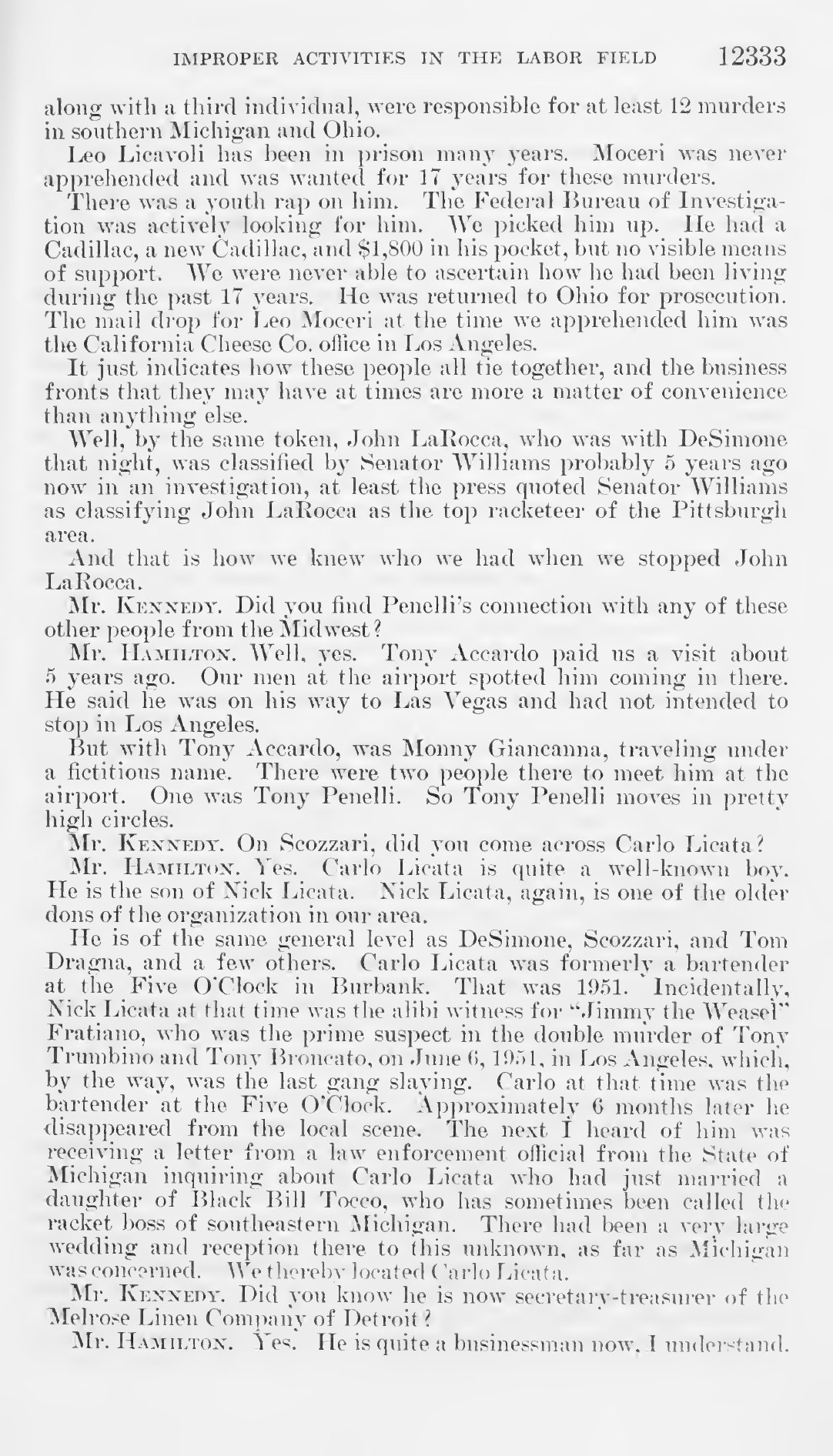 itemTestimony of Capt. James E. Hamilton, Los Angeles Police Department, before the McClellan Committee (Part 32)The commander of the Los Angeles police intelligence division described stopping Frank DeSimone's car in 1956 and finding "John S. LaRocca, of Pittsburgh, Pa." as a passenger, and said police knew who LaRocca was only from newspaper clippings.itemMcClellan Part 33: testimony of Anthony J. Accardo (11 July 1958), pp. 12782-12790Accardo gave his residence as River Forest and invoked the Fifth Amendment on his occupation, birthplace and citizenship. Chief counsel Kennedy asked whether he took over the Capone syndicate in 1943 and showed a photograph of him with Giancana; he declined every question.itemMcClellan Part 53: staff testimony on the January 1953 Los Angeles trip and Frank Ferraro (9 June 1959)Staff members Pierre Salinger and James McShane described a January 1953 trip to Los Angeles by Giancana, Anthony Accardo and Dr. Eugene Chesrow, met by Frank Ferraro and Anthony Pinelli. McShane called Ferraro 'Gus Alex's No. 1 man in the first ward' and gave his true name as Frank Sortino.itemFBI Chicago clipping compilation, October 1959 to January 1960: Accardo's European trip and a Chicago police lieutenant (Vault Accardo Part 01)The FBI's compilation of newspaper clippings about Accardo and a Chicago police lieutenant travelling in Europe at the same time in October 1959, as the FBI's own caption lines describe them. This page rests only on those caption lines.
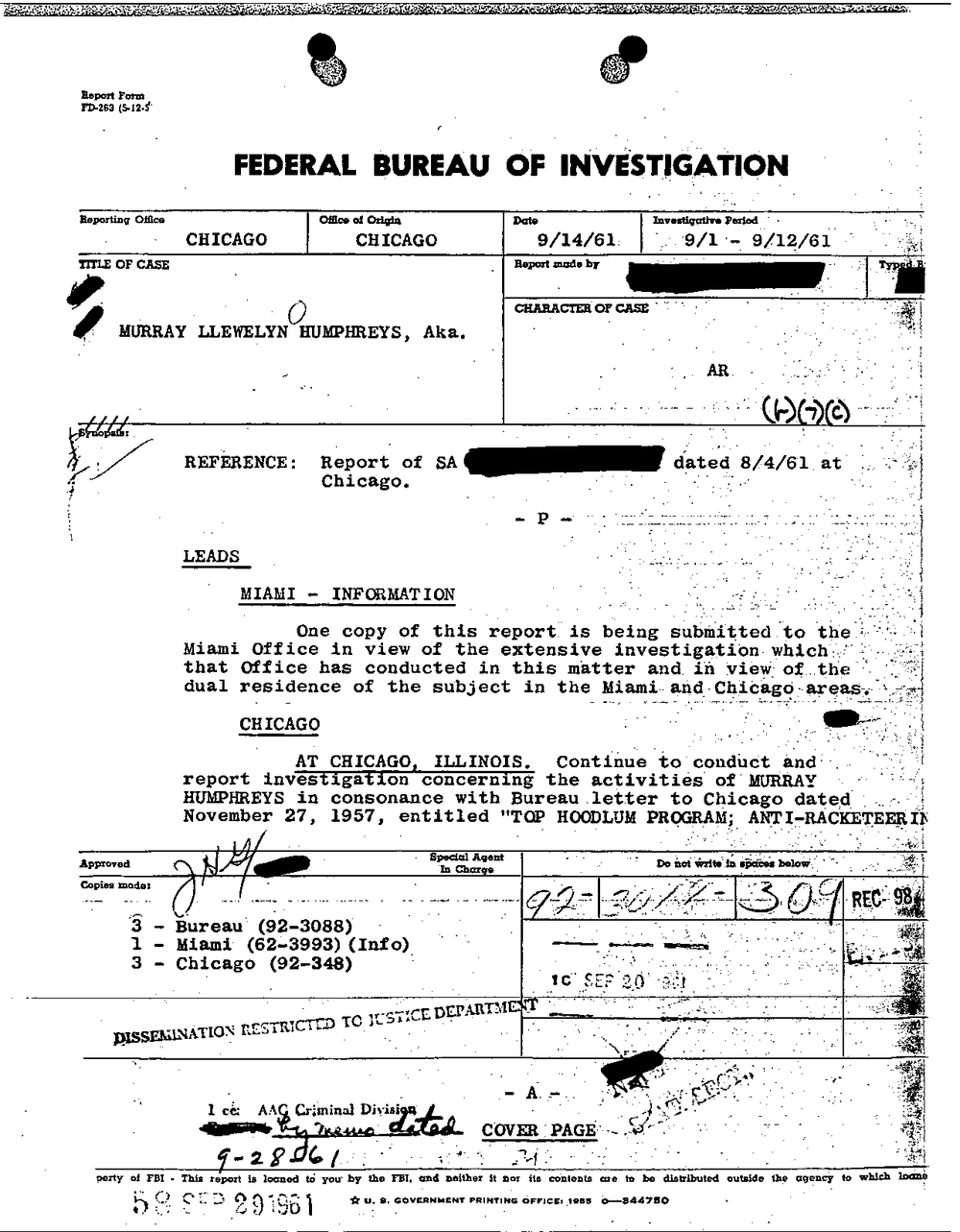 itemFBI Chicago report, September 14, 1961: inquiry whether jurors in Accardo's 1960 tax trial were approached (Vault Humphreys Part 12)The report investigates whether Humphreys or anyone for him approached a juror in Anthony Accardo's 1960 income-tax trial. An informant said Humphreys masterminded the defense strategy and obtained the jury list, but the synopsis says no approach was ever made.
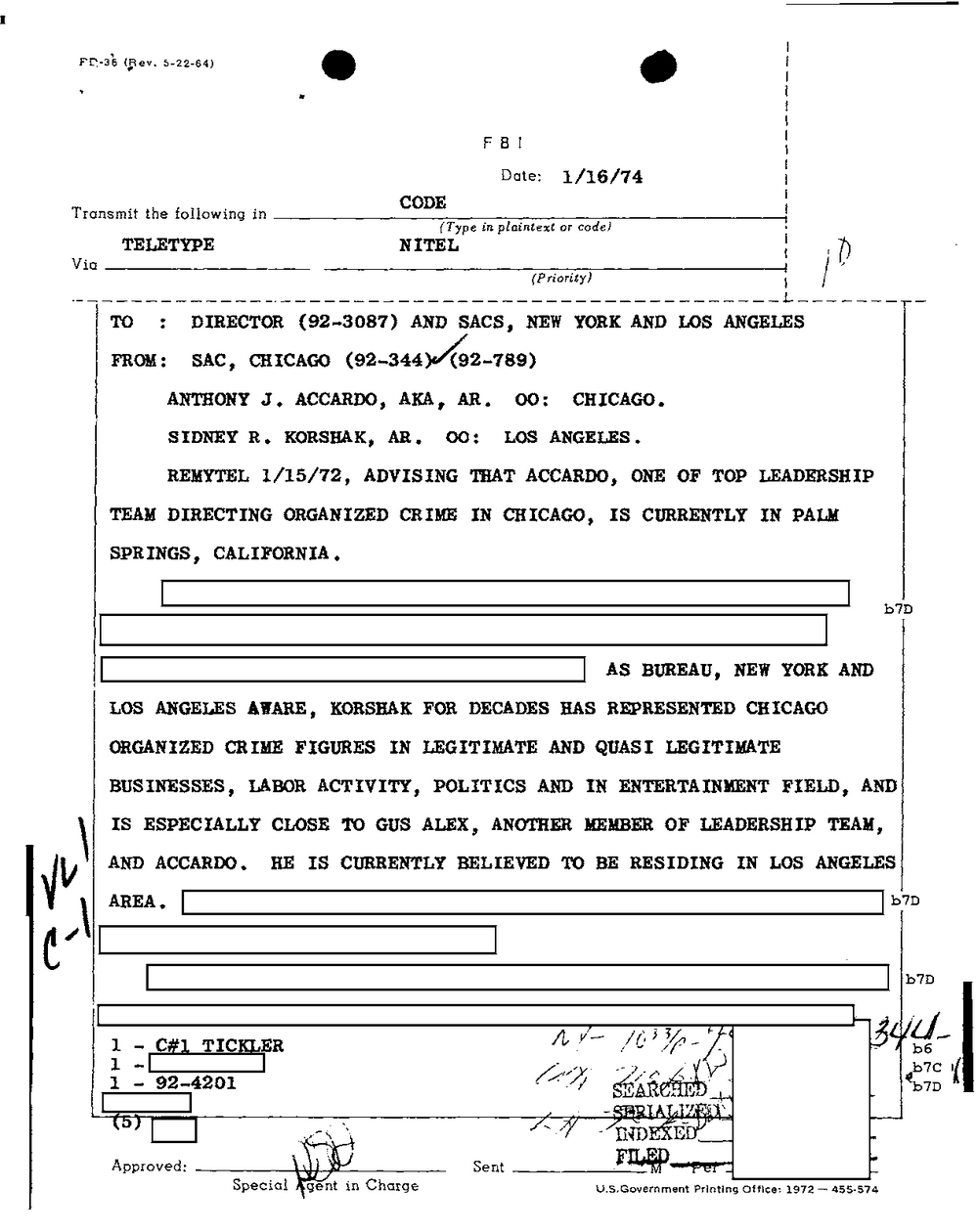 itemFBI Chicago teletypes, January 1974: Accardo, Gus Alex and the 'three man leadership team' (Vault Accardo Part 01)Chicago and Los Angeles communications in the Accardo file describe Accardo and Gus Alex as two members of a 'three man leadership team' directing organized crime in Chicago, refer to the 'deceased LCN leader Fiore Buccieri who died 1973', and note Marshall Caifano's parole travel.
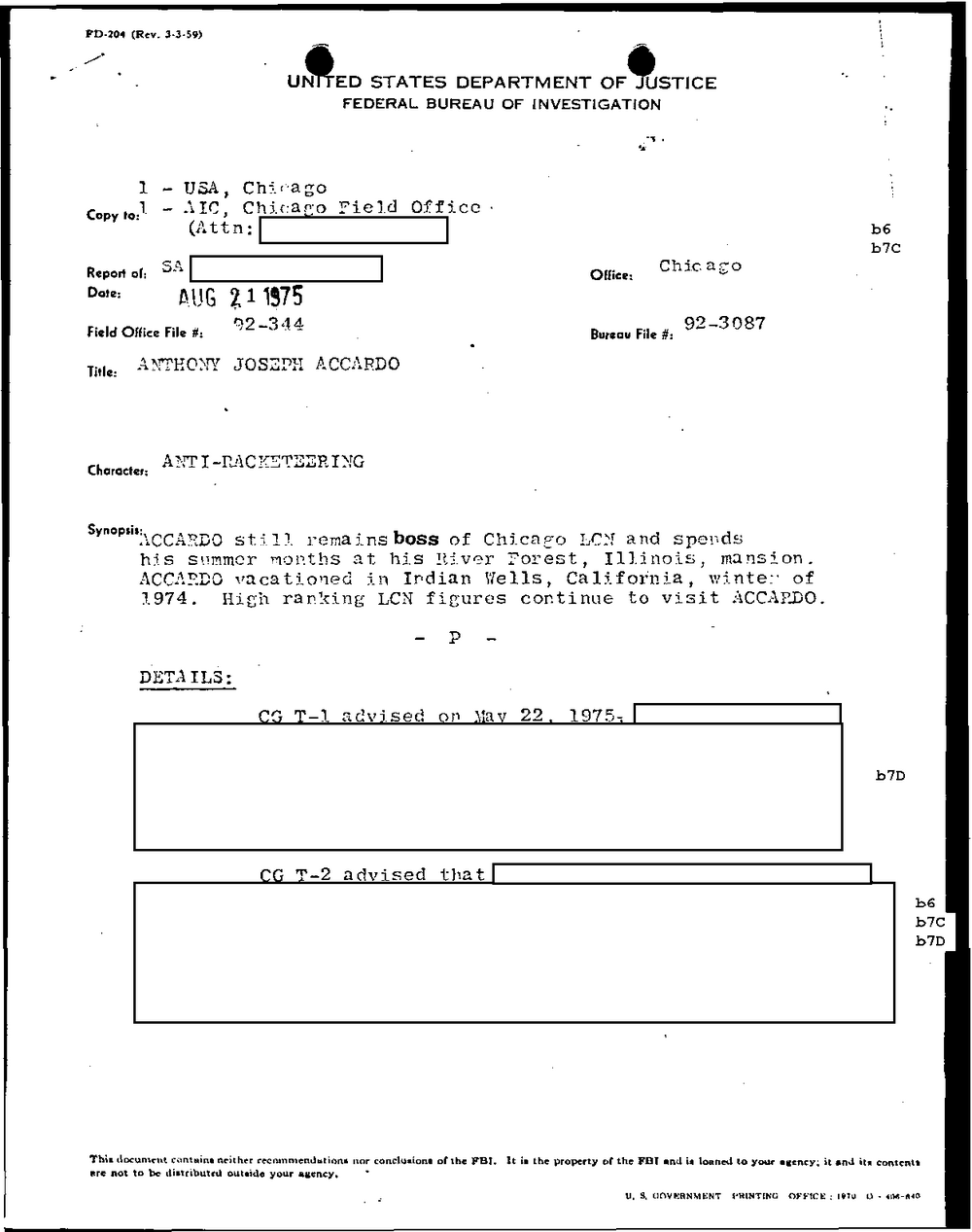 itemFBI Chicago reports, 1975: 'ACCARDO still remains Chicago LCN Boss' (Vault Accardo Part 01)Chicago field-office reports and teletypes of 1975 call Accardo the 'Chicago LCN boss', and informants quoted in them say Accardo and Joseph Aiuppa 'still run the Chicago Mafia', with Aiuppa the 'street boss.'
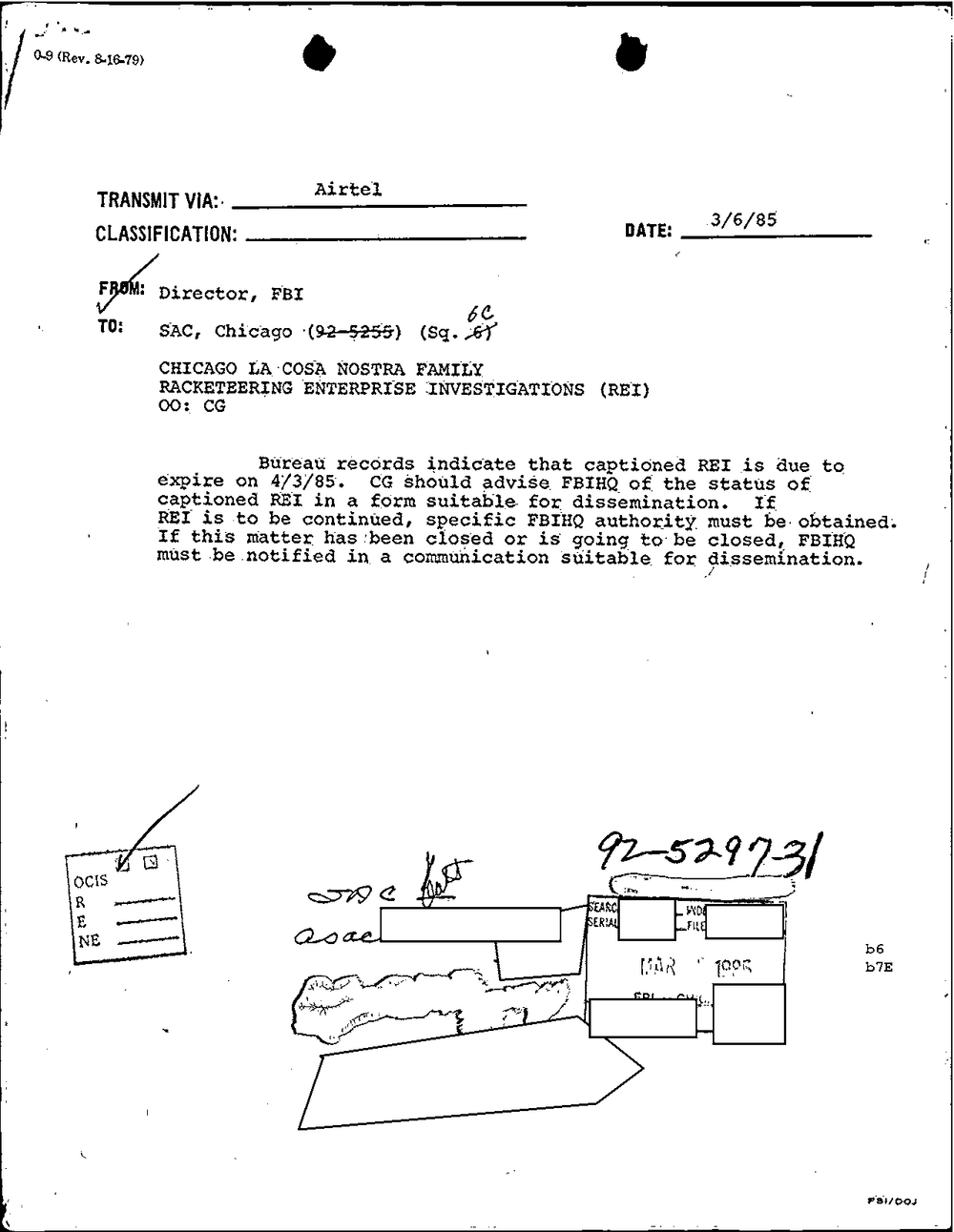 itemFBI Chicago Racketeering Enterprise Investigation of 'the Chicago LCN Family', 1984-1985 (Vault Accardo Part 01)Memoranda and airtels on the Chicago division's Racketeering Enterprise Investigation of 'the Chicago La Cosa Nostra Family': the authority to open it, Headquarters' reminders that it would expire, and a further 180 days granted on November 25, 1985.