Sam Giancana
Called "a top figure in the underworld in Chicago" by McClellan Committee staff in 1959, when he refused to answer. The Church Committee identified him as the "Sam Gold" of the CIA's Castro operation and recorded his murder on June 20, 1975.
- Died
- 1975
- Aliases
- Mooney, Momo Salvatore Giancana, Sam Gold
- Rights
- Biography on this page is limited to what the cited federal records state.
On the record
- 1929 and 1939 — McClellan Committee staff member Pierre Salinger testified on June 9, 1959 (Part 53) to two major convictions, "for burglary and larceny in 1929 and violation of the internal revenue laws as they relate to liquor, in 1939," and said "He served a total of 6 years 11 months in penitentiaries as a result of those two convictions."
- August 1946 — An FBI report extract in the Accardo Vault file (Part 02, p. 2) names "SAM GIANCANA, with alias, 'Mooney'" among callers at Accardo's residence.
- 5 October 1950 — Frederick Pretzie, Jr. of the Chicago Crime Commission told the Kefauver Committee (Part 5, p. 202) that "Mooney Giancana" was "probably the youngest member of that mob" and "the chauffeur and body guard for Tony Accardo." The witness's characterization.
- January 1953 — McClellan staff testified on 9 June 1959 (Part 53, pp. 18674-18676, 18696-18697) that he flew to Los Angeles under another name ("Mantuso" or "Mancuso" in the transcript) with Anthony Accardo and Dr. Eugene Chesrow, and was met by Frank Ferraro and Anthony Pinelli. Los Angeles police Capt. James E. Hamilton had told the committee in 1958 (Part 32, p. 12333) of an Accardo visit about five years earlier accompanied by "Monny Giancanna" traveling under a fictitious name.
- 1957 — A Chicago FBI memorandum dictated July 22, 1959 (Vault, Anthony Accardo Part 02, p. 5) relays a source's account that "After RICCA went to prison, SAM GIANCANA moved in and took over both positions of 'the man' and 'the boss'" and that "GIANCANA in 1957 forced ACCARDO into semi-retirement and assumed the reins of the Syndicate." The account reached the FBI through two reporters from an unnamed person. It is third-hand and is not a Bureau finding.
- 11 July 1958 — McClellan chief counsel Robert Kennedy said (Part 33, p. 12785), showing a photograph of Giancana with Accardo, that "Mr. Giancana is one of the most important and perhaps one of the two or three most important underworld figures in the Chicago area." Counsel's statement.
- 9 June 1959 — Before the McClellan Committee (Part 53, pp. 18672–18673) he gave his name and an Oak Park address and declined to state his occupation: "I decline to answer because I honestly believe my answer might tend to incriminate me." Staff member Salinger testified: "Mr. Giancana is a top figure in the underworld in Chicago." Staff member LaVern Duffy referred to him as Sam "Mooney" Giancana.
- October 1960 — The Church Committee report (PDF pp. 89-91) quotes an October 18, 1960 memorandum from J. Edgar Hoover to the CIA relaying an untested source who said Giancana was telling friends that Castro "was to be done away with very shortly," and sets out conflicting accounts of why a wiretap found in Las Vegas on 31 October 1960 was placed. The report adopts none of them.
- June-July 1961 — FBI teletypes in the Balletti wiretap case (Vault, Roselli Part 12) report that Robert Maheu named John Roselli as the man through whom he made his original contact with Giancana.
- 1962-1963 — A Chicago FBI report (Vault, Giancana Part 01, p. 5) calls the Villa Venice, reopened 11/9/62, an "alleged GIANCANA enterprise" and says he "should be considered armed and dangerous." An informant in the same file (p. 48) calls him "generally considered as the number one gangland leader in the country today" and names Fiore Buccieri and Charles English as top lieutenants; a December 1963 informant statement (pp. 389-391) calls him the leader of the Chicago syndicate. Informants' claims, relayed by the FBI.
- 30 June 1964 — Giancana v. Johnson, 335 F.2d 366 (7th Cir. 1964), vacated an injunction he had obtained in a suit "growing out of alleged surveillance of plaintiff, his home and his recreation, by FBI agents," holding that the district court lacked jurisdiction.
- August 1964 — A Chicago FBI teletype citing a "highly confidential source" (Vault, Humphreys Part 18) says Giancana had ordered associates to stay away from Frank Ferraro's wake. The source's account.
- 1 June 1965 — In re Grand Jury Investigation of Sam Giancana, 352 F.2d 921 (7th Cir. 1965), affirmed the order in which the district judge said: "I adjudge the respondent, Sam Giancana, in direct and continuing contempt of this Court," committing him to the custody of the U.S. Marshal.
- 1960 — The Church Committee report, S. Rep. No. 94-465 (1975), p. 88 of the PDF, states that "'Sam Gold' was Momo Salvatore Giancana, a Chicago-based gangster," brought into the CIA's operation against Castro.
- 20 June 1975 — The same report, in a footnote on that page: "Sam Giancana was murdered in his home on June 20, 1975."
- 19 June 1975 — A Chicago FBI teletype dated 2-13-76 (Vault, Giancana Part 02, p. 39) states: "FORMER CHICAGO LCN BOSS SAM GIANCANA WAS MURDERED IN BASEMENT OF HIS OAK PARK, ILLINOIS, RESIDENCE, JUNE 19, 1975." A December 1993 Chicago airtel (p. 349) gives the same date. The Church Committee report gives June 20, 1975 (see above). "Former Chicago LCN boss" is the FBI's description.
The role field is left empty. The 1959 FBI memorandum’s claim, kept in the events with its source because it is third-hand, rests on this chain: an unnamed person told a reporter, who told a Chicago Tribune reporter, who told an agent. The McClellan staff description is sworn staff testimony, not a committee finding. The FBI Vault’s two-part Giancana file has since been read in part (Parts 01 and 02 are filed). The died field gives the year only: the Church Committee report says he was murdered on June 20, 1975, and the FBI’s 1976 teletype and 1993 airtel say June 19, 1975, so neither day is set. The FBI’s “former Chicago LCN boss” and its informants’ statements are kept in the events, and the role field stays empty. No opened record gives his birth date.
Records
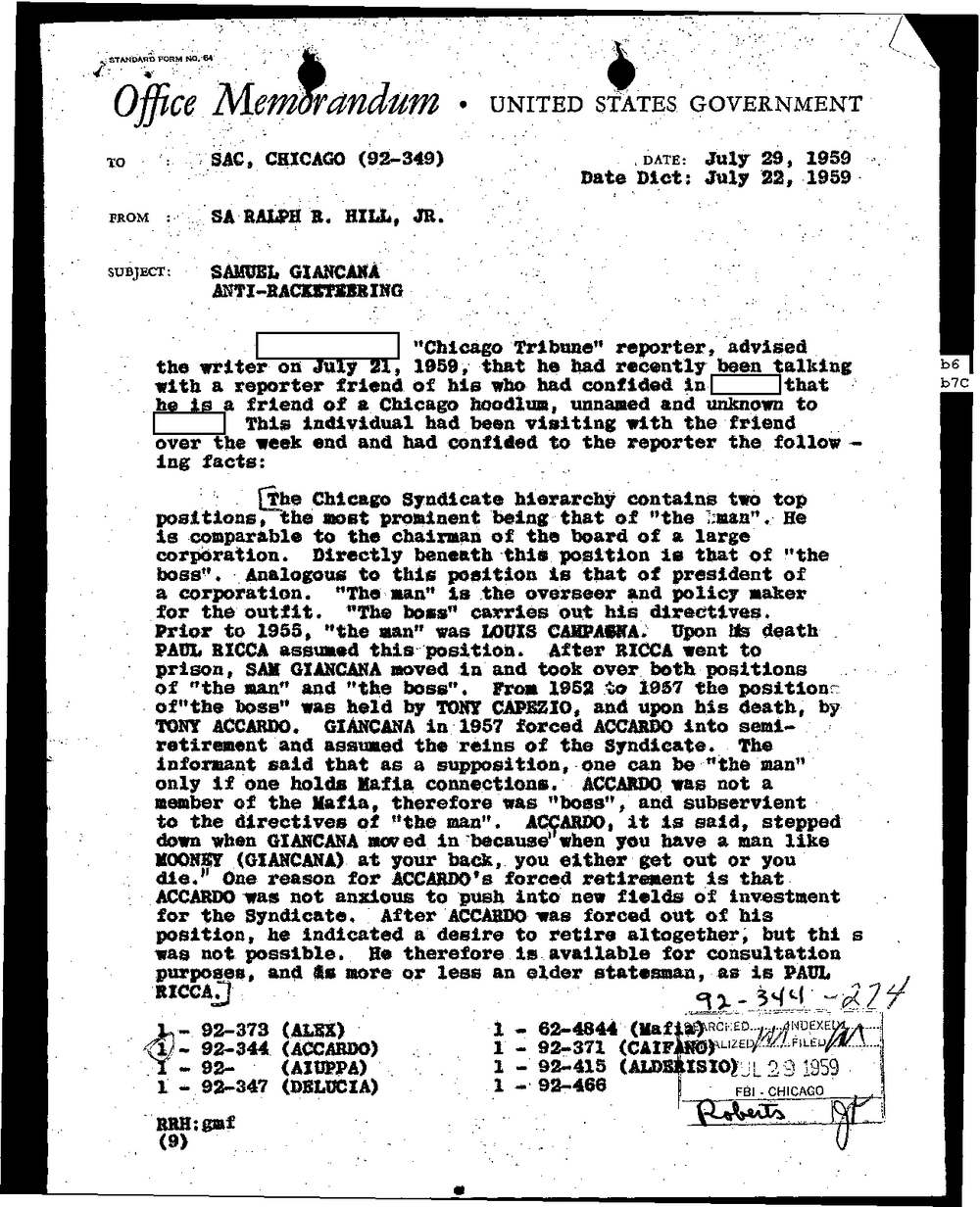 itemFBI Vault file on Anthony AccardoThe FBI Vault's release of the Bureau file on Anthony Accardo, in two parts, including a 1946 informant report, a 1959 Chicago memorandum relaying a source's account of the Chicago syndicate's hierarchy, and early-1970s teletypes on its leadership.itemGiancana v. Johnson, 335 F.2d 366 (7th Cir. 1964)Seventh Circuit opinion of June 30, 1964 vacating an injunction that had restricted FBI surveillance of Sam Giancana, for want of district-court jurisdiction.itemIn re Grand Jury Investigation of Sam Giancana, 352 F.2d 921 (7th Cir. 1965)Seventh Circuit opinion of October 8, 1965 affirming the June 1965 orders that held Sam Giancana in contempt for refusing to answer grand jury questions after an order to testify.itemChurch Committee, Alleged Assassination Plots Involving Foreign Leaders, S. Rep. No. 94-465 (1975)Interim report of the Senate Select Committee to Study Governmental Operations with Respect to Intelligence Activities, November 20, 1975. It identifies the man called "Sam Gold" in the CIA's Castro operation as Sam Giancana and records his murder on June 20, 1975.itemKefauver Part 5: statement of Frederick Pretzie, Jr., Chicago Crime Commission (5 October 1950), pp. 197-203The Crime Commission's administrative assistant described the defeat of its bills in the 1949 legislature and the 'West Side bloc', and called 'Mooney Giancana' the youngest member of the mob and the chauffeur and bodyguard for Tony Accardo.itemMcClellan Part 53: staff testimony on the January 1953 Los Angeles trip and Frank Ferraro (9 June 1959)Staff members Pierre Salinger and James McShane described a January 1953 trip to Los Angeles by Giancana, Anthony Accardo and Dr. Eugene Chesrow, met by Frank Ferraro and Anthony Pinelli. McShane called Ferraro 'Gus Alex's No. 1 man in the first ward' and gave his true name as Frank Sortino.itemMcClellan Part 32: Chicago in the testimony of Martin F. Pera (1 July 1958) and the chairman's closing statement (3 July 1958)Bureau of Narcotics agent Martin Pera told the committee that 'the important figures in Chicago would be Tony Accardo and Paul Ricca.' The chairman's statement of 3 July announced hearings on the Chicago restaurant industry, naming Accardo among the witnesses.itemMcClellan Part 33: testimony of Anthony J. Accardo (11 July 1958), pp. 12782-12790Accardo gave his residence as River Forest and invoked the Fifth Amendment on his occupation, birthplace and citizenship. Chief counsel Kennedy asked whether he took over the Capone syndicate in 1943 and showed a photograph of him with Giancana; he declined every question.itemChurch Committee report, PDF pp. 86-88: Rosselli, 'John Rawlston' and 'Sam Gold' in the 1960 approachThe report explains how the CIA's Support Chief and Robert Maheu approached John Rosselli in 1960, how he used the cover name 'John Rawlston', and how 'Sam Gold' and 'Joe' were later identified from a newspaper supplement as Giancana and Santos Trafficante.itemChurch Committee report, PDF pp. 89-91: the October 1960 Las Vegas wiretap and the Hoover memorandum on GiancanaThe report describes the arrest of Arthur Balletti in Las Vegas on 31 October 1960 over a wiretap, the conflicting accounts of why it was placed, a Hoover memorandum of 18 October 1960 relaying a source on Giancana and Castro, and the 1962 decision not to prosecute.
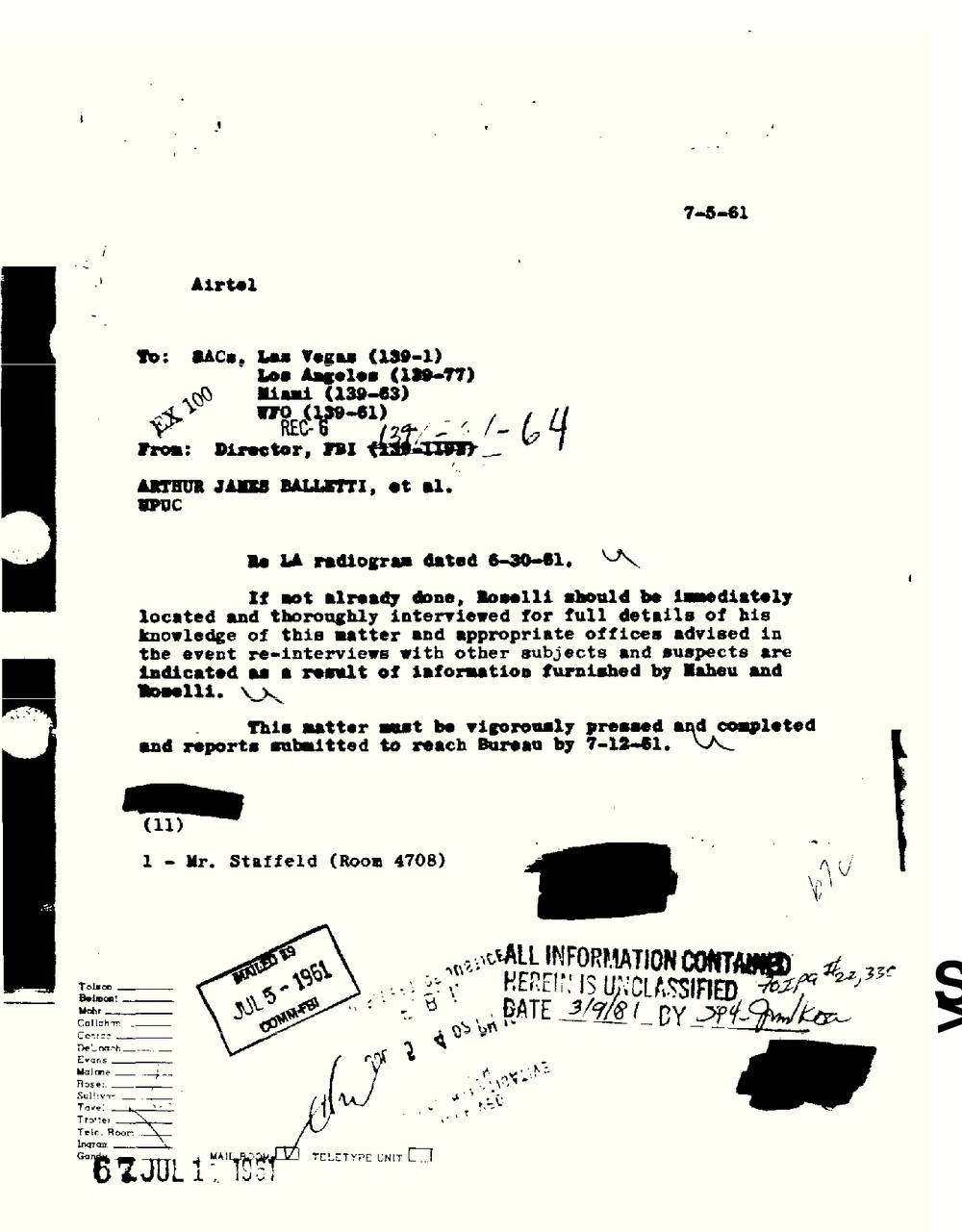 itemFBI teletypes and airtels, June-July 1961: the Balletti wiretap case and Robert Maheu's account of reaching Giancana through Roselli (Vault Roselli Part 12)In the case 'Arthur James Balletti, et al', FBI teletypes report that Robert Maheu, located on June 29, 1961, named John Roselli as his route to Sam Giancana, and that on re-interview he said his work had been for a Central Intelligence Agency assignment.
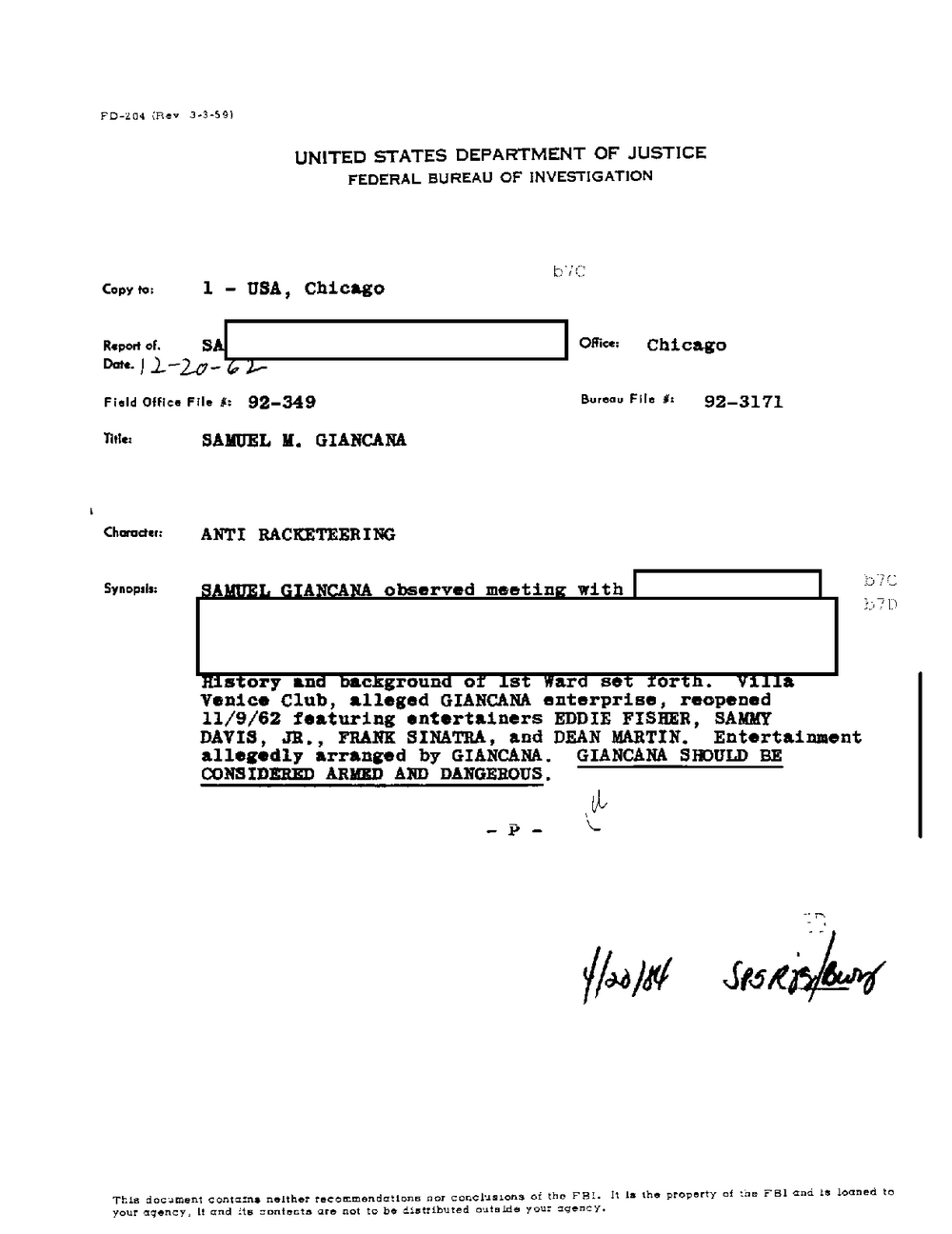 itemFBI Chicago reports on Samuel Giancana, 1962-1964 (Vault Giancana Part 01)Chicago reports in the first part of the Giancana file call the Villa Venice an 'alleged GIANCANA enterprise' that reopened on 11/9/62, say he 'should be considered armed and dangerous', and quote an informant naming Fiore Buccieri and Charles English as two of his top lieutenants.itemFBI Chicago teletypes, August 1964: Frank Ferraro's wake and Humphreys's contacts (Vault Humphreys Part 18)Daily-summary teletypes stamped August 27, 1964 and after, citing a 'highly confidential source', report arrangements at the funeral home 'where Frank Ferraro is being laid out', and say Humphreys stayed away from the wake and funeral to avoid being photographed.
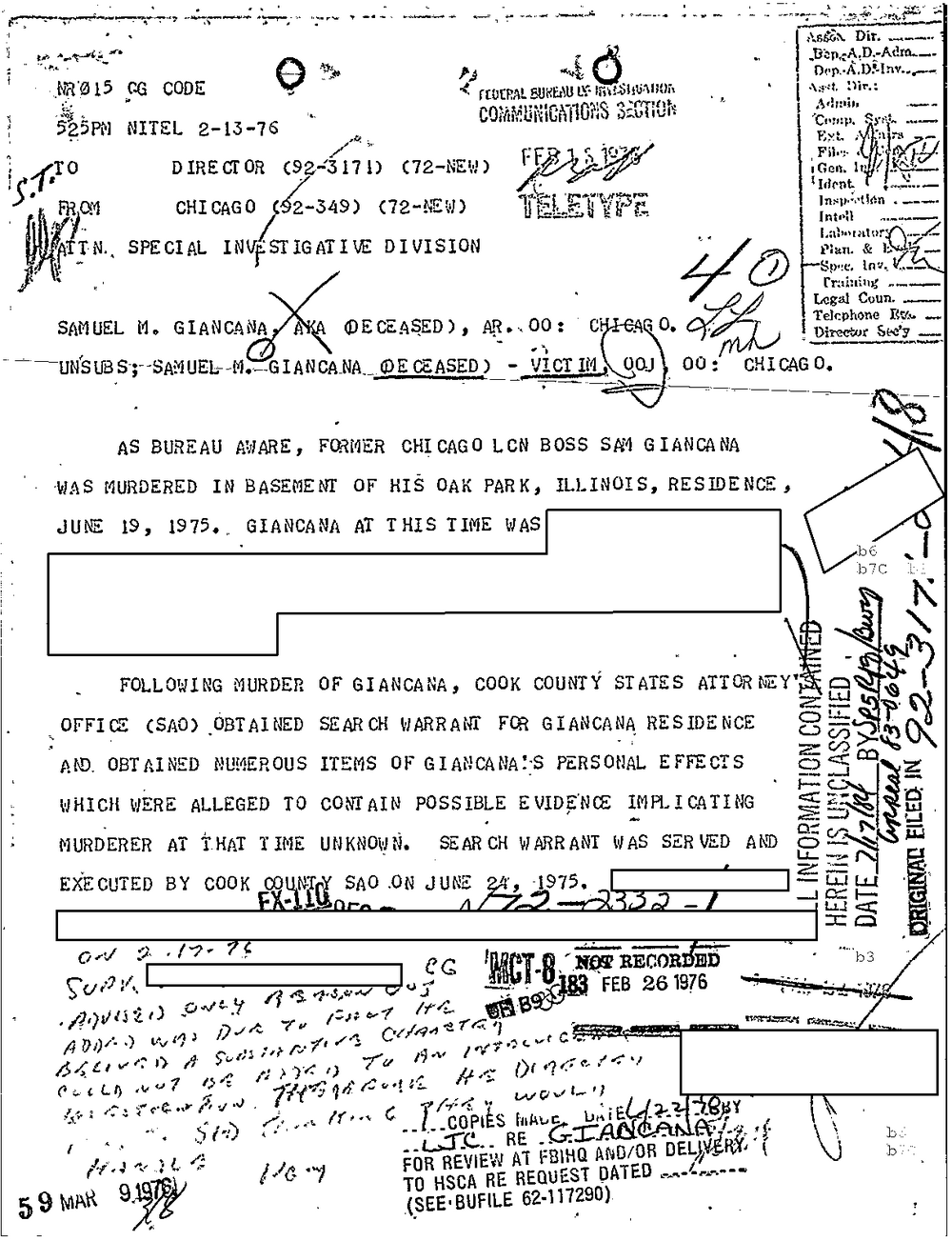 itemFBI Chicago file on Samuel Giancana, 1971-1993: his 1975 murder and later inquiries (Vault Giancana Part 02)The second and final Giancana part runs from 1971 through his murder in June 1975 to a December 1993 Chicago airtel on the weapons used in the Giancana and Allen Dorfman killings. It includes a February 1976 teletype calling him the 'former Chicago LCN boss.'