Frank Costello
Kefauver Committee witness in 1951, convicted of contempt of the Senate and of income-tax evasion, and stripped of his citizenship in 1959. New York police testimony in 1963 said that "at least he was second in command at one time."
- Born
- 1891
- Role
- "At least he was second in command at one time," in NYPD testimony (testimony, 1963)
- Rights
- Biography on this page is limited to what the cited federal records state.
On the record
- 1925 — The Supreme Court (1964): "He became a naturalized citizen in 1925." In 1961 the Court recited the District Court's finding that he had sworn his occupation was "real estate" when "his true occupation was bootlegging." Court opinions.
- February 1946 — The FBI's Luciano file records that Costello, with Meyer Lansky and attorney Moses Polakoff, visited Luciano at Ellis Island before his deportation. FBI file.
- March 1951 — Before the Kefauver Committee in New York (Part 7, printed p. 882), counsel Rudolph Halley asked, "Have you ever used the name Castiglia?" (the OCR reads "yoii"). Counsel's question, not testimony.
- 3 July 1952 — United States v. Costello, 198 F.2d 200: he "was convicted of ten separate contempts of the United States Senate Crime Investigation Committee" and sentenced to eighteen months and a $5,000 fine; the court reversed several counts. Court opinion.
- 5 April 1955 — United States v. Costello, 221 F.2d 668 affirmed his conviction for attempting to evade income taxes for 1947–1949; Judge McGohey had imposed five years on each count. Court opinion. The Supreme Court affirmed on March 5, 1956 (350 U.S. 359).
- 1957 — Shanley testified (printed p. 250) that the attempt to kill Costello was in 1957. Attorney General Robert F. Kennedy told the subcommittee (printed p. 7) that the Apalachin meeting was called partly over "the attempted assassination of Frank Costello, deposed New York rackets boss." Testimony; Attorney General's statement.
- 20 February 1961 — Costello v. United States, 365 U.S. 265 affirmed the revocation of his citizenship: "In 1925 a known bootlegger would probably not have been admitted to citizenship." Court opinion.
- 8 October 1963 — Shanley testified (printed pp. 250–251) that "There was talk that he was the topman, but still Vito seemed to be strong, too," and "At least he was second in command at one time." He said Thomas Lucchese took Costello's place when Costello went to jail for contempt of Congress (printed p. 275). Testimony.
- 17 February 1964 — Costello v. INS, 376 U.S. 120: "The petitioner, born in Italy in 1891," could not be deported under the two-crimes provision for convictions entered while he was a naturalized citizen. Court opinion.
The birth year is the Supreme Court’s. No opened record gives his death.
The 1963 staff chart of the Genovese family is reported to name him, with the name “Castiglia,” as a predecessor of Genovese, but the text layer of that chart is only partly legible, so neither the name nor the chart is used here. The role line is Shanley’s testimony, which he hedged; the Attorney General’s “deposed New York rackets boss” is an official statement, and neither names a family, so the family line is empty.
Records
itemCostello v. Immigration and Naturalization Service, 376 U.S. 120 (1964)Supreme Court decision of February 17, 1964 holding that Frank Costello could not be deported under the two-crimes provision for convictions entered while he was a naturalized citizen.itemCostello v. United States, 365 U.S. 265 (1961)Supreme Court decision of February 20, 1961 affirming the revocation of Frank Costello's 1925 naturalization because he had concealed that his occupation was bootlegging.itemCostello v. United States, 350 U.S. 359 (1956)Supreme Court decision of March 5, 1956 affirming Frank Costello's income-tax conviction and holding that an indictment resting only on hearsay before the grand jury is valid.itemUnited States v. Costello, 221 F.2d 668 (2d Cir. 1955)Second Circuit opinion of April 5, 1955 affirming Frank Costello's conviction for attempting to evade income taxes for 1947, 1948 and 1949, proved on a net-worth theory.itemUnited States v. Costello, 198 F.2d 200 (2d Cir. 1952)Second Circuit opinion of July 3, 1952 on Frank Costello's conviction for contempt of the Senate crime committee. It reversed several counts and affirmed the counts based on his leaving the March 1951 hearings.itemSenate Report 199: proceedings against Frank Costello (1951)Senate Report No. 199, 82d Congress, ordering printed the Special Committee's contempt proceedings against Frank Costello after the 1951 New York hearings.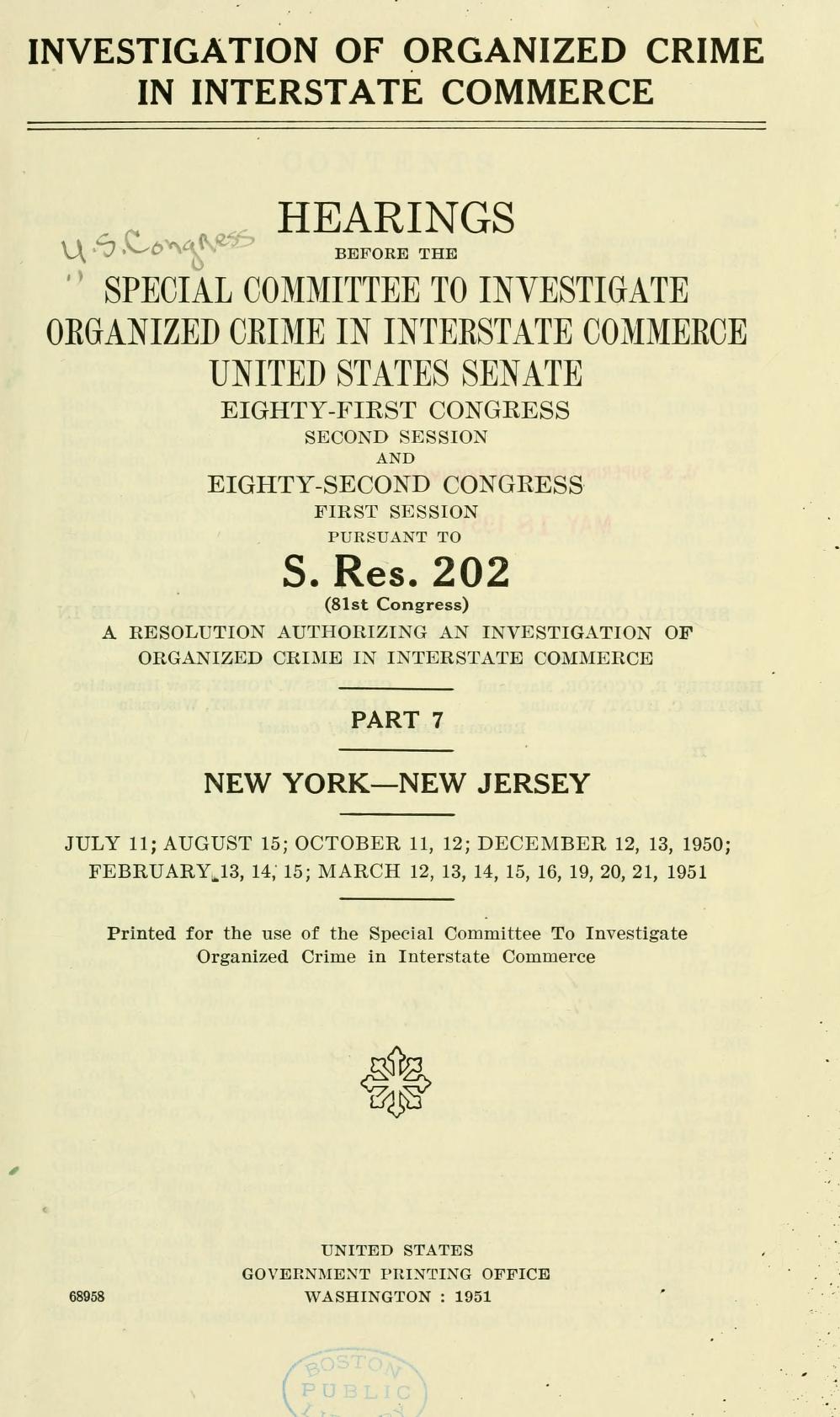 itemKefauver Committee hearings, Part 7: New York-New Jersey (1950–1951)Printed hearings of the Senate Special Committee to Investigate Organized Crime in Interstate Commerce, Part 7, New York-New Jersey: sessions in Washington and New York, July 1950 to March 1951.
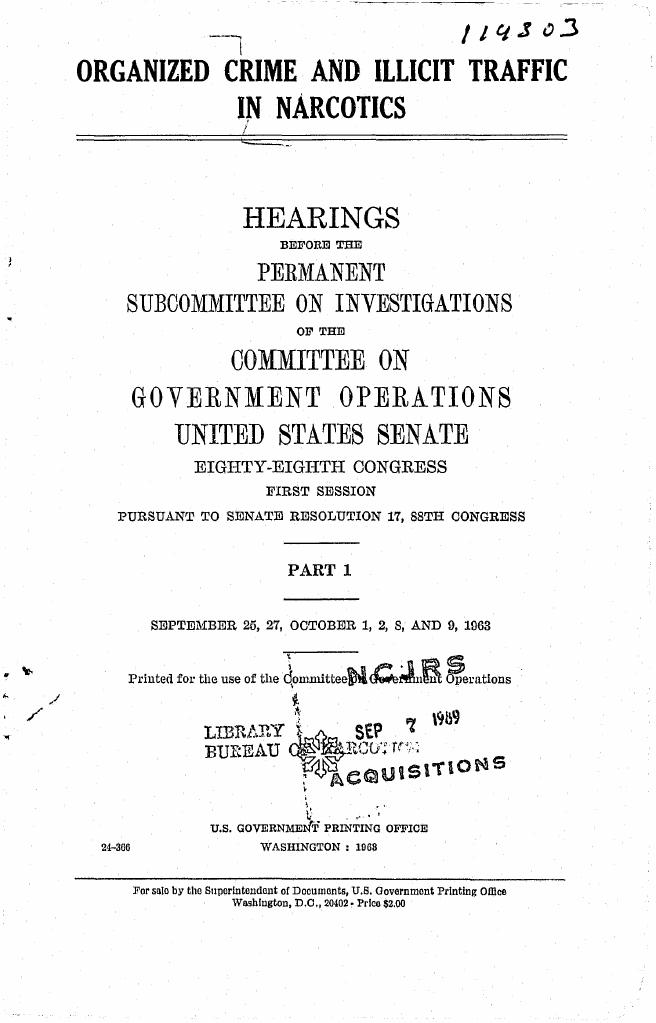 itemOrganized Crime and Illicit Traffic in Narcotics, Part 1 (September 25 to October 9, 1963)The first printed volume of the 1963 Senate hearings: Attorney General Robert F. Kennedy's opening testimony, Joseph Valachi's public testimony, New York police witnesses, Exhibit 8 and Charts A to E.
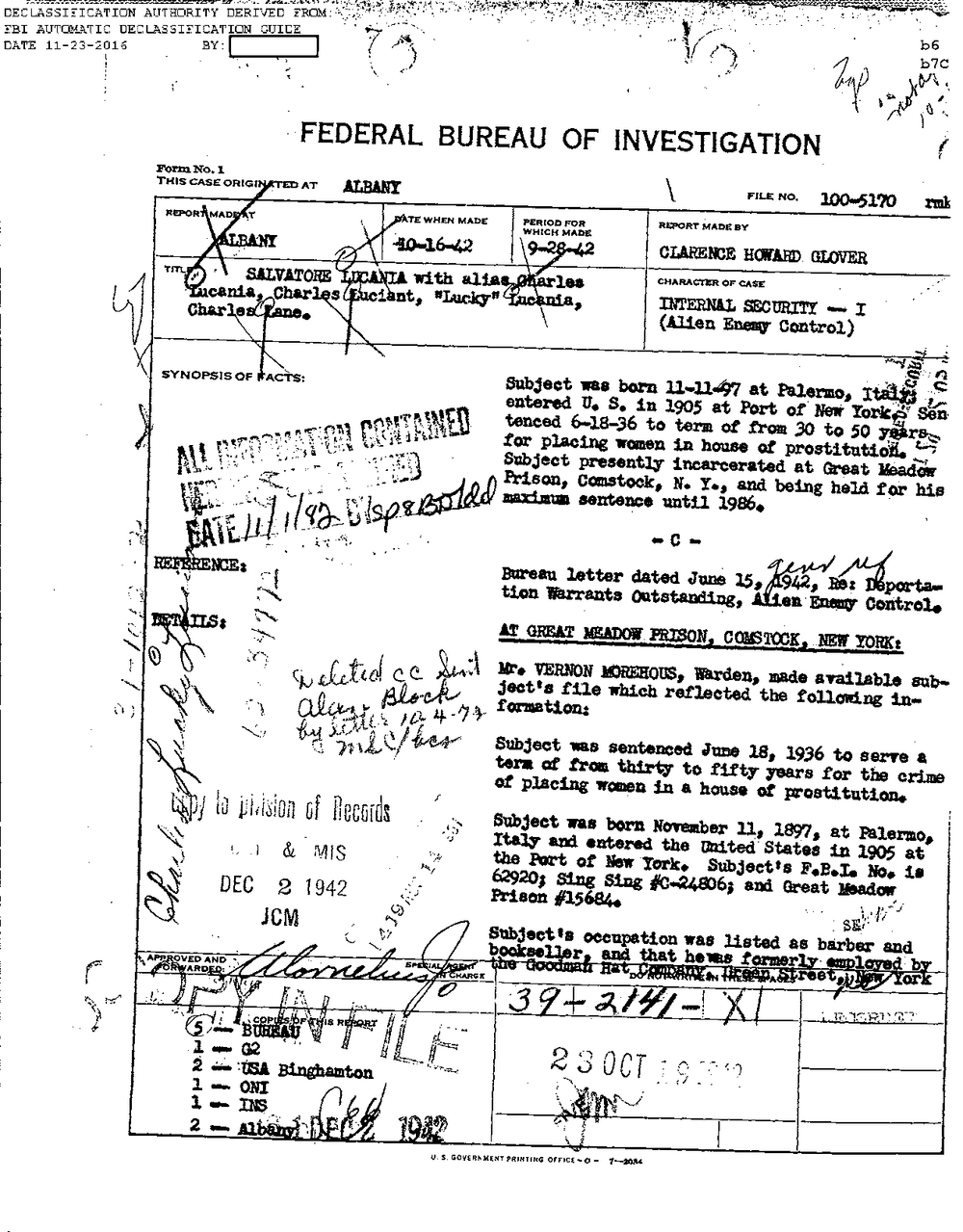 itemFBI Vault: Charles (Lucky) Luciano / Salvatore Lucania, Part 01Part 01 of the FBI's Luciano file: 1935 memoranda, a wartime report with his 1936 state sentence, and a 1946 group on his parole on condition of deportation, his move to Ellis Island, and his departure from Bush Terminal, Brooklyn.
itemKefauver Committee hearings, Part 7: New York-New Jersey (1950–1951)Printed hearings of the Senate Special Committee to Investigate Organized Crime in Interstate Commerce, Part 7, New York-New Jersey: sessions in Washington and New York, July 1950 to March 1951.itemOrganized Crime and Illicit Traffic in Narcotics, Part 1 (September 25 to October 9, 1963)The first printed volume of the 1963 Senate hearings: Attorney General Robert F. Kennedy's opening testimony, Joseph Valachi's public testimony, New York police witnesses, Exhibit 8 and Charts A to E.itemFBI Vault: Charles (Lucky) Luciano / Salvatore Lucania, Part 01Part 01 of the FBI's Luciano file: 1935 memoranda, a wartime report with his 1936 state sentence, and a 1946 group on his parole on condition of deportation, his move to Ellis Island, and his departure from Bush Terminal, Brooklyn.