Charles M. Wall
Testified at Tampa on 29 December 1950 about his gambling background; committee counsel called him an 'elder statesman' of Tampa gambling, and the state's attorney gave his own opinion that Wall was the 'head and brains of the underworld.' Wall said he left gambling in the county in 1939 or 1940.
- Aliases
- Charlie Wall
- Role
- Described by Hillsborough County State's attorney J. Rex Farrior, testifying before the committee, as the "self-confessed and public recorded head and brains of the underworld" (Kefauver Part 1-A, p. 415). The witness's opinion in testimony, not a finding.
- Rights
- Biography on this page is limited to what the cited federal records state.
On the record
- 29 December 1950 — Testifying with attorney Pat Whitaker, Wall said he was born in Florida, that his next birthday in March would be his 71st, that he first worked as a crap dealer in a gambling house called Fort Brooke, and that he was later in bolita. His counsel told the committee that Wall was under a pending Dade County gambling indictment (Kefauver Part 1-A, pp. 60-62).
- 29 December 1950 — He described three occasions on which he was shot at, with no one arrested to his knowledge, and said he did not remember the dates (pp. 65-69). He testified he had not been "directly or indirectly mixed up in any gambling in this county since oh, late in 1939 or 1940" (p. 69).
- 29 December 1950 — Tampa Chief of Police M. C. Beasley said the department had two files on the attempts on Wall's life; counsel described Eddie Verellio as a "lieutenant of Charlie Wall" killed on 21 January 1937, a statement of counsel's (pp. 84-85).
- 22 February 1951 — State's attorney Farrior testified that every murder in Tampa history except two (Velasco and Lumia) happened while Wall was a "recognized and admitted" and "self-confessed and public recorded head and brains of the underworld" (pp. 413-415).
Wall’s own testimony, taken at the United States Courthouse in Tampa, names no organization and no syndicate member. The descriptions of his place in Tampa gambling are counsel’s and the state’s attorney’s, quoted below and labelled. Committee counsel’s “elder statesman” (p. 61) is a remark made in questioning, not testimony, and the role line does not rest on it. The state’s attorney’s characterization is his opinion in testimony. It is not a finding of the committee, and no role is copied to a chart.
The attempts on his life that the records describe are unsolved in the testimony filed.
Records
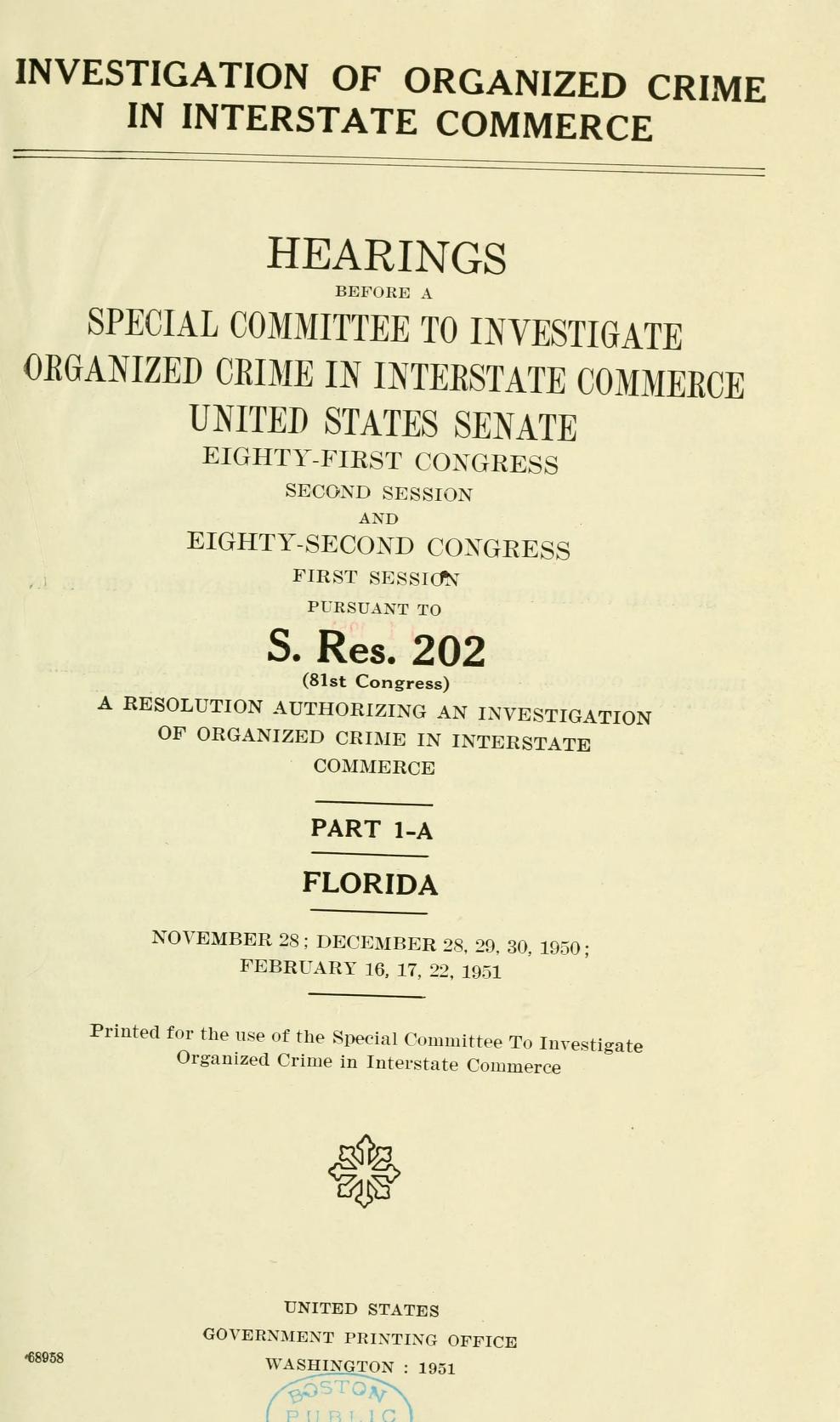 itemKefauver Committee hearings, Part 1A: Florida (1950–1951)Printed hearings of the Senate Special Committee to Investigate Organized Crime in Interstate Commerce, Part 1A, Florida: sessions in Washington and Tampa, November 1950 to February 1951.