Danny Greene
Killed by a remote-controlled car bomb in Cleveland on 6 October 1977; the Sixth Circuit, affirming the RICO convictions of James Licavoli and others, described him as the leader of a rival criminal organization in West Cleveland whom Licavoli decided in 1976 to have killed.
- Died
- 1977-10-06
- Role
- "the leader of a rival criminal organization which had developed a monopoly on criminal activity in West Cleveland" (Sixth Circuit, stating what the evidence established, 1984)
- Rights
- Biography on this page is limited to what the cited federal records and the filed newspaper pages state.
On the record
- 1976 — United States v. Licavoli: "In the spring of 1976 Licavoli decided that he needed to have one Danny Greene killed. Greene was the leader of a rival criminal organization which had developed a monopoly on criminal activity in West Cleveland."
- 1976 — Angelo Lonardo, Senate testimony (1988): he and Licavoli went to New York to ask Anthony Salerno for help in killing Greene and John Nardi; "Nardi and Greene never made a second trip to New York, so New York never helped in their murders." Testimony.
- 1977-10-06 — United States v. Licavoli: a wiretap tape "revealed that Greene was to go to a dentist's appointment at 2:30 p.m. on Thursday, October 6, 1977"; as he left, a bomb was detonated by remote control "and Danny Greene was killed." "Cisternino, Carabbia and Ciarcia were convicted of Greene's murder" in state court.
- 1983-04-18 — Justice Department report: Kevin McTaggart is described as "a former lieutenant of LCN rival Danny Greene who aligned with the LCN after they murdered Greene." The Department's wording.
- 1986-04-02 — United States v. Salerno, 631 F. Supp. 1364: the government proffered that Lonardo would testify that "John Nardi and Danny Green in the Cleveland LCN were killed in 1977." A proffer, as the court summarized it.
- 1988-04-15 — FBI SAC Joseph E. Griffin, Senate testimony: Greene was "a west side mobster" who, with John Nardi, moved against the Cleveland family after Scalish's health failed. Testimony.
The role line quotes the Sixth Circuit’s statement of what the evidence established, viewed in the light most favorable to the government; it is labelled as such. The death date is the opinion’s. The opinion gives no address for the dentist’s office. The Sixth Circuit’s order of July 31, 1986 after Licavoli’s death, 799 F.2d 752, is listed because Licavoli is its lead appellant; the order does not mention Greene.
The FBI Vault file on Daniel J. Greene, president of ILA Local 1317 in Cleveland in 1964-1966, is filed separately. No record filed here says that union president is this man, so the file is not listed among his records and none of its facts appear on this page.
Records
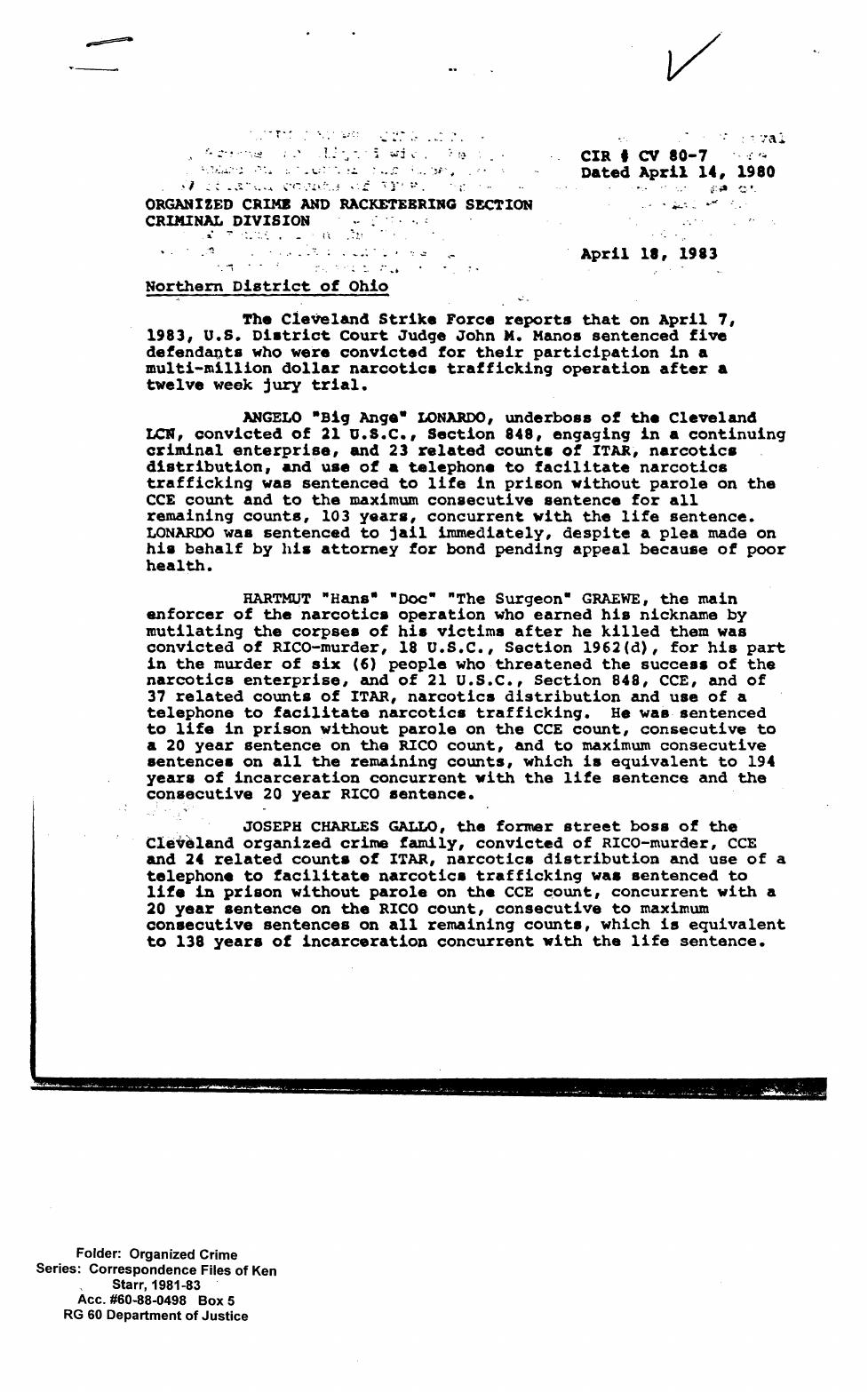 itemJustice Department report: Cleveland strike force sentencings of 7 April 1983An Organized Crime and Racketeering Section report of 18 April 1983 that Judge John M. Manos sentenced five Cleveland defendants after a twelve-week jury trial, among them Angelo 'Big Ange' Lonardo, 'underboss of the Cleveland LCN', to life without parole plus 103 years.itemUnited States v. Licavoli, Cisternino and Carabbia, 799 F.2d 752 (6th Cir. 1986): order after James Licavoli's deathUnpublished Sixth Circuit order of July 31, 1986. Because James T. Licavoli died while his appeal was pending, the court vacates its earlier dismissal of his appeal and remands for the indictment against him to be dismissed.