Joseph Stacher
Named in an FBI Los Angeles report of 1963 as the person the Las Vegas Office believed the Sands Hotel's owner of record "now appears to be a front for," with the Gerardo Catena group. The Second Circuit records the Government's belief in 1961 and 1962 that he held undisclosed interests in Las Vegas gambling.
- Aliases
- Doc Stacher, Gdale Oistaczer, Doc Harris, Doc Rosen
- Rights
- Biography on this page is limited to what the cited federal records state.
On the record
- 1963 — An FBI Los Angeles report says the Las Vegas Office advised that Aaron Weisberg, "owner of record of 6.87% in the Sands Hotel, Las Vegas," "now appears to be a front for Joseph Stacher and the Gerardo Catena group." It also says the Las Vegas Office learned of a planned meeting among "Joseph Stacher, top hoodlum of the Los Angeles Division," Catena and an individual from Miami to "decide future plans for the Sands Hotel" (Vault, as far as the OCR can be read).
- 30 August 1963 — The same report records a source's account that Stacher checked into the Flamingo Hotel at Las Vegas on August 30, 1963, visited the Fremont, Horseshoe, Dunes, Desert Inn and Stardust on August 30 and 31, and was seen gambling at the Dunes. The report does not say he held an interest in any of them.
- 1961 — United States v. Cole, 463 F.2d 163 (2d Cir. 1972): the FBI's eavesdropping in 1961 and 1962 was begun to assist "a full-scale investigation of Stacher, who was believed to hold a high position in organized crime and to own undisclosed interests in Las Vegas gambling establishments, with a view to a prosecution for tax evasion on a large scale."
- 1963 — In re Refusal of the Witnesses Levinson, 219 F. Supp. 589 (S.D. Cal. 1963), says witnesses before a grand jury were told that the investigation "concerns possible income tax evasion by Mr. Joseph (Doc) Stacher."
- 15 November 1950 — William J. Moore of the Nevada Tax Commission testified to the Kefauver Committee that "recently a license was denied in Reno, principally due to the man's associates in New Jersey," and, asked by counsel whether that was Stacher, answered "Stacher" (Part 10, pp. 24-25).
- 11 May 1943 — Rutkin v. United States, 343 U.S. 130 (1952): "Reinfeld paid $358,000 to Zwillman and Stacher representing their conceded interest in the proceeds of Browne Vintners stock," and "Petitioner, with Zwillman and Stacher, thereupon signed a 'general release.'" The Court's statement of facts; surnames only.
- 11 July 1951 — Kefauver Committee, Part 18, pp. 260-267 (Newark): testifying as Joseph Stacher of South Orange, N.J., with counsel, he gives his nicknames as "Doc Harris. Doc Rosen," and "Doc Stacher," says he came to the United States "around 1911, 1912" from "Russia-Poland" and was naturalized about 1929 or 1930, and calls Abner Zwillman a boyhood friend who lived "Around the corner." Testimony.
- 16 August 1951 — Kefauver Committee, Part 18, pp. 765 and 768: the retired Treasury agent Edwin A. Baldwin says Stacher "was one of the men who operated these bank accounts" in the Reinfeld syndicate investigation of 1926 to 1933, and names "Joe Stacher, better known as Doc Rosen." A witness's recollection.
This page is limited to the records cited. The FBI called Stacher a “top hoodlum of the Los Angeles Division,” which is the Bureau’s program label and not a rank or a family, so no family or role is given here. The FBI’s statements are reports of what informants and offices said, and the Second Circuit’s are statements of what the Government believed. A Bureau report that he visited a casino is not a statement that he held an interest in it. No Vault file page images were available for this page, and the FBI wording is as far as the OCR can be read.
The 1951 Newark testimony and the Treasury agent’s recollections add New Jersey records to this page; neither states a family or a role, and none is given. The Archive OCR of the hearing prints the name “Stacker”; the page image reads Stacher. Street addresses in the testimony are not reproduced.
Records
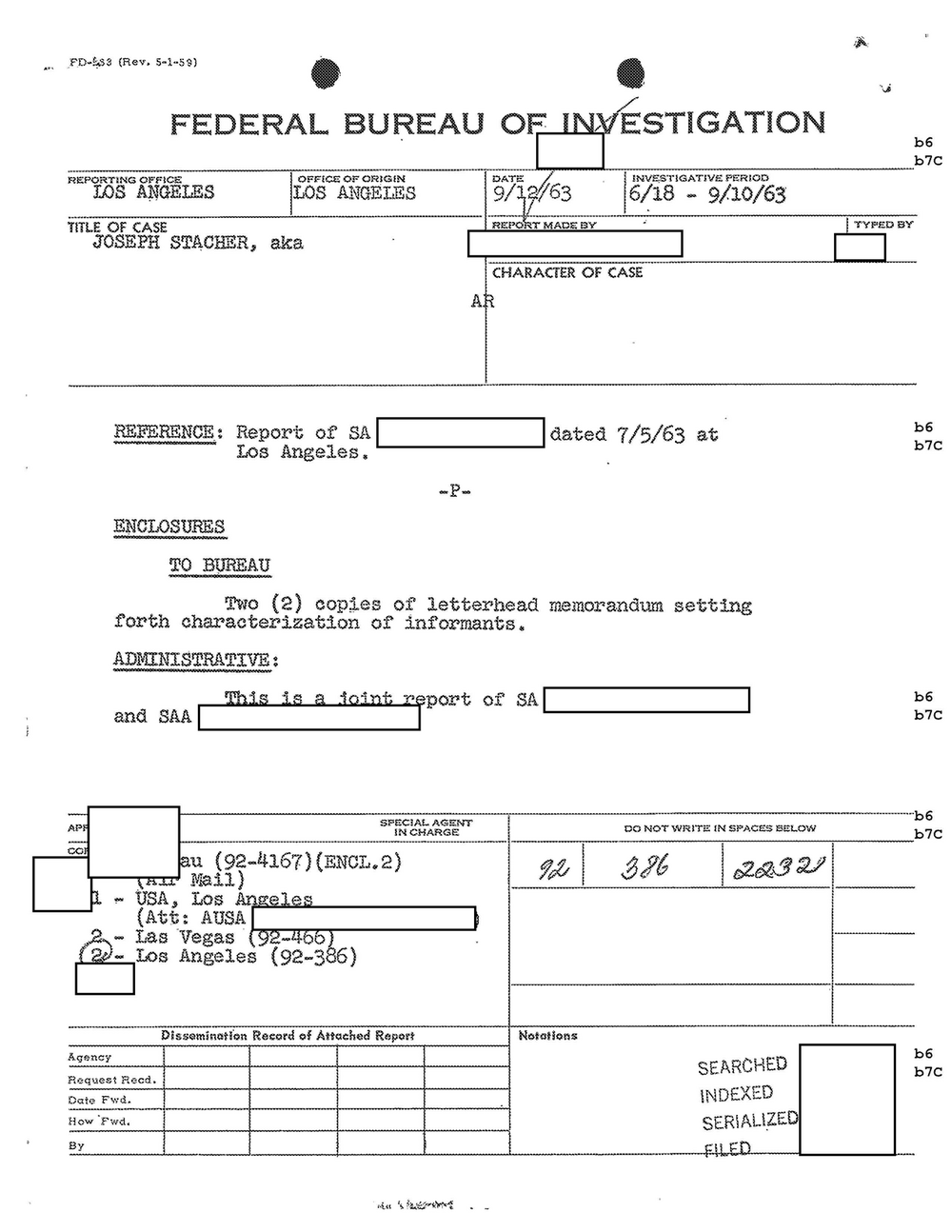 itemFBI Los Angeles reports of 1963 on Joseph Stacher and the Sands HotelFBI Los Angeles reports of 1963 on Joseph Stacher (Los Angeles file 92-386), including the Las Vegas Office's statement that the owner of record of 6.87 percent of the Sands Hotel "now appears to be a front for Joseph Stacher and the Gerardo Catena group."itemUnited States v. Cole, 463 F.2d 163 (2d Cir. 1972)Second Circuit opinion of June 6, 1972 in a tax case against an advertising agency and its officers, stating that illegal FBI eavesdropping in 1961-62 began as part of an investigation of Joseph Stacher, "believed to hold a high position in organized crime and to own undisclosed interests in Las Vegas gambling establishments."itemKefauver Committee, Las Vegas session (15 November 1950)The printed record of the Special Committee's Las Vegas session of November 15, 1950 (Part 10, pp. 1-104): testimony on the race-wire service, the Flamingo Hotel's ownership, the Desert Inn and Benjamin Siegel, by Nevada officials, Louis Wiener, Wilbur Clark and Moe Sedway.
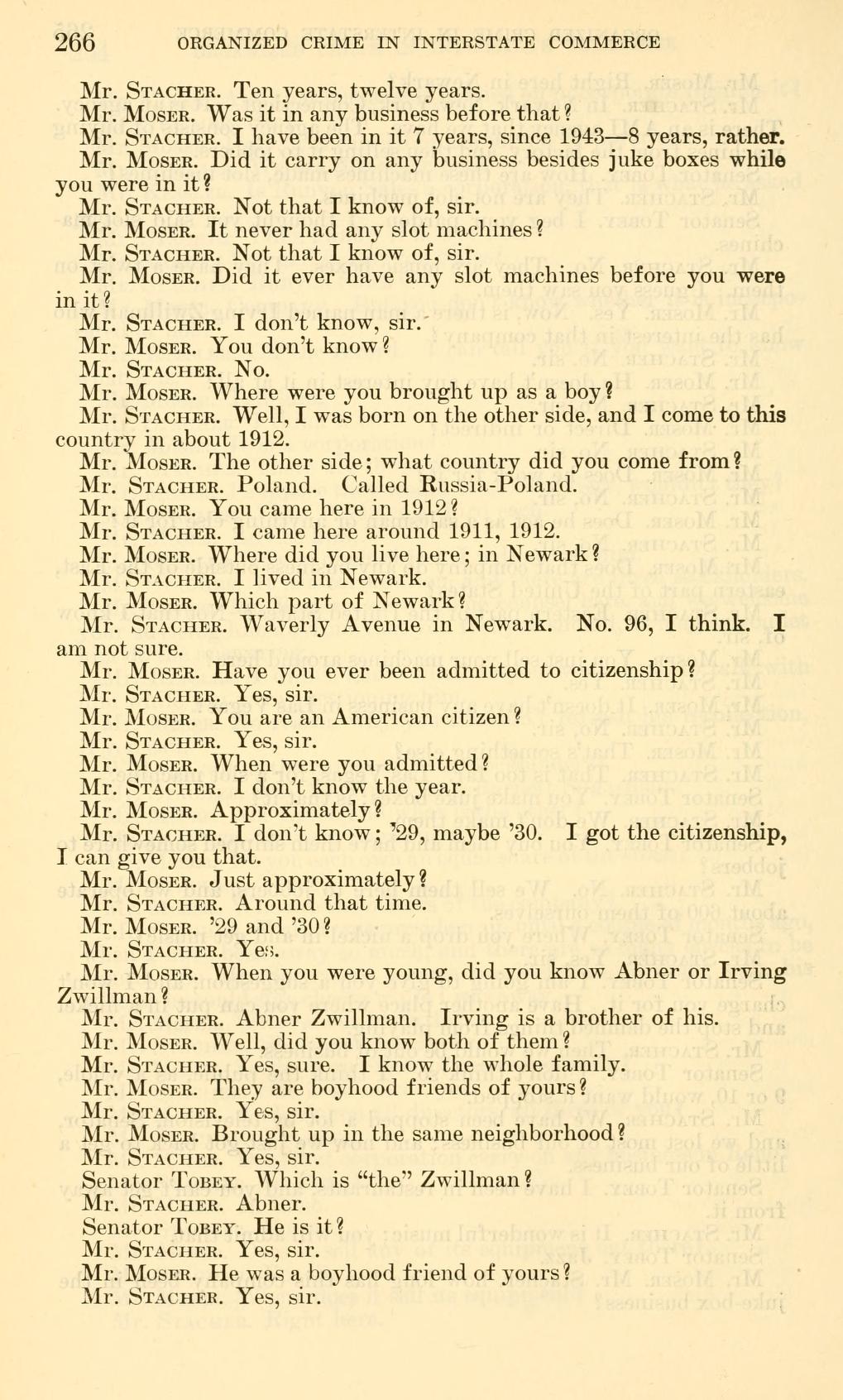 itemTestimony of Joseph Stacher, Newark, July 11, 1951 (Kefauver Committee, Part 18, pp. 260 ff.)Joseph Stacher, giving his aliases as Doc Harris, Doc Rosen and Doc Stacher, tells the Kefauver Committee in Newark that Abner Zwillman was a boyhood friend who lived "around the corner."itemRutkin v. United States, 343 U.S. 130 (1952)The Supreme Court holds that money obtained by extortion is taxable income. Its statement of facts recites that on May 11, 1943 Joseph Reinfeld paid $358,000 to Zwillman and Stacher "representing their conceded interest in the proceeds of Browne Vintners stock."
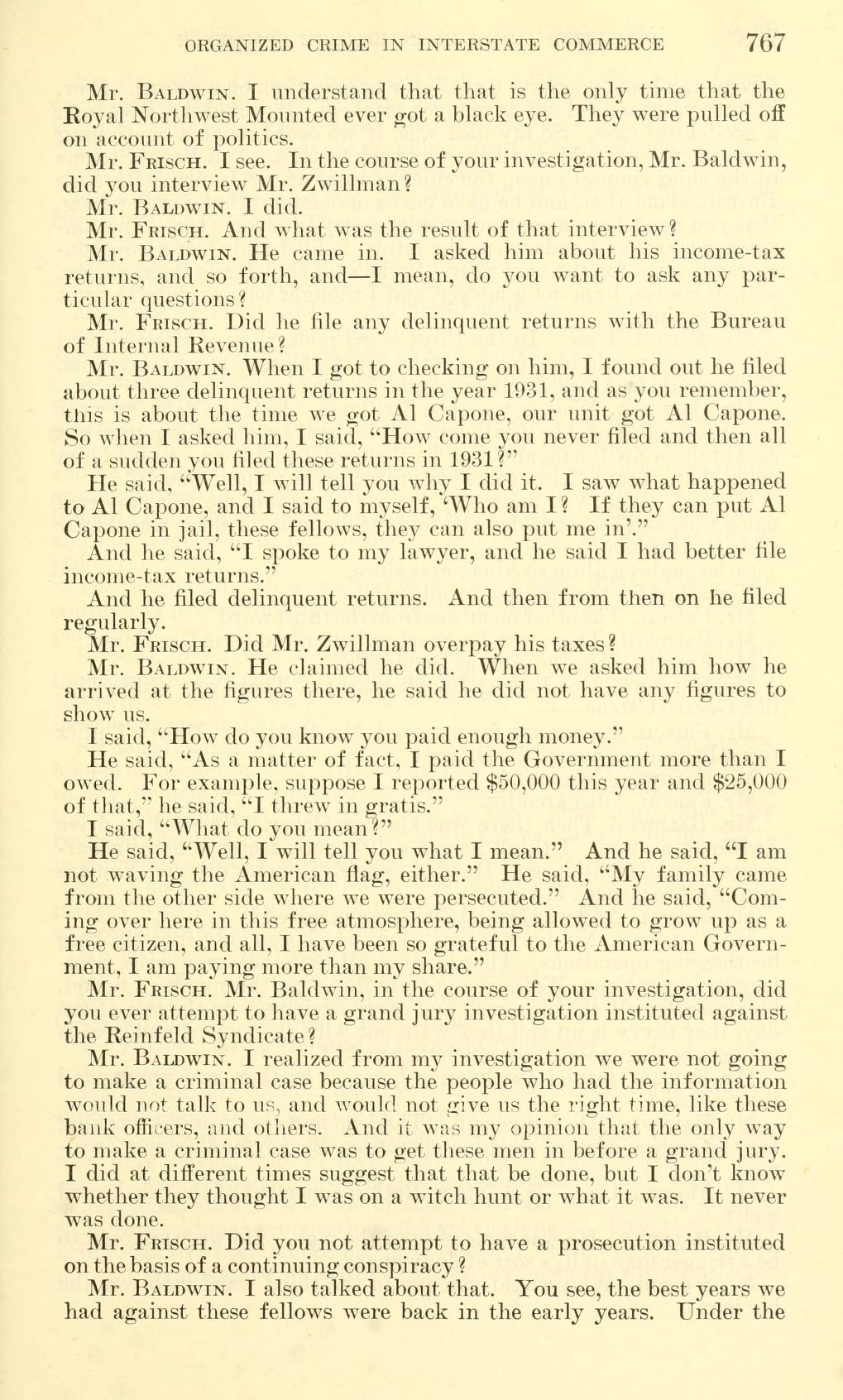 itemTestimony of Edwin A. Baldwin, retired Treasury intelligence agent, August 16, 1951 (Kefauver Committee, Part 18, pp. 761–771)A retired Treasury Intelligence Unit agent tells the Kefauver Committee about his 1926–1933 investigation of the "Reinfeld syndicate" and Abner Zwillman's tax returns, including Zwillman's account of why he filed delinquent returns in 1931: "I saw what happened to Al Capone."