Ignazio Lupo
Convicted with Giuseppe Morello of counterfeiting in 1910 and sentenced to thirty years; paroled in 1920, his sentence was conditionally commuted by President Harding in 1921, the commutation was revoked in 1936, and the Fifth Circuit upheld his return to Atlanta in 1937.
- Aliases
- Ignatio Lupo (the name under which he was indicted, per pardon warrant 36-638), Ignatzio Lupo (189 F. 305), Ignacio Lupo (New-York Tribune, 28 January 1910)
- Rights
- Biography on this page is limited to what the cited records state.
On the record
- April 1903 — A Secret Service report of about 8 or 9 April 1903 records an application for a search warrant for premises of "Ignazio Lupo" on West 40th Street (NARA 151173326, page 49).
- 15-17 April 1903 — The Secret Service reports record a search of his residence on the night of 15 April and list "Ignazio Lupo" among the suspects under arrest (NARA 151173326, pages 107-110). An agency's report.
- 20 April 1903 — The New-York Tribune of 21 April reports that the assistant district attorney consented to his release from the murder inquiry and that he was at once rearrested by United States marshals on a counterfeiting charge. A newspaper report.
- 19 February 1910 — Pardon warrant 36-638 recites that he "was convicted in the United States District Court for the Southern District of New York of counterfeiting, and on February nineteenth, 1910, was sentenced to imprisonment for thirty years in the United States Penitentiary at Atlanta, Georgia, and to pay a fine of one thousand dollars."
- 19 June 1911 — The Second Circuit affirmed the conviction (189 F. 305). The opinion records that he "testified on direct that he had killed a man in Italy in self-defense."
- 30 June 1920 — Released on parole, as both the 1921 pardon warrant and Lupo v. Zerbst, 92 F.2d 362, state.
- 29 October 1921 — President Harding commuted the sentence to expire at once on condition that he be law-abiding, reciting that "it is highly important for business reasons that he return to Italy for a brief period" (pardon warrant 36-638). The Fifth Circuit states that he went to Italy the following month and returned in May 1922.
- 10 July 1936 — The President revoked the commutation on the Attorney General's advice and Governor Lehman's recommendation, and ordered him delivered to the Warden at Atlanta (White House memorandum, FDR Library OF 2126). A handwritten note on the 1921 warrant records the revocation and his return to Atlanta "to complete sentence."
- 19 October 1937 — Lupo v. Zerbst, 92 F.2d 362: the Fifth Circuit affirmed the discharge of his habeas corpus petition. It quotes the revocation as resting on his "association with persons of evil character," arrests and indictments "on various charges," and "racketeering and other unlawful enterprises"; those are the grounds recited in the revocation order, not findings of the court, and the opinion names no person or charge.
The records spell the given name Ignazio, Ignatio, Ignatzio and Ignacio; the pardon warrant says he was “indicted as Ignatio Lupo.” The 1910 newspapers call him “The Wolf”; that is the papers’ nickname and is not listed as an alias. The surname “Saietta,” which some later works give for him, does not appear in any record opened for this section and is not an alias here. A blurred surname on a 1903 Secret Service page about a brother’s arrival is not read as one either.
Role and family. The Sun reports Judge Ray as saying that Lupo and Morello “were at the head of this enterprise,” a counterfeiting operation; that is a newspaper report. The 1936 revocation’s reference to “racketeering” is a recital in a presidential order, quoted in the 1937 opinion, and names no organisation. No federal record filed here states a role or a family for him, so both fields are left empty.
No record filed here gives his dates of birth or death or his release after 1936.
Records
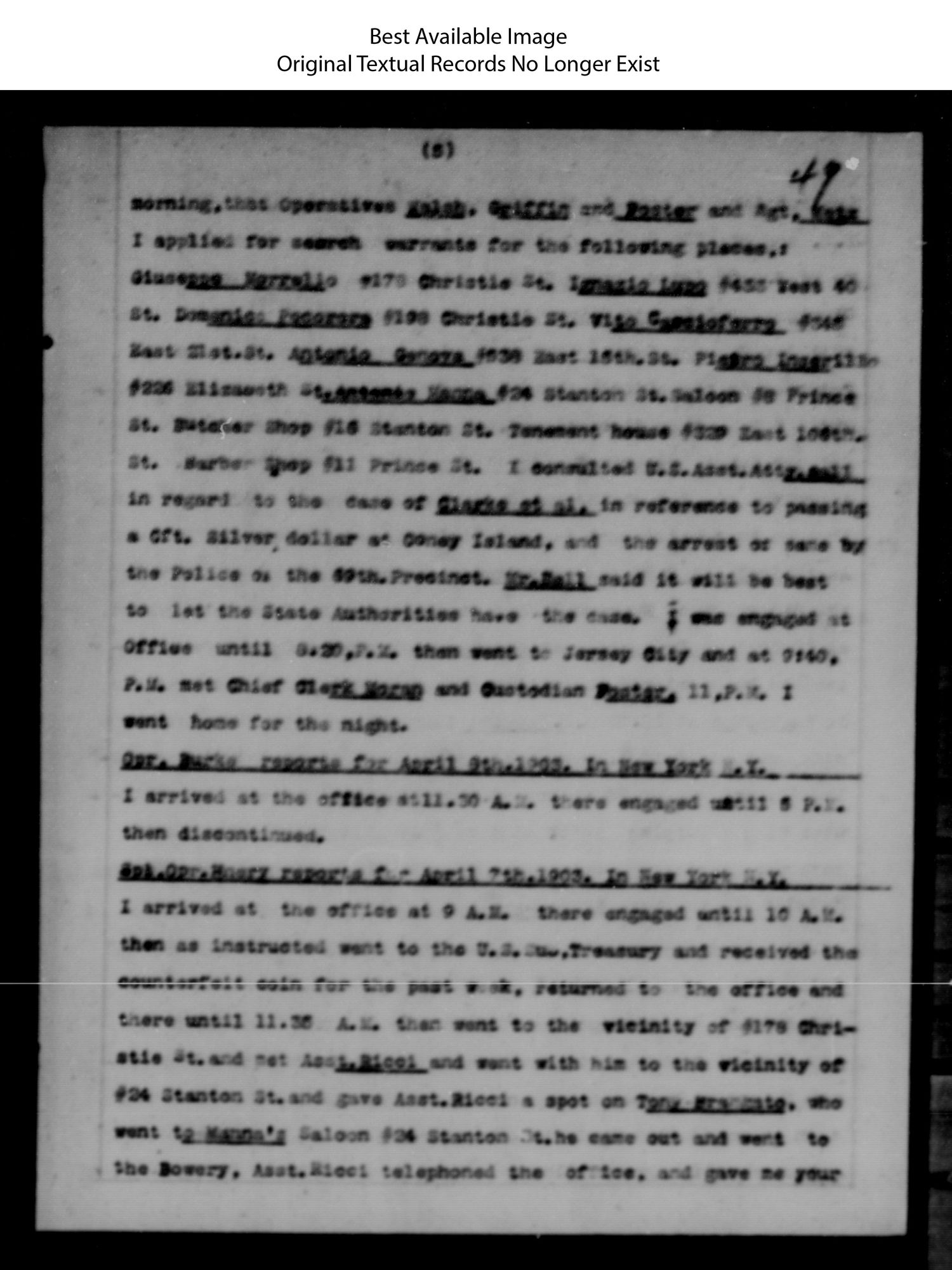 itemSecret Service daily report, New York District, about 8-9 April 1903: search warrants and the watch on Morrello and Lupo (T915 roll 109, pages 47-49)Typed pages of the U.S. Secret Service New York District daily report from the week before the barrel killing: an application for search warrants for premises including those of 'Giuseppe Morrello' and 'Ignazio Lupo', and operatives' surveillance in a counterfeiting inquiry.
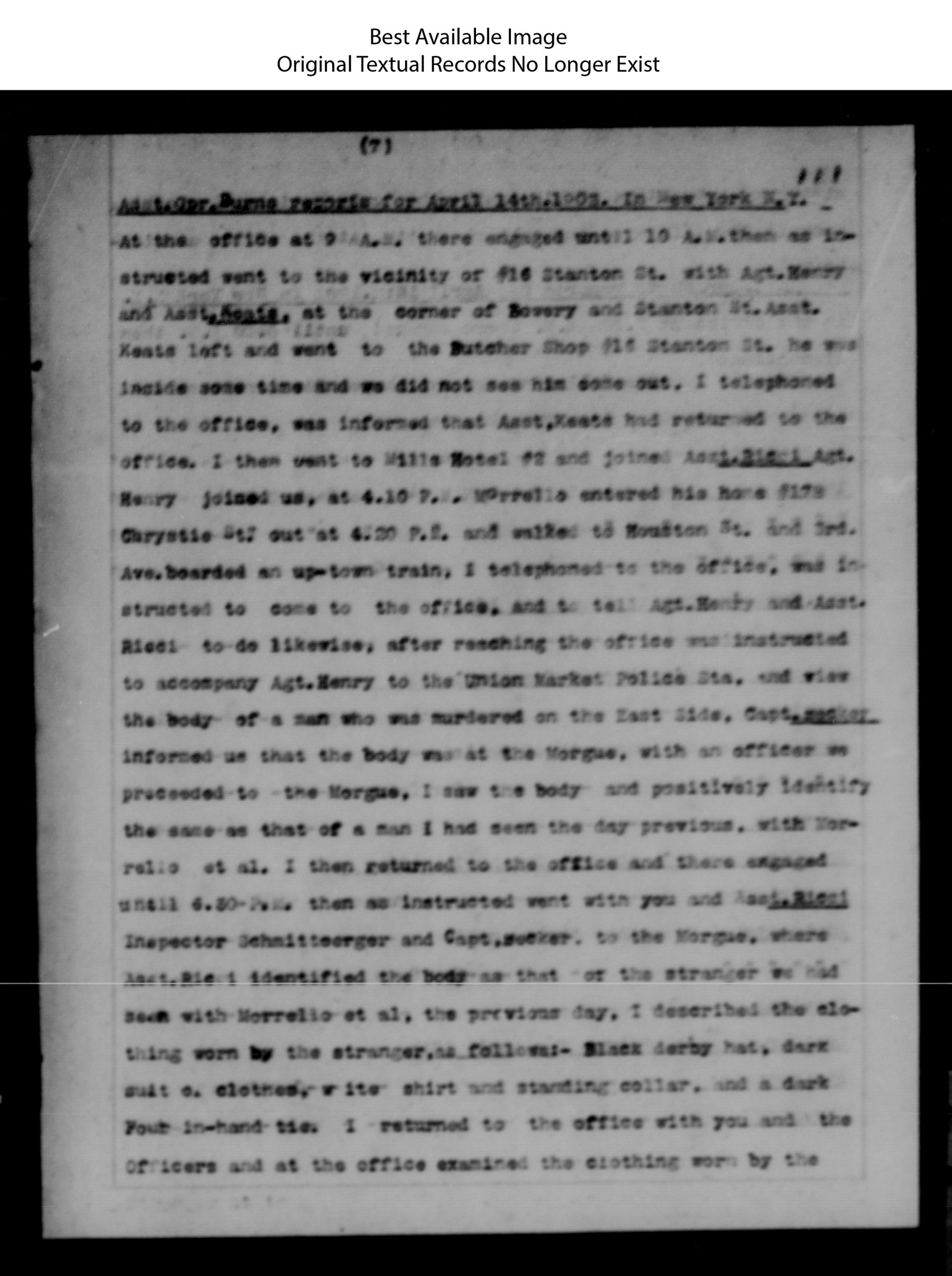 itemSecret Service daily reports, New York District, 14-17 April 1903: the body identified, the arrests, and a telegram about a letter to New Orleans (T915 roll 109, pages 103-111)Secret Service reports received on 17 April 1903: an operative's identification of the body at the Morgue as a man seen 'with Morrello et al.' the day before, the arrests of 15 April, a telegram to Chief Wilkie about a letter that 'indicated that murder was to be done', and the list of suspects.clippingNew-York Tribune, 21 April 1903, page 1: barrel victim identified as a Buffalo manThe New-York Tribune front page of 21 April 1903 reports that the man found in the barrel was identified as a 48-year-old stone mason from Buffalo, after Detective Petrosino showed his photograph to the dead man's brother-in-law in Sing Sing.clippingNew-York Tribune, 28 January 1910, page 8: counterfeiting witness testifies to a death threatThe New-York Tribune of 28 January 1910 reports the testimony of Antonio Comito, the government's principal witness at the federal counterfeiting trial of eight men, that he printed counterfeit notes at a farm near Highland, N.Y., and that Morello and Lupo threatened him.clippingNew-York Tribune, 19 February 1910, page 4: counterfeiting case goes to the juryA short New-York Tribune report of 19 February 1910 that the case of the eight men charged with counterfeiting, among them Ignazio Lupo and Giuseppi Morello, 'alleged leader of the band', would go to the jury after Judge Ray's charge.
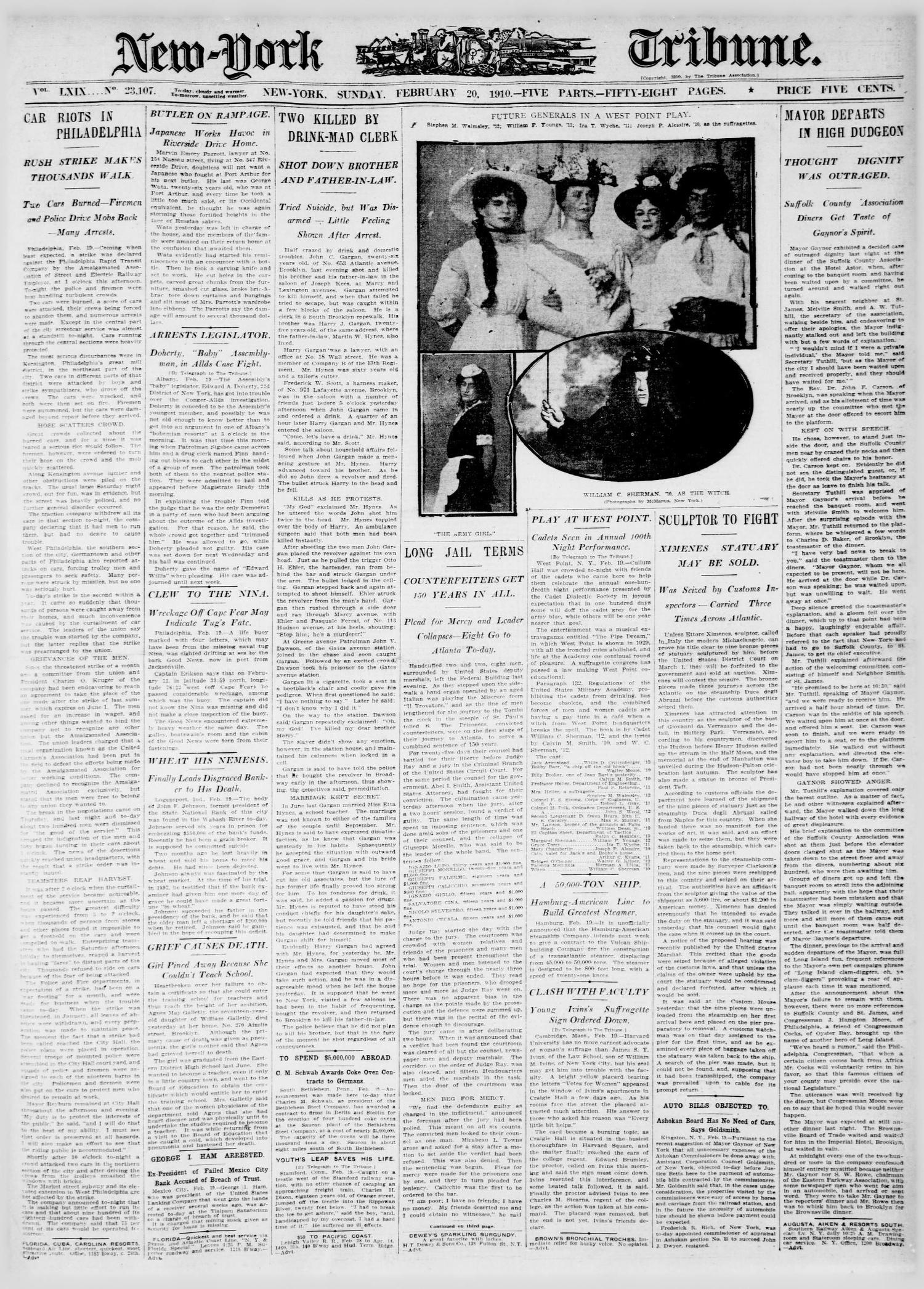 clippingNew-York Tribune, 20 February 1910, page 1: long jail terms for eight counterfeitersThe New-York Tribune front page of 20 February 1910 reports that eight men were convicted of counterfeiting after a trial of twenty-five days and sentenced the same afternoon, Lupo to thirty years and Morello to twenty-five. A scan is stored here.clippingThe Sun (New York), 20 February 1910, page 1: Lupo to prison for 30 yearsThe Sun's front page of 20 February 1910 reports that eight men were found guilty on all six counts of counterfeiting and sentenced, Lupo to thirty years and Morello to twenty-five, and quotes Judge Ray on the verdict.itemCalicchio v. United States, 189 F. 305 (2d Cir. 1911)Second Circuit opinion of 19 June 1911 affirming the 1910 counterfeiting convictions of Giuseppe Calicchio, Giuseppe Morello, Ignatzio Lupo and five others. It holds a question about Morello's 1903 arrest in the 'Barrel Murder' improper but cured, and says: 'The arrest of Morelio for the murder proved nothing.'
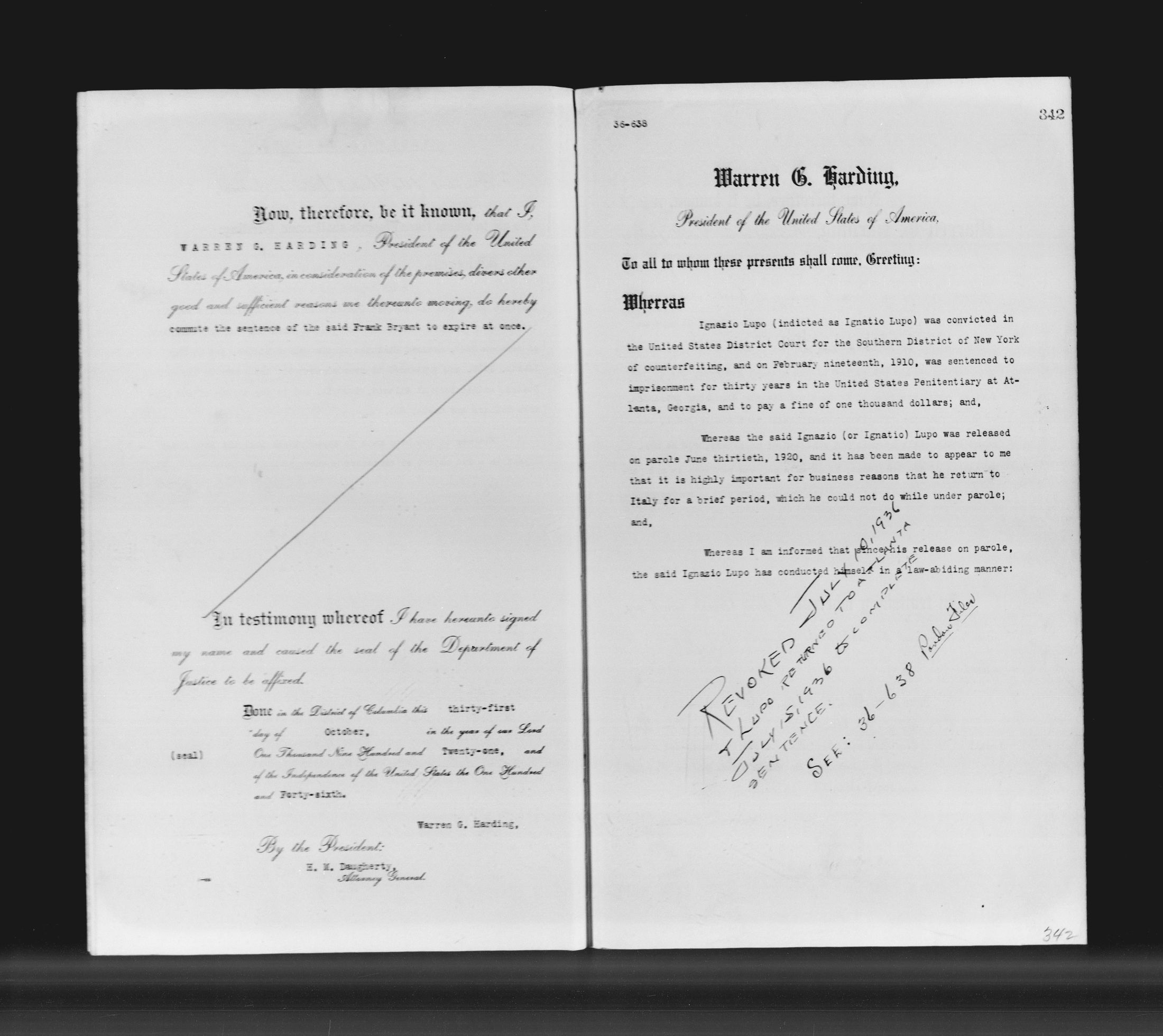 itemPardon warrant 36-638: conditional commutation of the sentence of Ignazio Lupo, 1921, with the 1936 revocation notePrinted warrant signed by President Warren G. Harding commuting Ignazio Lupo's thirty-year counterfeiting sentence on condition that he be law-abiding, so that he could go to Italy; a handwritten note records the revocation of 10 July 1936 and his return to Atlanta.
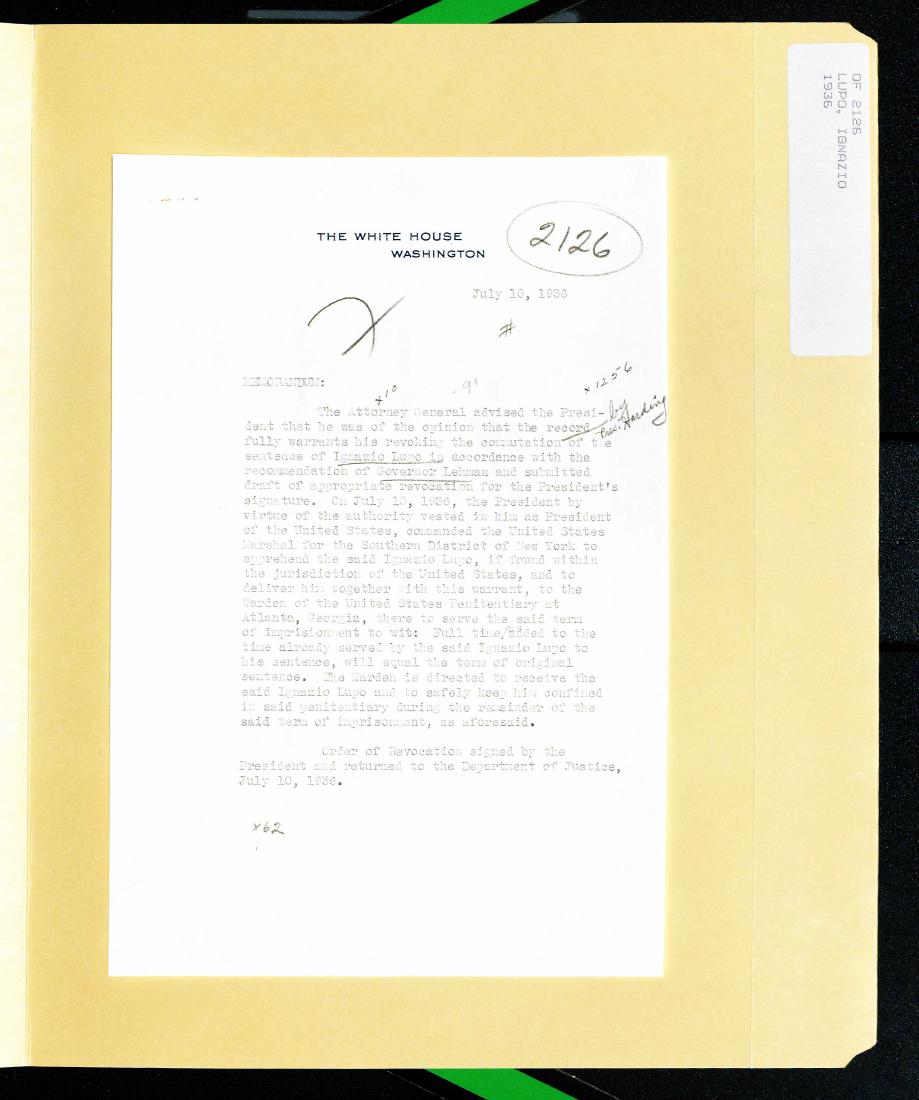 itemPresident's Official File 2126: Lupo, Ignazio, 1936 (Franklin D. Roosevelt Library)A three-image file from the Roosevelt White House: a memorandum of 10 July 1936 recording that the President, on the Attorney General's advice and Governor Lehman's recommendation, revoked the commutation of Ignazio Lupo's sentence and ordered him returned to Atlanta, and a telegram telling the Governor.itemLupo v. Zerbst, Warden, 92 F.2d 362 (5th Cir. 1937)Fifth Circuit opinion of 19 October 1937 affirming the denial of Ignazio Lupo's habeas corpus petition after the President revoked his conditional commutation in 1936 and he was returned to the Atlanta penitentiary.