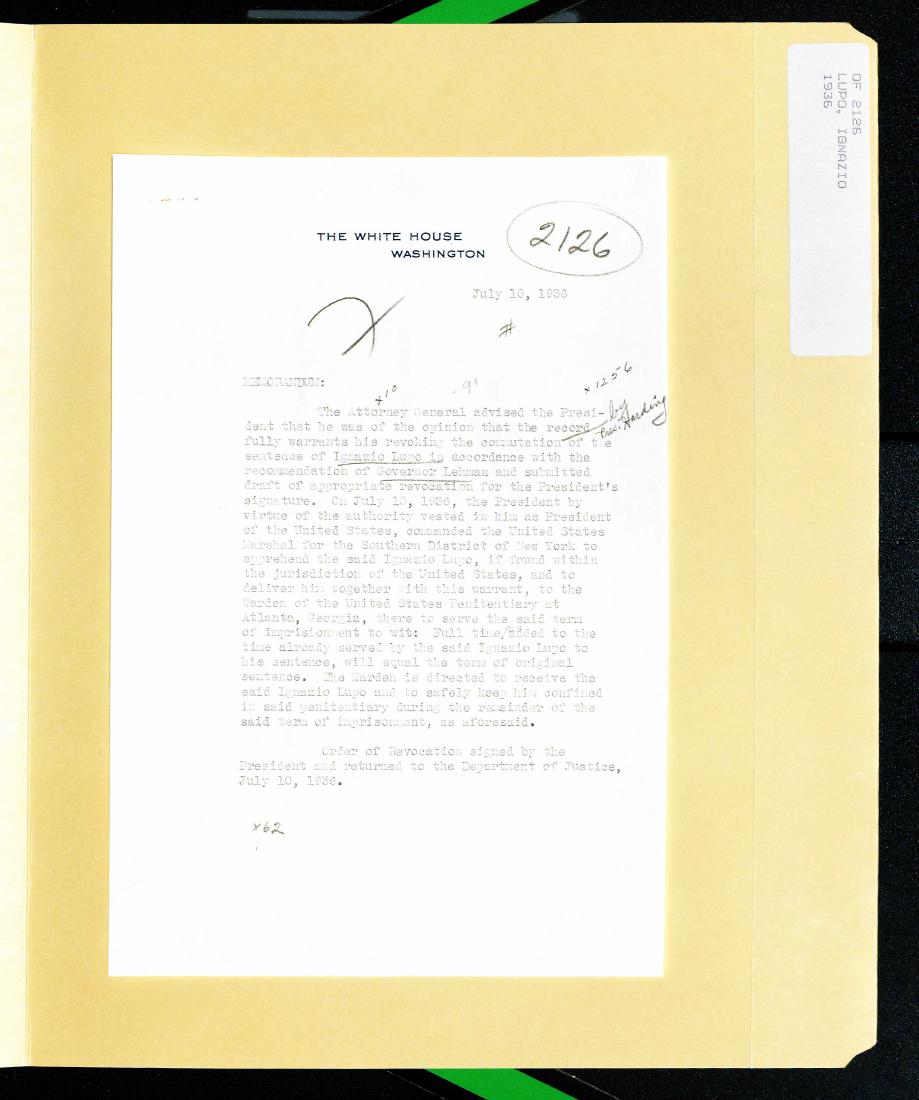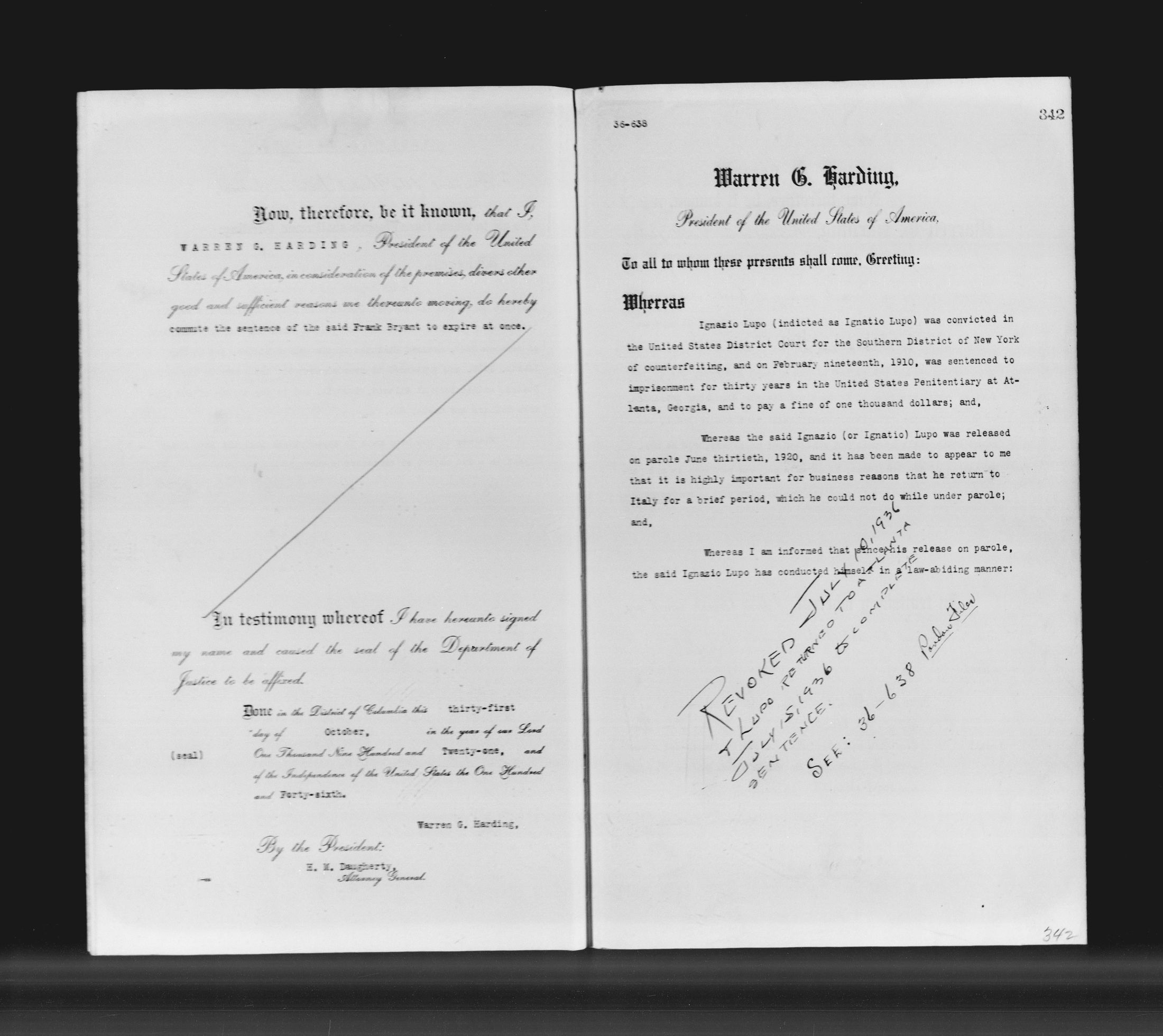
Pardon warrant 36-638: conditional commutation of the sentence of Ignazio Lupo, 1921, with the 1936 revocation note
Printed warrant signed by President Warren G. Harding commuting Ignazio Lupo's thirty-year counterfeiting sentence on condition that he be law-abiding, so that he could go to Italy; a handwritten note records the revocation of 10 July 1936 and his return to Atlanta.
- Date
- 1921-10-29
- Kind
- case-file
- Retrieved
- 2026-10-12
- NAID
- 648066344
- Rights
- A record of the Department of Justice held by the National Archives in Record Group 64 and reproduced on microfilm P2288, Pardon Warrants (Pardons), 1893-1936, reel 16. A United States government work, public domain in the United States under 17 U.S.C. § 105. The National Archives catalog lists access and use as unrestricted.
The warrant is in the National Archives file unit “December 1920 THRU December 1921” (423 images on microfilm P2288, reel 16). Its number, 36-638, is typed at the top of volume page 342, shown here on the right of the spread; the left page belongs to a different warrant. The operative clause and the date are on the facing page in the next image: “Done in the District of Columbia this twenty-ninth day of October … 1921,” signed by Warren G. Harding and, for the President, by Attorney General H. M. Daugherty. Warrants in the volume are not in strict date order.
The recitals read: “Ignazio Lupo (indicted as Ignatio Lupo) was convicted in the United States District Court for the Southern District of New York of counterfeiting, and on February nineteenth, 1910, was sentenced to imprisonment for thirty years in the United States Penitentiary at Atlanta, Georgia, and to pay a fine of one thousand dollars”; that “the said Ignazio (or Ignatio) Lupo was released on parole June thirtieth, 1920”; that “it is highly important for business reasons that he return to Italy for a brief period, which he could not do while under parole”; and that since his release he “has conducted himself in a law-abiding manner.” The warrant commutes the sentence to expire at once on condition that he remain law-abiding.
A handwritten note across the page reads, as far as it can be read: “Revoked Jul 10 1936 / Lupo returned to Atlanta July 15 1936 to complete sentence. See: 36-638 Pardon Files.” The “15” is the least certain reading. The Fifth Circuit’s 1937 opinion gives the commutation date as 29 October 1921 and the revocation as 10 July 1936 (92 F.2d 362).