Salvatore Maranzano
Head of the other side in the 1930–31 war, according to the 1963 Senate hearings. Valachi testified that Maranzano declared himself "the boss of all bosses." A 1931 Bureau of Investigation report concerns papers found in the Park Avenue office where he was killed.
- Died
- 1931-09-10
- Family
- "The Gagliano-Maranzano family," of which "Maranzano was actually boss at that time," in Valachi's words (testimony, 1963)
- Role
- Declared himself "the boss of all bosses," as Valachi testified (testimony, 1963)
- Rights
- Biography on this page is limited to what the cited federal records state.
On the record
- 10 September 1931 — New York police record, read into the hearing by Sgt. Ralph Salerno on 2 October 1963 (printed p. 232): "September 10, 1931, Salvatore Maranzano ... was shot and stabbed to death in the office of the Eagle Building Corp., in a suite of rooms including 925 and 926, at 230 Park Avenue, which is at 46th Street, New York City. Perpetrators were four unknown men posing as police officers." The time given is 3:50 p.m.; four gunshot and six stab wounds, a knife and two pistols recovered; no one indicted (printed pp. 232–233). Police record, read aloud.
- 9 October 1931 — A Bureau of Investigation report made at New York on 10/9/31 by agent J. Kilmartin (FBI Vault, Salvatore Maranzano (Final), pp. 1–2) concerns papers taken from the office suite at 230 Park Avenue where Maranzano was killed; the OCR reads "Wiio was killed in hia office at 230 Park." The office was leased by James F. Alascia, from whom Maranzano had subleased. FBI report.
- 1 October 1963 — Duffy, presenting Exhibit 8 (printed p. 162): "we had Salvatore Maranzano, head of the gang." Committee staff, describing its chart.
- 1 October 1963 — Asked what family he was made a member in, Valachi answered (printed p. 181): "The Gagliano-Maranzano family, we will put it that way. In other words, Maranzano was actually boss at that time" (the OCR reads "Gugliuno-Maranzuno" and "thut"). The chairman asked, "He was boss of the family?" Valachi: "That is right." Testimony.
- 2 October 1963 — Valachi testified (printed p. 215) that after the war Maranzano told the members: "first we have the boss of all bosses, which is myself." He agreed with the chairman (printed p. 217) that a banquet was held to raise money and to acknowledge Maranzano as boss of bosses. Testimony.
- 2 October 1963 — Valachi testified (printed p. 230) that Maranzano was killed "in the office on 46th Street" by men posing as detectives. Testimony.
- 1 October 1963 — Asked by counsel "Was Maranzano a Castellemarese?", Valachi answered "Yes" (printed p. 167). He testified that Maranzano would not make peace until Joe Baker was killed: "If I don't get Joe Baker, I will never make peace" (printed pp. 188–192), and that Maranzano refused Masseria's offer of peace (printed p. 198). Testimony.
- 2 October 1963 — Valachi testified (printed p. 221) that shortly before the killing Maranzano told him "We have to go to the mattress again" and gave him a list of names to be got rid of, and that he learned of the killing from a newspaper headline, "Park Avenue Murder" (printed p. 223). Testimony, not corroborated in the record.
- undated — The FBI's history page "La Cosa Nostra" says Maranzano set up "five separate criminal groups in New York" and called himself "Boss of Bosses," and that Luciano "less than five months later" sent "five men dressed as police officers to Maranzano's office to murder him." An older FBI overview calls him "the first leader of La Cosa Nostra" and says he "was murdered within six months." FBI history essays.
The Bureau report and Valachi place the killing differently, at 230 Park Avenue and “on 46th Street.” The police record read into the 1963 hearing reconciles them: “230 Park Avenue, which is at 46th Street.” The date of death, September 10, 1931, is the police record’s; the 1931 report’s OCR reads “Se?cember 10, 193l.” The police record says four men posing as police officers did the killing, and the FBI’s history page says five; both are given as printed. The police record also prints his home address, which is not repeated here.
The 1931 report is about an immigration inquiry that grew out of the killing. It says nothing about Maranzano’s place in any organization. The family line is Valachi’s name for the family he joined; Duffy’s “head of the gang” is the staff reading its own chart and is not used for it. The role line is Valachi quoting Maranzano. The 1963 hearing record mixes kinds of statement. Valachi’s and Shanley’s answers are sworn testimony; counsel’s questions are not, though a witness’s “yes” makes them part of the testimony; LaVern Duffy’s description of Exhibit 8 is the committee staff reading its own chart. A chart entry never fills a role on this archive.
Records
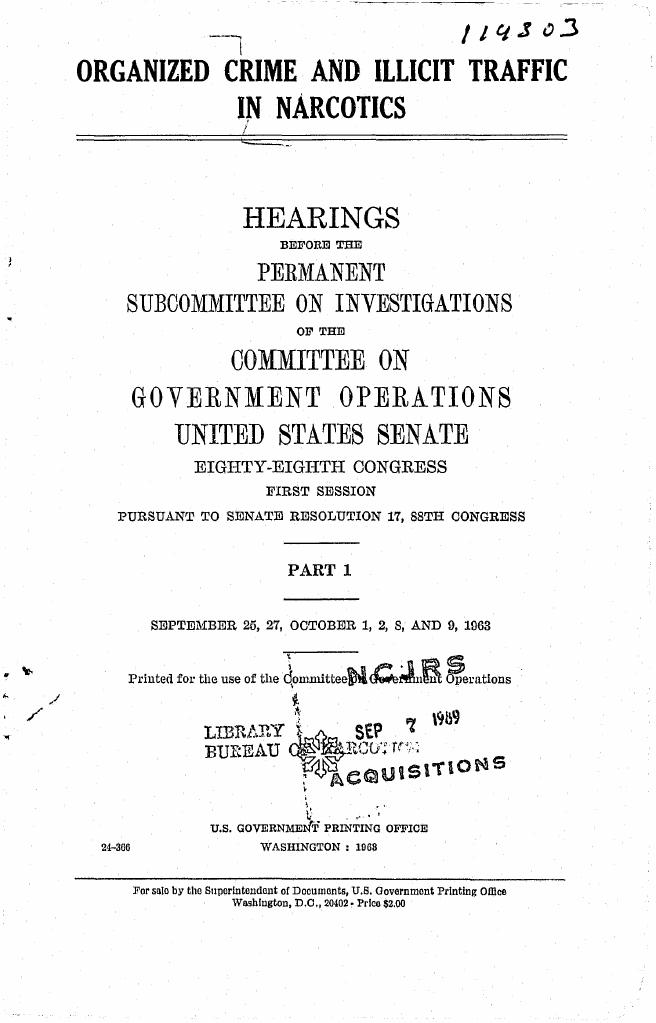 itemOrganized Crime and Illicit Traffic in Narcotics, Part 1 (September 25 to October 9, 1963)The first printed volume of the 1963 Senate hearings: Attorney General Robert F. Kennedy's opening testimony, Joseph Valachi's public testimony, New York police witnesses, Exhibit 8 and Charts A to E.
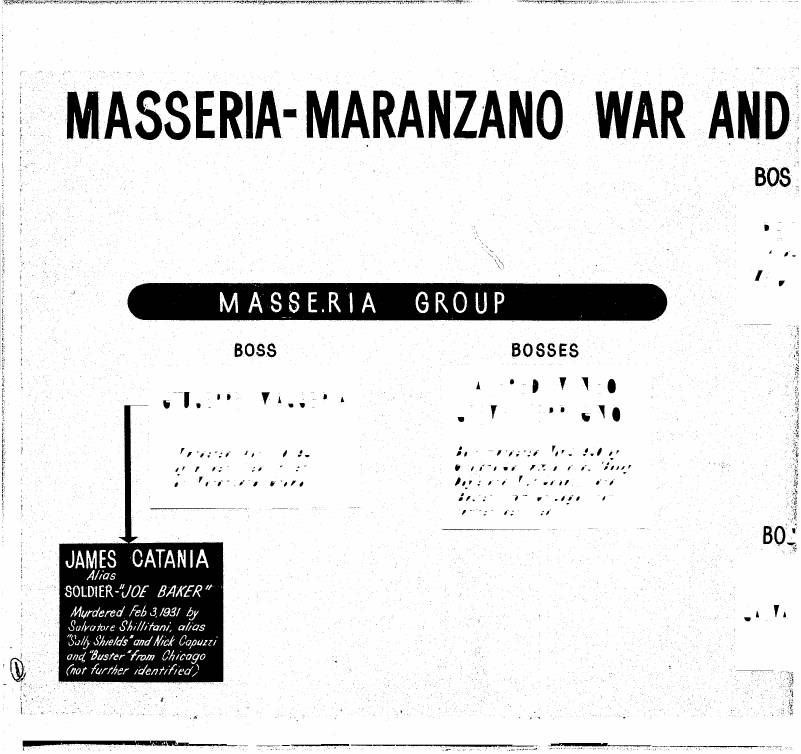 itemExhibit No. 8: "Masseria-Maranzano War and Evolution of Gang Control—1930 to Present"Staff fold-out chart presented on October 1, 1963: the 1930 to 1931 war in three key-coded groups and the lines of succession drawn from it to five 1963 bosses. Several name boxes are illegible in the scan.
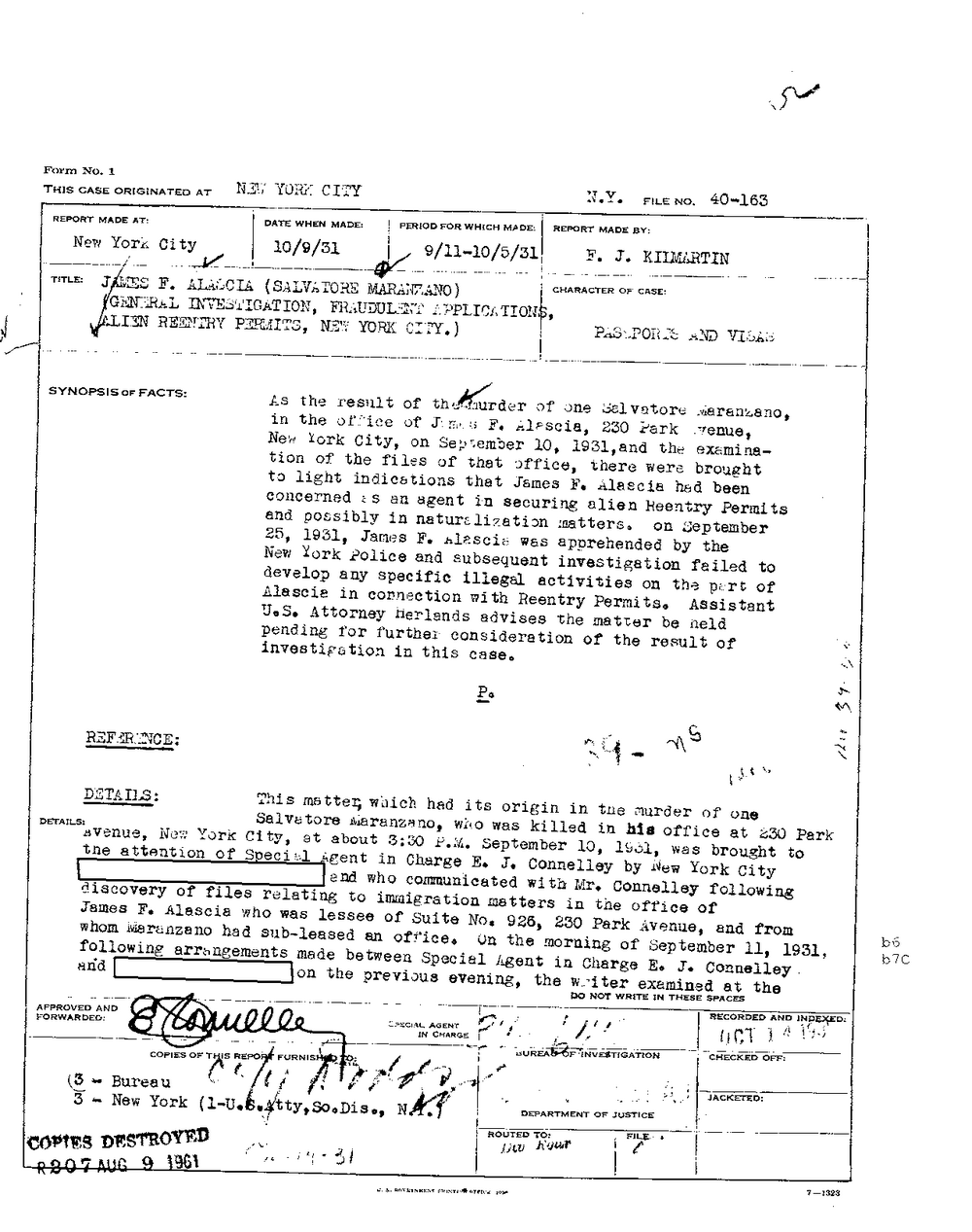 itemFBI Vault: Salvatore Maranzano (Final), with a 1931 Bureau of Investigation reportAn 18-page FBI file whose main serial is a Bureau of Investigation report made at New York on 10/9/31 about immigration papers found in the office suite at 230 Park Avenue where Maranzano was killed.
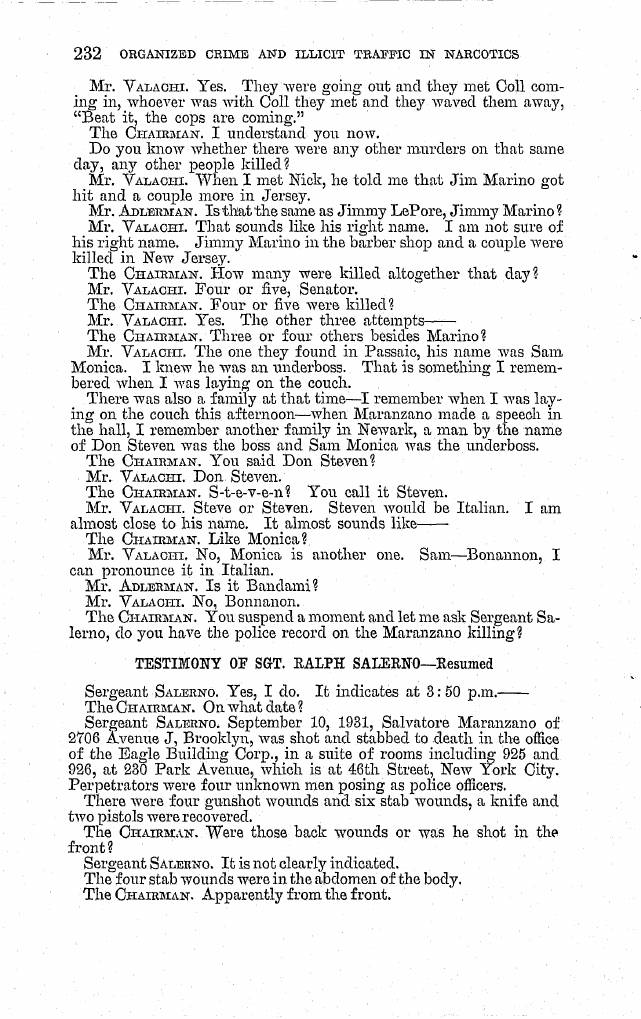 itemHearing of October 2, 1963, pp. 227–233: Valachi's account of the killing of Salvatore Maranzano, and the police records of September 10, 1931 (Maranzano at 230 Park Avenue; James Le Pore at 2400 Arthur Avenue)Sgt. Ralph Salerno read the police record: at 3:50 p.m. on September 10, 1931, Salvatore Maranzano was shot and stabbed to death in the office of the Eagle Building Corp., rooms 925 and 926, 230 Park Avenue at 46th Street, by "four unknown men posing as police officers." The same day at 5:45 p.m. James Le Pore was shot dead at 2400 Arthur Avenue in the Bronx. Valachi gave a hearsay account of the killing.
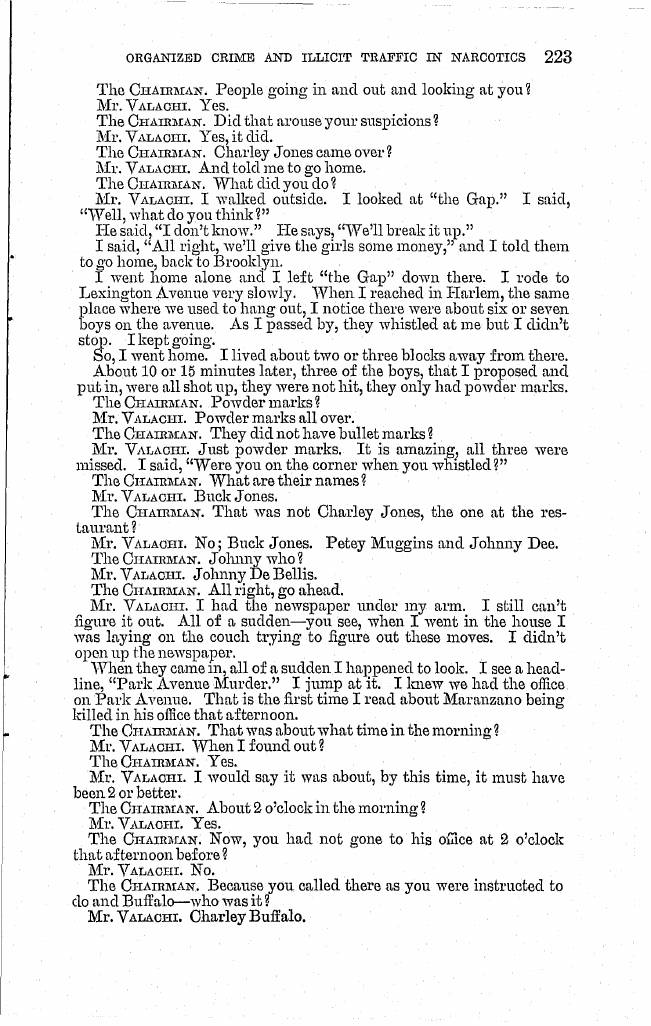 itemHearing of October 2, 1963, pp. 220–224: "We have to go to the mattress again," Maranzano's list, and the "Park Avenue Murder" headlineValachi testified that shortly before his death Maranzano told him "We have to go to the mattress again," gave him a list of names, and was to meet Genovese and Luciano at his office the next afternoon; Valachi was told by phone not to come, and learned of the killing from a newspaper headline, "Park Avenue Murder." Uncorroborated testimony.
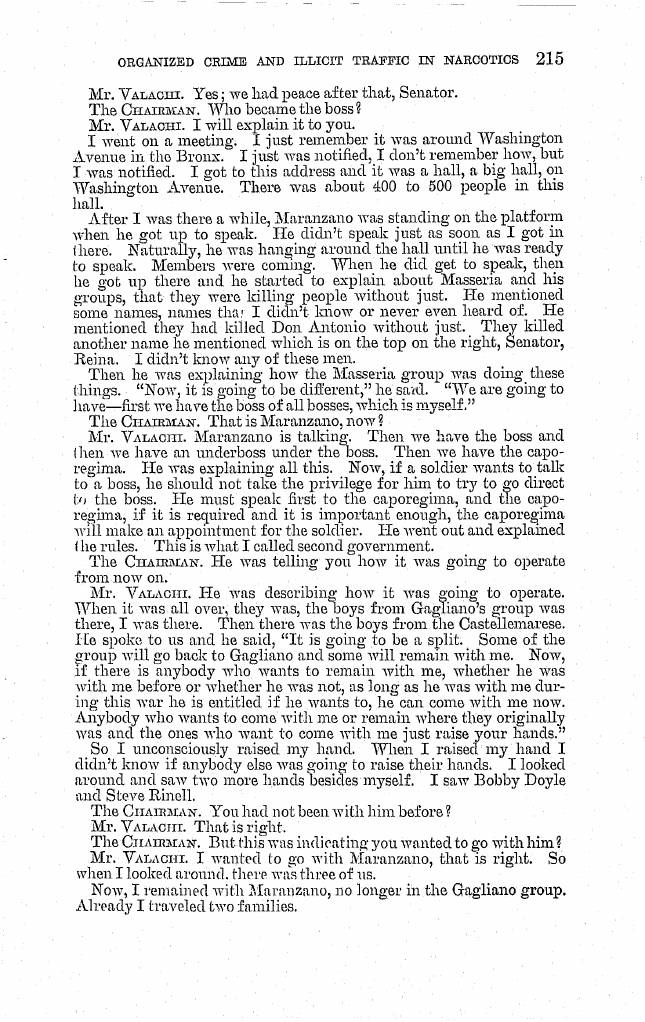 itemHearing of October 2, 1963, pp. 214–218: the "score" of the war, Maranzano's meeting on Washington Avenue ("the boss of all bosses, which is myself"), and the banquetValachi testified that the score was "we lost 1 and they lost from 40 to 60," described a meeting of 400 to 500 people in a hall on Washington Avenue in the Bronx where Maranzano declared himself "the boss of all bosses," named the bosses he recalled being designated there, and described a five-night banquet he understood raised $115,000. Testimony, not findings.
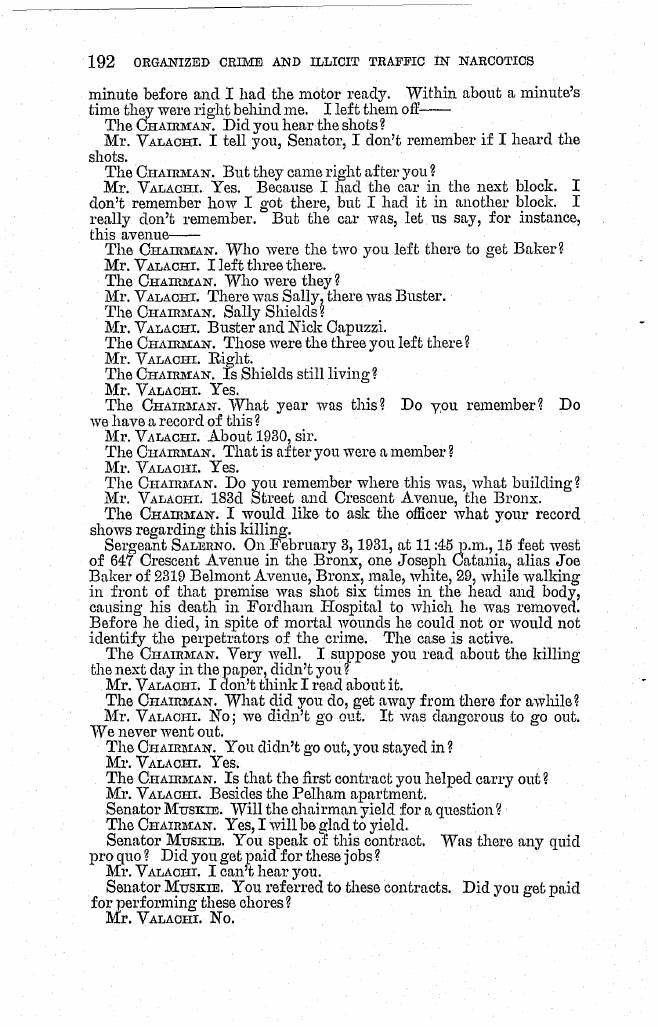 itemHearing of October 1, 1963, pp. 188–192: the "contract" on Joseph Catania ("Joe Baker") and the police record of his killing on February 3, 1931Valachi testified that Maranzano would not make peace until Joe Baker was killed, and described the watch from an apartment in the Bronx. Sgt. Ralph Salerno read the police record: Joseph Catania, alias Joe Baker, 29, shot six times 15 feet west of 647 Crescent Avenue on February 3, 1931, died in Fordham Hospital.
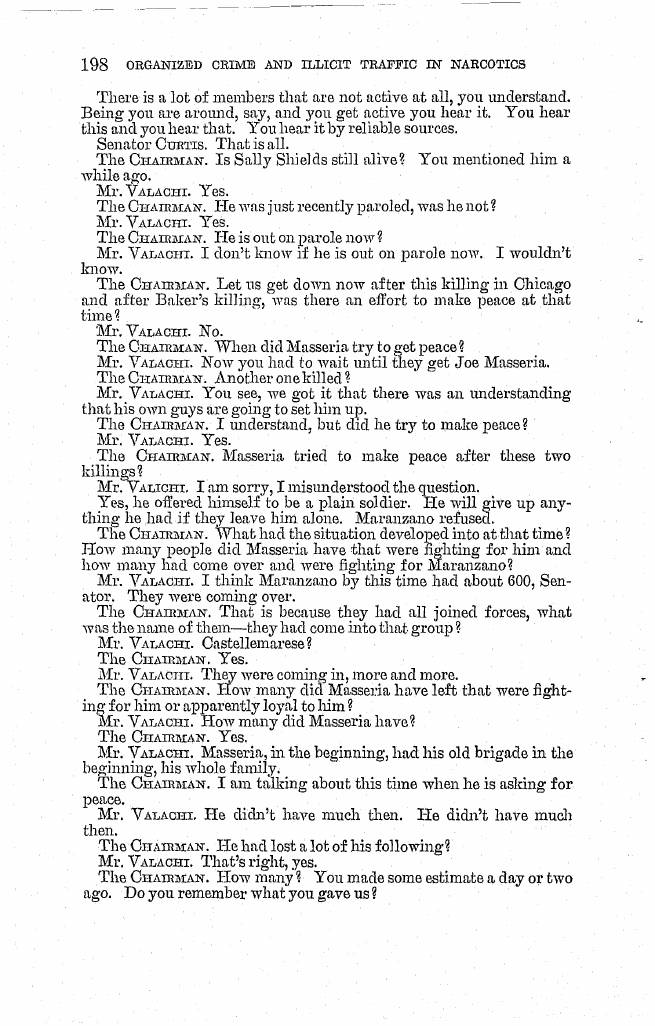 itemHearing of October 1, 1963, pp. 198–199: Masseria's offer of peace, Maranzano's refusal, and the men Valachi said "set him up"Valachi testified that Masseria "offered himself to be a plain soldier" and that Maranzano refused, that Maranzano's side had grown to about 600, and that Masseria's own men set him up at a Coney Island restaurant. Testimony from hearsay; Valachi was not there.
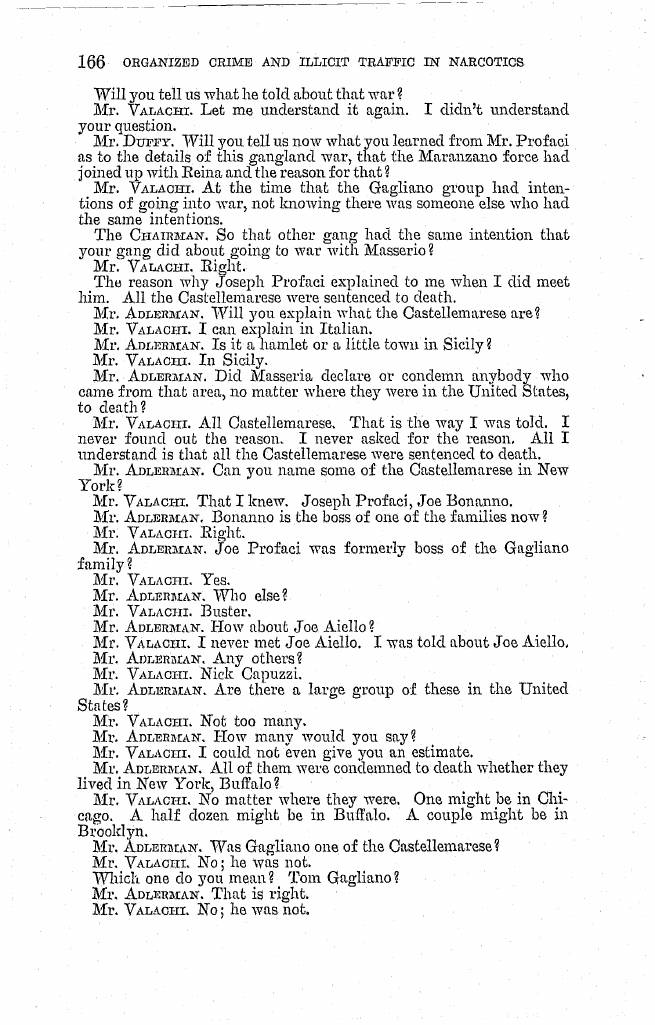 itemHearing of October 1, 1963, pp. 166–168: "All the Castellemarese were sentenced to death"; the Morello and Pinzolo killings as Valachi told themValachi testified that Masseria had condemned "all the Castellemarese" to death, that Peter Morello was killed "by the Maranzano group," and that the Maranzano and Gagliano sides then joined forces. Counsel put the dates of August 15 and September 9, 1930 from police records. Testimony, much of it hearsay.
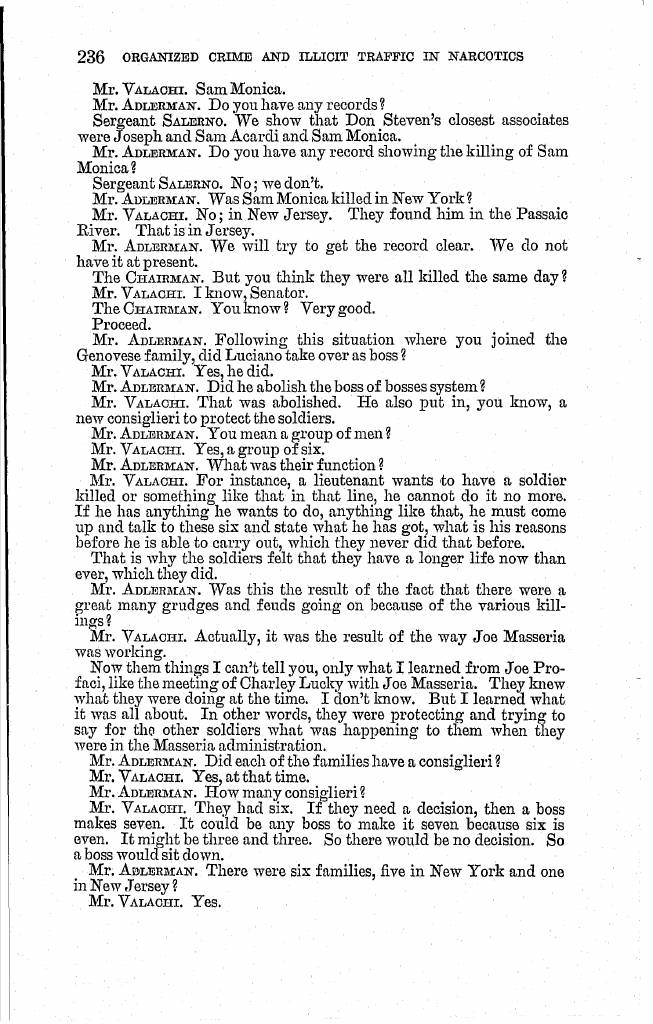 itemHearing of October 2, 1963, pp. 236–239: the "boss of bosses" abolished, the Chicago meeting, and the membership "books" closed in about 1931Valachi testified that after Maranzano's death Luciano took over as boss, that the "boss of bosses" system "was abolished" and a group of six consiglieri was set up, that Luciano and Genovese had to justify the killing before the bosses at a meeting in Chicago, and that "the books were closed in about 1931." One witness's account, not a finding.itemLa Cosa Nostra (FBI history page)The FBI's history essay on the Genovese family. It says that Valachi survived three attempts on his life in prison and testified before the Senate subcommittee on September 27, 1963.itemFBI, "Italian Organized Crime – Overview" (archived www2.fbi.gov page)An older FBI web overview, still served on the www2.fbi.gov archive host. It says the murder of "faction leader Joseph Masseria brought an end to the gang warfare," that Maranzano, "the first leader of La Cosa Nostra, was murdered within six months," and that Luciano "set up the 'Commission.'" An agency narrative, not a record of the events.itemNew York teletype on the FBI interview of Salvatore Vincent ("Bill") Bonanno, Tucson, December 31, 1964: "Organization of Joseph Bonanno" and the death of MaranzanoAn urgent FBI teletype reporting agents' interview of Bill Bonanno after his father's reported abduction in October 1964. On its fifth page the son said his father had been "the boss" since about 1930 or 1931; when agents put to him the date of the death of Salvatore Maranzano, "who was boss prior to Joseph Bonanno's taking over," he said it "must have been around that time." His statement as the FBI recorded it.