Record
Agency history
undated
Federal Bureau of Investigation, Organized Crime: Italian Organized Crime – Overview (www2.fbi.gov archive)
FBI, "Italian Organized Crime – Overview" (archived www2.fbi.gov page)
An older FBI web overview, still served on the www2.fbi.gov archive host. It says the murder of "faction leader Joseph Masseria brought an end to the gang warfare," that Maranzano, "the first leader of La Cosa Nostra, was murdered within six months," and that Luciano "set up the 'Commission.'" An agency narrative, not a record of the events.
- Date
- undated
- Kind
- agency-history
- Retrieved
- 2026-10-12
- Rights
- Text published by the Federal Bureau of Investigation. A United States government work, public domain under 17 U.S.C. § 105.
This is an older FBI web page, “Italian Organized Crime – Overview,” still served on the Bureau’s www2.fbi.gov archive host. The page carries no date. It is the FBI’s general account, written long after the events, and is cited here for what the Bureau says, not as a record of 1930 or 1931.
Its section “History of La Cosa Nostra” says that by the end of the 1920s “two primary factions had emerged, leading to a war for control of organized crime in New York City,” and continues: “The murder of faction leader Joseph Masseria brought an end to the gang warfare, and the two groups united to form the organization now dubbed La Cosa Nostra. It was not a peaceful beginning: Salvatore Maranzano, the first leader of La Cosa Nostra, was murdered within six months.” It then says Luciano “became the new leader,” that “Luciano set up the ‘Commission’ to rule all La Cosa Nostra activities,” and that “The Commission included bosses from six or seven families.”
Its Genovese family section carries the same paragraph as the Bureau’s current history page: that Masseria “sparked the so-called ‘Castellammarese War’ in 1928,” that the war “ended in 1931 when Salvatore Maranzano conspired with Masseria’s top soldier, Charles ‘Lucky’ Luciano, to have Masseria killed,” that Maranzano set up “five separate criminal groups in New York” and called himself “Boss of Bosses,” and that Luciano “less than five months later” sent “five men dressed as police officers to Maranzano’s office to murder him.” The same section says the Commission was “composed of seven bosses.”
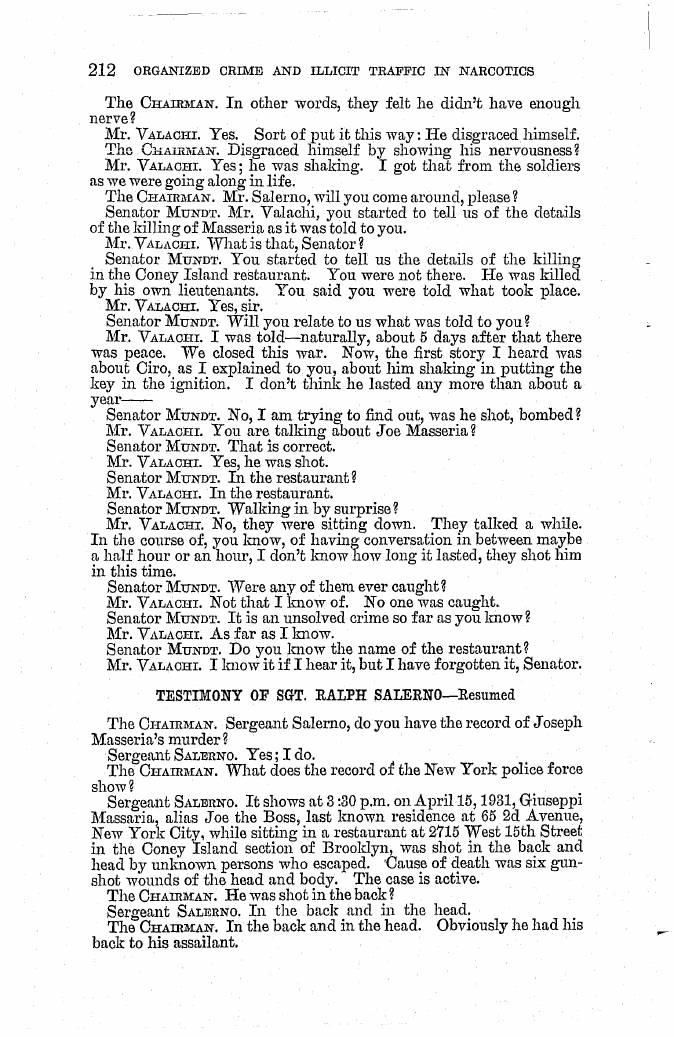
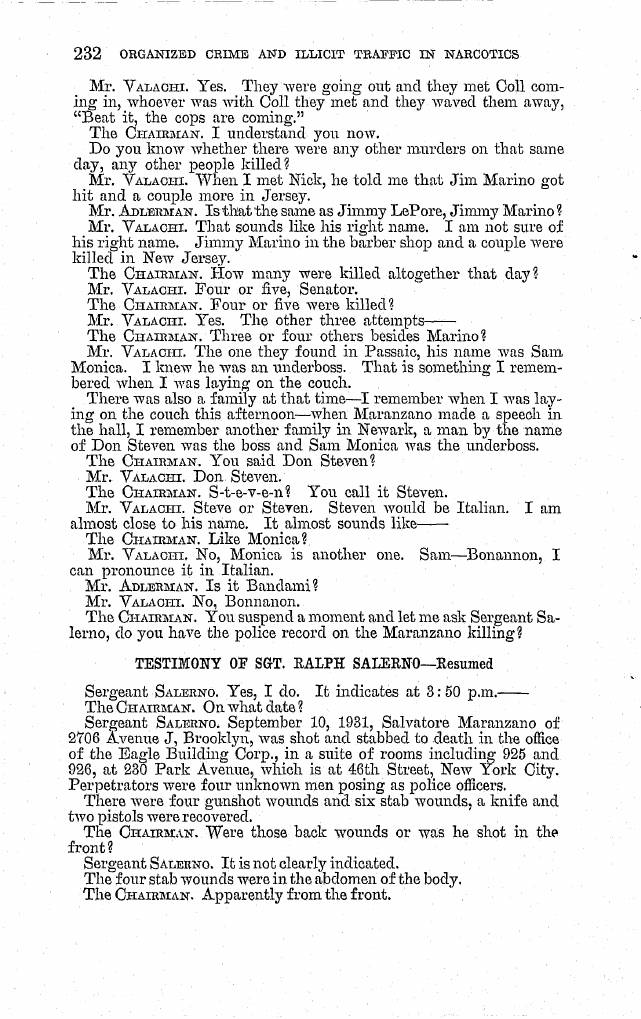
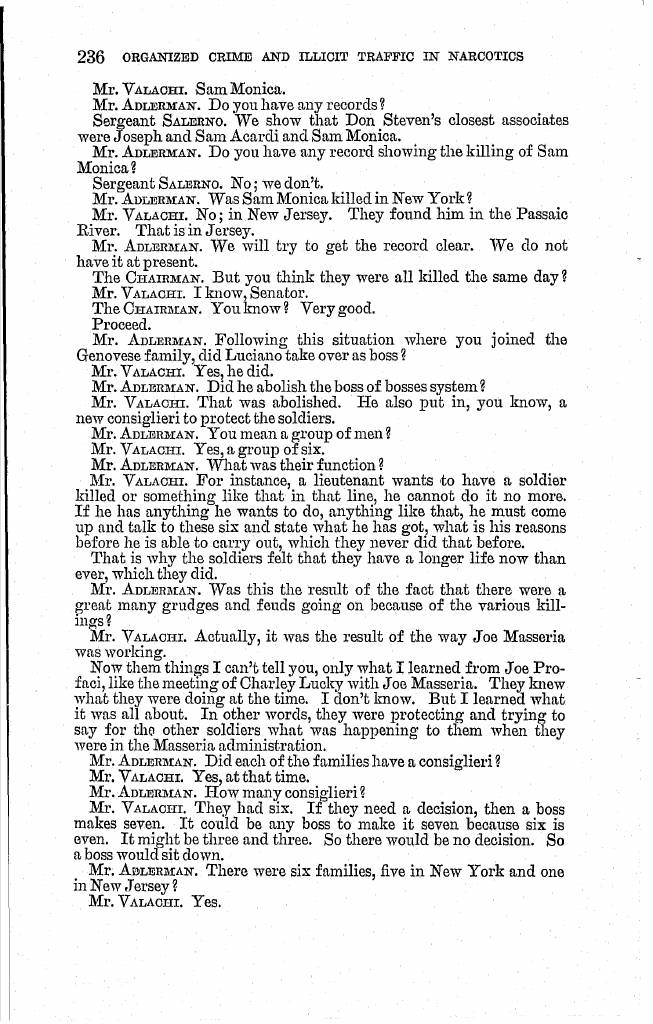
The page gives two intervals between the killings, “within six months” and “less than five months,” and two sizes for the Commission, “six or seven families” and “seven bosses.” By the New York police dates read into the 1963 hearing, April 15 and September 10, 1931 (Masseria; Maranzano), the interval is just under five months. The police record says four men posed as police officers, not five. No chart seat on this archive is filled from this page.