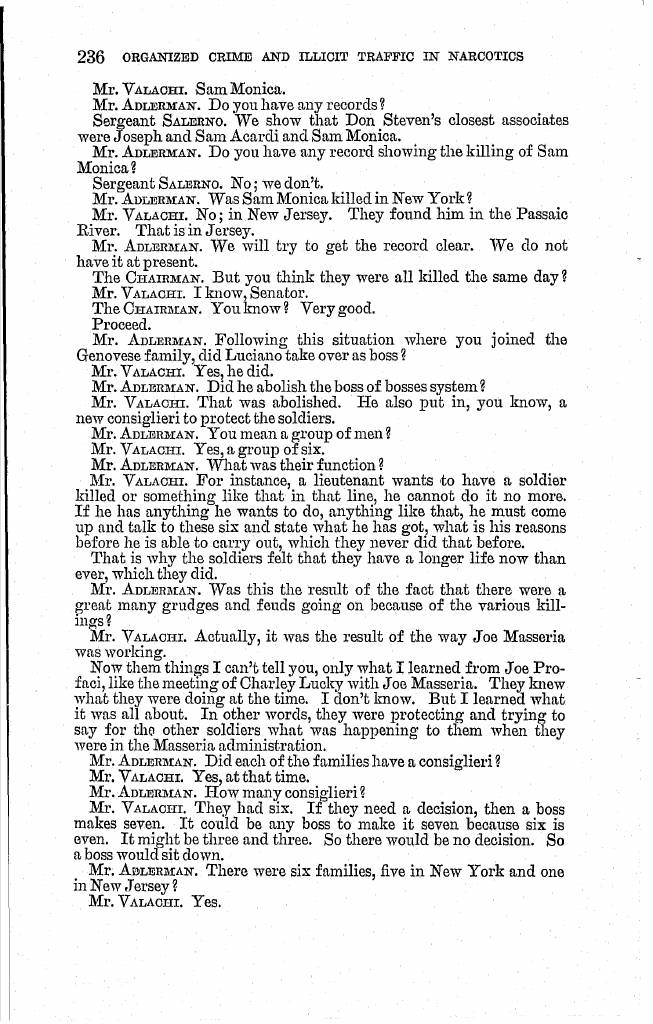
Hearing of October 2, 1963, pp. 236–239: the "boss of bosses" abolished, the Chicago meeting, and the membership "books" closed in about 1931
Valachi testified that after Maranzano's death Luciano took over as boss, that the "boss of bosses" system "was abolished" and a group of six consiglieri was set up, that Luciano and Genovese had to justify the killing before the bosses at a meeting in Chicago, and that "the books were closed in about 1931." One witness's account, not a finding.
- Date
- 1963-10-02
- Kind
- hearing
- Retrieved
- 2026-10-12
- Rights
- A work of the United States Senate, printed by the Government Printing Office. Public domain in the United States. 17 U.S.C. § 105. The NCJRS cover sheet records reproduction permission as "Public Domain / U.S. Senate."
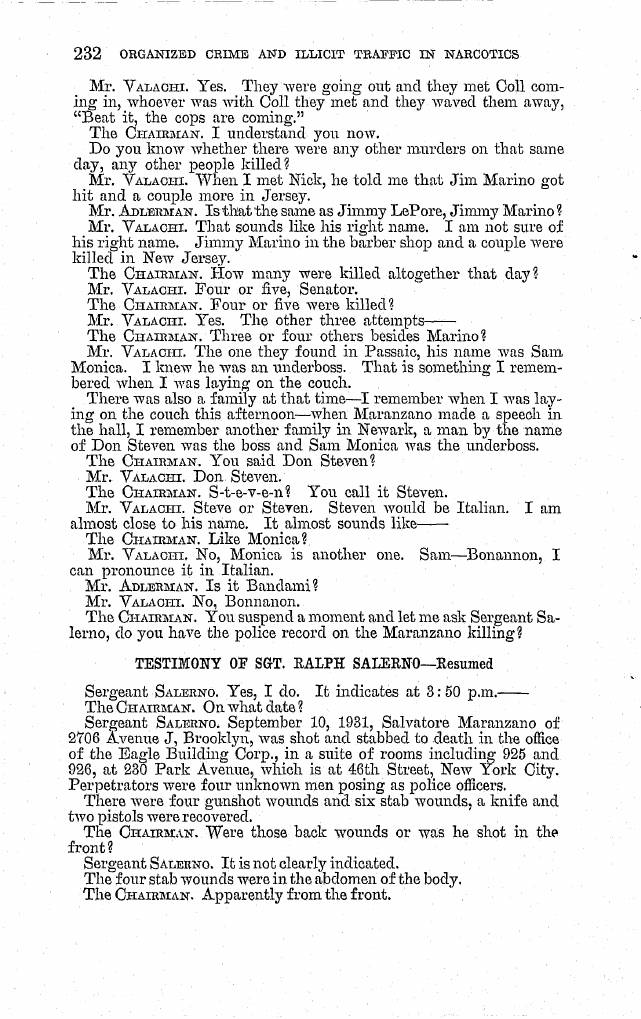
Printed pages 236 to 239 of Part 1 (NCJRS PDF pages 250 to 253), October 2, 1963. The passage opens with “Sam Monica.” Valachi said he was killed “in New Jersey. They found him in the Passaic River.” Sergeant Salerno said police records showed “Don Steven’s closest associates were Joseph and Sam Acardi and Sam Monica,” but had no record of Monica’s killing. New Jersey’s records were read a week later (Bergin, October 9).
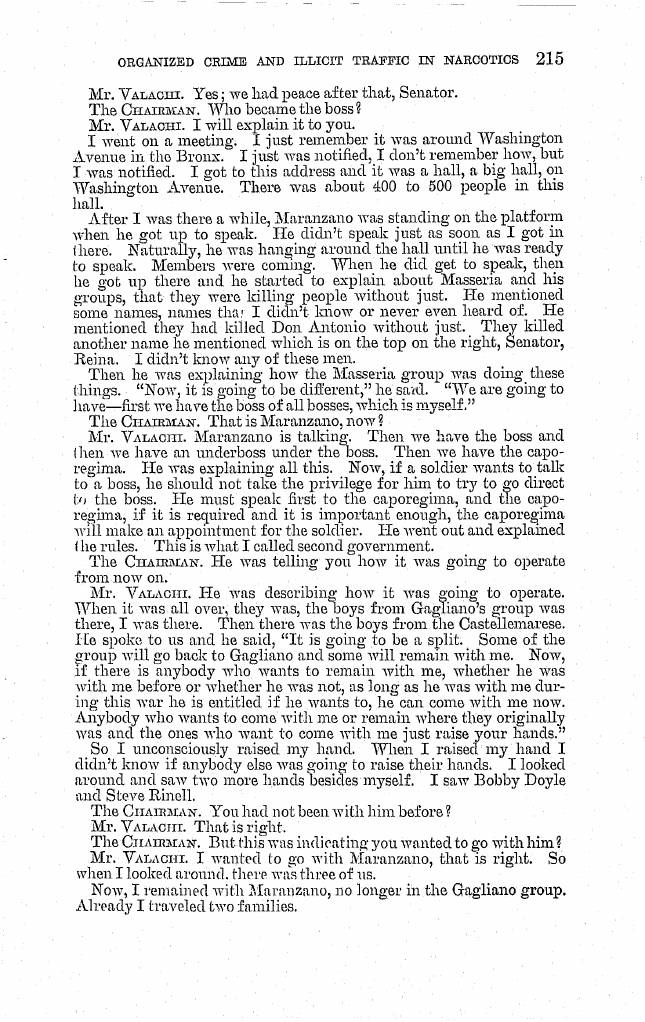
Counsel Jerome Adlerman asked: “Following this situation where you joined the Genovese family, did Luciano take over as boss?” Valachi: “Yes, he did.” Asked “Did he abolish the boss of bosses system?”, he answered: “That was abolished. He also put in, you know, a new consiglieri to protect the soldiers.” He said this was “a group of six,” and that a lieutenant who wanted a soldier killed now had to “come up and talk to these six and state what he has got, what is his reasons before he is able to carry out, which they never did that before.” Asked whether this came from grudges and feuds, he said: “Actually, it was the result of the way Joe Masseria was working.” He agreed there were “six families, five in New York and one in New Jersey.”
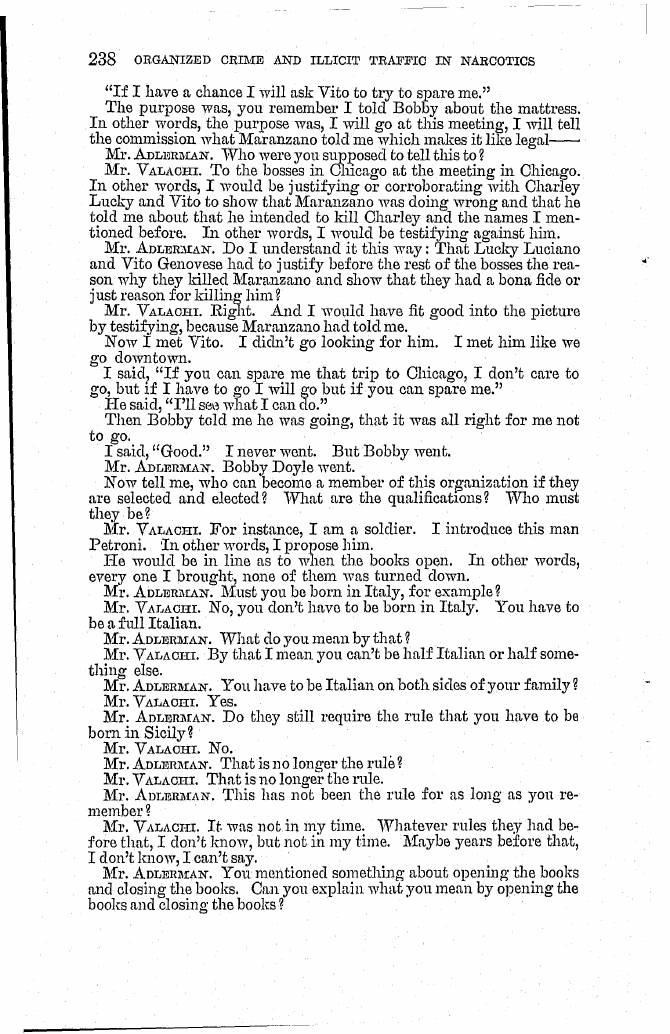
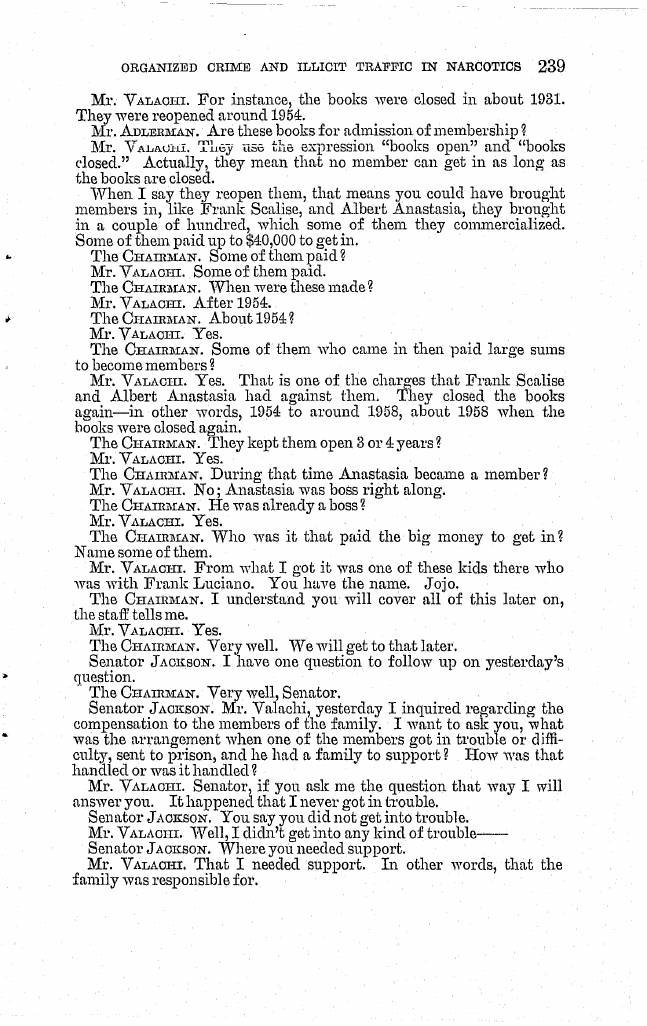
Valachi testified that he was to go to “the bosses in Chicago at the meeting in Chicago” to tell “the commission what Maranzano told me,” so that Luciano and Genovese could show “a bona fide or just reason for killing him”; he asked to be spared, and Bobby Doyle went instead (printed page 238). He explained that “the books were closed in about 1931. They were reopened around 1954,” meaning that no new member could be admitted while they were closed (printed page 239).
These are one witness’s recollections. The “commission,” the consiglieri and the Chicago meeting are Valachi’s words, and the meeting is not dated here. This archive does not date the founding of the Commission from these pages, and does not put any name on a chart from them. The FBI’s own later statements on the Commission are filed separately: a 1974 memorandum and an older FBI overview. The Second Circuit’s account of the Commission in the 1980s is in United States v. Salerno.
Page images: printed p. 236 (stored above), p. 238 and p. 239.