Giuseppe Morello
Arrested in April 1903 in the barrel-murder inquiry and watched by the Secret Service; convicted of counterfeiting in February 1910 and sentenced to twenty-five years. The Second Circuit, affirming in 1911, wrote that his 1903 arrest for the murder 'proved nothing.'
- Aliases
- Giuseppi Morello (New-York Tribune, 1910), Morrello (Secret Service daily reports, 1903 and 1909), Morelio (OCR of 189 F. 305)
- Rights
- Biography on this page is limited to what the cited records state.
On the record
- April 1903 — A Secret Service report of about 8 or 9 April 1903 records an application for search warrants for premises including those of "Giuseppe Morrello" (NARA 151173326, page 49).
- 13 April 1903 — Secret Service operatives followed "Morrello" to La Duca's butcher shop at #16 Stanton Street and to Elizabeth Street, where he met "Cascioferro" and other men (NARA 151173326, page 87). An agency's surveillance report.
- 14 April 1903 — An operative identified the body found in a barrel, at the Morgue, as "that of a man I had seen the day previous, with Morrello et al." (NARA 151173326, page 111). An agency's report, not a finding about the killing.
- 15 April 1903 — Arrested. The New-York Tribune lists "Giuseppe Morello, agent" among eight men held and calls him "the leader of the band, according to the police"; the Sun reports his arrest with Petto at the Bowery and Delancey Street; the Secret Service report puts it at Delancey and Forsyth Streets. Newspaper reports and an agency report.
- 16-17 April 1903 — A telegram from Flynn to Chief Wilkie, copied in the Secret Service report, says Morrello mailed a letter to a man in New Orleans and that the "Letter indicated that murder was to be done" (NARA 151173326, page 106). The agency's belief; the letter is not in any record filed here.
- 15 November 1909 — Secret Service agents with ten members of the Italian Squad executed search warrants on "Morrello et al."; the report's writer was "satisfied" that Morrello held "very damaging 'Black Hand' letters" (NARA 151194549, page 165). An agent's belief in an internal report, not a finding; no extortion charge followed in any record filed here.
- 19 February 1910 — Convicted with seven others of counterfeiting and sentenced to twenty-five years, as the New-York Tribune and the Sun of 20 February report. The Sun quotes Judge Ray as saying "Lupo and Morello were at the head of this enterprise." Newspaper reports of the sentencing.
- 19 June 1911 — The Second Circuit affirmed the convictions in Calicchio v. United States, 189 F. 305, for making counterfeit $2 silver certificates and $5 notes. On a question put at trial about his 1903 arrest as "the principal in the murder" of the barrel victim, the court wrote: "The arrest of Morelio for the murder proved nothing."
The records spell the name Morello, Morrello, Giuseppi Morello and, in the OCR of the 1911 opinion, Morelio. No record filed here gives his date of birth, his release from prison or his death.
Role and family. The 1903 Tribune reports that police called him “the leader of the band,” the 1910 Tribune calls him “alleged leader of the band,” and the Sun reports the trial judge’s remark that he and Lupo “were at the head of this enterprise.” These are newspaper reports about a counterfeiting group. No federal record filed here states a role or a family for him, so both fields are left empty and nothing here supports a family-chart seat.
The barrel killing of April 1903 was never the subject of a conviction in any record filed here. The 1911 court’s sentence that his arrest “proved nothing” is the limit this archive places on the 1903 and 1910 press accounts that connect him with it, and on the February 1910 suggestion that he was connected with Petrosino’s killing.
Records
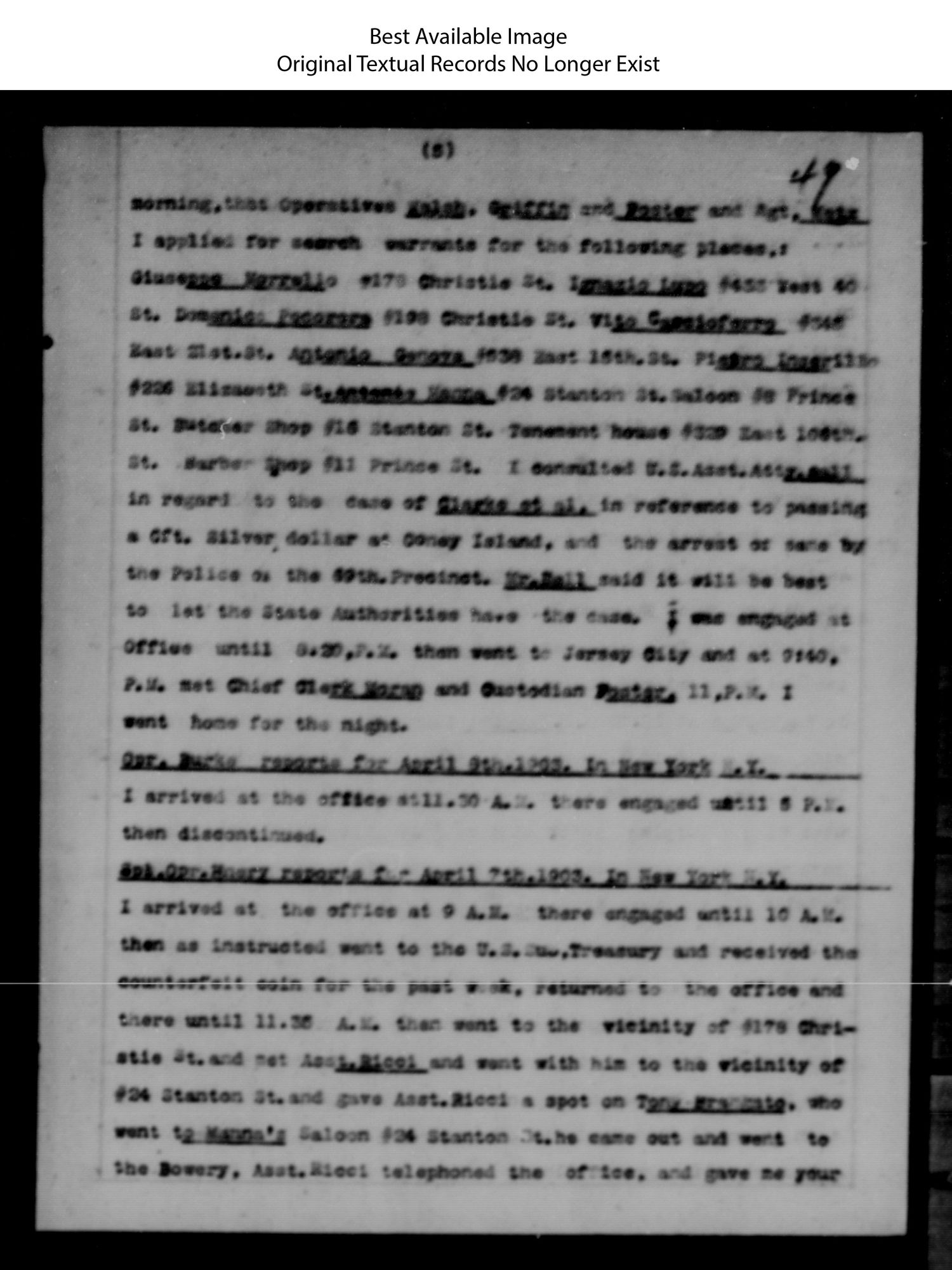 itemSecret Service daily report, New York District, about 8-9 April 1903: search warrants and the watch on Morrello and Lupo (T915 roll 109, pages 47-49)Typed pages of the U.S. Secret Service New York District daily report from the week before the barrel killing: an application for search warrants for premises including those of 'Giuseppe Morrello' and 'Ignazio Lupo', and operatives' surveillance in a counterfeiting inquiry.
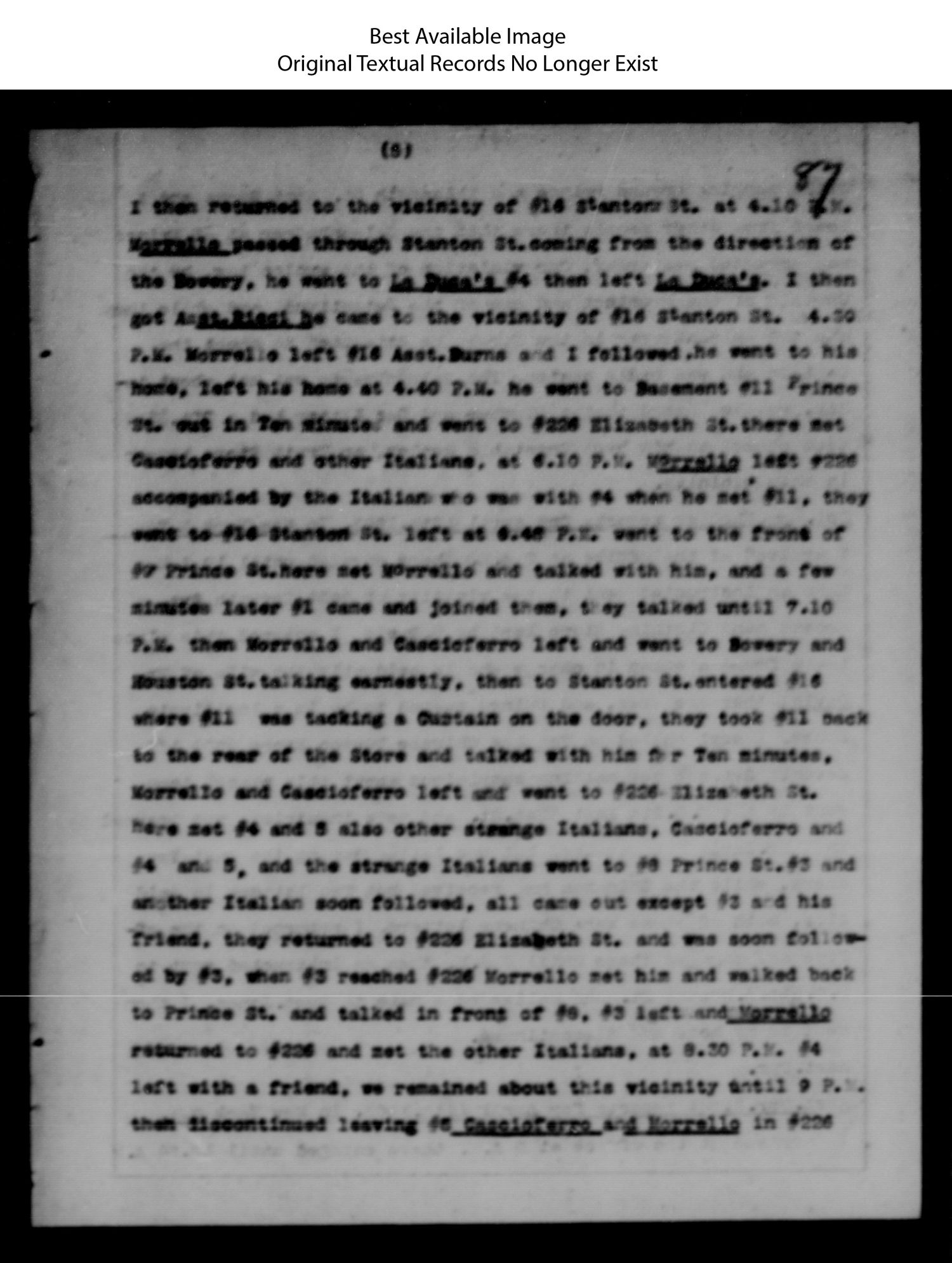 itemSecret Service daily reports, New York District, 13 April 1903: the watch on Morrello at Stanton Street and Elizabeth Street (T915 roll 109, pages 85-89)Operatives' reports for 13 April 1903, the day before the barrel was found: agents followed 'Morrello' to La Duca's butcher shop at 16 Stanton Street and to Elizabeth Street, where he met 'Cascioferro' and other men.
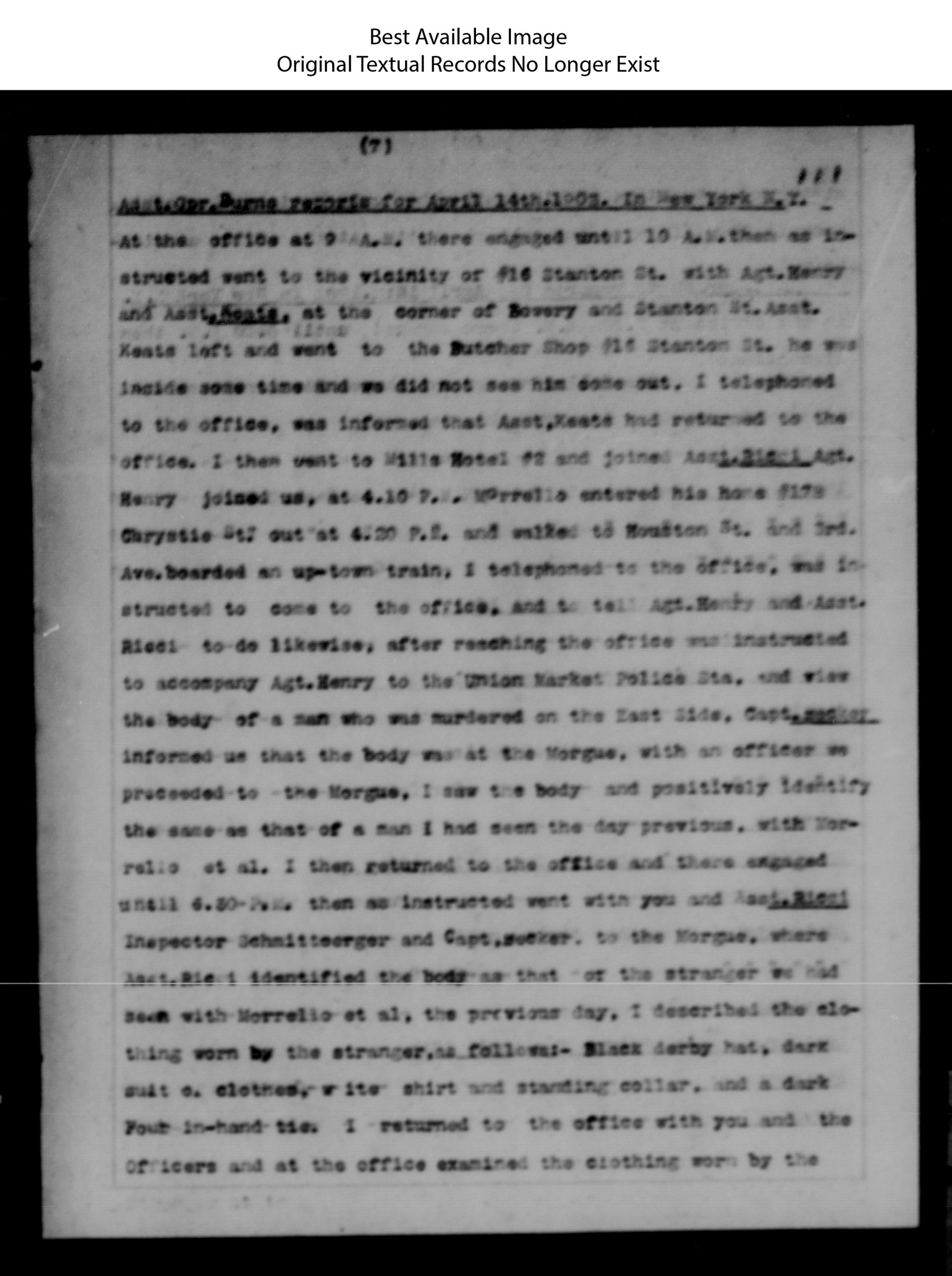 itemSecret Service daily reports, New York District, 14-17 April 1903: the body identified, the arrests, and a telegram about a letter to New Orleans (T915 roll 109, pages 103-111)Secret Service reports received on 17 April 1903: an operative's identification of the body at the Morgue as a man seen 'with Morrello et al.' the day before, the arrests of 15 April, a telegram to Chief Wilkie about a letter that 'indicated that murder was to be done', and the list of suspects.clippingNew-York Tribune, 16 April 1903, page 1: eight arrested in the barrel caseThe New-York Tribune front page of 16 April 1903 reports the arrest of eight men by police and Secret Service agents on suspicion of counterfeiting and of the killing of the man found in a barrel two days earlier, and names Giuseppe Morello among them.clippingThe Sun (New York), 16 April 1903, page 2: how Morello and Petto were arrestedPage 2 of the Sun of 16 April 1903 carries a long account of the barrel-murder inquiry, crediting Secret Service Chief Flynn, Inspector McClusky and Detective Sergeant Petrosino, and describing the arrest of Morello and Petto at the Bowery and Delancey Street.
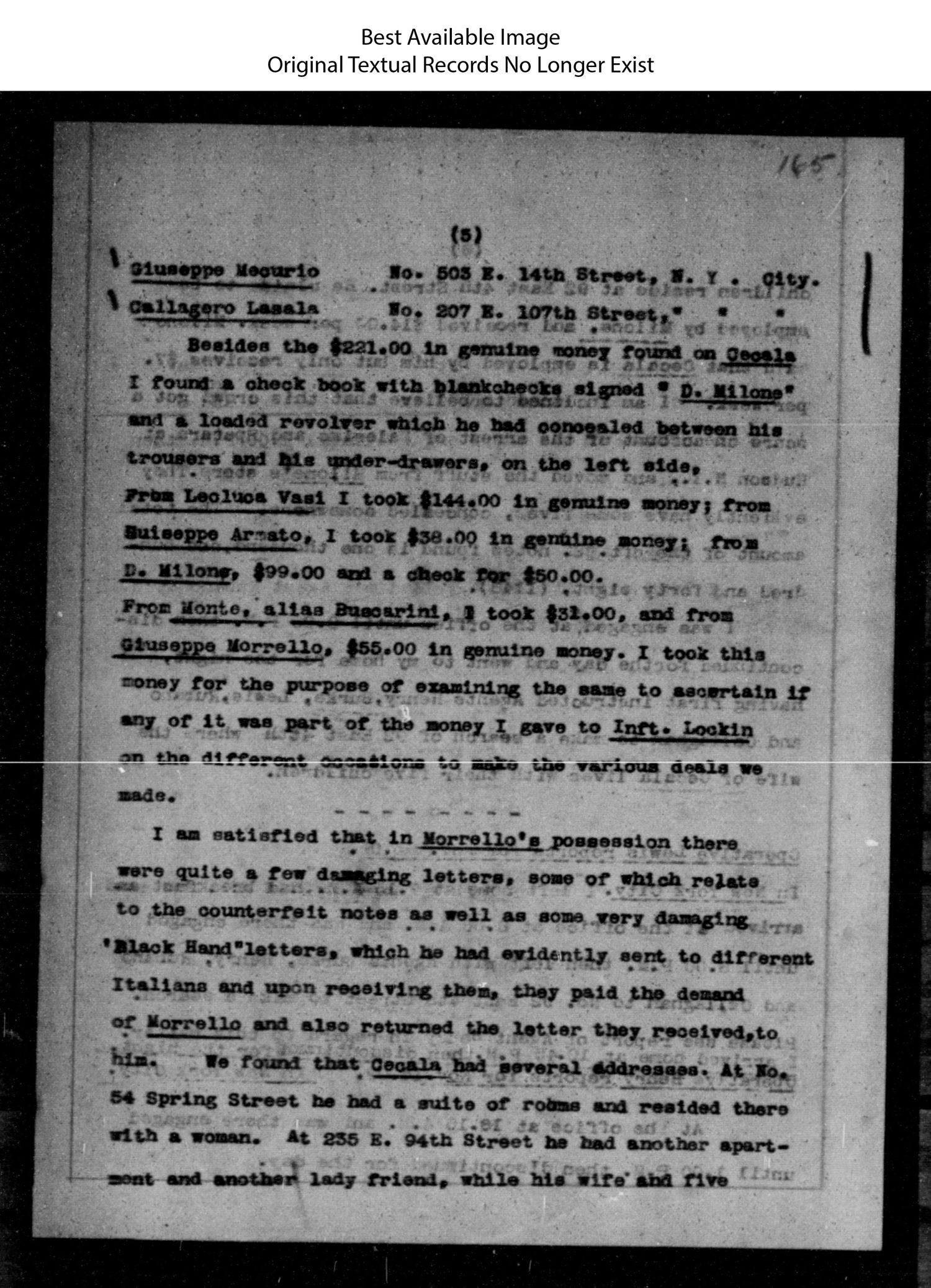 itemSecret Service daily report, New York District, 15 November 1909: search warrants on 'Morrello et al.' with the Italian Squad (T915 roll 116, pages 162-173)The New York District's report of the day Secret Service agents, helped by ten members of the New York police Italian Squad, executed search warrants against 'Morrello et al.' in a counterfeiting case. An agent wrote that he was 'satisfied' Morrello held 'very damaging "Black Hand" letters'; that is the agent's belief, not a finding.clippingNew-York Tribune, 28 January 1910, page 8: counterfeiting witness testifies to a death threatThe New-York Tribune of 28 January 1910 reports the testimony of Antonio Comito, the government's principal witness at the federal counterfeiting trial of eight men, that he printed counterfeit notes at a farm near Highland, N.Y., and that Morello and Lupo threatened him.clippingNew-York Tribune, 19 February 1910, page 4: counterfeiting case goes to the juryA short New-York Tribune report of 19 February 1910 that the case of the eight men charged with counterfeiting, among them Ignazio Lupo and Giuseppi Morello, 'alleged leader of the band', would go to the jury after Judge Ray's charge.
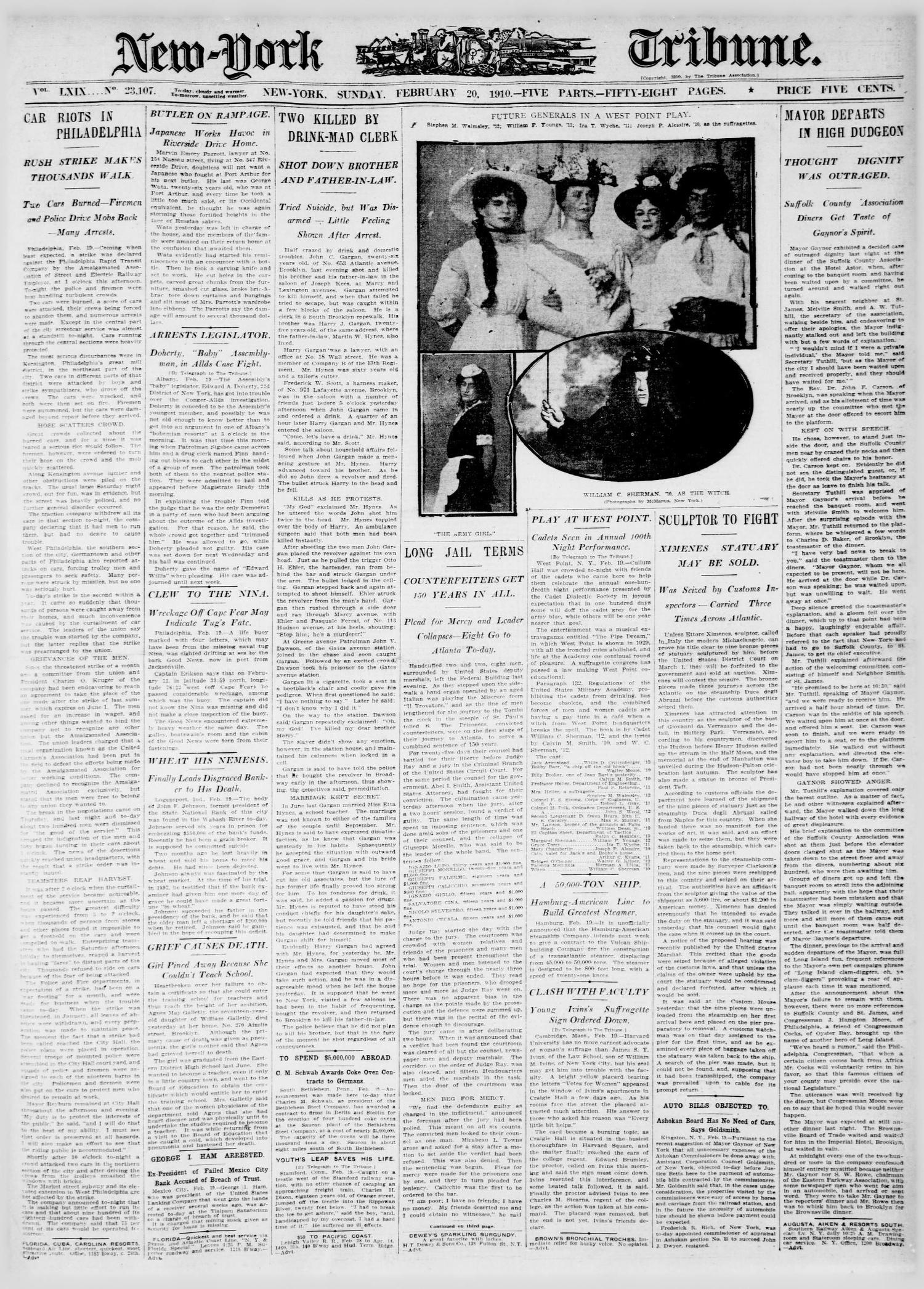 clippingNew-York Tribune, 20 February 1910, page 1: long jail terms for eight counterfeitersThe New-York Tribune front page of 20 February 1910 reports that eight men were convicted of counterfeiting after a trial of twenty-five days and sentenced the same afternoon, Lupo to thirty years and Morello to twenty-five. A scan is stored here.clippingNew-York Tribune, 20 February 1910, page 3: sentencing story continued, with press speculationPage 3 of the New-York Tribune of 20 February 1910 continues the counterfeiting sentencing story under portraits captioned 'Italians sentenced for counterfeiting', and repeats detectives' unproven suspicions about the barrel killing and the Petrosino killing. Flagged as speculation.clippingThe Sun (New York), 20 February 1910, page 1: Lupo to prison for 30 yearsThe Sun's front page of 20 February 1910 reports that eight men were found guilty on all six counts of counterfeiting and sentenced, Lupo to thirty years and Morello to twenty-five, and quotes Judge Ray on the verdict.itemCalicchio v. United States, 189 F. 305 (2d Cir. 1911)Second Circuit opinion of 19 June 1911 affirming the 1910 counterfeiting convictions of Giuseppe Calicchio, Giuseppe Morello, Ignatzio Lupo and five others. It holds a question about Morello's 1903 arrest in the 'Barrel Murder' improper but cured, and says: 'The arrest of Morelio for the murder proved nothing.'