Raymond Patriarca
The subject of 1968 and 1979 First Circuit opinions about his conviction for conspiring to use interstate facilities to commit murder to further an unlawful gambling enterprise, and about FBI surveillance of his Providence office. An FBI airtel of 1961 lists him at Boston among selected "hoodlums." No opened record ties him to Las Vegas.
- Aliases
- Raymond L. S. Patriarca
- Rights
- Biography on this page is limited to what the cited federal records state.
On the record
- 11 February 1959 — The record of the Senate Permanent Subcommittee's hearing of October 15, 1963 states that he "appeared before the Senate Select Committee on Improper Activities in the Labor-Management Field on February 11, 1959"; a staff summary of that testimony was filed as Exhibit 55 and is not printed.
- 1961 — An FBI airtel of July 1961 under the Criminal Intelligence Program lists "Boston Raymond L. S. Patriarca" among ten additional "hoodlums" selected for "concentrated all-out investigative attention," as far as the OCR can be read.
- 1962 — Providence Journal Co. v. FBI, 602 F.2d 1010 (1st Cir. 1979): "Between March of 1962 and July of 1965 defendant-appellant, the Federal Bureau of Investigation (FBI), conducted electronic surveillance of Raymond Patriarca's business office," which the court says violated the Fourth Amendment.
- 6 March 1962 — Limone v. United States, 497 F. Supp. 2d 143 (D. Mass. 2007): "On March 6, 1962, the FBI installed electronic surveillance without a warrant at Patriarca's office in Providence, Rhode Island." House Report 108-414 (2004) quotes a 1967 Justice Department memorandum placing the device "at his place of business, 168 Atwells Avenue, Providence, Rhode Island, during the period March 6, 1962 to July 12, 1965."
- 2 October 1963 — Joseph Valachi told the Senate Permanent Subcommittee on Investigations that Patriarca was introduced to him as a member of the Cosa Nostra: "Yes, 100 percent." Testimony, not a finding.
- 8–9 October 1963 — Valachi testified that he met Patriarca "around 1939 or 1940," that he "heard about Raymond being the new boss in Boston. I heard that in prison," and that he met him "as a soldier." Hearsay testimony, not a finding.
- 15 October 1963 — Colonel Walter E. Stone of the Rhode Island State Police testified that "Raymond L. Patriarca was born on March 17, 1908, in Worcester, Mass.," and that "The FBI record ... shows five convictions." Boston Police testimony the same day called him "the so-called boss of the rackets in the Greater Boston area," while saying the police were "not cognizant" that the men discussed were members of the Mafia or Cosa Nostra. Police testimony, not findings.
- 14 October 1968 — Patriarca v. United States, 402 F.2d 314 (1st Cir. 1968), affirms convictions for conspiracy "to travel and use the telephone in interstate commerce with intent both to commit murder to further an unlawful gambling enterprise." The appellants' brief, quoted by the court, said the Senate's 1963 Valachi hearings "named the defendant Patriarca as 'Boss' of the New England 'Cosa Nostra' or 'Mafia.'"
- July 1984 — United States v. Patriarca, 948 F.2d 789 (1st Cir. 1991): the Government's position, as the court summarizes it, was that his son "assumed leadership of the Patriarca Family following the death of his father in July 1984."
- 1999 — United States v. Salemme, 91 F. Supp. 2d 141 (D. Mass. 1999): "Barboza's testimony led to the convictions of Patriarca and several of his associates."
This page is for Raymond L. S. Patriarca, the father, who died in July 1984 according to the Government’s account in a 1991 opinion about his son. The son, Raymond J. Patriarca, is the subject of that opinion. Neither is linked to Las Vegas in any record opened for this page. The word “Boss” appears only in the defendants’ own brief, as the First Circuit quotes it, and in the Government’s contentions about the son. No finding about the father’s rank is quoted here, so no family or rank is given.
Records
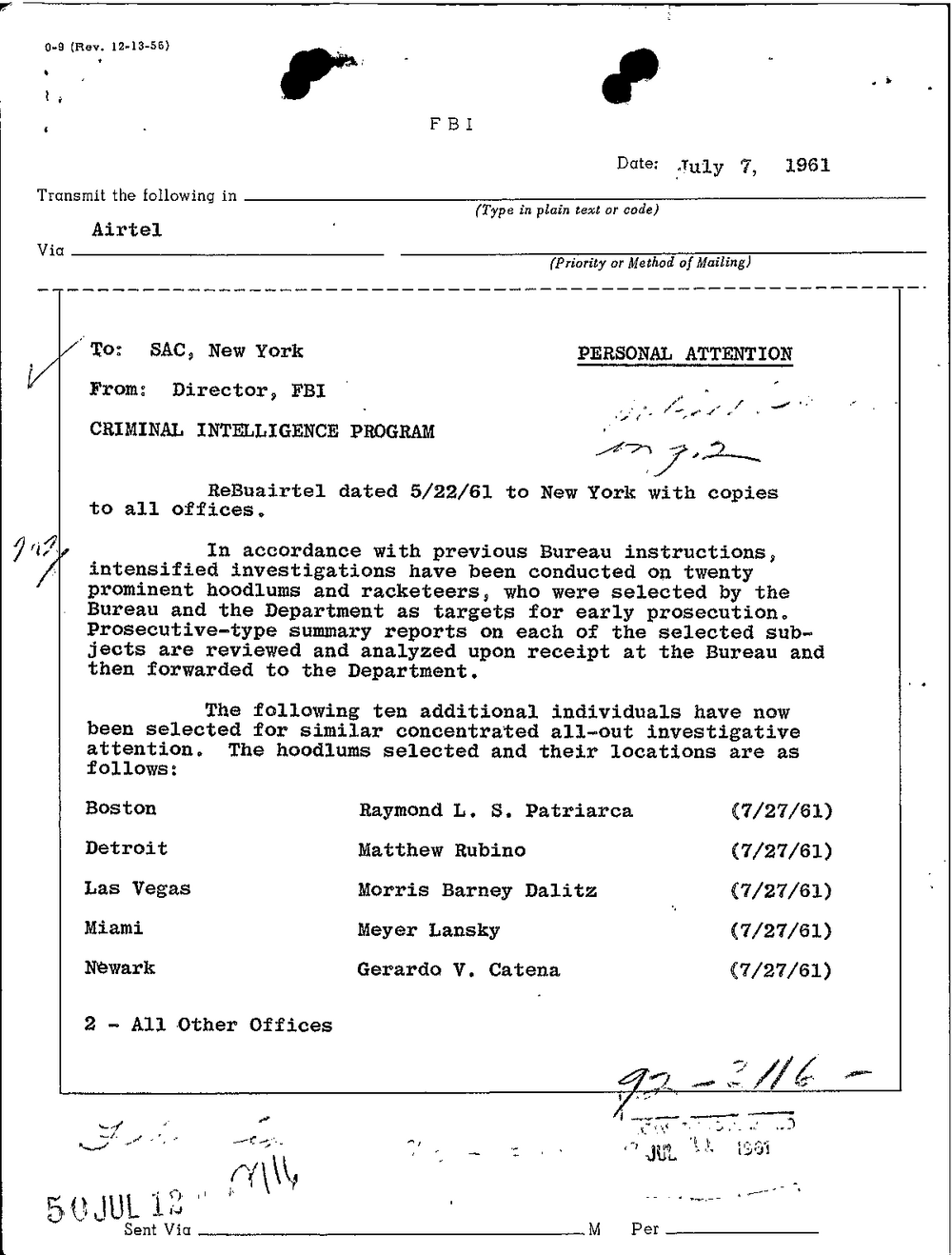 itemFBI Director's airtel of July 1961 listing hoodlums selected under the Criminal Intelligence ProgramAn FBI Director's airtel of July 1961, filed in the Vault's Balistrieri file, selecting ten more "hoodlums" for "concentrated all-out investigative attention," listed by city: among them Raymond L. S. Patriarca at Boston, Morris Barney Dalitz at Las Vegas, Meyer Lansky at Miami and Gerardo V. Catena at Newark.itemValachi hearing, October 2, 1963: Valachi questioned on Raymond PatriarcaJoseph Valachi told the Senate Permanent Subcommittee on Investigations that he met Raymond Patriarca through horse racing in New England and that Patriarca was introduced to him as a member of the Cosa Nostra. Testimony, not a finding.itemValachi hearing, October 8, 1963: Valachi on Patriarca and the Boston bossesJoseph Valachi testified that he met Raymond Patriarca around 1939 or 1940, that Patriarca was a member, and that he heard in prison that Patriarca had become the boss in Boston after Joe Bruno and Phil Buccola. Testimony, not a finding.itemValachi hearing, October 9, 1963: "the Raymond family"Asked by Senator McIntyre about the Boston area, Joseph Valachi named Phil Buccola as the boss he had met, said he met Patriarca "as a soldier," and said he understood Patriarca was the boss now: "That is what I heard." Testimony, not a finding.itemHearing, October 15, 1963: Rhode Island State Police testimony on Raymond L. PatriarcaColonel Walter E. Stone, superintendent of the Rhode Island State Police, read a statement on Raymond L. Patriarca to the Senate subcommittee, entered the Rhode Island half of the Exhibit 53 chart, and the record notes Patriarca's 1959 appearance before the McClellan committee.itemHearing, October 15, 1963: Boston Police testimony on the Boston half of Exhibit 53Boston Police Commissioner Edmund L. McNamara and Deputy Superintendent John T. Howland walked the Senate subcommittee through the Boston half of the Exhibit 53 chart, while saying they were not cognizant that the men were members of the Mafia or Cosa Nostra.itemLimone v. United States, 497 F. Supp. 2d 143 (D. Mass. 2007)Judge Gertner's findings of July 26, 2007, after a bench trial, that the 1968 convictions for the 1965 Deegan murder rested on Joseph Barboza's perjured testimony and that the FBI was liable under the Federal Tort Claims Act.itemUnited States v. Taglianetti, 274 F. Supp. 220 (D.R.I. 1967)District court opinion of October 4, 1967 on the FBI's 1962 to 1965 microphone, installed by trespass, at 168 Atwells Avenue, Providence, and whether it tainted a tax-evasion conviction.itemEverything Secret Degenerates: The FBI's Use of Murderers as Informants, H. Rept. 108-414, vol. 1 (2004)Report of the House Committee on Government Reform on the FBI's use of Joseph Barboza, the Flemmi brothers and James Bulger as informants in Boston, with a long chronology. It quotes a 1967 Justice Department memorandum on the microphone at Raymond Patriarca's Providence office.itemUnited States v. Salemme, 91 F. Supp. 2d 141 (D. Mass. 1999)Judge Wolf's memorandum of September 15, 1999 setting out, after long hearings, the FBI's relationship with informants Stephen Flemmi and James Bulger, the 1981 bugging of 98 Prince Street and the 1989 Medford recording. Reversed in part in 2000.