Record
Hearing
1963-10-15
National Criminal Justice Reference Service, scan of the printed hearings (NCJ 119303)
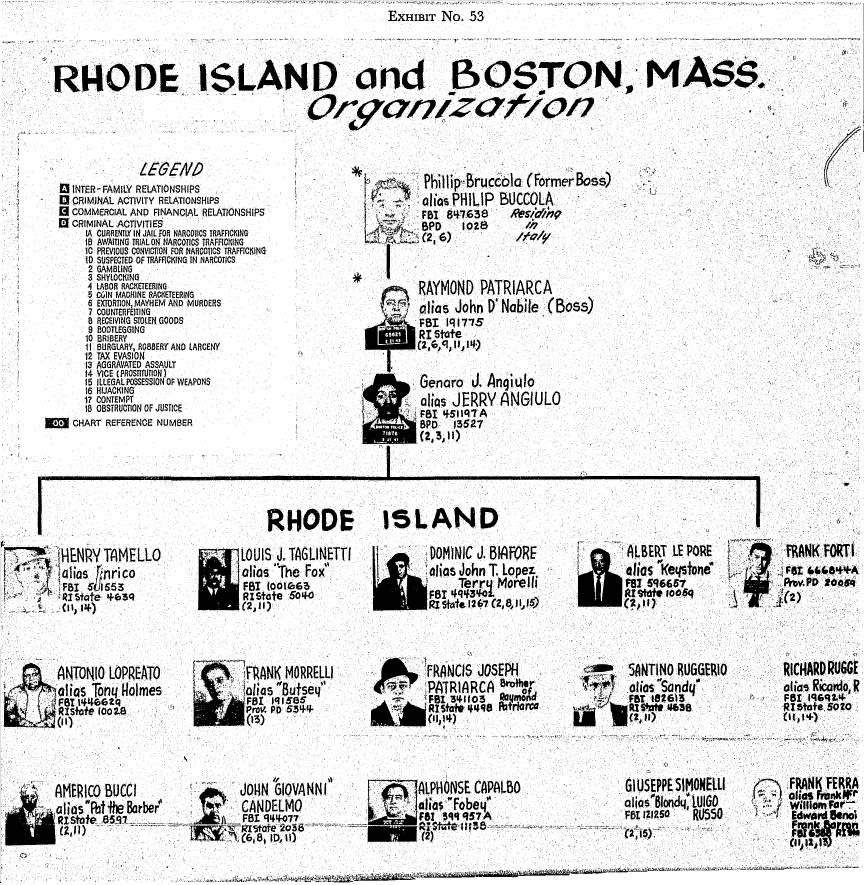
Hearing, October 15, 1963: Boston Police testimony on the Boston half of Exhibit 53
Boston Police Commissioner Edmund L. McNamara and Deputy Superintendent John T. Howland walked the Senate subcommittee through the Boston half of the Exhibit 53 chart, while saying they were not cognizant that the men were members of the Mafia or Cosa Nostra.
- Date
- 1963-10-15
- Kind
- hearing
- Retrieved
- 2026-10-12
- Docket
- Organized Crime and Illicit Traffic in Narcotics: Hearings before the Permanent Subcommittee on Investigations of the Committee on Government Operations, United States Senate, 88th Cong., 1st sess., Part 2
- Rights
- A work of the United States Senate, printed by the Government Printing Office. Public domain in the United States. 17 U.S.C. § 105. The NCJRS cover sheet records reproduction permission as "Public Domain / U.S. Senate."
Session of October 15, 1963, printed pages 564 to 574 of Part 2. Commissioner Edmund L. McNamara read a statement that included this caution: “We are not cognizant of the fact that the personalities we intend to discuss are, in fact, members of the Mafia or the Cosa Nostra, but we do recognize the fact that these persons are apparently responsible and pay tribute to one individual who may be termed as the ‘Boss’ in the New England area.”
Deputy Superintendent John T. Howland said the Boston intelligence division confirmed “that the so-called boss of the rackets in the Greater Boston area is one, Raymond Patriarca, of Providence, R.I.” Turning to the Boston half of Exhibit 53, he described older figures as semiretired and said of Philip Buccola: “We believe that he was headman prior to Patriarca in the organization.”
Of Gennaro “Jerry” Angiulo he said: “The oldest of six brothers who are all involved in controlling the largest single gaming operation within and without the city of Boston,” and “Jerry is in constant contact with Raymond Patriarca through Henry Tamello and when Patriarca visits Boston.” He named others on the chart, among them Peter Limone, who was later convicted in the Deegan case; that conviction was vacated, and a federal court found it rested on perjured testimony (Limone v. United States).
This is police intelligence offered as testimony in 1963. The witnesses themselves said they could not say the men were members. None of it is a finding.