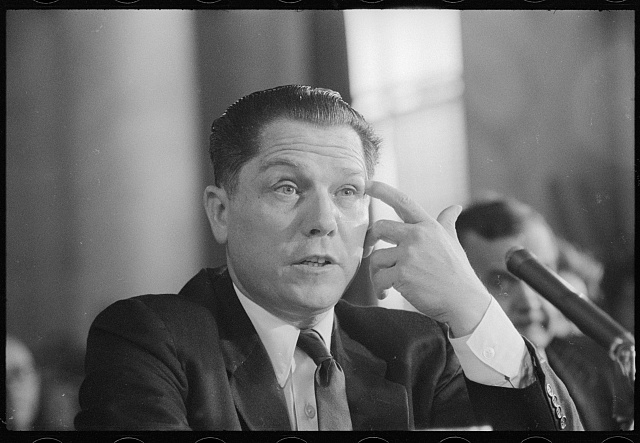
James R. Hoffa
Teamsters president. Convicted in 1964 of jury tampering in Tennessee and of defrauding the Teamsters Pension Fund in Illinois; President Nixon commuted his sentence in December 1971 on condition that he not manage a union before 1980. The FBI took jurisdiction after his disappearance on 30 July 1975 and says the investigation remains active.
- Aliases
- James Riddle Hoffa, Jimmy Hoffa
- Role
- President of the Teamsters International Union, president of Local 299 in Detroit and a trustee of the Teamsters Pension Fund, as "the indictment charged and the proof showed" (court record: Seventh Circuit, 1966)
- Rights
- Biography on this page is limited to what the cited federal records state. Each event names its record and the kind of statement it is. The aliases are the forms used in the 1971 Executive Grant of Clemency and in Library of Congress photograph titles.
On the record
- June 1953 — Congressional finding. The House joint subcommittee report on racketeering in the Detroit area (1954) lists him as "president of teamsters union, local No. 299; president of teamsters joint council 43," finds that William E. Bufalino of Local 985 "could not have succeeded" in controlling the jukebox and vending business "without the cognizance and approval of Hoffa," and records that Hoffa refused three questions.
- 20 August 1957 — His own testimony. Sworn before the Senate select committee, he said: "My name is James R. Hoffa. I am a business representative and a vice president of the International Brotherhood of Teamsters" (Hearings, Part 13, p. 4927).
- 24 March 1958 — Congressional finding. The committee's interim report (S. Rept. 85-1417) finds that he "repeatedly betrayed the members of his own union" and calls him "a dangerous influence in the labor movement."
- 5 August 1958 — Committee chairman's statement. Opening Part 36 of the hearings, Senator McClellan called him "general president of this labor organization," elected at a convention in Miami, and recalled the interim report's finding that he had "alined himself with certain underworld characters."
- 28 March 1960 — Congressional finding. Part 3 of the committee's final report (S. Rept. 86-1139) quotes its second interim report: "Time and time again the committee has found Hoffa to be faithless to the members of his own union."
- Autumn 1962 — Court record. The Supreme Court records that he was tried in a federal court in Nashville on a Taft-Hartley Act charge, the Test Fleet case (Hoffa v. United States, 385 U.S. 293).
- 4 and 12 March 1964 — Court record. Convicted at Chattanooga on two counts of endeavoring to influence jurors in the Nashville trial and sentenced to four years on each count, consecutively, with a $5,000 fine on each (United States v. Hoffa, 349 F.2d 20; dates from Hoffa v. Saxbe).
- August 1964 — Court record. Convicted in the Northern District of Illinois of mail and wire fraud and conspiracy in a scheme to defraud the Teamsters Pension Fund, and sentenced to five years on each count, consecutive to the Tennessee term (Hoffa v. Saxbe). The Seventh Circuit affirmed on 4 October 1966 (367 F.2d 698).
- 12 December 1966 — Court record. The Supreme Court affirmed the jury-tampering convictions (385 U.S. 293).
- 7 March 1967 — Court record. "On March 7, 1967, plaintiff entered the Federal Penitentiary at Lewisburg, Pennsylvania," to serve thirteen years (Hoffa v. Saxbe, 378 F. Supp. 1221).
- 23 December 1971 — Executive act. President Nixon's Executive Grant of Clemency commuted his sentence to six and one-half years "upon the condition that the said James R. Hoffa not engage in direct or indirect management of any labor organization prior to March sixth, 1980" (National Archives, NAID 258225384). Hoffa v. Saxbe records his release the same day.
- 19 July 1974 — Court record. The district court held that the condition "was within the President's pardoning power" (Hoffa v. Saxbe).
- 3 August 1975 — FBI statement. An FBI release in the Vault file announces that, after "Hoffa's disappearance on Wednesday, July 30, 1975," extortionate communications had been received and the FBI was "assuming investigative jurisdiction under the Federal Extortion Statutes."
- 18 November 1975 — Senate resolution. S. Res. 302 (94th Congress), in a Ford White House counsel's folder at the National Archives, proposed a select committee to study, among other matters, "the disappearance of James R. Hoffa."
- March 1986 — Commission characterization. The President's Commission on Organized Crime (The Edge) states that he "was convicted of jury tampering in 1964 and disappeared (presumably murdered by organized crime) in 1975," and that "Hoffa and Williams were indisputably direct instruments of organized crime." These are the Commission's words, not a court's.
- 31 July 2025 — FBI statement. FBI Detroit: "The Hoffa investigation remains active." The release names no suspect.
The role line is taken from a court opinion. No federal record filed here gives his date of birth or a date of death, and no record places him in a crime family. The congressional findings and the Commission’s characterizations on this page are labelled as such and are not court findings. Newspaper clippings in the FBI file that name suspects in his disappearance are not used.
Records
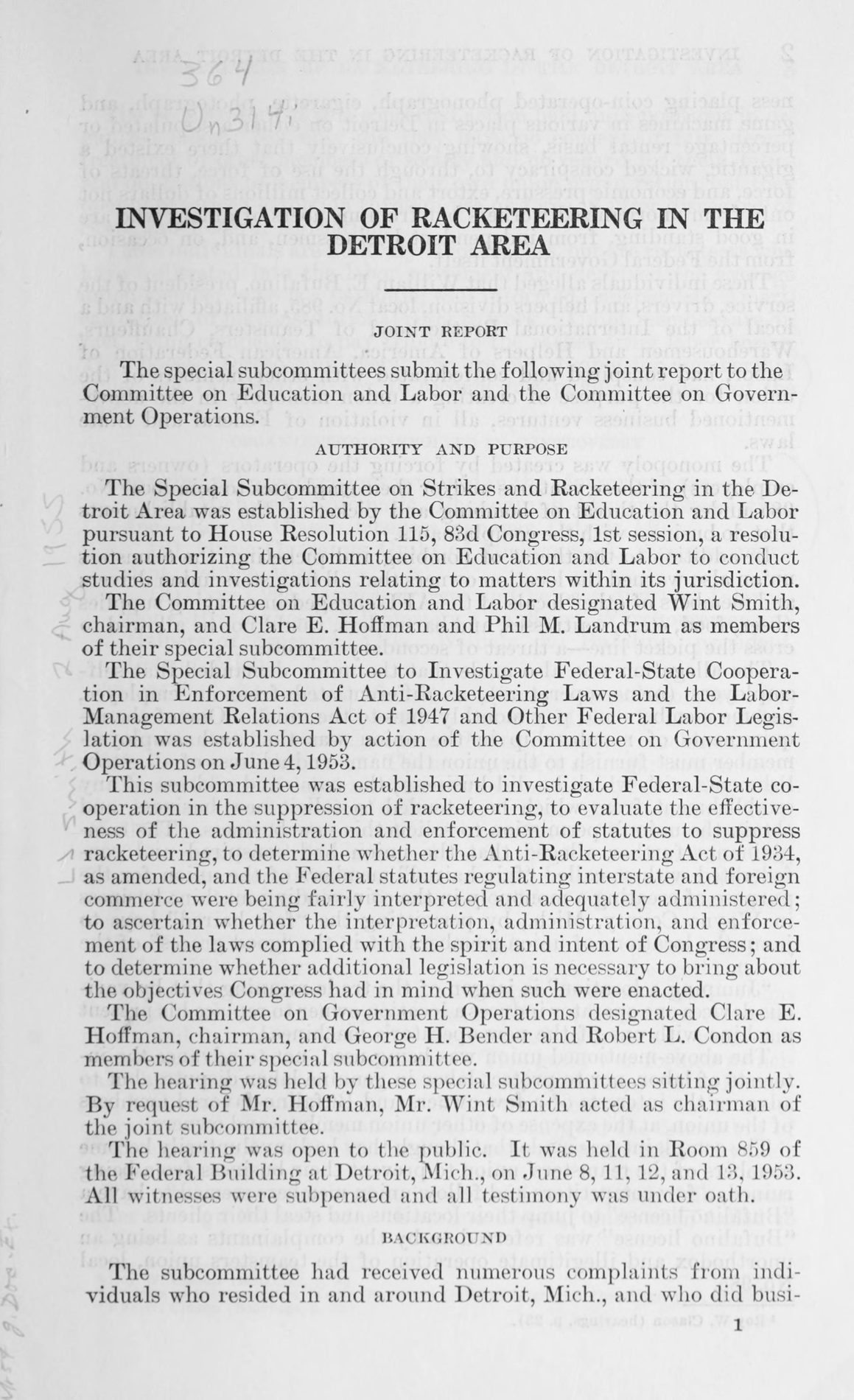 itemInvestigation of Racketeering in the Detroit Area: House joint subcommittee report (1954)Report of two House special subcommittees on their June 1953 hearings in Detroit. It found that Teamsters Local 985 used picketing and threats to build a monopoly in jukebox and vending locations, and that James R. Hoffa refused three questions.
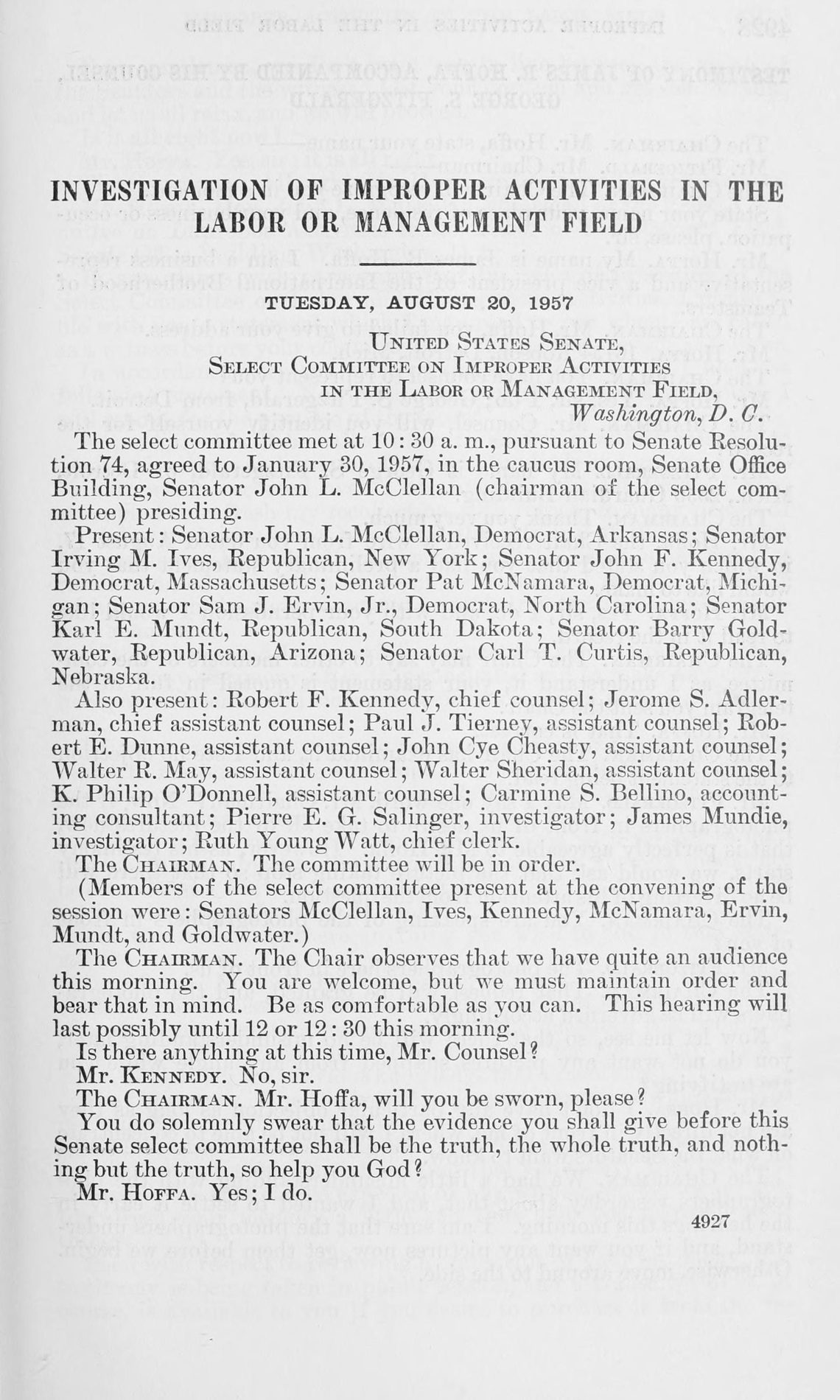 itemMcClellan Committee hearings, Part 13: James R. Hoffa's first testimony (20 to 23 August 1957)The hearing at which James R. Hoffa first testified before the select committee. Sworn on 20 August 1957, he identified himself as "a business representative and a vice president of the International Brotherhood of Teamsters."itemJames R. Hoffa at the witness table of the Senate rackets committee, 20 August 1957 (Library of Congress)Warren K. Leffler's U.S. News & World Report photograph of James R. Hoffa testifying before the McClellan Committee, dated 20 August 1957 in the log book. A copy is stored here.
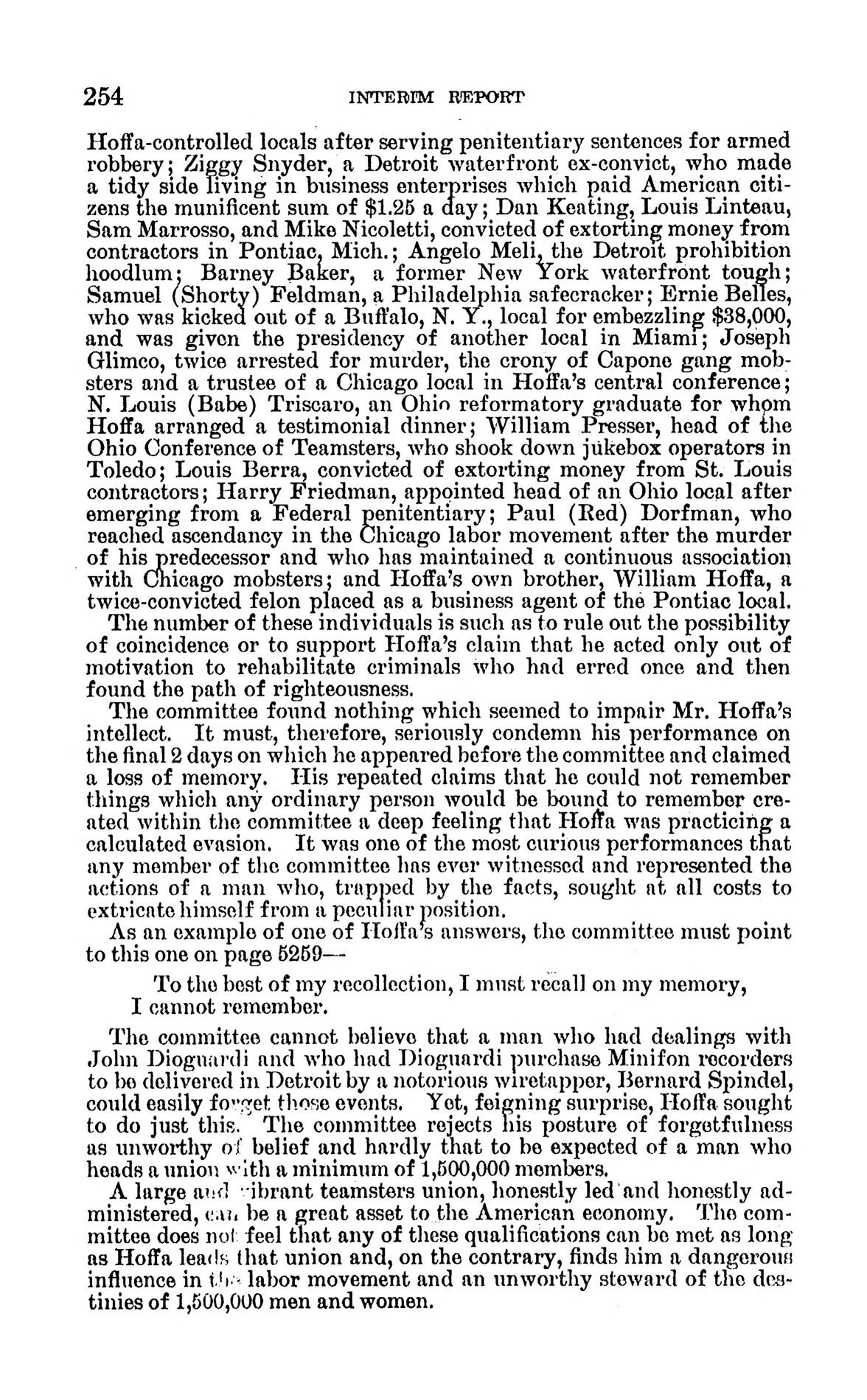 itemInterim Report of the McClellan Committee, S. Rept. 85-1417 (March 1958)The select committee's report on its first year, ordered printed 24 March 1958. It finds that Dave Beck "took, not borrowed, more than $370,000 in union funds" and that James R. Hoffa "repeatedly betrayed the members of his own union."
 itemMcClellan Committee hearings, Part 36: Hoffa recalled as general president (5 to 12 August 1958)The committee resumed its inquiry into the Teamsters under James R. Hoffa, by then general president. The chairman's opening statement recalls the interim report's finding that Hoffa had "alined himself with certain underworld characters."itemFinal Report of the McClellan Committee, Part 3, S. Rept. 86-1139 (March 1960): the criminal syndicate, and HoffaPart 3 of the committee's final report, ordered printed 28 March 1960. It finds that "underworld infiltration of business and labor is a national problem" and restates its findings on James R. Hoffa, adding that it had found him "faithless to the members of his own union."
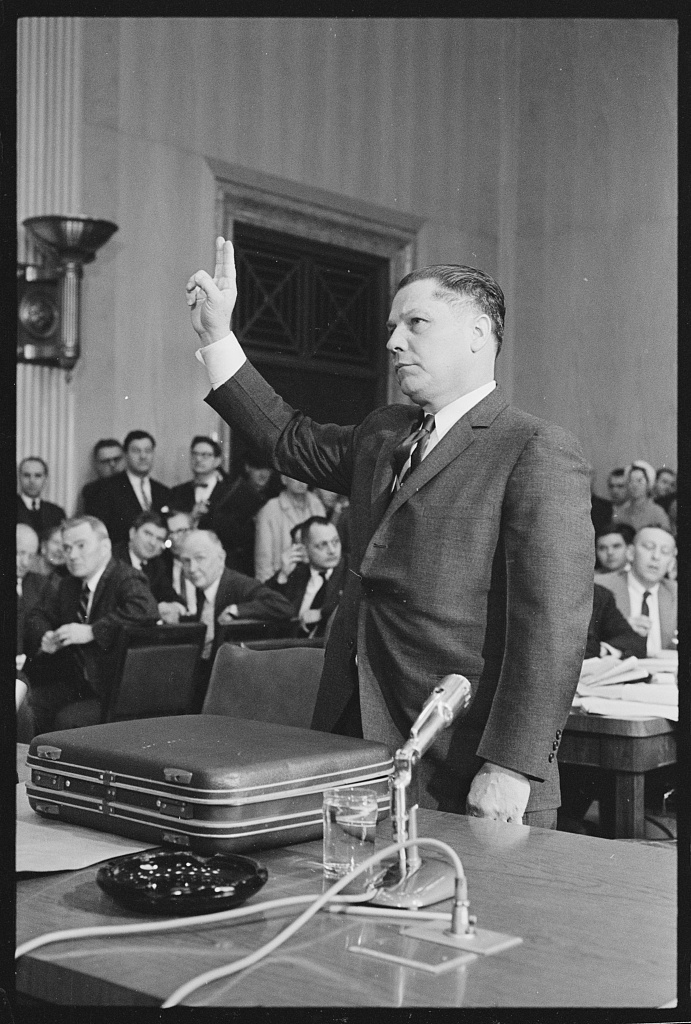 itemJimmy Hoffa before the McClellan Committee, right hand raised, 24 January 1961 (Library of Congress)U.S. News & World Report photograph by John T. Bledsoe of Teamster President James "Jimmy" Hoffa standing with his right hand raised before the Senate Select Committee on Improper Activities in Labor and Management, 24 January 1961. A copy is stored here.
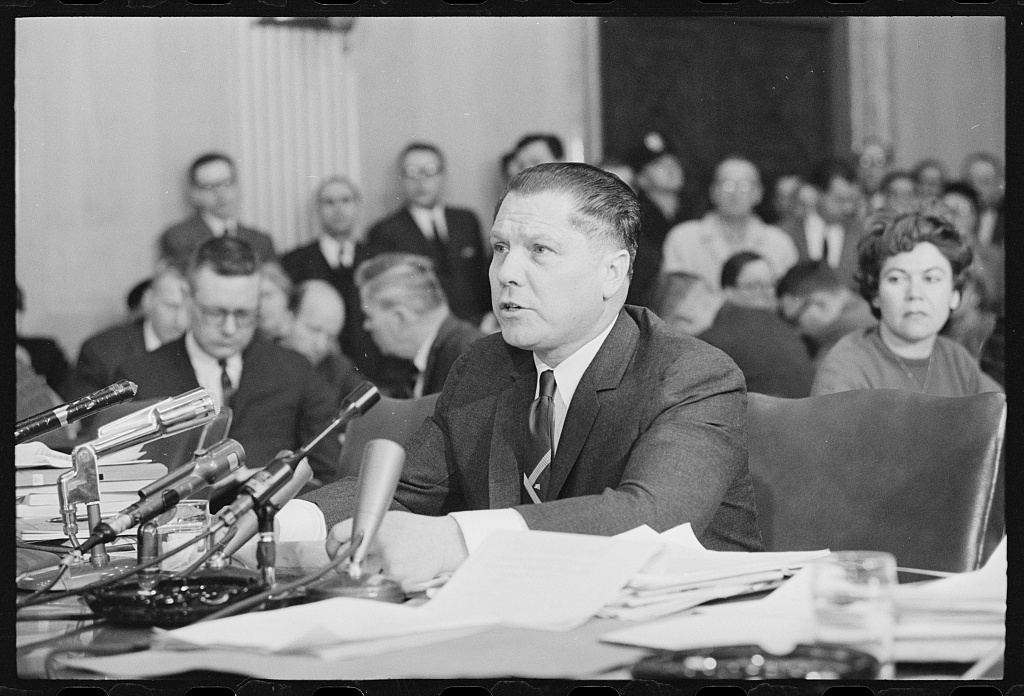 itemJimmy Hoffa testifying before the McClellan Committee, 24 January 1961 (Library of Congress)U.S. News & World Report photograph by John T. Bledsoe of Teamster President James "Jimmy" Hoffa testifying before the Senate Select Committee on Improper Activities in Labor and Management, 24 January 1961. A copy is stored here.
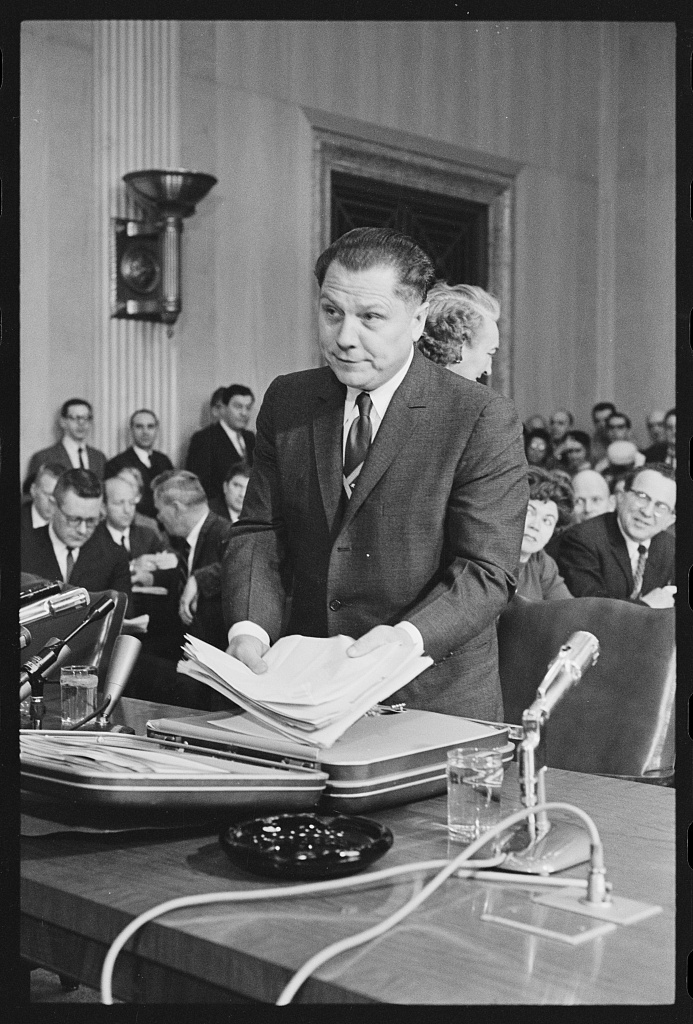 itemJames R. Hoffa holding a stack of papers before the Select Committee, 24 January 1961 (Library of Congress)U.S. News & World Report photograph by John T. Bledsoe of Teamsters president James R. Hoffa holding a stack of papers while appearing before the Select Committee, 24 January 1961. A copy is stored here.
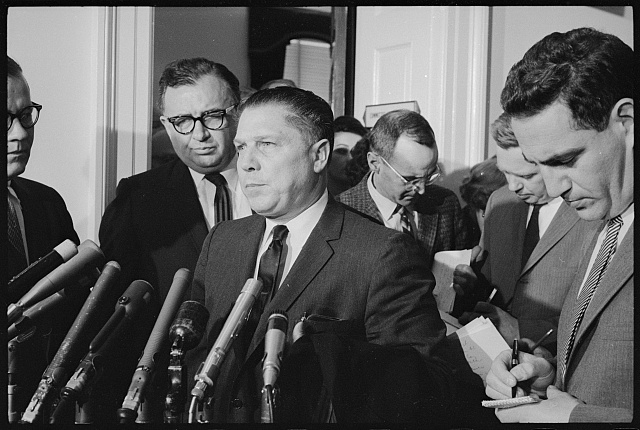 itemJimmy Hoffa speaking to reporters after a congressional hearing, 1 February 1963 (Library of Congress)Marion S. Trikosko's U.S. News & World Report photograph of Teamster president Jimmy Hoffa at a bank of microphones, interviewed by reporters after testifying at a congressional hearing on 1 February 1963. A copy is stored here.itemUnited States v. Hoffa, 349 F.2d 20 (6th Cir. 1965)The Sixth Circuit affirmed the Chattanooga convictions of James R. Hoffa and three others for endeavoring to influence jurors in the 1962 Test Fleet trial. Hoffa was sentenced to four years and a $5,000 fine on each of two counts, consecutively.itemUnited States v. Hoffa, 367 F.2d 698 (7th Cir. 1966)The Seventh Circuit affirmed the convictions of James R. Hoffa and six others for mail and wire fraud and conspiracy to defraud the Teamsters Central States, Southeast and Southwest Areas Pension Fund.itemHoffa v. United States, 385 U.S. 293 (1966)The Supreme Court upheld the 1964 jury-tampering convictions of James Hoffa and three others, holding that the Government's use of Edward Partin, who reported Hoffa's statements during the 1962 Nashville trial, did not violate the Fourth, Fifth or Sixth Amendments.
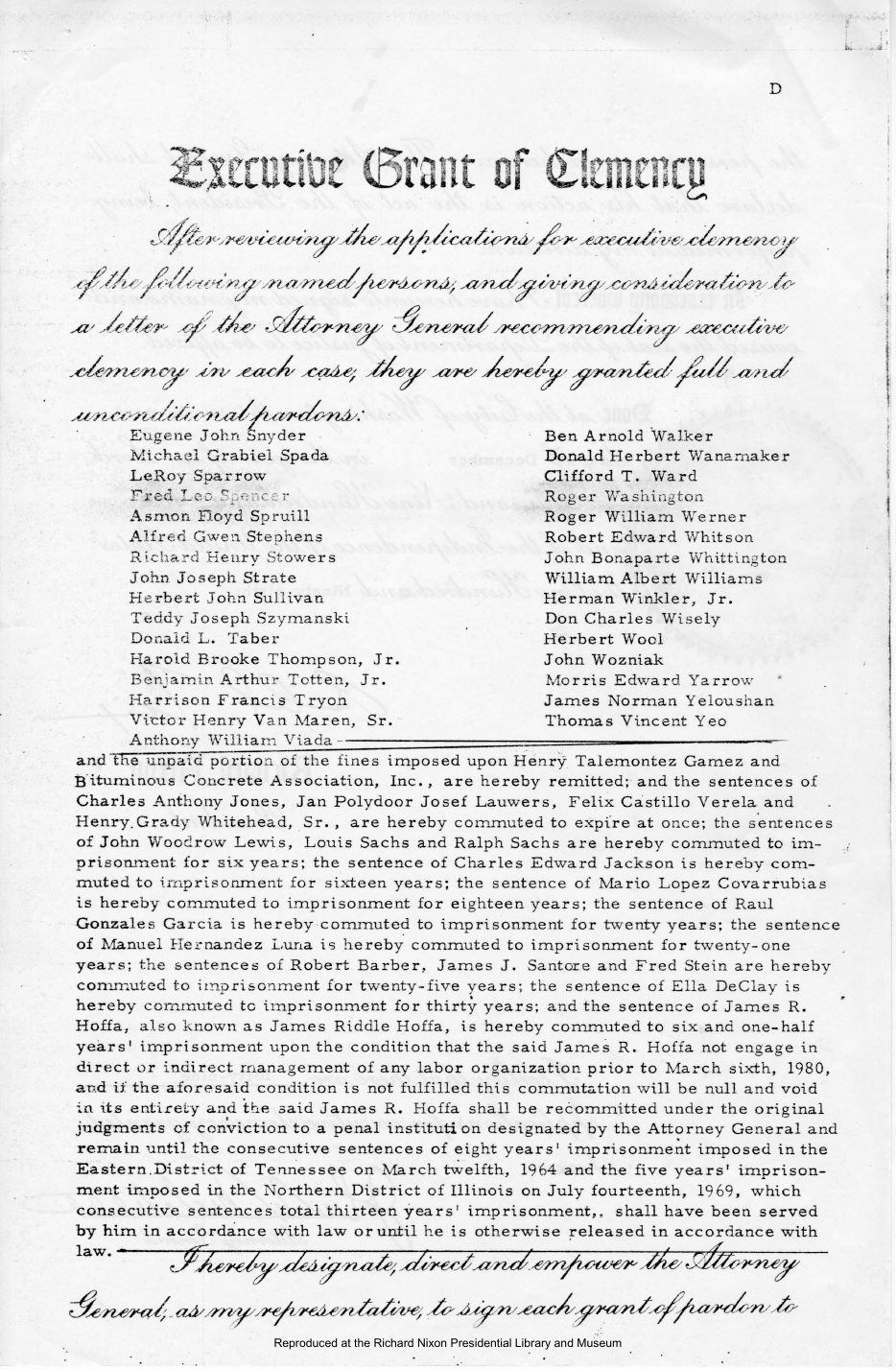 itemExecutive Grant of Clemency commuting James R. Hoffa's sentence, 23 December 1971 (National Archives)President Nixon's Executive Grant of Clemency of 23 December 1971, filed in a Nixon White House staff folder, commuted James R. Hoffa's sentence to six and one-half years on condition that he not manage any labor organization before 6 March 1980.itemHoffa v. Saxbe, 378 F. Supp. 1221 (D.D.C. 1974)The district court rejected James R. Hoffa's suit against the condition in his 1971 commutation, which barred him from managing a labor organization until 6 March 1980. The opinion recites his entry into Lewisburg penitentiary on 7 March 1967 and his release on 23 December 1971.
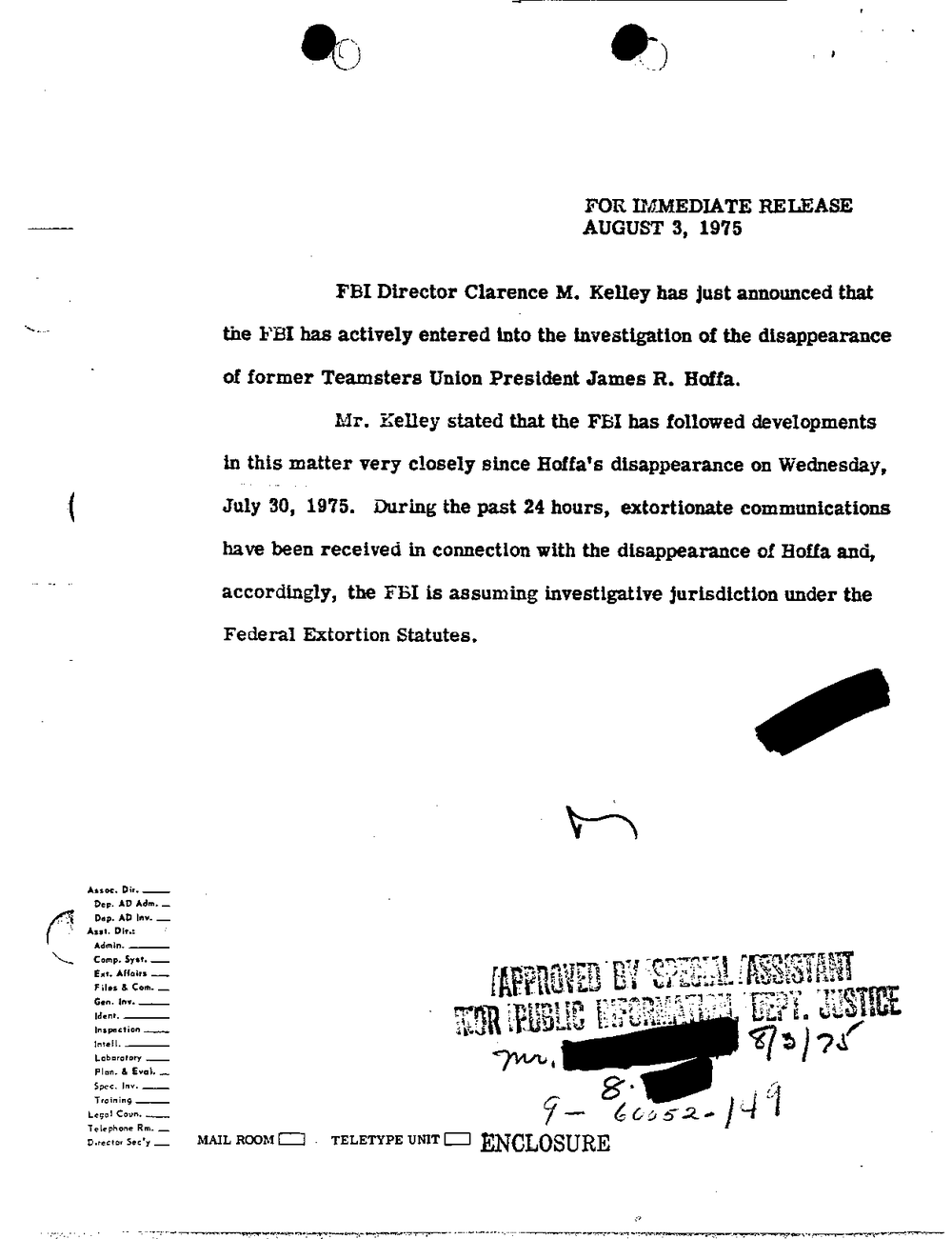 itemFBI Vault: Jimmy Hoffa, Part 01The first of the FBI Vault parts on the Hoffa disappearance: 168 pages, largely newspaper clippings gathered after 30 July 1975, with the FBI's press release of 3 August 1975 announcing that it was taking jurisdiction under the federal extortion statutes.itemFBI Vault: Jimmy Hoffa, Part 02The second Vault part on the Hoffa disappearance, 183 pages: Detroit agents' transcriptions of broadcast interviews about the case from November 1976, then teletypes and press clippings on the investigation into the 1980s.item"Crime - Hoffa Disappearance": Philip Buchen Files, Gerald R. Ford Presidential Library (National Archives)A Ford White House counsel's folder on the Hoffa disappearance. It holds a November 1975 Senate resolution to create a select committee that would study, among other matters, "the disappearance of James R. Hoffa," and a Labor Department letter of 2 December 1975.
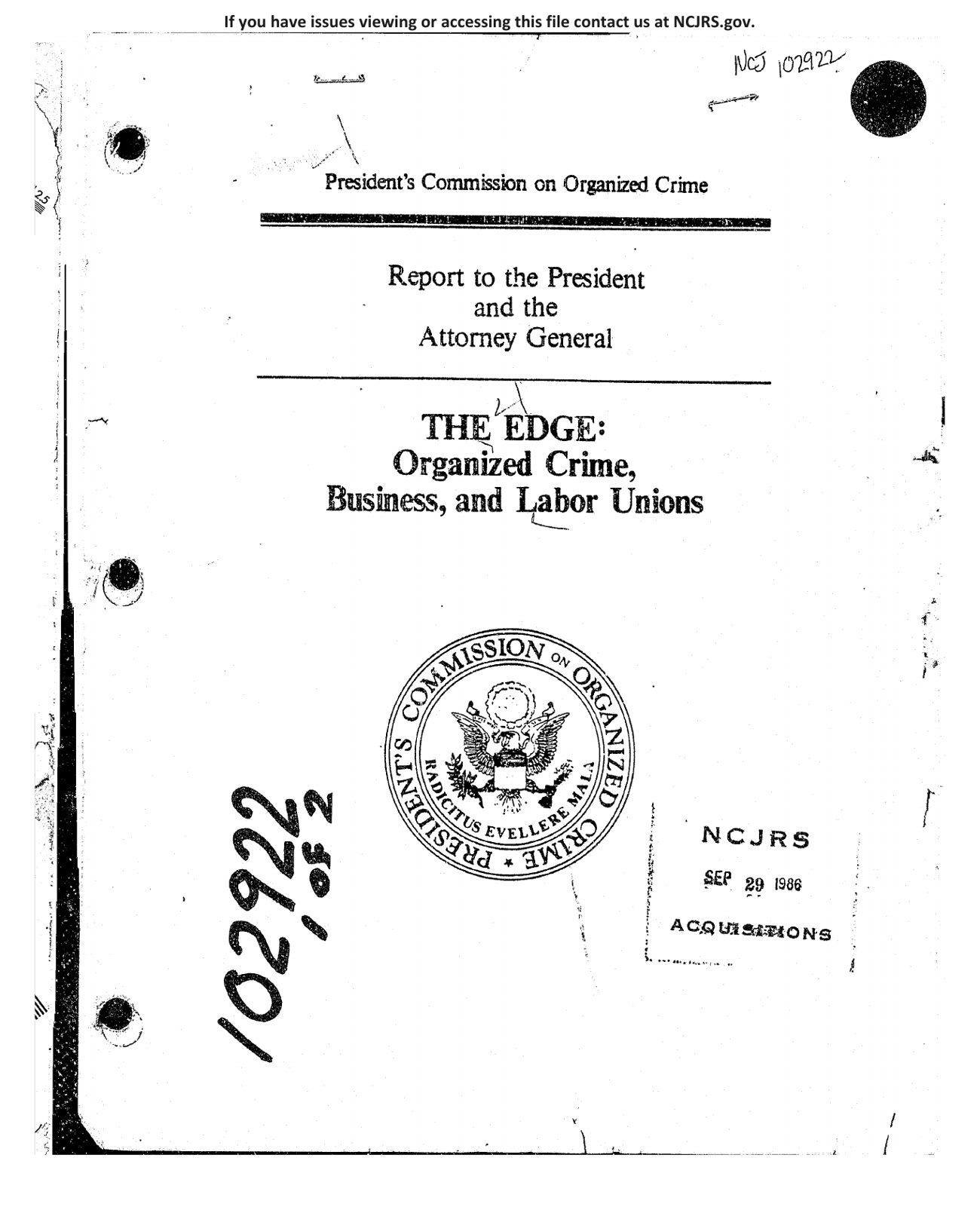 itemPresident's Commission on Organized Crime, The Edge (1986): the Teamsters and longshoremen sectionsThe Commission's 1986 report on organized crime, business and labor unions. Its Teamsters section, "The Most Controlled Union," reviews five IBT presidents from 1952 to 1985 and quotes Roy L. Williams: "Every big [Teamster] local union ... had some connection with organized crime."itemFBI Detroit marks the 50th anniversary of Jimmy Hoffa's disappearance (31 July 2025)FBI Detroit press release of 31 July 2025: "The Hoffa investigation remains active." It names no suspect.