Investigation of Racketeering in the Detroit Area: House joint subcommittee report (1954)
Report of two House special subcommittees on their June 1953 hearings in Detroit. It found that Teamsters Local 985 used picketing and threats to build a monopoly in jukebox and vending locations, and that James R. Hoffa refused three questions.
- Date
- 1954
- Kind
- hearing
- Retrieved
- 2026-10-12
- Docket
- Investigation of Racketeering in the Detroit Area, Joint Subcommittee Report, House Committees on Education and Labor and on Government Operations, 83d Cong., 2d sess.
- Rights
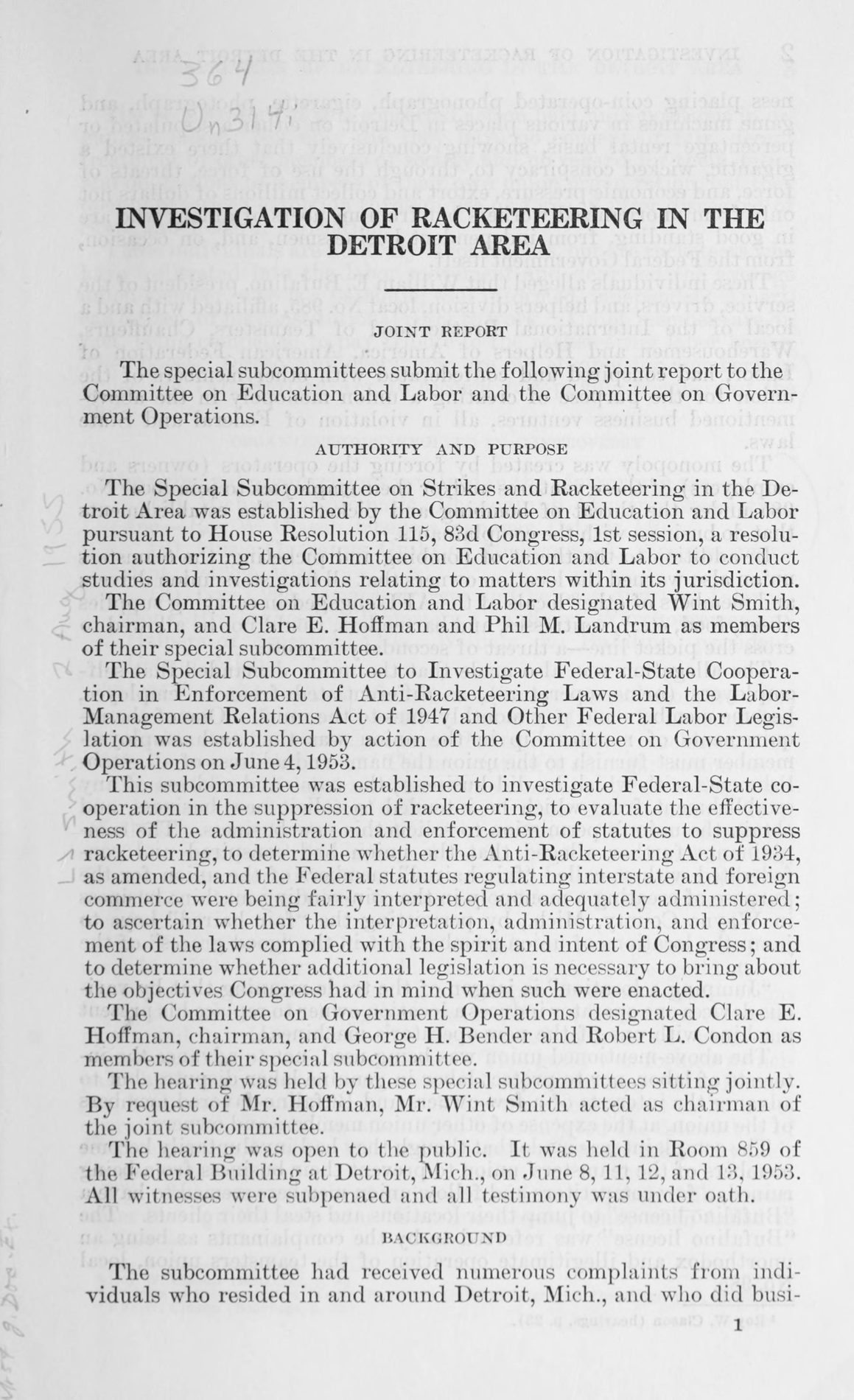
- A work of the United States House of Representatives, printed by the Government Printing Office. Public domain in the United States under 17 U.S.C. § 105. Read from the Internet Archive scan and its OCR text; the page image stored here is the first page of the report from that scan.
The Special Subcommittee on Strikes and Racketeering in the Detroit Area, of the House Committee on Education and Labor, and a special subcommittee of the Committee on Government Operations sat jointly. The report says: “The hearing was open to the public. It was held in Room 859 of the Federal Building at Detroit, Mich., on June 8, 11, 12, and 13, 1953.” Wint Smith acted as chairman.
The report deals with complaints from owners of jukeboxes and coin-operated machines. It says that William E. Bufalino, president of Teamsters Local 985, and others built a union monopoly in the business by picketing, by threats to bomb, and by the threat that Teamsters drivers would not cross a picket line. Owners and witnesses believed that a series of bombings were instigated by Bufalino or the union; the report states that “Only one person was ever arrested as a suspect in the bombings by the Detroit police, and he was subsequently released for lack of evidence.” It records that the local’s financial records “are destroyed at the close of each year.”
Under the heading “Hoffa Influence” the report lists James R. Hoffa’s posts: “He is president of teamsters union, local No. 299; president of teamsters joint council 43,” among others. It concludes that “Bufalino could not have succeeded in gaining monopolistic control of the coin-vending business in Detroit without the cognizance and approval of Hoffa,” and says that Hoffa refused to answer three questions and testified that the records of Local 299 were destroyed each year. These are the subcommittees’ findings, not those of a court.
The date 1954 comes from the Archive’s record and the title’s “83d Congress, second session”; the OCR of the imprint reads “1964,” which is a misreading. The report prints private home addresses, which are not repeated here.