Charles Luciano
Convicted in a New York State vice prosecution in 1936; the state's highest court called him "the head of this enterprise." Valachi testified in 1963 that Luciano took over as boss after Maranzano's killing. An FBI file records his parole on condition of deportation in 1946.
- Aliases
- Salvatore Lucania, Charley Lucky, Charles Luciana, Lucky Luciano
- Role
- Took over as boss after Maranzano's killing, as Valachi testified in answer to counsel (testimony, 1963)
- Rights
- Biography on this page is limited to what the cited federal records state.
On the record
- 18 June 1936 — An FBI report synopsis (Vault, Luciano Part 01, p. 7) records that he was sentenced on 6-18-36 "to term of from 30 to 50 vars" (OCR for "years") for placing women in a house of prostitution, and was held at Great Meadow Prison, Comstock, New York. FBI report.
- 12 April 1938 — People v. Luciano, 277 N.Y. 348: the New York Court of Appeals affirmed his conviction on sixty-two counts and wrote that "The appellant Luciano was the head of this enterprise," a combination controlling commercialized prostitution in New York City. State court opinion, about that enterprise.
- 3 January 1946 — An FBI report summarized in the file (Part 01, p. 58) states that "LUCIANO was paroled by Governor THOMAS E. DEWEY of New York State on the condition that he be deported" (OCR "THOMAS EB."), and that he was moved from Sing Sing to Ellis Island on February 2, 1946. FBI report.
- February 1946 — The file records that "MOSES POLAKOFF, MEYER LANSKY, FRANK COSTELLO and MICHAEL LASCAR visited CHARLES LUCIANO" at Ellis Island, and quotes an immigration memorandum saying he was to be "placed on board the S.S. Laura Keene for deportation, sailing from pier Bush Terminal, Brooklyn" (cleaned from the OCR). FBI file.
- 2 October 1963 — Valachi testified (printed p. 230) that after Maranzano's killing "Charley 'Lucky,' and Genovese" took over. Asked by counsel "did Luciano take over as boss," he answered "Yes, he did" (printed p. 236), and said Luciano abolished the boss-of-bosses arrangement and "put in, you know, a new consiglieri to protect the soldiers." Testimony.
- 1–2 October 1963 — Valachi testified that Masseria's own men set him up at a Coney Island restaurant; asked who, he answered "Charley, Lucky, and Vito" (printed p. 199), and said he was told "Charley was there" (printed p. 211). He was not present. He recalled that at Maranzano's meeting after the war it was announced that "Charley Lucky was boss, and Vito Genovese underboss" (printed p. 216), and that Maranzano later named "Charley Lucky" among men to be got rid of (printed p. 221). Testimony, much of it hearsay.
- 8 October 1963 — NYPD Deputy Chief Inspector John Shanley testified (printed pp. 250–251) that before Genovese emerged in 1949 "There is every indication that Charley 'Lucky' was the leader," and that "his power was so great that even in Europe he could exercise it." Testimony.
- 7 December 1965 — A letter from the FBI Legal Attache in Rome (Vault, Luciano Part 02, viewer pp. 128–130, OCR) reports a confidential source as saying that Luciano "and VITO GENOVESE engineered the murder of JOE MASSERIA and later of SALVATORE MARANZANO." The Legal Attache called the source's knowledge "very limited, general in nature." What the Bureau was told.
- 2 October 1974 — An FBI memorandum on a book presented as his memoirs (Vault, Luciano Part 02, viewer p. 143, OCR) states that "most of the information gathered to date by the Bureau indicates" that Luciano dropped an old title "when he created the concept of the La Cosa Nostra ruling Commission in 1931." The Bureau's 1974 summary, not a 1931 record.
- undated — The FBI's history page "La Cosa Nostra" calls him "Masseria's top soldier" and says Maranzano conspired with him "to have Masseria killed"; an older FBI overview says "Luciano set up the 'Commission' to rule all La Cosa Nostra activities." FBI history essays.
The heading follows the Vault file title, “Charles (Lucky) Luciano / Salvatore Lucania.” Valachi and Shanley call him “Charley Lucky.” A 1935 FBI memorandum spells the surname “Luciana.”
His 1936 conviction was a New York State case, prosecuted by District Attorney Thomas E. Dewey; no federal court tried him. The state opinion is free to use because judicial opinions are not subject to copyright, and its “head of this enterprise” refers to the vice combination in that case, not to a family.
The FBI file’s OCR gives his birth both as “11-11-07” and as “November 11, 1897.” Neither is used until the scan is read, so the birth field is empty. No opened record gives his death. The role line is Valachi’s answer to counsel. The FBI’s statements about the killings of 1931 and the Commission are the Bureau’s own later summaries and are labelled as such; none is a finding, and no chart on this archive carries his name. The 1963 hearing record mixes kinds of statement. Valachi’s and Shanley’s answers are sworn testimony; counsel’s questions are not, though a witness’s “yes” makes them part of the testimony; LaVern Duffy’s description of Exhibit 8 is the committee staff reading its own chart. A chart entry never fills a role on this archive.
Records
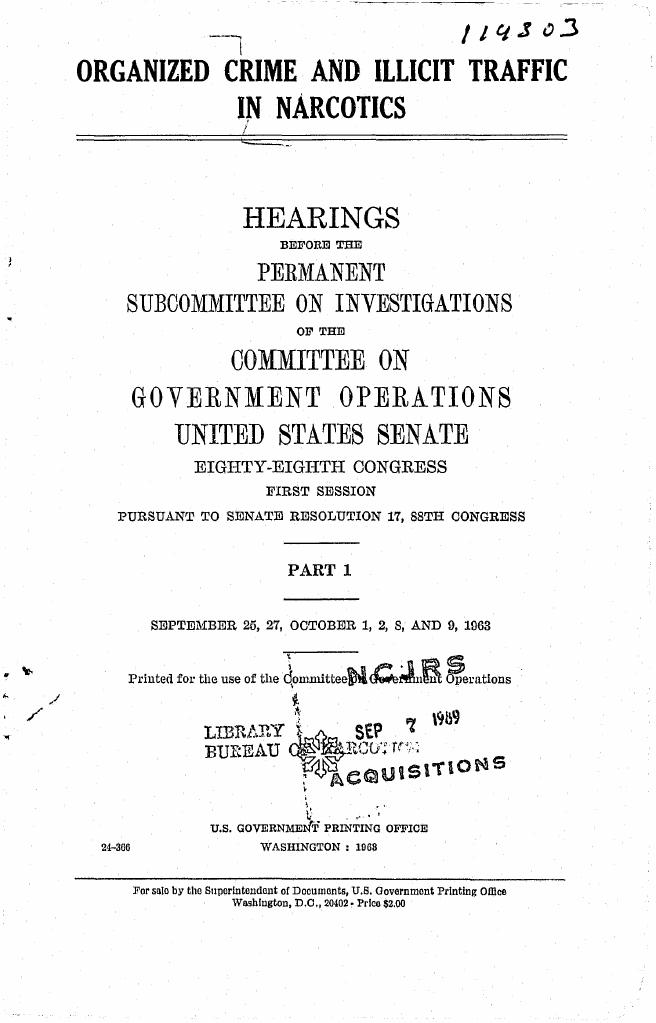 itemOrganized Crime and Illicit Traffic in Narcotics, Part 1 (September 25 to October 9, 1963)The first printed volume of the 1963 Senate hearings: Attorney General Robert F. Kennedy's opening testimony, Joseph Valachi's public testimony, New York police witnesses, Exhibit 8 and Charts A to E.itemPeople v. Luciano, 277 N.Y. 348 (1938)New York Court of Appeals decision of April 12, 1938 affirming the 1936 compulsory-prostitution convictions of Charles Luciano and five co-defendants. A state prosecution, not a federal case.
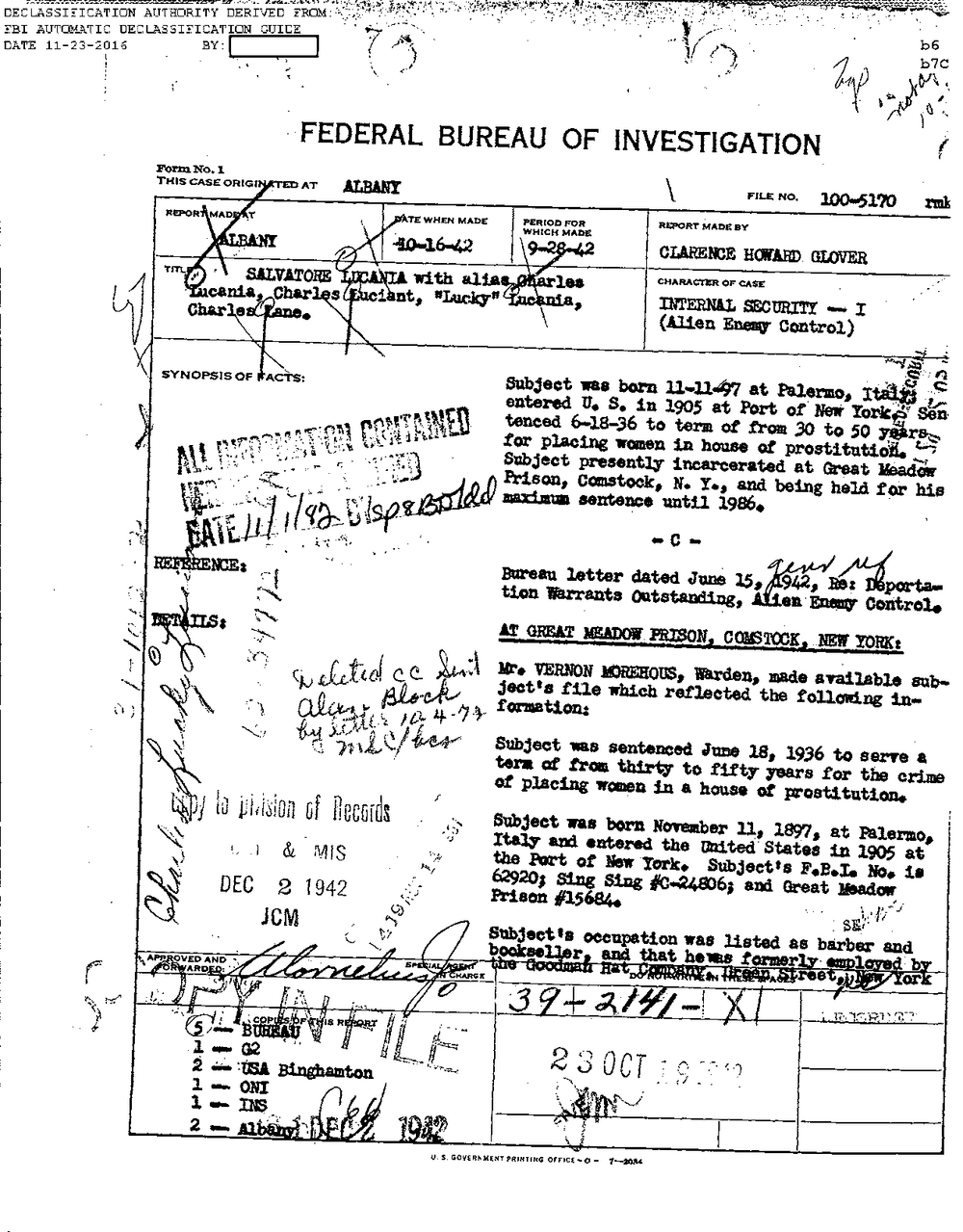 itemFBI Vault: Charles (Lucky) Luciano / Salvatore Lucania, Part 01Part 01 of the FBI's Luciano file: 1935 memoranda, a wartime report with his 1936 state sentence, and a 1946 group on his parole on condition of deportation, his move to Ellis Island, and his departure from Bush Terminal, Brooklyn.
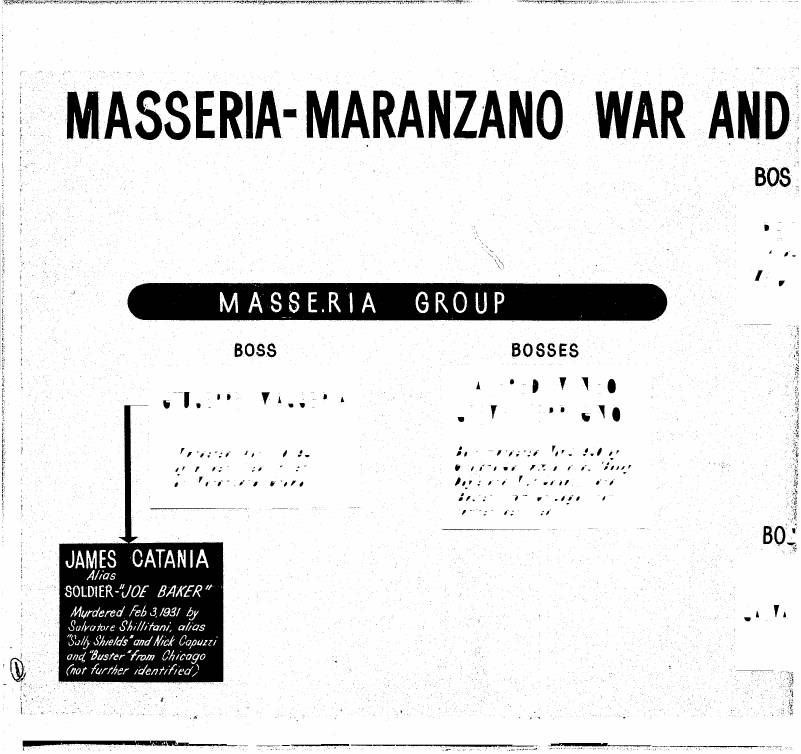 itemExhibit No. 8: "Masseria-Maranzano War and Evolution of Gang Control—1930 to Present"Staff fold-out chart presented on October 1, 1963: the 1930 to 1931 war in three key-coded groups and the lines of succession drawn from it to five 1963 bosses. Several name boxes are illegible in the scan.
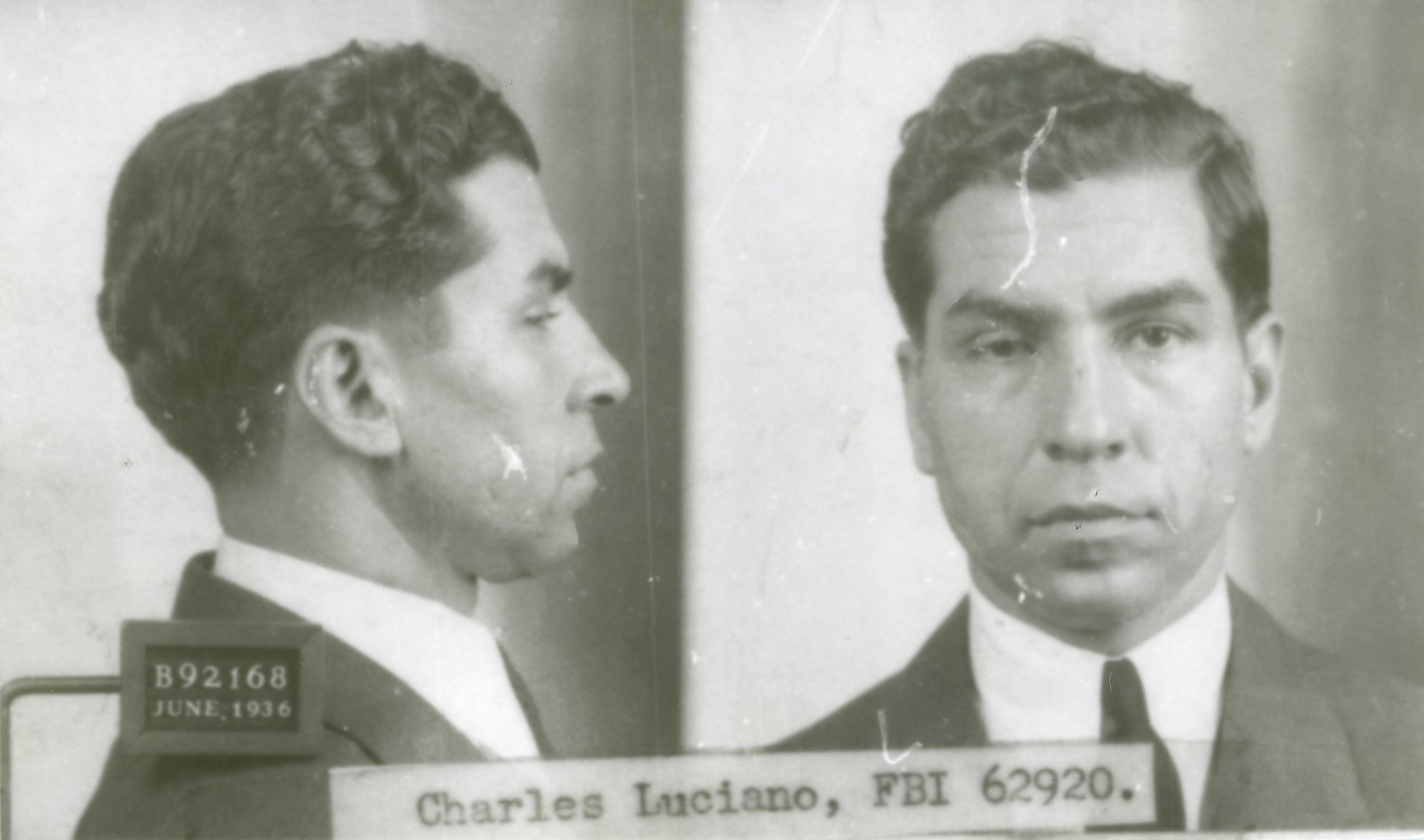 itemCharles Luciano mug shot, June 1936 (National Archives, 65-CC-37-9)Front and profile mug shot of Charles Luciano with a placard reading "B92168 JUNE 1936", held by the National Archives in the FBI's criminal-case photograph series. A copy is stored here.itemTestimony of Charles Siragusa, Bureau of Narcotics agent, 27 June 1951 (Kefauver Committee, Part 14, pp. 343–357)A Federal Bureau of Narcotics agent tells the Kefauver Committee of his spring 1951 work with the Italian police on Lucky Luciano and a heroin arrest at the Rome airport, and answers "Yes, sir" when asked whether narcotics distribution and smuggling is "the principal source of income of the Mafia."itemTestimony of Commissioner Henry L. Giordano, Bureau of Narcotics, 28 July 1964 (Organized Crime and Illicit Traffic in Narcotics, Part 3)The Commissioner of Narcotics tells the Senate subcommittee that since 1956 the Bureau has "developed 20 major conspiracy cases resulting in the conviction of 206 important gangsters," naming Vito Genovese, John Ormento, Carmine Galante and Joseph Valachi, and presents the Valachi-hearing family charts marked for Bureau convictions.
 itemKefauver Committee hearings, Part 14: Narcotics (1951)Printed hearings of the Senate Special Committee to Investigate Organized Crime in Interstate Commerce, Part 14, Narcotics: sessions in Jessup, Lexington, and Washington, May to June 1951.
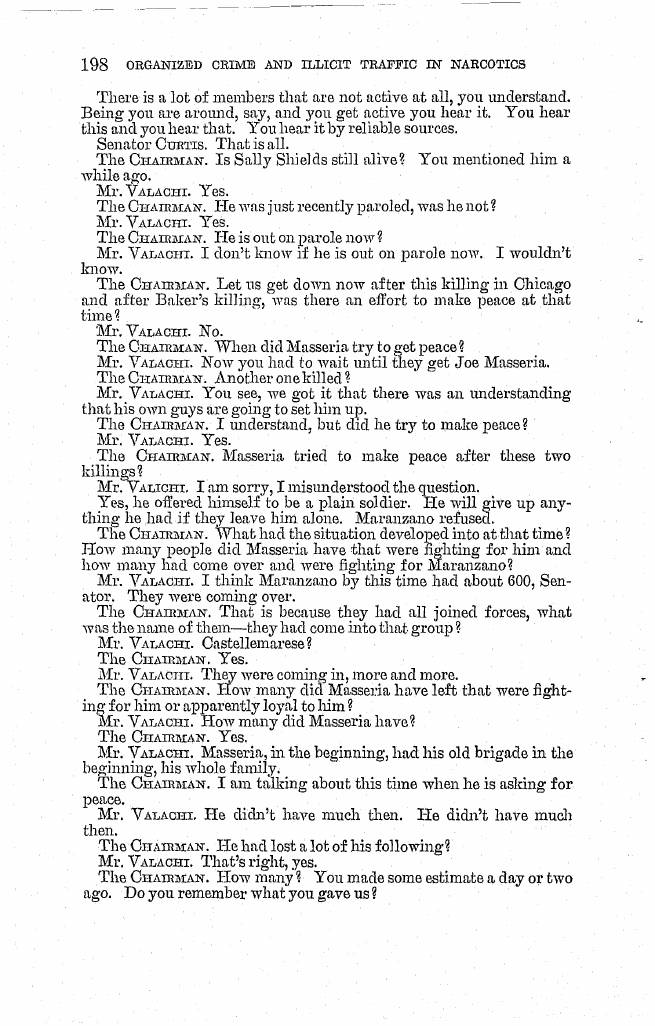 itemHearing of October 1, 1963, pp. 198–199: Masseria's offer of peace, Maranzano's refusal, and the men Valachi said "set him up"Valachi testified that Masseria "offered himself to be a plain soldier" and that Maranzano refused, that Maranzano's side had grown to about 600, and that Masseria's own men set him up at a Coney Island restaurant. Testimony from hearsay; Valachi was not there.
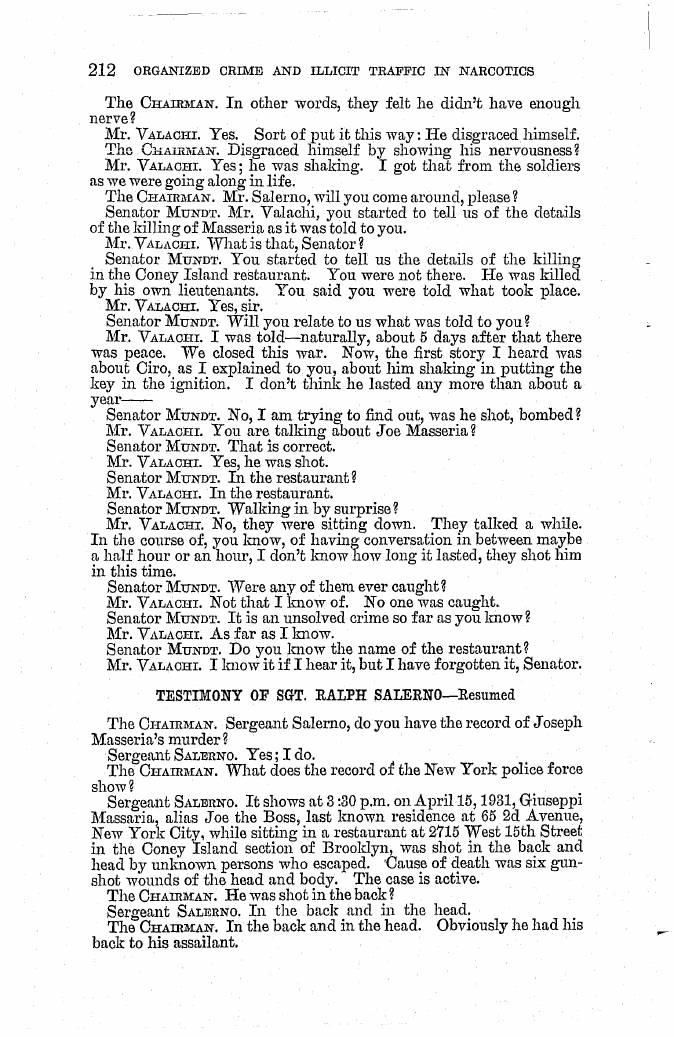 itemHearing of October 2, 1963, pp. 210–213: Valachi's account of the killing of Joseph Masseria, and the police record of April 15, 1931 at 2715 West 15th Street, Coney IslandValachi testified from hearsay that Masseria's own men took him to a Coney Island restaurant and killed him. Sgt. Ralph Salerno read the police record: at 3:30 p.m. on April 15, 1931, "Giuseppi Massaria, alias Joe the Boss," was shot in the back and head in a restaurant at 2715 West 15th Street by unknown persons who escaped.
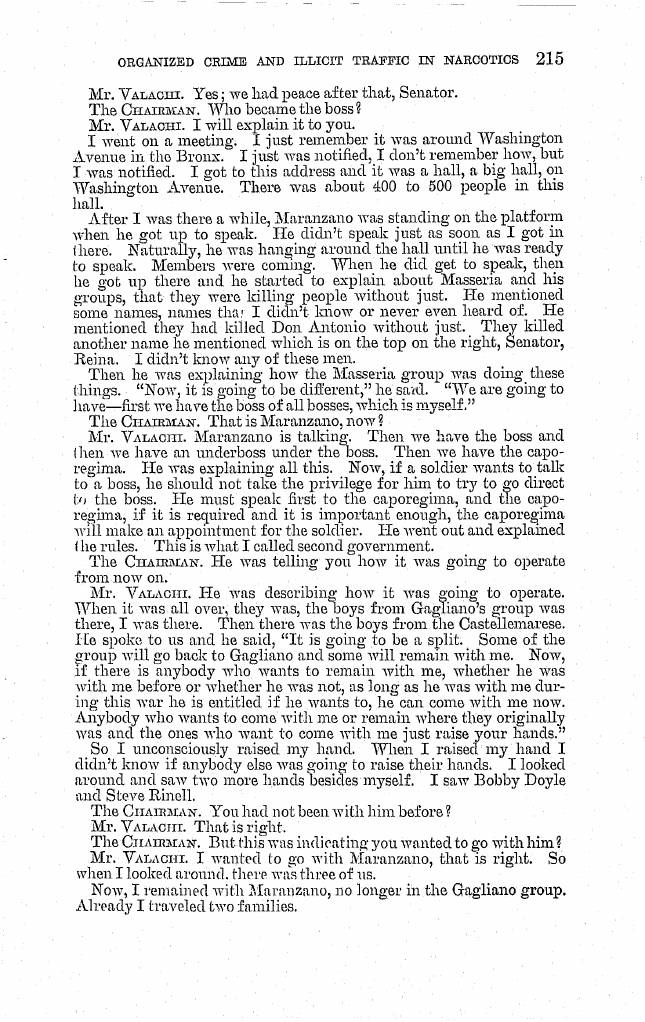 itemHearing of October 2, 1963, pp. 214–218: the "score" of the war, Maranzano's meeting on Washington Avenue ("the boss of all bosses, which is myself"), and the banquetValachi testified that the score was "we lost 1 and they lost from 40 to 60," described a meeting of 400 to 500 people in a hall on Washington Avenue in the Bronx where Maranzano declared himself "the boss of all bosses," named the bosses he recalled being designated there, and described a five-night banquet he understood raised $115,000. Testimony, not findings.
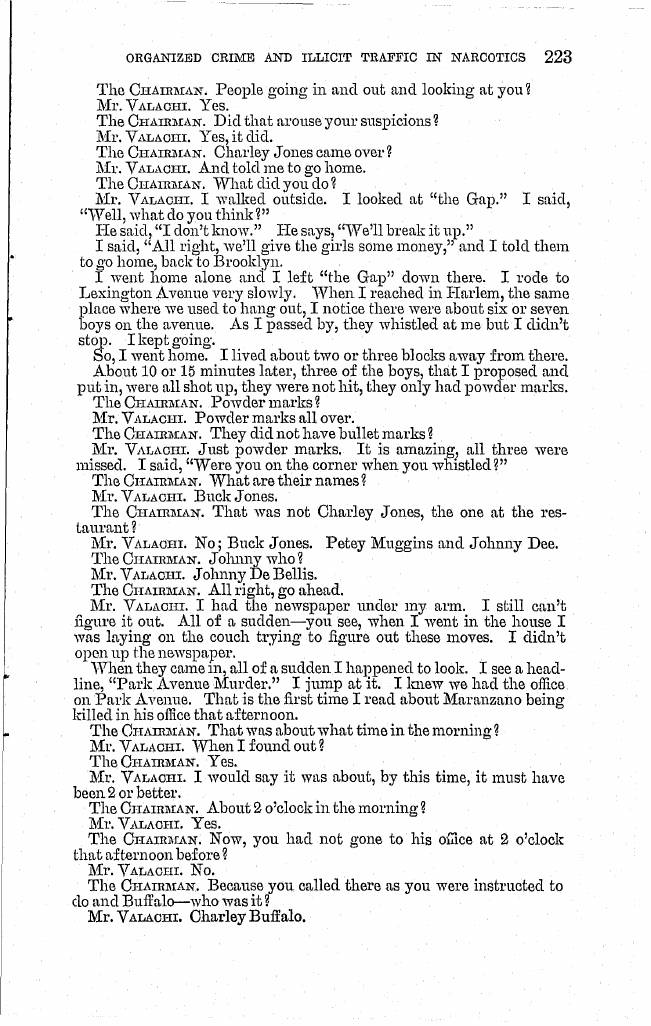 itemHearing of October 2, 1963, pp. 220–224: "We have to go to the mattress again," Maranzano's list, and the "Park Avenue Murder" headlineValachi testified that shortly before his death Maranzano told him "We have to go to the mattress again," gave him a list of names, and was to meet Genovese and Luciano at his office the next afternoon; Valachi was told by phone not to come, and learned of the killing from a newspaper headline, "Park Avenue Murder." Uncorroborated testimony.
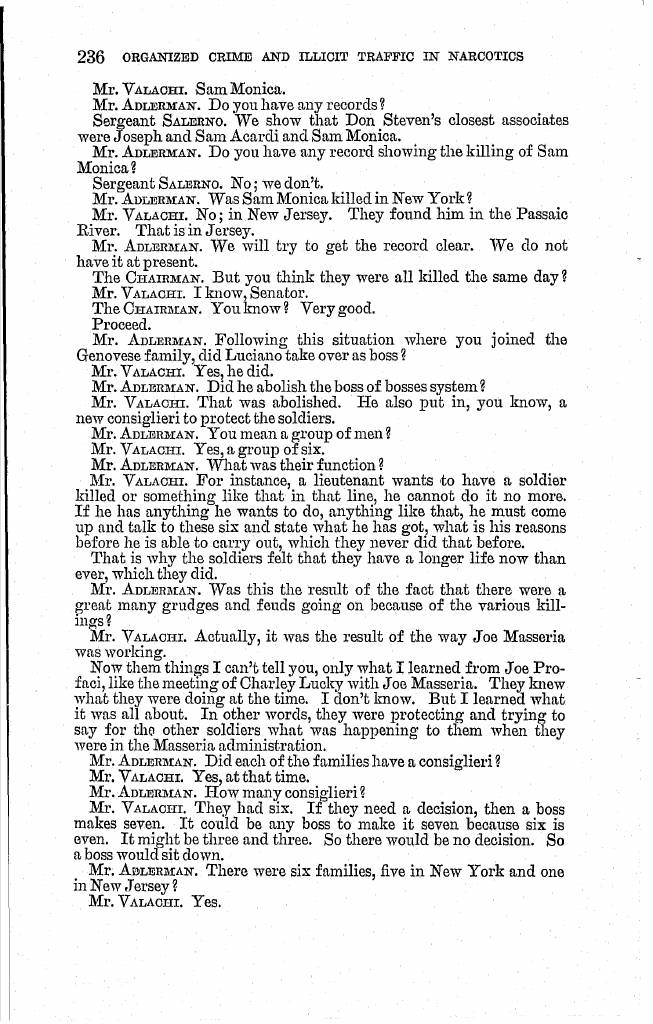 itemHearing of October 2, 1963, pp. 236–239: the "boss of bosses" abolished, the Chicago meeting, and the membership "books" closed in about 1931Valachi testified that after Maranzano's death Luciano took over as boss, that the "boss of bosses" system "was abolished" and a group of six consiglieri was set up, that Luciano and Genovese had to justify the killing before the bosses at a meeting in Chicago, and that "the books were closed in about 1931." One witness's account, not a finding.itemFBI memorandum of October 2, 1974, "The Last Testament of Lucky Luciano": the Bureau's statement that Luciano created the Commission "in 1931"An FBI headquarters memorandum judged a 1974 book presented as Luciano's memoirs to be "a complete fraud." Among the errors it lists, it says Bureau information indicates Luciano dropped an old title "when he created the concept of the La Cosa Nostra ruling Commission in 1931." The Bureau's 1974 summary, not a record of a 1931 event.itemLegal Attache, Rome, to the FBI Director, December 7, 1965: a confidential source on Charles Luciano, including the Masseria and Maranzano killings as the source recounted themA letter in Part 02 of the FBI's Luciano file reports a December 1965 interview of a source who had known Luciano in Italy. The source said Luciano "and VITO GENOVESE engineered the murder of JOE MASSERIA and later of SALVATORE MARANZANO." The Legal Attache called the source's knowledge "very limited, general in nature." What the Bureau was told, not a finding.itemLa Cosa Nostra (FBI history page)The FBI's history essay on the Genovese family. It says that Valachi survived three attempts on his life in prison and testified before the Senate subcommittee on September 27, 1963.itemFBI, "Italian Organized Crime – Overview" (archived www2.fbi.gov page)An older FBI web overview, still served on the www2.fbi.gov archive host. It says the murder of "faction leader Joseph Masseria brought an end to the gang warfare," that Maranzano, "the first leader of La Cosa Nostra, was murdered within six months," and that Luciano "set up the 'Commission.'" An agency narrative, not a record of the events.
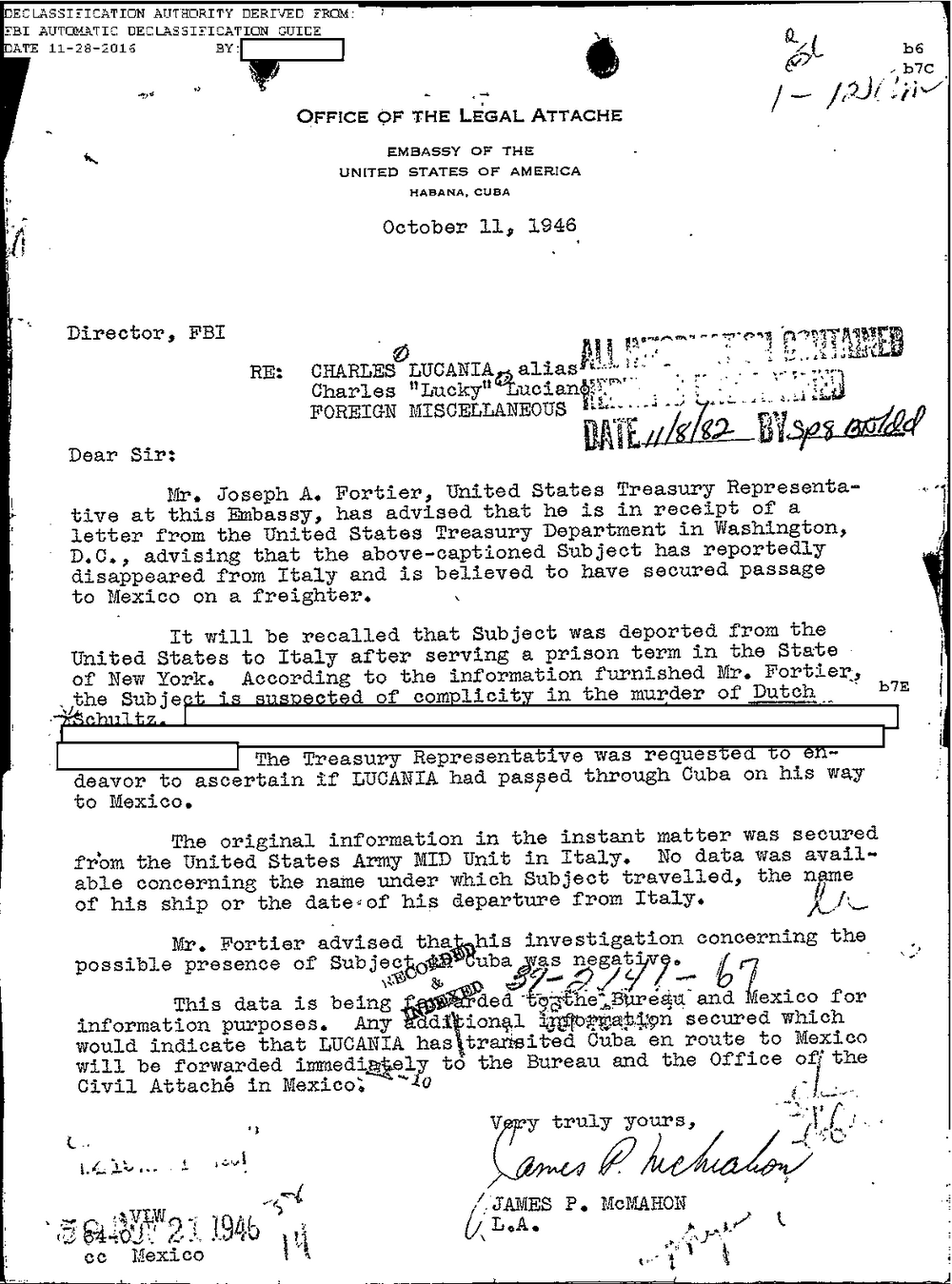 itemLegal Attache, Havana, to the Director, 11 October 1946: Treasury report that Luciano had left Italy, and a negative check in CubaThe FBI's Legal Attache at the embassy in Havana reports that the Treasury representative, Joseph A. Fortier, had word that Luciano 'has reportedly disappeared from Italy and is believed to have secured passage to Mexico on a freighter,' and that Fortier's check for him in Cuba was negative. It is the earliest Cuba document in the file.
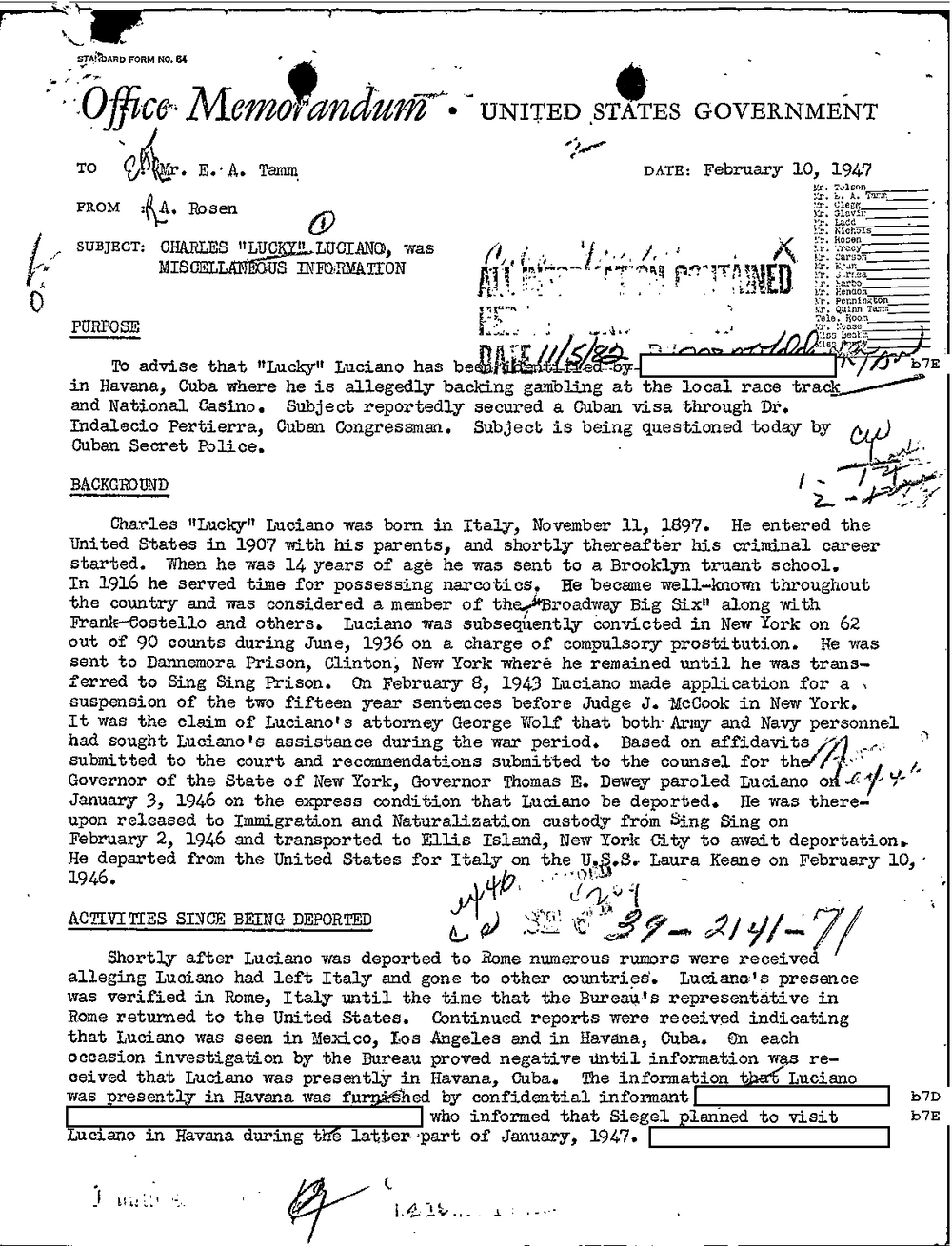 itemFBI memorandum, A. Rosen to E. A. Tamm, 10 February 1947: Luciano found in Havana, 'allegedly backing gambling at the local race track and National Casino'A headquarters memorandum reports that Luciano has been identified in Havana, where 'he is allegedly backing gambling at the local race track and National Casino,' that he 'reportedly secured a Cuban visa through Dr. Indalecio Pertierra, Cuban Congressman,' and that the Cuban Secret Police were questioning him that day.
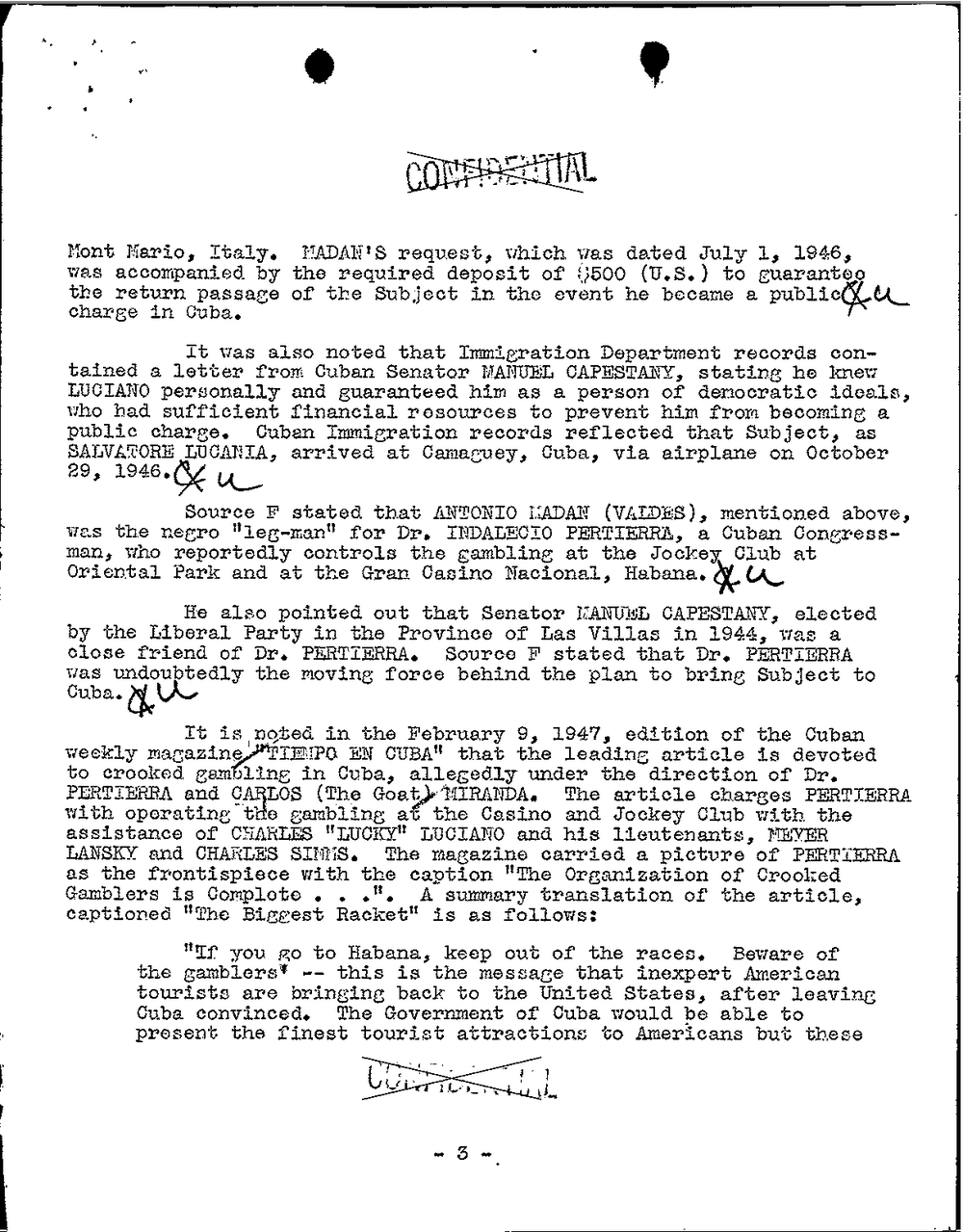 itemFBI report of Special Agent Leo J. Fox, Havana, 12 February 1947: Luciano's entry into Cuba, the Pertierra visa, and the gambling at the Gran Casino Nacional and Oriental ParkThe Havana office's first full report states that Luciano arrived at Camaguey by airplane on 29 October 1946 as Salvatore Lucania, that his visa was backed by a Cuban senator's letter, that Congressman Indalecio Pertierra 'reportedly controls the gambling at the Jockey Club at Oriental Park and at the Gran Casino Nacional,' and that Luciano frequented both.
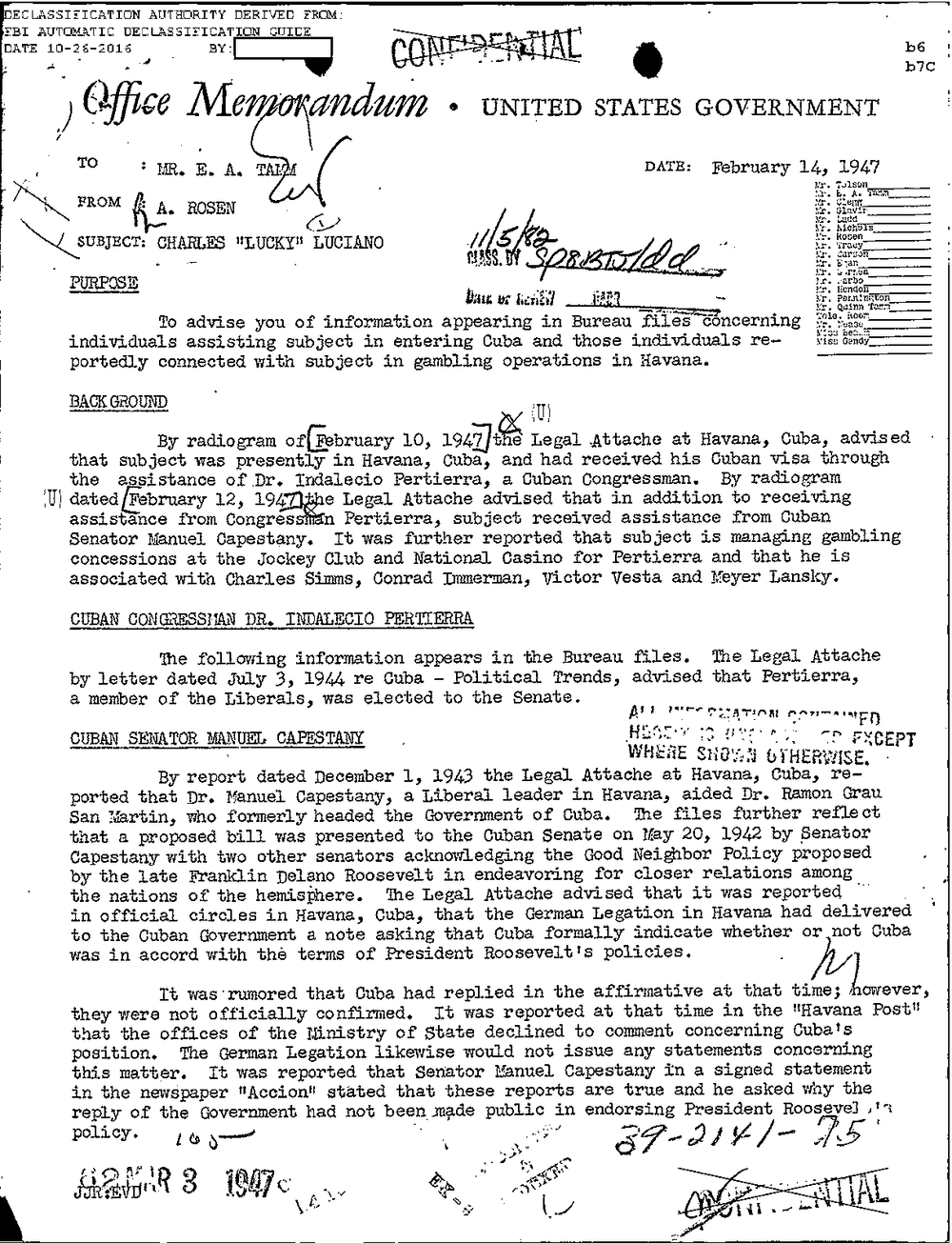 itemFBI memorandum, A. Rosen to E. A. Tamm, 14 February 1947: who helped Luciano enter Cuba, and his reported gambling associates in HavanaSummarizing the Legal Attache's radiograms, headquarters records that Luciano had help from Congressman Pertierra and Senator Manuel Capestany, that he 'is managing gambling concessions at the Jockey Club and National Casino for Pertierra,' and that he was associated with Charles Simms, Conrad Immerman, Victor Vesta and Meyer Lansky.
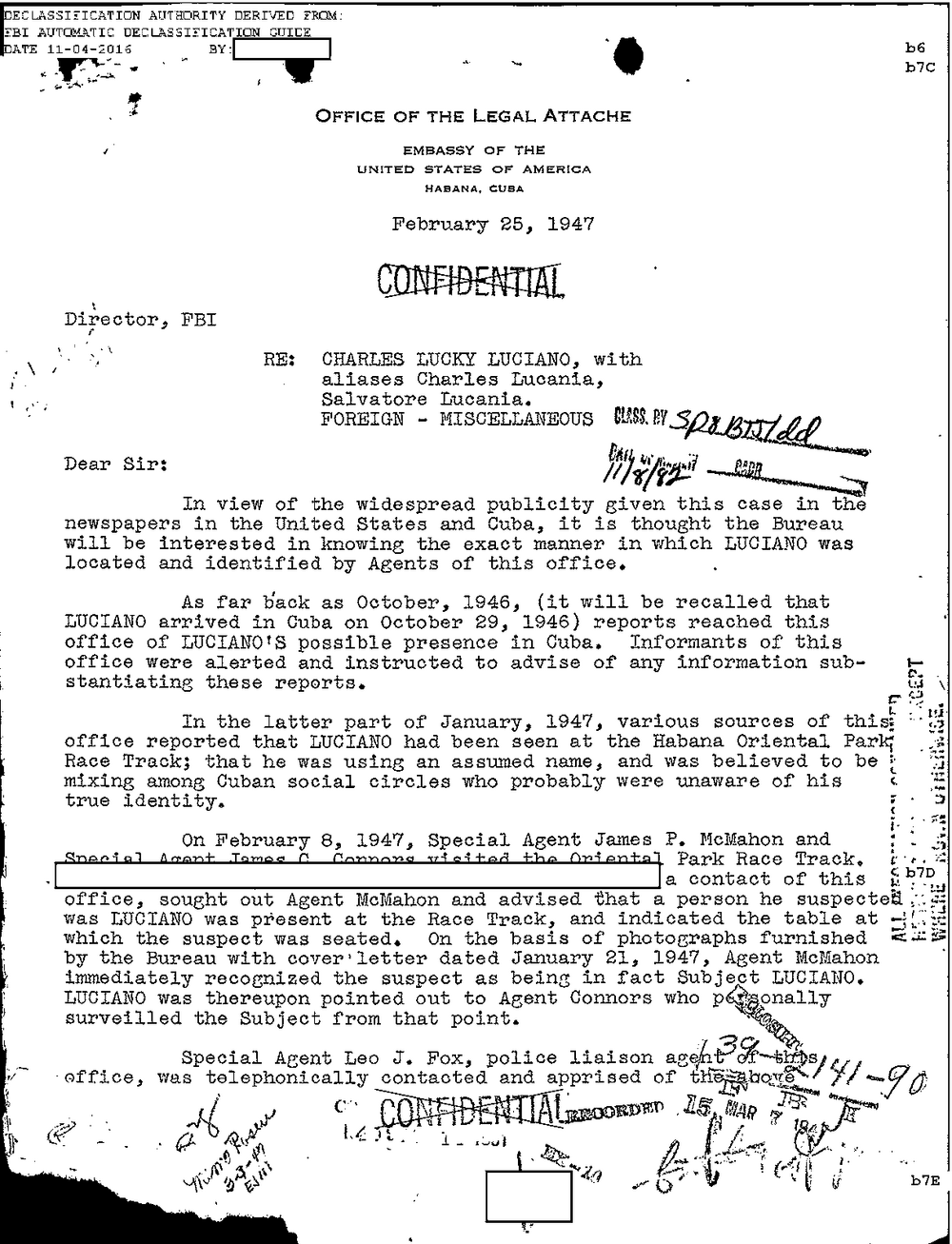 itemLegal Attache James P. McMahon, Havana, to the Director, 25 February 1947, with a headquarters memorandum of 3 March: how FBI agents identified Luciano at Oriental ParkWritten 'In view of the widespread publicity,' the Legal Attache's letter says informants reported Luciano at the Oriental Park race track in late January 1947, 'using an assumed name,' and that on 8 February a contact pointed him out to McMahon, who recognized him from Bureau photographs; Agent Leo J. Fox arrived with two Cuban Secret Police officers and confirmed the identification.
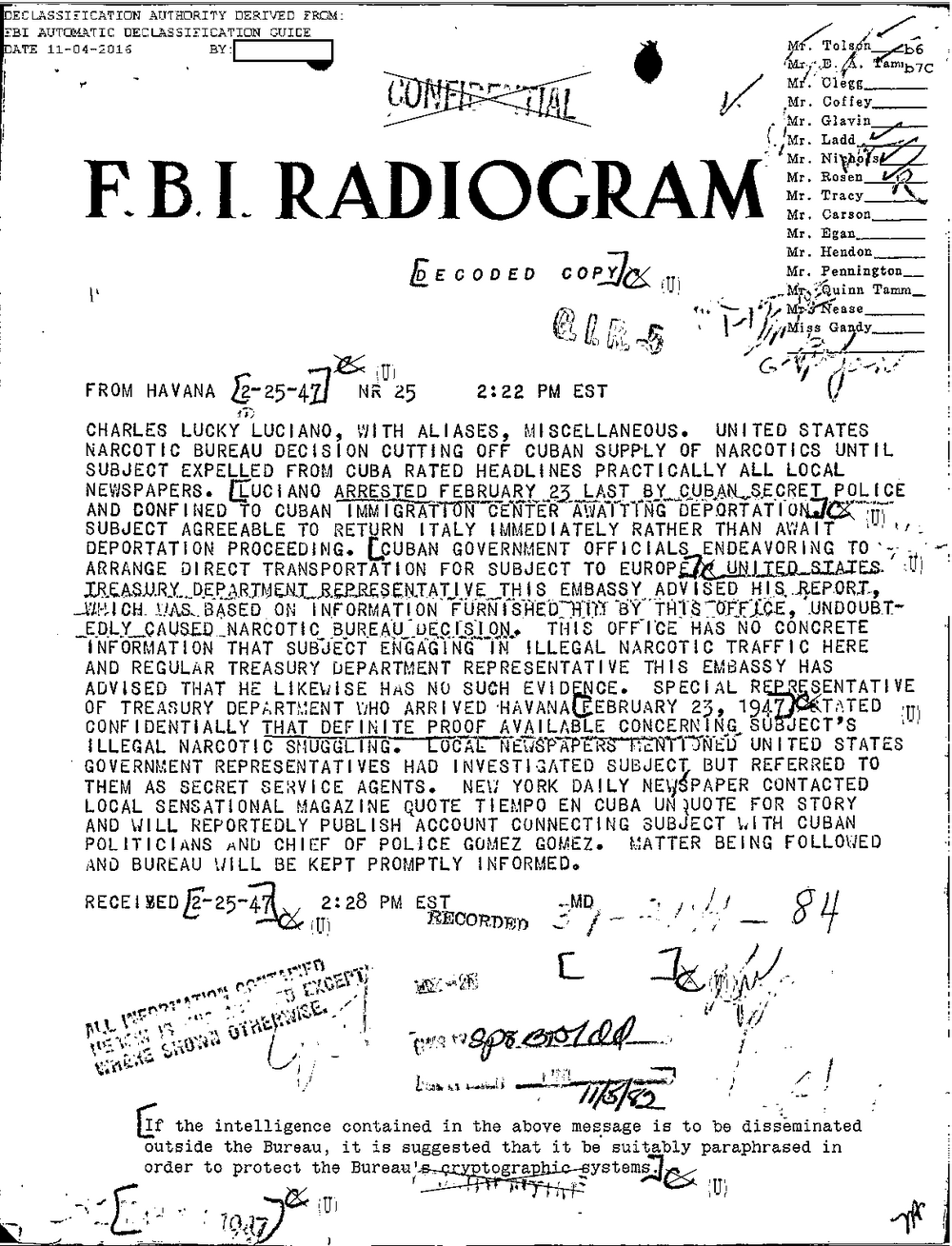 itemFBI radiogram from Havana, 25 February 1947: the Narcotics Bureau's decision 'cutting off Cuban supply of narcotics until subject expelled,' and Luciano's arrestA decoded radiogram reports that the United States Narcotic Bureau's decision 'cutting off Cuban supply of narcotics until subject expelled from Cuba rated headlines practically all local newspapers,' that Luciano was arrested and confined at the Cuban immigration center, and that 'THIS OFFICE HAS NO CONCRETE INFORMATION THAT SUBJECT ENGAGING IN ILLEGAL NARCOTIC TRAFFIC HERE.'
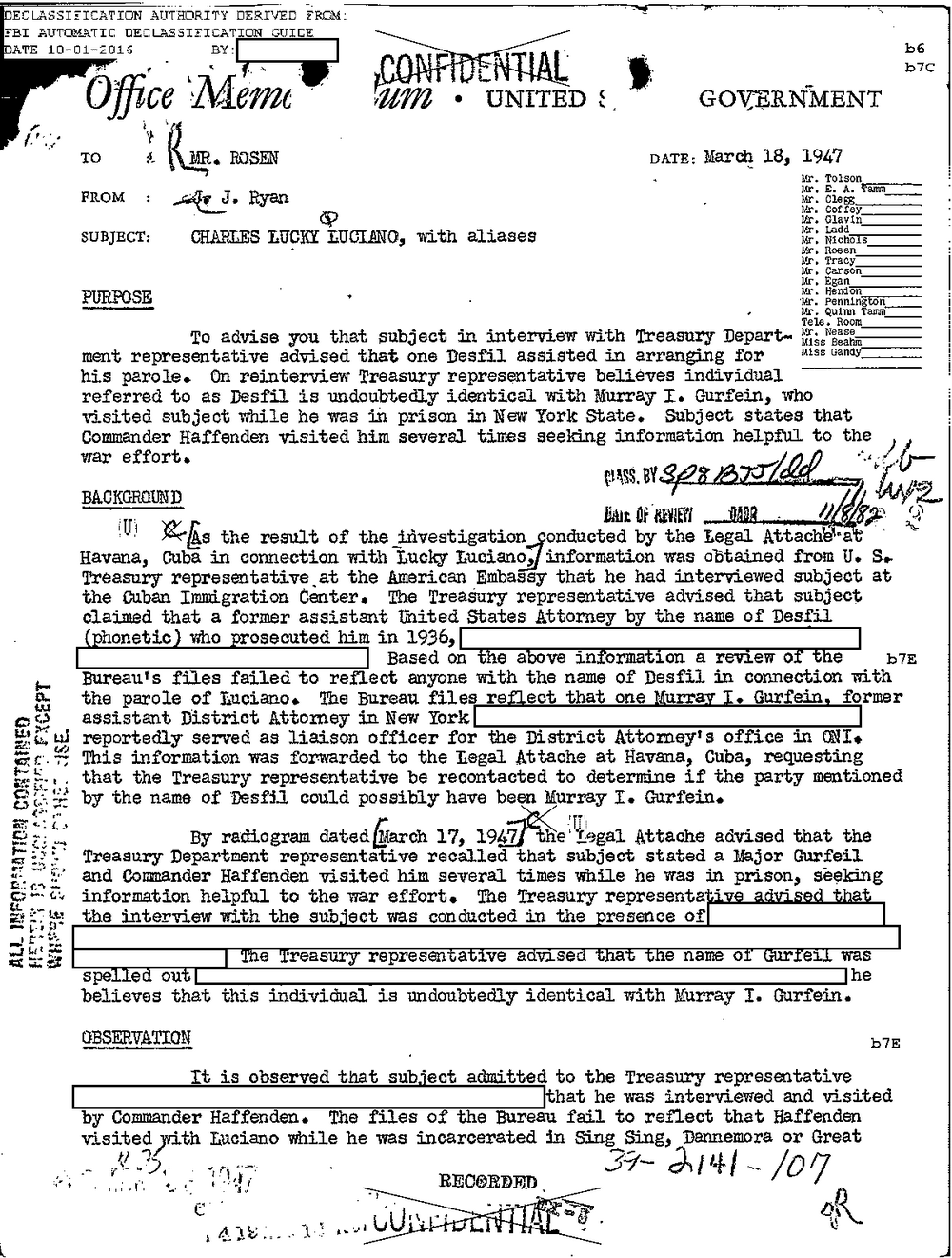 itemFBI memorandum, J. Ryan to Mr. Rosen, 18 March 1947: Luciano, interviewed at the Cuban Immigration Center, names 'Major Gurfeil' and Commander HaffendenHeadquarters records that the Treasury representative in Havana interviewed Luciano at the Cuban Immigration Center, where Luciano said a former prosecutor helped arrange his parole; on reinterview the representative recalled the name as 'Major Gurfeil,' believed to be Murray I. Gurfein, and said Luciano named Commander Haffenden of Naval Intelligence.
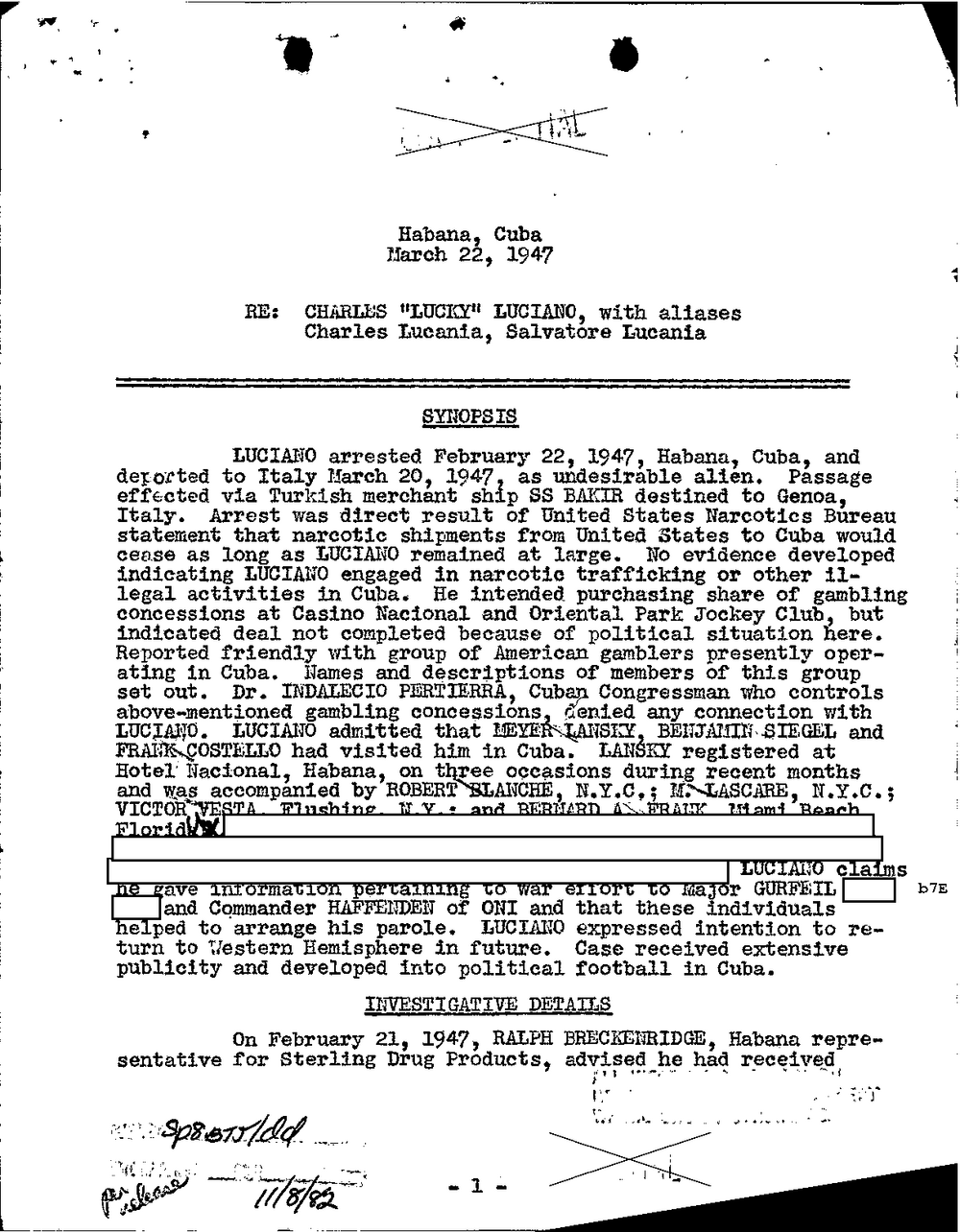 itemFBI report of Special Agent Leo J. Fox, Havana, 22 March 1947: Luciano's arrest and deportation, and the visits by Lansky, Siegel and CostelloThe closing report on Luciano in Cuba: arrested in Havana on 22 February 1947 and deported to Italy on 20 March 1947; 'No evidence developed indicating LUCIANO engaged in narcotic trafficking or other illegal activities in Cuba'; and 'LUCIANO admitted that MEYER LANSKY, BENJAMIN SIEGEL and FRANK COSTELLO had visited him in Cuba,' with Lansky's three Hotel Nacional registrations.
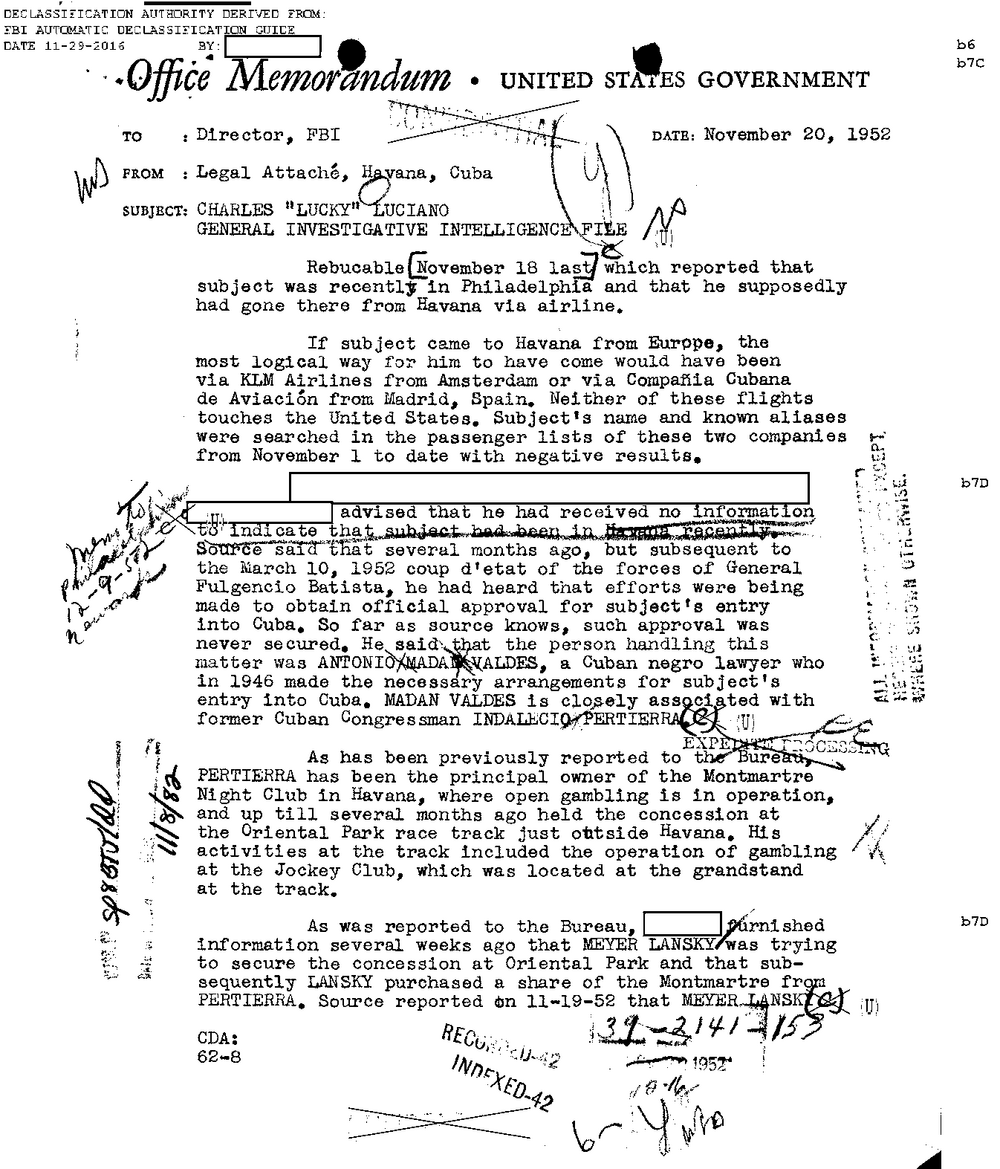 itemLegal Attache, Havana, to the Director, 20 November 1952: no trace of Luciano in Havana; Lansky's reported share of the Montmartre and bid for Oriental ParkAnswering a report that Luciano had flown from Havana to Philadelphia, the Havana office found nothing in airline lists. It relayed informants' reports that Meyer Lansky had bought a share of the Montmartre night club from Pertierra and was trying to secure the Oriental Park concession, with 'his brother JAKE LANSKY' in Havana 'looking after his interests.'
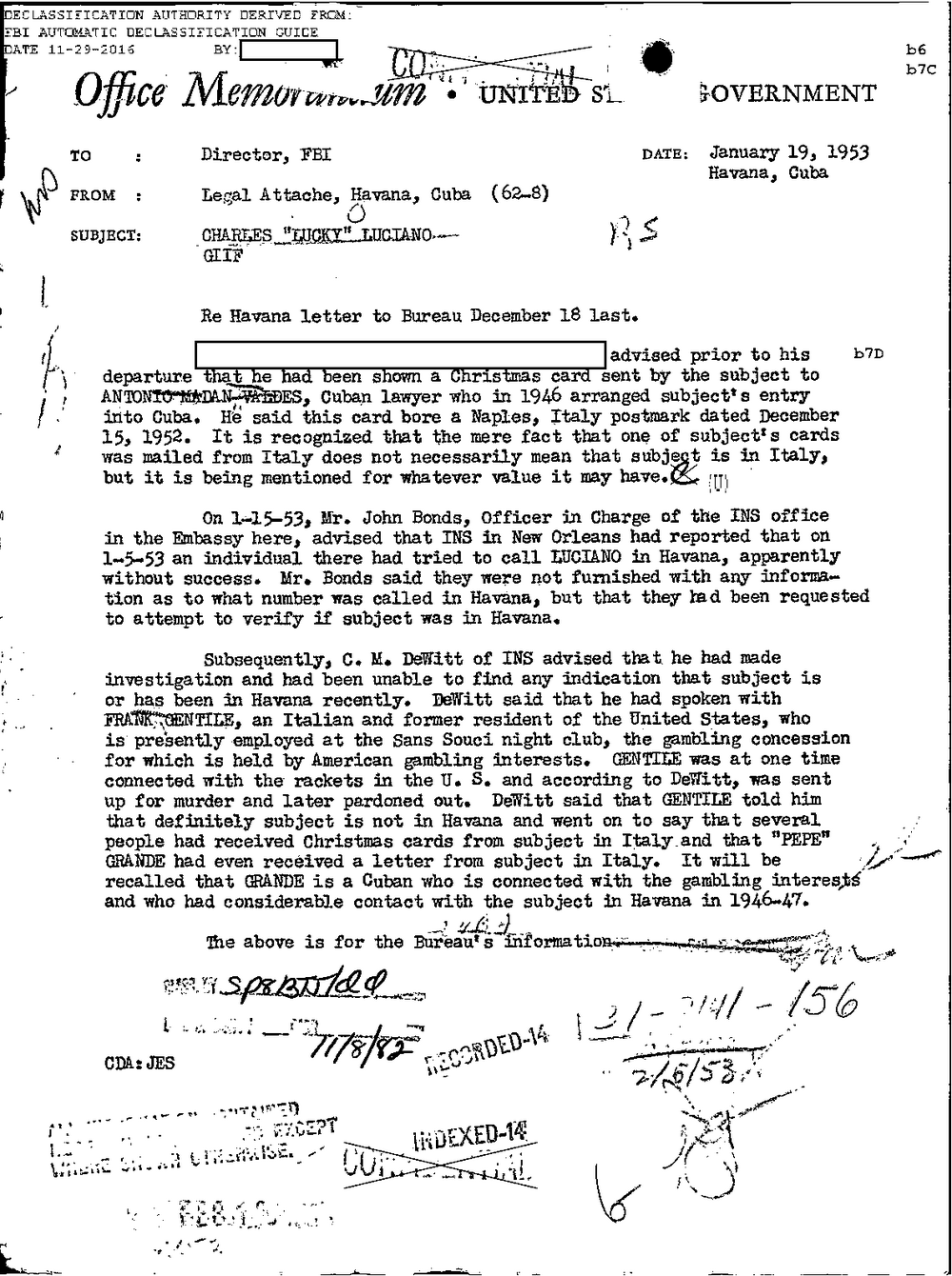 itemLegal Attache, Havana, to the Director, 19 January 1953: no sign of Luciano in Havana; the Sans Souci's gambling concession 'held by American gambling interests'The Havana office reports a Christmas card from Luciano postmarked Naples and an INS inquiry that found no indication he had been in Havana recently. The INS officer had spoken with a man employed at the Sans Souci night club, 'the gambling concession for which is held by American gambling interests.'