FBI report of Special Agent Leo J. Fox, Havana, 22 March 1947: Luciano's arrest and deportation, and the visits by Lansky, Siegel and Costello
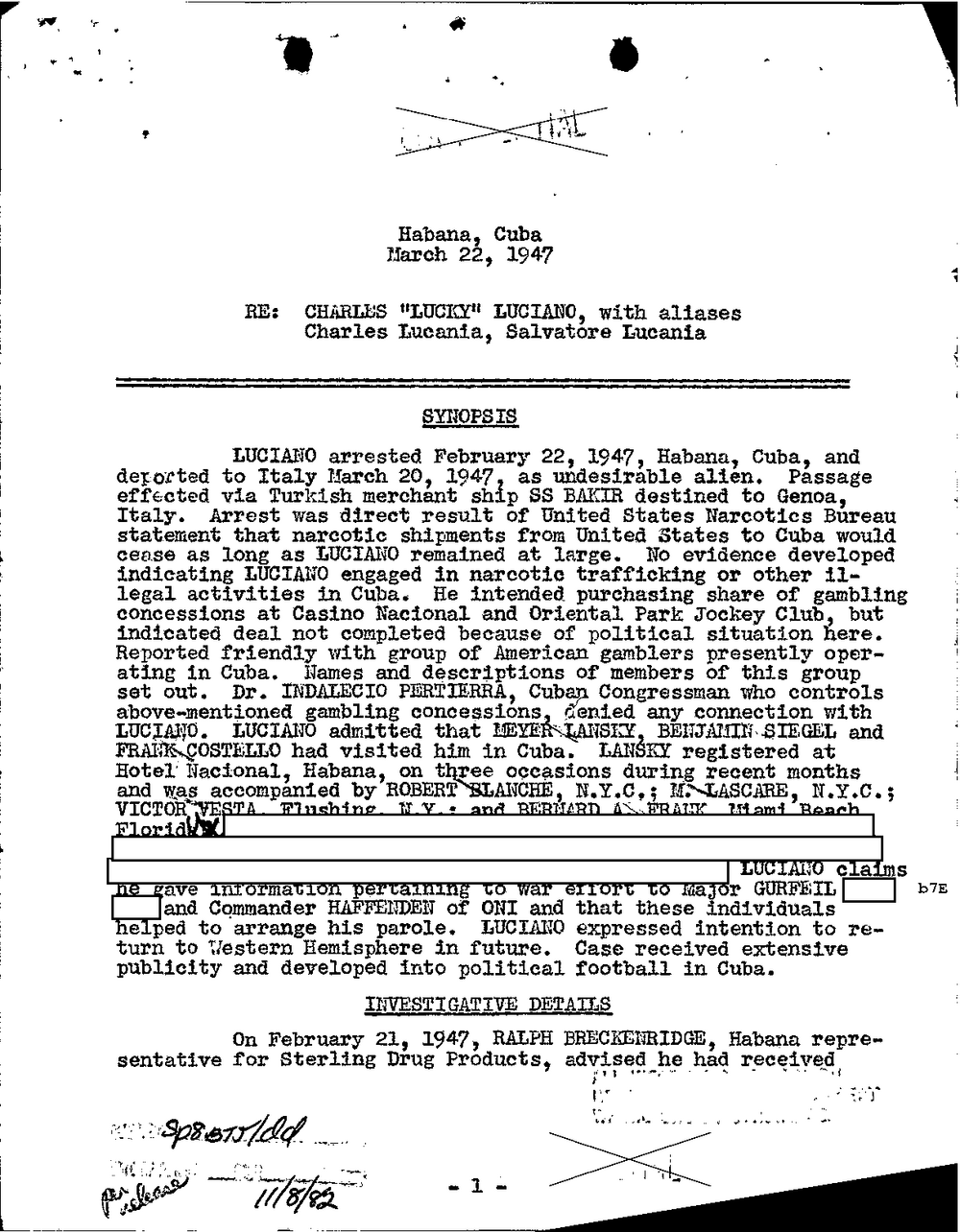
The closing report on Luciano in Cuba: arrested in Havana on 22 February 1947 and deported to Italy on 20 March 1947; 'No evidence developed indicating LUCIANO engaged in narcotic trafficking or other illegal activities in Cuba'; and 'LUCIANO admitted that MEYER LANSKY, BENJAMIN SIEGEL and FRANK COSTELLO had visited him in Cuba,' with Lansky's three Hotel Nacional registrations.
- Date
- 1947-03-22
- Kind
- case-file
- Retrieved
- 2026-10-12
- Rights
- A record of the Federal Bureau of Investigation released under FOIA. A work of the United States government, public domain under 17 U.S.C. § 105. The page image of viewer page 278, the synopsis, is stored here.
Viewer pages 277 to 297 of Part 01 hold the report made at Havana by Special Agent Leo J. Fox, dated 22 March 1947, with a synopsis page headed 23 March. Viewer pages 289 to 292 are blank or illegible in the text layer. The stored image is the synopsis, page 278, which was checked against the text quoted here.
The synopsis reads: “LUCIANO arrested February 22, 1947, Habana, Cuba, and deported to Italy March 20, 1947, as undesirable alien. Passage effected via Turkish merchant ship SS BAKIR destined to Genoa, Italy. Arrest was direct result of United States Narcotics Bureau statement that narcotic shipments from United States to Cuba would cease as long as LUCIANO remained at large. No evidence developed indicating LUCIANO engaged in narcotic trafficking or other illegal activities in Cuba. He intended purchasing share of gambling concessions at Casino Nacional and Oriental Park Jockey Club, but indicated deal not completed because of political situation here.” It adds that Pertierra “denied any connection with LUCIANO,” and: “LUCIANO admitted that MEYER LANSKY, BENJAMIN SIEGEL and FRANK COSTELLO had visited him in Cuba. LANSKY registered at Hotel Nacional, Habana, on three occasions during recent months.”
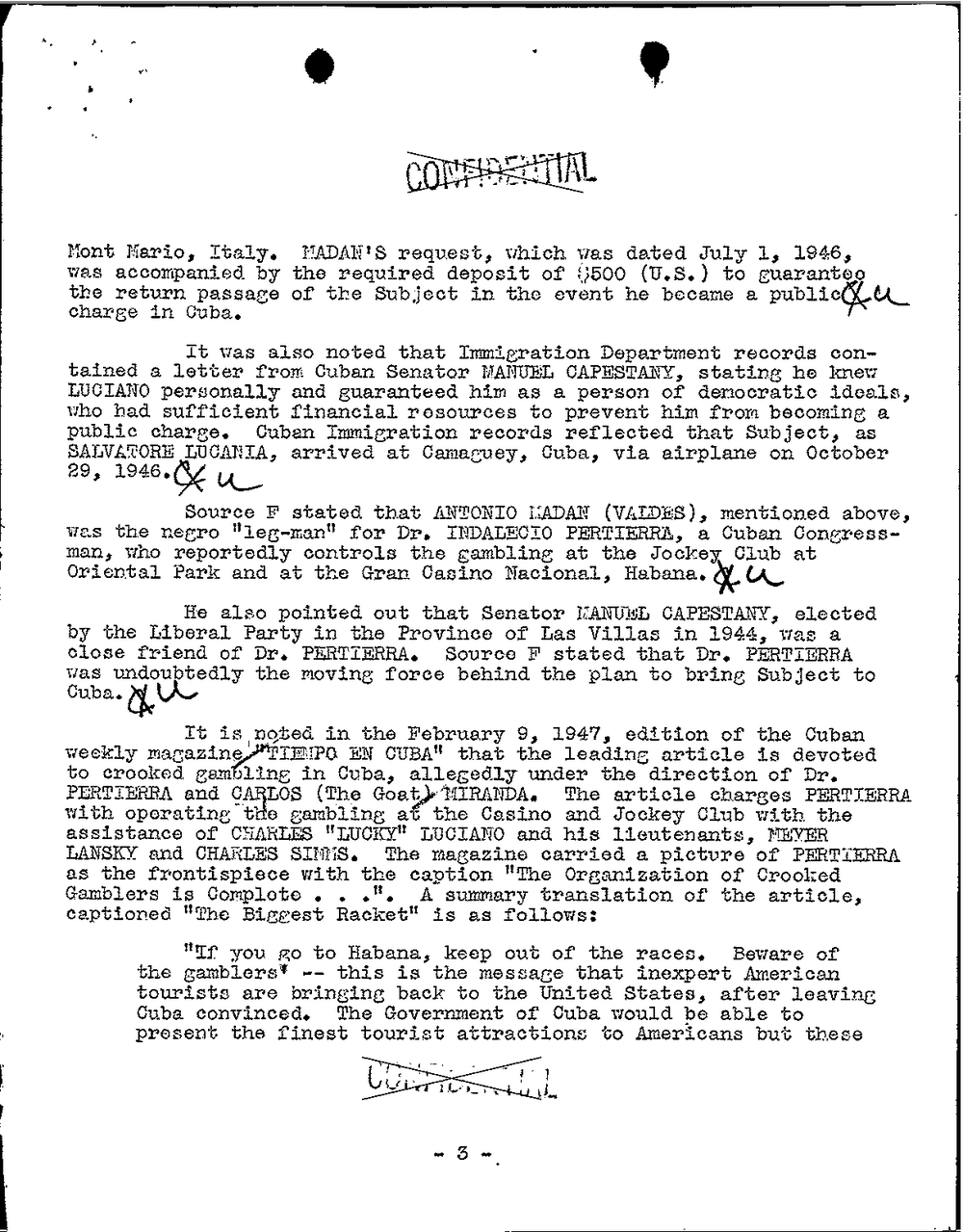
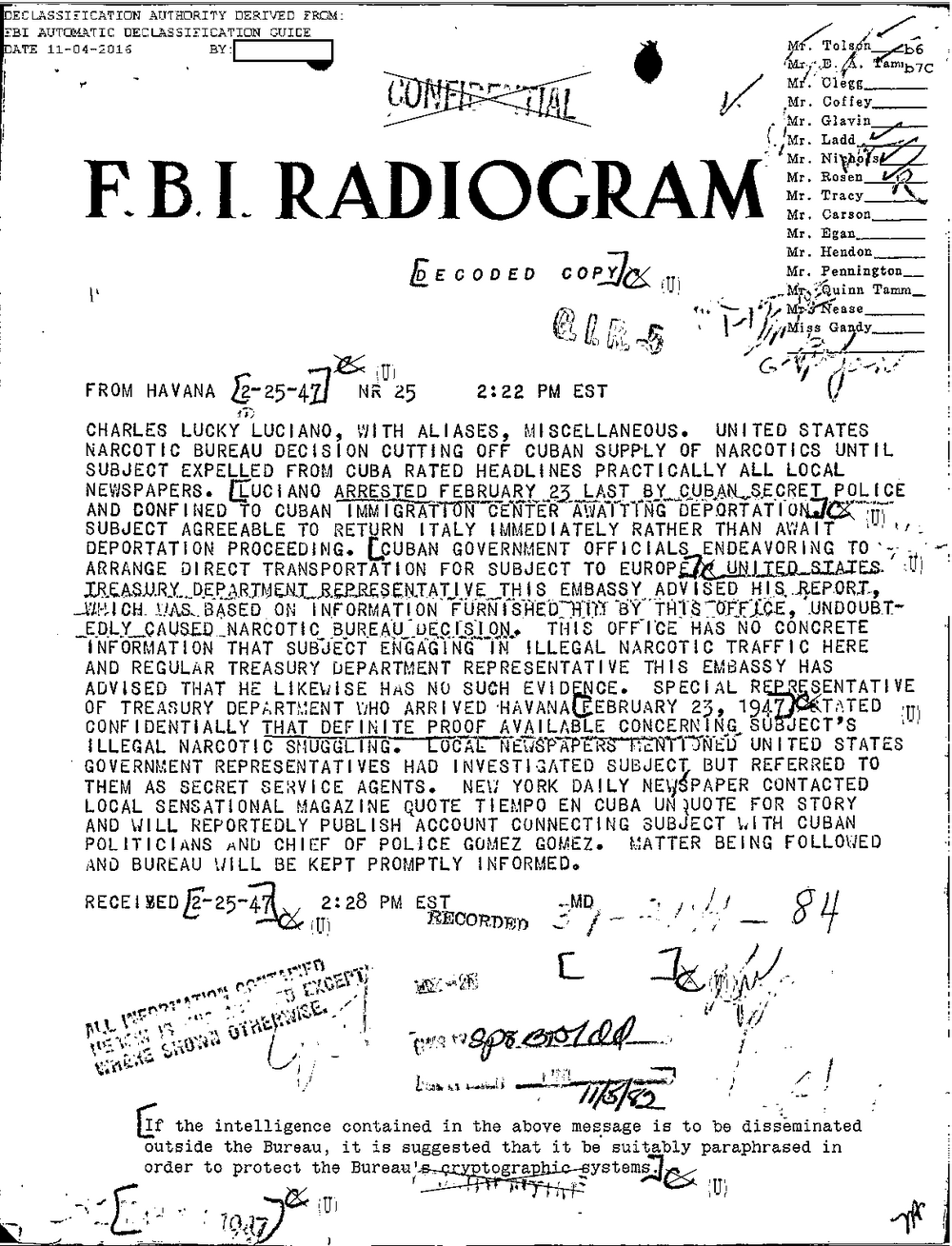
The details follow. Luciano was sent to “the Tiscornia Immigration Camp” on the day of his arrest (page 280). Fortier, the Treasury representative, said he “had no evidence whatsoever” that Luciano was in the narcotic traffic, but that the Bureau of Narcotics apparently considered his “mere presence in Cuba sufficiently dangerous to place an embargo.” On 27 February President Grau San Martin signed a decree classing Luciano an undesirable alien, and the American Embassy “advised the Cuban Ministry of State that no actual embargo had been placed on shipments of narcotics to Cuba, despite the statements to the contrary made by United States Narcotic Bureau officials” (page 281). Hotel Nacional records show Lansky checking in on 27 December 1946, again on 6 January 1947, and on 24 February 1947 (pages 287-288); the hotel’s manager said he saw Luciano at a cabana rented by two of the American gamblers “on several occasions.” Interviewed by Fortier at Tiscornia on 19 March, Luciano said he had planned to buy a share in the gambling concession at the Casino Nacional and Oriental Park but had not, because gambling in Cuba “was so deeply involved in politics that he wanted no part of it” (pages 294-295).
This report records visits and hotel registrations. It does not describe a meeting or conference of any kind, and no federal record opened for this archive describes a December 1946 gathering in Havana. The report also names private individuals, one of whom denied any part in the gambling; this archive does not repeat their names or addresses.