Record
Hearing
1964-07-28
National Criminal Justice Reference Service, scan of the printed hearings (NCJ 119303)
Testimony of Commissioner Henry L. Giordano, Bureau of Narcotics, 28 July 1964 (Organized Crime and Illicit Traffic in Narcotics, Part 3)
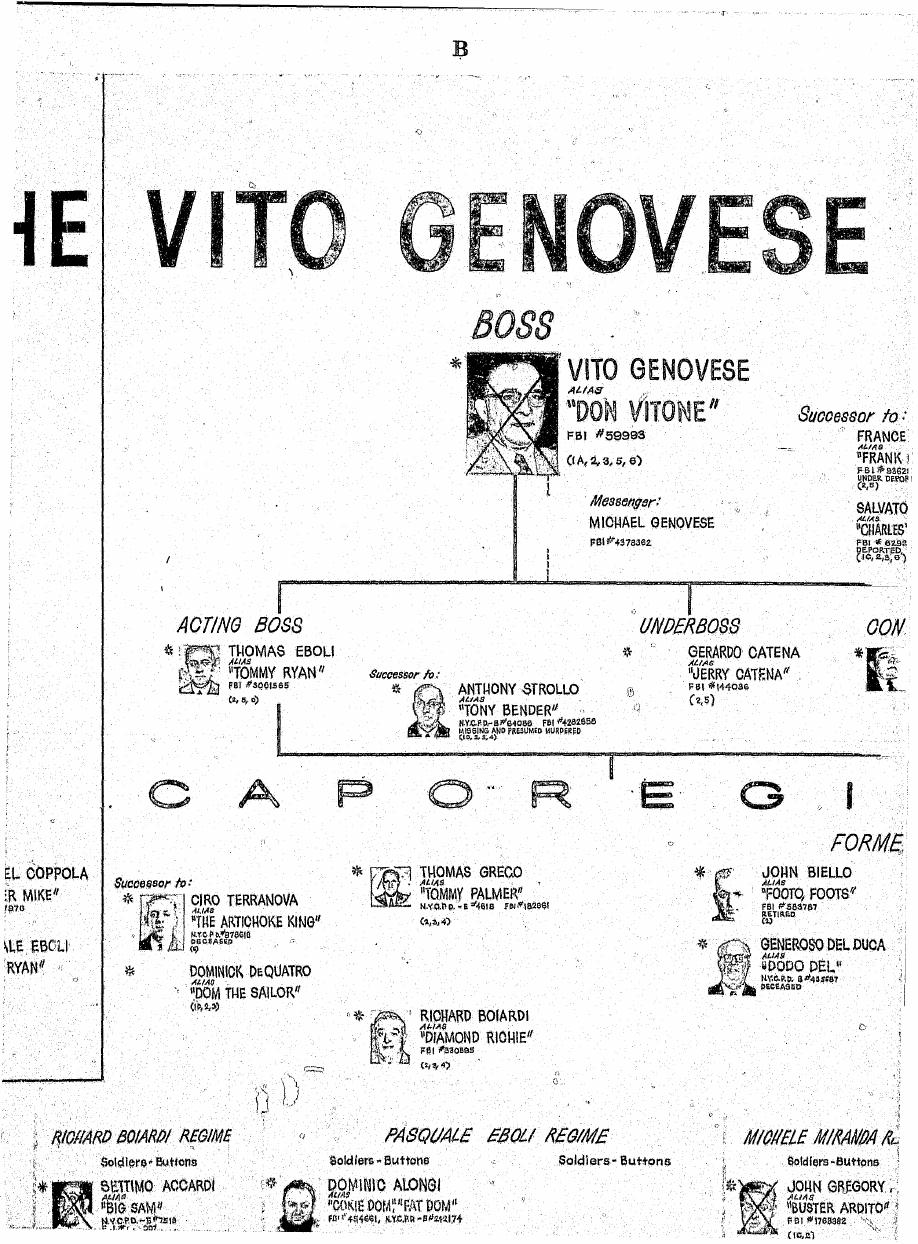
The Commissioner of Narcotics tells the Senate subcommittee that since 1956 the Bureau has "developed 20 major conspiracy cases resulting in the conviction of 206 important gangsters," naming Vito Genovese, John Ormento, Carmine Galante and Joseph Valachi, and presents the Valachi-hearing family charts marked for Bureau convictions.
- Date
- 1964-07-28
- Kind
- hearing
- Retrieved
- 2026-10-12
- Docket
- Organized Crime and Illicit Traffic in Narcotics: Hearings before the Permanent Subcommittee on Investigations of the Committee on Government Operations, United States Senate, 88th Cong., 1st and 2d sess., pursuant to S. Res. 278, 88th Cong., Part 3, printed pp. 642–678
- Rights
- A work of the United States Senate, printed by the Government Printing Office. Public domain in the United States. 17 U.S.C. § 105. The NCJRS cover sheet records reproduction permission as "Public Domain / U.S. Senate."
Henry L. Giordano testified as Commissioner of the Bureau of Narcotics on July 28, 1964, in Part 3 of the subcommittee’s narcotics hearings, at printed pages 642 to 678 (NCJRS PDF pages 714 to 774). The passages below were read from the scan’s text layer, which is imperfect; page numbers are the printed ones.
He called the Narcotic Control Act of 1956 “the most significant legislation in more than 40 years to help check the spread of addiction” (p. 644) and gave the Bureau’s count of “48,535 active addicts recorded in our central index as of December 31, 1963.” He quoted Joseph Valachi’s testimony that “all families were notified—no narcotics” (p. 646). Asked about the postwar rise in addiction, he said that when shipping reopened “the racketeers—and here is where we move into the Mafia—took advantage of this over in Italy,” diverting heroin from a manufacturing company, and that “our Luciana was one of the ones making the arrangements”; the text layer spells the name “Luciana,” and in answer to Senator Mundt he said “Lucky Luciana” (p. 651).
He then presented the family charts from the Valachi hearings, marked to show members the Bureau had convicted: “Here on Vito Genovese we have marked off those individuals of the family that the U.S. Bureau of Narcotics was responsible for convicting. In this one family we eliminated 19 percent of that family.” He gave 40 percent for the Lucchese family and 20 percent for the Gambino family. Asked what he meant by “family,” he answered: “I am using the designation on the chart” (p. 652). The marked charts are filed as a separate record.
At page 655 he said the Bureau had, “since 1956, developed 20 major conspiracy cases resulting in the conviction of 206 important gangsters, including such notorious violators as Vito Genovese, Big John Ormento, Carmine Galente and Joseph Valachi,” and that “Four Apalachin delegates are included among those who were convicted.” Asked Genovese’s term, he said, “I believe it is 20 years”; the Second Circuit’s Aviles opinion records fifteen years. He introduced lists of international and national cases since 1951, printed in the appendix at page 772, which this archive has not read. The percentages and characterizations are the Commissioner’s; they are not findings of the subcommittee.