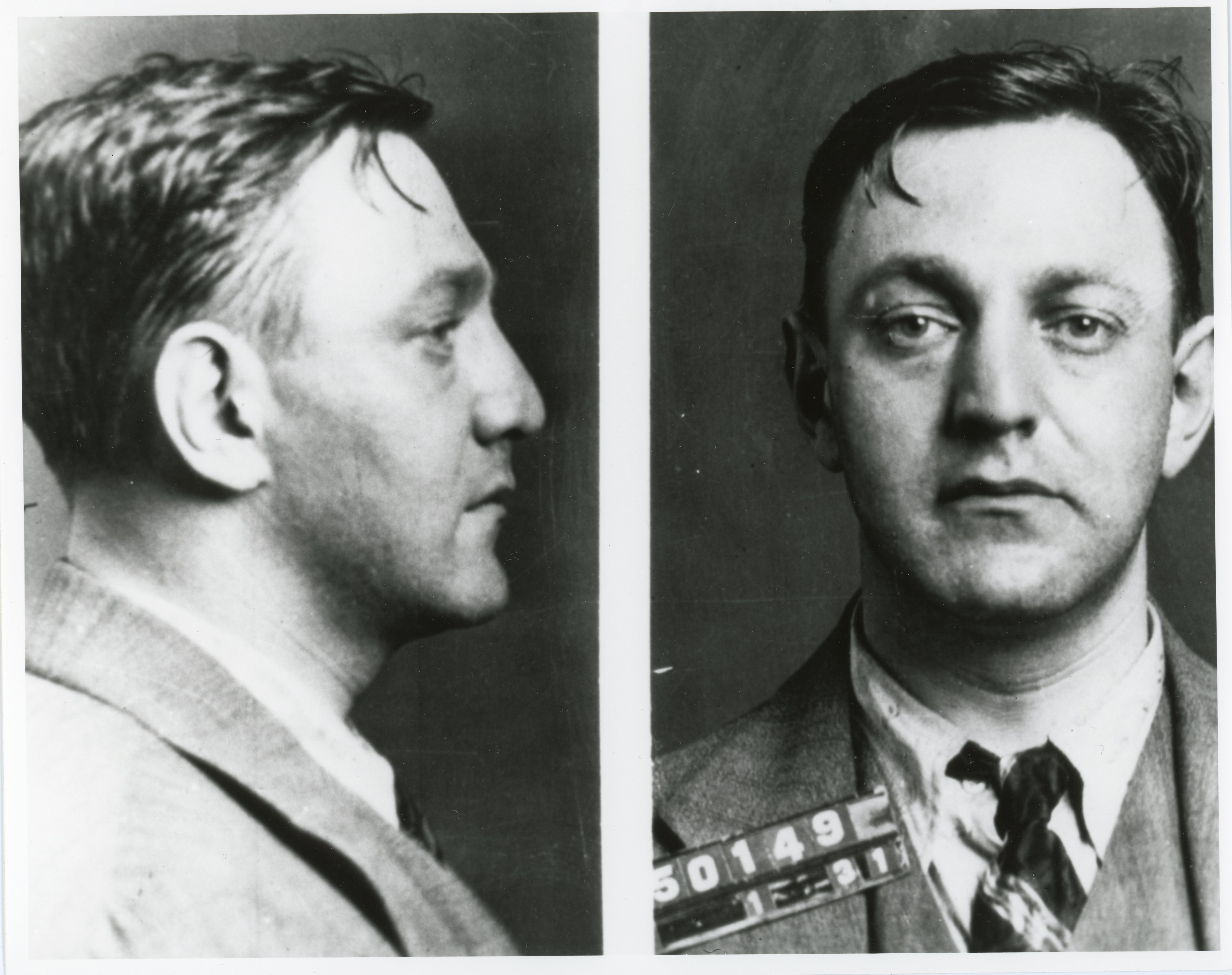
Arthur Flegenheimer (Dutch Schultz)
Named Arthur Flegenheimer, alias "Dutch" Schultz, in a Division of Investigation wanted notice of 1934 that states his indictment in the Southern District of New York on January 25, 1933 for violation of the federal income tax law. The FBI states he was shot at the Palace Chop House in Newark on October 23, 1935 and died the next day. No record filed here states a family or rank.
- Born
- 1901
- Died
- 1935-10-24
- Aliases
- Dutch Schultz, Arthur Schultz, George Schultz, Charles Harman, Charles Harmon, Joseph Harmon, Arthur New, Charles New, Artie, The Dutchman, Arthur Simon Flegenheimer
- Rights
- Biography on this page is limited to what the cited records state. The photograph is held by the National Archives in the records of the FBI and is marked unrestricted for use.
On the record
- 1933-01-25 — The Division of Investigation's Identification Order No. 1234 (November 19, 1934) states: "Arthur Flegenheimer was indicted in the United States District Court, Southern District of New York on January 25, 1933, for violation of the Federal Income Tax Law." It gives his birth as 1901 in New York City. A wanted notice states a charge, not a finding.
- 1934 — A Treasury Department Intelligence Unit broadside of 1934 states that "Flegenheimer is under indictment jointly with Henry Margolis (alias Henry Stevens), Frank J. Ahearn and George Yarlasavetsky."
- 1934-12-24 — In Westheimer v. Collector, 12 F. Supp. 20, the District Court for the Southern District of New York states that "An assessment for income tax was entered against one Flegenheimer, alias Dutch Schultz, in the amount of $79,000," and that the Collector served a levy on a bank account on December 24, 1934 (court record).
- 1935-07 — A private person's letter to J. Edgar Hoover, stamped July 30, 1935 in the FBI's file 23-2130, refers to "the trial of Arthur ( Dutch Schults )Flegenheimer, now being held at Malone, N.Y." The letter does not name the court or the charge.
- 1935-10-23 — The FBI's Palace Chop House artifact page states that Arthur Flegenheimer (Dutch Schultz) and four associates were shot at the Palace Chop House in Newark, New Jersey, on the night of October 23, 1935, and that Schultz died the next day.
- 1935-10-25 — An FBI memorandum for the Director of October 25, 1935 records the New York Special Agent in Charge's theory about "the death of "Dutch" Schultz as a result of his being shot by gangsters." It is an opinion recorded by the Bureau and names no suspect.
- 1940-04-25 — An FBI memorandum of April 25, 1940 says that Schultz "was originally involved in an income tax matter with the Federal authorities" and that "primarily the Bureau was not investigating this case," meaning "the murder of Dutch Schultz in Newark some years ago."
The heading follows the National Archives file title, “U.S. v. Arthur Flegenheimer, alias “Dutch Schultz.”” The aliases above are those printed on the 1934 identification order and the Treasury broadside, with “Arthur Simon Flegenheimer” from the National Archives photograph record. Newspapers and the FBI’s own files also spell the surname “Flagenheimer” and the alias “Schults.”
The federal record of Schultz is a tax case. The identification order and the broadside state an income-tax indictment, the Westheimer opinion states a $79,000 assessment, and the FBI’s 1940 memorandum says the Bureau “was not investigating” his killing, which it treated as a matter for the New Jersey authorities. No reported opinion from the 1935 criminal tax trials has been found, and the case file at the National Archives is only partly digitized. The FBI’s account of the Newark shooting is the artifact page; the newspaper pages of October 1935 that describe it are not filed, because their rights have not been cleared.
A 1930 newspaper page names “Arthur Flagenheimer, alias Dutch Schultz, Bronx beer baron” among men held for questioning after the shooting of Jack Diamond (Indianapolis Times, 16 October 1930). That is a wire service’s report, and no charge is stated.
The 1934 order also lists New York arrests from 1919 to 1931, some of them marked as unsupported by fingerprints, with dispositions that are mostly discharges. They are on the order’s page and are not repeated here. No record filed on this page states a family, a rank, or a role in any organization.
Records
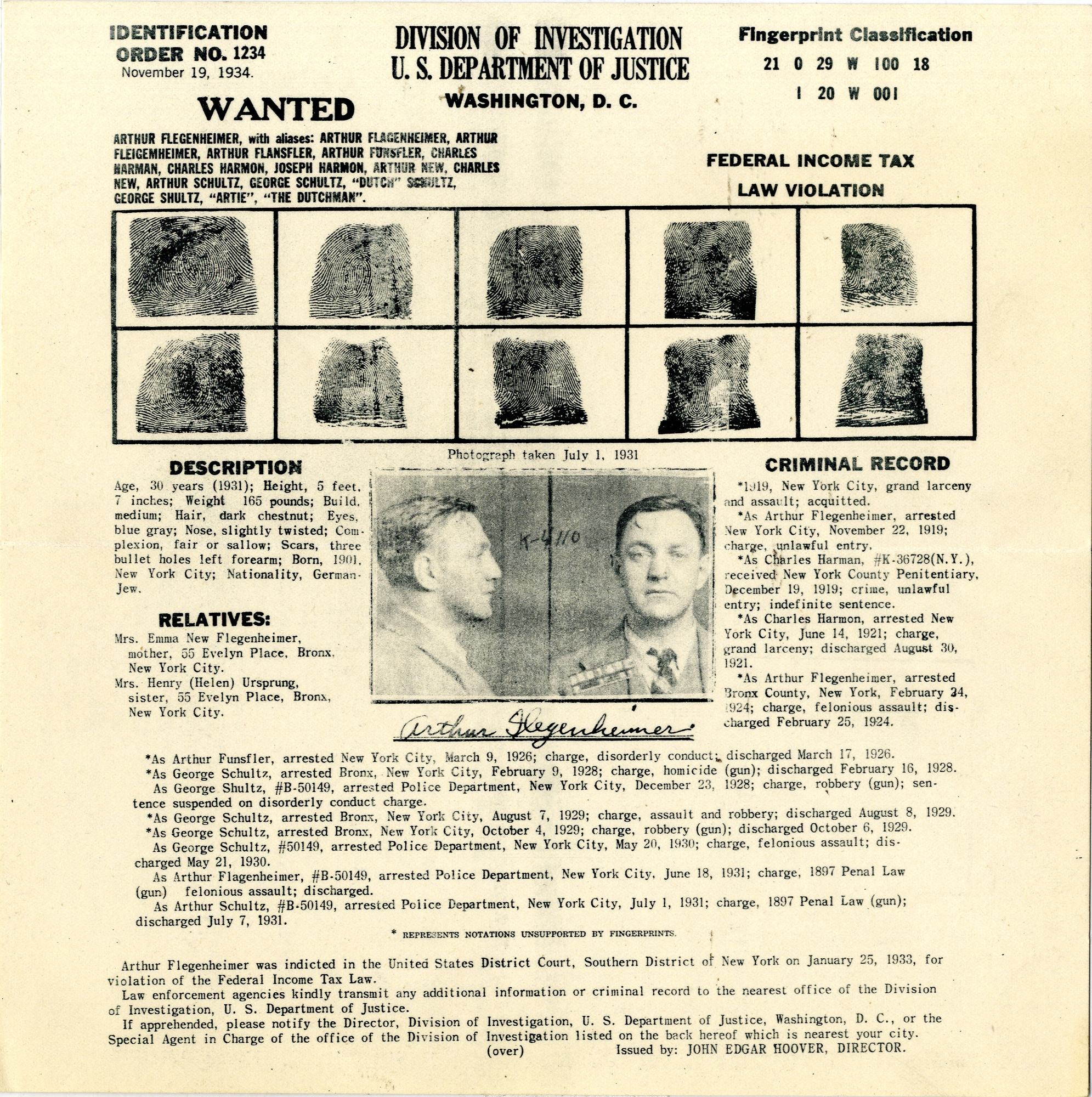 itemIdentification Order No. 1234: Arthur Flegenheimer, "Federal Income Tax Law Violation" (19 November 1934)Division of Investigation wanted notice for Arthur Flegenheimer, with aliases including "Dutch" Schultz, indicted in the Southern District of New York on 25 January 1933 for violating the federal income tax law. A copy is stored here.
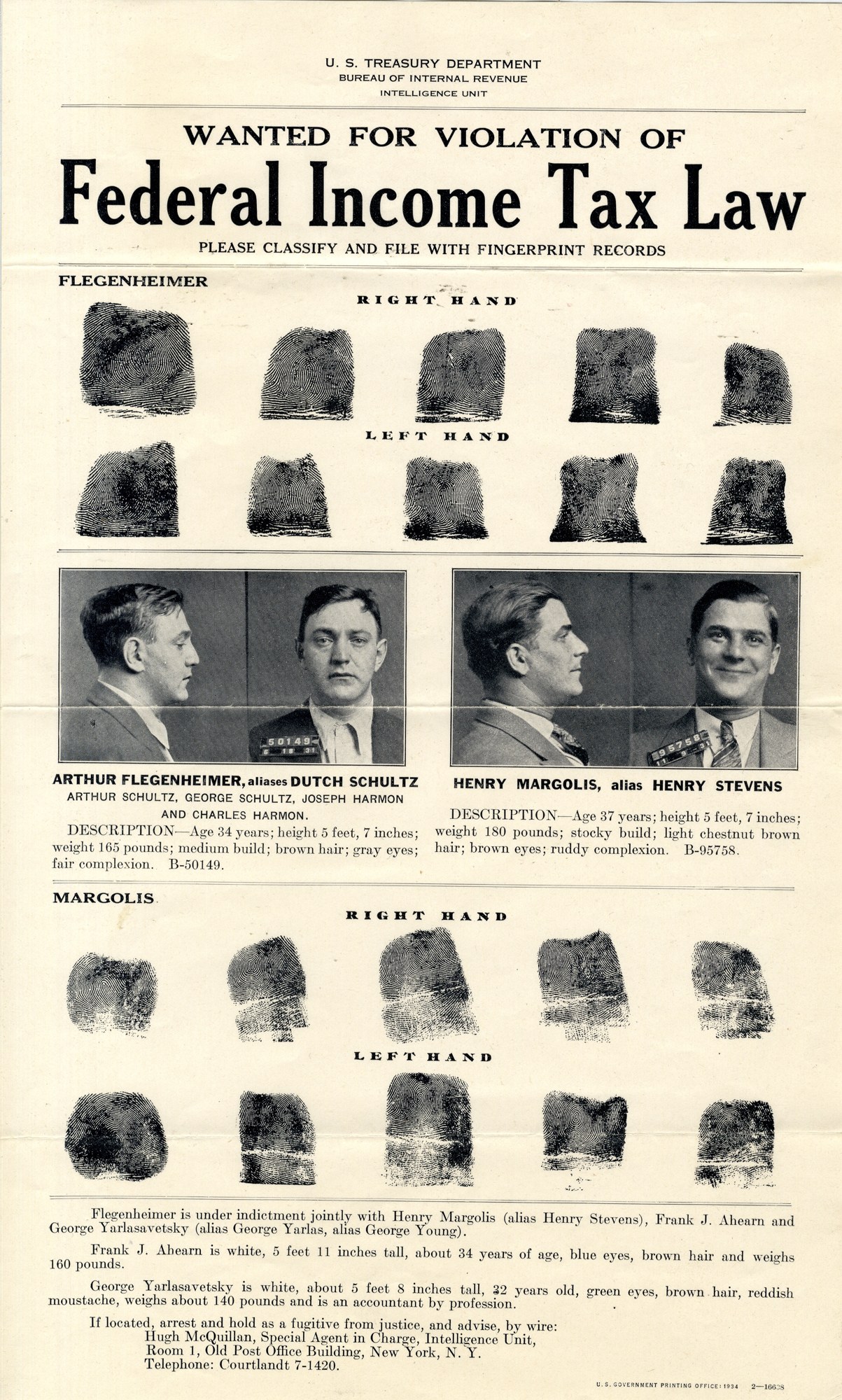 item"Wanted for Violation of Federal Income Tax Law": Treasury broadside for Arthur Flegenheimer and Henry Margolis (1934)A 1934 Treasury Department, Bureau of Internal Revenue, Intelligence Unit broadside with fingerprints and booking photographs of Arthur Flegenheimer ("Dutch Schultz") and Henry Margolis. A copy is stored here.itemU.S. v. Arthur Flegenheimer, alias "Dutch Schultz" (National Archives file unit)National Archives catalog entry for the case file of the United States Attorney for the Southern District of New York on Arthur Flegenheimer, held in Boxes 64 to 75 at the National Archives at Kansas City. Two items in it are digitized: the 1934 identification order and the Treasury broadside.itemPeople v. Hines, 284 N.Y. 93 (1940)New York Court of Appeals opinion of 8 October 1940 affirming James J. Hines's conviction for conspiracy to conduct the lotteries known as the "numbers game" and "policy." It states that in 1931 "the notorious Dutch Schultz" and associates formed a combination to control policy enterprises. It does not mention Harlem or any Black policy operator.itemDutch Schultz mug shot (National Archives, 65-CC-37-3)Undated front and profile mug shot of Dutch Schultz, also known as Arthur Simon Flegenheimer, held by the National Archives in the FBI's criminal-case photograph series. A copy is stored here.itemWestheimer v. Collector of Internal Revenue, 12 F. Supp. 20 (S.D.N.Y. 1935)District Court opinion of 1935 dismissing a petition over a tax levy on a bank account: it states that an income-tax assessment of $79,000 was entered "against one Flegenheimer, alias Dutch Schultz," and that the Collector levied on an account in another person's name on December 24, 1934.
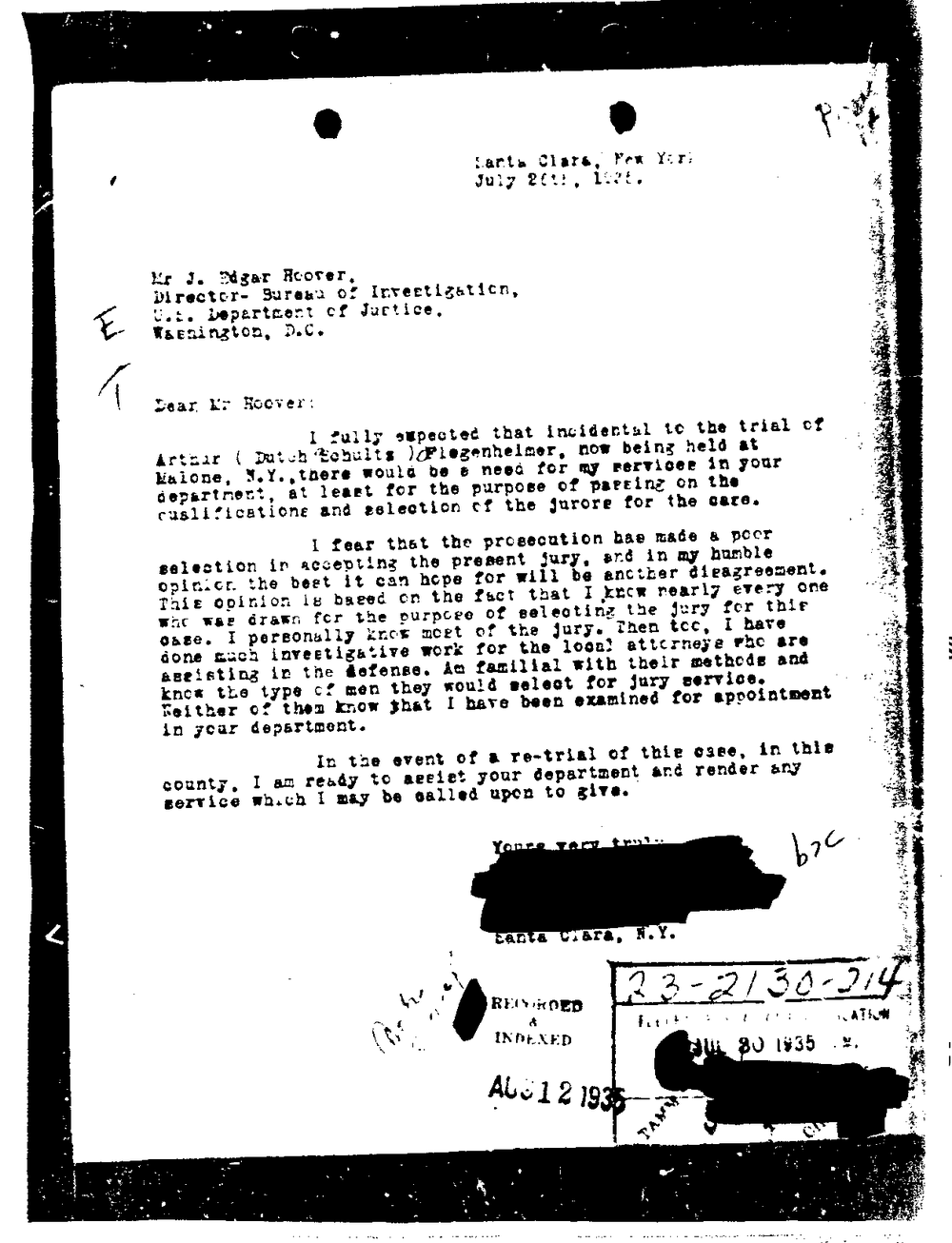 itemFBI Vault: Arthur Flegenheimer (Dutch Schultz), Part 01First of five parts of the FBI's file 23-2130 on Arthur Flegenheimer. The scans are poor; the clearest page is a July 1935 letter to J. Edgar Hoover about the jury at Flegenheimer's trial "now being held at Malone, N.Y." That page is stored here.
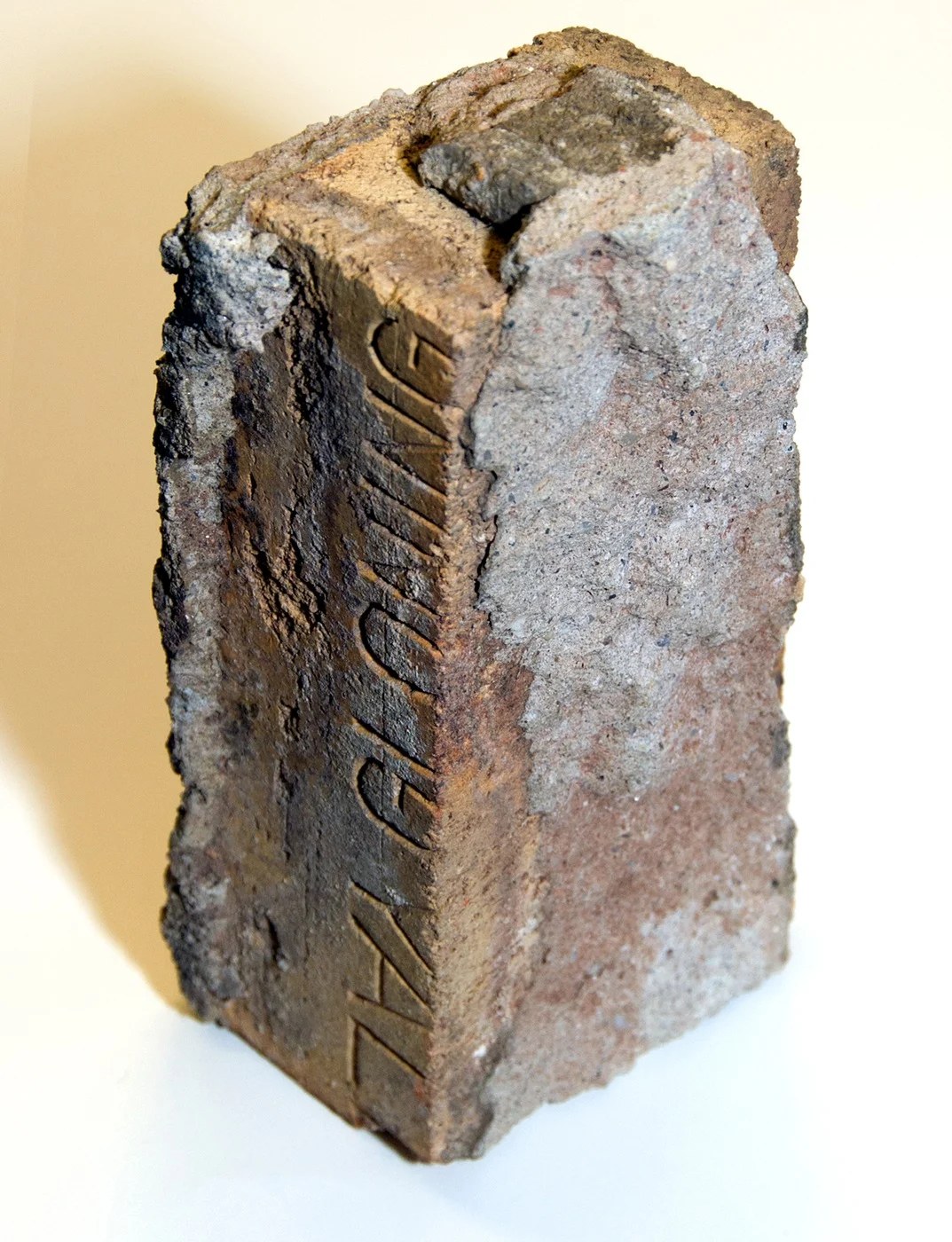 itemBrick from the Palace Chop House, Newark, New Jersey, 23 October 1935 (FBI artifact)FBI photograph of a brick salvaged from the Palace Chop House in Newark, where Arthur Flegenheimer, known as Dutch Schultz, and four associates were shot on the night of 23 October 1935.
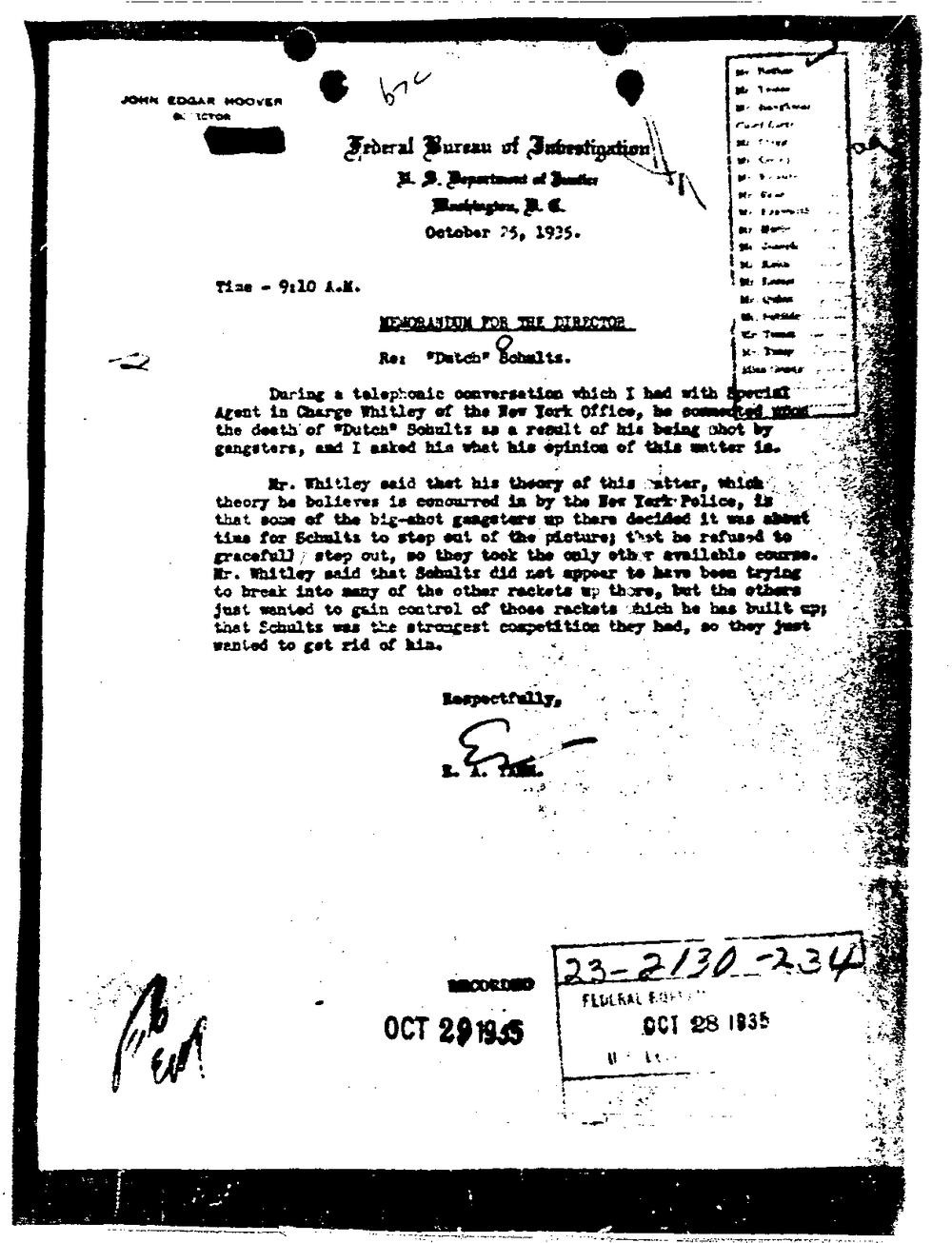 itemFBI memorandum for the Director: "Dutch" Schultz (October 25, 1935)A one-page memorandum of October 25, 1935, signed by E. A. Tamm, recording the New York Special Agent in Charge's theory about the shooting of Dutch Schultz. It is the Bureau's record of an opinion, and it names no suspect. The page is stored here.
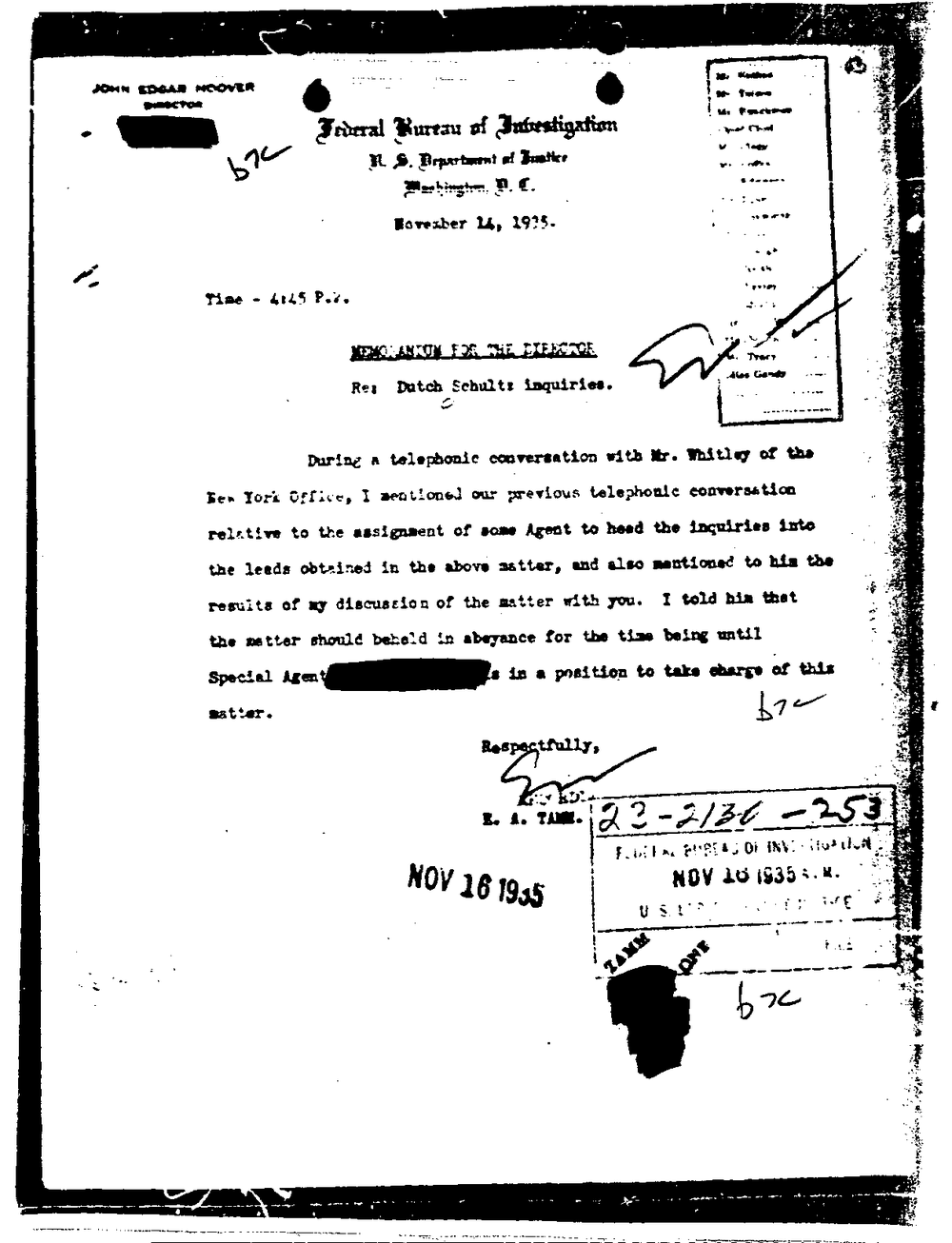 itemFBI memorandum for the Director: "Dutch Schultz inquiries" (November 14, 1935)A one-page memorandum of November 14, 1935, signed by E. A. Tamm, telling the New York office that inquiries into leads in the Schultz matter "should be held in abeyance" until a named agent could take charge. The page is stored here.
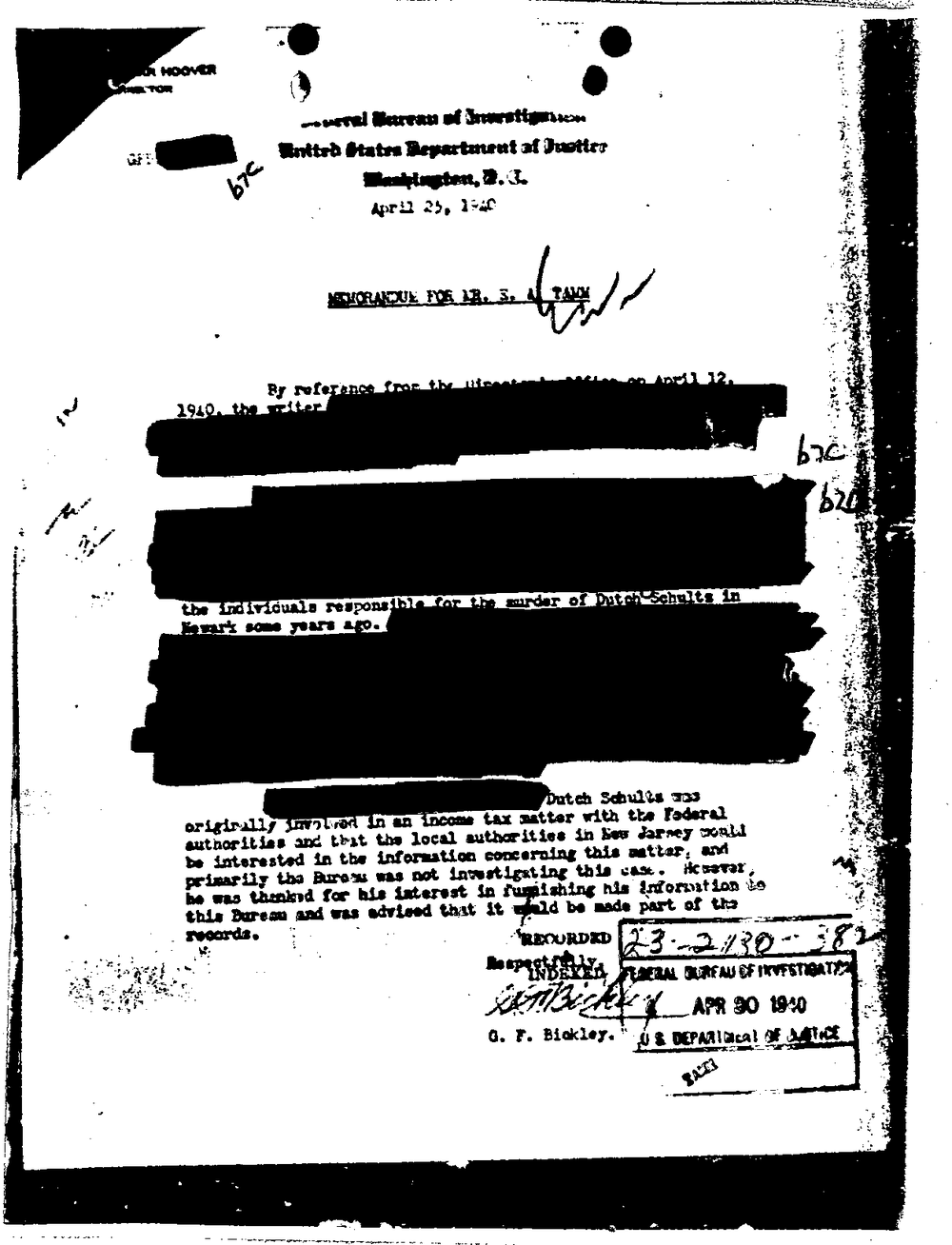 itemFBI memorandum: information on "the murder of Dutch Schultz in Newark" (April 25, 1940)A heavily redacted memorandum of April 25, 1940 from G. F. Bickley to E. A. Tamm recording a caller's information about the Newark killing of Dutch Schultz, and stating that "primarily the Bureau was not investigating this case." The page is stored here.itemFBI memorandum on "Charles Luciana, with aliases" (August 28, 1935)A copy of a Bureau memorandum of August 28, 1935, at the start of the FBI's Luciano file: what the Bureau's files held on him, a reporter's July 1935 account of contacts in which Luciano was said to offer help finding the fugitive Karpis, and his arrest record from 1921 to 1931.