Santo Trafficante, Jr.
The subject of a Tampa and Cuba record from 1950 to 1979: Kefauver rumor, FBI memoranda on his Havana casinos and his 1959 detention, Tampa police testimony, a 1964 tax-lien opinion, the Church Committee's passages, and the House committee's report, which calls him the 'La Cosa Nostra leader in Florida' and concludes it is unlikely he plotted the President's death.
- Born
- 1914-11-15
- Aliases
- Santos Trafficante, Jr., Santos Trafficante (Church Committee spelling), Santo Trafficante, Jr. (Kefauver Committee spelling), Santos Traficante, Jr. (FBI spelling, 1956), Louis Santos (the name at Apalachin, as the Tampa police identified it, 1963), B. Hill (alias the Tampa police said he used in October 1957)
- Role
- As characterized by the House Select Committee on Assassinations (1979, p. 172): "the La Cosa Nostra leader in Florida." The Church Committee (1975, p. 77): "the Cosa Nostra chieftain in Cuba." Characterizations in congressional committee reports, not court findings.
- Source
- House Select Committee on Assassinations, Report (1979), pp. 172-175, via the National Archives
- Rights
- Biography on this page is limited to what the cited federal records state.
On the record
- 29-30 December 1950 — At the Tampa hearings, Lt. Charles A. Marvin said he had heard street talk that Trafficante Jr. would head the Tampa gambling syndicate ("rumor"), and Oscar Perez, repeating what Jimmy Velasco told him, said the Trafficantes fronted for one section of it and that he could not vouch for it (Kefauver Part 1-A, pp. 146, 243-244). Secondhand testimony.
- 30 September 1953 — An FBI Miami memorandum (Vault, Trafficante Part 01; OCR only) states he was born 15 November 1914 at Tampa, and repeats informant and newspaper allegations that he headed an "Italian Syndicate" in Tampa, that he was shot by shotgun blasts on 2 January 1953 by unknown assailants, and that a state subpoena was served on 23 August 1953.
- 30 September 1955 — An FBI Miami memorandum (Vault, Trafficante Part 01) states that "In recent months SANTO TRAFFICANTE, JR. has been making frequent trips to Havana, Cuba, where he is closely associated with NORMAN ROTHMAN," and that in Cuba he "hangs out around the Sans Souci Night Club outside of Havana, and at the Sevilla Biltmore Hotel." A 1957 Miami airtel says the memo gave no source for the hangouts.
- 1 November 1955 — A 1971 FBI correlation summary (Vault, Trafficante Part 04) relays a report that the Sevilla Biltmore Hotel in Havana was approved to open a gambling establishment and that Trafficante "had been selected to operate the gambling casino," over the hotel manager's objection.
- 28 September 1956 — An FBI Miami memorandum states: "Subject still active in gambling casino at the Sans Souci Hotel outside of Havana, Cuba," and an informant said the same on 3 August 1956.
- 20 December 1956 — The same 1971 summary records the Legal Attache's letter that the Sans Souci Night Club and gambling casino "was owned and operated by Santos Traficante, Jr., and Joe Stassi, a more or less silent partner." A Miami airtel of 29 July 1957 names that letter and an informant's report of 3 August 1956 as the sources for the line that he "owns and operates the Sans Souci Night Club and Casino in Havana."
- 29 March 1957 — An FBI Miami memorandum records that Trafficante and his brother Henry, charged with conspiring to violate the gambling tax laws, had their federal case moved from Tampa, that the Florida Supreme Court had granted them new trials in January 1957, and that the Legal Attache at Havana advised on 20 December 1956 that the Sans Souci Night Club and gambling casino was operated by Trafficante.
- 1958 — The 1971 FBI summary relays Legal Attache and informant reports that he was "one of the major interest holders" in the Hotel Capri casino (25 September 1958) and "appeared to have been one of the interest holders in the Havana-Riviera casino" (3 December 1958). Informant reporting.
- January to May 1959 — The same summary records the Legal Attache's reports that after the fall of the Batista government "there had been an exodus of gamblers and top hoodlums from Havana," while some, including Trafficante, remained to see if they could "deal" with the new government (15 January 1959), and that the Sans Souci casino, "formerly operated by Santo Trafficante," had closed "because of financial problems" and that he had gone into hiding in Cuba (21 May 1959).
- June to August 1959 — The House committee states that on 6 June 1959 he and others controlling gambling interests in Cuba were detained at Trescornia, and that Cuban documents show his release on 18 August 1959 (HSCA report, p. 153).
- 1959 — FBI file summaries in the 1971 correlation summary refer to him as "confined in the Cuban Immigration detention house 'Tiscornia'," arrested "reportedly as a result of a telegram from the US Narcotics Commissioner," and "detained by the Cuban police for possible deportation but was released."
- 15 October 1963 — Tampa police chief Neil G. Brown testified that he "previously lived in Havana, Cuba, where he owned and operated gambling casinos under the Battista regime," that when Castro took over his operations were stopped and he "was expelled from Cuba," and that the "Louis Santos of Havana, Cuba," apprehended at Apalachin in November 1957 was identified as Santo Trafficante, Jr. (Senate narcotics hearings, pp. 524-525). A police chief's statement.
- 31 January 1964 — United States v. Trafficante, 328 F.2d 117 (5th Cir. 1964), states that on 11 January 1962 the United States sued him and Sam Trafficante to foreclose federal tax liens including 1945-1947 income taxes, and asserted a wagering-tax liability. The court ordered the disqualification of a former IRS attorney.
- 20 November 1975 — The Church Committee's interim report states he "made regular trips between Miami and Cuba on gambling syndicate business" and records Rosselli's account, denied by Maheu, of a meeting at the Fountainebleau Hotel in Miami (S. Rept. 94-465, pp. 77, 80-82).
- 1979 — The House committee finds he had "the motive, means, and opportunity" to assassinate President Kennedy, notes that he admitted taking part in the CIA plot against Castro, and concludes it is unlikely that he plotted to kill the President (HSCA report, pp. 172-175).
The role line is a committee’s characterization, quoted and labelled by kind, and is not a finding of a court. The House Select Committee on Assassinations calls him “the La Cosa Nostra leader in Florida,” and the Church Committee calls him “the Cosa Nostra chieftain in Cuba.” An FBI memorandum of 1968 calls him “boss” of La Cosa Nostra in Florida on a source’s inference; because it rests on a source, it is not used in the role line. The same House report concludes that it is unlikely he plotted to kill President Kennedy, though it could not rule the possibility out on the available evidence. None of these labels is copied to a family chart without a separate cited decision.
The Tampa material in the Kefauver volume about him is hearsay or counsel’s questions. The FBI Vault records were read on the viewer’s text layer, and page images are now stored for several of them. The 1971 correlation summary is a digest of informant and Legal Attache reports, and it repeats “boss” and Mafia labels from informants and newspapers that are not copied here. The three accounts of how the Havana casinos ended (the Church Committee’s, Joseph Valachi’s and Lewis McWillie’s) are set out separately on the Havana page. This page records each statement with its speaker.
Records
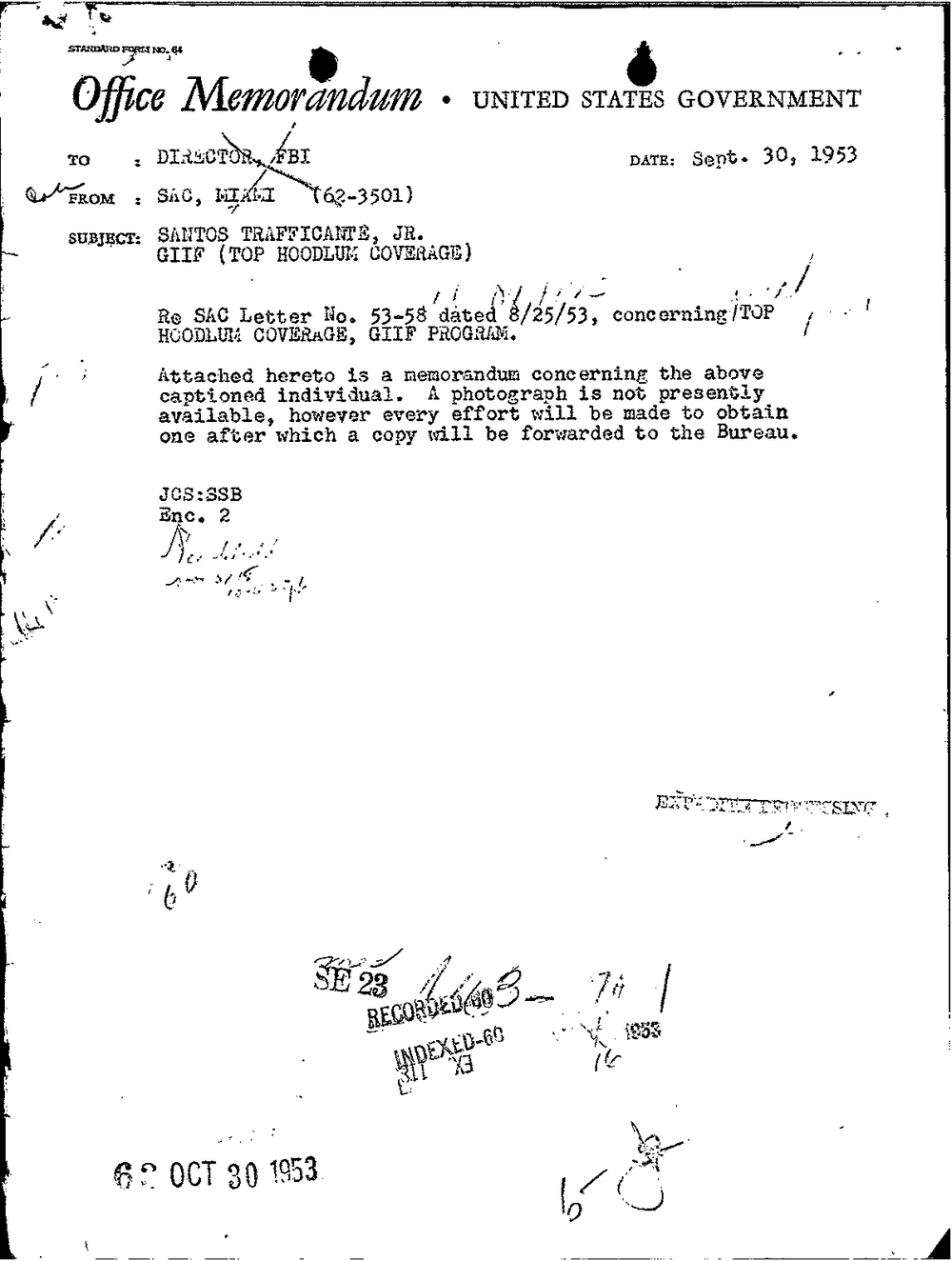 itemFBI Miami memorandum on Santos Trafficante, Jr.: Top Hoodlum Coverage (30 September 1953)A Miami office memorandum to the Director transmits a background memorandum on Santos Trafficante, Jr., with birth data for him and his father and informant and newspaper allegations that the family headed an 'Italian Syndicate' in Tampa.
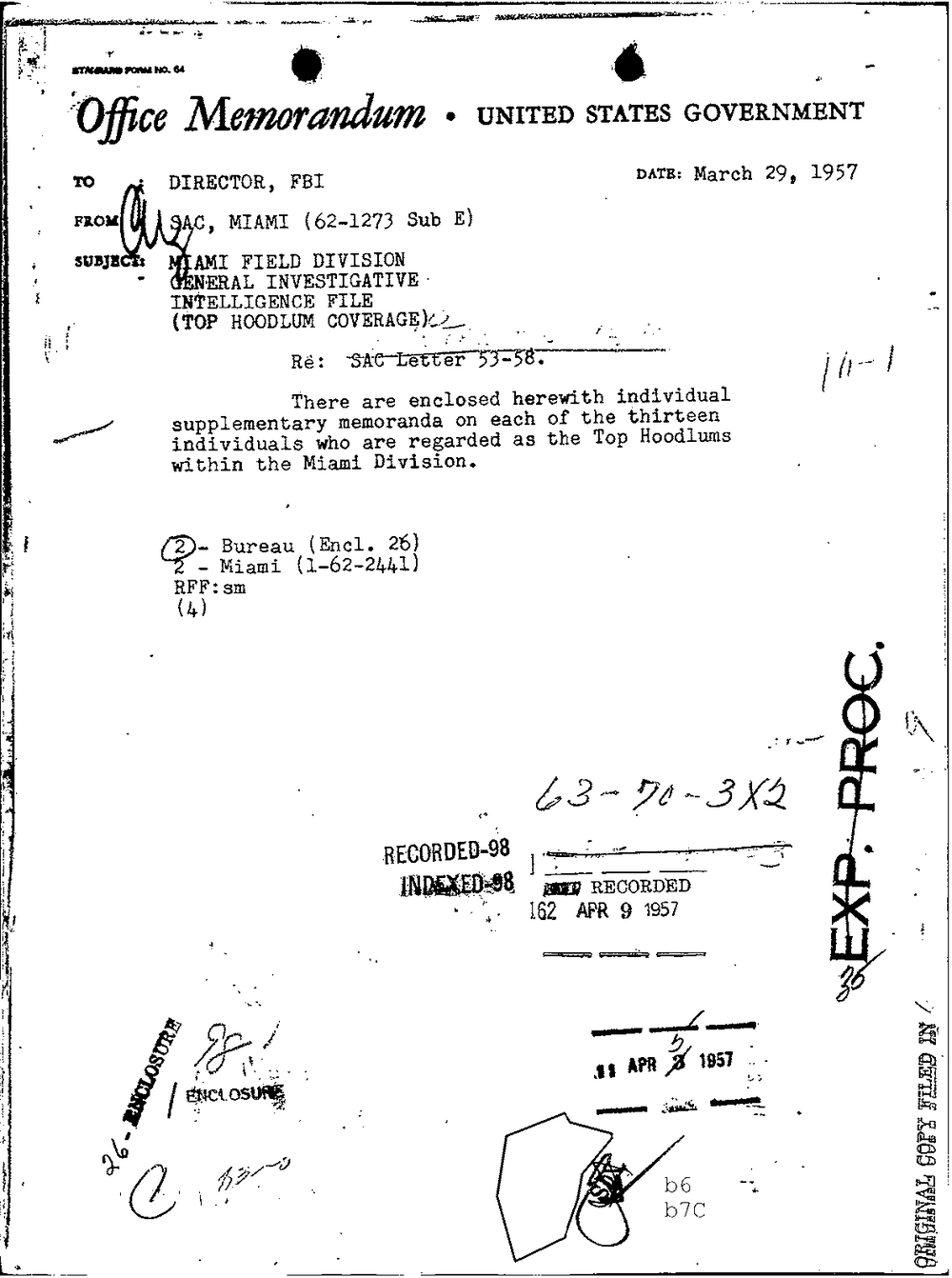 itemFBI Miami memorandum on Santo Trafficante, Jr.: the federal gambling-tax case and Havana's Sans Souci casino (29 March 1957)A supplementary FBI memorandum on Miami-division 'top hoodlums' reports the Trafficante brothers' gambling-tax charge and new trials, and that the Legal Attache at Havana advised on 20 December 1956 that the Sans Souci Night Club and casino was operated by Trafficante.
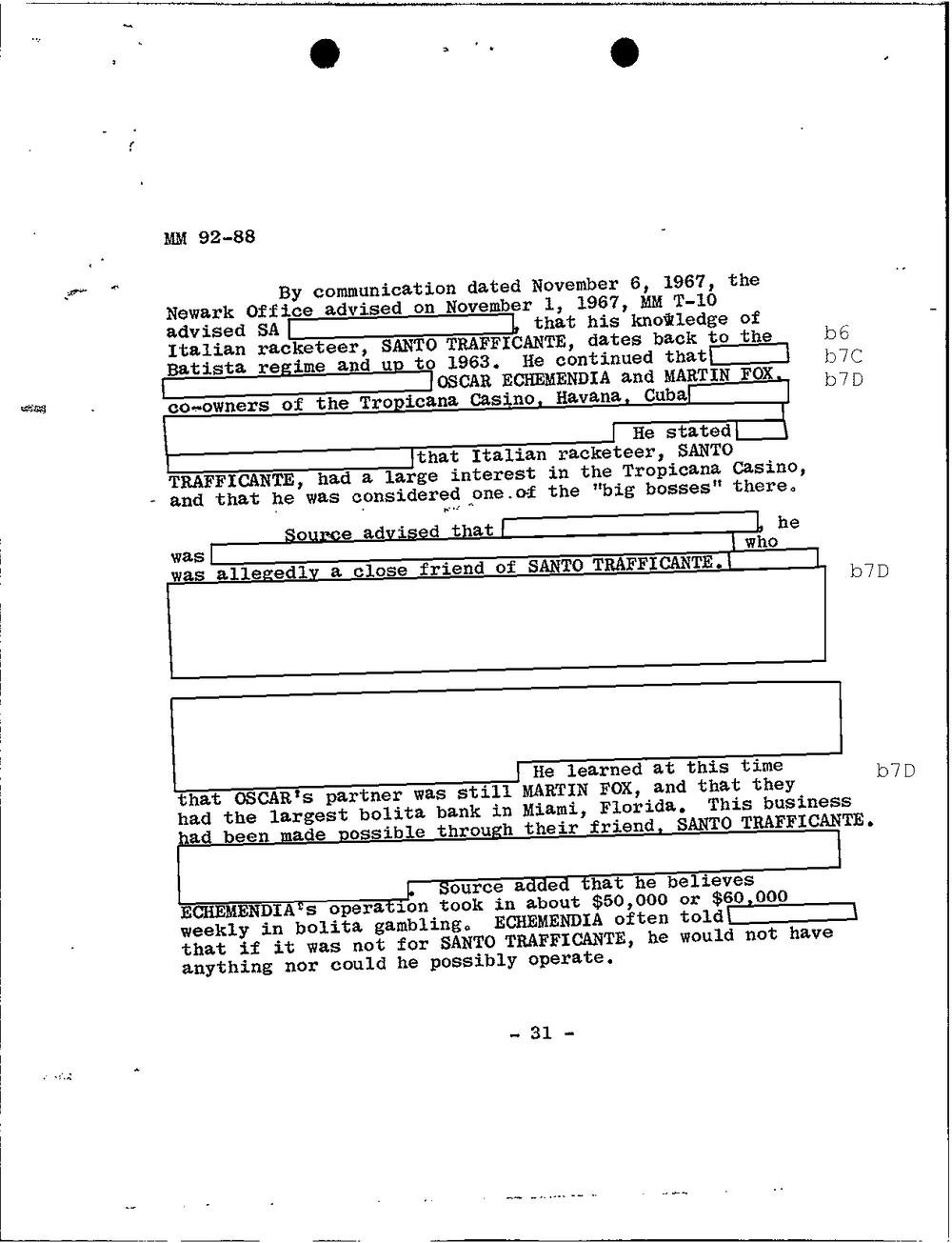 itemFBI Miami file 92-88, November 1967: a source's report on Trafficante and the Tropicana Casino in HavanaA paragraph in the Miami field-office file relays a November 1967 Newark Office communication in which a confidential source says Trafficante had 'a large interest in the Tropicana Casino' in Havana and was considered one of the 'big bosses' there. The source is redacted.
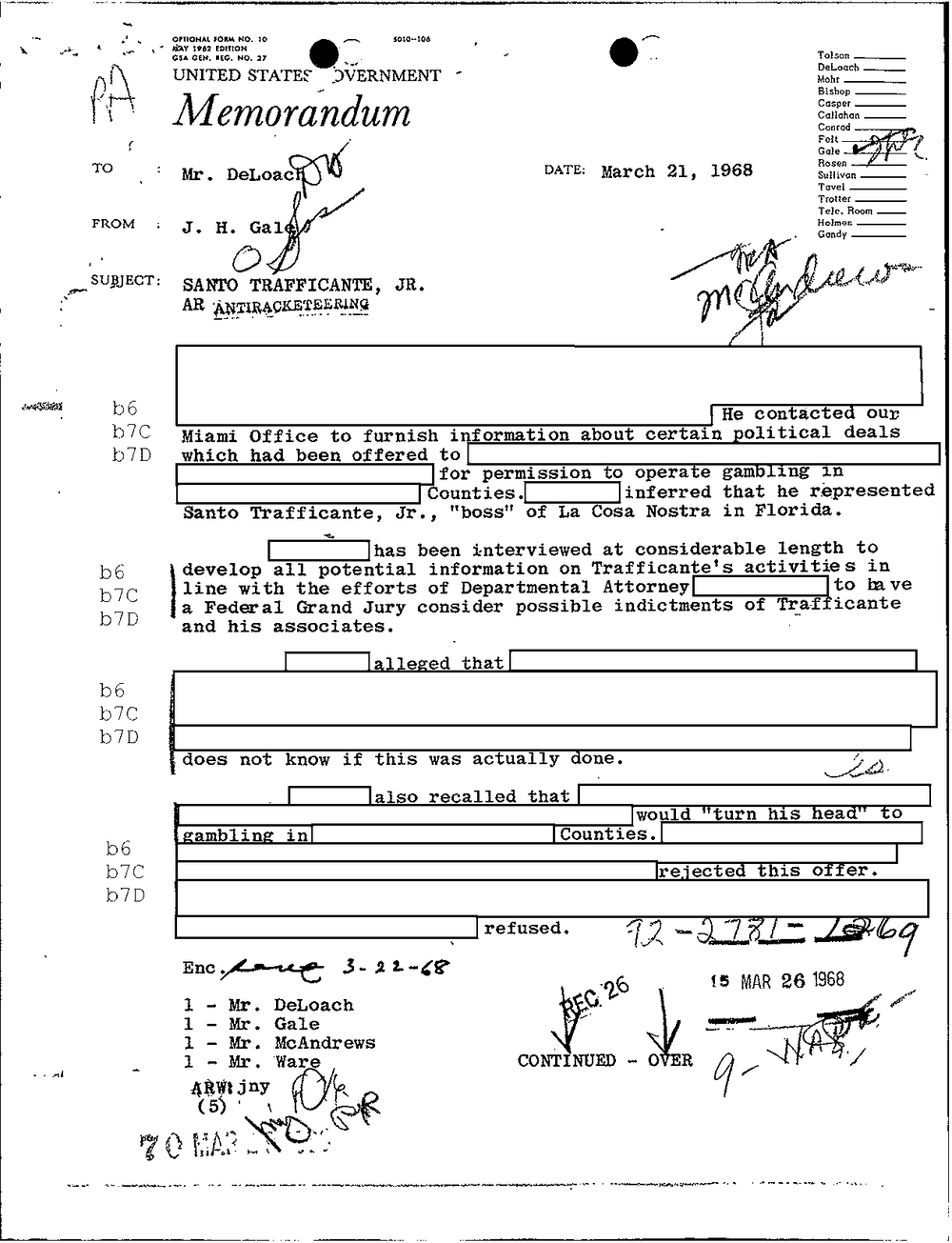 itemFBI memorandum, J. H. Gale to Mr. DeLoach: Santo Trafficante, Jr., called 'boss' of La Cosa Nostra in Florida (21 March 1968)A headquarters memorandum on a source's information about political arrangements said to have been offered for permission to operate gambling in Florida counties describes Santo Trafficante, Jr. as 'boss' of La Cosa Nostra in Florida and records that a Departmental Attorney was seeking a federal grand jury.itemUnited States v. Santo Trafficante, Jr., 328 F.2d 117 (5th Cir. 1964)The Fifth Circuit reverses and orders the disqualification of a former IRS attorney from representing the Trafficantes in the government's 1962 suit to foreclose federal tax liens. It states that the suit was filed on 11 January 1962; the court finds no intentional wrongdoing.itemKefauver Part 1-A: testimony of Lt. Charles A. Marvin, former Tampa police officer (29 December 1950)A former Tampa patrolman repeats street talk that Santo Trafficante, Jr. would head the gambling syndicate and that Santo Trafficante, Sr. had 'supposedly or allegedly' been head of the Mafia in Tampa for twenty years. By his own account the statements are rumor. Pp. 137-150.itemKefauver Part 1-A: testimony of Oscar Perez, Miami (30 December 1950)Jimmy Velasco's former chauffeur agrees with counsel's list of sections of the Tampa syndicate, including 'The Trafficantes in another section,' and repeats what Velasco told him, adding that he cannot vouch for it. Pp. 242-253, syndicate passage at pp. 243-244.itemHouse Select Committee on Assassinations: immunity orders, Thomas through Trafficante (NARA file unit 641695970)A National Archives file unit of immunity orders and orders compelling testimony before the House Select Committee on Assassinations, alphabetically from Thomas, Carl through Trafficante, with 158 digital scans. The title shows an order concerning Trafficante is in it; the scans were not opened.
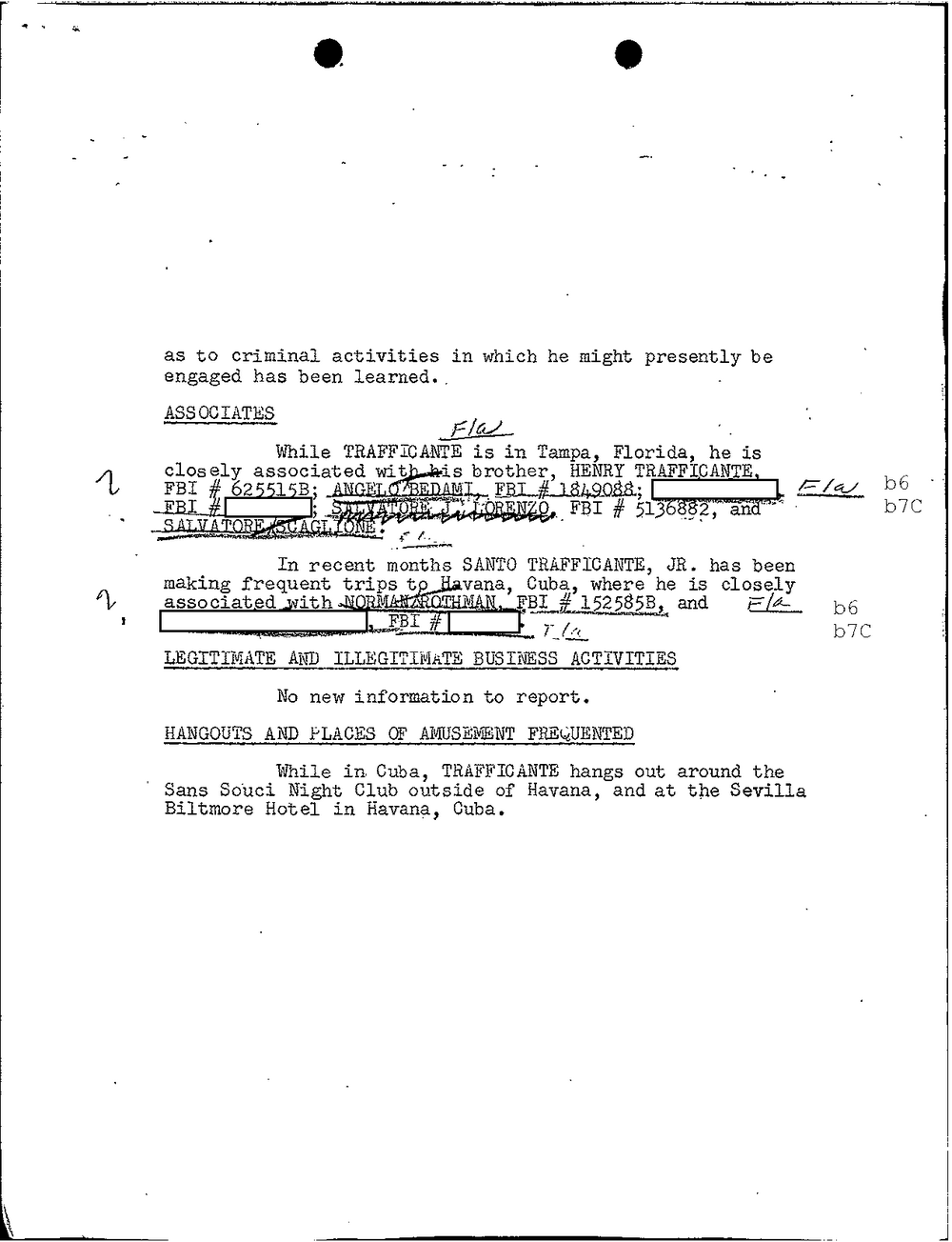 itemFBI Miami memorandum on Santo Trafficante, Jr., 30 September 1955: frequent trips to Havana, the Sans Souci and the Sevilla BiltmoreA semi-annual 'Top Hoodlum' memorandum states that 'In recent months SANTO TRAFFICANTE, JR. has been making frequent trips to Havana, Cuba, where he is closely associated with NORMAN ROTHMAN,' and that in Cuba he 'hangs out around the Sans Souci Night Club outside of Havana, and at the Sevilla Biltmore Hotel.'
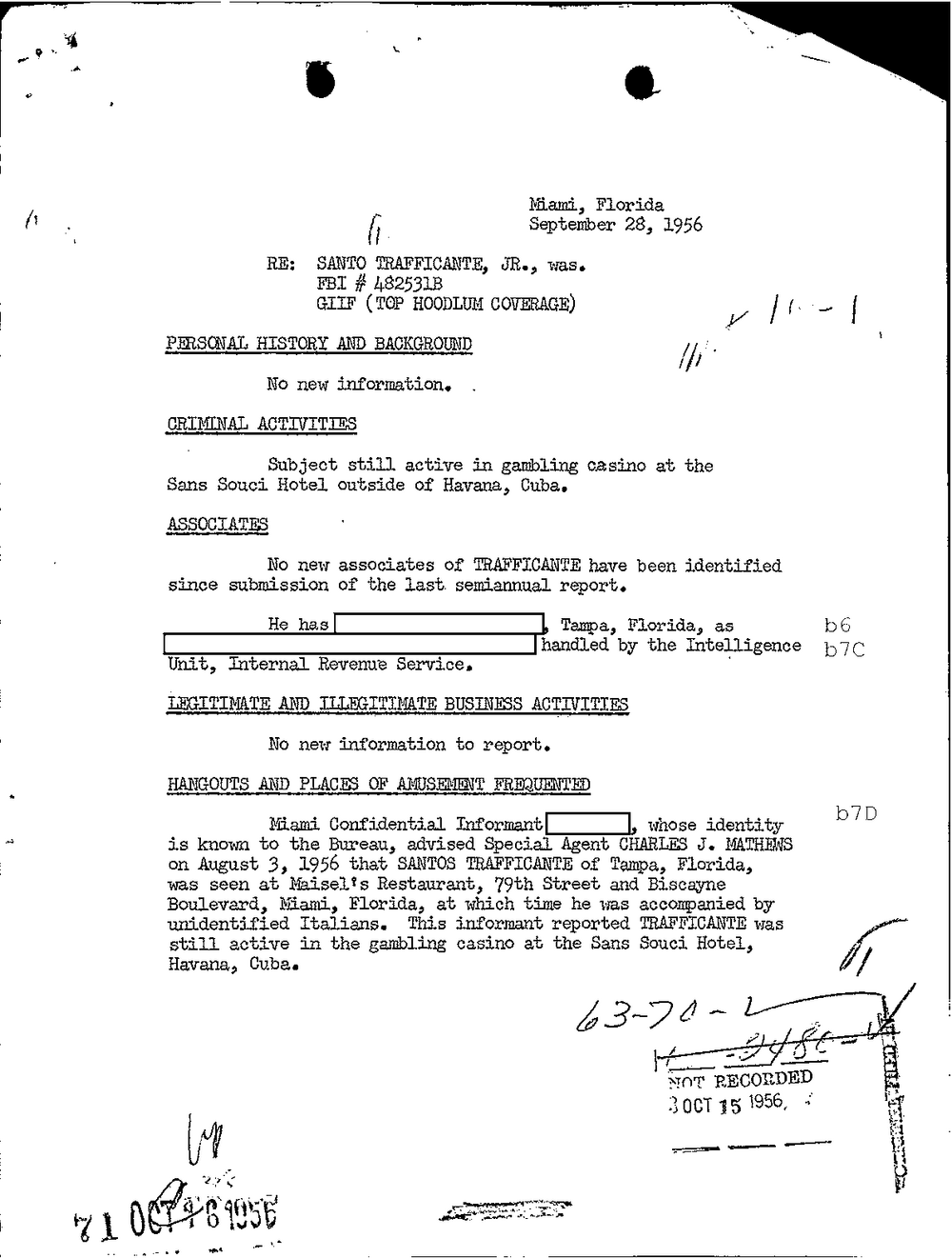 itemFBI Miami memorandum on Santo Trafficante, Jr., 28 September 1956: 'Subject still active in gambling casino at the Sans Souci Hotel outside of Havana, Cuba'The next semi-annual memorandum reports under criminal activities that the subject is 'still active in gambling casino at the Sans Souci Hotel outside of Havana, Cuba,' and that a Miami informant said the same on 3 August 1956.
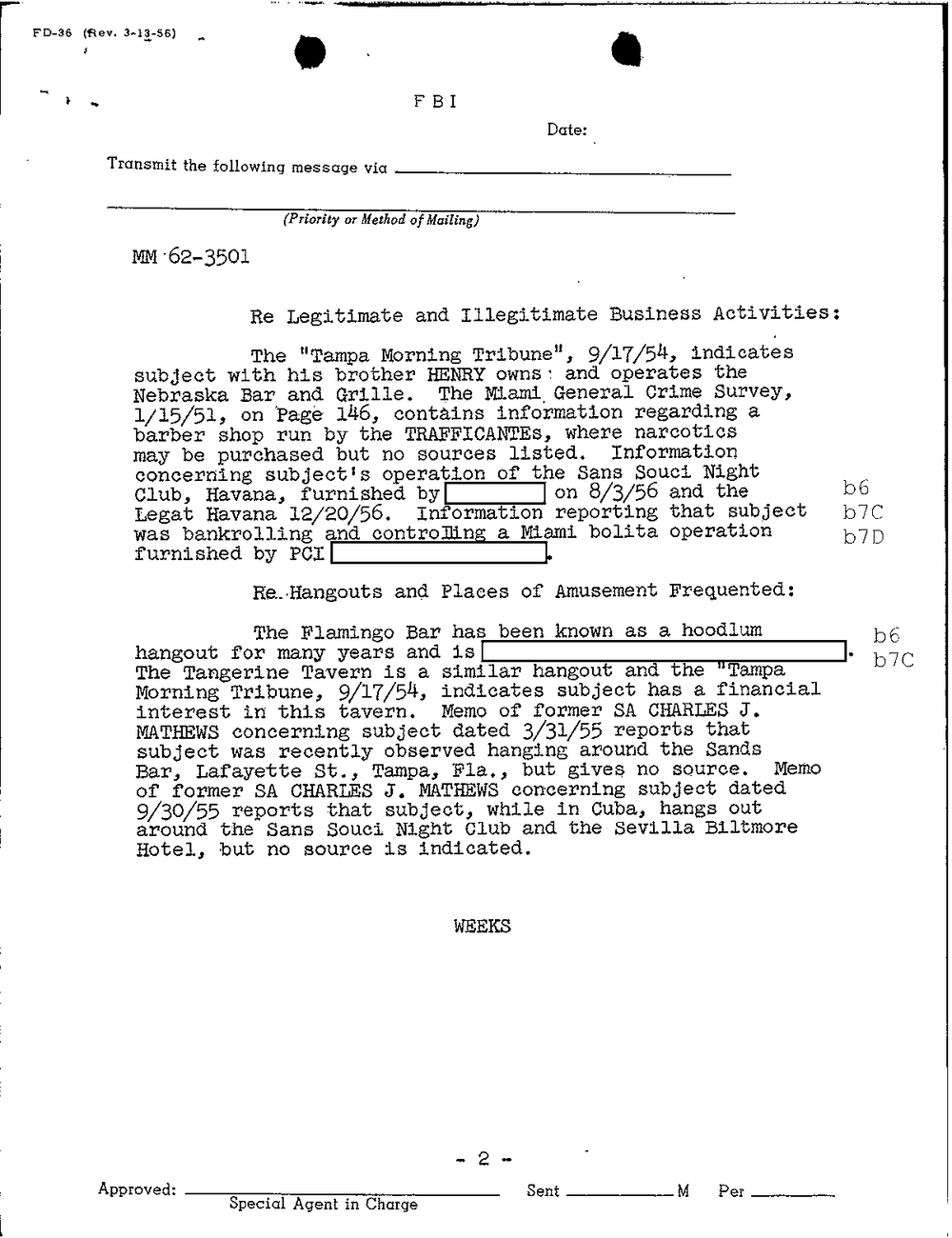 itemFBI summary on Santo Trafficante, Jr., and the Miami airtel of 29 July 1957 giving its sources: 'owns and operates the Sans Souci Night Club and Casino in Havana'A mid-1957 Top Hoodlum summary states that in December 1956 'information was developed that subject' owns and operates the Sans Souci Night Club and Casino in Havana; Miami's reply to headquarters names the sources for that line as information of 3 August 1956 and the Legal Attache in Havana on 20 December 1956.
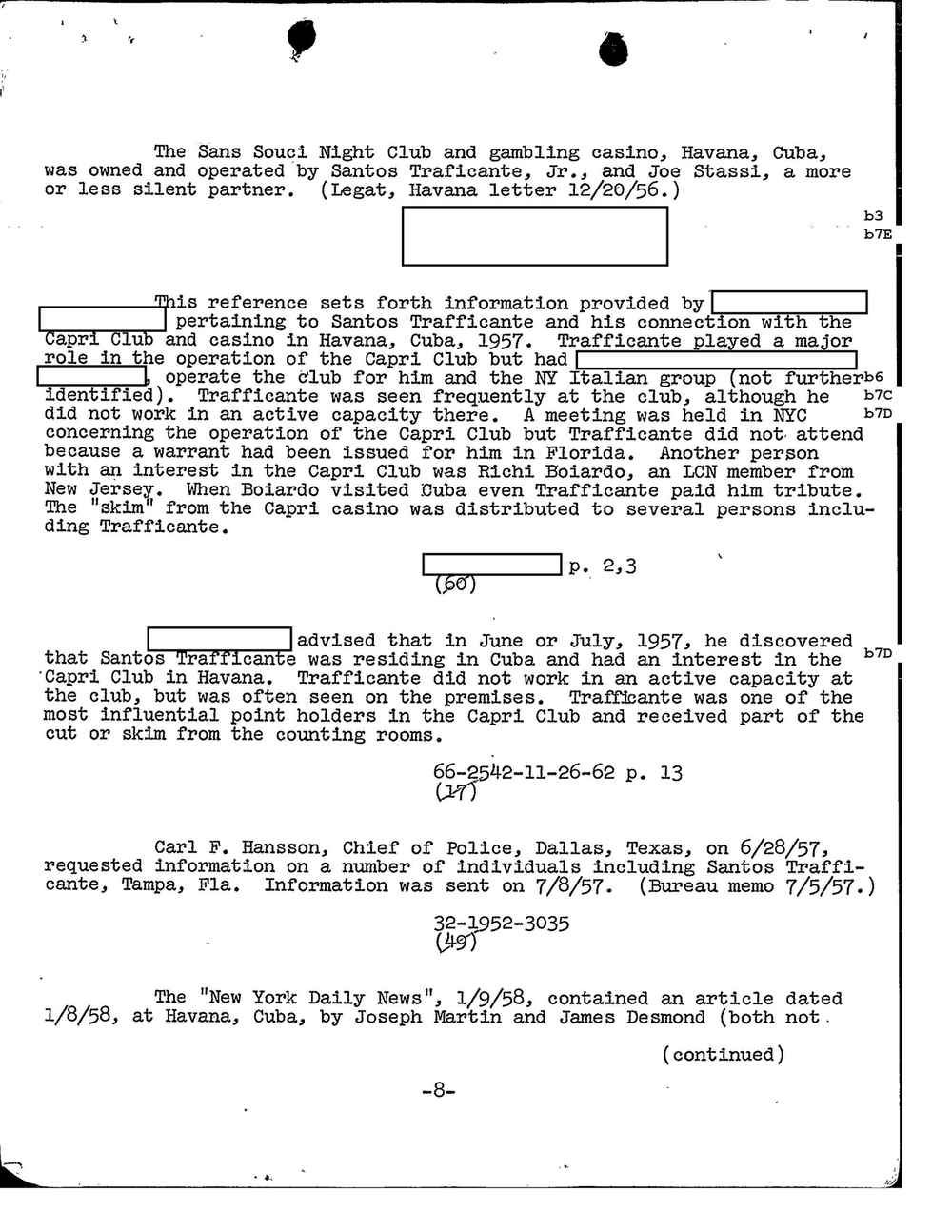 itemFBI Correlation Summary on Santo Trafficante, Jr. (main file 92-2781, searched 4 March 1971): Havana entries for 1955-1958A 1971 headquarters digest of Bureau references, marked 'NOT SUITABLE FOR DISSEMINATION,' records Legal Attache and informant reports placing Trafficante at the Sevilla Biltmore, the Sans Souci, the Hotel Nacional, the Capri and the Havana-Riviera, nearly all with 'reportedly,' 'allegedly' or 'appeared.'
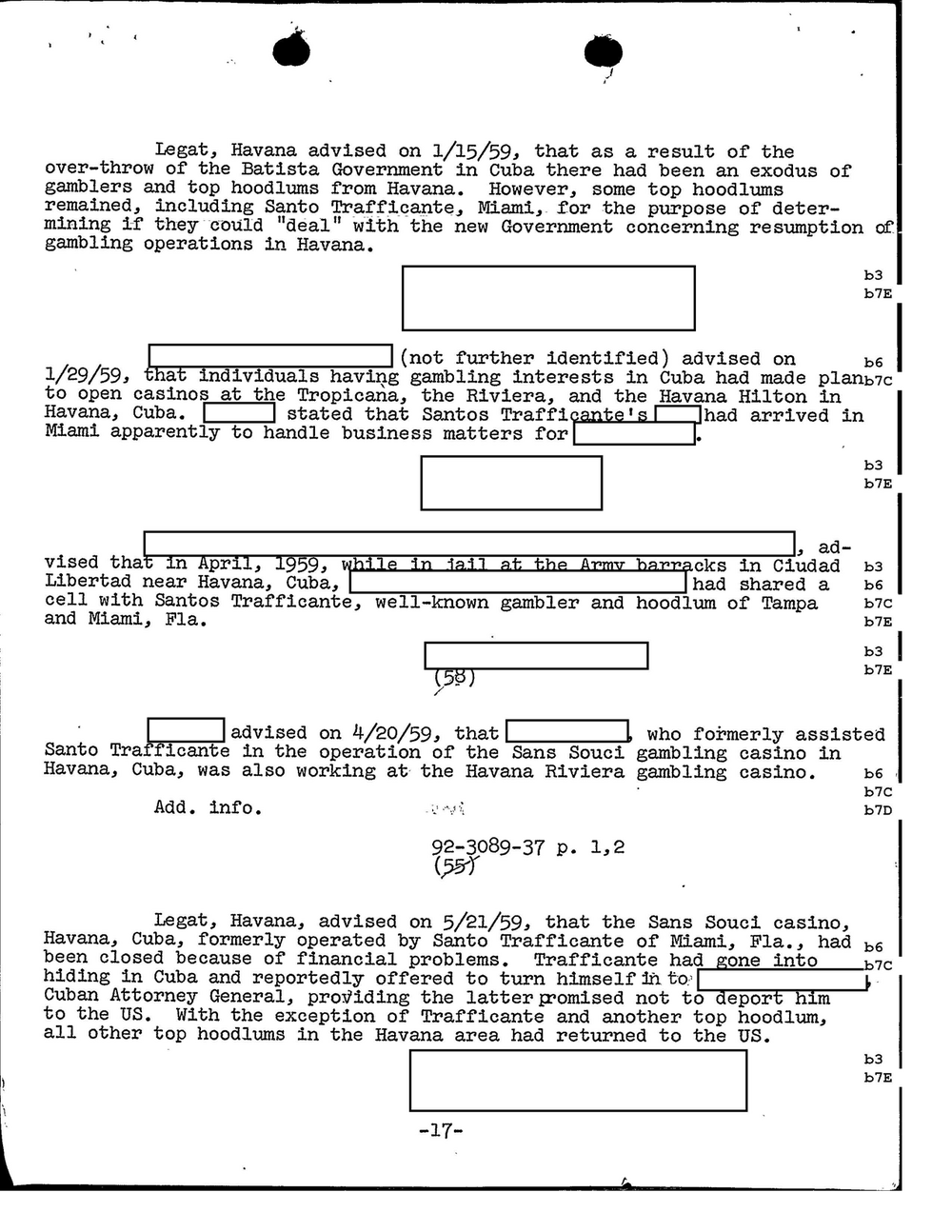 itemFBI Correlation Summary on Santo Trafficante, Jr. (searched 4 March 1971): the January 1959 exodus, the Sans Souci's closing, and detention at TiscorniaThe 1959 entries of the same digest: the Legal Attache reported on 15 January 1959 'an exodus of gamblers and top hoodlums from Havana,' with Trafficante among those who stayed to see if they could 'deal' with the new government; on 21 May that the Sans Souci had closed 'because of financial problems'; and later that Trafficante was confined at the immigration detention house 'Tiscornia.'
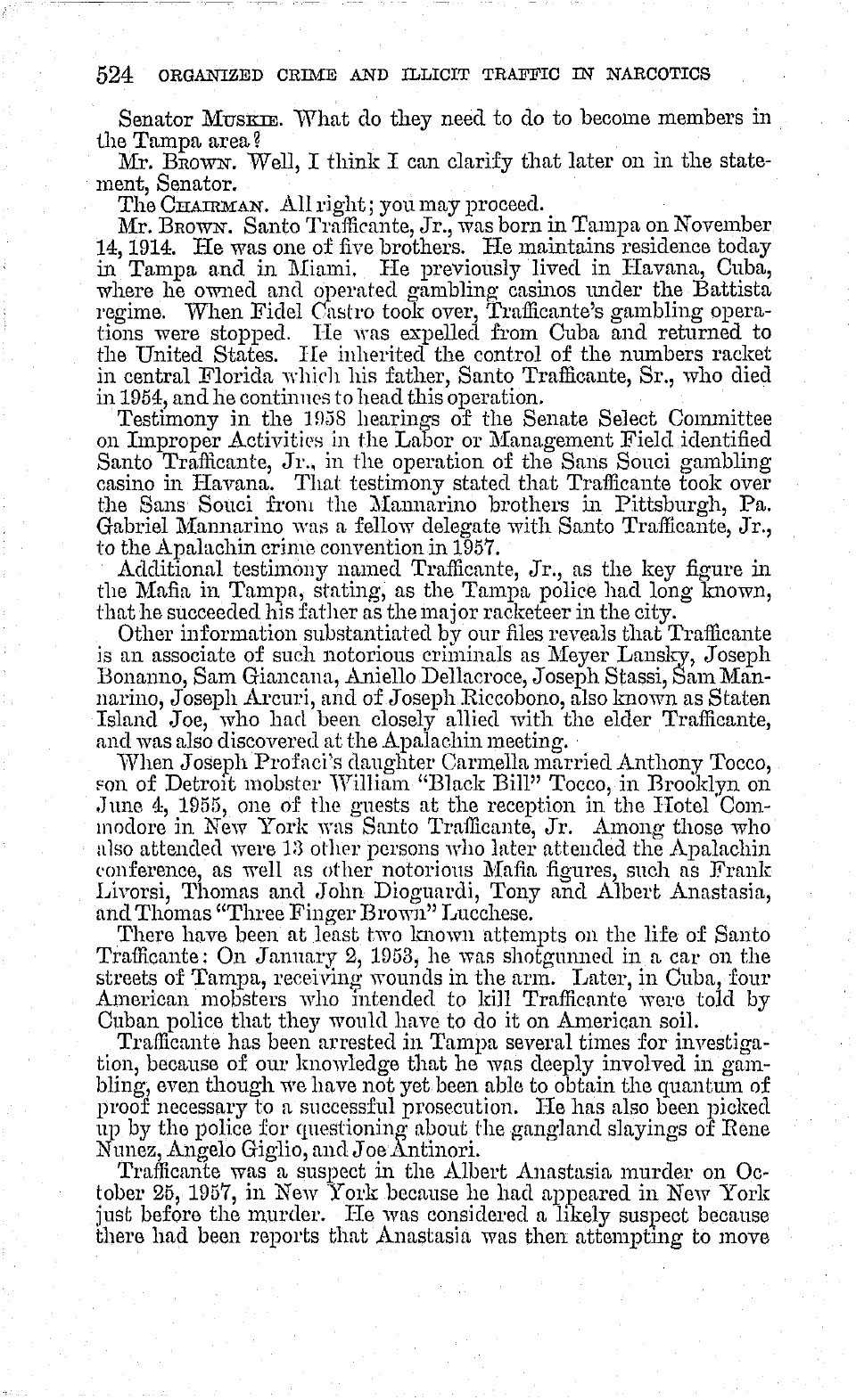 itemTestimony of Tampa Police Chief Neil G. Brown, October 15, 1963 (opening pages)Tampa's police chief introduced the Tampa chart (Exhibit 45) and said he believed it "completely accurate in showing that Santo Trafficante is the boss of this criminal group." His statement says 1958 Senate testimony had Trafficante taking over Havana's Sans Souci casino from "the Mannarino brothers in Pittsburgh, Pa."itemSenate narcotics hearings, 15 October 1963: Chief Brown on 'Louis Santos of Havana, Cuba' at Apalachin, and Sergeant de la Llana's statement (pp. 525-526)Tampa police chief Neil G. Brown said the 'Louis Santos of Havana, Cuba' apprehended at Apalachin in November 1957 was positively identified as Santo Trafficante, Jr., and gave the police account of his stay with Albert Anastasia as 'B. Hill'; a statement by Sgt. Jack de la Llana says a visitor to Trafficante had worked as a 'pit boss' in casinos in Las Vegas and Havana.