This section gathers the federal records filed here that concern Havana and Cuba, from American gamblers at the Jockey Club in the 1930s to the closing of the casinos after the revolution. Each statement below comes from the record linked beside it. Most of what these records say about named people is a report of a report: a Legal Attache relaying an informant, a witness’s answer, counsel’s question, a police chief’s summary, a 1971 digest of older serials. Each record’s page says which. None of it is a court finding unless the page says so, and no role is copied from these records to a family chart. The South Florida section holds the Tampa and Miami records and some of the Havana pages linked below.
Luciano in Cuba, 1946-47
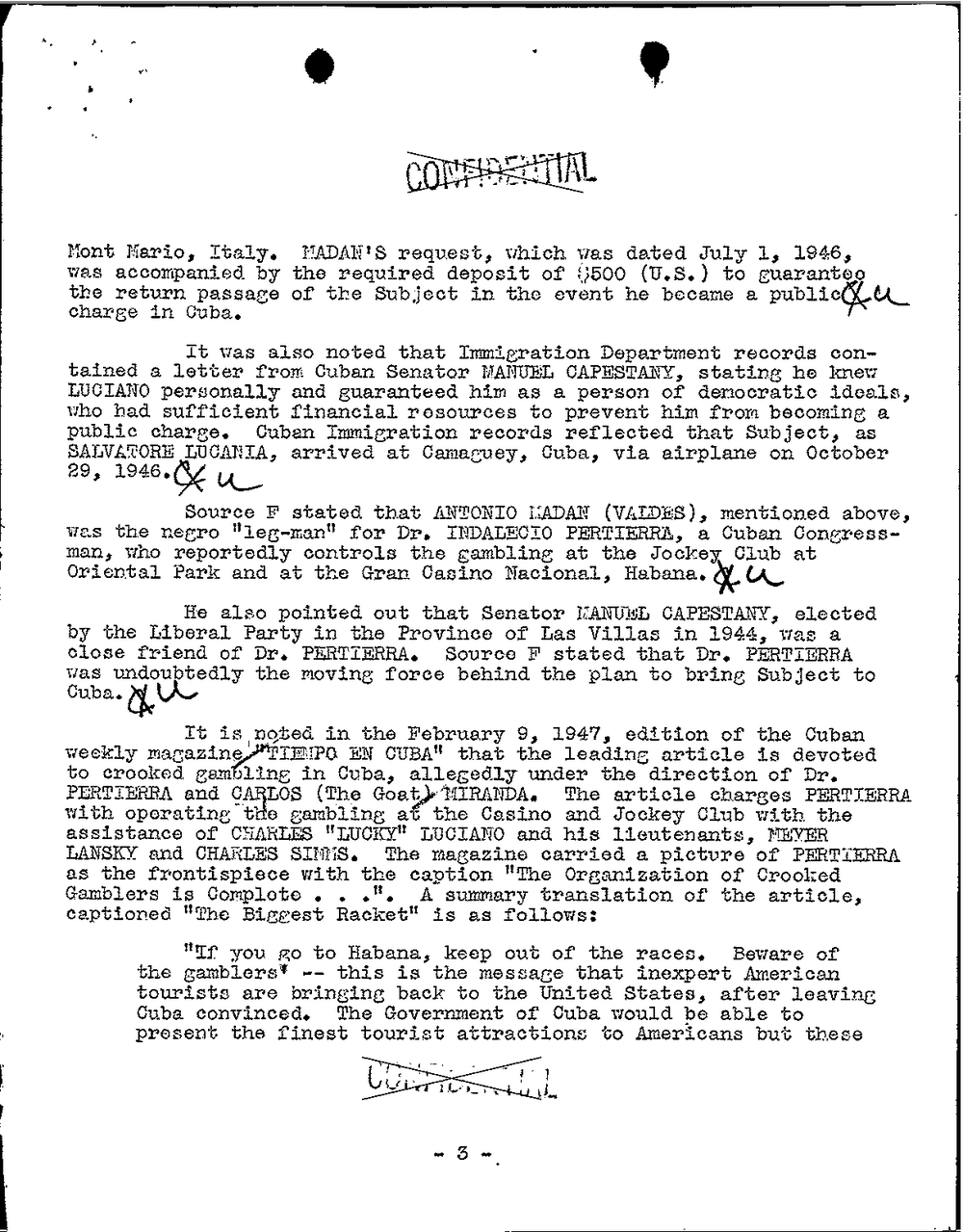
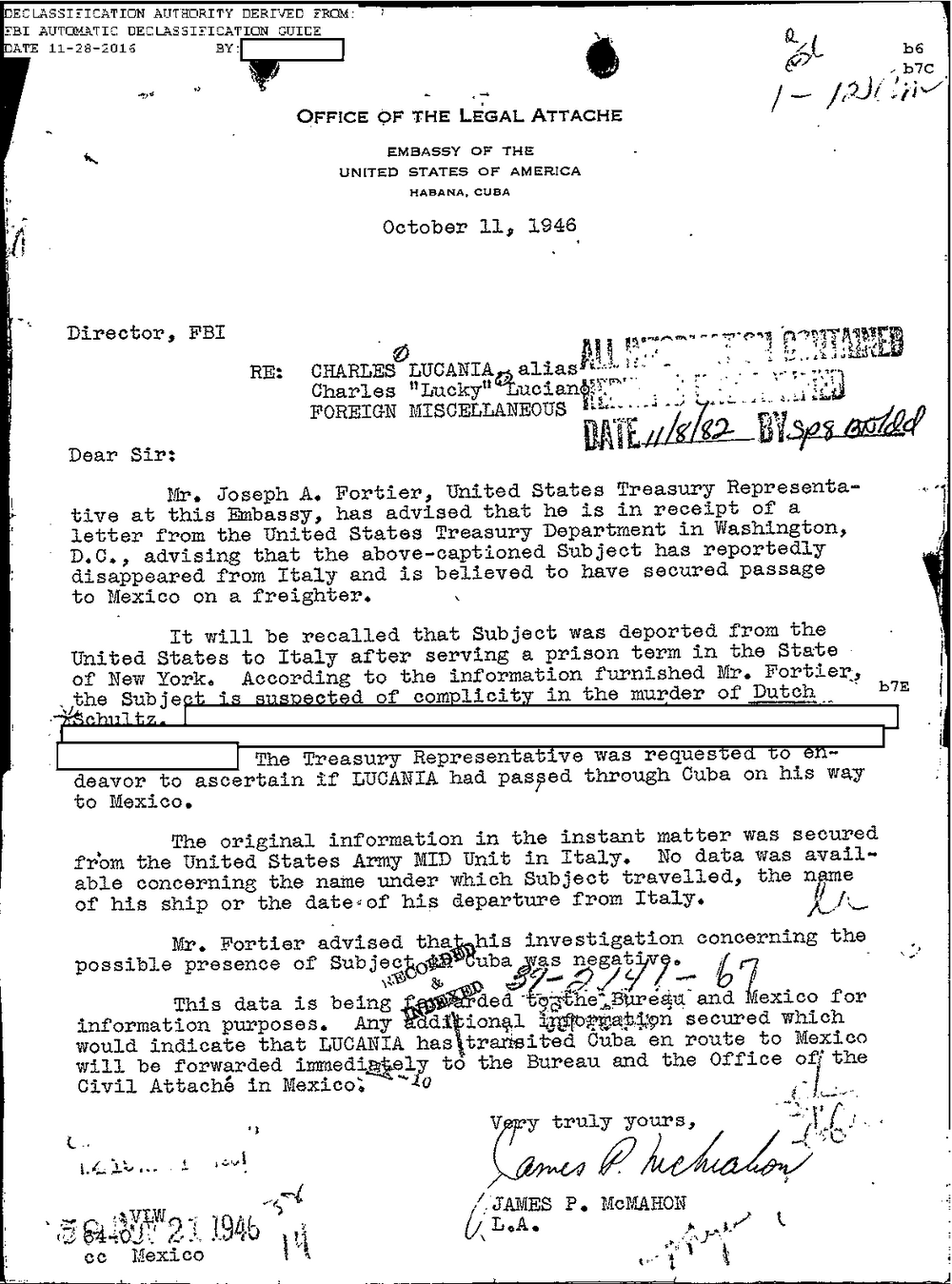
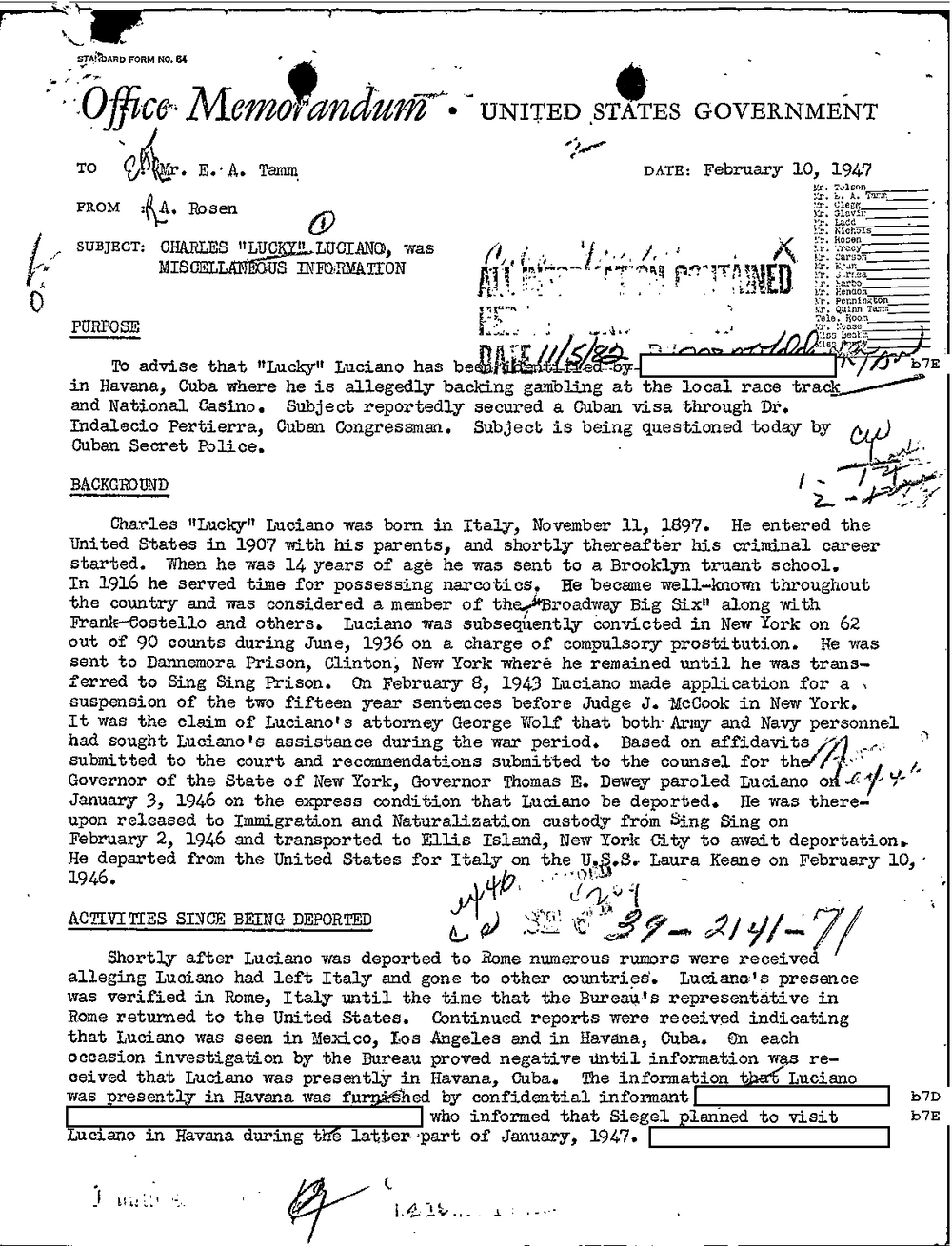
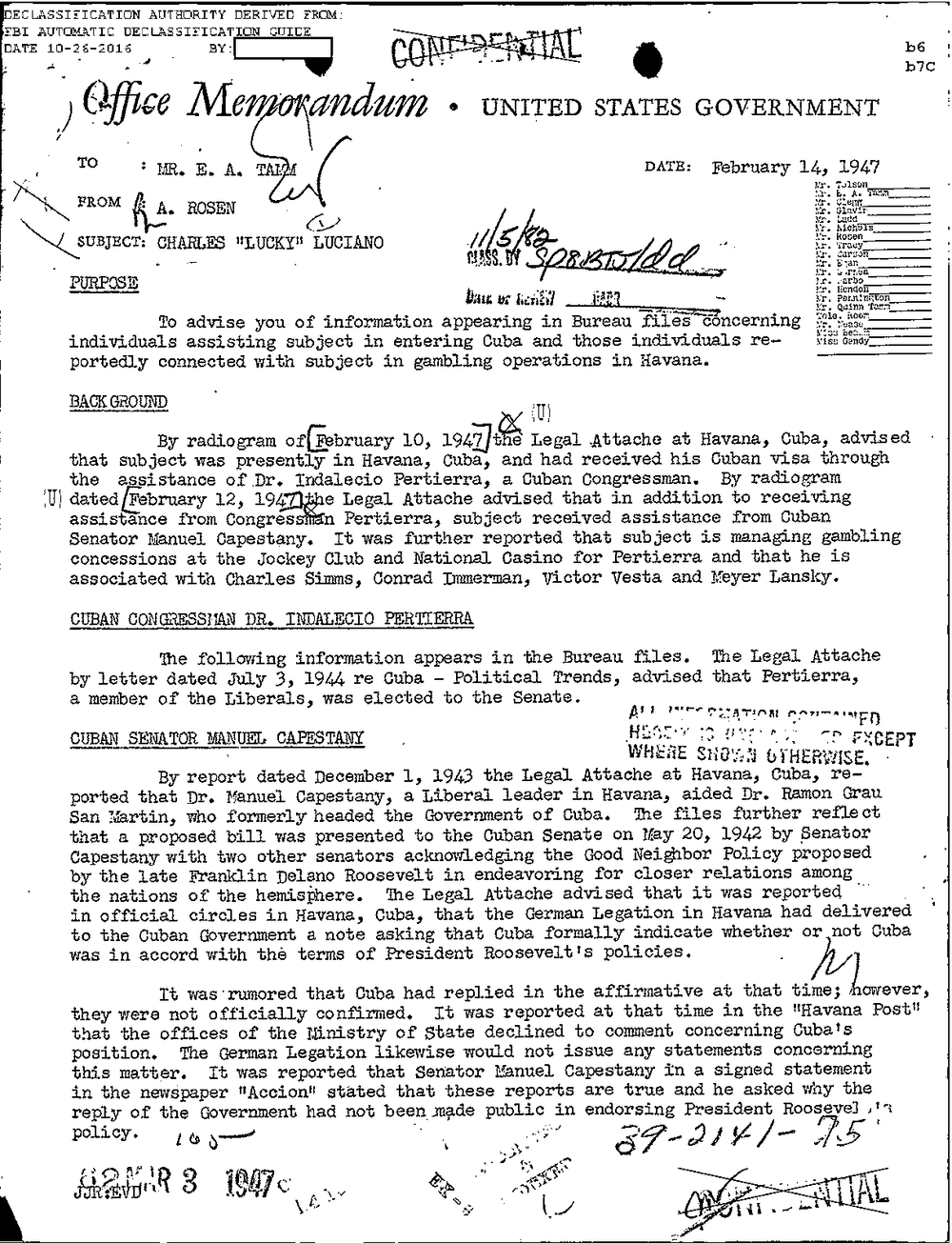
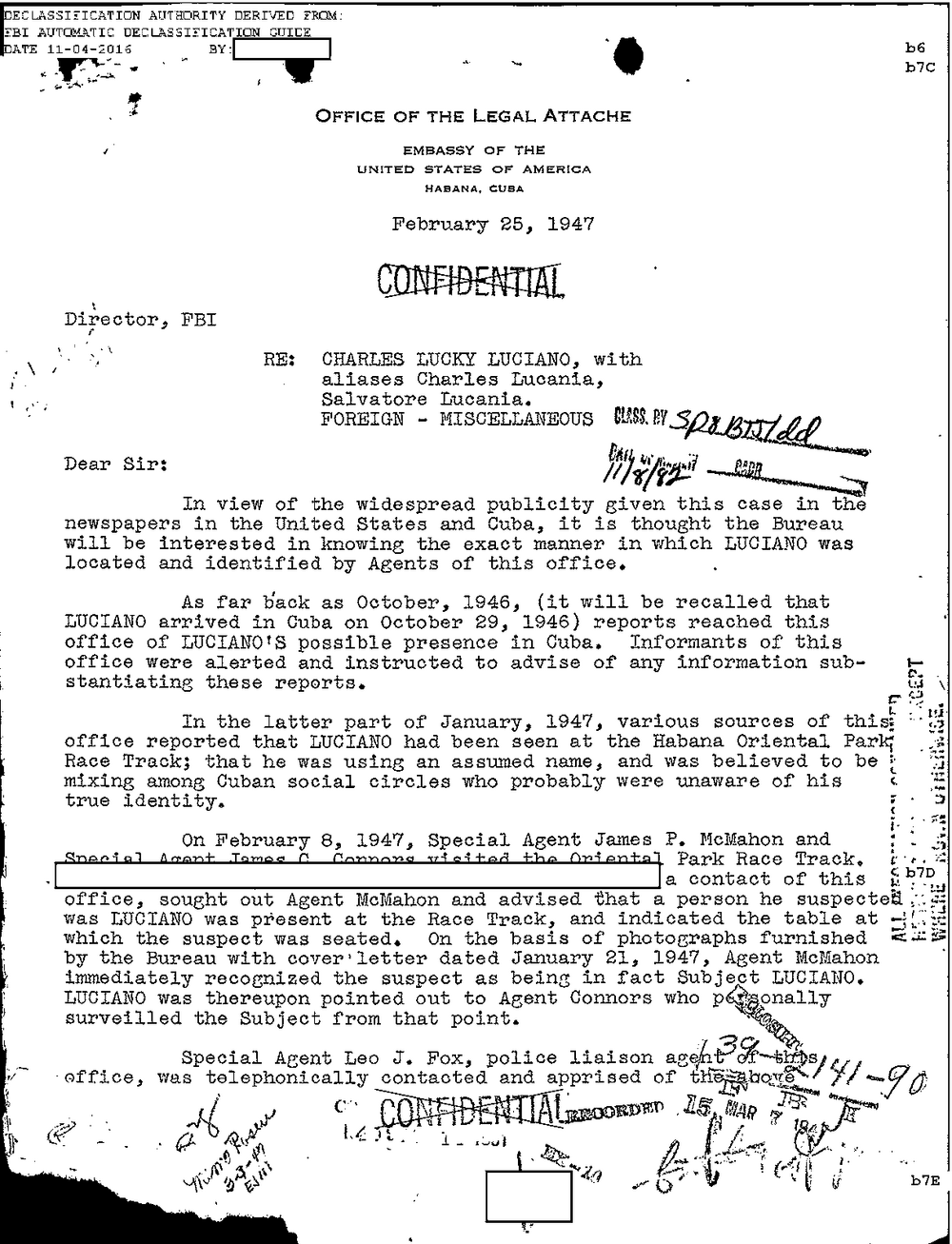
The FBI Vault’s Luciano file, Part 01, carries the Bureau’s Havana reporting. On 11 October 1946 the Legal Attache at the embassy wrote that the Treasury representative, Joseph A. Fortier, had word that Luciano had left Italy, and that a check for him in Cuba was negative. A headquarters memorandum of 10 February 1947 reports him found in Havana, “allegedly backing gambling at the local race track and National Casino,” with a visa obtained through Congressman Indalecio Pertierra. Special Agent Leo J. Fox’s report of 12 February gives his arrival at Camaguey by air on 29 October 1946 as Salvatore Lucania, the guarantee letter of Senator Manuel Capestany, and the gambling at “the Gran Casino Nacional and the Oriental Park Race Track,” which it calls “the only two places in Cuba where gambling is legal.” A memorandum of 14 February relays the radiogram report that he was “managing gambling concessions” for Pertierra. The Legal Attache’s letter of 25 February tells how agents identified him at the track on 8 February.
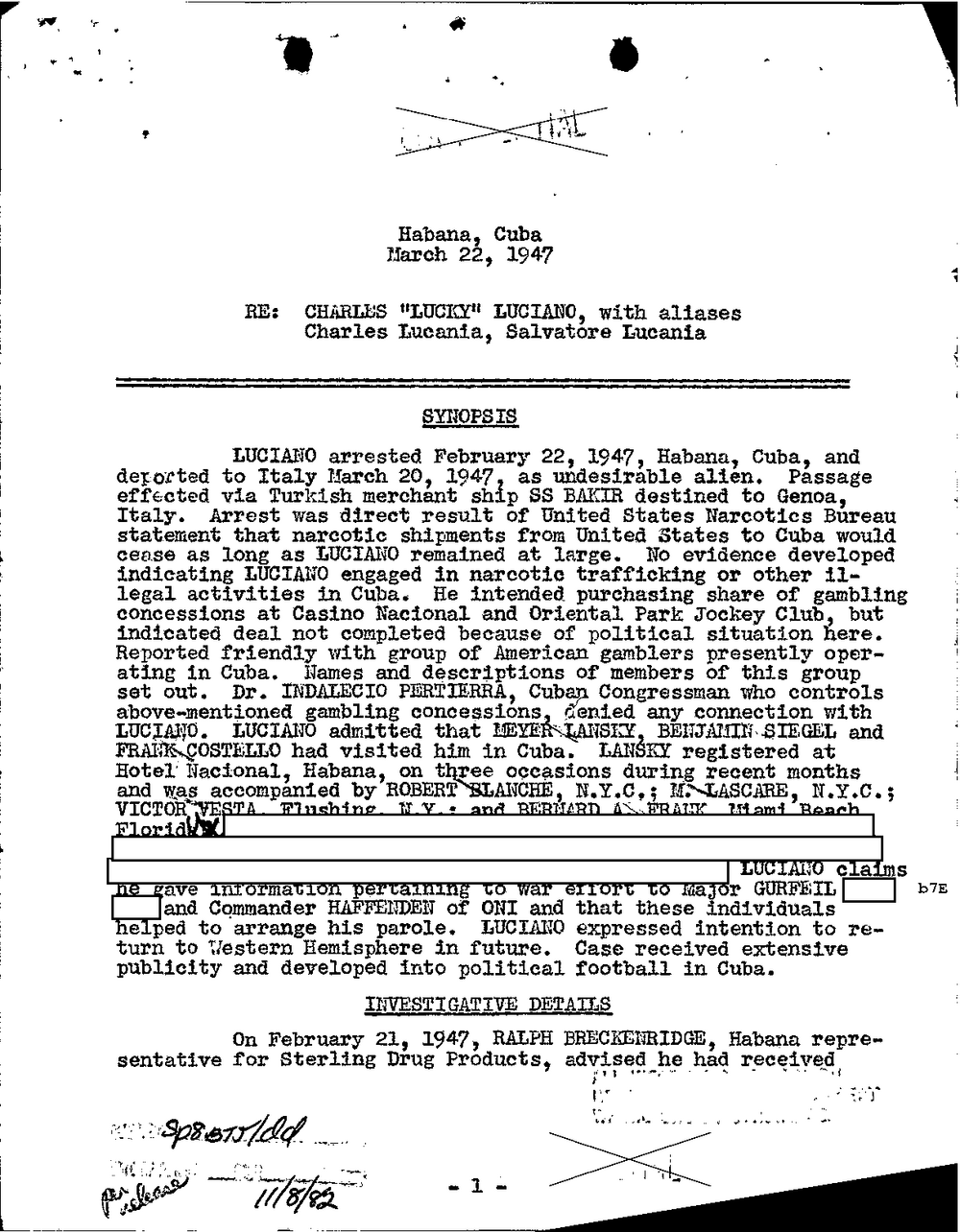
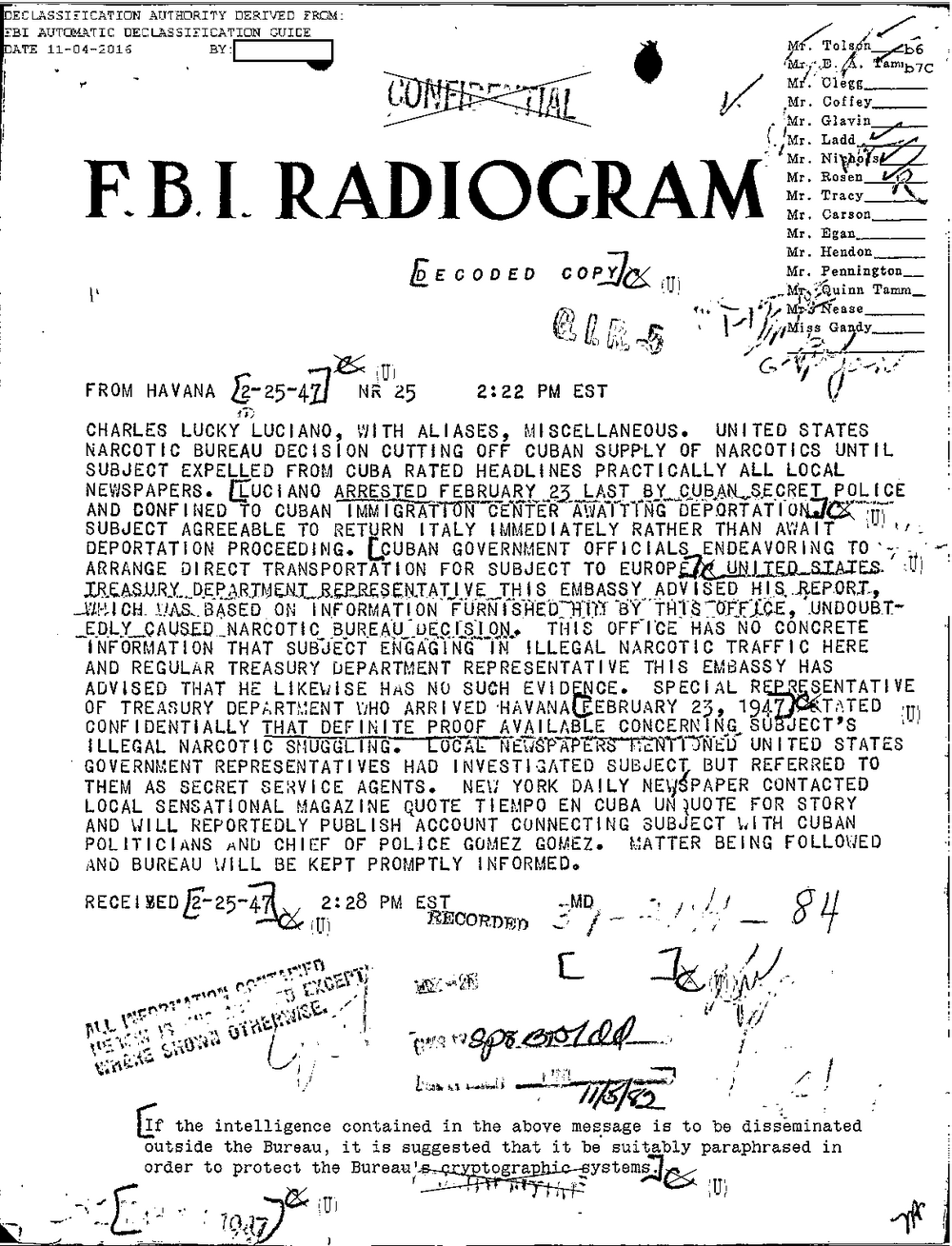
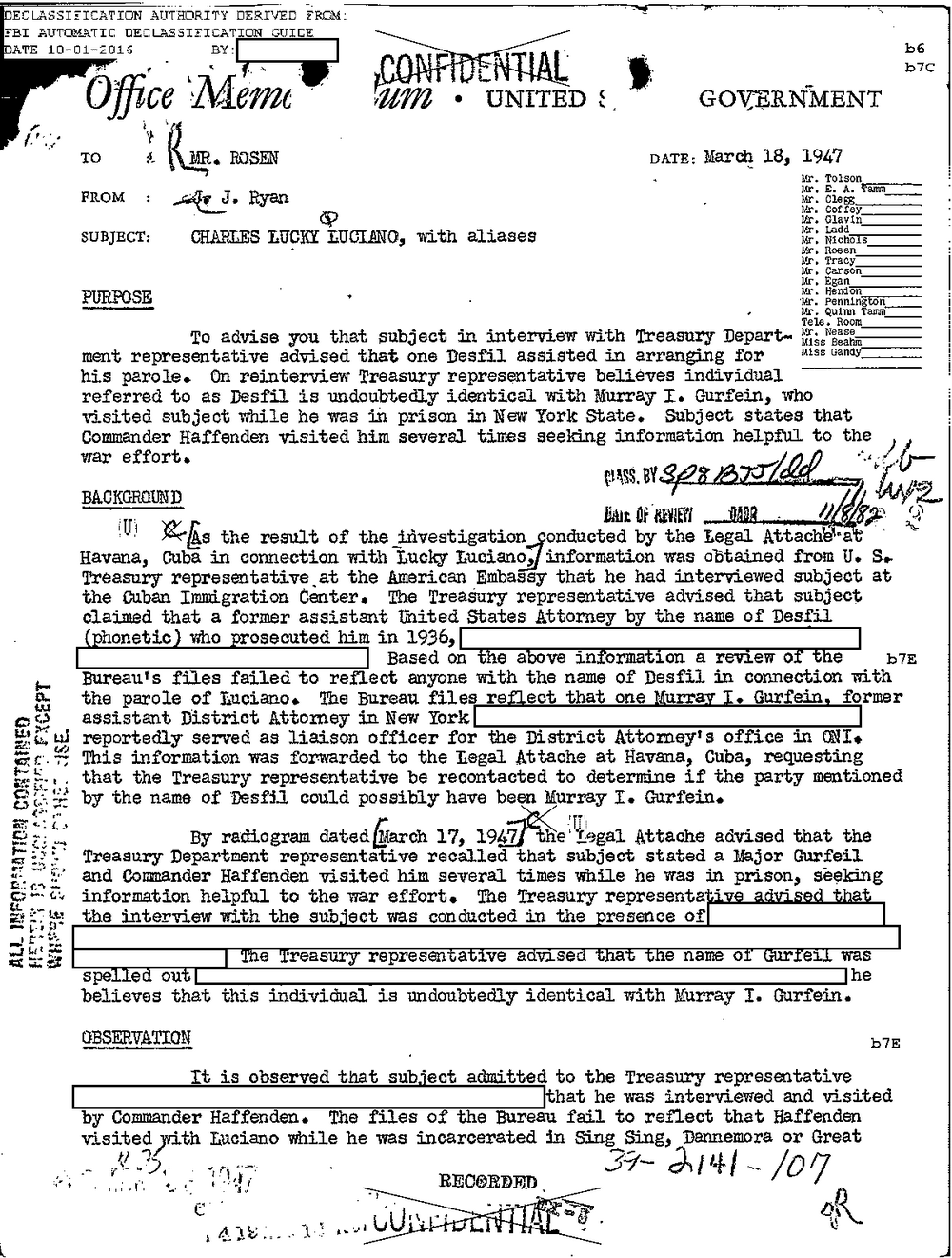
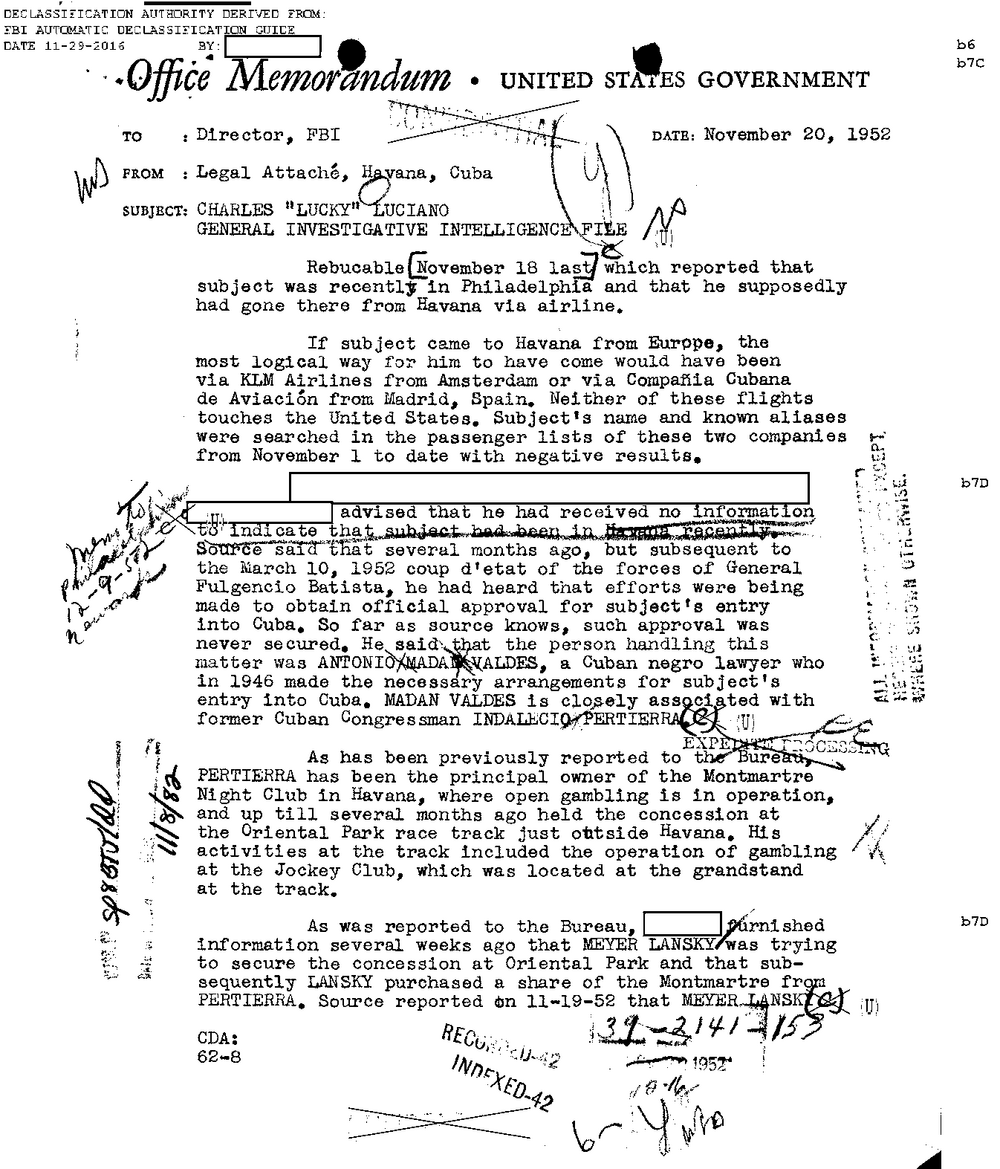
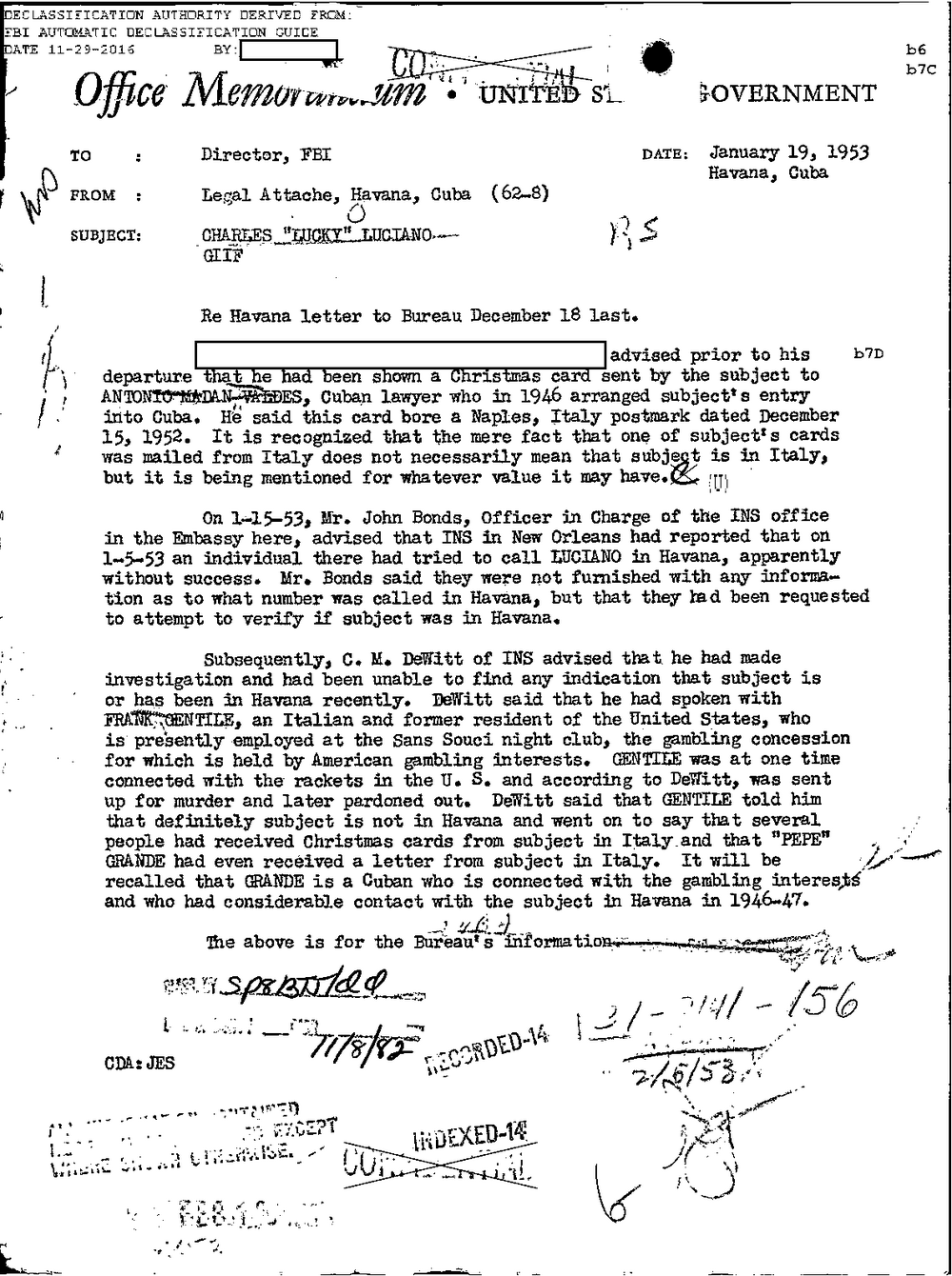
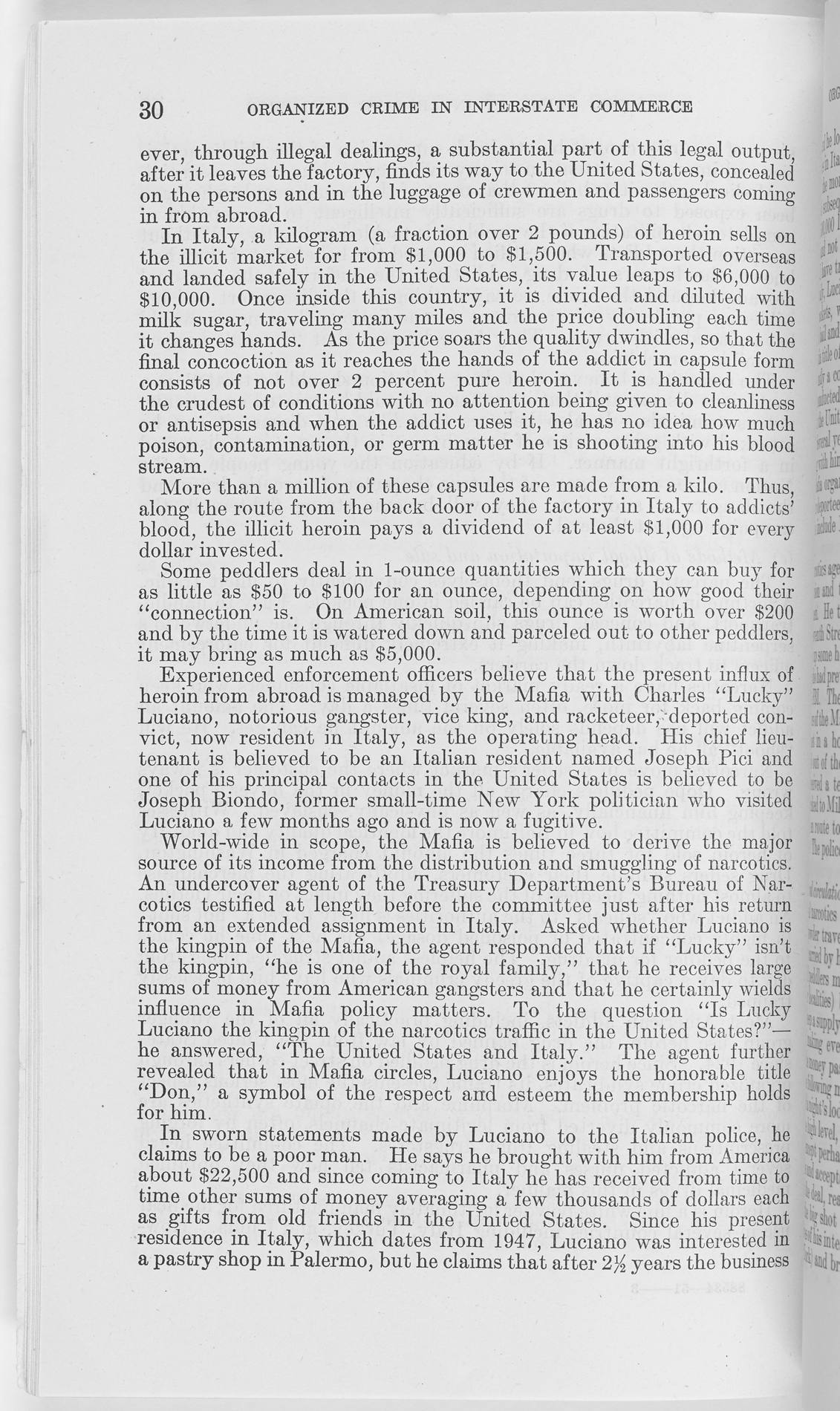
On narcotics the file records three things, and this page keeps all three. A radiogram of 25 February 1947 reports the Bureau of Narcotics’ decision “cutting off Cuban supply of narcotics until subject expelled,” and says the Havana office “HAS NO CONCRETE INFORMATION” that he was in the traffic there. The closing report of 22 March 1947 says his arrest on 22 February “was direct result of United States Narcotics Bureau statement that narcotic shipments from United States to Cuba would cease as long as LUCIANO remained at large,” that “No evidence developed indicating LUCIANO engaged in narcotic trafficking or other illegal activities in Cuba,” and that the American Embassy told the Cuban Ministry of State “that no actual embargo had been placed on shipments of narcotics to Cuba.” He was held at the Tiscornia immigration camp, where he talked to the Treasury representative about his parole (18 March), and deported to Italy on 20 March 1947. The Kefauver Committee’s Final Report says his residence in Italy “dates from 1947”. Later Havana memoranda of November 1952 and January 1953 found no sign that he had come back.
The “Havana meeting,” as the records state it
No federal record filed here describes a meeting or conference of bosses in Havana in December 1946. What the records say is narrower. The FBI’s report of 22 March 1947 states: “LUCIANO admitted that MEYER LANSKY, BENJAMIN SIEGEL and FRANK COSTELLO had visited him in Cuba.” It adds that Hotel Nacional records show Lansky checking in on 27 December 1946, 6 January 1947 and 24 February 1947. An informant’s earlier report that Siegel “planned to visit” him is in the 10 February memorandum. That is all.
Two Kefauver witnesses described a separate trip. William Moretti testified on 13 December 1950 that he went to Cuba to see Luciano with “Vincent Mangano and Gerry Catena” for “About 5 or 6 days.” Gerald Catena testified on 14 February 1951 that he went with Moretti “About 3 years ago,” had dinner with Luciano at the hotel he named as the “Nationale,” saw “Vince” (Mangano) there, heard no business talked “in front of me,” and that Lansky was not there. Catena’s date is his own estimate. Joe Adonis declined to answer whether he ever saw Luciano in Havana (12 December 1950); a refusal establishes nothing.
Meyer Lansky: his own account, and the FBI’s later reports
Meyer Lansky told the Kefauver Committee in executive session on 14 February 1951 that he was in business in Havana “In the late years of 1937,” that “I had the race track, and a casino, Nationale,” leased from the National City Bank, and that “we stopped when the war broke out.” He said his meetings with Luciano in Havana were “Purely social” and that he stayed at “The Nationale.” A 1947 FBI memorandum had placed him in 1939 with Frank Erickson in “the operation of the Oriental Racetrack in the Nacionale Gambling Casino” (14 February 1947).
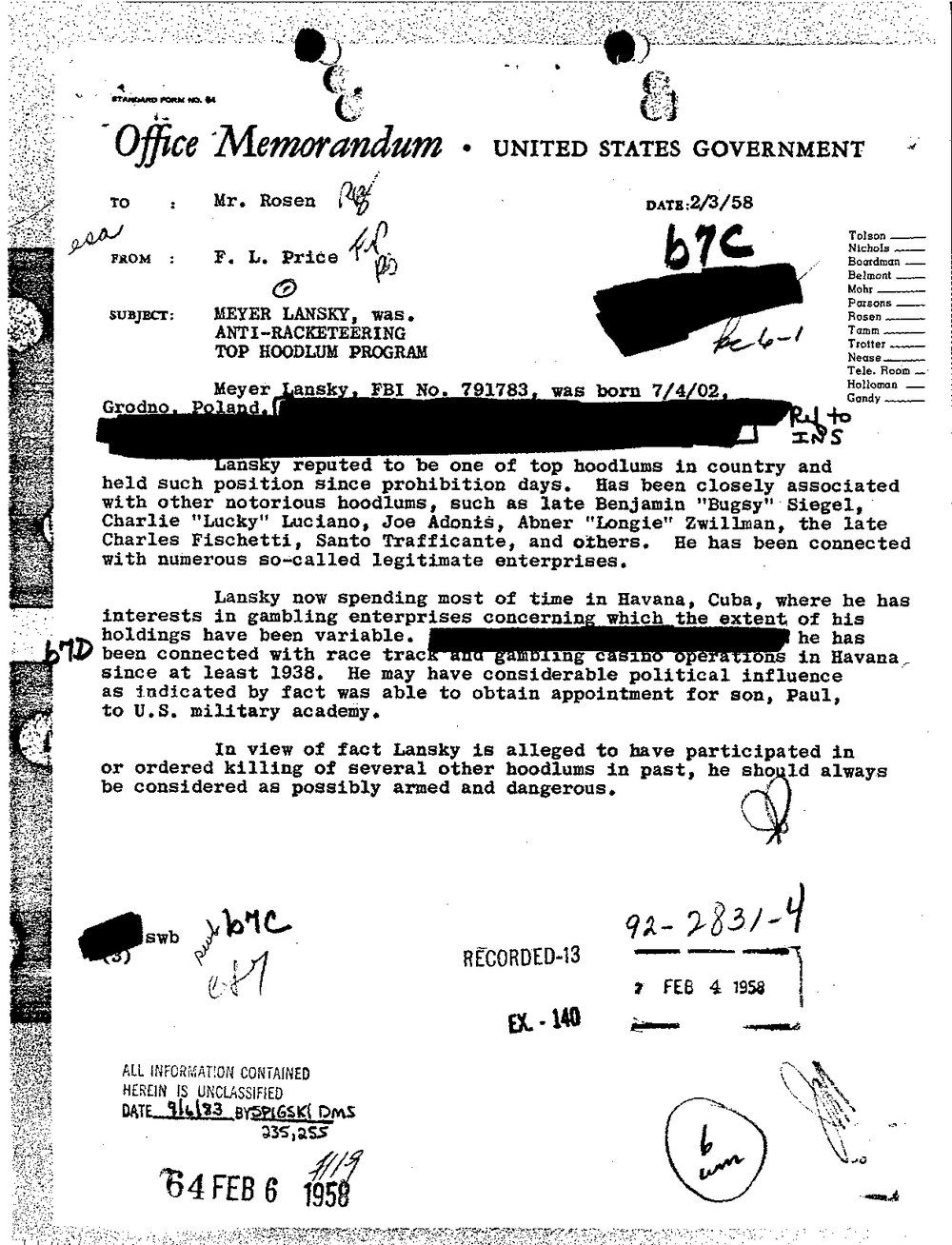
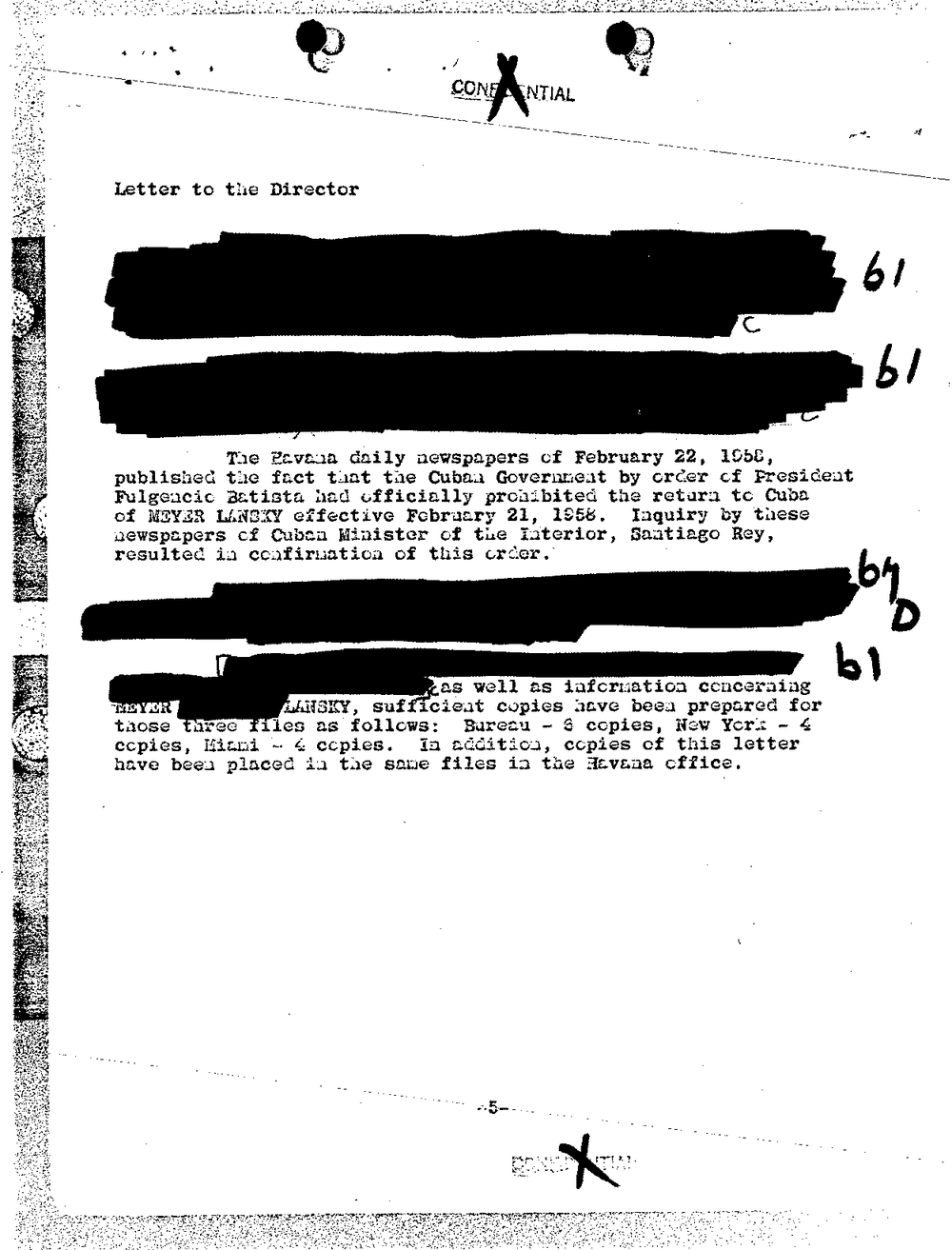
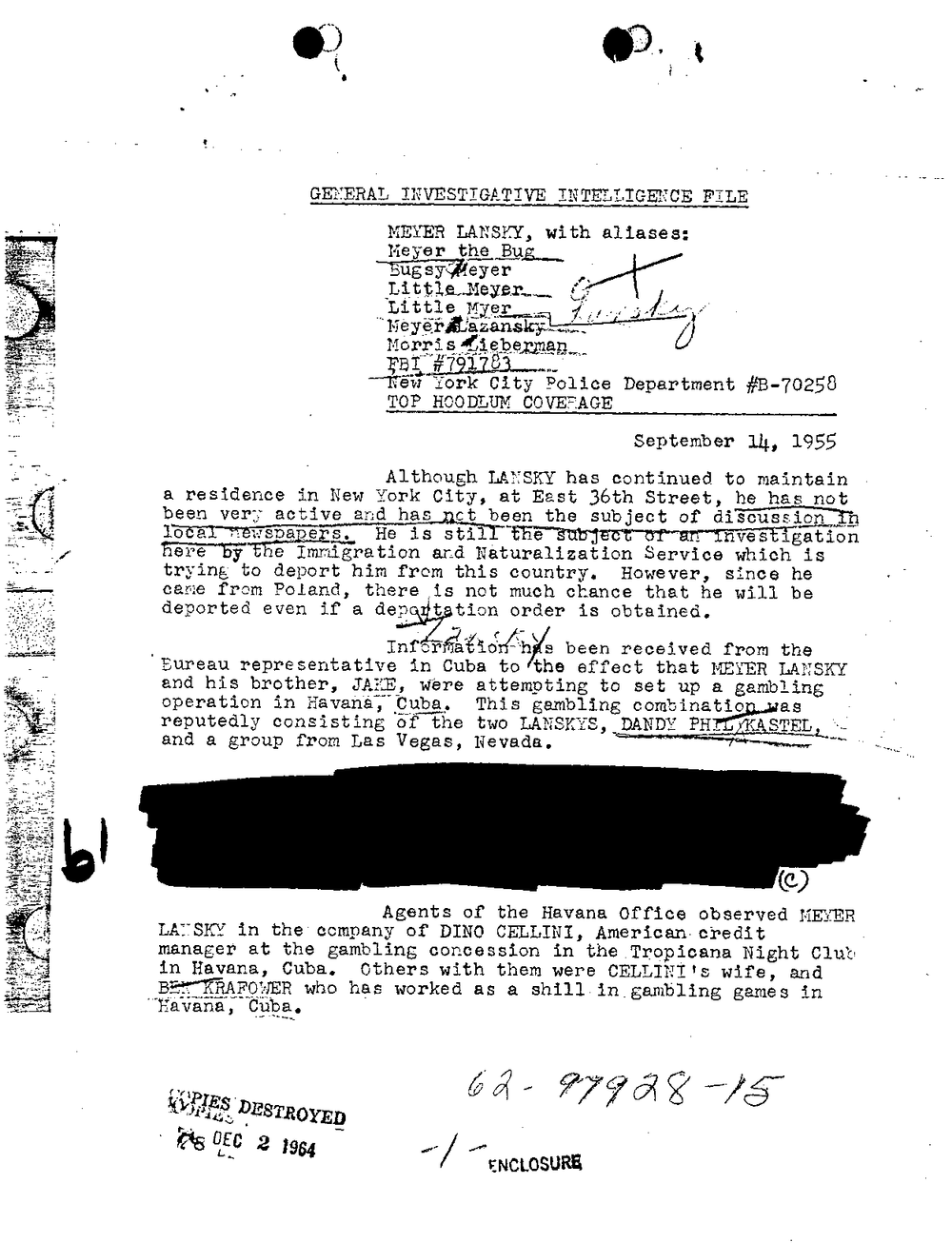
The Bureau’s later reporting is in the Lansky file. A 1955 summary filed under South Florida records information that Meyer and Jake Lansky were trying to set up a gambling operation in Havana. A headquarters memorandum of 3 February 1958 says he was “now spending most of time in Havana, Cuba, where he has interests in gambling enterprises,” and had been “connected with race track and gambling casino operations in Havana since at least 1938.” The Legal Attache reported that the Cuban government, “by order of President Fulgencio Batista,” barred his return effective 21 February 1958; the record does not say whether the order was lifted. A Miami airtel of February 1961 says that “prior to the revolution in Cuba, LANSKY was active in legalized gambling in Cuba,” and that he came back to the United States after Castro took power. Informants in 1952 and 1958 placed his brother, Jake Lansky, in Havana, the second time as “overseer of operations at the hotel casino” of the Hotel Nacional.
The Hotel Nacional and the Gran Casino Nacional
The 1947 FBI reports name two different places: the Hotel Nacional de Cuba, where Lansky and other American gamblers registered, and the Gran Casino Nacional at Marianao, one of the two places where gambling was then legal. Lansky’s “Nationale” casino of 1937 could be either. The Kefauver chairman, asking a question, called it “the casino at the Nationale Hotel—the Nationale Casino.” The testimony does not settle it, and neither do the FBI records. This archive does not decide which building he meant.
Santo Trafficante, Jr.
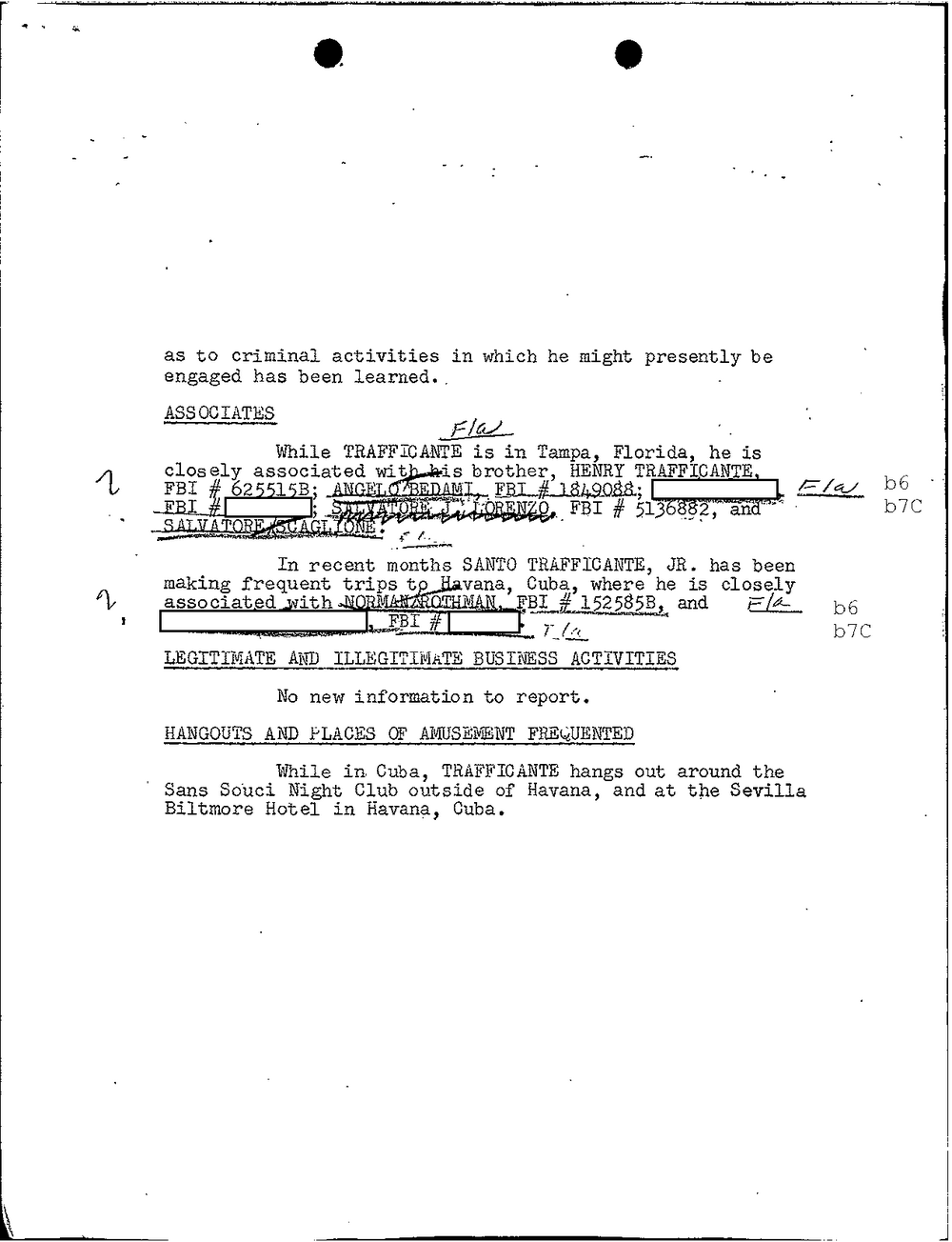
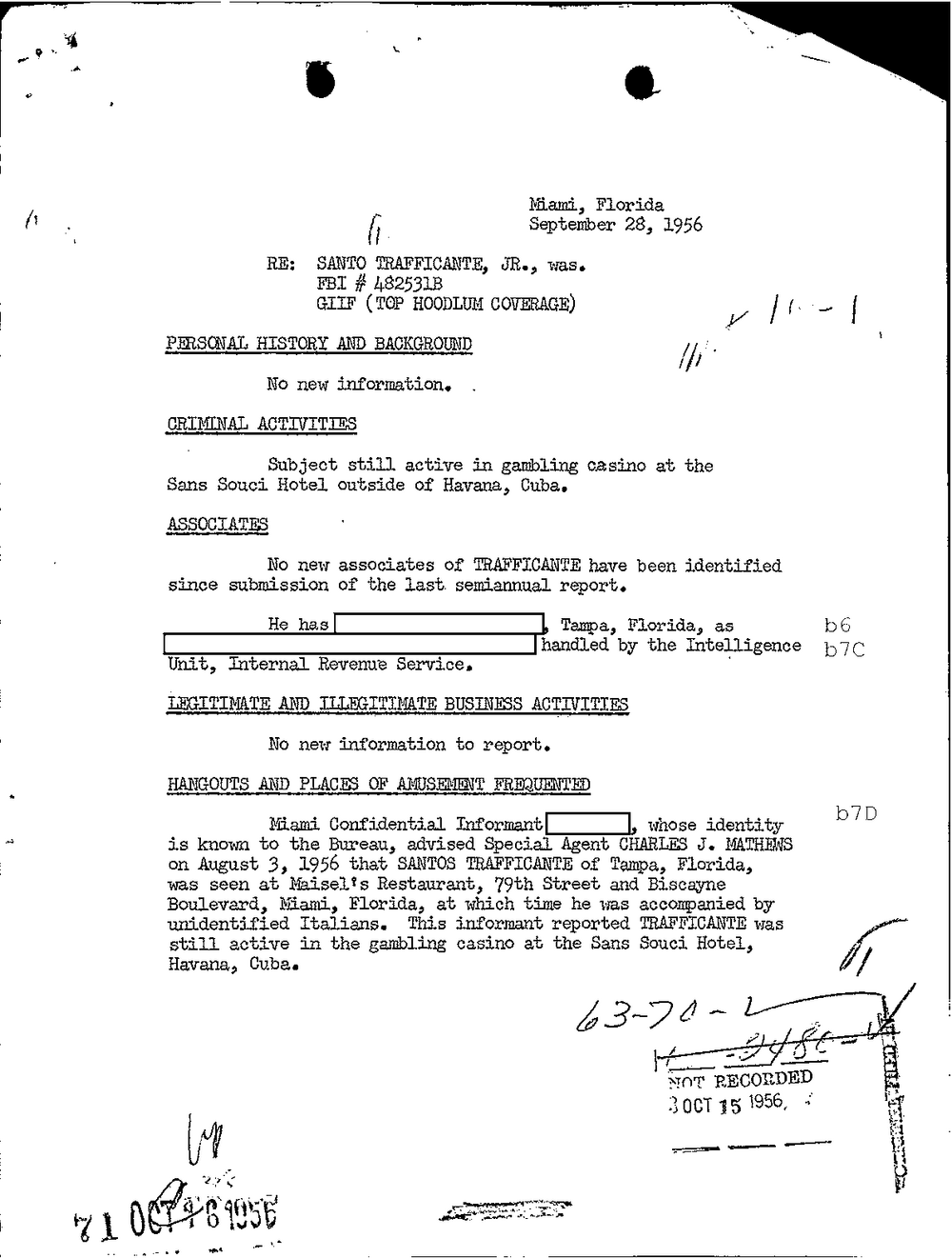
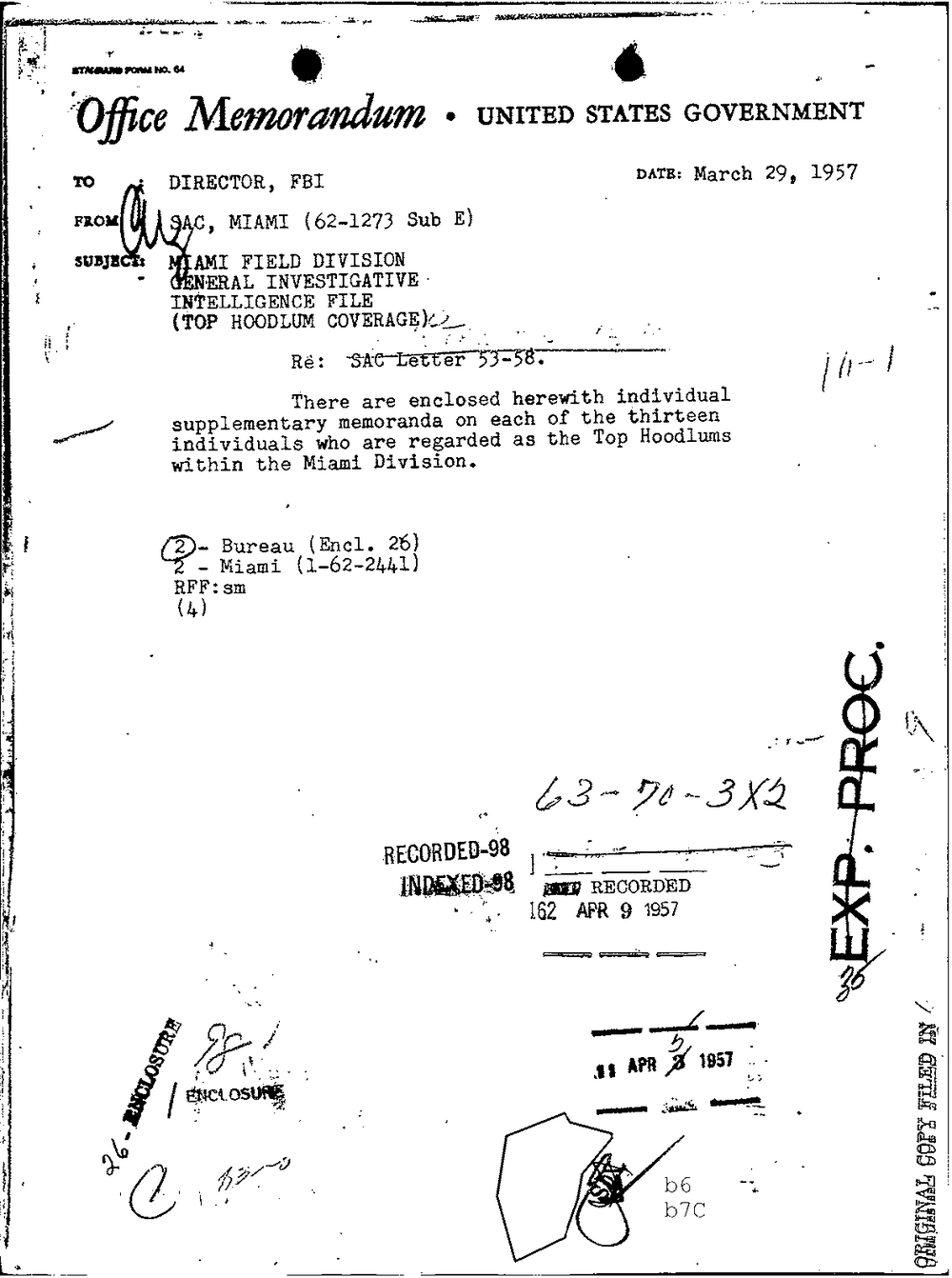
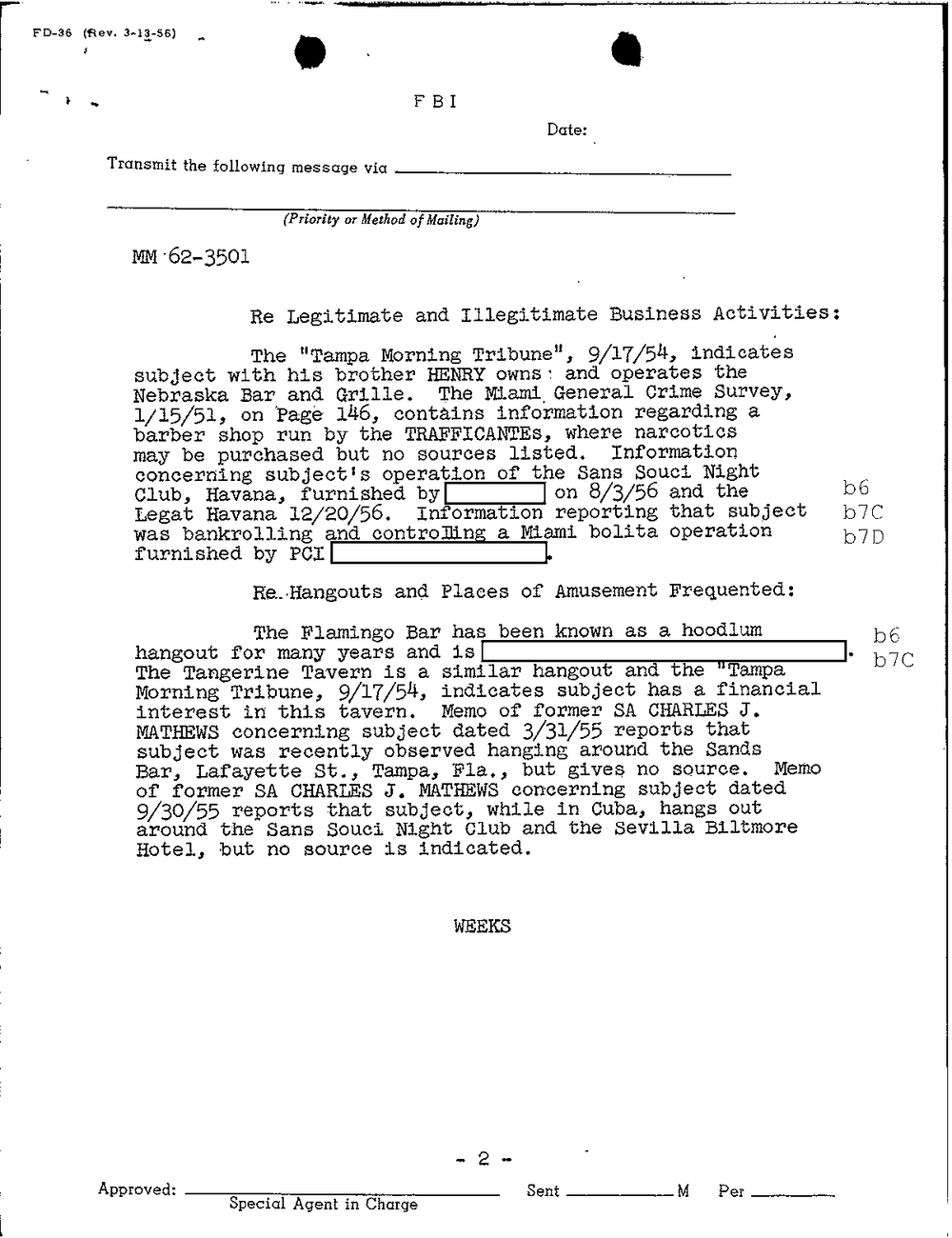
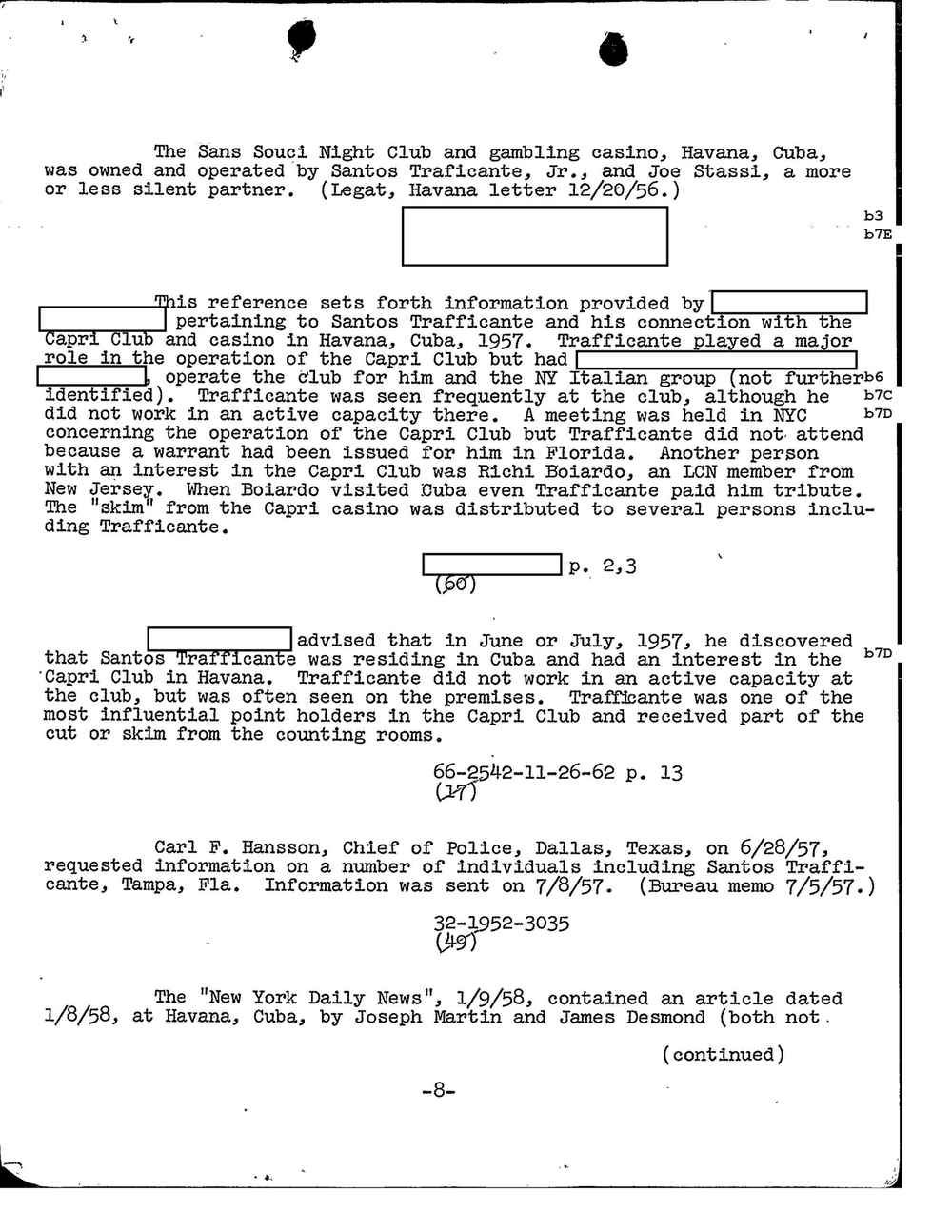
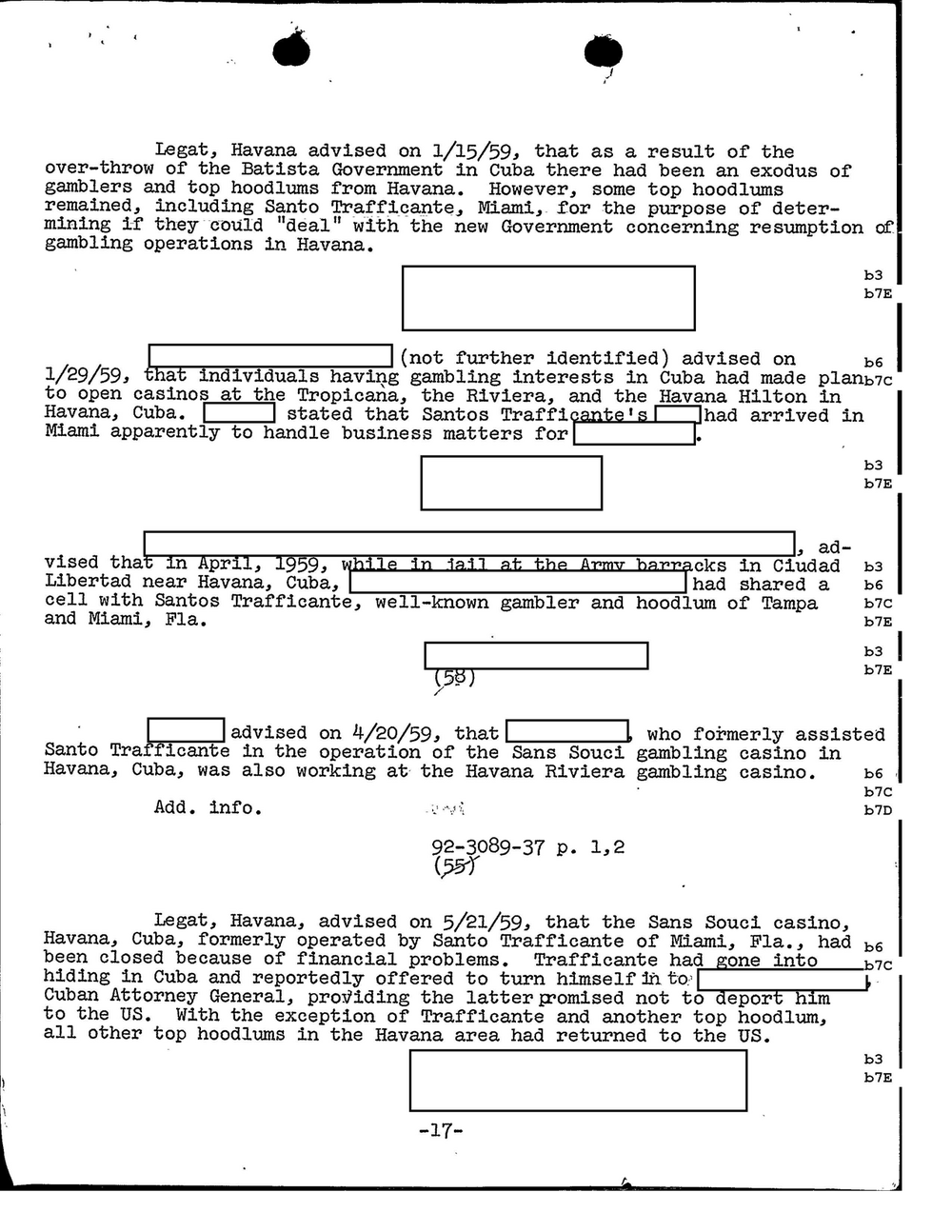
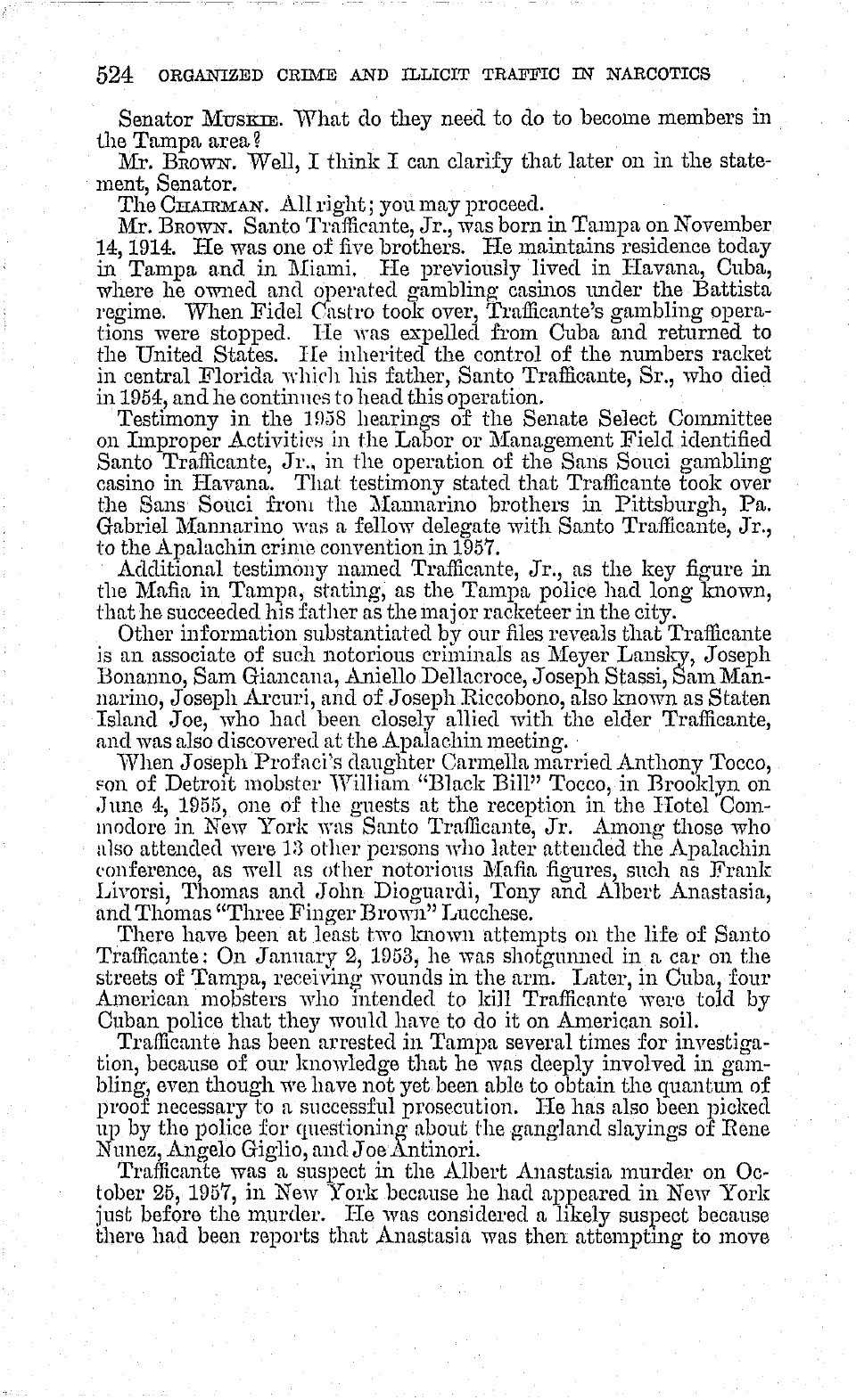
The FBI’s Miami memoranda place Santo Trafficante, Jr. in Havana from 1955: making “frequent trips to Havana, Cuba, where he is closely associated with NORMAN ROTHMAN” and frequenting the Sans Souci and the Sevilla Biltmore (30 September 1955); “still active in gambling casino at the Sans Souci Hotel outside of Havana” (28 September 1956); and, on the Legal Attache’s report of 20 December 1956, operating the Sans Souci (March 1957; July 1957). A 1971 FBI correlation summary digests the Legal Attache and informant reports: the Sans Souci “owned and operated by Santos Traficante, Jr., and Joe Stassi, a more or less silent partner,” and reported interests in the Capri and the Havana-Riviera (1955-58); then the January 1959 “exodus of gamblers and top hoodlums from Havana,” the Sans Souci’s closing “because of financial problems” in May, and his confinement at “Tiscornia” (1959). The House committee dates that detention from 6 June to 18 August 1959 (Trescornia). The same camp held Luciano in 1947.
Tampa’s police chief, Neil G. Brown, told the Senate subcommittee on 15 October 1963 that Trafficante “owned and operated gambling casinos under the Battista regime” and “was expelled from Cuba” (pp. 519-524), and that the “Louis Santos of Havana, Cuba” taken at Apalachin was Trafficante (pp. 525-526). The “boss” and Mafia labels in these records come from police, informants and newspapers. They are not chart seats.
The 1963-64 Senate hearings
The McClellan subcommittee’s narcotics hearings mention Havana in passing. New York’s Inspector Shanley gave the example of $200,000 sewn into a coat and carried to Cuba. Joseph Valachi said Vito Genovese had gambling interests “like Las Vegas and Havana, Cuba, when it was there” (27 September), that “Anywhere where Meyer Lansky is, Vito Genovese is” (1 October), and that he had “a half point with a friend” in the casino at the Capri (9 October). Detroit’s Inspector Piersante said deported men turned up in Cuba “during the tail end of the Batista regime” (10 October), and Boston police said John Guglielmo was a casino operator at the Tropicana from 1956 to the revolution (15 October, p. 569).
The Bureau of Narcotics’ documents printed in 1964 record an undercover cocaine case in Havana in 1956-57 (international cases), French traffickers “equally active in Florida and Cuba” (Pera, p. 884) with nightclub interests in Havana (background sheets), the 1954-58 Genovese heroin conspiracy “via Cuba” (Exhibit 3), and sheets placing Richard Boiardo’s gambling in Havana and Joseph Catalanotti’s deportation “from Cuba” in 1959 (background sheets). These are dossier entries, not findings.
The Kefauver Committee, 1950-51
Besides the Lansky, Moretti and Catena testimony above, two New Jersey gambling-house employees described working at the Jockey Club in Havana around 1933 and 1939, where “there were Americans running it” (Silver and Barker). On narcotics, Commissioner Anslinger said a Tampa man “went to Habana, Cuba, frequently to obtain narcotics” (Part 2, p. 91); the Kansas City supervisor described drugs from Marseilles “via Havana, Cuba” (Follmer, pp. 82-83); and agent Siragusa said Luciano “was in Cuba and enjoyed many privileges there” (Part 14, p. 354).
The Church Committee and the House assassinations committee
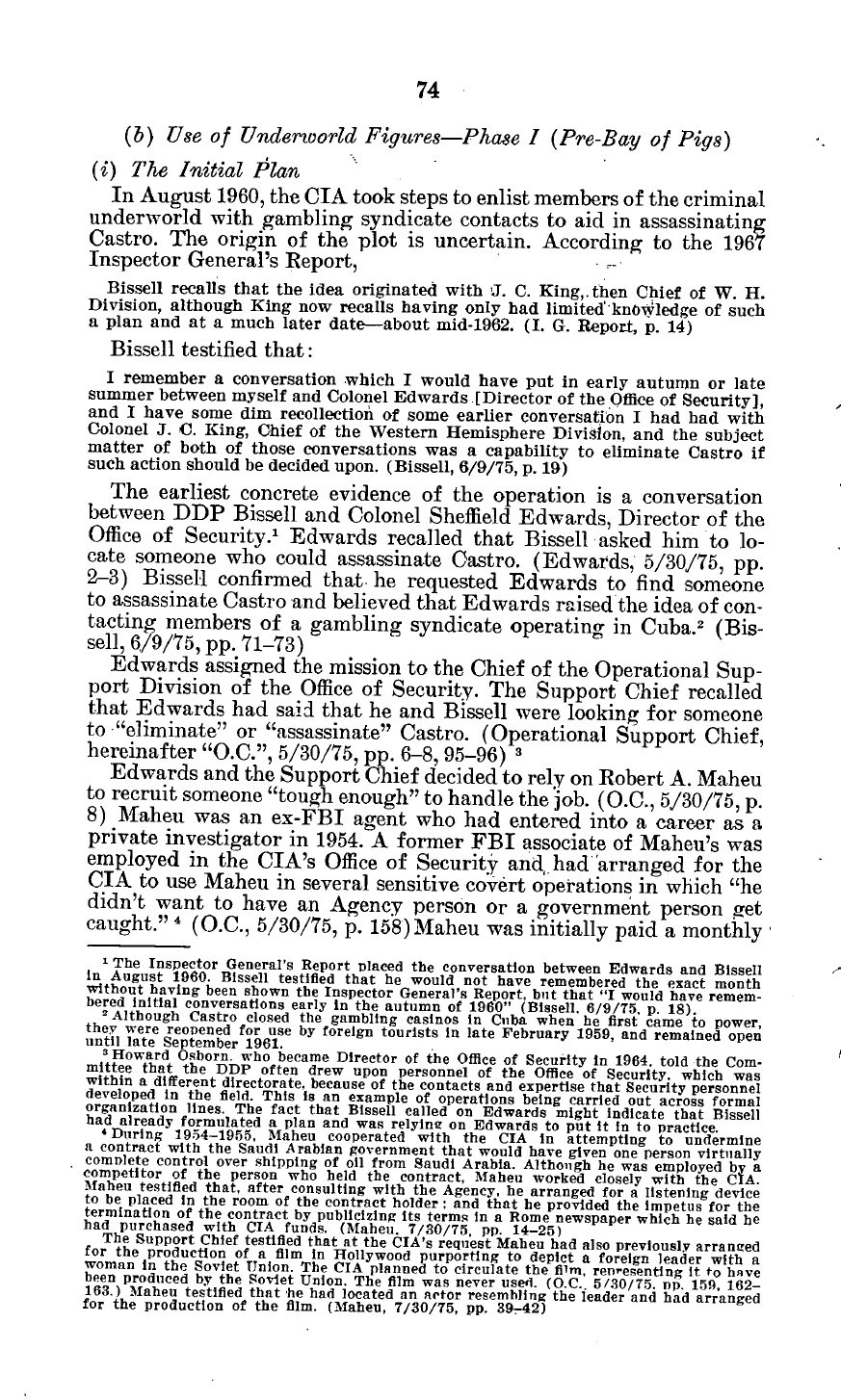
The Church Committee records that in August 1960 the CIA sought underworld figures “with gambling syndicate contacts” and that Bissell believed Edwards raised “the idea of contacting members of a gambling syndicate operating in Cuba” (pp. 74-75). Its passages on Trafficante and Senator Baker’s additional views are filed separately. The House Select Committee on Assassinations found that organized crime “probably was active in attempts to assassinate Castro” and that by 1962-63 the prospect of “regaining the old Havana territory” had faded (p. 114).
How the casinos ended: three accounts
The records give three different accounts, and this archive keeps them apart.
- The Church Committee (1975). “Although Castro closed the gambling casinos in Cuba when he first came to power, they were reopened for use by foreign tourists in late February 1959, and remained open until late September 1961” (footnote, p. 74).
- Joseph Valachi (1963). When Castro took over, the operators “were paying $25,000 a year rent,” Castro “raised it to $50,000 and 50 percent of the business,” and “They told him to take a walk and they all went out of Havana” (pp. 391-392).
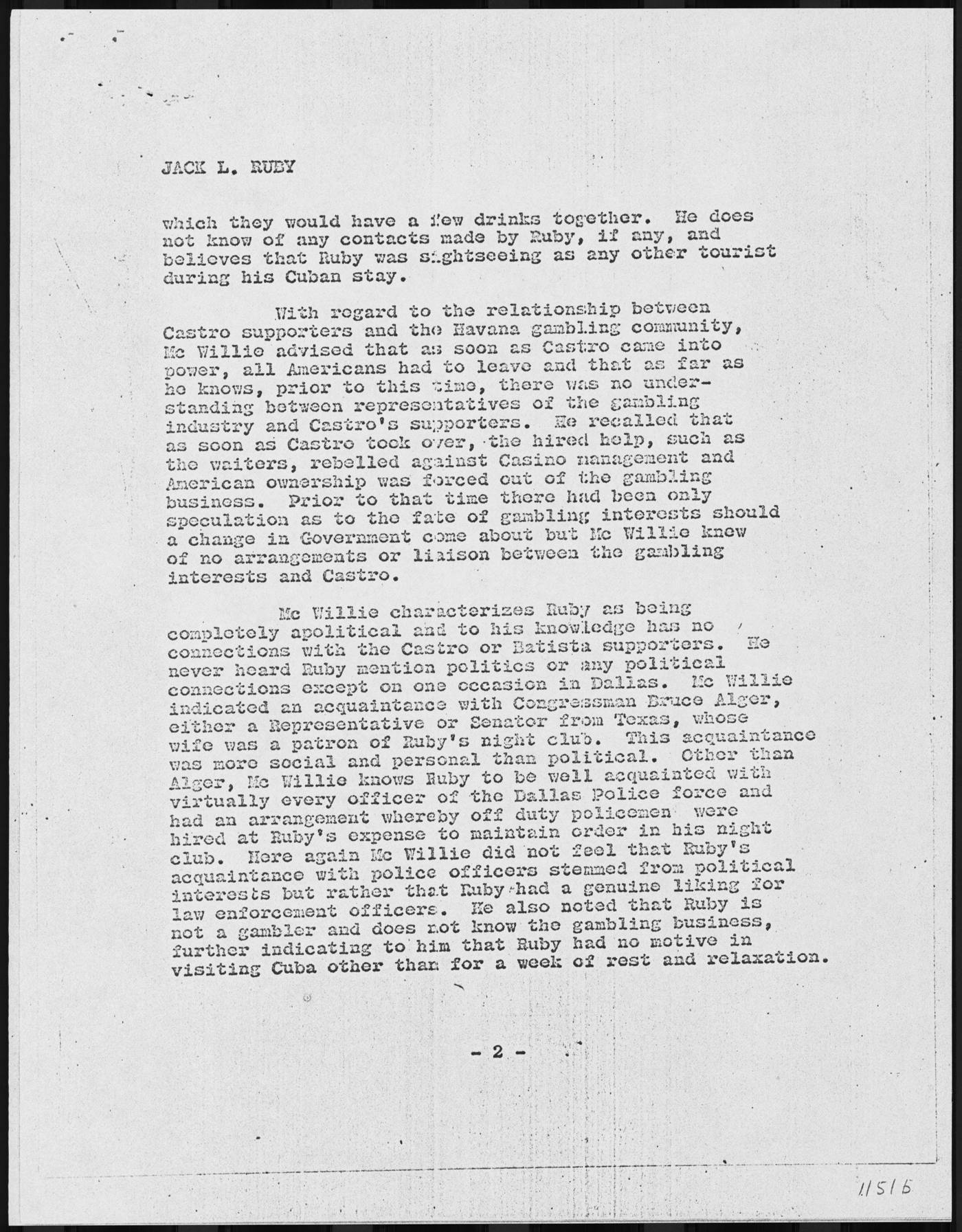
- Lewis McWillie (1964). “As soon as Castro took over, the hired help, such as the waiters, rebelled against Casino management and American ownership was forced out of the gambling business” (Commission Exhibit 1697).
The FBI’s 1959 summary adds the Legal Attache’s reports of the January exodus and the Sans Souci’s closing “because of financial problems,” and Lewis J. McWillie’s own dates for his work at the Tropicana and the Capri run to January 1961.
Two court records
A New York trial court let a Havana casino “duly licensed by the Government of Cuba,” which the opinion calls the “Tropicals Night Club, S. A.,” collect a $12,000 gambling check, holding that “The laws of Cuba prevail and not the laws of New York” (Tropicales v. Drinkhouse, 1959). The opinion does not use the name Tropicana. The Fifth Circuit’s opinion in Time, Inc. v. McLaney (1969) quotes 1958-59 newspaper statements that no one could work in Havana “without Lansky’s OK” and that he was “a virtual partner of Dictator Batista”; the court quotes them as clippings a reporter relied on in a libel case, not as findings, and this archive does not cite them as fact.
People
Pages for figures with more than one record here: Charles “Lucky” Luciano, Meyer Lansky, Jake Lansky, Santo Trafficante, Jr., Norman Rothman, William Moretti, Lewis J. McWillie, Joseph Catalanotti, the Cuban officials Indalecio Pertierra and Manuel Capestany, and the American officials Joseph A. Fortier and Leo J. Fox. The officials’ pages give only their jobs as the reports state them.
Not filed yet
- Any primary record of a December 1946 gathering in Havana. The Bureau of Narcotics’ own files on Luciano in 1946-47, and the Treasury representative’s reports, were not found in a digitized government copy.
- The American Embassy’s note of 27 February 1947 to the Cuban Ministry of State, known here only from the FBI report.
- The Kefauver Committee’s Third Interim Report, which would carry its own findings on New York and New Jersey.
- The 1958 Senate Rackets Committee testimony on Trafficante and the Sans Souci that Chief Brown cited.
- The FBI serials summarized in the 1971 Trafficante correlation summary, Trafficante Vault Part 03 and Lansky Vault Part 05, which the viewer would not open.
- Trafficante’s 1978 testimony before the House committee and its staff report on organized crime.
- The later pages of Commission Exhibit 1697 and the other Warren Commission exhibits on McWillie.
- A cleared photograph of a Havana casino, the Hotel Nacional, or Luciano or Trafficante in Havana. Six candidates from the Library of Congress and the Luciano file are held back because their rights are not cleared.
- A street address for any casino. No record filed here gives one.