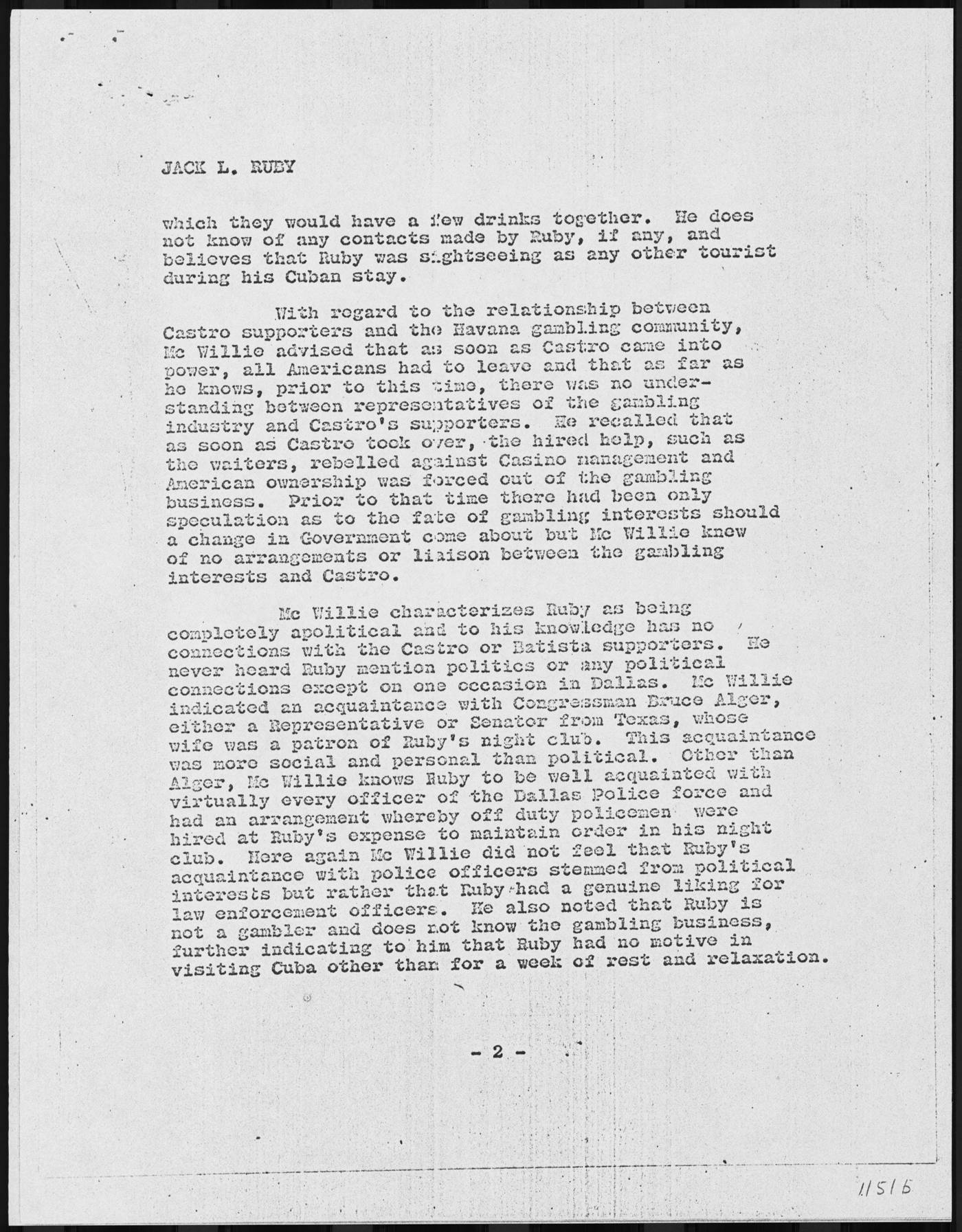
Warren Commission Exhibit 1697: FBI report of the interview of Lewis J. McWillie on the Tropicana and Capri casinos in Havana (11 June 1964)
An FBI Las Vegas report printed as Commission Exhibit 1697 records that McWillie went to Cuba in September 1958, managed the Tropicana Casino until May 1960, was a pit boss at the Capri Hotel-Casino until 2 January 1961, and said that when Castro took over 'American ownership was forced out of the gambling business.'
- Date
- 1964-06-11
- Kind
- case-file
- Retrieved
- 2026-10-12
- NAID
- 488846833
- Rights
- A report of the Federal Bureau of Investigation, entered as an exhibit of the President's Commission and held by the National Archives. A work of the United States government, public domain under 17 U.S.C. § 105. The National Archives catalog lists the use restriction as Unrestricted.
Commission Exhibit 1697 is a report of the FBI’s Las Vegas office dated 11 June 1964, captioned for Jack L. Ruby, recording an interview of Lewis J. McWillie by FBI agents on 8 June 1964. The National Archives catalog lists the item as Unrestricted. Report pages 1 and 2 (scans _0001 and _0003) were read; the later pages were not. The image stored here is page 2. Page 1 prints a home address and is not stored.
On page 1 McWillie said “He went to Cuba in September, 1958, and immediately went to work at the Tropicana Casino, remaining there as manager until May, 1960, after which he left and worked at the Capri Hotel-Casino from May, 1960 to January 2, 1961, as a pitboss.” He “stated the Tropicana was Cuban owned and that he did not know the owner of the Capri, but that he worked under one Angelo Di Christofano (Phonetic).” He said that in 1959 he invited Ruby to Havana and arranged for him to stay at a small hotel “about three blocks from the Nacional Hotel, name unrecalled.” The year of arrival is typed faintly and reads 1958 on a full-resolution crop.
On page 2 he gave his account of the end of the casinos: “as soon as Castro came into power, all Americans had to leave,” and “as soon as Castro took over, the hired help, such as the waiters, rebelled against Casino management and American ownership was forced out of the gambling business.” He said he knew “of no arrangements or liaison between the gambling interests and Castro.”
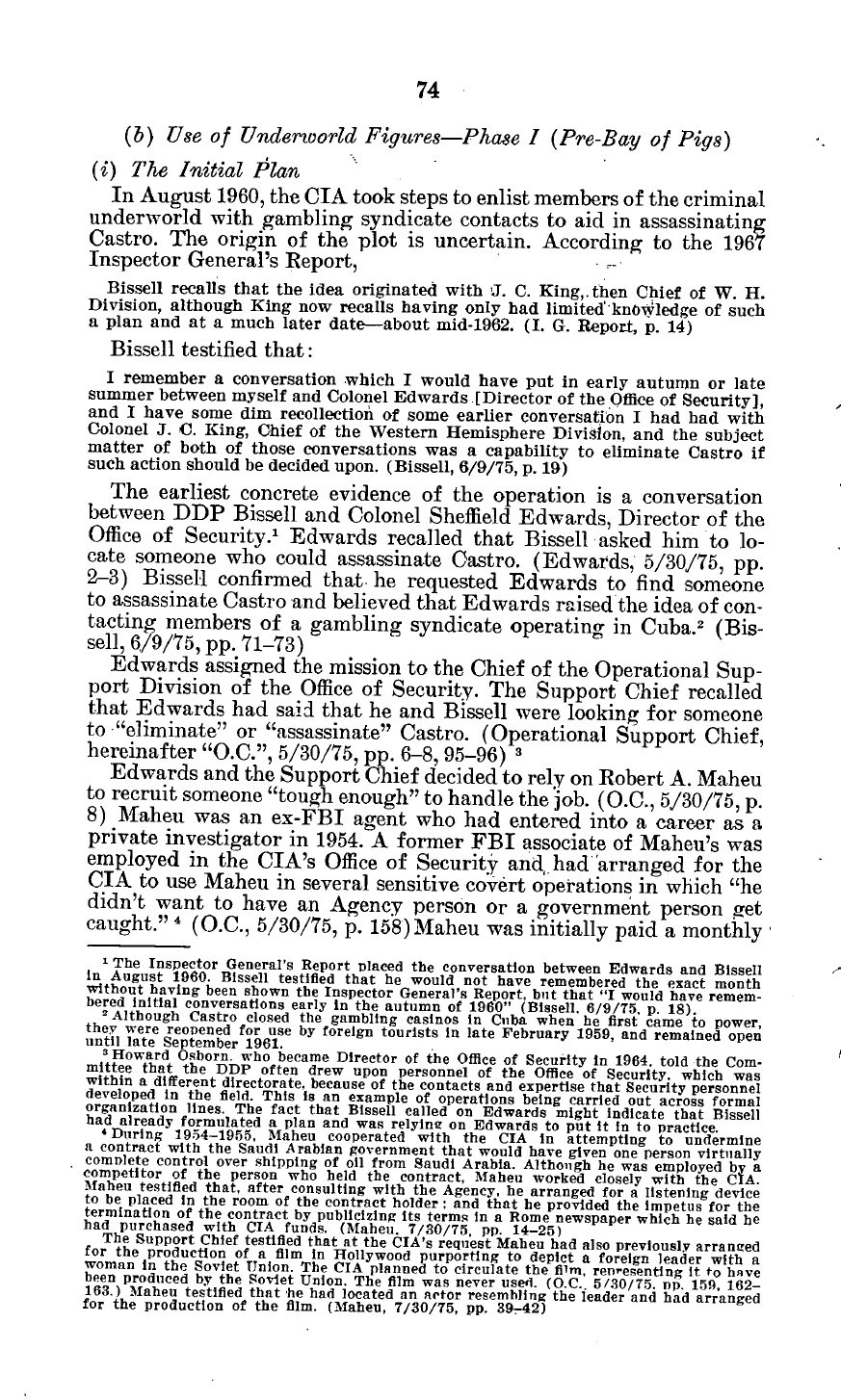
This is McWillie’s account to the FBI, not a finding. His dates for his own work run to January 1961, and his account of how the American owners left is one of three filed here, alongside the Church Committee’s footnote that the casinos reopened for tourists in late February 1959 and stayed open until late September 1961 (pp. 74-75) and Joseph Valachi’s account of a rent demand (1963). The House committee’s later treatment of McWillie is filed separately.