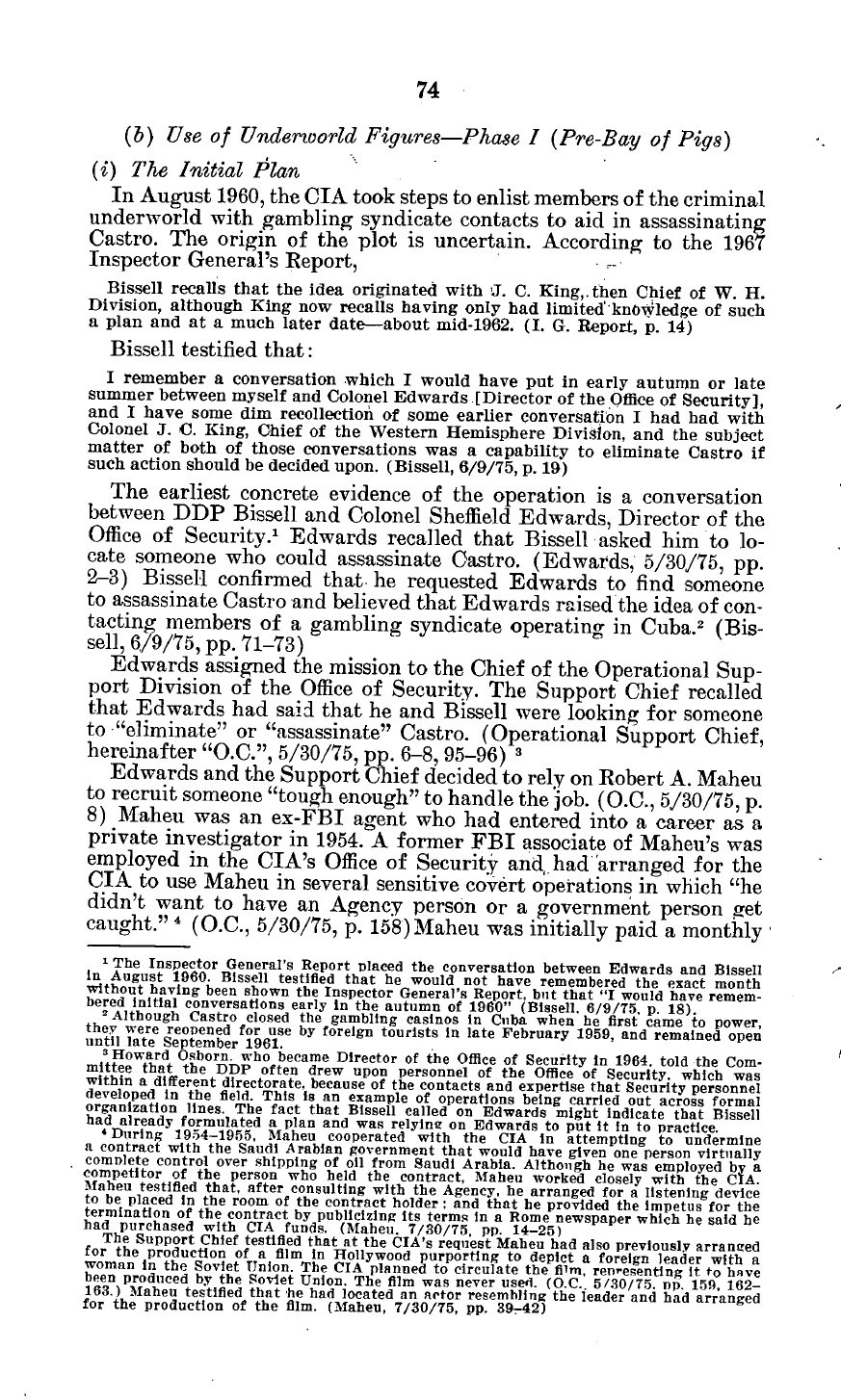
Church Committee report (S. Rep. 94-465, 1975), pp. 74-75: a 'gambling syndicate operating in Cuba' and the casinos' closing, reopening and final closing
The committee records that in August 1960 the CIA sought underworld figures 'with gambling syndicate contacts' to kill Castro, and states in a footnote that the casinos Castro closed 'were reopened for use by foreign tourists in late February 1959, and remained open until late September 1961.'
- Date
- 1975-11-20
- Kind
- hearing
- Retrieved
- 2026-10-12
- Docket
- S. Rep. No. 94-465, 94th Cong., 1st Sess. (1975)
- Rights
- A report of the United States Senate. Public domain in the United States. 17 U.S.C. § 105.
Printed pages 74 and 75 (PDF pages 85 and 86) of the Church Committee’s interim report, “Alleged Assassination Plots Involving Foreign Leaders.” The stored image is printed page 74, rendered from the Senate PDF. The report itself and its later pages on Trafficante, the Miami meeting and Senator Baker’s views are filed separately.
The section on “Phase I” of the CIA’s use of underworld figures begins: “In August 1960, the CIA took steps to enlist members of the criminal underworld with gambling syndicate contacts to aid in assassinating Castro.” The committee records that Richard Bissell asked Sheffield Edwards to find someone to kill Castro, and “believed that Edwards raised the idea of contacting members of a gambling syndicate operating in Cuba.” On page 75 it quotes the CIA Inspector General’s report that Robert Maheu would approach John Rosselli “as the representative of businessmen with interests in Cuba who saw the elimination of Castro as the first essential step to the recovery of their investments.”
Footnote 2 on page 74 gives the committee’s account of the casinos after the revolution: “Although Castro closed the gambling casinos in Cuba when he first came to power, they were reopened for use by foreign tourists in late February 1959, and remained open until late September 1961.” The text layer of the PDF scrambles this two-column footnote; the wording here was checked against the page image. Other records filed here describe the end of the Havana casinos differently: Joseph Valachi in his 1963 testimony and Lewis McWillie in a 1964 FBI interview. This archive keeps the three accounts separate.