Record
Court opinion
1969-01-03
CourtListener (Free Law Project), opinion text
Time, Inc. v. McLaney, 406 F.2d 565 (5th Cir. 1969): Life's 1967 article on 'Havana gamblers' in the Bahamas, and the press reports the reporter relied on
The Fifth Circuit directed summary judgment for the publisher of Life in a libel suit by Mike McLaney, holding that the record showed no actual malice. The opinion quotes 1958-59 newspaper reports on Meyer Lansky and Havana gambling as material the reporter had before him; those quotations are not findings of the court.
- Date
- 1969-01-03
- Kind
- court-opinion
- Retrieved
- 2026-10-12
- Docket
- No. 25585
- Rights
- Opinion of a federal court. A work of the United States government, public domain under 17 U.S.C. § 105; judicial opinions are also not copyrightable under the government edicts doctrine. The text is served by CourtListener.
The Fifth Circuit (Chief Judge John R. Brown, Circuit Judge Tuttle and District Judge Fisher; opinion by Judge Tuttle) decided the interlocutory appeal on 3 January 1969 and denied rehearing en banc on 11 February 1969. Michael J. McLaney had sued Time, Inc., publisher of Life, over one paragraph of a February 3, 1967 article, “The Scandal in the Bahamas,” which said he “managed one of Havana’s big casinoes in the days when Lansky was a top mobster in the Cuban capital.” The court reversed the denial of Time’s motion for summary judgment and directed judgment for the publisher.
The opinion sets out what the reporter, William Lambert, had before him. Robert Peloquin of the Justice Department’s Organized Crime and Racketeering Section told him “that gamblers who had formerly operated in Havana under the Batista regime had moved to the Bahamas.” Life’s clipping file held New York Times stories of March 1959 describing McLaney as “The owner of a casino at the Nacional Hotel in Havana” and “operator of the casino of the Nacional Hotel,” and a 1963 Washington Post column calling him “an American gambler who ran a casino in Havana and stayed on for 18 months after Castro’s takeover.”
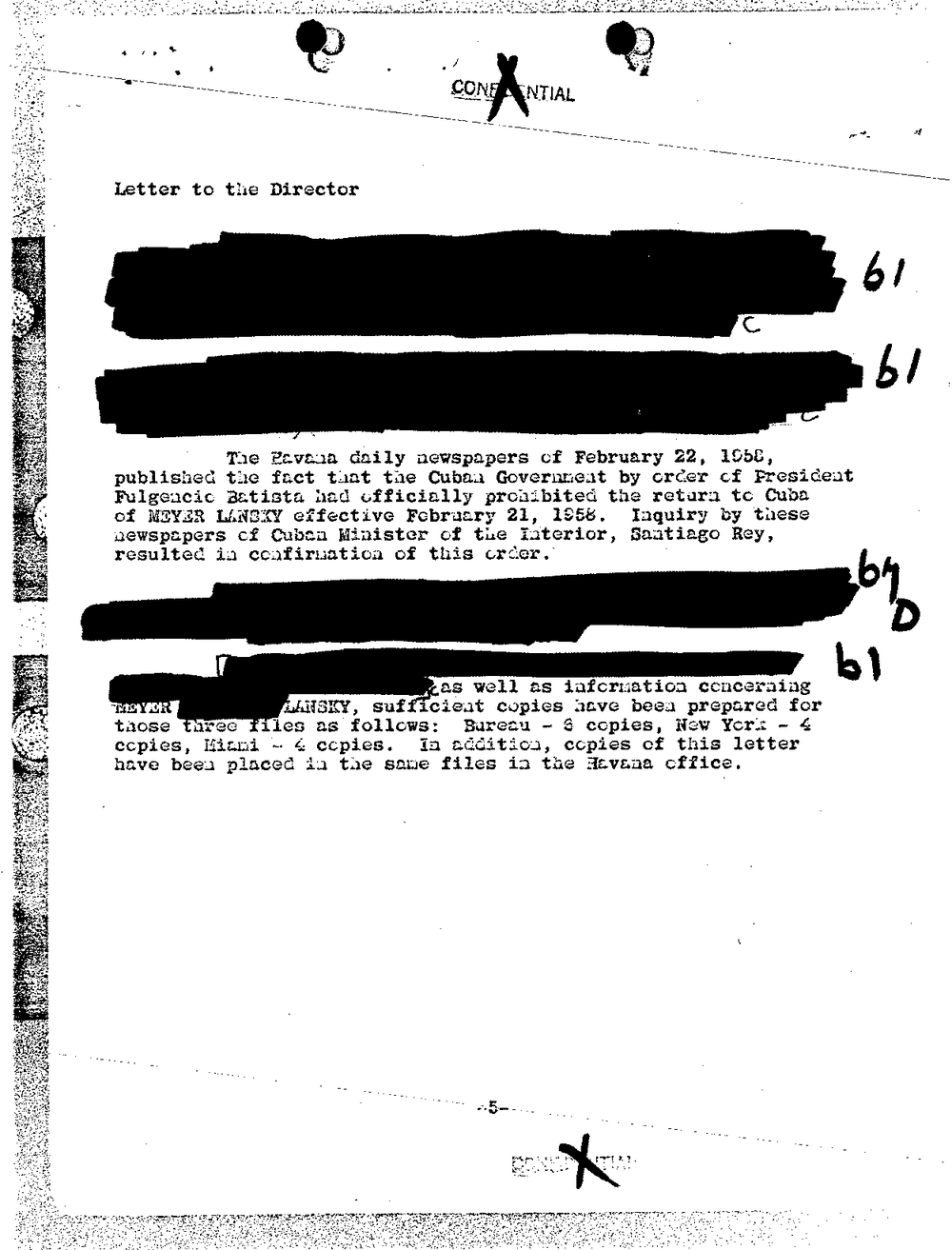
In a footnote the court quotes press statements on Lansky from the same file, for example “No American gambler, gangster or racketeer now can work in Havana without Lansky’s OK” (New York World-Telegram, 9 January 1958) and “All concessions to operate in Cuba had to have the OK of Lansky” (New York Journal American, 21 February 1958). These are newspaper quotations reproduced to show what the reporter read. The court’s own holding is that Lambert “had ample justification” for his statements and that the record showed no “actual malice”; it did not find as fact that Lansky controlled Havana gambling or that he was Batista’s partner, and this archive does not cite the opinion for either.