Peter Licavoli
Refused on self-incrimination grounds to answer most of the Kefauver Committee's questions at Detroit in 1951; named by relatives and investigators in 1951, 1958 and 1963 records, and drawn as 'Nominal Leader' on a Youngstown police chief's 1951 chart.
- Aliases
- Pete Licavoli
- Rights
- Biography on this page is limited to what the cited federal records and the filed newspaper pages state.
On the record
- 1951-01-18 — Kefauver Committee, Cleveland: Youngstown police chief Edward J. Allen's chart (exhibit 61) puts "Peter Licavoli (Detroit, Mich. - Tucson, Ariz.)" in a box headed "Nominal Leader." That is a chart label; it sets no role.
- 1951-01-19 — Kefauver Committee, Cleveland: James Licavoli testified that he was Pete Licavoli's "First cousin."
- 1951-02-08 — Kefauver Committee, Detroit: born in St. Louis, living in Detroit about ten years; refused to state his occupation or answer about a police record read by counsel. He said of Sam Zerilli, "My brother-in-law ... My wife and his wife are sisters."
- 1951-02-21 — Senate Report No. 121 (82d Cong.) asked the Senate to certify the facts of his refusals to the United States Attorney.
- 1958-07-01 — McClellan Committee, Part 32: investigator George H. Martin named "Pete Licavoli" among Detroit men "interrelated through various marriages" and said the Licavolis "had a wide range of influence extending down from Detroit into Ohio."
- 1963-10-10 — An FBI page summarizing a newspaper account says Commissioner George Edwards named Peter Licavoli among five Detroit "dons." Second-hand.
- 1963-10-10 — Named on the 1963 subcommittee chart: the "Ruling Council" band of Exhibit 18, "The Mafia Organization in the Detroit Area," presented by Detroit Police Commissioner George C. Edwards, carries a name plate for Peter Licavoli. A chart label, not a finding.
No family or role is set. The records are his own refusals, a relative’s testimony, a police chief’s chart, an investigator’s marriage chart and a second-hand account of testimony. The police record read at the 1951 hearing lists arrests from 1922, including a 1931 murder charge that ended in a not-guilty finding; it is not a list of convictions. No filed record gives his birth date or death.
Records
itemKefauver Committee, Detroit: testimony of Peter Licavoli (8 February 1951)Peter Licavoli, born in St. Louis, declined on self-incrimination grounds to state his occupation or answer about a Detroit police record read into the hearing, and identified Sam Zerilli as his brother-in-law.itemSenate Report 121: proceedings against Pete Licavoli (1951)Senate Report No. 121, 82d Congress, 1st Session, on the Kefauver Committee's contempt proceedings against Pete Licavoli, who refused to answer questions. The report accompanies S. Res. 79 and annexes excerpts of the hearing record.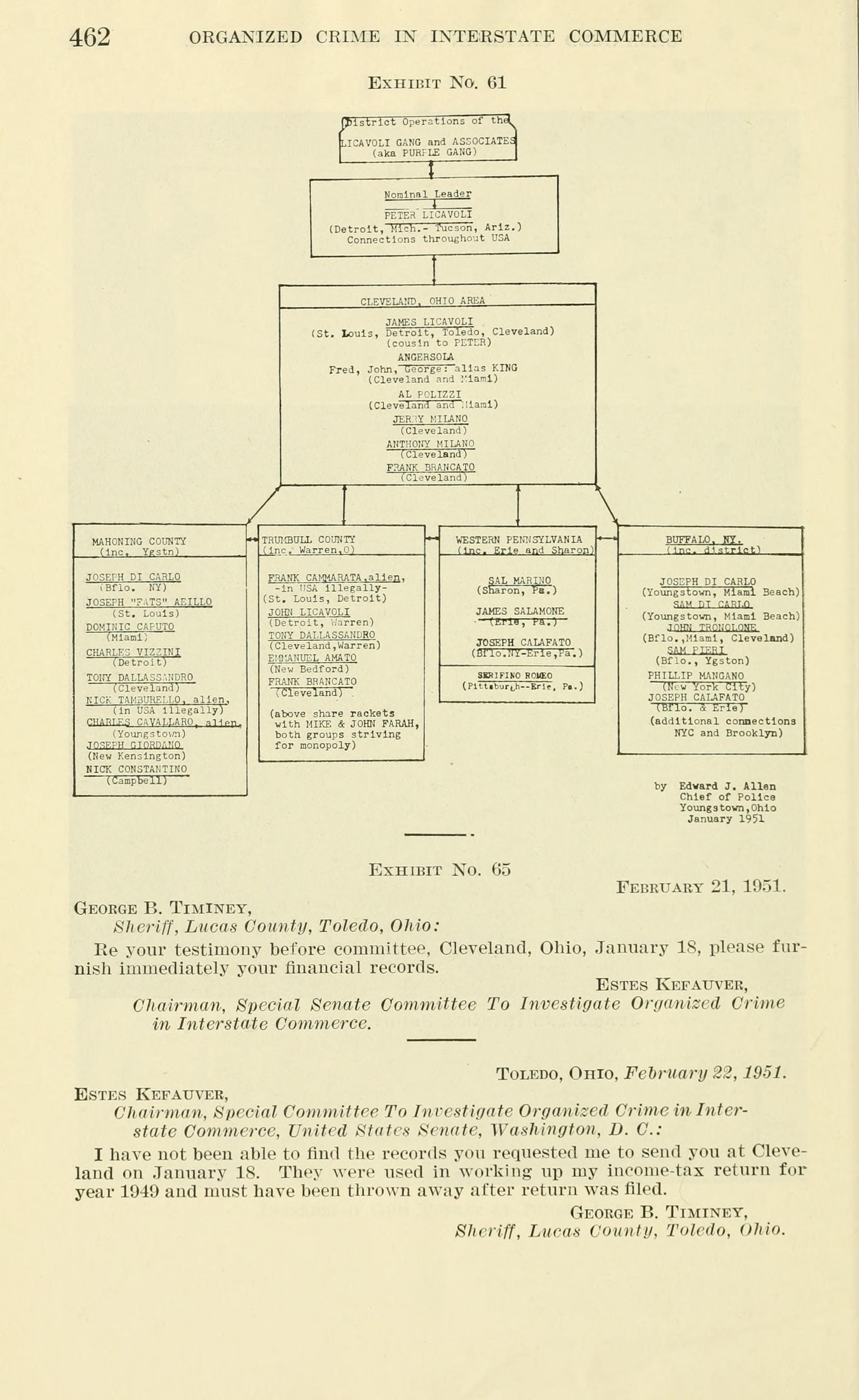 itemKefauver Committee exhibit 61: Youngstown police chief's chart of the 'Licavoli gang and associates' (January 1951)A chart drawn by Youngstown Police Chief Edward J. Allen for the committee and printed as exhibit 61, headed 'District Operations of the Licavoli Gang and Associates (aka Purple Gang)', with Peter Licavoli as 'Nominal Leader' above a Cleveland box and four regional boxes.itemKefauver Committee, Cleveland: testimony of James Licavoli (19 January 1951)James Licavoli told the committee he had been arrested 'many times', had 'copped a plea on extortion' in Toledo with a one-to-five-year term and a 1946 parole, and that Pete and Thomas Licavoli were his first cousins; he refused to answer questions about his business.itemMcClellan Committee: investigator George H. Martin on the Detroit intermarriage chart (1 July 1958)In the committee's 'Mafia' hearings, investigator George H. Martin explained a chart of intermarriages to chief counsel Robert F. Kennedy and named Detroit men he said were 'interrelated through various marriages'; the committee's printed list of Apalachin contacts adds Detroit entries.
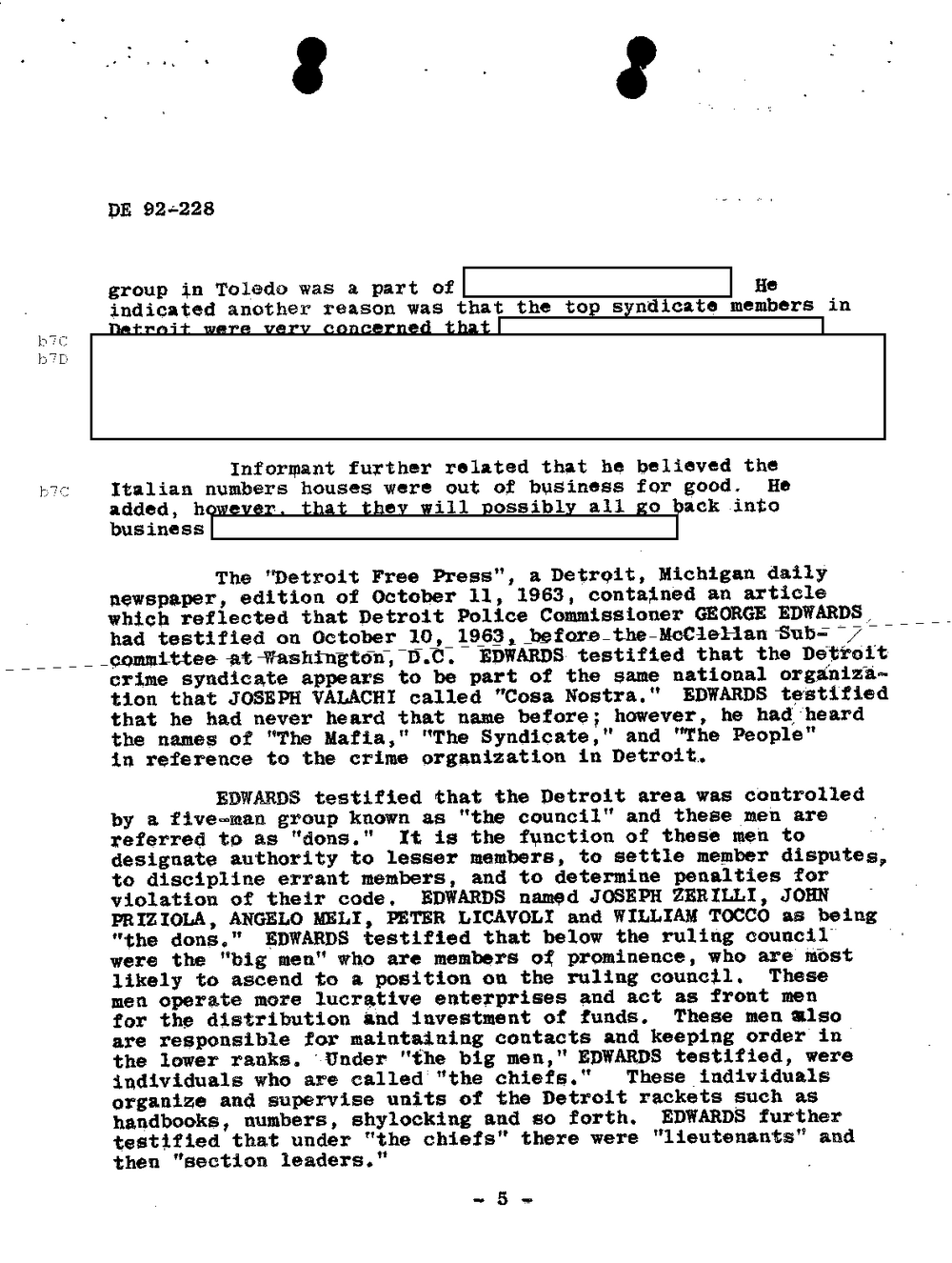 itemFBI Detroit report page summarizing Commissioner George Edwards's McClellan testimony (October 1963)A page of a Detroit report in the Giacalone file summarizes a Detroit Free Press article of 11 October 1963: Police Commissioner George Edwards had told the McClellan subcommittee that the Detroit area was controlled by a five-man 'council' whose members were called 'dons'.
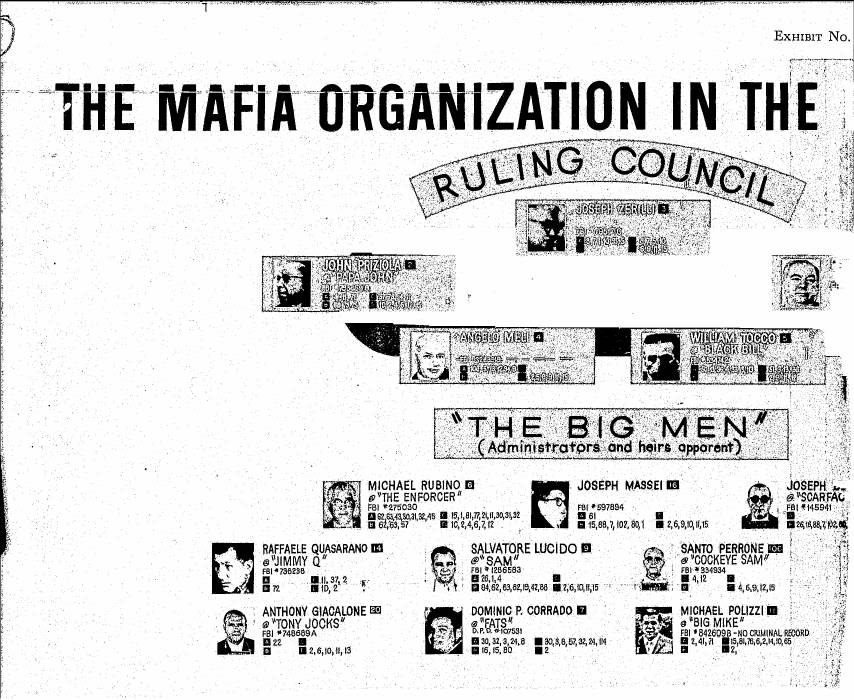 itemExhibit No. 18: "The Mafia Organization in the Detroit Area"Detroit Police Department fold-out chart presented on October 10, 1963: a "Ruling Council," "The Big Men," and lower tiers, with photographs, a relationship legend and a criminal-activity code.
itemKefauver Committee exhibit 61: Youngstown police chief's chart of the 'Licavoli gang and associates' (January 1951)A chart drawn by Youngstown Police Chief Edward J. Allen for the committee and printed as exhibit 61, headed 'District Operations of the Licavoli Gang and Associates (aka Purple Gang)', with Peter Licavoli as 'Nominal Leader' above a Cleveland box and four regional boxes.itemKefauver Committee, Cleveland: testimony of James Licavoli (19 January 1951)James Licavoli told the committee he had been arrested 'many times', had 'copped a plea on extortion' in Toledo with a one-to-five-year term and a 1946 parole, and that Pete and Thomas Licavoli were his first cousins; he refused to answer questions about his business.itemMcClellan Committee: investigator George H. Martin on the Detroit intermarriage chart (1 July 1958)In the committee's 'Mafia' hearings, investigator George H. Martin explained a chart of intermarriages to chief counsel Robert F. Kennedy and named Detroit men he said were 'interrelated through various marriages'; the committee's printed list of Apalachin contacts adds Detroit entries.itemFBI Detroit report page summarizing Commissioner George Edwards's McClellan testimony (October 1963)A page of a Detroit report in the Giacalone file summarizes a Detroit Free Press article of 11 October 1963: Police Commissioner George Edwards had told the McClellan subcommittee that the Detroit area was controlled by a five-man 'council' whose members were called 'dons'.itemExhibit No. 18: "The Mafia Organization in the Detroit Area"Detroit Police Department fold-out chart presented on October 10, 1963: a "Ruling Council," "The Big Men," and lower tiers, with photographs, a relationship legend and a criminal-activity code.