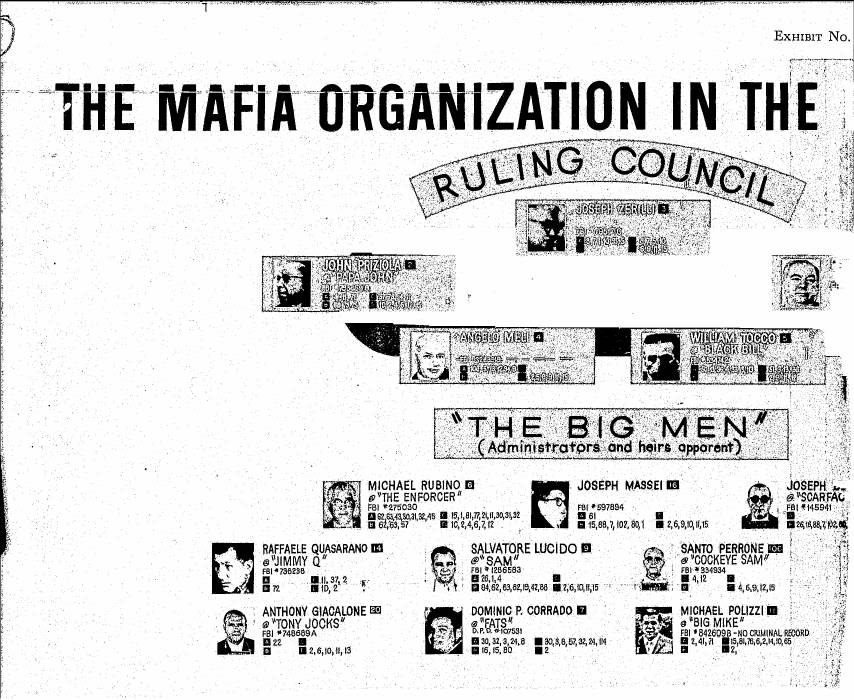
Exhibit No. 18: "The Mafia Organization in the Detroit Area"
Detroit Police Department fold-out chart presented on October 10, 1963: a "Ruling Council," "The Big Men," and lower tiers, with photographs, a relationship legend and a criminal-activity code.
- Date
- 1963-10-10
- Kind
- hearing
- Retrieved
- 2026-10-12
- Docket
- Organized Crime and Illicit Traffic in Narcotics: Hearings before the Permanent Subcommittee on Investigations of the Committee on Government Operations, United States Senate, 88th Cong., pursuant to S. Res. 17, 88th Cong., Part 2
- Rights
- A work of the United States Senate, printed by the Government Printing Office. Public domain in the United States. 17 U.S.C. § 105. The NCJRS cover sheet records reproduction permission as "Public Domain / U.S. Senate."
Exhibit No. 18 faces printed page 410 of Part 2. It was presented on October 10, 1963 by Detroit Police Commissioner George C. Edwards, with District Inspector Vincent W. Piersante; Edwards calls it “our exhibit 2.” It was scanned in four segments, at NCJRS PDF pages 444 to 447. The image stored here is the first segment, PDF page 444.
The chart is headed “The Mafia Organization in the Detroit Area.” Its top band, labelled “Ruling Council,” holds name plates for Joseph Zerilli, John Priziola, Angelo Meli, William Tocco and Peter Licavoli. The plates are dark-tinted, and the names are legible but faint on this segment. Beneath them is a band labelled “The Big Men (Administrators and heirs apparent),” and lower tiers follow. Each man has a photograph, an FBI or police number, and numbered codes from the chart’s legend of relationship types and criminal activities. Segments at PDF pages 446 and 447 have been checked only through the text layer.
This is a subcommittee exhibit. The names, ranks and relationships printed on it are the labels of a 1963 police or staff chart. They are not findings of the subcommittee or of a court, and this archive does not copy any of them onto a family page or a person page. The scan is the Bureau of Narcotics library copy of the printed hearings. The fold-out was photographed in overlapping segments, so a name at the edge of one segment may be cut off and repeated on the next.