Marshall Caifano
Named in the Ninth Circuit's 1966 opinion as "John Marshall," one of eleven men in Nevada's 1960 "black book" who was asked to leave the Tropicana and the Desert Inn. A footnote quotes a California report giving his birth name as Marchello Caifano.
- Aliases
- John Marshall, Marshall Cafano
- Rights
- Biography on this page is limited to what the cited federal records state.
On the record
- 11 July 1958 — Before the McClellan Committee (Part 33, pp. 12802-12808) he appeared without counsel and declined, on self-incrimination grounds, every question including his occupation, birthplace and citizenship. Exhibit 24 was a photograph of him with Sam Battaglia.
- 1960 — Marshall v. Sawyer, 365 F.2d 105 (9th Cir. 1966): "Marshall is one of the persons so identified in the black book." In October 1960 he was asked to leave the Tropicana, and on October 28, 1960 he was asked to leave the Desert Inn.
- 1966 — The opinion recites the district court's findings that his six convictions between April 1929 and August 1952 were obtained under names "including the names Joe Russo, Frank Roberto, Marshall Cafano, Joseph Rinaldi and George Marshall," and that he admitted booking illegal horse-race bets in Chicago from 1937 to 1951.
- 1966 — A footnote quotes a California report on organized crime: "Plaintiff was born Marchello Caifano in New York City, and legally changed his name to John Michael Marshall in 1955." The same report calls him "Reported to be top Lieutenant in Tony Accardo's Syndicate, the successor of the old Capone gang." The court quotes both in a margin note and makes no finding on the second.
- 1966-1967 — Caifano v. United States, 471 F.2d 763 (7th Cir. 1972), captioned "Marshall Caifano, a/k/a John Marshall," states that he began a ten-year California sentence on October 12, 1966, and on June 27, 1967 pleaded guilty in the Northern District of Illinois to a seven-count indictment under 18 U.S.C. §§ 1343, 2314 and 371; after a remand he was resentenced to two years on each of five counts, consecutive to the California term.
- January 1974 — A Los Angeles FBI memorandum of 1/28/74 in the Accardo file (Vault, Accardo Part 01, p. 174) calls him "LCN Chicago member" and notes his parole officer's permission to visit San Diego and Las Vegas from January 3 to 18, 1974. The FBI's description.
- 1987 — The Solicitor General's brief in opposition (No. 86-1304) summarizes his Southern District of Florida conviction for transporting stolen securities taken at O'Hare Airport in October 1968 and his 20-year sentence as a "dangerous special offender," and recounts sentencing-hearing testimony that he was introduced to Jimmy Fratianno in 1952 as a member of the Cosa Nostra and, per Alva Rodgers, spoke of being part of the Chicago "Outfit" since age 19. The government's account of testimony.
The 1966 opinion recites district-court findings and quotes a California report, and the court itself found a Chicago bookmaking history, with no statement of a family or rank. The words “top Lieutenant in Tony Accardo’s Syndicate” are the California report’s, quoted in a footnote, and they are not a federal finding, so no family or role is given. The 1980 Senate hearing reprints a Nevada exclusion-list sheet for him. That is a state record and is not used here. The 1974 FBI memorandum and the Solicitor General’s 1987 brief, which describe membership, are quoted in the events as the FBI’s description and as the government’s account of hearing testimony; neither is a court finding, so family and role stay empty.
Records
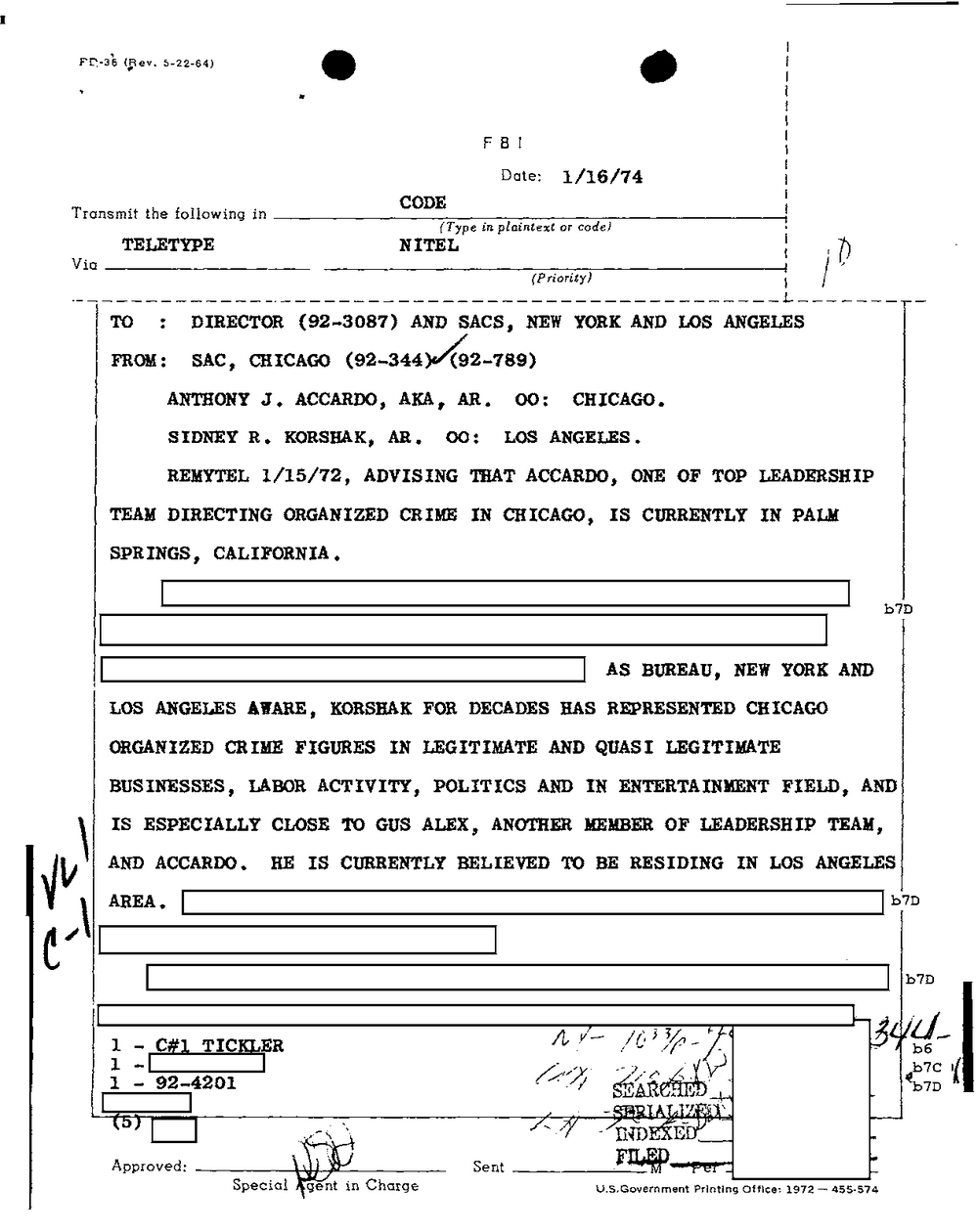 itemFBI Chicago teletypes, January 1974: Accardo, Gus Alex and the 'three man leadership team' (Vault Accardo Part 01)Chicago and Los Angeles communications in the Accardo file describe Accardo and Gus Alex as two members of a 'three man leadership team' directing organized crime in Chicago, refer to the 'deceased LCN leader Fiore Buccieri who died 1973', and note Marshall Caifano's parole travel.itemBrief for the United States in Opposition, Caifano v. United States, No. 86-1304 (S. Ct., October Term 1986)The Solicitor General's brief opposing review of Marshall Caifano's Florida conviction for transporting stolen securities and his 20-year 'dangerous special offender' sentence. It recounts sentencing-hearing testimony that he was introduced in 1952 as a member of the Cosa Nostra and spoke of membership in the Chicago 'Outfit.'