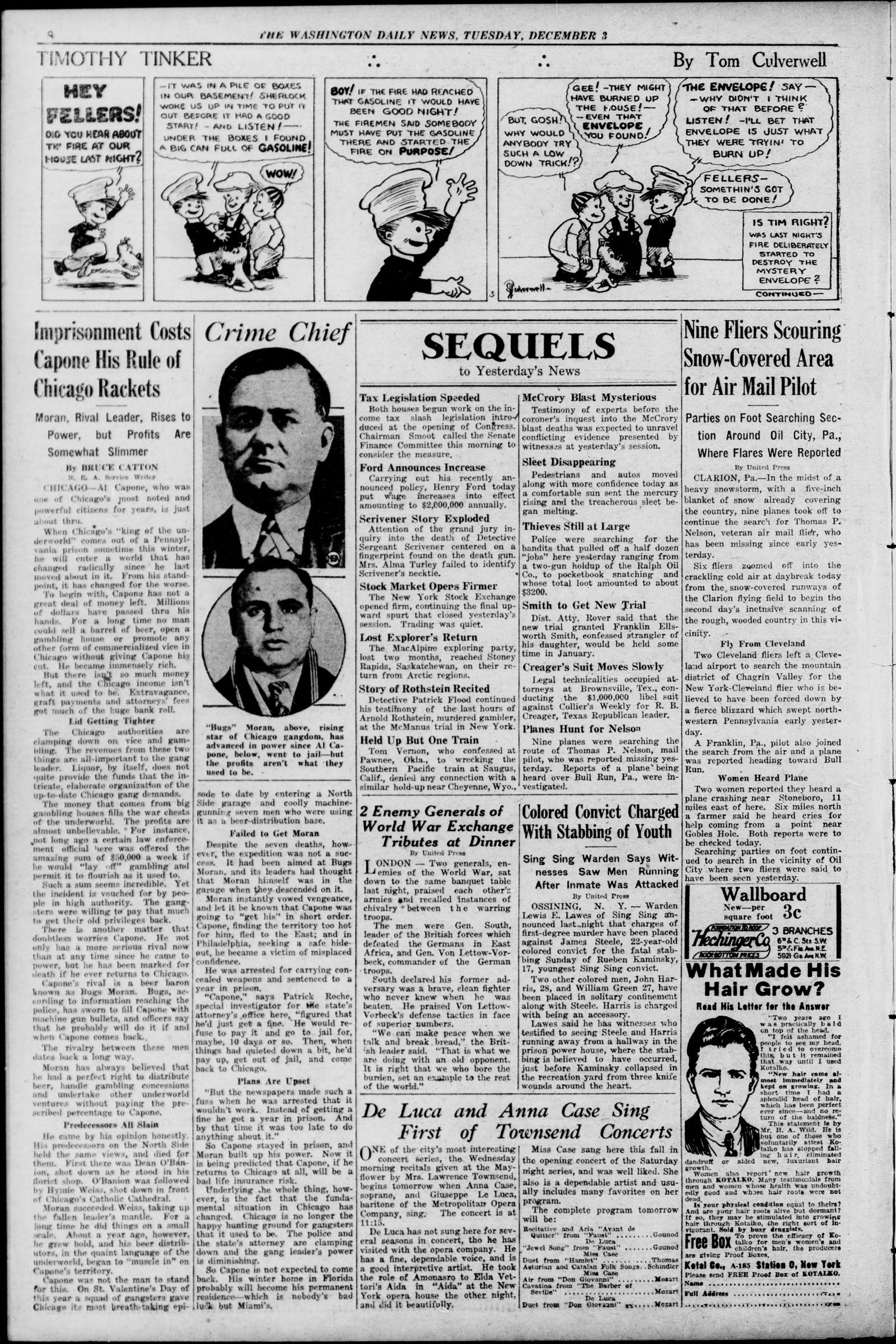
Washington Daily News, 3 December 1929, page 8: Imprisonment Costs Capone His Rule of Chicago Rackets
Imprisonment Costs Capone His Rule of Chicago Rackets
- Paper
- The Washington Daily News (Washington, D.C.)
- Date
- 1929-12-03
- Page
- Page 8
- Headline
- Imprisonment Costs Capone His Rule of Chicago Rackets
- Rights
- A United States newspaper published in 1930 or earlier. Public domain in the United States. The Library of Congress serves the page from Chronicling America.
Page 8 of the Washington Daily News of Tuesday, 3 December 1929. Below a comic strip, the left-hand columns carry the headline “Imprisonment Costs Capone His Rule of Chicago Rackets” and the deck “Moran, Rival Leader, Rises to Power, but Profits Are Somewhat Slimmer.” The byline reads “By Bruce Catton, N. E. A. Service Writer,” and the dateline is Chicago. Beside it, a box headed “Crime Chief” holds two photographs captioned: “‘Bugs’ Moran, above, rising star of Chicago gangdom, has advanced in power since Al Capone, below, went to jail—but the profits aren’t what they used to be.”
The feature calls Moran “a beer baron” and says his “predecessors on the North Side held the same views, and died for them,” naming Dean O’Banion and Hymie Weiss, and that “Moran succeeded Weiss, taking up the fallen leader’s mantle.” Of the February 1929 killings in a North Side garage it says the attack “had been aimed at Bugs Moran, and its leaders had thought that Moran himself was in the garage when they descended on it.” It quotes Patrick Roche, special investigator for the state’s attorney’s office, on Capone’s Philadelphia arrest.
All of this is a feature writer’s account, built partly on what it calls “information reaching the police.” This archive files the page as a record of how the press described Moran at the end of 1929. It does not take from it that Moran held any position, or what the 1929 attackers intended.