Record
Court opinion
1968-11-07
Public.Resource.Org, text of the opinion
United States v. Balistrieri, 403 F.2d 472 (7th Cir. 1968)
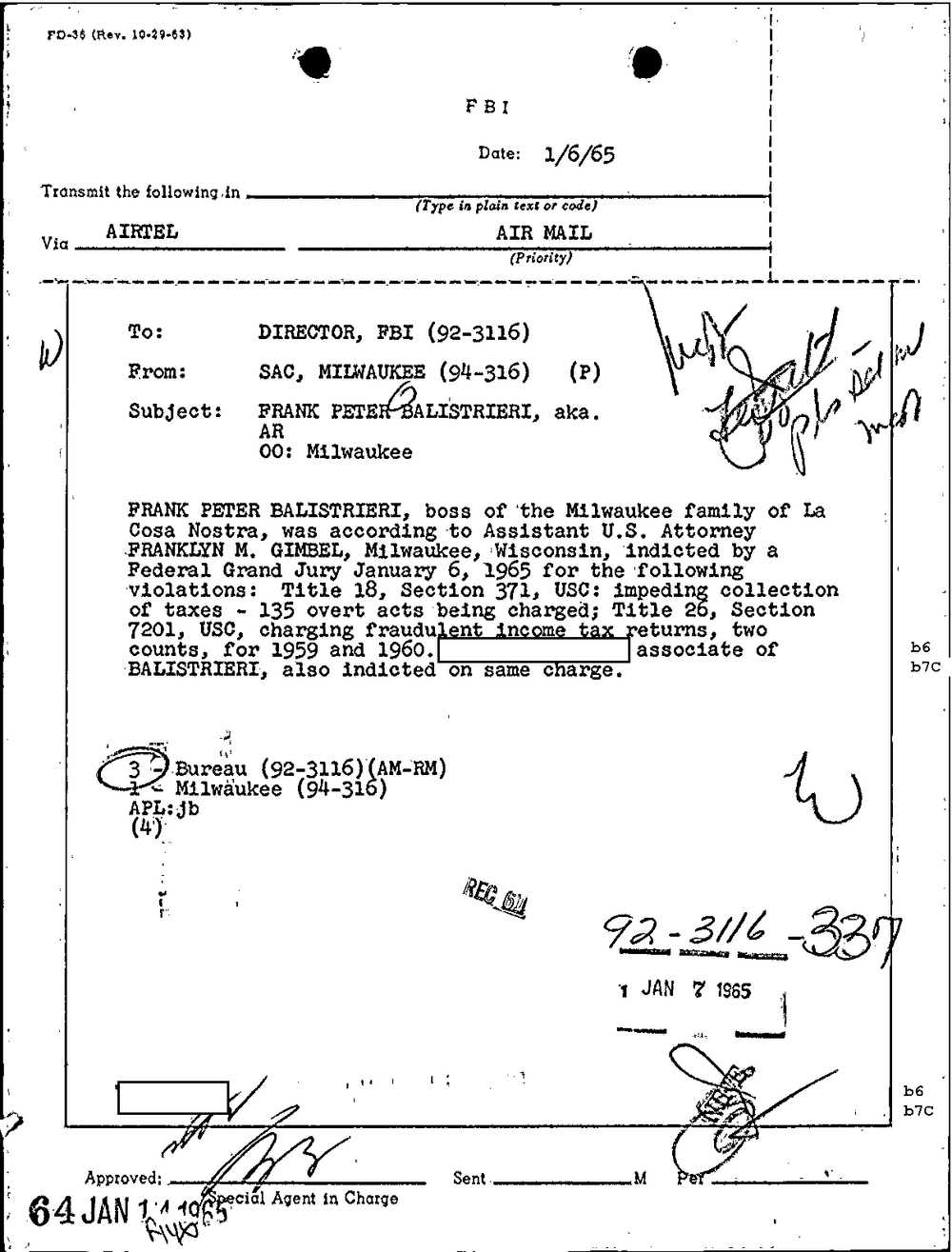
Seventh Circuit opinion of November 7, 1968 affirming Frank Peter Balistrieri's conviction for income-tax evasion for 1959 and 1960, after the government disclosed admittedly illegal FBI eavesdropping and the trial court found its evidence free of taint.
- Date
- 1968-11-07
- Kind
- court-opinion
- Retrieved
- 2026-10-12
- Docket
- No. 16639
- Rights
- Opinion of a United States court. Works of the federal judiciary are in the public domain in the United States (17 U.S.C. § 105). The page's tag "COPYRIGHT MATERIAL OMITTED" marks editorial matter the publisher left out; the opinion text itself is a federal work.
United States Court of Appeals, Seventh Circuit, decided November 7, 1968; rehearing denied December 31, 1968. Chief Judge Castle wrote the opinion.
Balistrieri appealed “from his conviction on Counts II and III of a three-count indictment charging him with crimes against the revenue.” Counts II and III charged “income tax evasion for the years 1959 and 1960 by filing false and fraudulent tax returns, in violation of 26 U.S.C. § 7201.” Count I, a conspiracy count against him and a co-defendant, was not tried. The trial was transferred from the Eastern District of Wisconsin to the Southern District of Illinois, and the government proved its case on the “net worth theory.”
On the day trial was to begin, government attorneys disclosed “three categories of F.B.I. reports obtained by admittedly illegal electronic eavesdropping”: devices in the co-defendant’s apartment from October 3, 1961 to June 8, 1962, in Balistrieri’s office from March 9, 1964 to June 3, 1965, and in the office of one of his attorneys in 1963. The court held that the government had met its burden of showing its trial evidence was “free from taint,” tracing its key lead to IRS mail covers of 1961. He was sentenced “to two years imprisonment and fined $5000 on each count, the prison terms to run concurrently.” The court affirmed.
The opinion concerns tax evasion and the use of eavesdropping evidence. It says nothing about any organization. The Supreme Court later vacated the judgment and remanded in light of Alderman v. United States; see Balistrieri v. United States, 395 U.S. 710.