Record
Court opinion
1935-11-04
CourtListener (Free Law Project), text of the opinion
United States v. Wexler, 79 F.2d 526 (2d Cir. 1935)
Second Circuit opinion of November 4, 1935 affirming a defendant named Wexler's conviction on four income-tax counts for 1930 and 1931, in a case built on the sales of the Eureka Brewery at Paterson, New Jersey. The opinion gives no first name and no alias.
- Date
- 1935-11-04
- Kind
- court-opinion
- Retrieved
- 2026-10-12
- Docket
- No. 67
- Rights
- Opinion of a United States court. Works of the federal judiciary are in the public domain in the United States (17 U.S.C. § 105; judicial opinions are not subject to copyright). The text was read on CourtListener.
Circuit Court of Appeals, Second Circuit, No. 67, decided November 4, 1935, before Judges Manton, L. Hand and Swan; opinion by Judge L. Hand. United States Attorney F. W. H. Adams appeared for the government. Certiorari was denied, 56 S. Ct. 384. The headnote cross-refers to the district court’s pretrial ruling, 6 F. Supp. 258.
“Wexler, the accused, was indicted upon four counts; the first and third being for conspiracy to defraud the income tax; the second and fourth for an attempt to defraud it.” The counts covered 1930 and 1931. The indictment alleged that he “had been engaged in New York and New Jersey in making and selling beer.” The court summarizes the evidence: “The Eureka Brewery was a New Jersey corporation making beer at Paterson, for the most part illicitly”; sums “amounting to over $2,000,000 each year, were traced from the sales of Eureka beer” to two of his former employees, who banked them under fictitious names. In 1930 he had returned an income of $8,125. When the Bureau of Internal Revenue asked to interview him in April 1933, the court says, “he lied,” was indicted on April 27, and was found on May 21 “hiding in a remote and secluded house in the country.”
The jury convicted on all four counts, and the sentence totalled ten years, with fines of $10,000 on each count (two of them suspended if the others were paid) and costs of $876. The court found “a case for the jury,” held that an improperly admitted remark at his arrest did not require reversal, and ruled: “Judgment affirmed.”
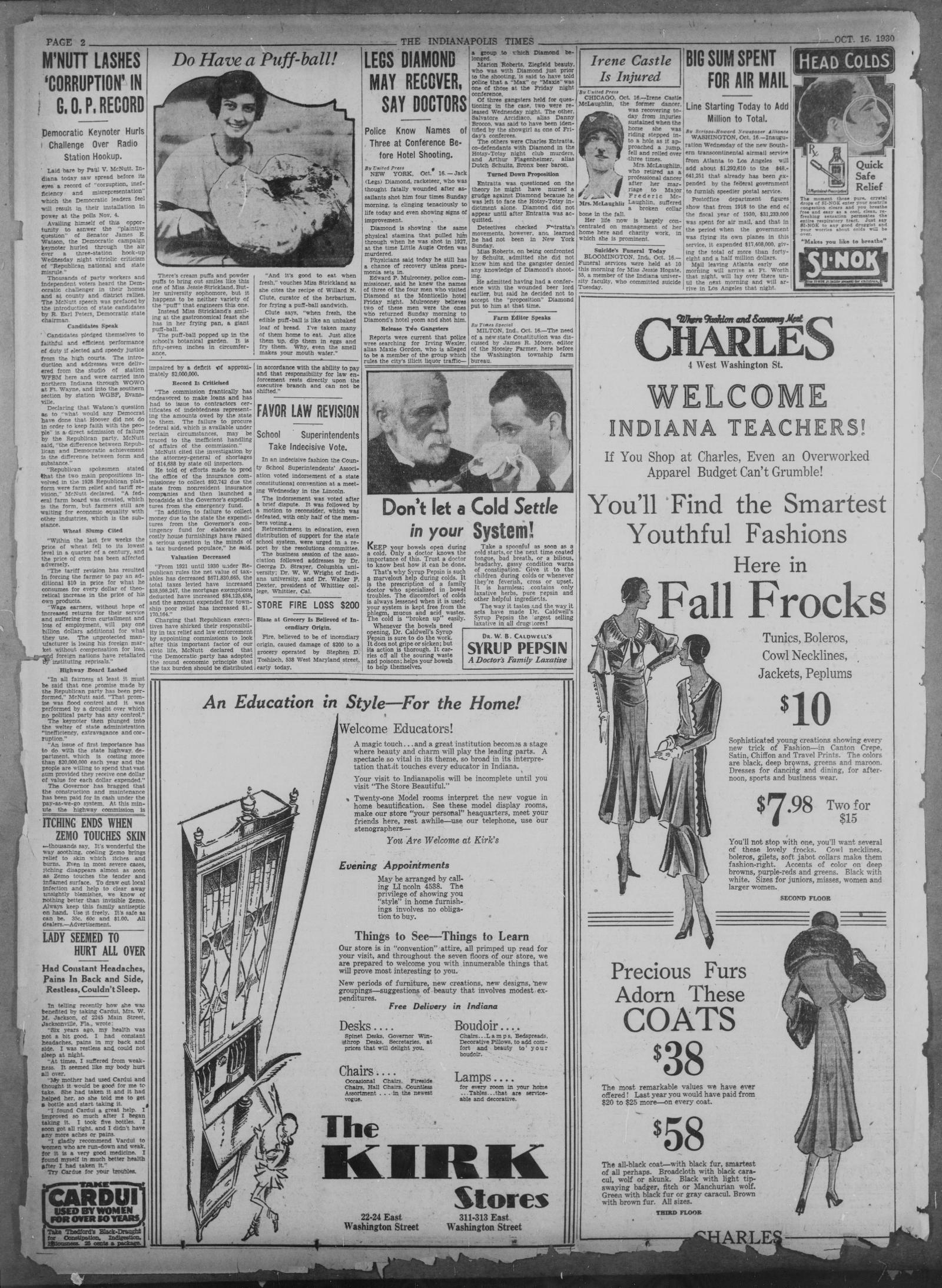
The opinion names the defendant only as “Wexler.” It does not use the name Waxey Gordon, and this archive does not identify the defendant with any other person on the strength of this record. A 1930 newspaper page printed “Irving Wexler, alias Maxie Gordon” in another context (Indianapolis Times); that page does not mention this case.